
Chapter 1 Breakfast Food and Sandwiches Copyright 2011
Chapter 1 Breakfast Food and Sandwiches © Copyright 2011 by the National Restaurant Association Educational Foundation (NRAEF) and published by Pearson Education, Inc. All rights reserved.
Milk and Milk Products § Two processes applied to milk products: § Pasteurization: Milk is heated to kill microorganisms that cause spoilage and disease without affecting its nutritional value. § Homogenization: Milk is strained through very fine holes to break down fat and then blended into one fluid. § Lactose intolerance is a common digestive condition and is a reaction to many cultured dairy products, not just milk. § Dairy alternatives, such as soy milk and rice milk, can be used instead. § Low-fat and skim milks behave differently when cooking because of low fat content. 1. 1 Chapter 1 | Breakfast Food and Sandwiches 2
Receiving and Storing Milk § Milk products should be received and stored at 41°F or lower. § Always use the FIFO (First In, First Out) method of stock rotation for milk § All milk and milk products should be labeled “Grade A. ” § Any milk that has passed its use-by or expiration date should be thrown away. 1. 1 Chapter 1 | Breakfast Food and Sandwiches 3
Creams § Cream contains far more fat than milk. § Chefs use it based mainly on its fat content, which provides richness. § Whipping or heavy cream: 30% fat § Half & half: 18% fat (part milk, part cream) § Sour cream: 18% fat (tangy flavor because of added bacteria to ferment the lactose) 4
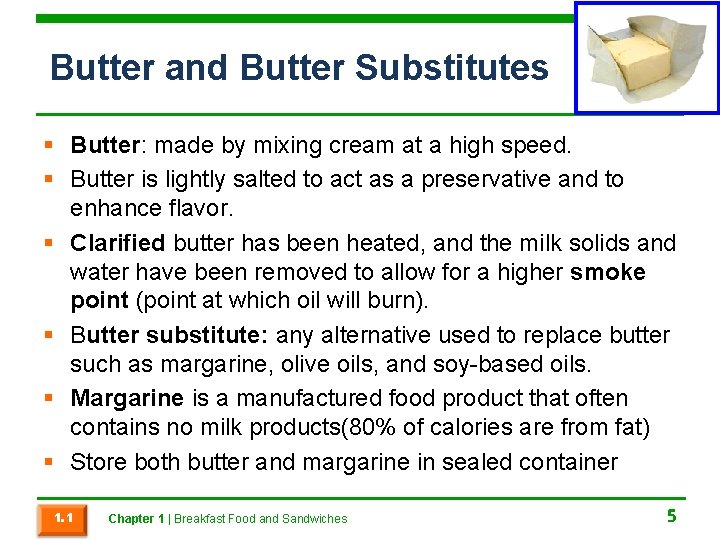
Butter and Butter Substitutes § Butter: made by mixing cream at a high speed. § Butter is lightly salted to act as a preservative and to enhance flavor. § Clarified butter has been heated, and the milk solids and water have been removed to allow for a higher smoke point (point at which oil will burn). § Butter substitute: any alternative used to replace butter such as margarine, olive oils, and soy-based oils. § Margarine is a manufactured food product that often contains no milk products(80% of calories are from fat) § Store both butter and margarine in sealed container 1. 1 Chapter 1 | Breakfast Food and Sandwiches 5
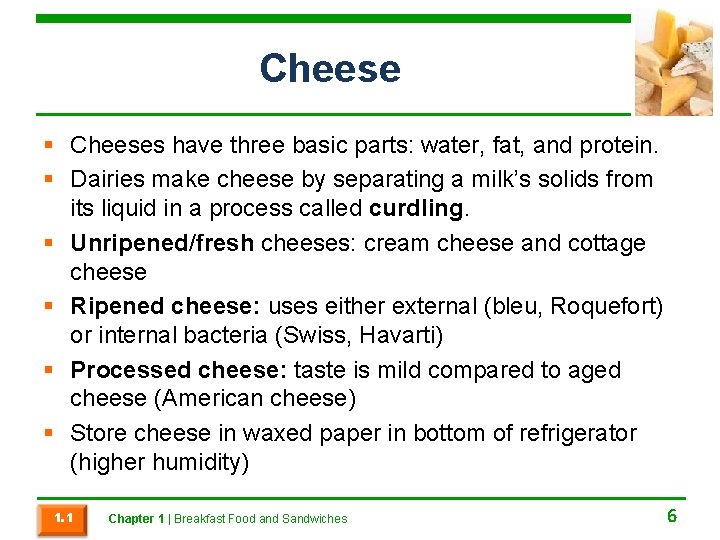
Cheese § Cheeses have three basic parts: water, fat, and protein. § Dairies make cheese by separating a milk’s solids from its liquid in a process called curdling. § Unripened/fresh cheeses: cream cheese and cottage cheese § Ripened cheese: uses either external (bleu, Roquefort) or internal bacteria (Swiss, Havarti) § Processed cheese: taste is mild compared to aged cheese (American cheese) § Store cheese in waxed paper in bottom of refrigerator (higher humidity) 1. 1 Chapter 1 | Breakfast Food and Sandwiches 6
Varieties of Cheese § Unripened/fresh: soft and white (cream, cottage, ricotta) § Blue veined/mold ripened: blue or green (Blue, Roquefort) § Firm ripened: mild to sharp flavor (cheddar) § Very firm/ripened: takes 2 years to make, good for grating (Asiago, parmesan, Romano) 7
Egg Grades § An egg is composed of the outer shell, the white, and the yolk: § white (albumen): protein and water § Yolk: protein, fat, and lecithin, a natural emulsifier (thickener) § The membranes that hold the egg yolk in place are called chalazae. § There are USDA grades for shell eggs—Grade AA, A, and B: § Grade AA : the yolk is high and the white will not spread much when the shell is broken. § Grade B eggs are good for use in menu items that will hide their appearance, such as baked items. § Fresh eggs must be stored at 45°F or lower. 1. 1 Chapter 1 | Breakfast Food and Sandwiches 8
Market forms of eggs § Fresh: most often used for breakfast cooking (use pasteurized if serving high risk populations) § Frozen: used in scrambled eggs, omelets, French toast and baking § Dried: used for baking; do not store well; keep in refrigerator or freezer § Egg substitutes: may be egg free or just the whites; used for cholesterol-free diets § Organic eggs: no hormones used on chickens; may be from free range chickens 9
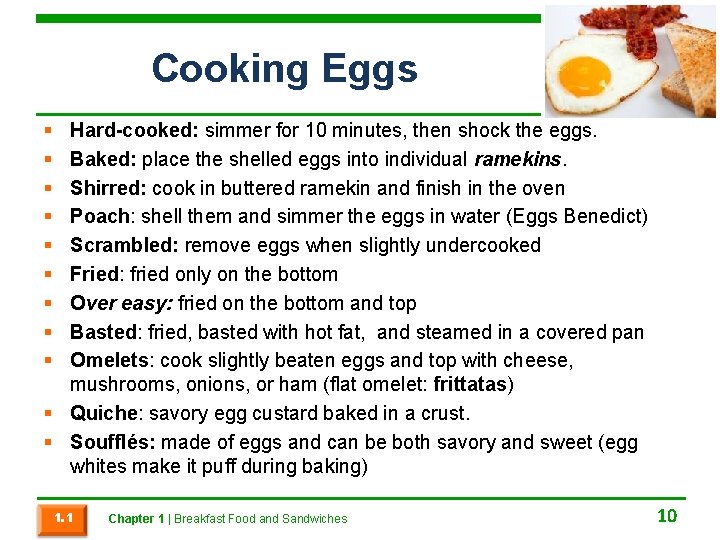
Cooking Eggs § § § § § Hard-cooked: simmer for 10 minutes, then shock the eggs. Baked: place the shelled eggs into individual ramekins. Shirred: cook in buttered ramekin and finish in the oven Poach: shell them and simmer the eggs in water (Eggs Benedict) Scrambled: remove eggs when slightly undercooked Fried: fried only on the bottom Over easy: fried on the bottom and top Basted: fried, basted with hot fat, and steamed in a covered pan Omelets: cook slightly beaten eggs and top with cheese, mushrooms, onions, or ham (flat omelet: frittatas) § Quiche: savory egg custard baked in a crust. § Soufflés: made of eggs and can be both savory and sweet (egg whites make it puff during baking) 1. 1 Chapter 1 | Breakfast Food and Sandwiches 10
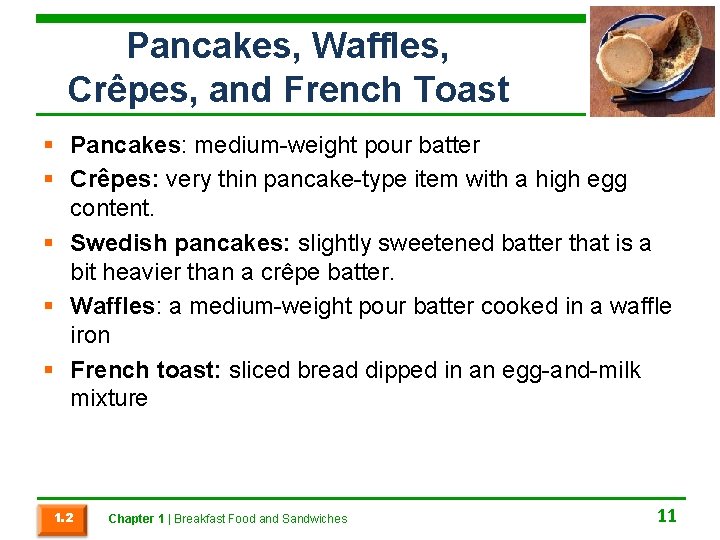
Pancakes, Waffles, Crêpes, and French Toast § Pancakes: medium-weight pour batter § Crêpes: very thin pancake-type item with a high egg content. § Swedish pancakes: slightly sweetened batter that is a bit heavier than a crêpe batter. § Waffles: a medium-weight pour batter cooked in a waffle iron § French toast: sliced bread dipped in an egg-and-milk mixture 1. 2 Chapter 1 | Breakfast Food and Sandwiches 11
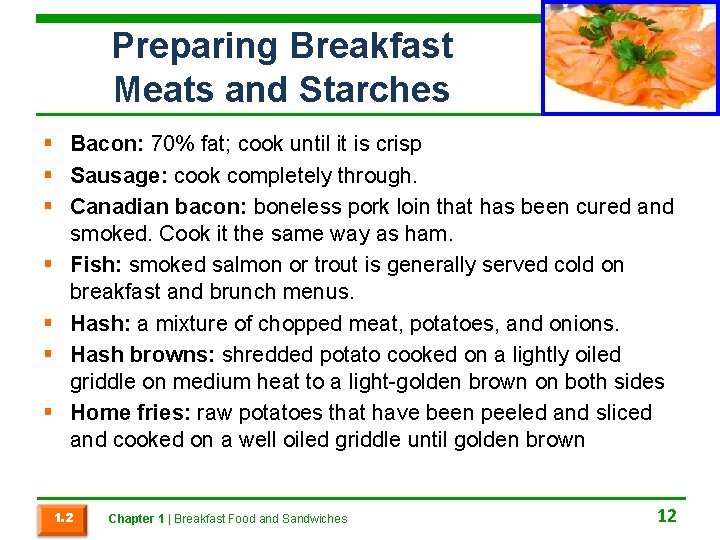
Preparing Breakfast Meats and Starches § Bacon: 70% fat; cook until it is crisp § Sausage: cook completely through. § Canadian bacon: boneless pork loin that has been cured and smoked. Cook it the same way as ham. § Fish: smoked salmon or trout is generally served cold on breakfast and brunch menus. § Hash: a mixture of chopped meat, potatoes, and onions. § Hash browns: shredded potato cooked on a lightly oiled griddle on medium heat to a light-golden brown on both sides § Home fries: raw potatoes that have been peeled and sliced and cooked on a well oiled griddle until golden brown 1. 2 Chapter 1 | Breakfast Food and Sandwiches 12
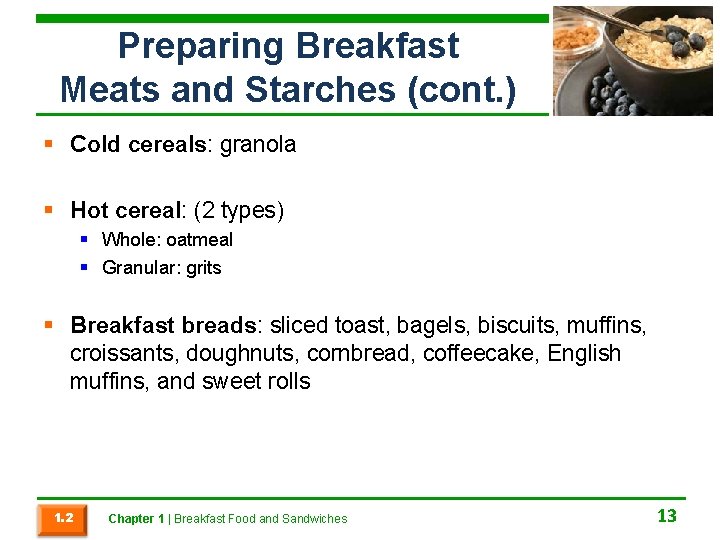
Preparing Breakfast Meats and Starches (cont. ) § Cold cereals: granola § Hot cereal: (2 types) § Whole: oatmeal § Granular: grits § Breakfast breads: sliced toast, bagels, biscuits, muffins, croissants, doughnuts, cornbread, coffeecake, English muffins, and sweet rolls 1. 2 Chapter 1 | Breakfast Food and Sandwiches 13
Hot Breakfast Beverages: Coffee, Tea, and Cocoa § Coffee: brew at temp. of 195 -200 degrees; don’t hold longer than 1 hour; clean coffee urn with vinegar § black teas (tea leaves that have been fermented) § Steep in water 175 degrees for at least 5 minutes § green teas (tea leaves that are not fermented). § Herbal tea is made from many different fruits and herbs and is naturally caffeine-free. § Hot chocolate is made from actual chocolate bars. § Hot cocoa is made from the powder of the cacao bean. § Both coffee and tea contain caffeine § Tea has half the caffeine contained in a cup of coffee. 1. 2 Chapter 1 | Breakfast Food and Sandwiches 14
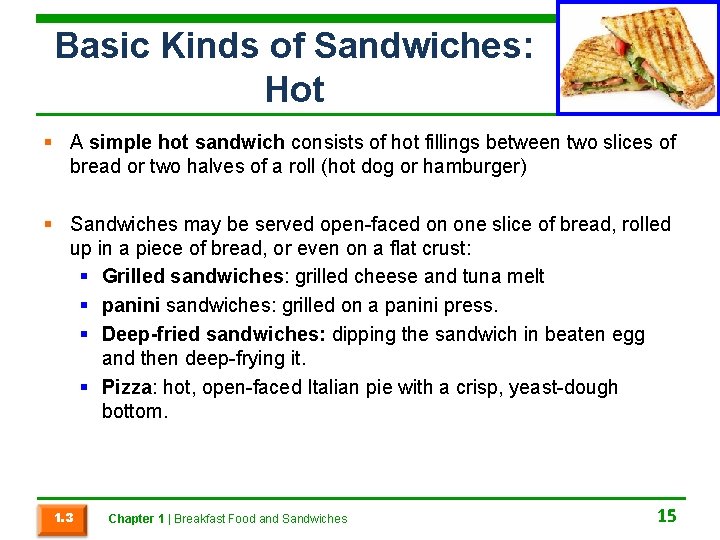
Basic Kinds of Sandwiches: Hot § A simple hot sandwich consists of hot fillings between two slices of bread or two halves of a roll (hot dog or hamburger) § Sandwiches may be served open-faced on one slice of bread, rolled up in a piece of bread, or even on a flat crust: § Grilled sandwiches: grilled cheese and tuna melt § panini sandwiches: grilled on a panini press. § Deep-fried sandwiches: dipping the sandwich in beaten egg and then deep-frying it. § Pizza: hot, open-faced Italian pie with a crisp, yeast-dough bottom. 1. 3 Chapter 1 | Breakfast Food and Sandwiches 15
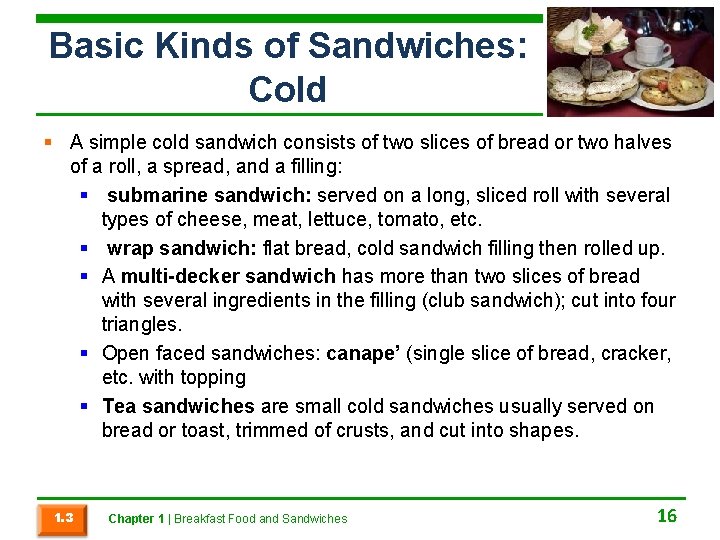
Basic Kinds of Sandwiches: Cold § A simple cold sandwich consists of two slices of bread or two halves of a roll, a spread, and a filling: § submarine sandwich: served on a long, sliced roll with several types of cheese, meat, lettuce, tomato, etc. § wrap sandwich: flat bread, cold sandwich filling then rolled up. § A multi-decker sandwich has more than two slices of bread with several ingredients in the filling (club sandwich); cut into four triangles. § Open faced sandwiches: canape’ (single slice of bread, cracker, etc. with topping § Tea sandwiches are small cold sandwiches usually served on bread or toast, trimmed of crusts, and cut into shapes. 1. 3 Chapter 1 | Breakfast Food and Sandwiches 16
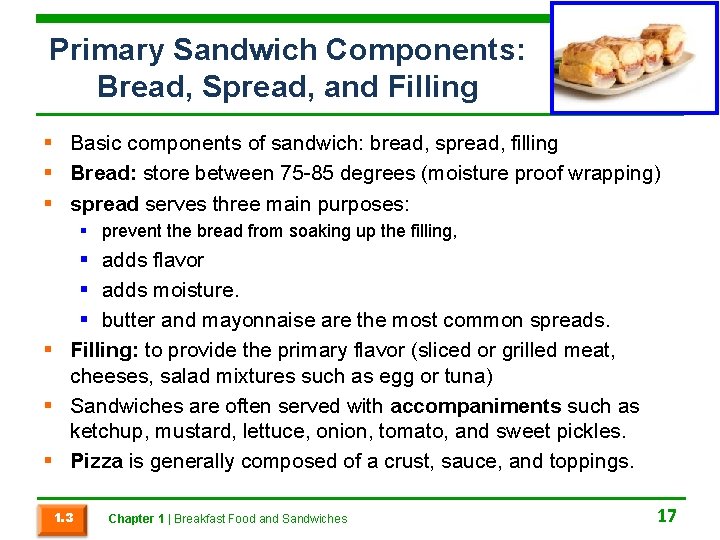
Primary Sandwich Components: Bread, Spread, and Filling § Basic components of sandwich: bread, spread, filling § Bread: store between 75 -85 degrees (moisture proof wrapping) § spread serves three main purposes: § prevent the bread from soaking up the filling, § adds flavor § adds moisture. § butter and mayonnaise are the most common spreads. § Filling: to provide the primary flavor (sliced or grilled meat, cheeses, salad mixtures such as egg or tuna) § Sandwiches are often served with accompaniments such as ketchup, mustard, lettuce, onion, tomato, and sweet pickles. § Pizza is generally composed of a crust, sauce, and toppings. 1. 3 Chapter 1 | Breakfast Food and Sandwiches 17
Sandwich Stations § Mise en place means that everything needed to prepare an item is ready and at hand. § Portion sliced items by count and by weight. § Portion fillings by weight as well. § Most sandwich stations include: § work table § hand tools § portion control equipment § cooking equipment for hot sandwiches. 1. 3 Chapter 1 | Breakfast Food and Sandwiches 18
- Slides: 18