
CHAPTER 1 BRANDS AND BRAND MANAGEMENT Copyright 2013

CHAPTER 1: BRANDS AND BRAND MANAGEMENT Copyright © 2013 Pearson Education, Inc. Publishing as Prentice Hall.
Learning Objectives Define “brand, ” state how brand differs from a product, and explain what brand equity is Summarize why brands are important Explain how branding applies to virtually everything Describe the main branding challenges and opportunities Identify the steps in the strategic brand management process Copyright © 2013 Pearson Education, Inc. Publishing as Prentice Hall.
What is a Brand? Brand Elements Brands versus Products Copyright © 2013 Pearson Education, Inc. Publishing as Prentice Hall.

Brand Elements Different components that identifies and differentiates a brand Name, logo, symbol, package design, or other characteristic Can be based on people, places, things, and abstract images Copyright © 2013 Pearson Education, Inc. Publishing as Prentice Hall.

Brand versus Product Brand Product Has dimensions that differentiate it in some way from other products designed to satisfy the same need Anything available in the market for use or consumption, that may satisfy a need or want Can be differentiated on the basis of: • Packaging • Services provided • Customer advice • Financing • Delivery arrangements • Warehousing • Other things valued by the customers Can be categorized into five levels namely: • Core benefit level • Generic product level • Expected product level • Augmented product level • Potential product level Copyright © 2013 Pearson Education, Inc. Publishing as Prentice Hall.
To Sum Up. . Through branding, organizations: Create perceived differences amongst products Develop loyal customer franchise Create value that can translate to financial profits Copyright © 2013 Pearson Education, Inc. Publishing as Prentice Hall.
Why Do Brands Matter? Consumers Firms Copyright © 2013 Pearson Education, Inc. Publishing as Prentice Hall.
Consumers Encompass all types of customers, including individuals as well as organizations Functions provided by brands to consumers Identify the source or maker of the product Simplify product decisions Lower the search costs for products internally and externally Helps set reasonable expectations about what consumers may not know about the brand Copyright © 2013 Pearson Education, Inc. Publishing as Prentice Hall.
Consumers Signal product characteristics and attributes On the basis of attributes products can be classified as: Search goods Experience goods Credence goods Reduce risks in product decision These risk can be categorised as Functional , physical, financial, social psychological, and time Copyright © 2013 Pearson Education, Inc. Publishing as Prentice Hall.
Firms Brands provide valuable functions Simplify product handling and tracing Help organizing inventory and accounting records Offer the firm legal protection for unique features or aspects of the product Provide predictability and security of demand for the firm and creates barriers of entry for competitors Provide a powerful means to secure competitive advantage Copyright © 2013 Pearson Education, Inc. Publishing as Prentice Hall.
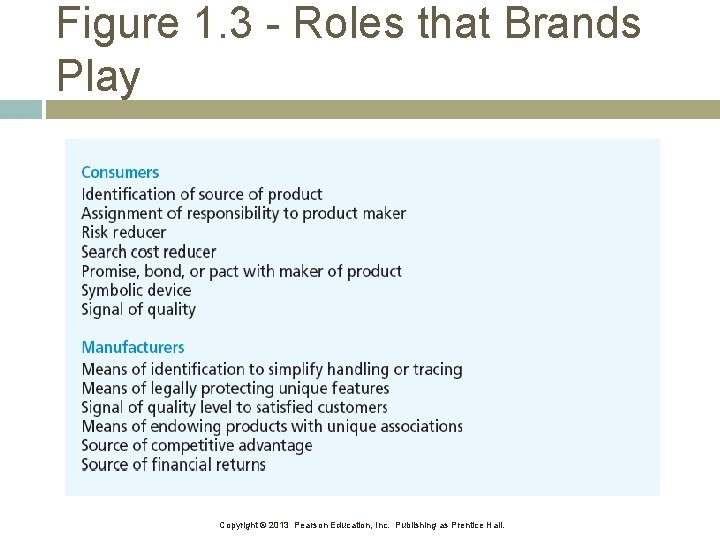
Figure 1. 3 - Roles that Brands Play Copyright © 2013 Pearson Education, Inc. Publishing as Prentice Hall.
Can Anything Be Branded Physical Goods Services Copyright © 2013 Pearson Education, Inc. Publishing as Prentice Hall.

Physical Goods Business-to-Business Products High-tech Products Copyright © 2013 Pearson Education, Inc. Publishing as Prentice Hall.
Services Role of Branding with Services Professional Services Copyright © 2013 Pearson Education, Inc. Publishing as Prentice Hall.
Can Anything Be Branded Retailers and Distributors Online Products and Services People and Organizations Copyright © 2013 Pearson Education, Inc. Publishing as Prentice Hall.
Role of Branding Sports , Arts, and Entertainment Geographic Locations Ideas and Causes Copyright © 2013 Pearson Education, Inc. Publishing as Prentice Hall.
To Sum up. . Branding is universal and pervasive in different product categories Applicable to both tangible and intangible offerings of an organization Technological developments have impacted the way firms market their offerings Organizations reap financial benefits from positive brand images Copyright © 2013 Pearson Education, Inc. Publishing as Prentice Hall.
Strong Brands that have been market leaders in their categories for decades Any brand is vulnerable and susceptible to poor brand management Copyright © 2013 Pearson Education, Inc. Publishing as Prentice Hall.
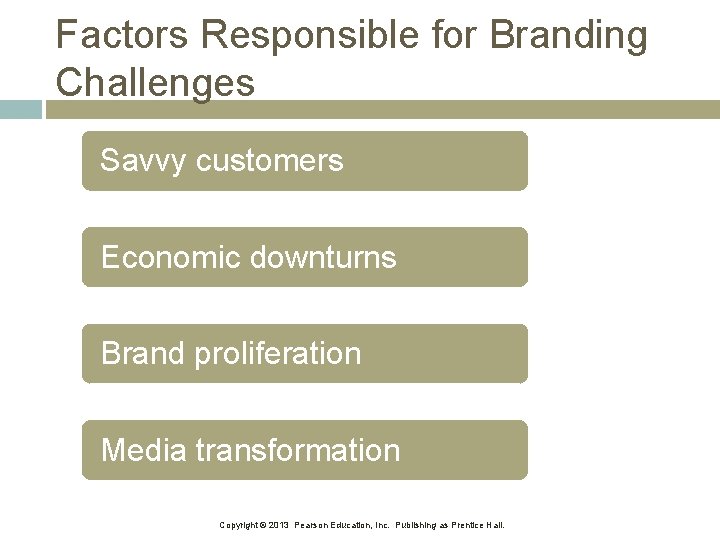
Factors Responsible for Branding Challenges Savvy customers Economic downturns Brand proliferation Media transformation Copyright © 2013 Pearson Education, Inc. Publishing as Prentice Hall.
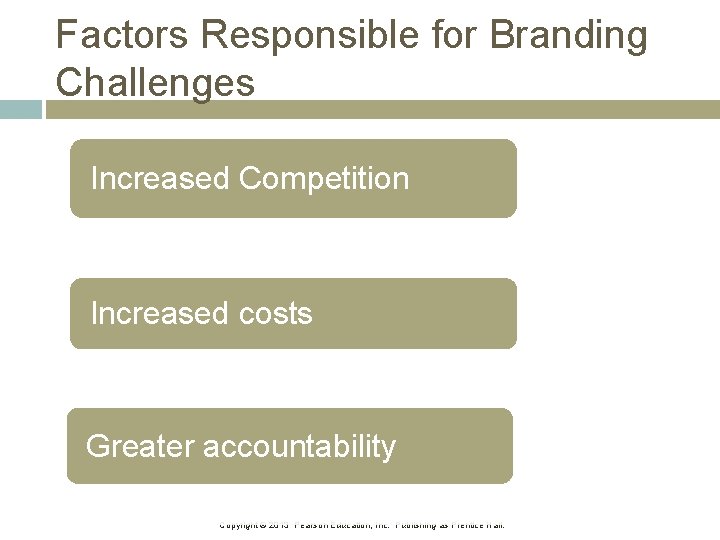
Factors Responsible for Branding Challenges Increased Competition Increased costs Greater accountability Copyright © 2013 Pearson Education, Inc. Publishing as Prentice Hall.
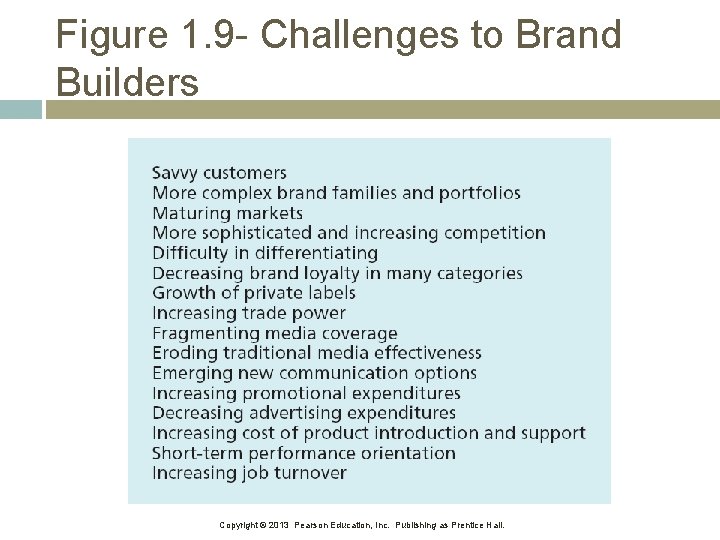
Figure 1. 9 - Challenges to Brand Builders Copyright © 2013 Pearson Education, Inc. Publishing as Prentice Hall.
Brand Equity Principles of branding and brand equity Differences in outcomes arise from the “added value” endowed to a product The added value can be created for a brand in many different ways Brand equity provides a common denominator for interpreting marketing strategies and assessing the value of a brand There are many different ways in which the value of a brand can be exploited to benefit the firm Copyright © 2013 Pearson Education, Inc. Publishing as Prentice Hall.
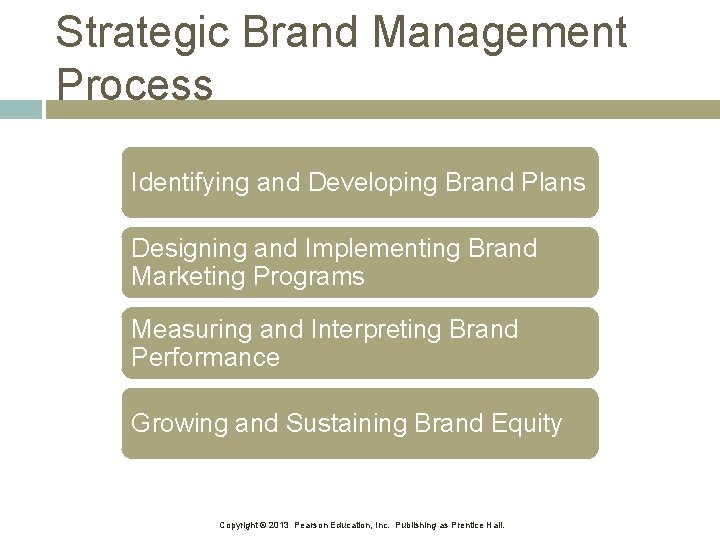
Strategic Brand Management Process Identifying and Developing Brand Plans Designing and Implementing Brand Marketing Programs Measuring and Interpreting Brand Performance Growing and Sustaining Brand Equity Copyright © 2013 Pearson Education, Inc. Publishing as Prentice Hall.
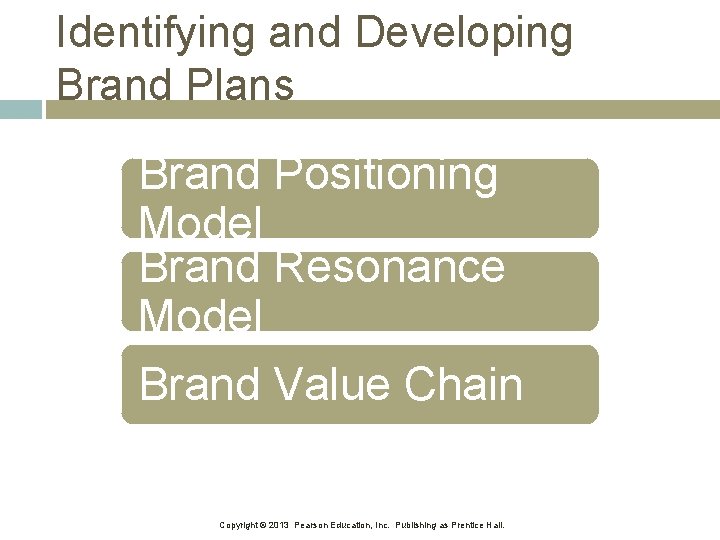
Identifying and Developing Brand Plans Brand Positioning Model Brand Resonance Model Brand Value Chain Copyright © 2013 Pearson Education, Inc. Publishing as Prentice Hall.
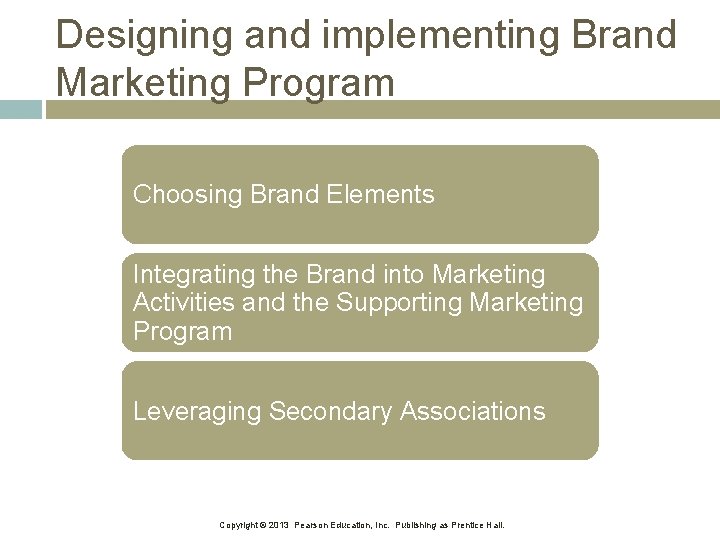
Designing and implementing Brand Marketing Program Choosing Brand Elements Integrating the Brand into Marketing Activities and the Supporting Marketing Program Leveraging Secondary Associations Copyright © 2013 Pearson Education, Inc. Publishing as Prentice Hall.
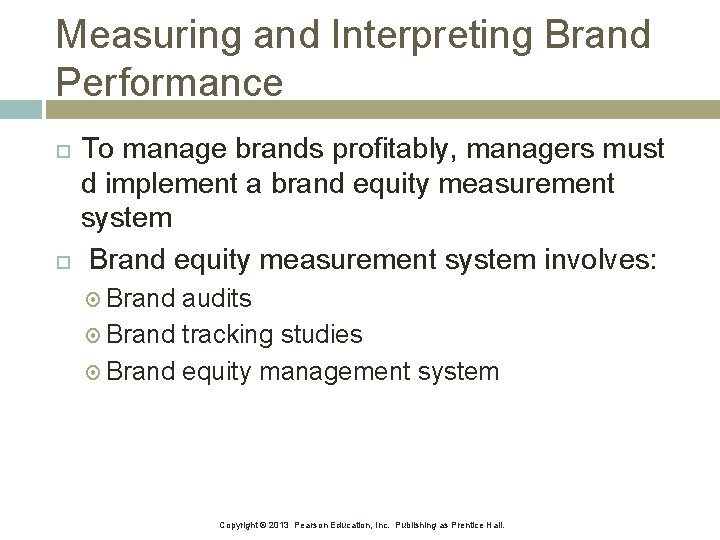
Measuring and Interpreting Brand Performance To manage brands profitably, managers must d implement a brand equity measurement system Brand equity measurement system involves: Brand audits Brand tracking studies Brand equity management system Copyright © 2013 Pearson Education, Inc. Publishing as Prentice Hall.
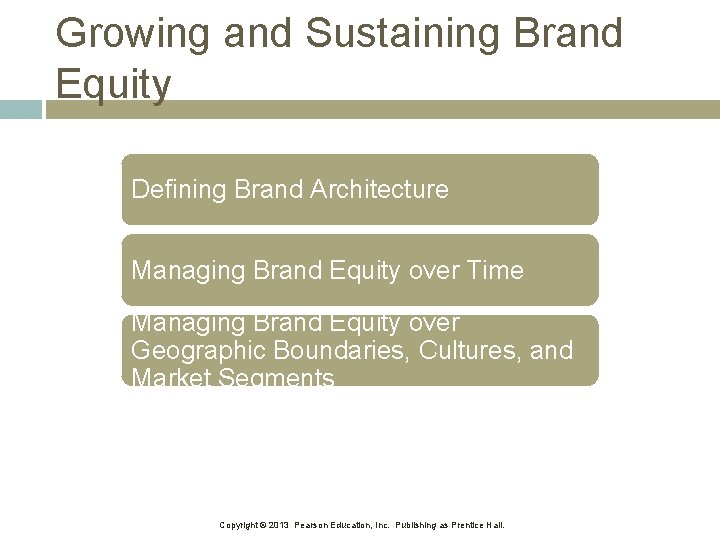
Growing and Sustaining Brand Equity Defining Brand Architecture Managing Brand Equity over Time Managing Brand Equity over Geographic Boundaries, Cultures, and Market Segments Copyright © 2013 Pearson Education, Inc. Publishing as Prentice Hall.
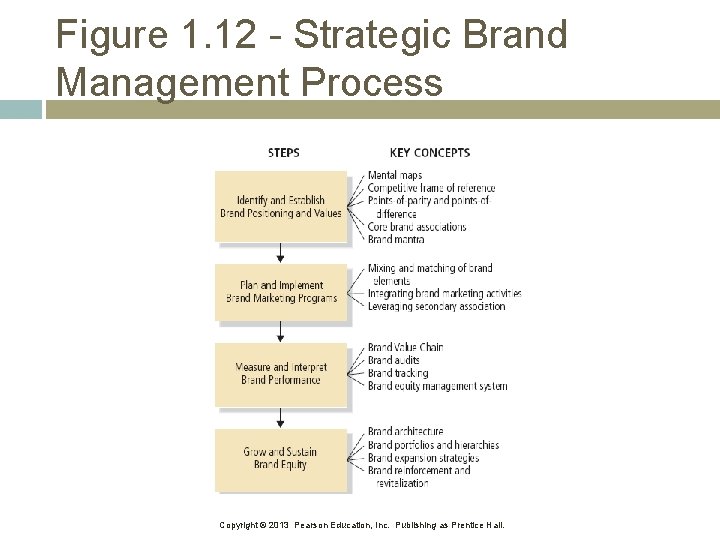
Figure 1. 12 - Strategic Brand Management Process Copyright © 2013 Pearson Education, Inc. Publishing as Prentice Hall.

All rights reserved. No part of this publication may be reproduced, stored in a retrieval system, or transmitted, in any form or by any means, electronic, mechanical, photocopying, recording, or otherwise, without the prior written permission of the publisher. Printed in the United States of America. Copyright © 2013 Pearson Education, Inc. Publishing as Prentice Hall
- Slides: 29