
Chapter 1 Birth Defects An Ounce of Prevention
Chapter 1 Birth Defects An Ounce of Prevention 2000, 2005, 2011 The Curators of the University of Missouri
An Ounce of Prevention Addressing Health Issues of Adolescents and Young Adults An Ounce of Prevention 2000, 2005, 2011 The Curators of the University of Missouri
Chapter 1 Birth Defects Can it happen to my baby? Practical problem: How do I make lifestyle choices to avoid preventable birth defects? An Ounce of Prevention 2000, 2005, 2011 The Curators of the University of Missouri
Key concepts 1. Risks and prenatal development during preimplantation, embryonic and fetal periods 2. Causes of birth defects • • • 3. Impact of birth defects • • • An Ounce of Prevention definition and frequency chromosomal genetic teratogenic multifactorial medical emotional family financial societal 2000, 2005, 2011 The Curators of the University of Missouri

Objectives 1. Define birth defect. 2. Relate the genetic and environmental factors to birth defects. 3. Analyze periods of development and associated risks. 4. Evaluate the impact of birth defects. An Ounce of Prevention 2000, 2005, 2011 The Curators of the University of Missouri
Rationale Birth defects affect 3 to 4 percent of infants and are the leading cause of prenatal and infant mortality in the United States. 20 percent of all infant deaths are the result of birth defects. This chapter provides general information on birth defects, their respective causes and impact, and developmental periods during pregnancy. An Ounce of Prevention 2000, 2005, 2011 The Curators of the University of Missouri

What are birth defects? • Abnormally formed organ or body part also known as malformation or congenital anomaly • Occur as major and minor anomalies • Internal or external • Present at birth • Sometimes detected later An Ounce of Prevention 2000, 2005, 2011 The Curators of the University of Missouri
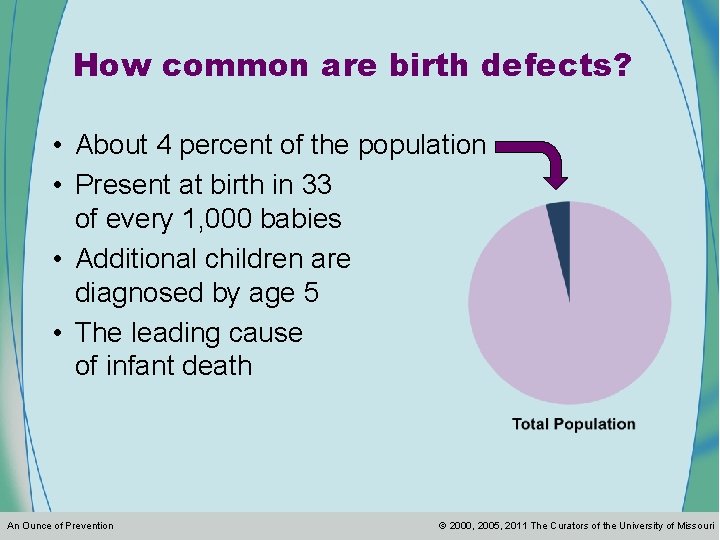
How common are birth defects? • About 4 percent of the population • Present at birth in 33 of every 1, 000 babies • Additional children are diagnosed by age 5 • The leading cause of infant death An Ounce of Prevention 2000, 2005, 2011 The Curators of the University of Missouri
Five causes of birth defects 1. Genetic (hereditary) 2. Chromosomal missing or extra genetic material 3. Teratogen 4. Multifactorial 5. Other causes An Ounce of Prevention 2000, 2005, 2011 The Curators of the University of Missouri

Five causes of birth defects An Ounce of Prevention 2000, 2005, 2011 The Curators of the University of Missouri
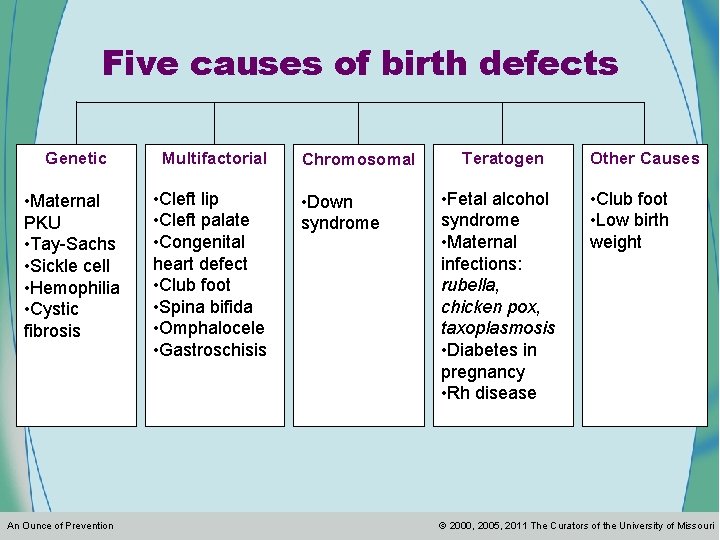
Five causes of birth defects Genetic Multifactorial • Maternal PKU • Tay-Sachs • Sickle cell • Hemophilia • Cystic fibrosis • Cleft lip • Cleft palate • Congenital heart defect • Club foot • Spina bifida • Omphalocele • Gastroschisis An Ounce of Prevention Chromosomal • Down syndrome Teratogen • Fetal alcohol syndrome • Maternal infections: rubella, chicken pox, taxoplasmosis • Diabetes in pregnancy • Rh disease Other Causes • Club foot • Low birth weight 2000, 2005, 2011 The Curators of the University of Missouri
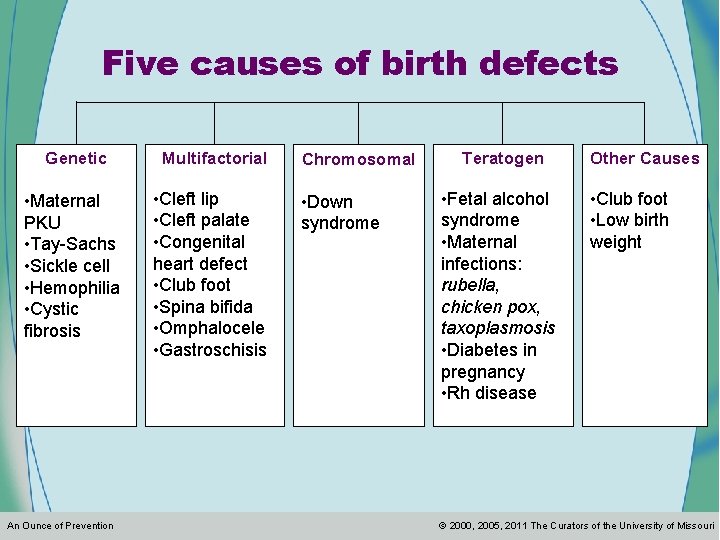
Five causes of birth defects Genetic Multifactorial • Maternal PKU • Tay-Sachs • Sickle cell • Hemophilia • Cystic fibrosis • Cleft lip • Cleft palate • Congenital heart defect • Club foot • Spina bifida • Omphalocele • Gastroschisis An Ounce of Prevention Chromosomal • Down syndrome Teratogen • Fetal alcohol syndrome • Maternal infections: rubella, chicken pox, taxoplasmosis • Diabetes in pregnancy • Rh disease Other Causes • Club foot • Low birth weight 2000, 2005, 2011 The Curators of the University of Missouri
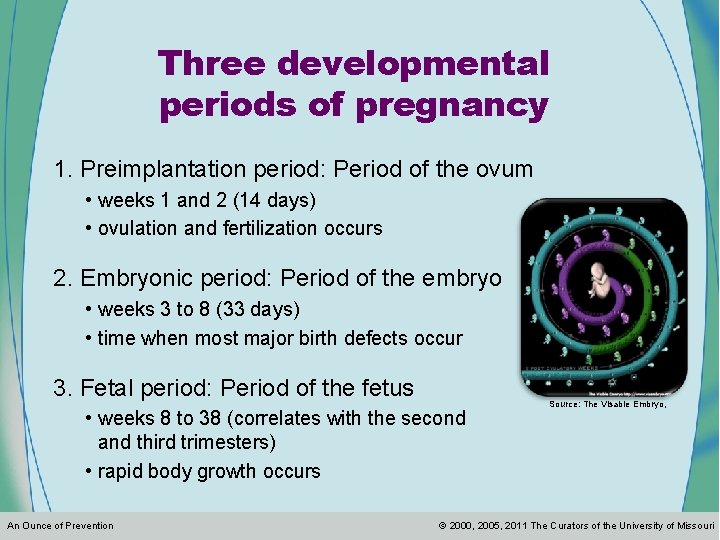
Three developmental periods of pregnancy 1. Preimplantation period: Period of the ovum • weeks 1 and 2 (14 days) • ovulation and fertilization occurs 2. Embryonic period: Period of the embryo • weeks 3 to 8 (33 days) • time when most major birth defects occur 3. Fetal period: Period of the fetus • weeks 8 to 38 (correlates with the second and third trimesters) • rapid body growth occurs An Ounce of Prevention Source: The Visable Embryo, 2000, 2005, 2011 The Curators of the University of Missouri
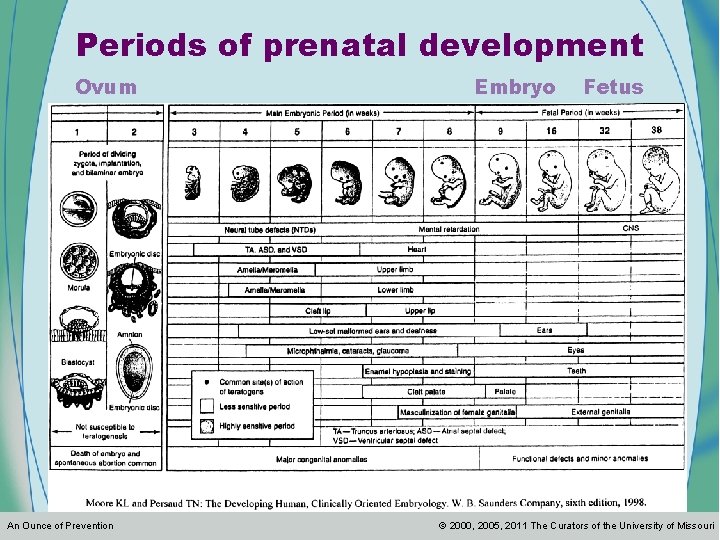
Periods of prenatal development Ovum An Ounce of Prevention Embryo Fetus 2000, 2005, 2011 The Curators of the University of Missouri

Prenatal development Source: The Multi-Dimensional Human Embryo, a collaboration funded by the National Institute of Child Health and Human Development, http: //embryo. soad. umich. edu Sample images: http: //embryo. soad. umich. edu/carn. Stages/stage 14. html Sample animation: http: //embryo. soad. umich. edu/resources/morph. html An Ounce of Prevention 2000, 2005, 2011 The Curators of the University of Missouri
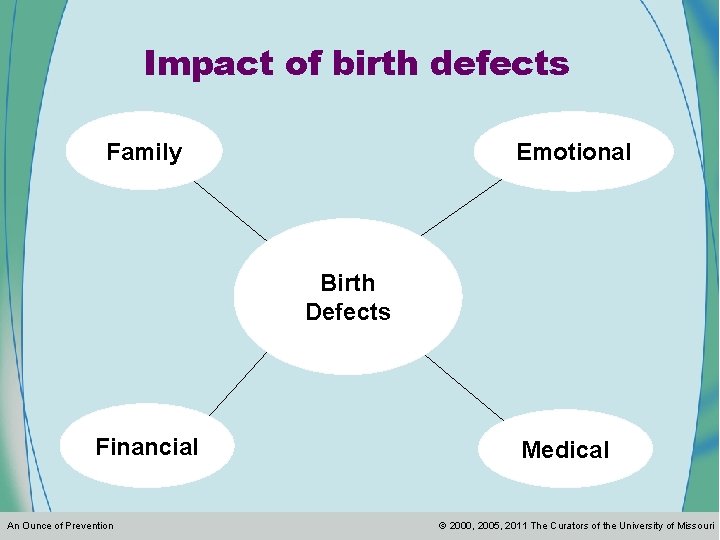
Impact of birth defects Family Emotional Birth Defects Financial An Ounce of Prevention Medical 2000, 2005, 2011 The Curators of the University of Missouri
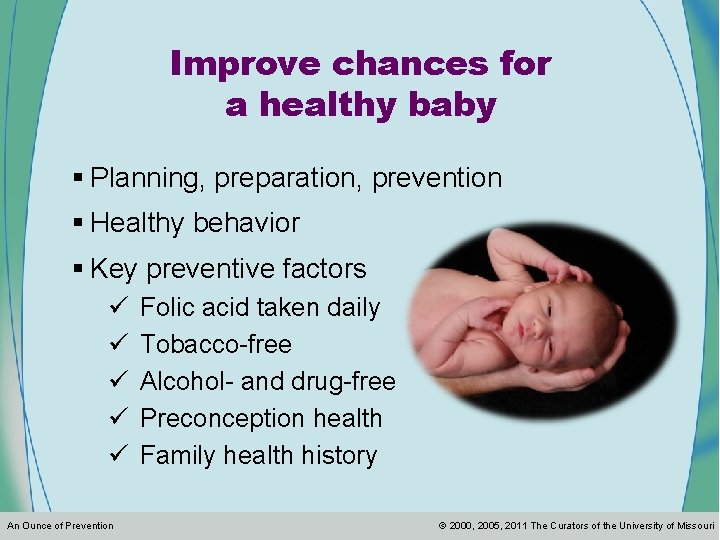
Improve chances for a healthy baby § Planning, preparation, prevention § Healthy behavior § Key preventive factors ü ü ü An Ounce of Prevention Folic acid taken daily Tobacco-free Alcohol- and drug-free Preconception health Family health history 2000, 2005, 2011 The Curators of the University of Missouri
Key learning activities • Illustration of risks for birth defects • Build a bubble • Periods of development and associated risks • Impact of Birth Defects graphic organizer • Terminology review • E-learning activity: Birth Defects Squares An Ounce of Prevention 2000, 2005, 2011 The Curators of the University of Missouri
- Slides: 18