
Chapter 1 Biology Exploring Life Power Point Lectures
Chapter 1 Biology: Exploring Life Power. Point Lectures for Biology: Concepts and Connections, Fifth Edition – Campbell, Reece, Taylor, and Simon Lectures by Chris Romero Copyright © 2005 Pearson Education, Inc. Publishing as Benjamin Cummings
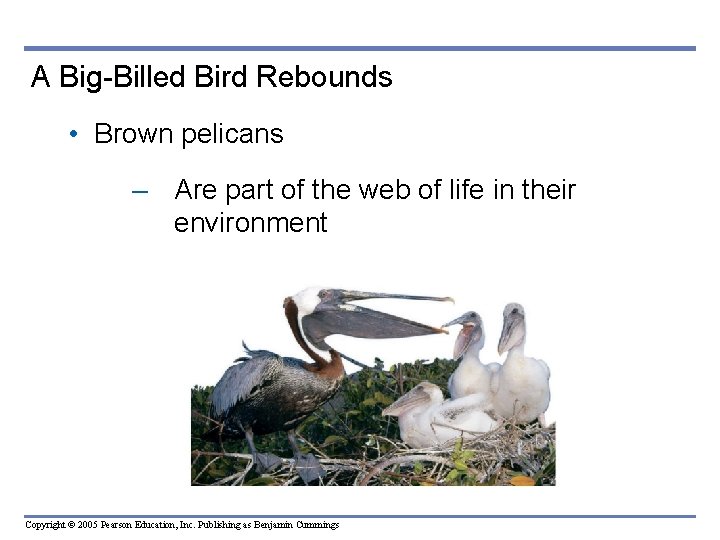
A Big-Billed Bird Rebounds • Brown pelicans – Are part of the web of life in their environment Copyright © 2005 Pearson Education, Inc. Publishing as Benjamin Cummings
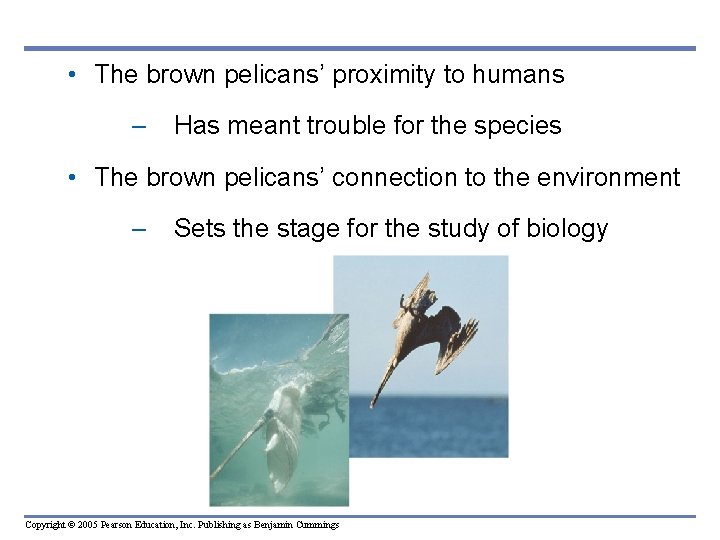
• The brown pelicans’ proximity to humans – Has meant trouble for the species • The brown pelicans’ connection to the environment – Sets the stage for the study of biology Copyright © 2005 Pearson Education, Inc. Publishing as Benjamin Cummings
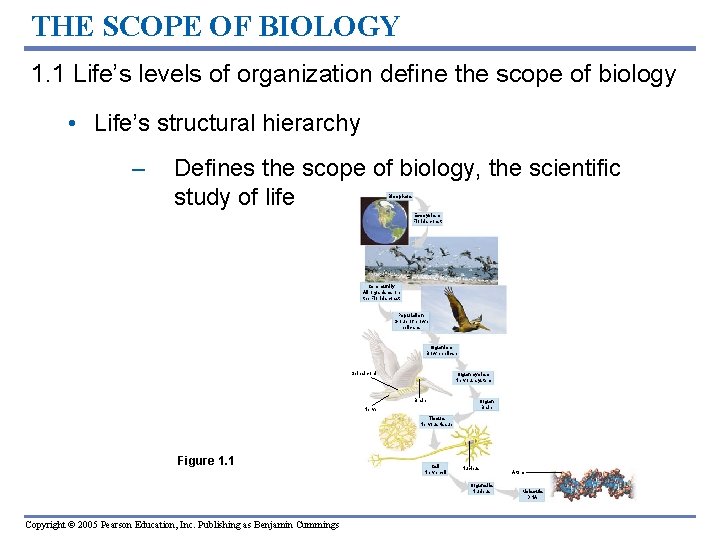
THE SCOPE OF BIOLOGY 1. 1 Life’s levels of organization define the scope of biology • Life’s structural hierarchy – Defines the scope of biology, the scientific study of life Biosphere Ecosystem Florida coast Community All organisms on the Florida coast Population Group of brown pelicans Organism Brown pelican Spinal cord Organ system Nervous system Brain Nerve Organ Brain Tissue Nervous tissue Figure 1. 1 Cell Nerve cell Nucleus Organelle Nucleus Copyright © 2005 Pearson Education, Inc. Publishing as Benjamin Cummings Atom Molecule DNA
• An ecosystem consists of all the organisms living in a par ticular area – As well as the nonliving environmental components • All the living organisms in an ecosystem – Make up a community Copyright © 2005 Pearson Education, Inc. Publishing as Benjamin Cummings
• A population – Consists of a localized group of individuals of a species • An individual living entity – Is an organism Copyright © 2005 Pearson Education, Inc. Publishing as Benjamin Cummings
• The hierarchy continues downward with – Organ systems – Organs – Tissues – Cells – Organelles – Molecules Copyright © 2005 Pearson Education, Inc. Publishing as Benjamin Cummings
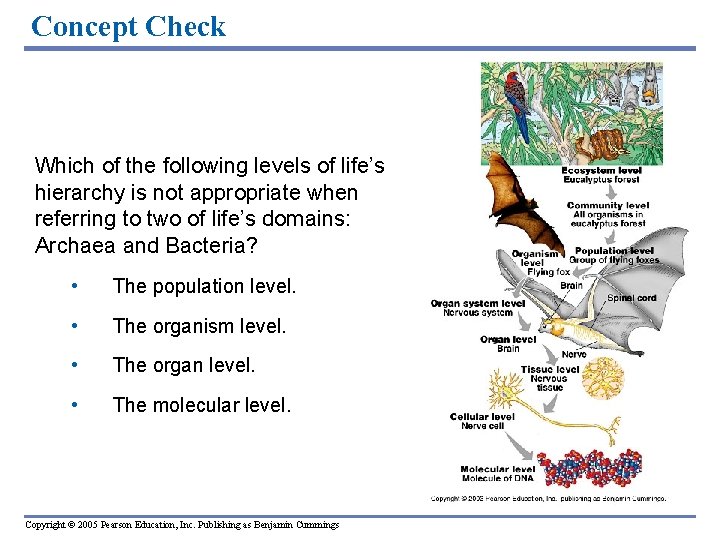
Concept Check Which of the following levels of life’s hierarchy is not appropriate when referring to two of life’s domains: Archaea and Bacteria? • The population level. • The organism level. • The organ level. • The molecular level. Copyright © 2005 Pearson Education, Inc. Publishing as Benjamin Cummings
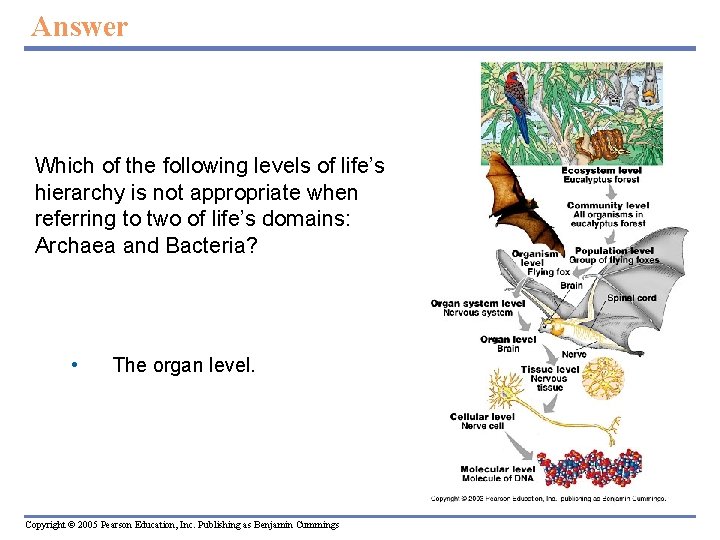
Answer Which of the following levels of life’s hierarchy is not appropriate when referring to two of life’s domains: Archaea and Bacteria? • The organ level. Copyright © 2005 Pearson Education, Inc. Publishing as Benjamin Cummings
1. 2 Living organisms and their environments form interconnecting webs • Ecosystems are characterized by the cycling of chemical nutrients from the atmosphere and soil – To producers to consumers to decomposers and back to the environment Copyright © 2005 Pearson Education, Inc. Publishing as Benjamin Cummings
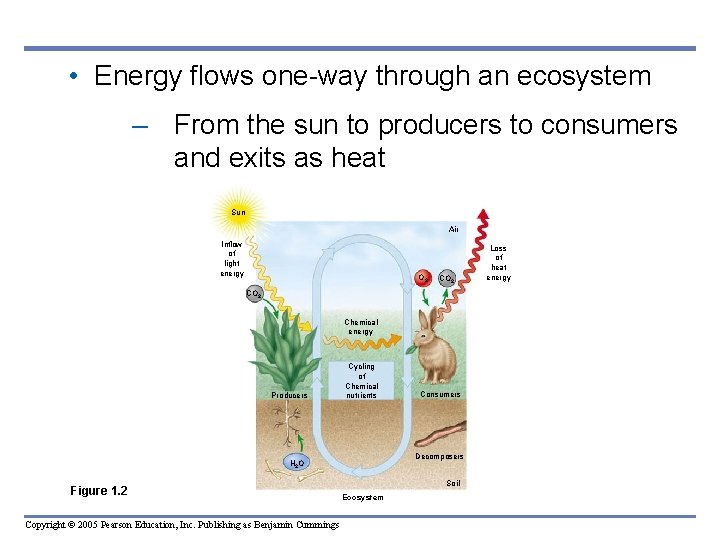
• Energy flows one-way through an ecosystem – From the sun to producers to consumers and exits as heat Sun Air Inflow of light energy O 2 CO 2 Chemical energy Producers Cycling of Chemical nutrients Decomposers H 2 O Figure 1. 2 Copyright © 2005 Pearson Education, Inc. Publishing as Benjamin Cummings Consumers Soil Ecosystem Loss of heat energy

1. 3 Cells are the structural and functional units of life • A cell – Is the basic unit of life Copyright © 2005 Pearson Education, Inc. Publishing as Benjamin Cummings
• New proper ties emerge – From the complex organization of a system, such as a cell Copyright © 2005 Pearson Education, Inc. Publishing as Benjamin Cummings
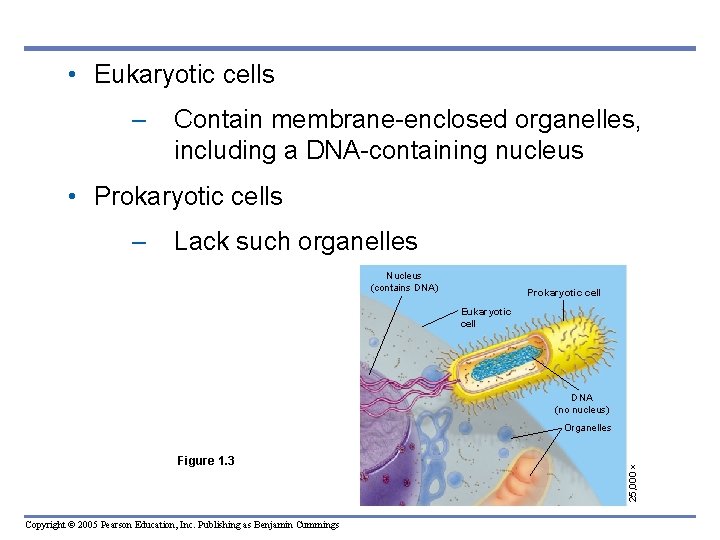
• Eukaryotic cells – Contain membrane-enclosed organelles, including a DNA-containing nucleus • Prokaryotic cells – Lack such organelles Nucleus (contains DNA) Prokar yotic cell Eukar yotic cell DNA (no nucleus) Figure 1. 3 Copyright © 2005 Pearson Education, Inc. Publishing as Benjamin Cummings 25, 000 Organelles
EVOLUTION, UNITY, AND DIVERSITY 1. 4 The unity of life: All forms of life have common features • DNA is the genetic information – For constructing the molecules that make up cells and organisms Copyright © 2005 Pearson Education, Inc. Publishing as Benjamin Cummings
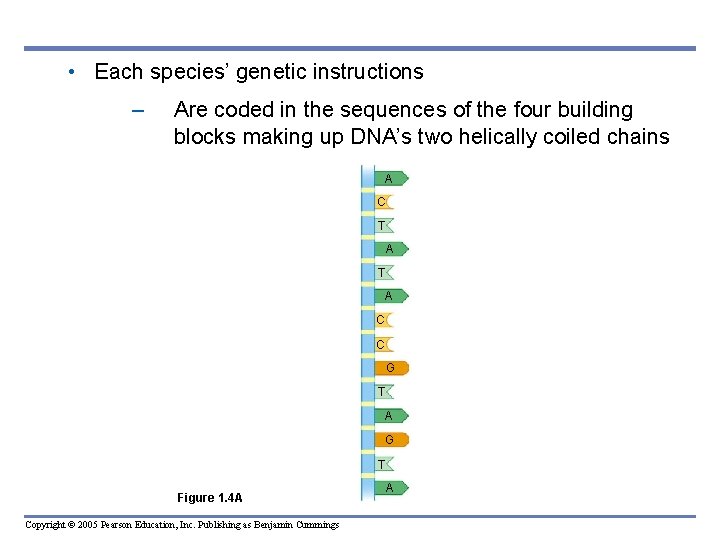
• Each species’ genetic instructions – Are coded in the sequences of the four building blocks making up DNA’s two helically coiled chains A C T A C C G T A G T Figure 1. 4 A Copyright © 2005 Pearson Education, Inc. Publishing as Benjamin Cummings A
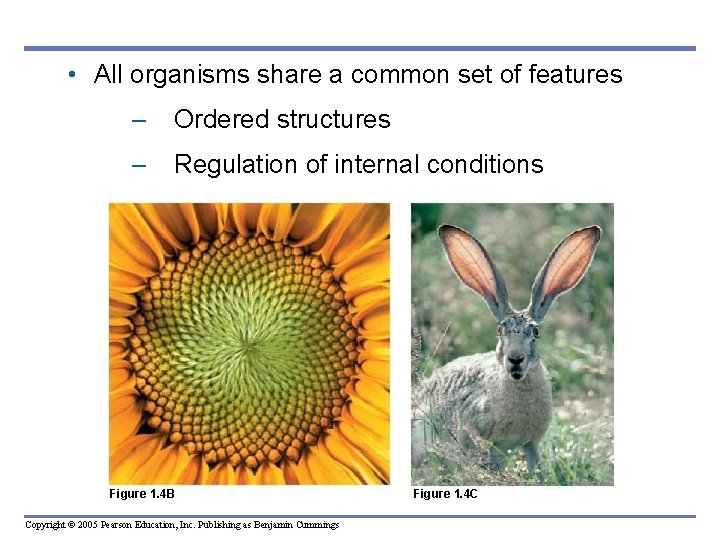
• All organisms share a common set of features – Ordered structures – Regulation of internal conditions Figure 1. 4 B Copyright © 2005 Pearson Education, Inc. Publishing as Benjamin Cummings Figure 1. 4 C
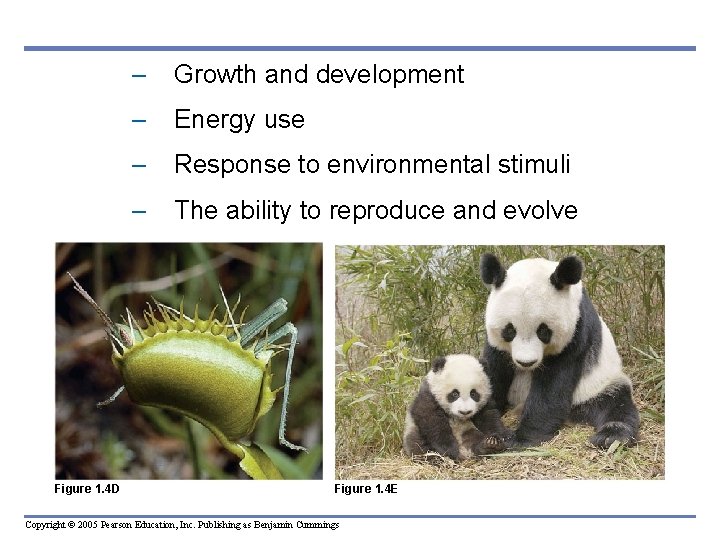
Figure 1. 4 D – Growth and development – Energy use – Response to environmental stimuli – The ability to reproduce and evolve Figure 1. 4 E Copyright © 2005 Pearson Education, Inc. Publishing as Benjamin Cummings
1. 5 The diversity of life can be arranged into three domains • Organisms are grouped (classified) – Into the prokaryotic domains Bacteria and Archaea and the eukaryotic domain Eukarya Copyright © 2005 Pearson Education, Inc. Publishing as Benjamin Cummings
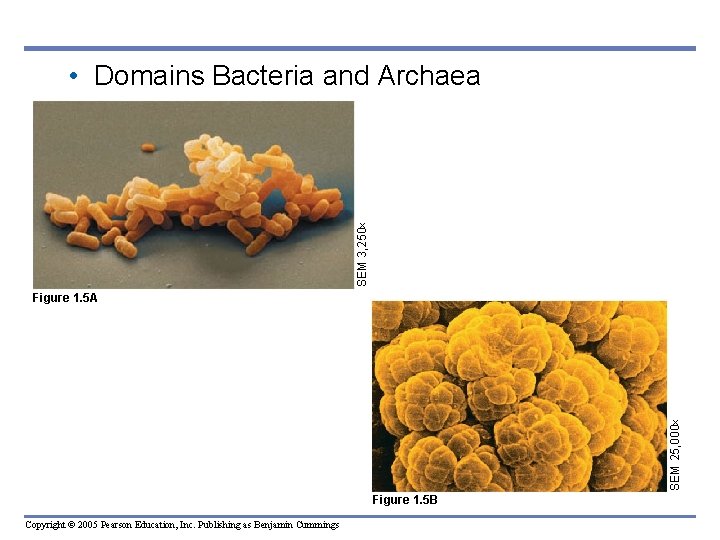
SEM 3, 250 • Domains Bacteria and Archaea SEM 25, 000 Figure 1. 5 A Figure 1. 5 B Copyright © 2005 Pearson Education, Inc. Publishing as Benjamin Cummings
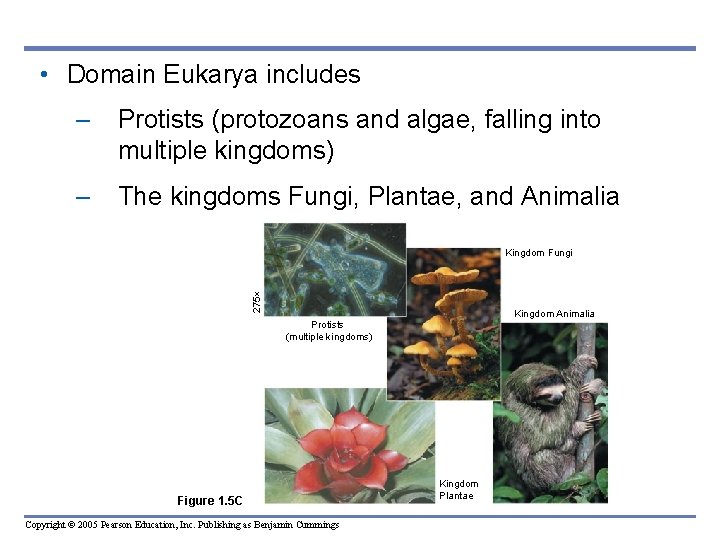
• Domain Eukarya includes – Protists (protozoans and algae, falling into multiple kingdoms) – The kingdoms Fungi, Plantae, and Animalia 275 Kingdom Fungi Kingdom Animalia Protists (multiple kingdoms) Figure 1. 5 C Copyright © 2005 Pearson Education, Inc. Publishing as Benjamin Cummings Kingdom Plantae
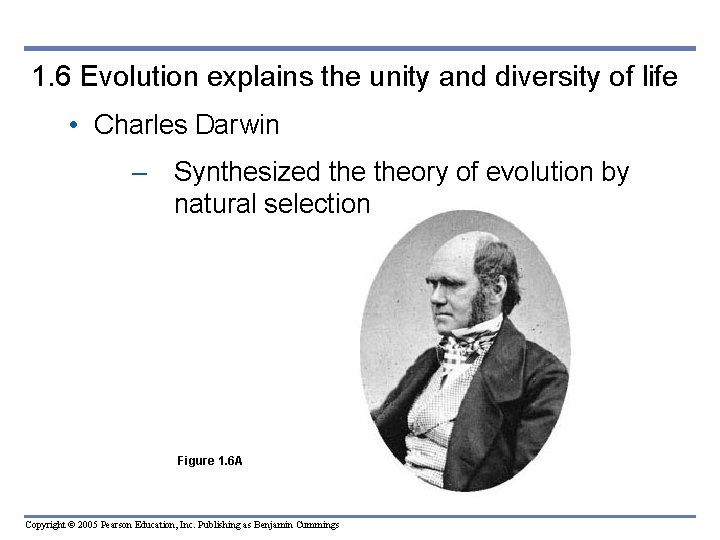
1. 6 Evolution explains the unity and diversity of life • Charles Dar win – Synthesized theory of evolution by natural selection Figure 1. 6 A Copyright © 2005 Pearson Education, Inc. Publishing as Benjamin Cummings
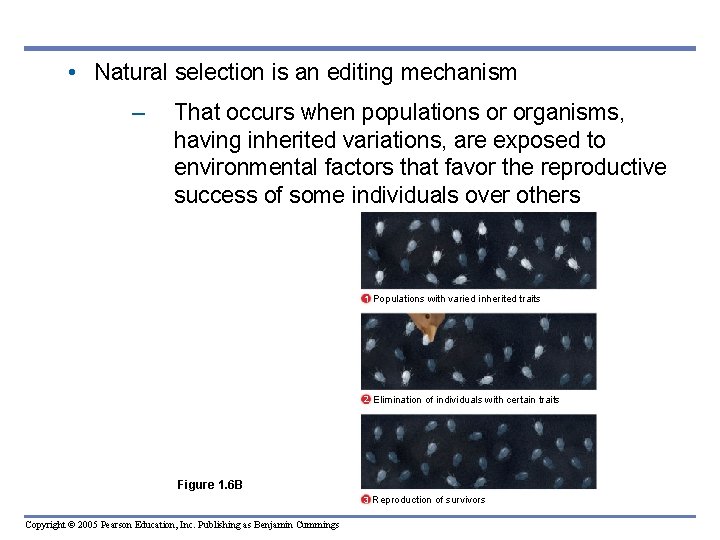
• Natural selection is an editing mechanism – That occurs when populations or organisms, having inherited variations, are exposed to environmental factors that favor the reproductive success of some individuals over others 1 Populations with varied inherited traits 2 Elimination of individuals with certain traits Figure 1. 6 B 3 Reproduction of survivors Copyright © 2005 Pearson Education, Inc. Publishing as Benjamin Cummings
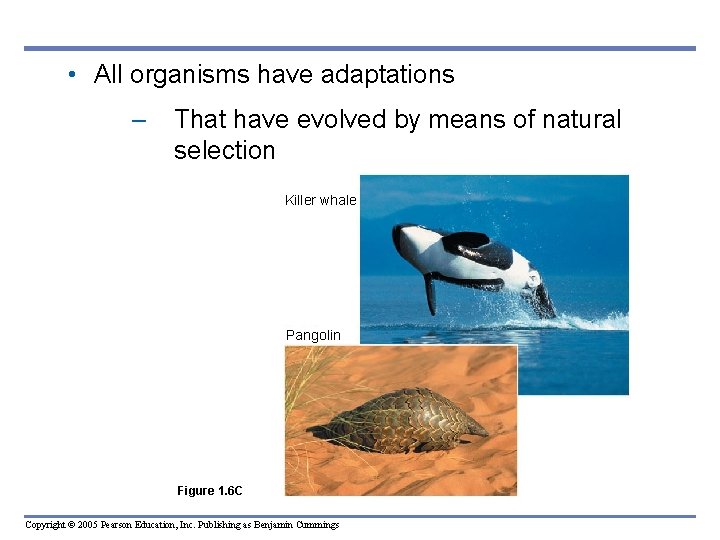
• All organisms have adaptations – That have evolved by means of natural selection Killer whale Pangolin Figure 1. 6 C Copyright © 2005 Pearson Education, Inc. Publishing as Benjamin Cummings
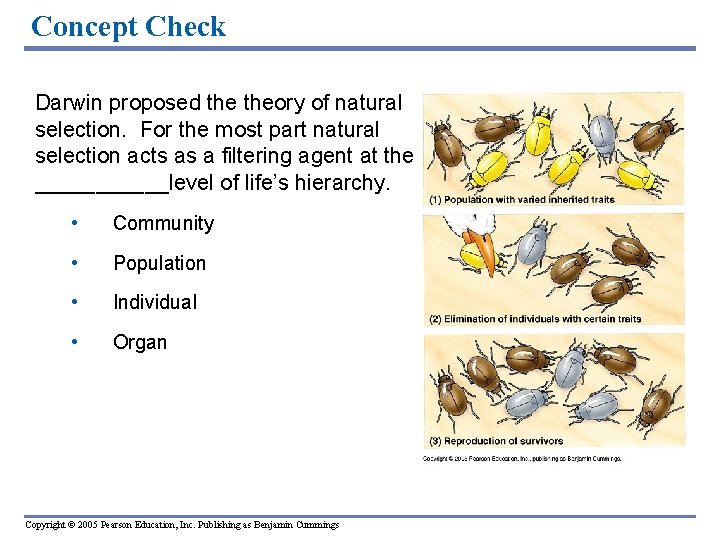
Concept Check Darwin proposed theory of natural selection. For the most part natural selection acts as a filtering agent at the ______level of life’s hierarchy. • Community • Population • Individual • Organ Copyright © 2005 Pearson Education, Inc. Publishing as Benjamin Cummings
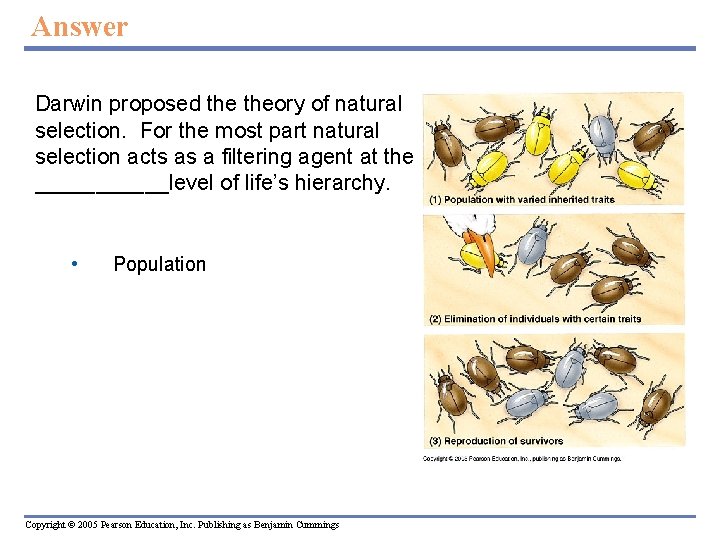
Answer Darwin proposed theory of natural selection. For the most part natural selection acts as a filtering agent at the ______level of life’s hierarchy. • Population Copyright © 2005 Pearson Education, Inc. Publishing as Benjamin Cummings
THE PROCESS OF SCIENCE 1. 7 Scientists use two main approaches to learn about nature • Science – Is a way of knowing – Seeks natural causes for natural phenomena Copyright © 2005 Pearson Education, Inc. Publishing as Benjamin Cummings
Discovery Science • In discovery science – Scientists describe some aspect of the world and use inductive reasoning to draw general conclusions Copyright © 2005 Pearson Education, Inc. Publishing as Benjamin Cummings
Hypothesis-Based Science • In hypothesis-based science – Scientists attempt to explain obser vations by testing hypotheses Copyright © 2005 Pearson Education, Inc. Publishing as Benjamin Cummings
Concept Check Not all science discoveries strictly follow the “scientific method”. Which of the following would best be described as discovery science? • Sequencing the human genome. • Describing a new bird species from the Philippines. • A project to find preserved specimens of the probably extinct Rocky Mountain locust frozen in glaciers. • All of the above. Copyright © 2005 Pearson Education, Inc. Publishing as Benjamin Cummings
Answer Not all science discoveries strictly follow the “scientific method”. Which of the following would best be described as discovery science? • All of the above. Copyright © 2005 Pearson Education, Inc. Publishing as Benjamin Cummings
1. 8 With hypothesis-based science, we pose and test hypotheses • Hypothesis-based science involves – Obser vations, questions, hypotheses as tentative answers to questions – Deductions leading to predictions, and then tests of predictions to see if a hypothesis is falsifiable Copyright © 2005 Pearson Education, Inc. Publishing as Benjamin Cummings
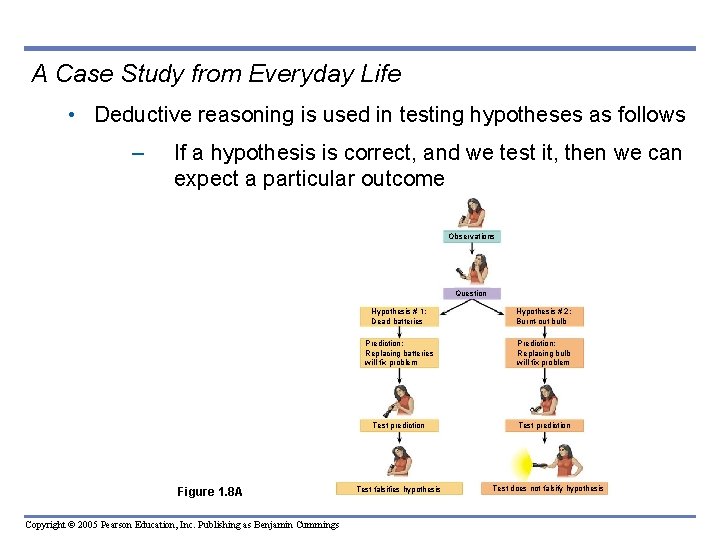
A Case Study from Ever yday Life • Deductive reasoning is used in testing hypotheses as follows – If a hypothesis is correct, and we test it, then we can expect a par ticular outcome Observations Question Figure 1. 8 A Copyright © 2005 Pearson Education, Inc. Publishing as Benjamin Cummings Hypothesis # 1: Dead batteries Hypothesis # 2: Burnt-out bulb Prediction: Replacing batteries will fix problem Prediction: Replacing bulb will fix problem Test prediction Test falsifies hypothesis Test does not falsify hypothesis
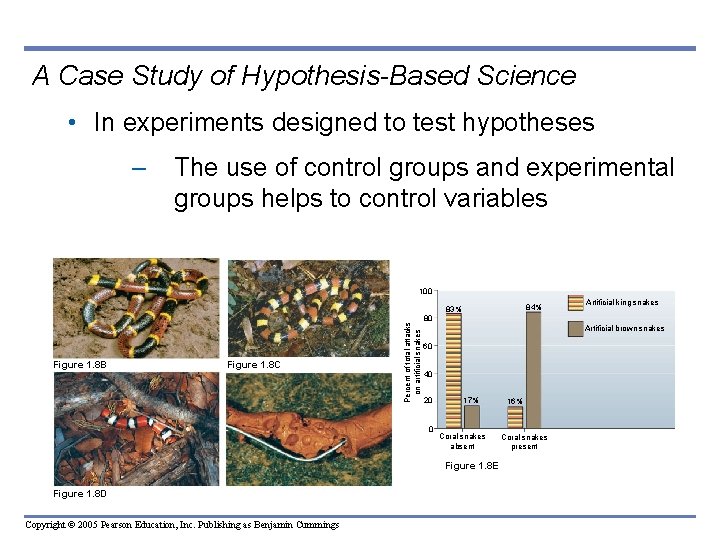
A Case Study of Hypothesis-Based Science • In experiments designed to test hypotheses – The use of control groups and experimental groups helps to control variables 100 84% Figure 1. 8 B Figure 1. 8 C Percent of total attacks on artificial snakes 83% 80 Artificial brown snakes 60 40 20 0 17% Coral snakes absent Figure 1. 8 E Figure 1. 8 D Copyright © 2005 Pearson Education, Inc. Publishing as Benjamin Cummings Artificial king snakes 16% Coral snakes present
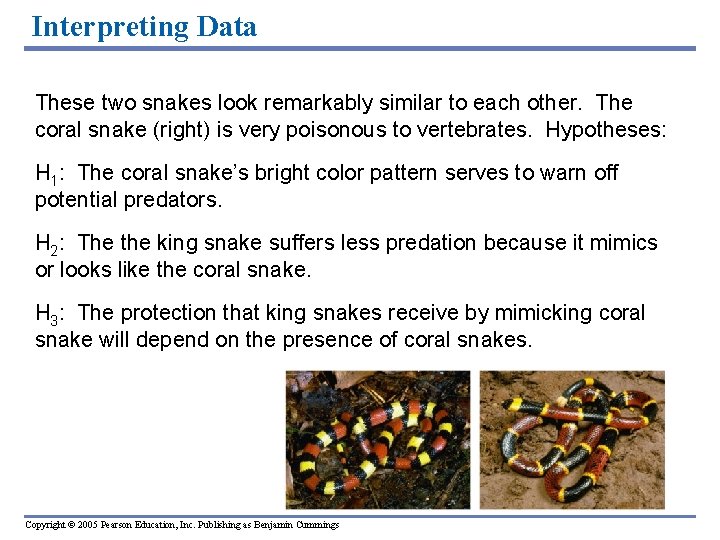
Interpreting Data These two snakes look remarkably similar to each other. The coral snake (right) is very poisonous to vertebrates. Hypotheses: H 1: The coral snake’s bright color pattern serves to warn off potential predators. H 2: The the king snake suffers less predation because it mimics or looks like the coral snake. H 3: The protection that king snakes receive by mimicking coral snake will depend on the presence of coral snakes. Copyright © 2005 Pearson Education, Inc. Publishing as Benjamin Cummings
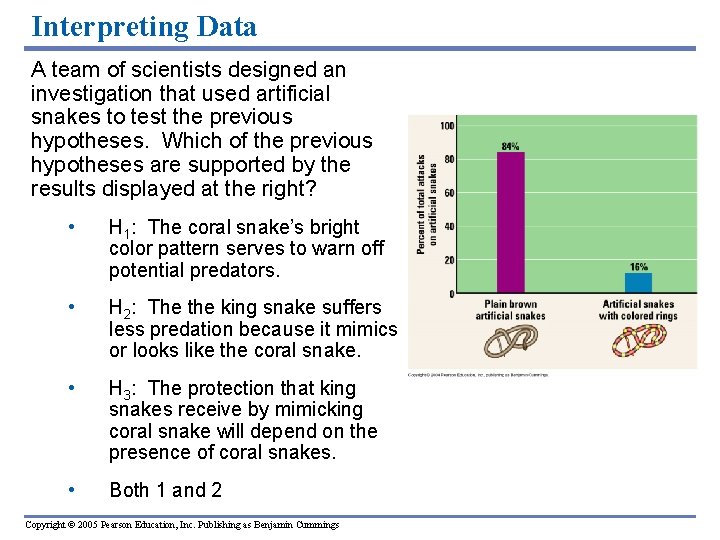
Interpreting Data A team of scientists designed an investigation that used artificial snakes to test the previous hypotheses. Which of the previous hypotheses are supported by the results displayed at the right? • H 1: The coral snake’s bright color pattern serves to warn off potential predators. • H 2: The the king snake suffers less predation because it mimics or looks like the coral snake. • H 3: The protection that king snakes receive by mimicking coral snake will depend on the presence of coral snakes. • Both 1 and 2 Copyright © 2005 Pearson Education, Inc. Publishing as Benjamin Cummings
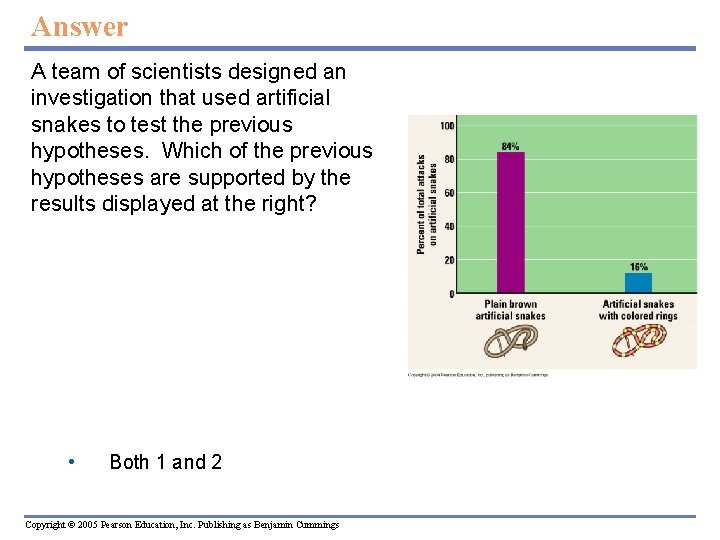
Answer A team of scientists designed an investigation that used artificial snakes to test the previous hypotheses. Which of the previous hypotheses are supported by the results displayed at the right? • Both 1 and 2 Copyright © 2005 Pearson Education, Inc. Publishing as Benjamin Cummings
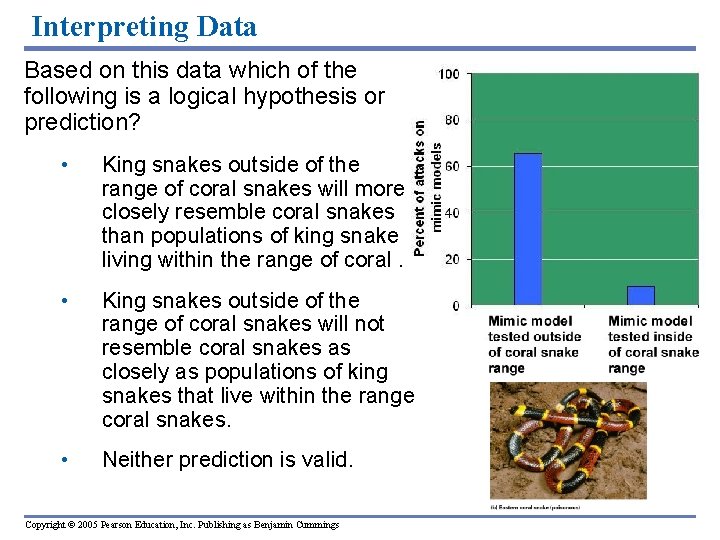
Interpreting Data Based on this data which of the following is a logical hypothesis or prediction? • King snakes outside of the range of coral snakes will more closely resemble coral snakes than populations of king snake living within the range of coral. • King snakes outside of the range of coral snakes will not resemble coral snakes as closely as populations of king snakes that live within the range coral snakes. • Neither prediction is valid. Copyright © 2005 Pearson Education, Inc. Publishing as Benjamin Cummings
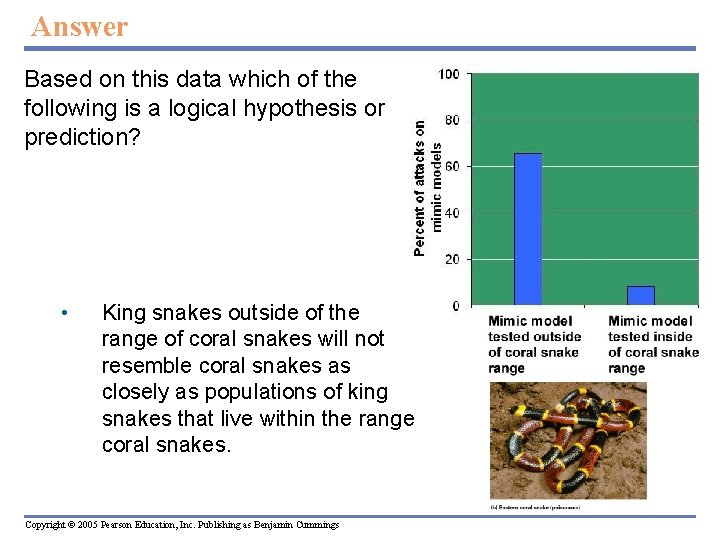
Answer Based on this data which of the following is a logical hypothesis or prediction? • King snakes outside of the range of coral snakes will not resemble coral snakes as closely as populations of king snakes that live within the range coral snakes. Copyright © 2005 Pearson Education, Inc. Publishing as Benjamin Cummings
BIOLOGY AND EVERYDAY LIFE CONNECTION 1. 8 Biology is connected to our lives in many ways Copyright © 2005 Pearson Education, Inc. Publishing as Benjamin Cummings
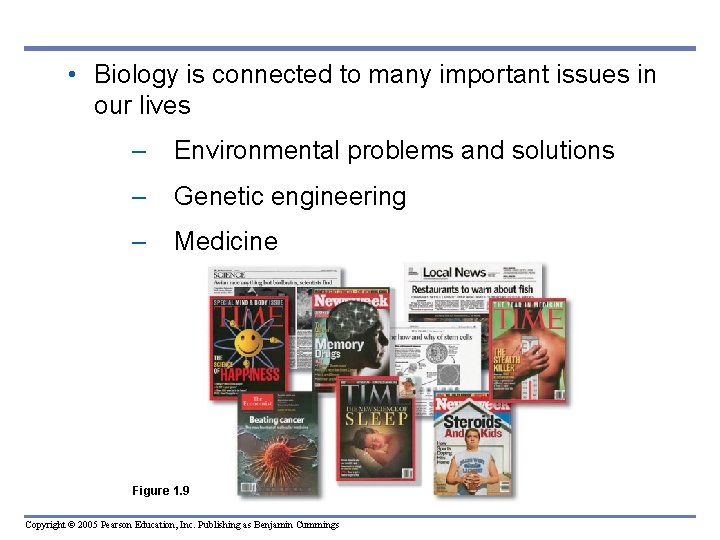
• Biology is connected to many impor tant issues in our lives – Environmental problems and solutions – Genetic engineering – Medicine Figure 1. 9 Copyright © 2005 Pearson Education, Inc. Publishing as Benjamin Cummings
• Many technological advances – Stem from scientific research • The science-technology-society relationship – Is an impor tant aspect of a biology course Copyright © 2005 Pearson Education, Inc. Publishing as Benjamin Cummings
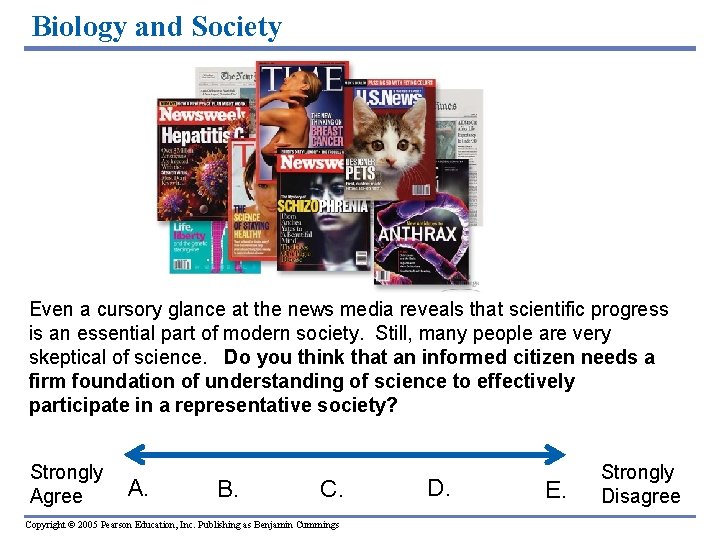
Biology and Society Even a cursory glance at the news media reveals that scientific progress is an essential part of modern society. Still, many people are very skeptical of science. Do you think that an informed citizen needs a firm foundation of understanding of science to effectively participate in a representative society? Strongly Agree A. B. Copyright © 2005 Pearson Education, Inc. Publishing as Benjamin Cummings D. E. Strongly Disagree
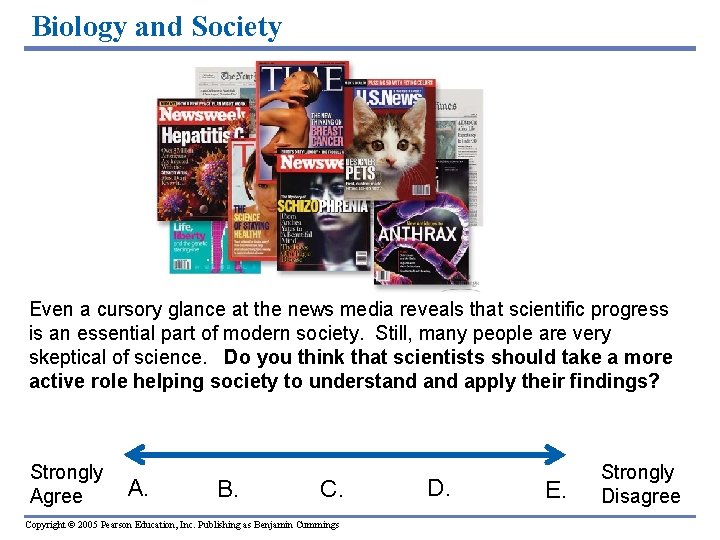
Biology and Society Even a cursory glance at the news media reveals that scientific progress is an essential part of modern society. Still, many people are very skeptical of science. Do you think that scientists should take a more active role helping society to understand apply their findings? Strongly Agree A. B. Copyright © 2005 Pearson Education, Inc. Publishing as Benjamin Cummings D. E. Strongly Disagree
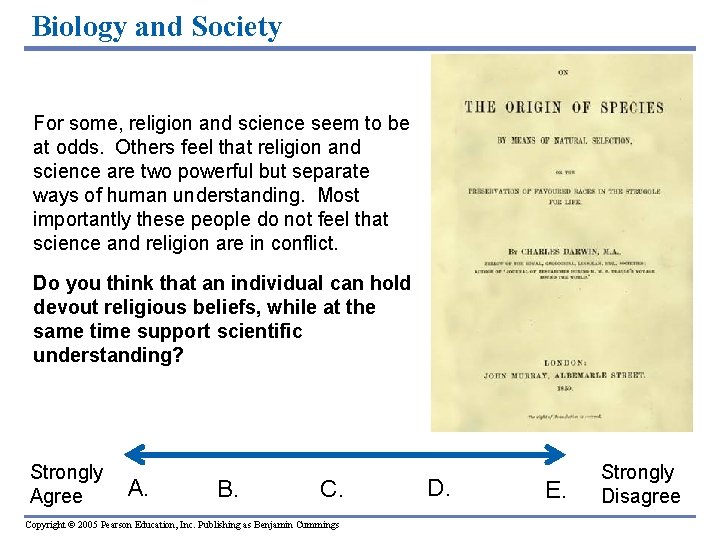
Biology and Society For some, religion and science seem to be at odds. Others feel that religion and science are two powerful but separate ways of human understanding. Most importantly these people do not feel that science and religion are in conflict. Do you think that an individual can hold devout religious beliefs, while at the same time support scientific understanding? Strongly Agree A. B. Copyright © 2005 Pearson Education, Inc. Publishing as Benjamin Cummings D. E. Strongly Disagree
- Slides: 45