
Chapter 1 Biology and You SECTION 3 SCIENTIFIC
Chapter 1: Biology and You SECTION 3: SCIENTIFIC PROCESSES
OBJECTIVES � Describe the stages common to scientific investigations. � Distinguish between forming a hypothesis and a theory.
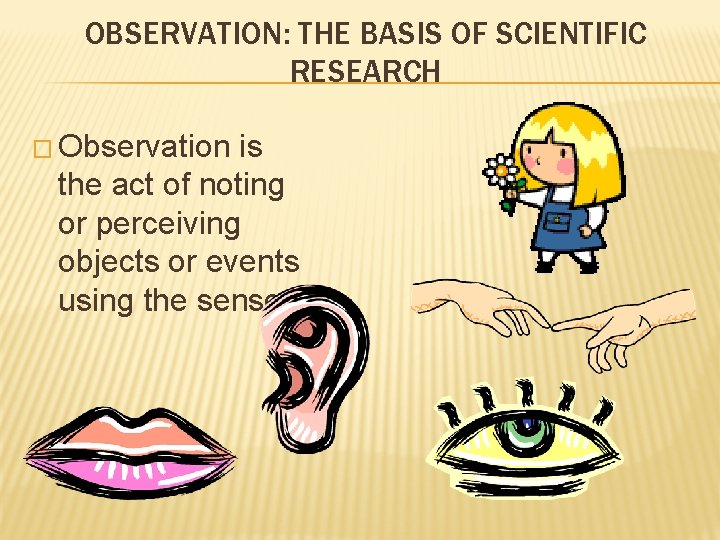
OBSERVATION: THE BASIS OF SCIENTIFIC RESEARCH � Observation is the act of noting or perceiving objects or events using the senses.
OBSERVATION: THE BASIS OF SCIENTIFIC RESEARCH � All scientists have a certain way of investigating the world. � Scientific investigations begin with observations. � Observations cause scientists to ask questions about their observations

STAGES OF SCIENTIFIC INVESTIGATIONS � Scientific investigations tend to have common stages. � These stages are called the Scientific Method. � There is more than one way to conduct an investigation. � Scientific Methods or Scientific Processes are more accurate terms for the stages of scientific investigation.
REAL LIFE EXAMPLES OF SCIENTIFIC METHOD THAT INVOLVES YOU!
STAGES OF SCIENTIFIC INVESTIGATIONS � Scientific Processes include the following steps: 1. 2. 3. 4. 5. Collecting observations. Asking questions Forming hypothesis Confirming predictions (with experiments when needed) Drawing conclusions

STAGES OF SCIENTIFIC INVESTIGATIONS � Hypothesis – an explanation that might be true, a statement that can be tested by additional observations or experimentation. �Educated Guess � Prediction – the expected outcome of a test, assuming the hypothesis is correct

STAGES OF SCIENTIFIC INVESTIGATIONS � Experiment –a planned procedure to test a hypothesis.
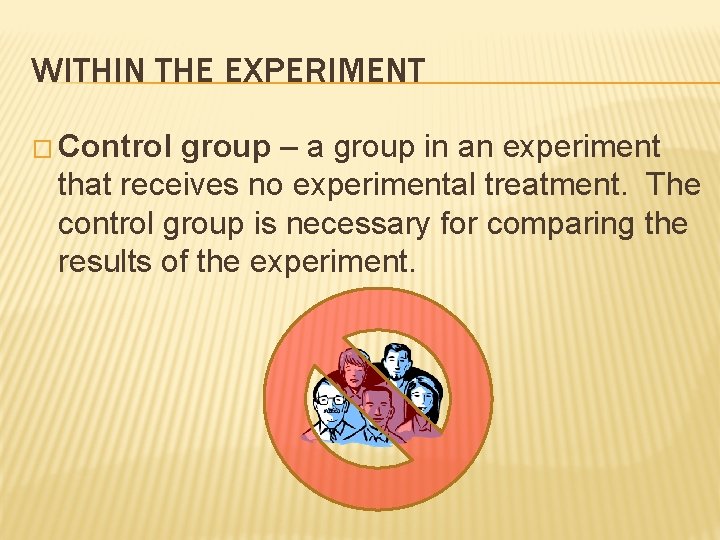
WITHIN THE EXPERIMENT � Control group – a group in an experiment that receives no experimental treatment. The control group is necessary for comparing the results of the experiment.
WITHIN THE EXPERIMENT � Independent variable - the factor that is changed in an experiment. � Dependent variable – the variable that is measured in an experiment, the outcome of the dependent variable depends on what is done to the independent variable.
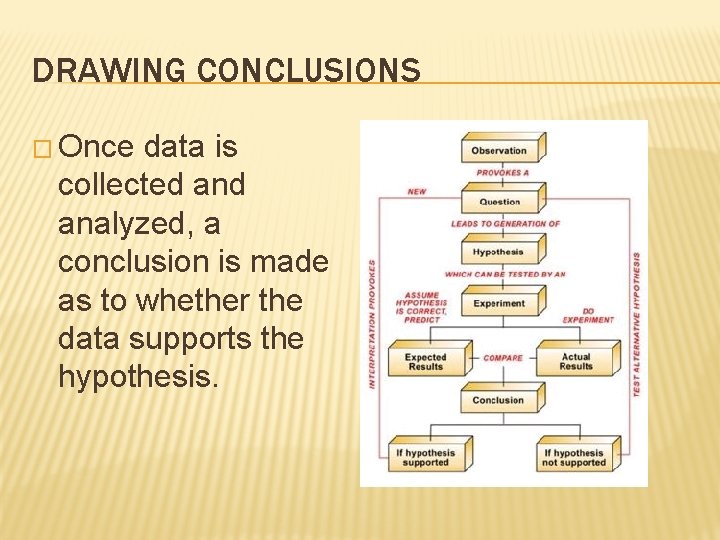
DRAWING CONCLUSIONS � Once data is collected analyzed, a conclusion is made as to whether the data supports the hypothesis.
VIEWING CONCLUSIONS IN CONTEXT � There is often more than one possible reason for a result. � All the factors that may affect an outcome must be considered.
SCIENTIFIC EXPLANATIONS � Constructing a Theory �What is a theory? �Theory – a set of related hypotheses that have been tested and confirmed many times by many scientists.
CONSTRUCTING A THEORY �A theory unites and explains a broad range of observations. � The word theory is used by the general public to mean a guess, or lack of certainty. � In science, a theory is a well-supported scientific explanation that makes useful predictions.
SCIENTISTS REPORT THEIR RESULTS � Scientific reports are reviewed by other scientists. � Scientific reports allow other scientists to use the information obtained in an experiment. � Scientific reports also allow other scientists to repeat and test experiments.
- Slides: 16