
Chapter 1 Basics of Geometry Lesson 1 2
Chapter 1 Basics of Geometry
Lesson 1. 2 Points, Lines, and Planes
How terms are defined in Math �A definition uses known words to describe a new word. �Some words are called undefined because they are impossible to define.

Undefined Terms �Terms that are undefined can be described using non-technical words. ◦ A point is usually represented by a small dot. A Point A
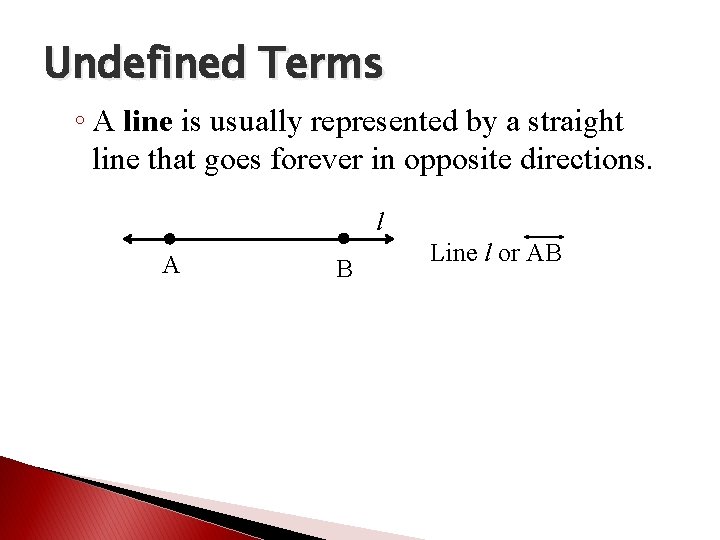
Undefined Terms ◦ A line is usually represented by a straight line that goes forever in opposite directions. l A B Line l or AB
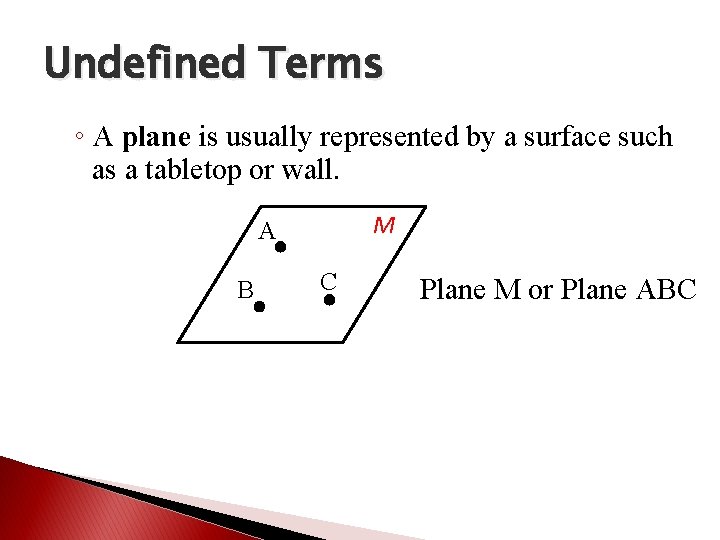
Undefined Terms ◦ A plane is usually represented by a surface such as a tabletop or wall. M A B C Plane M or Plane ABC
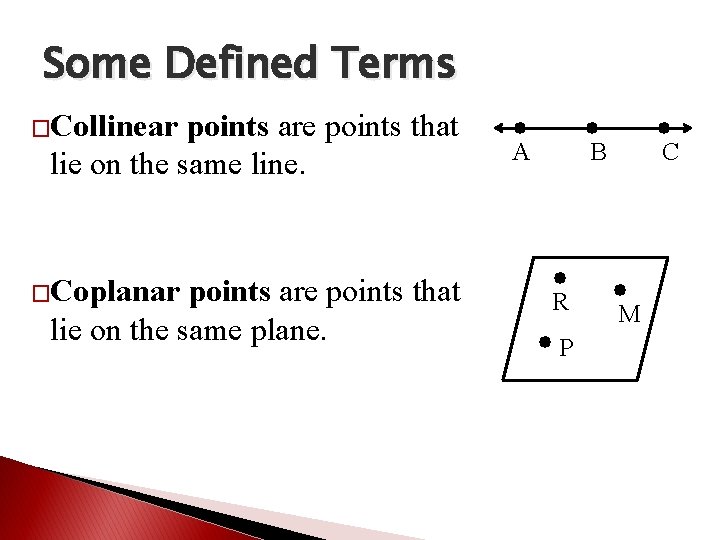
Some Defined Terms �Collinear points are points that lie on the same line. �Coplanar points are points that lie on the same plane. A B R P C M
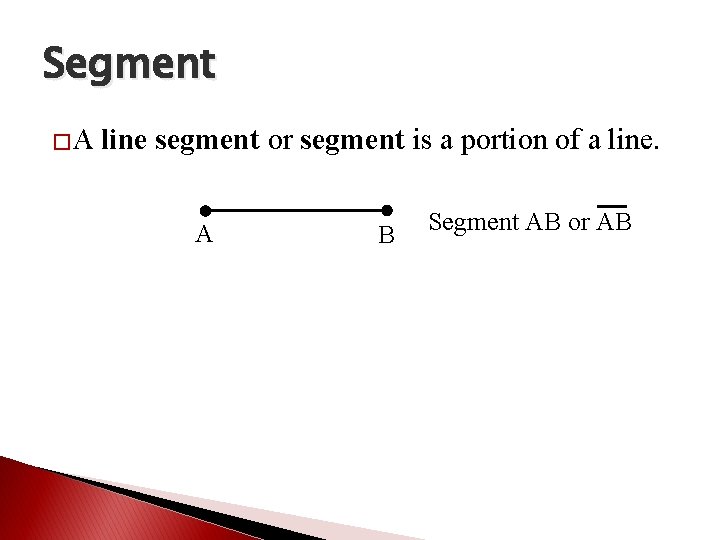
Segment �A line segment or segment is a portion of a line. A B Segment AB or AB
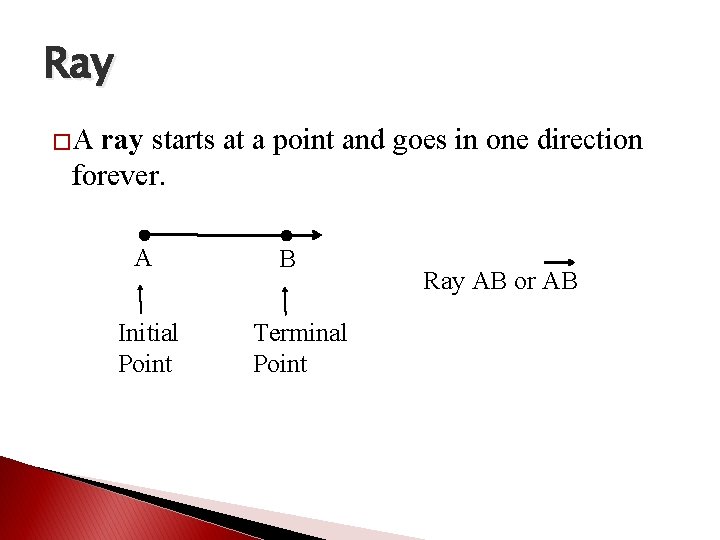
Ray �A ray starts at a point and goes in one direction forever. A Initial Point B Terminal Point Ray AB or AB
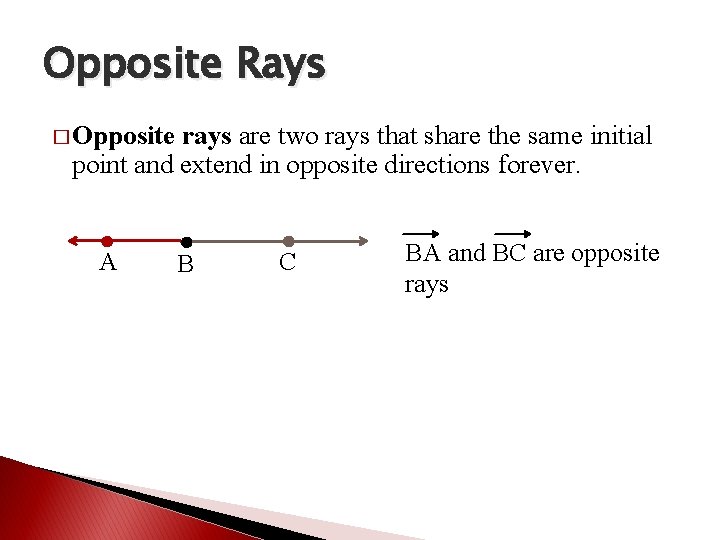
Opposite Rays � Opposite rays are two rays that share the same initial point and extend in opposite directions forever. A B C BA and BC are opposite rays
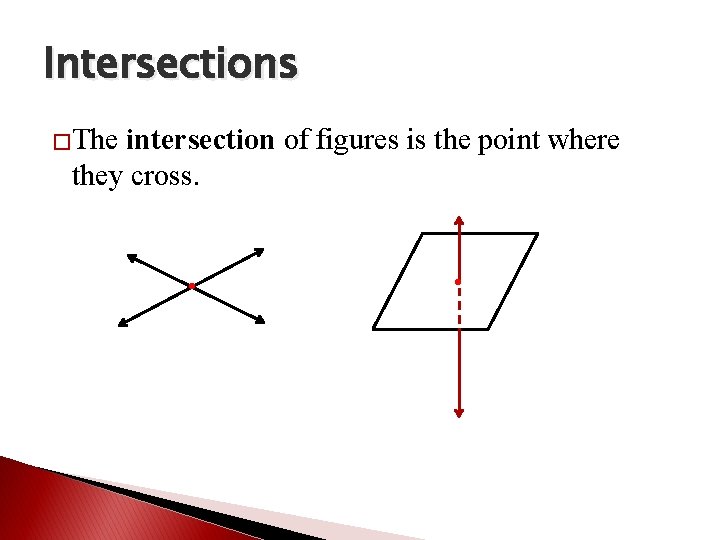
Intersections �The intersection of figures is the point where they cross. • •

Example 1. 2. 3. 4. The points S, P and ___ are collinear. The points S, P and ___ are not collinear. The points S, P, V and ___ are coplanar. The points S, P, V and ___ are not coplanar.
Homework � Page 16 � 10, 11, 12 -14, 15, 16, 19, 20, 27, 28, 33, 34, 37, 40 -45
Lesson 1. 3 Measuring Segments
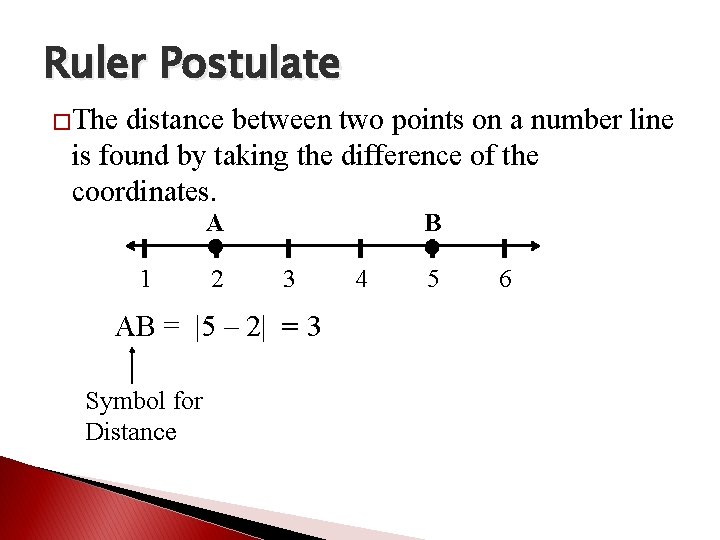
Ruler Postulate �The distance between two points on a number line is found by taking the difference of the coordinates. A 1 2 B 3 AB = |5 – 2| = 3 Symbol for Distance 4 5 6
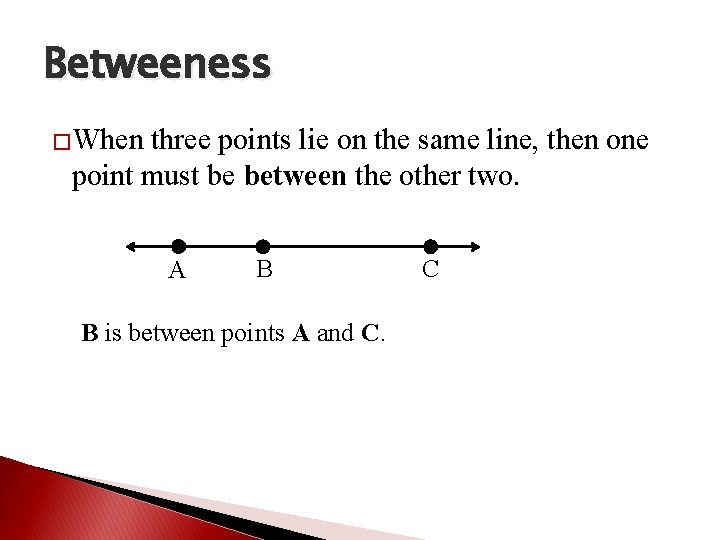
Betweeness �When three points lie on the same line, then one point must be between the other two. A B B is between points A and C. C
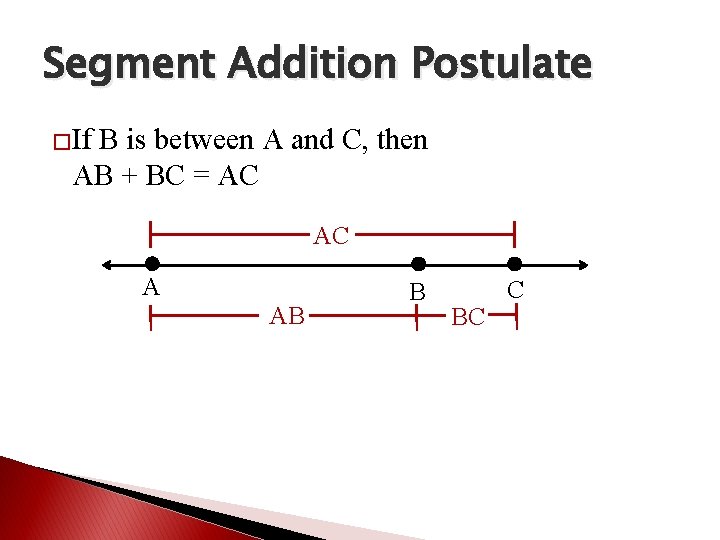
Segment Addition Postulate �If B is between A and C, then AB + BC = AC AC A AB B BC C
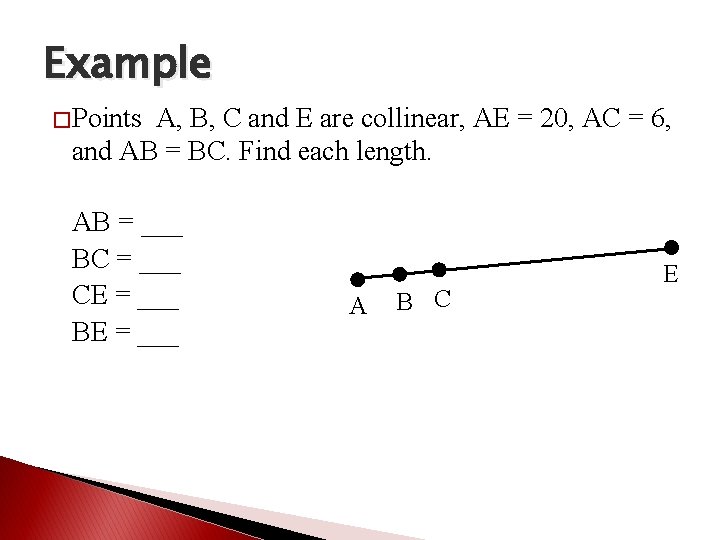
Example � Points A, B, C and E are collinear, AE = 20, AC = 6, and AB = BC. Find each length. AB = ___ BC = ___ CE = ___ BE = ___ A B C E
Example �M is between L and N. Use the Segment Addition Postulate to solve for the variable, then find LM, MN, and LN. LM = 3 x + 8 MN = 2 x – 5 LN = 23
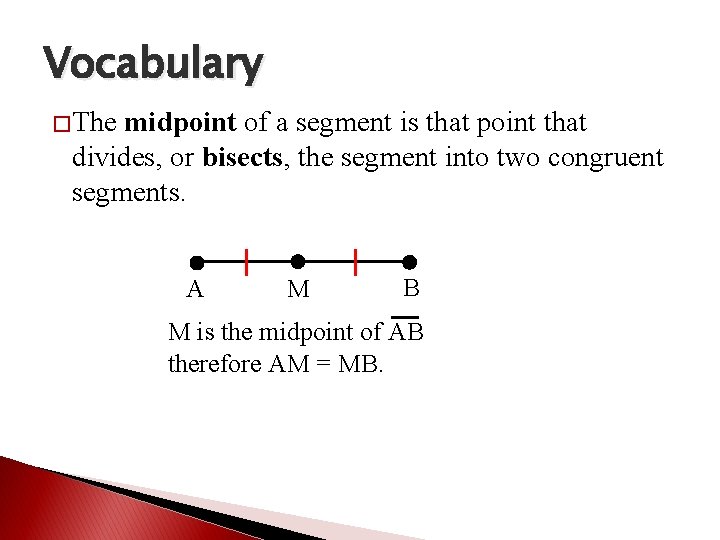
Vocabulary �The midpoint of a segment is that point that divides, or bisects, the segment into two congruent segments. A M B M is the midpoint of AB therefore AM = MB.
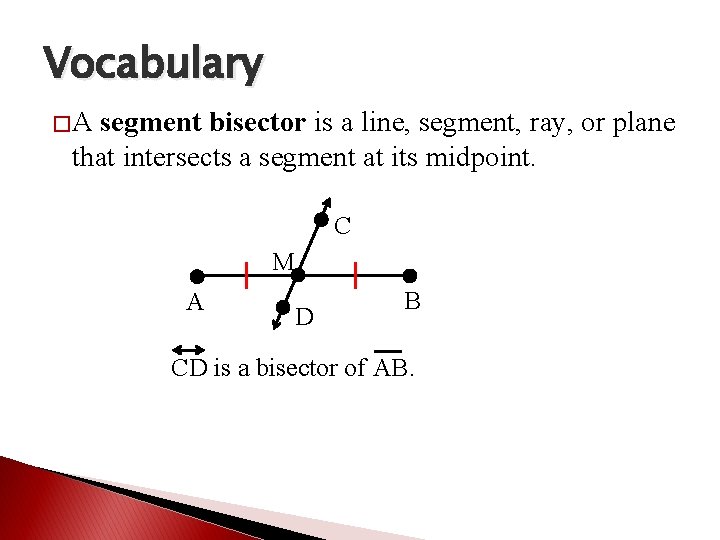
Vocabulary �A segment bisector is a line, segment, ray, or plane that intersects a segment at its midpoint. C M A D B CD is a bisector of AB.
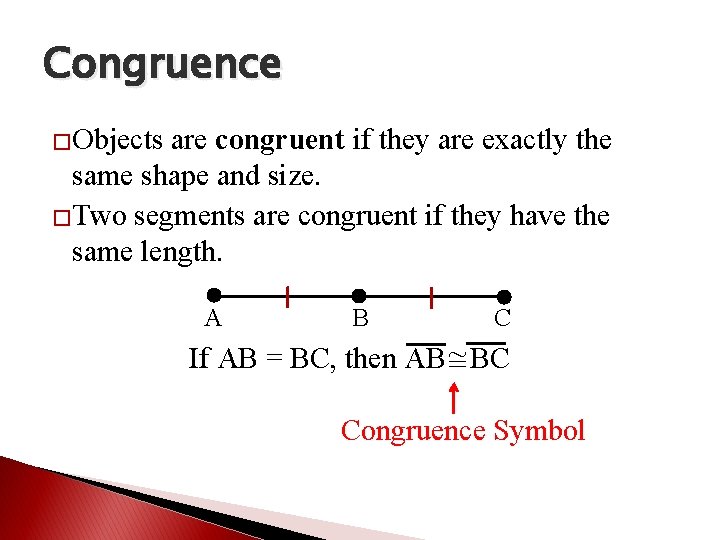
Congruence �Objects are congruent if they are exactly the same shape and size. �Two segments are congruent if they have the same length. A B C If AB = BC, then AB≅BC Congruence Symbol
Homework � Page 24 � 8, 9, 12, 13, 15, 16, 20, 21, 23, 24, 29
Lesson 1. 4 Measuring Angles
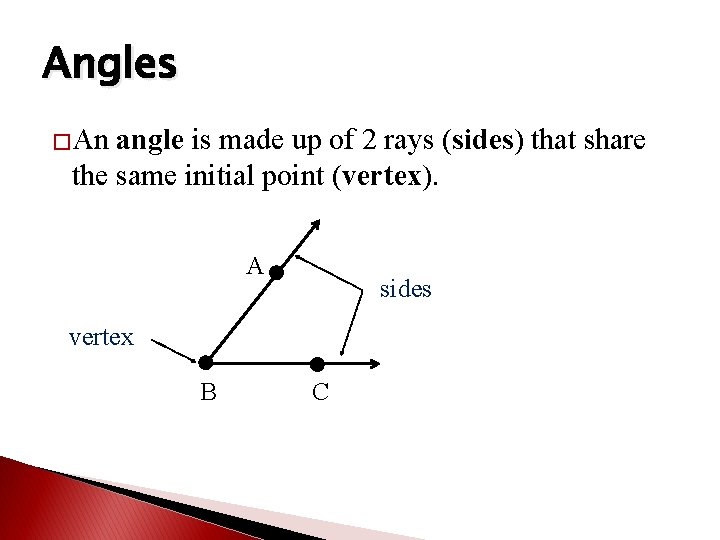
Angles �An angle is made up of 2 rays (sides) that share the same initial point (vertex). A sides vertex B C
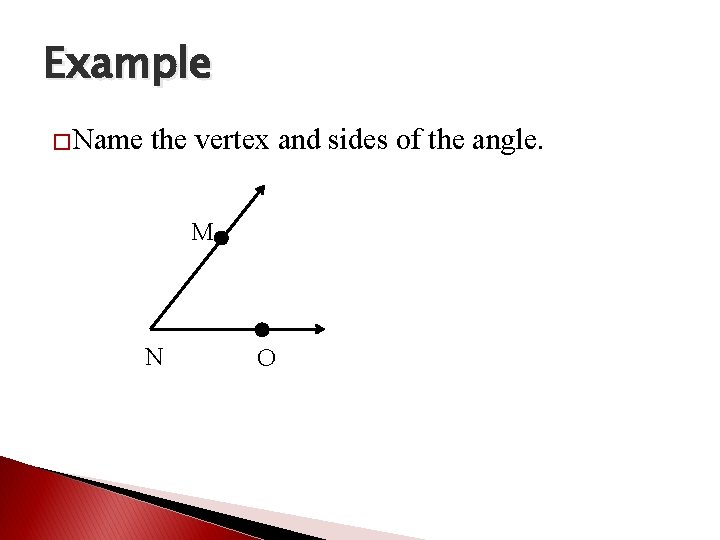
Example �Name the vertex and sides of the angle. M N O
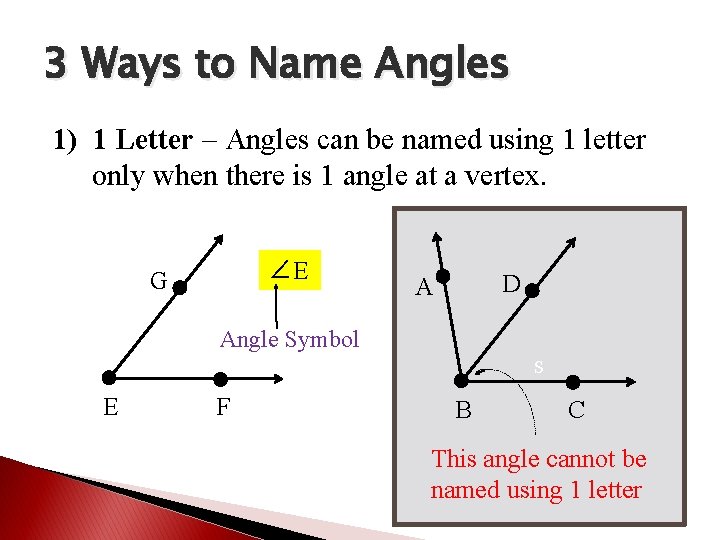
3 Ways to Name Angles 1) 1 Letter – Angles can be named using 1 letter only when there is 1 angle at a vertex. ∠E G D A Angle Symbol S E F B C This angle cannot be named using 1 letter
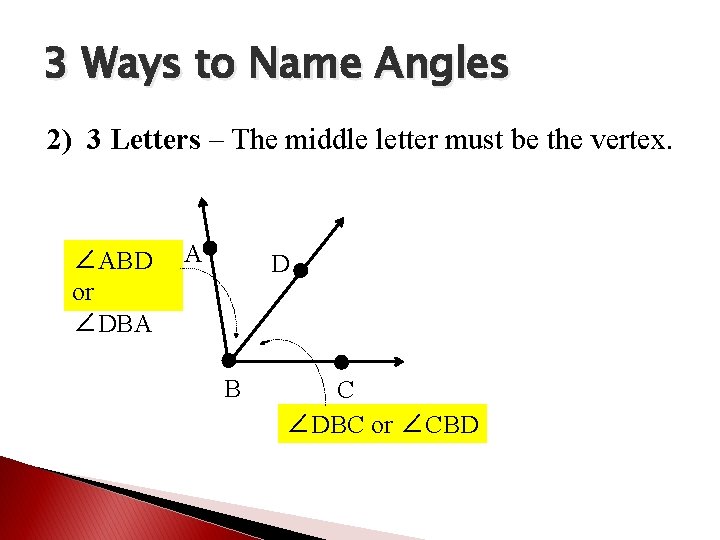
3 Ways to Name Angles 2) 3 Letters – The middle letter must be the vertex. ∠ABD or ∠DBA A D B C ∠DBC or ∠CBD
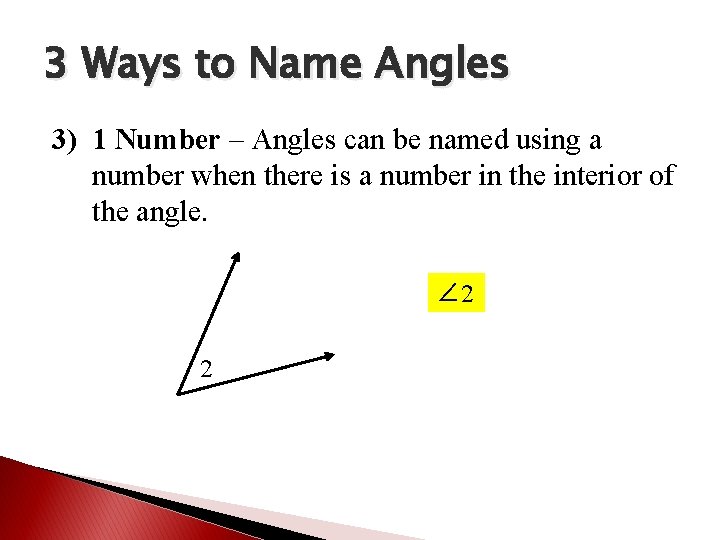
3 Ways to Name Angles 3) 1 Number – Angles can be named using a number when there is a number in the interior of the angle. ∠ 2 2
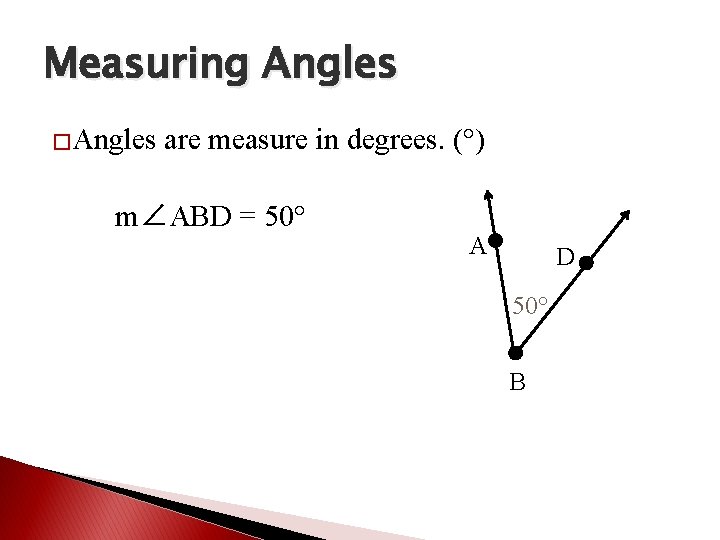
Measuring Angles �Angles are measure in degrees. (°) m∠ABD = 50° A D 50° B
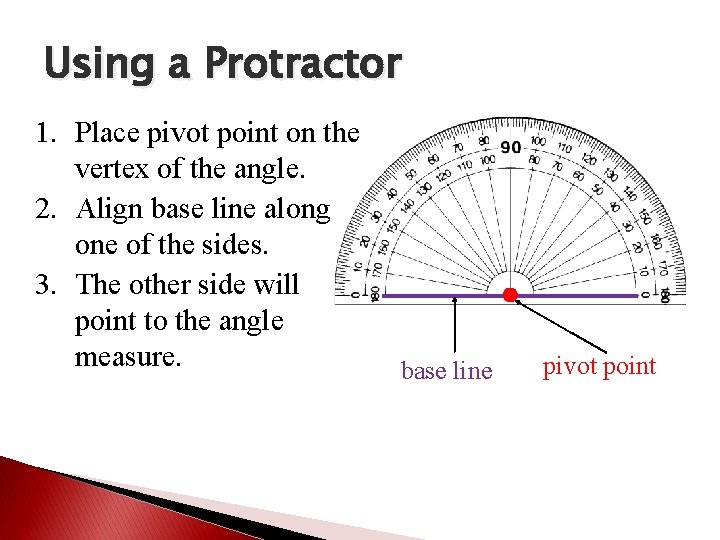
Using a Protractor 1. Place pivot point on the vertex of the angle. 2. Align base line along one of the sides. 3. The other side will point to the angle measure. base line pivot point
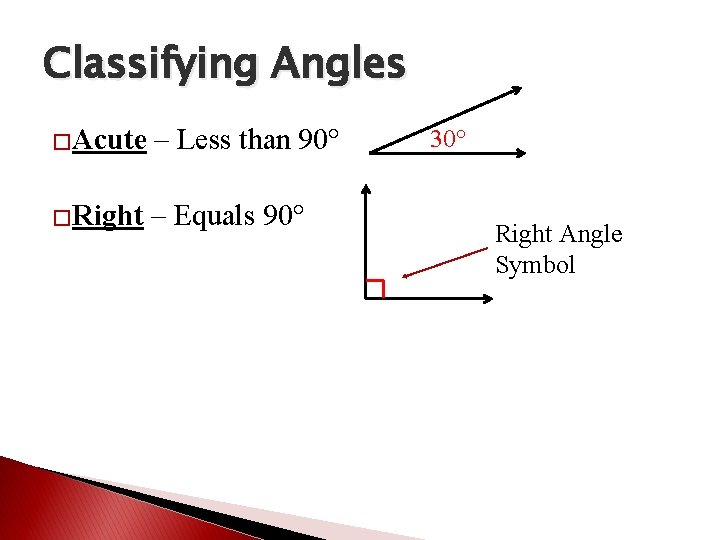
Classifying Angles �Acute – Less than 90° �Right – Equals 90° 30° Right Angle Symbol
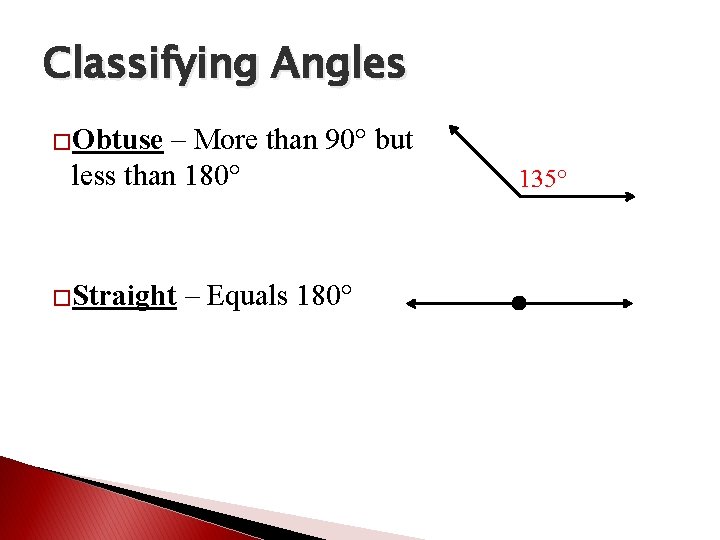
Classifying Angles �Obtuse – More than 90° but less than 180° �Straight – Equals 180° 135°
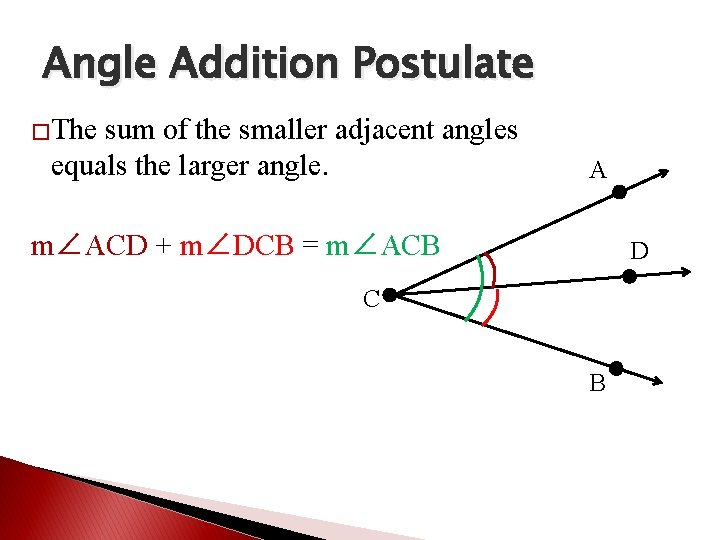
Angle Addition Postulate �The sum of the smaller adjacent angles equals the larger angle. A m∠ACD + m∠DCB = m∠ACB D C B
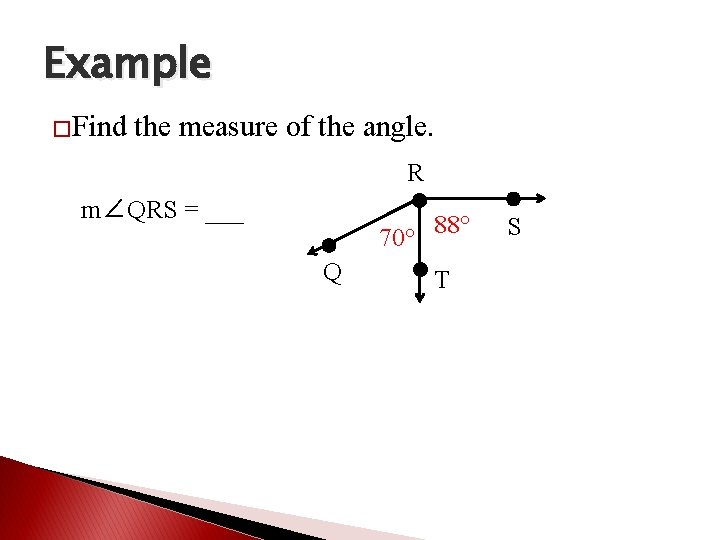
Example �Find the measure of the angle. R m∠QRS = ___ 70° Q 88° T S
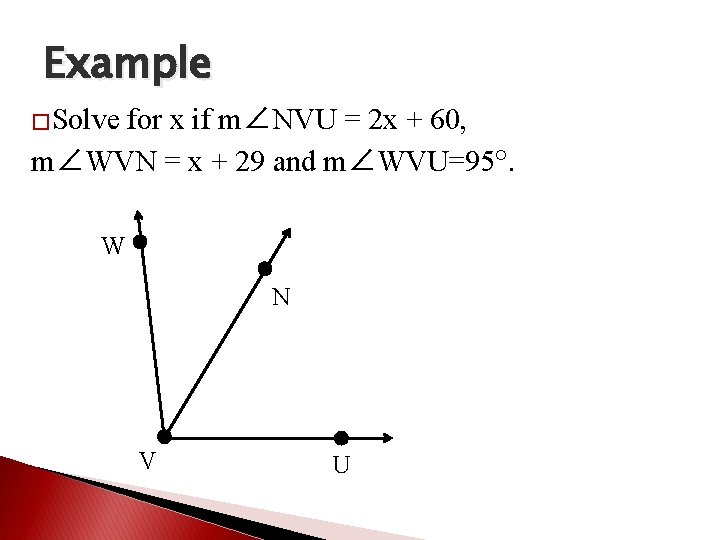
Example �Solve for x if m∠NVU = 2 x + 60, m∠WVN = x + 29 and m∠WVU=95°. W N V U
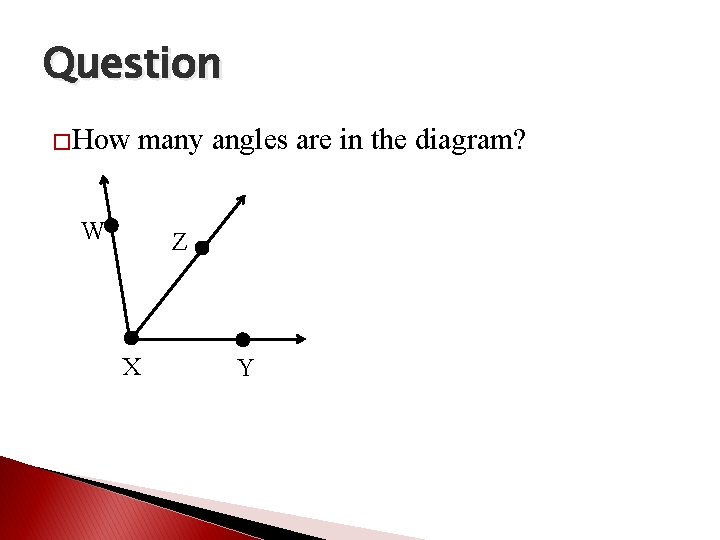
Question �How many angles are in the diagram? W Z X Y
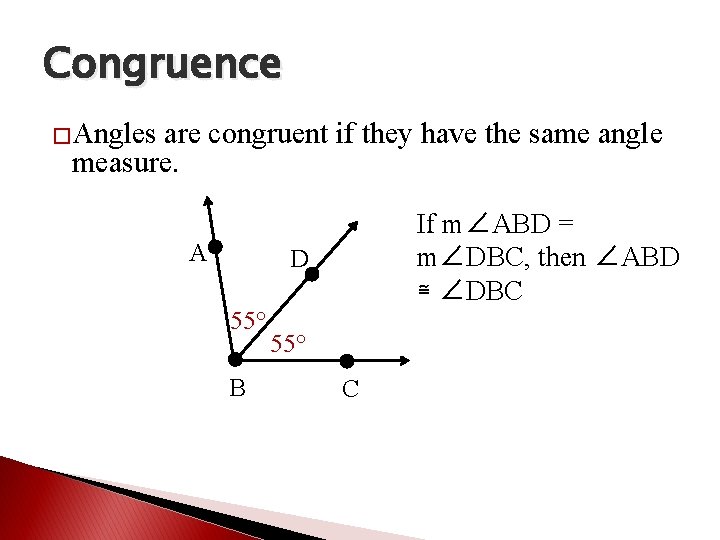
Congruence �Angles are congruent if they have the same angle measure. A If m∠ABD = m∠DBC, then ∠ABD ≅ ∠DBC D 55° B 55° C
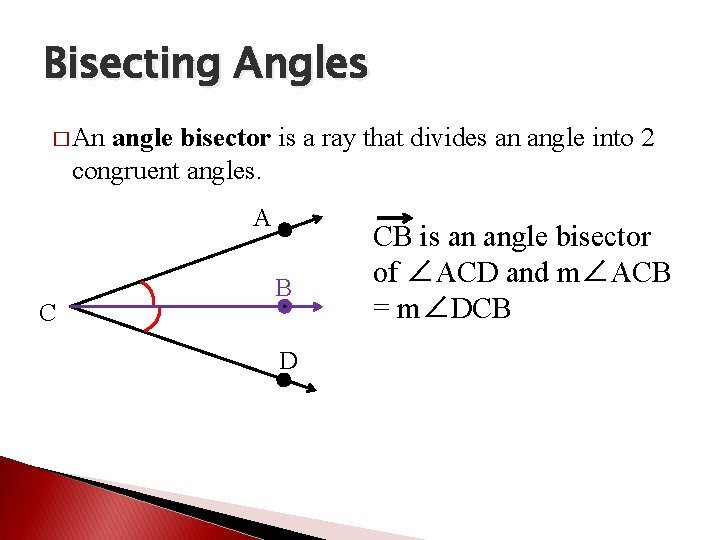
Bisecting Angles � An angle bisector is a ray that divides an angle into 2 congruent angles. A C B D CB is an angle bisector of ∠ACD and m∠ACB = m∠DCB
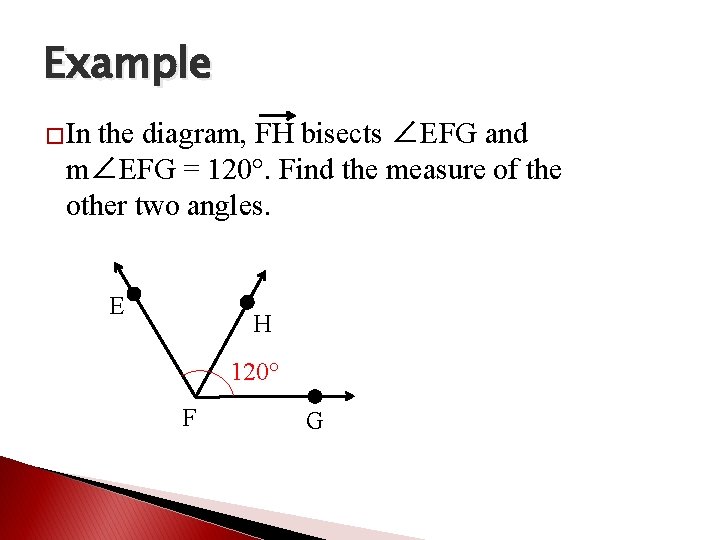
Example �In the diagram, FH bisects ∠EFG and m∠EFG = 120°. Find the measure of the other two angles. E H 120° F G
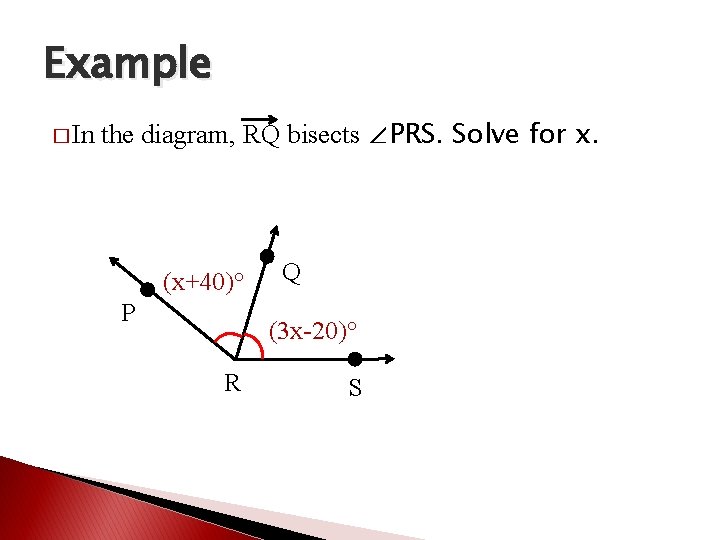
Example � In the diagram, RQ bisects ∠PRS. Solve for x. (x+40)° P Q (3 x-20)° R S
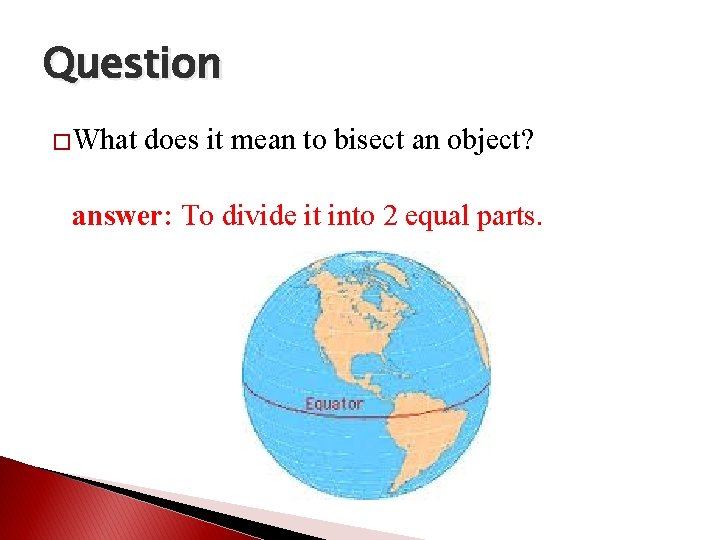
Question �What does it mean to bisect an object? answer: To divide it into 2 equal parts.
Homework � Page 31 � 7, 8, 9 -21, 22 -30 (24 -27 in class with protractor)
Lesson 1. 5 Exploring Angle Pairs
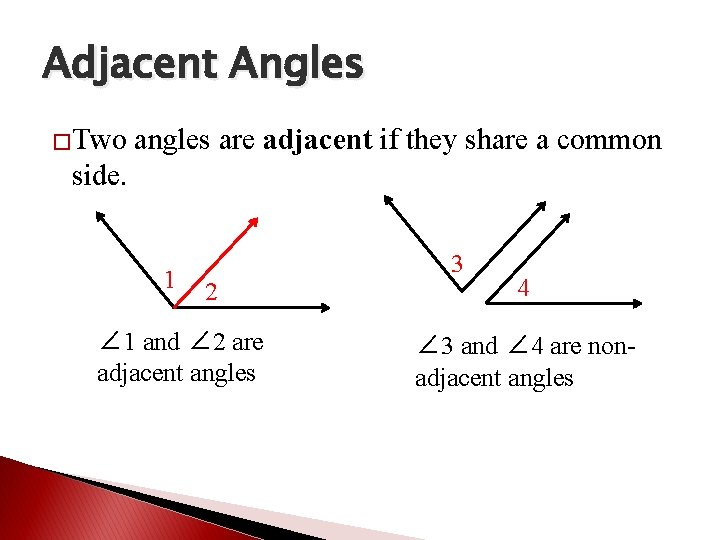
Adjacent Angles �Two angles are adjacent if they share a common side. 1 2 ∠ 1 and ∠ 2 are adjacent angles 3 4 ∠ 3 and ∠ 4 are nonadjacent angles
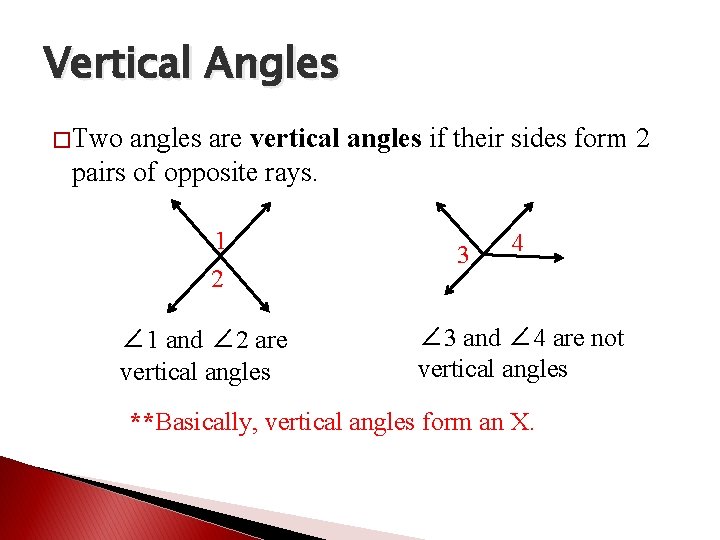
Vertical Angles � Two angles are vertical angles if their sides form 2 pairs of opposite rays. 1 2 ∠ 1 and ∠ 2 are vertical angles 3 4 ∠ 3 and ∠ 4 are not vertical angles **Basically, vertical angles form an X.
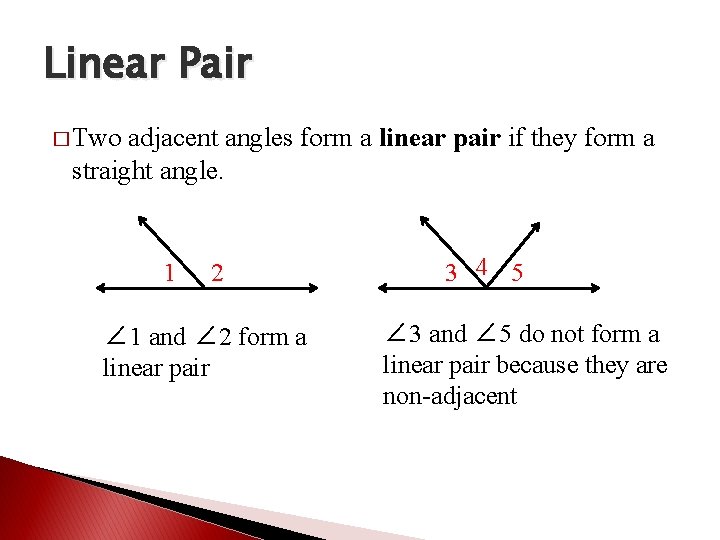
Linear Pair � Two adjacent angles form a linear pair if they form a straight angle. 1 2 ∠ 1 and ∠ 2 form a linear pair 3 4 5 ∠ 3 and ∠ 5 do not form a linear pair because they are non-adjacent
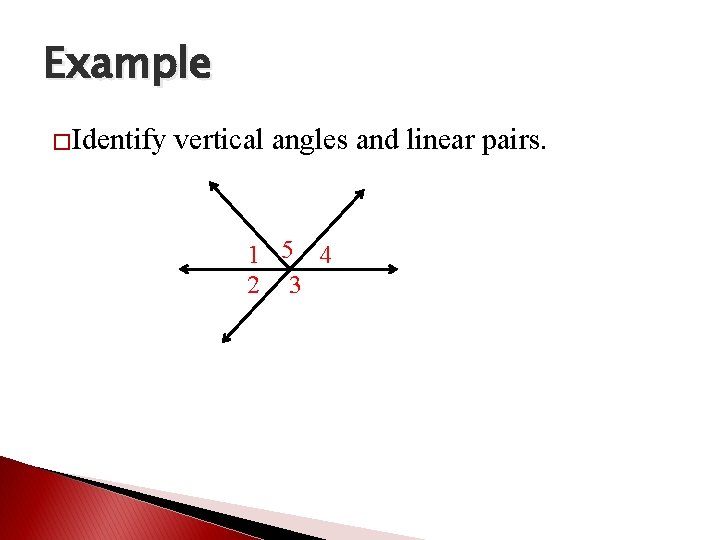
Example �Identify vertical angles and linear pairs. 1 5 4 2 3
2 Important Rules 1. The measures of two vertical angles are always equal 2. The measures of the angles of a linear pair always add up to 180°
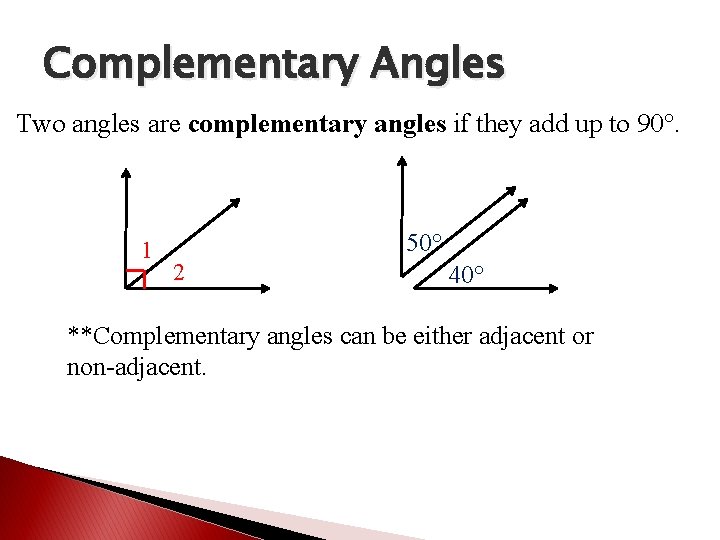
Complementary Angles Two angles are complementary angles if they add up to 90°. 1 50° 2 40° **Complementary angles can be either adjacent or non-adjacent.
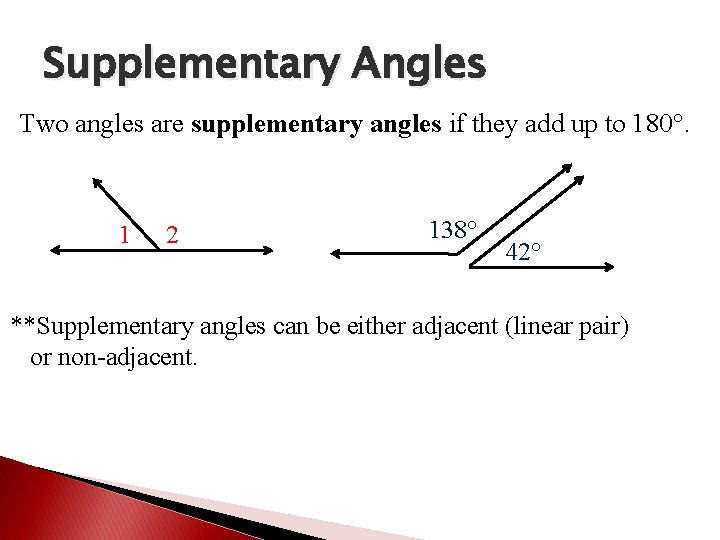
Supplementary Angles Two angles are supplementary angles if they add up to 180°. 1 2 138° 42° **Supplementary angles can be either adjacent (linear pair) or non-adjacent.
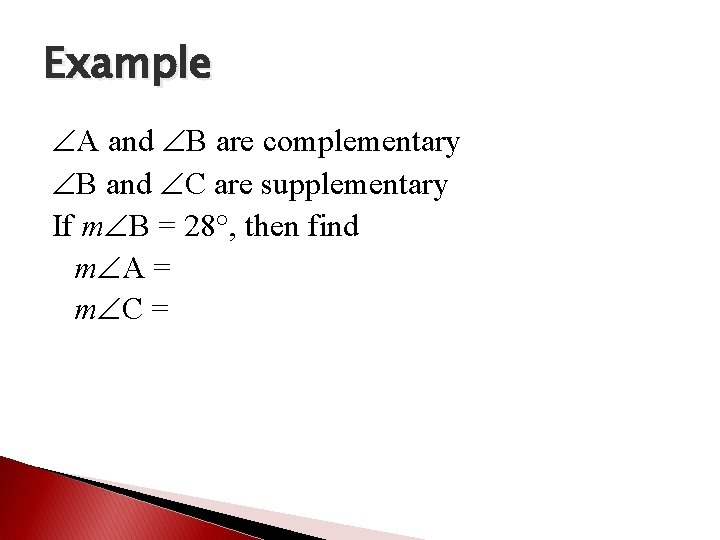
Example A and B are complementary B and C are supplementary If m B = 28°, then find m A = m C =
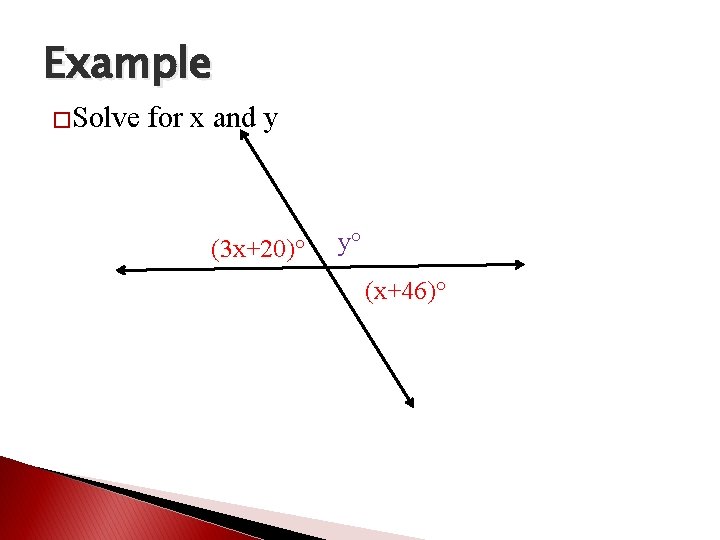
Example �Solve for x and y (3 x+20)° y° (x+46)°
Homework � Page 38 � 7 -25, 31 -37
Lesson 1. 7 Midpoint and Distance Formula in the Coordinate Plane
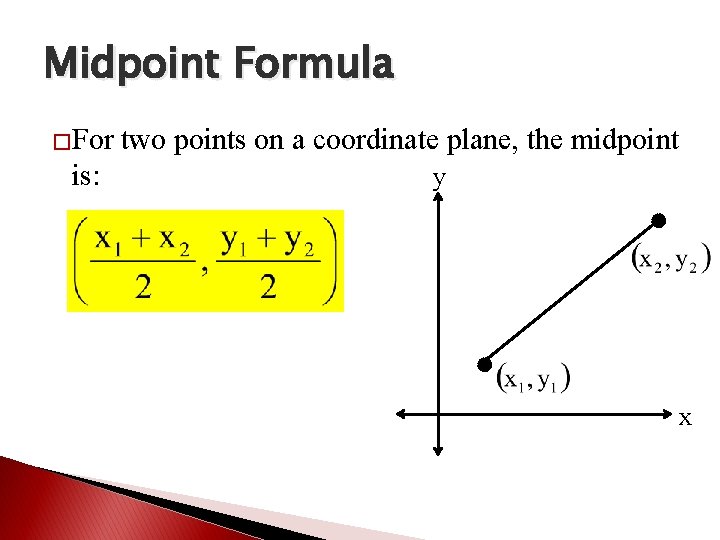
Midpoint Formula �For is: two points on a coordinate plane, the midpoint y x
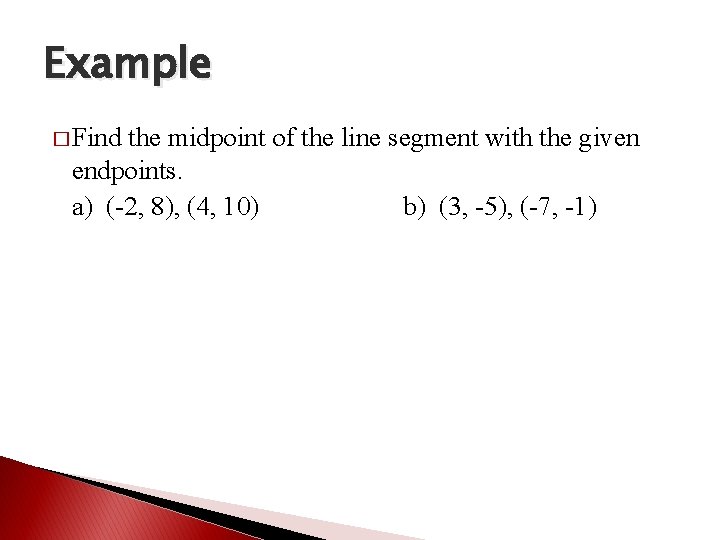
Example � Find the midpoint of the line segment with the given endpoints. a) (-2, 8), (4, 10) b) (3, -5), (-7, -1)
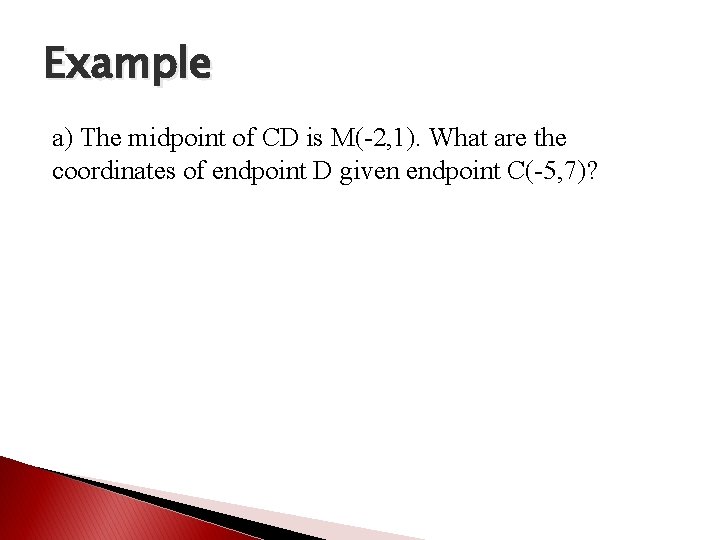
Example a) The midpoint of CD is M(-2, 1). What are the coordinates of endpoint D given endpoint C(-5, 7)?
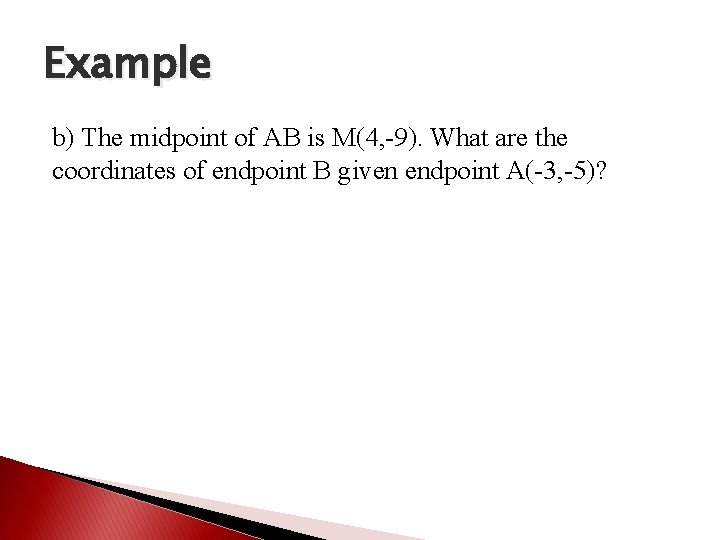
Example b) The midpoint of AB is M(4, -9). What are the coordinates of endpoint B given endpoint A(-3, -5)?
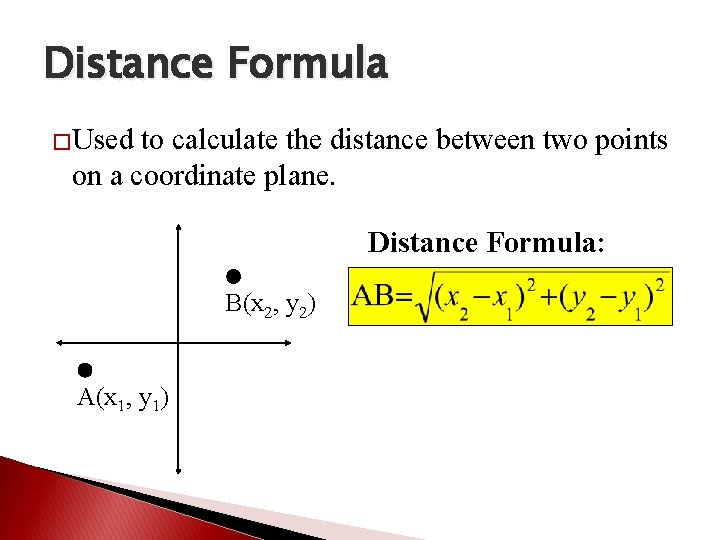
Distance Formula �Used to calculate the distance between two points on a coordinate plane. Distance Formula: B(x 2, y 2) A(x 1, y 1)
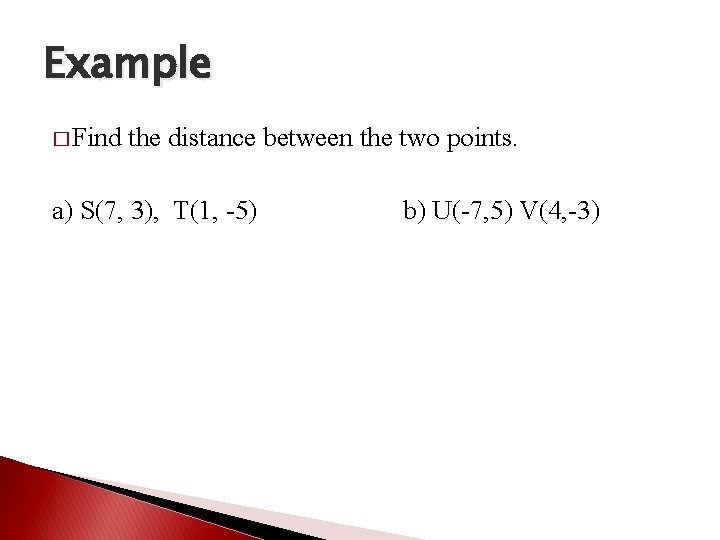
Example � Find the distance between the two points. a) S(7, 3), T(1, -5) b) U(-7, 5) V(4, -3)
Homework � Page 54 � 10 -13, 17, 19, 22 -24, 34
- Slides: 62