
Chapter 1 Basic Physics for Nuclear Medicine Slide
Chapter 1: Basic Physics for Nuclear Medicine Slide set of 101 slides based on the chapter authored by E. B. PODGORSAK, A. L. KESNER, P. S. SONI of the IAEA publication (ISBN 978– 92– 0– 143810– 2): Nuclear Medicine Physics: A Handbook for Teachers and Students Objective: To familiarize the student with the fundamental concepts of Physics for Nuclear Medicine Slide set prepared in 2015 by J. Schwartz (New York, NY, USA) IAEA International Atomic Energy Agency
CHAPTER 1 1. 1. 1. 2. 1. 3. 1. 4. 1. 5. 1. 6. TABLE OF CONTENTS Introduction Basic Definitions for Atomic Structure Basic Definitions for Nuclear Structure Radioactivity Electron Interactions With Matter Photon Interactions With Matter IAEA Nuclear Medicine Physics: A Handbook for Teachers and Students – Chapter 1 – Slide 2/101

1. 1 INTRODUCTION 1. 1. 1 Fundamental physical constants q Avogadro’s number: NA = 6. 022 × 1023 atoms/mol q Speed of light in vacuum: c ≈ 3 × 10⁸ m/s q Electron charge: e = 1. 602 × 10– 19 C q Electron/positron rest mass: me = 0. 511 Me. V/c 2 q Proton rest mass: mp = 938. 3 Me. V/c 2 q Neutron rest mass: mn = 939. 6 Me. V/c 2 IAEA Nuclear Medicine Physics: A Handbook for Teachers and Students – Chapter 1 – Slide 3/101
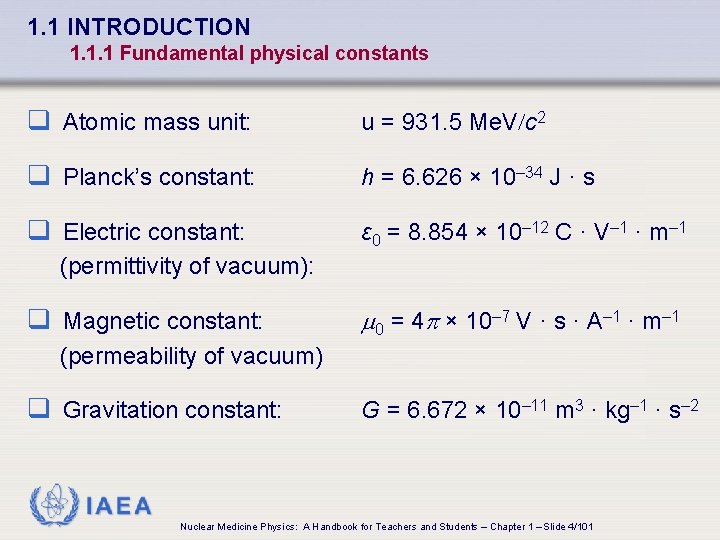
1. 1 INTRODUCTION 1. 1. 1 Fundamental physical constants q Atomic mass unit: u = 931. 5 Me. V/c 2 q Planck’s constant: h = 6. 626 × 10– 34 J · s q Electric constant: ε 0 = 8. 854 × 10– 12 C · V– 1 · m– 1 (permittivity of vacuum): q Magnetic constant: 0 = 4 p × 10– 7 V · s · A– 1 · m– 1 (permeability of vacuum) q Gravitation constant: G = 6. 672 × 10– 11 m 3 · kg– 1 · s– 2 IAEA Nuclear Medicine Physics: A Handbook for Teachers and Students – Chapter 1 – Slide 4/101
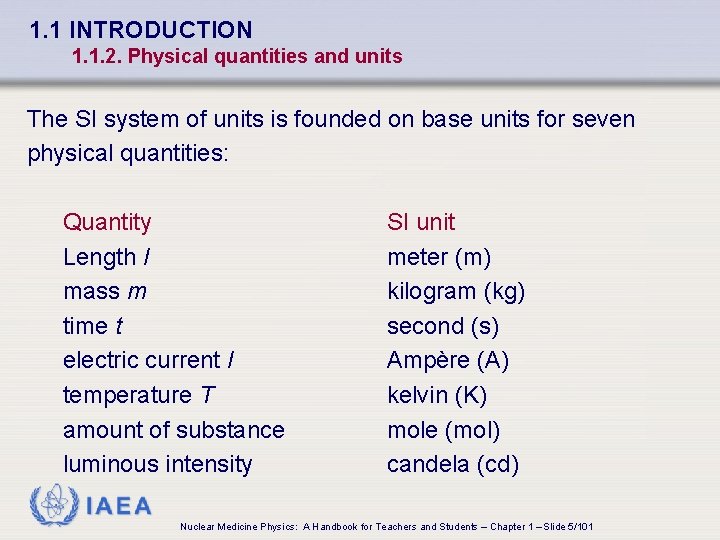
1. 1 INTRODUCTION 1. 1. 2. Physical quantities and units The SI system of units is founded on base units for seven physical quantities: Quantity Length l mass m time t electric current I temperature T amount of substance luminous intensity SI unit meter (m) kilogram (kg) second (s) Ampère (A) kelvin (K) mole (mol) candela (cd) IAEA Nuclear Medicine Physics: A Handbook for Teachers and Students – Chapter 1 – Slide 5/101
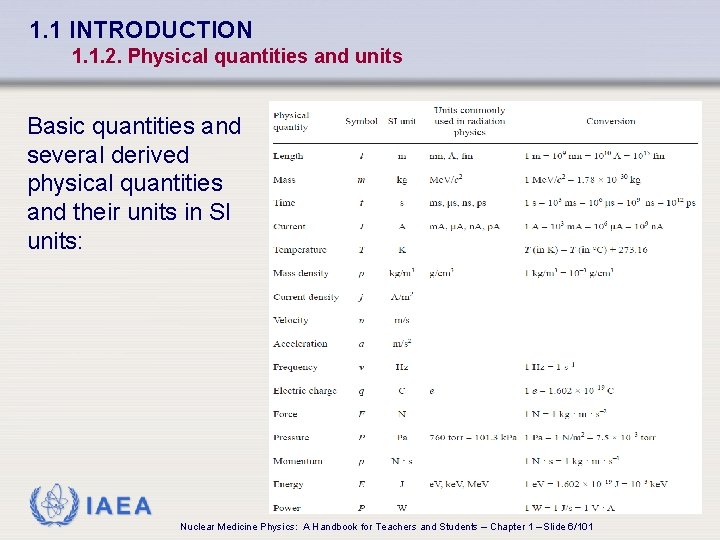
1. 1 INTRODUCTION 1. 1. 2. Physical quantities and units Basic quantities and several derived physical quantities and their units in SI units: IAEA Nuclear Medicine Physics: A Handbook for Teachers and Students – Chapter 1 – Slide 6/101
1. 1 INTRODUCTION 1. 1. 4. Classification of ionizing radiation q Ionizing radiation carries enough energy per quantum to remove an electron from an atom or molecule • Introduces reactive and potentially damaging ion into the environment of the irradiated medium • Can be categorized into two types: • Directly ionizing radiation • Indirectly ionizing radiation • Both can traverse human tissue • Can be used in medicine for imaging & therapy IAEA Nuclear Medicine Physics: A Handbook for Teachers and Students – Chapter 1 – Slide 7/101
1. 1 INTRODUCTION 1. 1. 5. Classification of indirectly ionizing photon radiation q Consists of three main categories: • Ultraviolet: limited use in medicine • X ray: used in disease imaging and/or treatment • Emitted by orbital or accelerated electrons • ray: used in disease imaging and/or treatment • Emitted by the nucleus or particle decays • Difference between X and rays is based on the radiation’s origin q The origin of these photons fall into 4 categories: • • Characteristic (fluorescence) X rays Bremsstrahlung X rays From nuclear transitions Annihilation quanta IAEA Nuclear Medicine Physics: A Handbook for Teachers and Students – Chapter 1 – Slide 8/101
1. 1 INTRODUCTION 1. 1. 6. Characteristic X rays q Orbital electrons inhabit atom’s minimal energy state q An ionization or excitation process leads to an open vacancy q An outer shell electron transitions to fill vacancy (~nsec) q Liberated energy may be in the form of: • Characteristic photon (fluorescence) • Energy = initial state binding energy - final state binding energy • Photon energy is characteristic of the atom • Transferred to orbital electron that • Emitted with kinetic energy = transition energy - binding energy • Called an Auger electron IAEA Nuclear Medicine Physics: A Handbook for Teachers and Students – Chapter 1 – Slide 9/101
1. 1 INTRODUCTION 1. 1. 7. Bremsstrahlung q Translated from German as 'breaking radiation' q Light charged particles (b- & b+) slowed down by interactions with other charged particles in matter (e. g. atomic nuclei) q Kinetic energy loss converted to electromagnetic radiation q Bremsstrahlung energy spectrum • Non-discrete (i. e. continuous) • Ranges: zero - kinetic energy of initial charged particle q Central to modern imaging and therapeutic technology • Can be used to produce X rays from an electrical energy source IAEA Nuclear Medicine Physics: A Handbook for Teachers and Students – Chapter 1 – Slide 10/101
1. 1 INTRODUCTION 1. 1. 8. Gamma rays q Nuclear reaction or spontaneous nuclear decay may leave product (daughter) nucleus in excited state q The nucleus can transition to a more stable state by emitting a ray q Emitted photon energy is characteristic of nuclear energy transition q ray energy typically > 100 ke. V & wavelengths < 0. 1 Å IAEA Nuclear Medicine Physics: A Handbook for Teachers and Students – Chapter 1 – Slide 11/101
1. 1 INTRODUCTION 1. 1. 9. Annihilation quanta q Positron results from: • b+ nuclear decay • high energy photon interacts with nucleus or orbital electron electric field q Positron kinetic energy (EK) loss in absorber medium by Coulomb interactions: • Collisional loss when interaction is with orbital electron • Radiation loss (bremsstrahlung) when interaction is with the nucleus • Final collision (after all EK lost) with orbital electron (due to Coulomb attraction) called positron annihilation IAEA Nuclear Medicine Physics: A Handbook for Teachers and Students – Chapter 1 – Slide 12/101
1. 1 INTRODUCTION 1. 1. 9. Annihilation quanta q During annihilation • • Positron & electron disappear Replaced by 2 oppositely directed annihilation quanta (photons) Each has energy = 0. 511 Me. V Conservation laws obeyed: • Electric charge, linear momentum, angular momentum, total energy q In-flight annihilation • Annihilation can occur while positron still has kinetic energy • 2 quanta emitted • Not of identical energies • Do not necessarily move at 180º IAEA Nuclear Medicine Physics: A Handbook for Teachers and Students – Chapter 1 – Slide 13/101
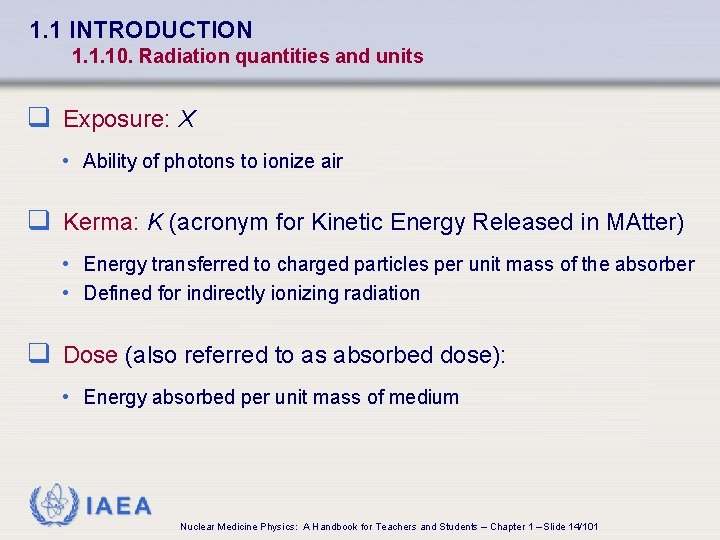
1. 1 INTRODUCTION 1. 1. 10. Radiation quantities and units q Exposure: X • Ability of photons to ionize air q Kerma: K (acronym for Kinetic Energy Released in MAtter) • Energy transferred to charged particles per unit mass of the absorber • Defined for indirectly ionizing radiation q Dose (also referred to as absorbed dose): • Energy absorbed per unit mass of medium IAEA Nuclear Medicine Physics: A Handbook for Teachers and Students – Chapter 1 – Slide 14/101
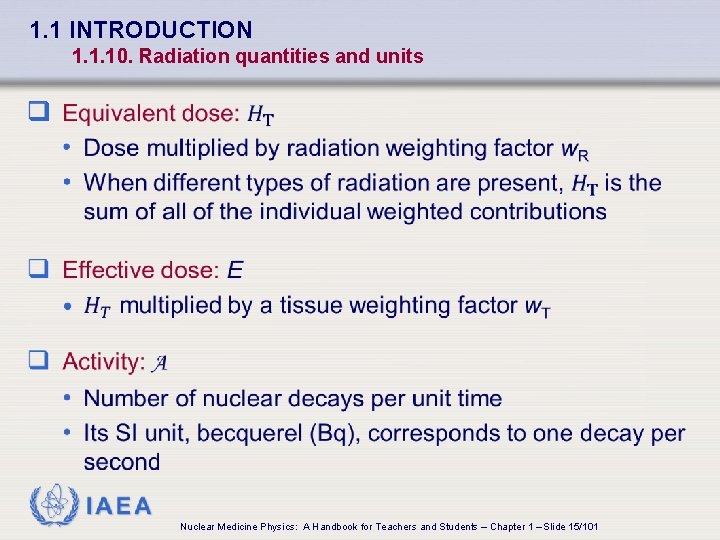
1. 1 INTRODUCTION 1. 1. 10. Radiation quantities and units q IAEA Nuclear Medicine Physics: A Handbook for Teachers and Students – Chapter 1 – Slide 15/101
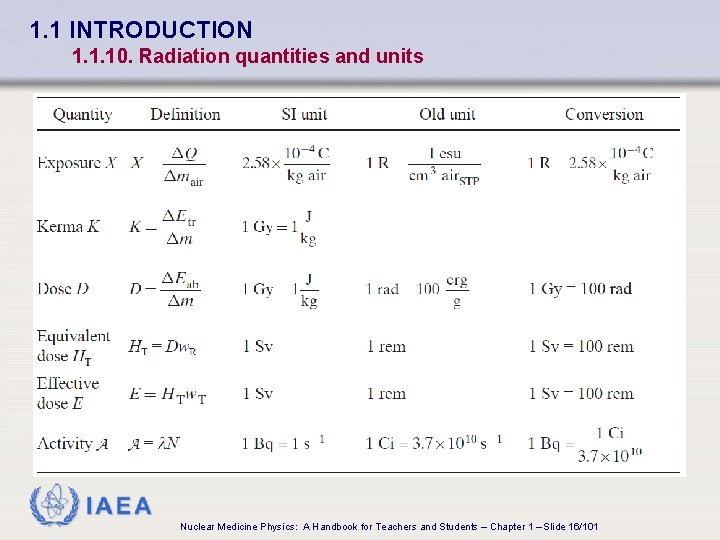
1. 1 INTRODUCTION 1. 1. 10. Radiation quantities and units IAEA Nuclear Medicine Physics: A Handbook for Teachers and Students – Chapter 1 – Slide 16/101
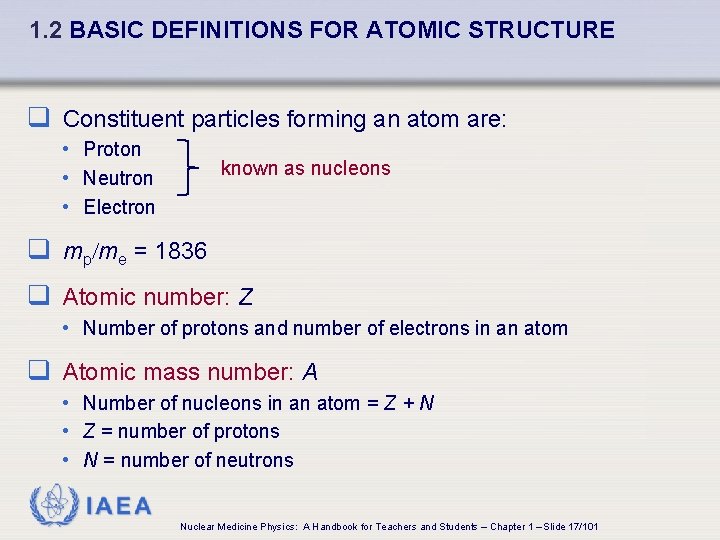
1. 2 BASIC DEFINITIONS FOR ATOMIC STRUCTURE q Constituent particles forming an atom are: • Proton • Neutron • Electron known as nucleons q mp/me = 1836 q Atomic number: Z • Number of protons and number of electrons in an atom q Atomic mass number: A • Number of nucleons in an atom = Z + N • Z = number of protons • N = number of neutrons IAEA Nuclear Medicine Physics: A Handbook for Teachers and Students – Chapter 1 – Slide 17/101
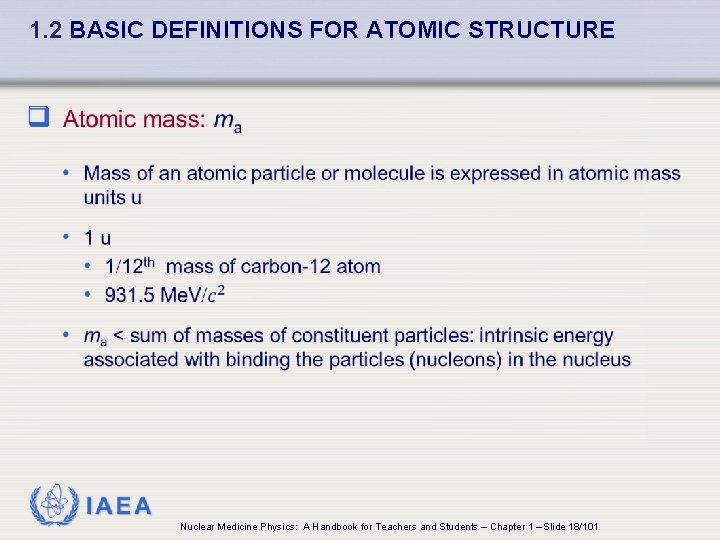
1. 2 BASIC DEFINITIONS FOR ATOMIC STRUCTURE q IAEA Nuclear Medicine Physics: A Handbook for Teachers and Students – Chapter 1 – Slide 18/101
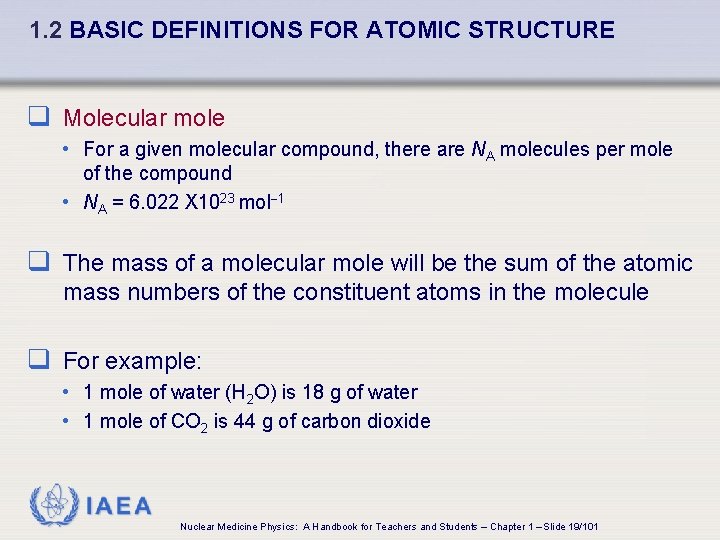
1. 2 BASIC DEFINITIONS FOR ATOMIC STRUCTURE q Molecular mole • For a given molecular compound, there are NA molecules per mole of the compound • NA = 6. 022 X 1023 mol-1 q The mass of a molecular mole will be the sum of the atomic mass numbers of the constituent atoms in the molecule q For example: • 1 mole of water (H 2 O) is 18 g of water • 1 mole of CO 2 is 44 g of carbon dioxide IAEA Nuclear Medicine Physics: A Handbook for Teachers and Students – Chapter 1 – Slide 19/101
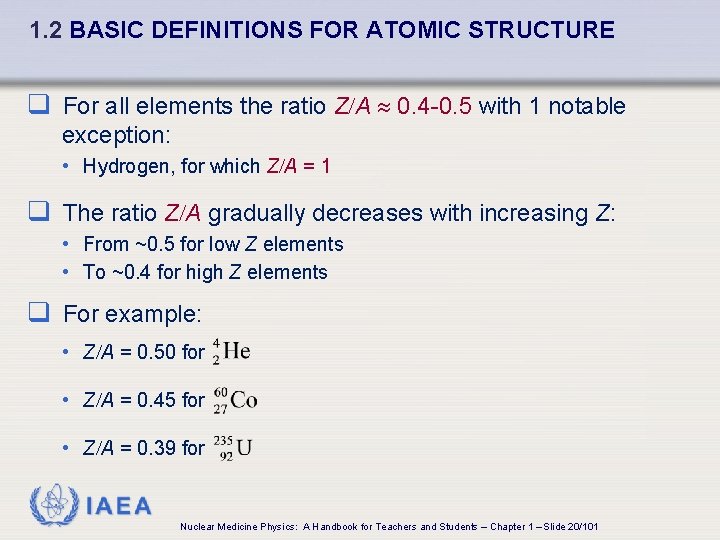
1. 2 BASIC DEFINITIONS FOR ATOMIC STRUCTURE q For all elements the ratio Z/A 0. 4 -0. 5 with 1 notable exception: • Hydrogen, for which Z/A = 1 q The ratio Z/A gradually decreases with increasing Z: • From ~0. 5 for low Z elements • To ~0. 4 for high Z elements q For example: • Z/A = 0. 50 for • Z/A = 0. 45 for • Z/A = 0. 39 for IAEA Nuclear Medicine Physics: A Handbook for Teachers and Students – Chapter 1 – Slide 20/101
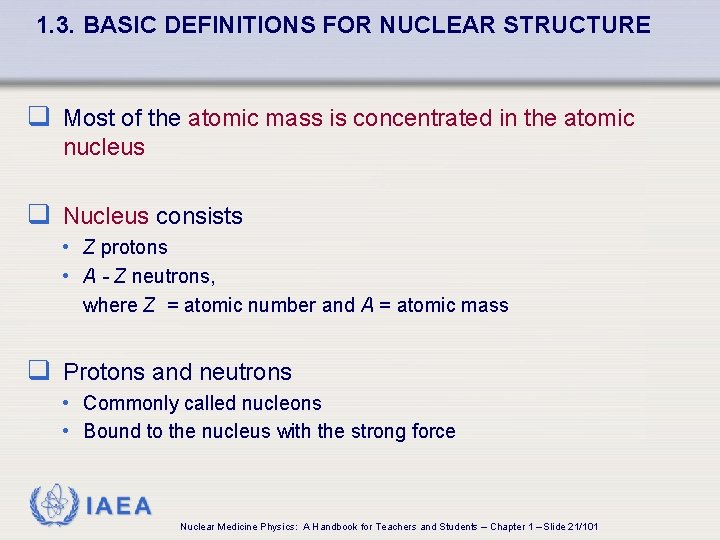
1. 3. BASIC DEFINITIONS FOR NUCLEAR STRUCTURE q Most of the atomic mass is concentrated in the atomic nucleus q Nucleus consists • Z protons • A - Z neutrons, where Z = atomic number and A = atomic mass q Protons and neutrons • Commonly called nucleons • Bound to the nucleus with the strong force IAEA Nuclear Medicine Physics: A Handbook for Teachers and Students – Chapter 1 – Slide 21/101
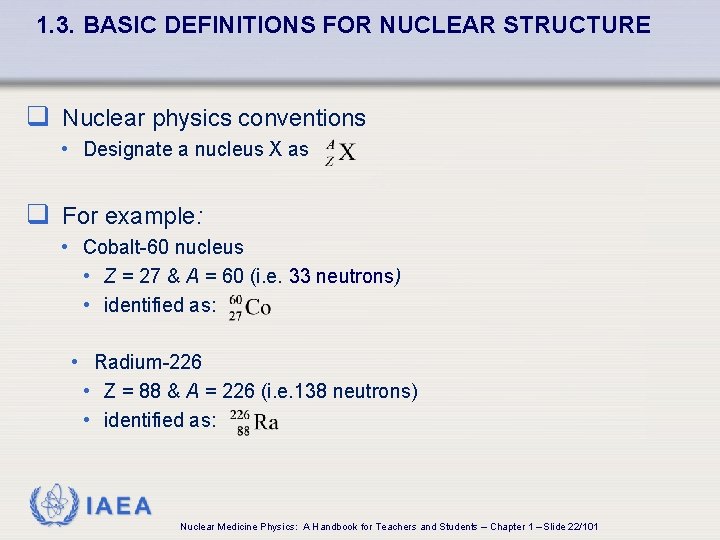
1. 3. BASIC DEFINITIONS FOR NUCLEAR STRUCTURE q Nuclear physics conventions • Designate a nucleus X as q For example: • Cobalt-60 nucleus • Z = 27 & A = 60 (i. e. 33 neutrons) • identified as: • Radium-226 • Z = 88 & A = 226 (i. e. 138 neutrons) • identified as: IAEA Nuclear Medicine Physics: A Handbook for Teachers and Students – Chapter 1 – Slide 22/101
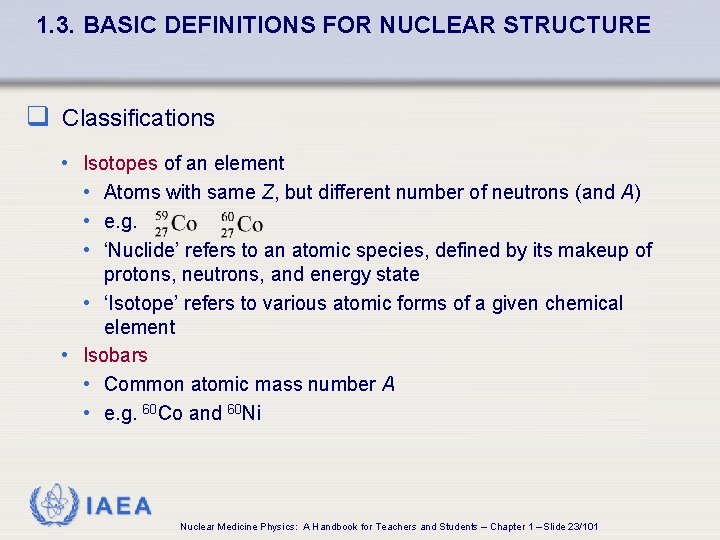
1. 3. BASIC DEFINITIONS FOR NUCLEAR STRUCTURE q Classifications • Isotopes of an element • Atoms with same Z, but different number of neutrons (and A) • e. g. • ‘Nuclide’ refers to an atomic species, defined by its makeup of protons, neutrons, and energy state • ‘Isotope’ refers to various atomic forms of a given chemical element • Isobars • Common atomic mass number A • e. g. 60 Co and 60 Ni IAEA Nuclear Medicine Physics: A Handbook for Teachers and Students – Chapter 1 – Slide 23/101
1. 3. BASIC DEFINITIONS FOR NUCLEAR STRUCTURE q Classifications • Isotones • Common number of neutrons • e. g. 3 H (tritium) and 4 He • Isomeric (metastable) state • Excited nuclear state that exists for some time • e. g 99 m. Tc is an isomeric state of 99 Tc IAEA Nuclear Medicine Physics: A Handbook for Teachers and Students – Chapter 1 – Slide 24/101
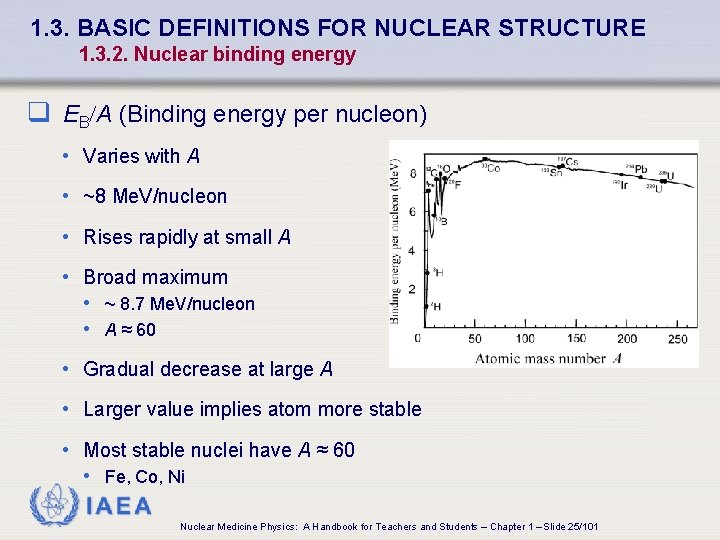
1. 3. BASIC DEFINITIONS FOR NUCLEAR STRUCTURE 1. 3. 2. Nuclear binding energy q EB/A (Binding energy per nucleon) • Varies with A • ~8 Me. V/nucleon • Rises rapidly at small A • Broad maximum • ~ 8. 7 Me. V/nucleon • A ≈ 60 • Gradual decrease at large A • Larger value implies atom more stable • Most stable nuclei have A ≈ 60 • Fe, Co, Ni IAEA Nuclear Medicine Physics: A Handbook for Teachers and Students – Chapter 1 – Slide 25/101
1. 3. BASIC DEFINITIONS FOR NUCLEAR STRUCTURE 1. 3. 3. Nuclear fusion and fission q EB/A vs. A curve suggests 2 methods for mass to energy conversion: 1) Fusion of low A nuclei • Creates a more massive nucleus • Releases energy • Presently, controlled fusion for energy production not successful in net energy generation • Remains active field of research 2) Fission of large A nuclei • Bombardment of large mass elements (e. g. 235 U) by thermal neutrons will create 2 more stable nuclei with lower mass • Process transforms some mass into kinetic energy • Fission reactors are important means of production of electrical power IAEA Nuclear Medicine Physics: A Handbook for Teachers and Students – Chapter 1 – Slide 26/101
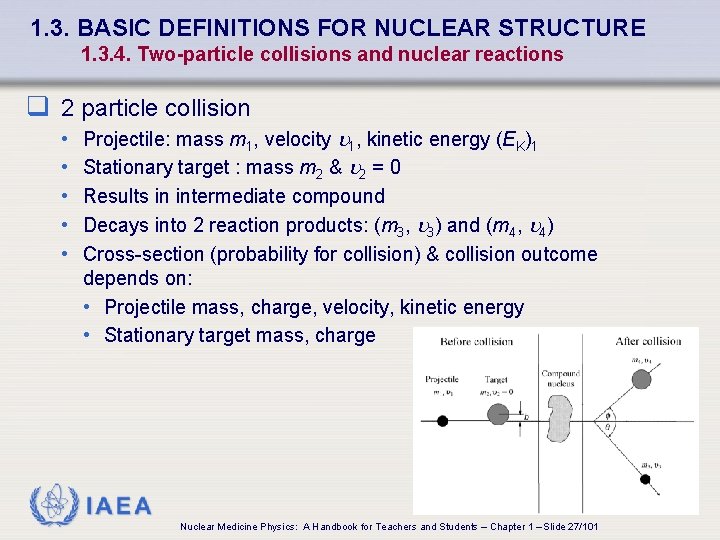
1. 3. BASIC DEFINITIONS FOR NUCLEAR STRUCTURE 1. 3. 4. Two-particle collisions and nuclear reactions q 2 particle collision • • • Projectile: mass m 1, velocity 1, kinetic energy (EK)1 Stationary target : mass m 2 & 2 = 0 Results in intermediate compound Decays into 2 reaction products: (m 3, 3) and (m 4, 4) Cross-section (probability for collision) & collision outcome depends on: • Projectile mass, charge, velocity, kinetic energy • Stationary target mass, charge IAEA Nuclear Medicine Physics: A Handbook for Teachers and Students – Chapter 1 – Slide 27/101
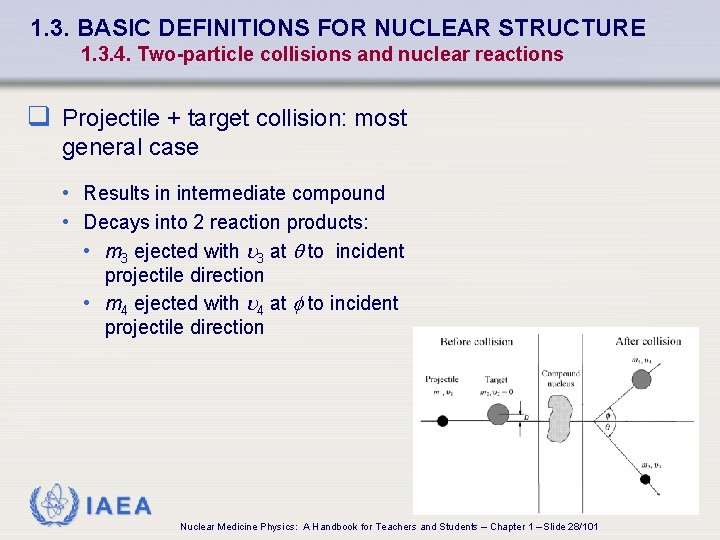
1. 3. BASIC DEFINITIONS FOR NUCLEAR STRUCTURE 1. 3. 4. Two-particle collisions and nuclear reactions q Projectile + target collision: most general case • Results in intermediate compound • Decays into 2 reaction products: • m 3 ejected with 3 at q to incident projectile direction • m 4 ejected with 4 at f to incident projectile direction IAEA Nuclear Medicine Physics: A Handbook for Teachers and Students – Chapter 1 – Slide 28/101
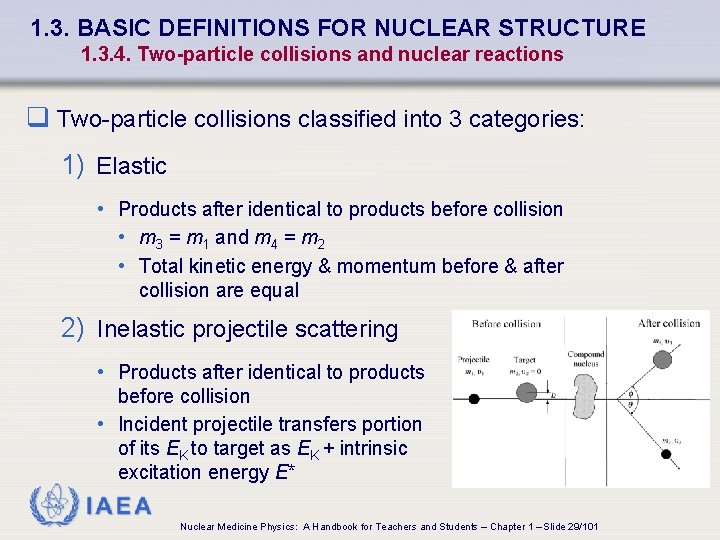
1. 3. BASIC DEFINITIONS FOR NUCLEAR STRUCTURE 1. 3. 4. Two-particle collisions and nuclear reactions q Two-particle collisions classified into 3 categories: 1) Elastic • Products after identical to products before collision • m 3 = m 1 and m 4 = m 2 • Total kinetic energy & momentum before & after collision are equal 2) Inelastic projectile scattering • Products after identical to products before collision • Incident projectile transfers portion of its EK to target as EK + intrinsic excitation energy E* IAEA Nuclear Medicine Physics: A Handbook for Teachers and Students – Chapter 1 – Slide 29/101
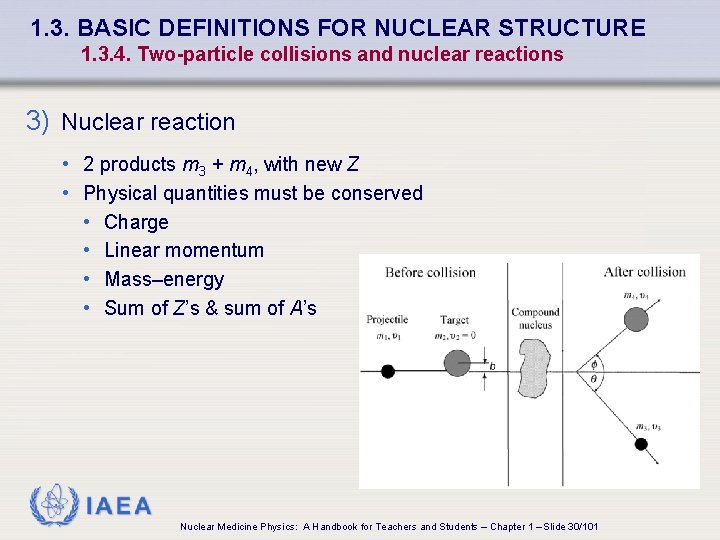
1. 3. BASIC DEFINITIONS FOR NUCLEAR STRUCTURE 1. 3. 4. Two-particle collisions and nuclear reactions 3) Nuclear reaction • 2 products m 3 + m 4, with new Z • Physical quantities must be conserved • Charge • Linear momentum • Mass–energy • Sum of Z’s & sum of A’s IAEA Nuclear Medicine Physics: A Handbook for Teachers and Students – Chapter 1 – Slide 30/101
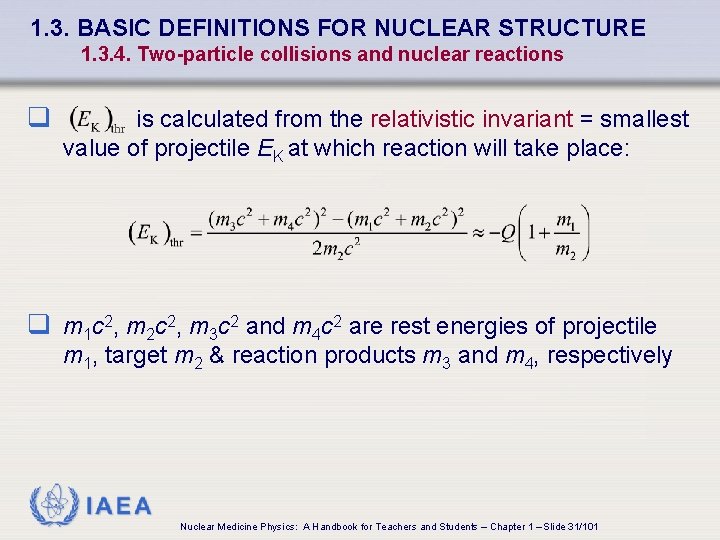
1. 3. BASIC DEFINITIONS FOR NUCLEAR STRUCTURE 1. 3. 4. Two-particle collisions and nuclear reactions q is calculated from the relativistic invariant = smallest value of projectile EK at which reaction will take place: q m 1 c 2, m 2 c 2, m 3 c 2 and m 4 c 2 are rest energies of projectile m 1, target m 2 & reaction products m 3 and m 4, respectively IAEA Nuclear Medicine Physics: A Handbook for Teachers and Students – Chapter 1 – Slide 31/101
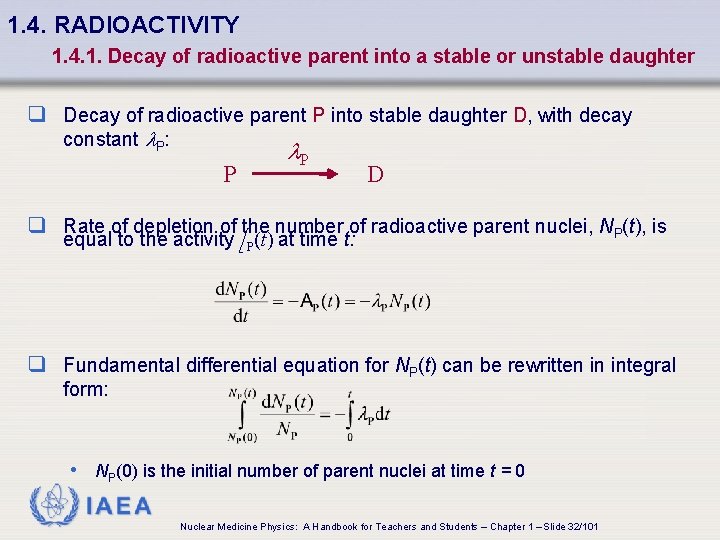
1. 4. RADIOACTIVITY 1. 4. 1. Decay of radioactive parent into a stable or unstable daughter q Decay of radioactive parent P into stable daughter D, with decay constant l. P: P l. P D q Rate of depletion of the number of radioactive parent nuclei, NP(t), is equal to the activity A P(t) at time t: q Fundamental differential equation for NP(t) can be rewritten in integral form: • NP(0) is the initial number of parent nuclei at time t = 0 IAEA Nuclear Medicine Physics: A Handbook for Teachers and Students – Chapter 1 – Slide 32/101
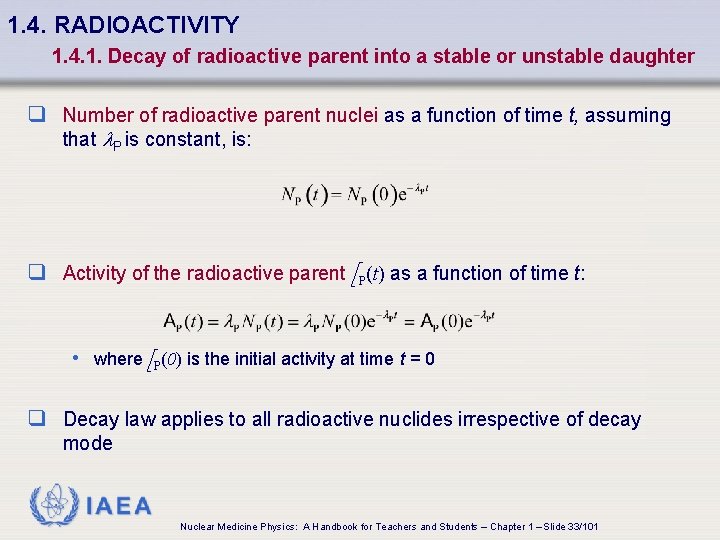
1. 4. RADIOACTIVITY 1. 4. 1. Decay of radioactive parent into a stable or unstable daughter q Number of radioactive parent nuclei as a function of time t, assuming that l. P is constant, is: q Activity of the radioactive parent A P(t) as a function of time t: • where A P(0) is the initial activity at time t = 0 q Decay law applies to all radioactive nuclides irrespective of decay mode IAEA Nuclear Medicine Physics: A Handbook for Teachers and Students – Chapter 1 – Slide 33/101
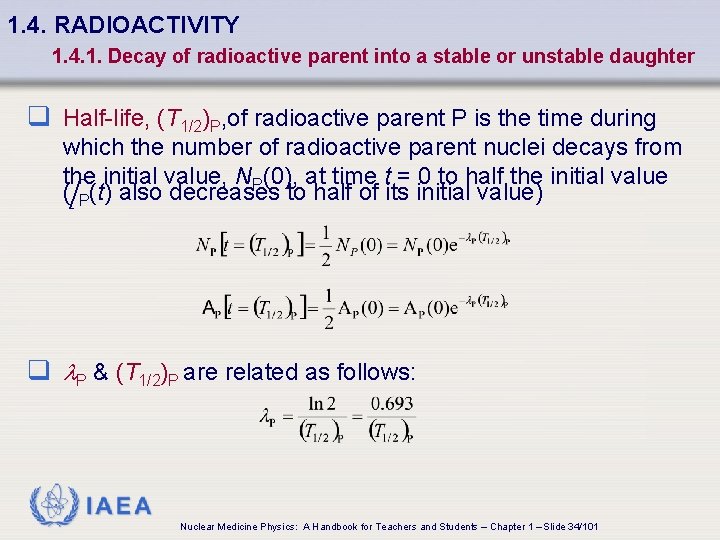
1. 4. RADIOACTIVITY 1. 4. 1. Decay of radioactive parent into a stable or unstable daughter q Half-life, (T 1/2)P, of radioactive parent P is the time during which the number of radioactive parent nuclei decays from the initial value, NP(0), at time t = 0 to half the initial value (A P(t) also decreases to half of its initial value) q l. P & (T 1/2)P are related as follows: IAEA Nuclear Medicine Physics: A Handbook for Teachers and Students – Chapter 1 – Slide 34/101
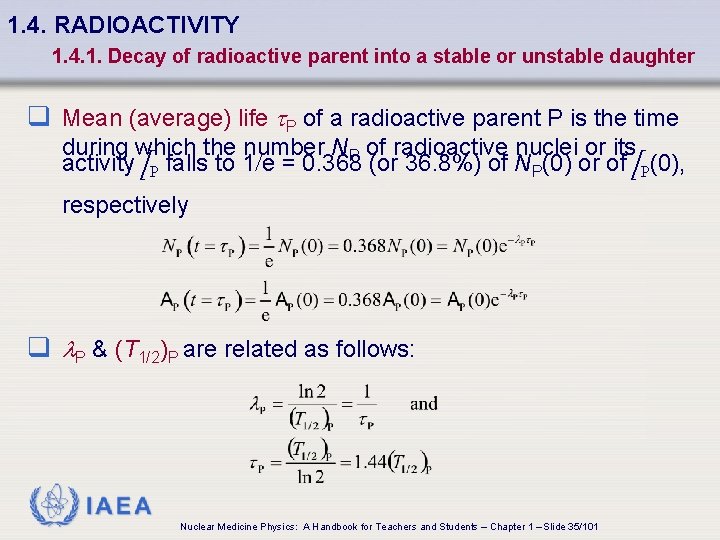
1. 4. RADIOACTIVITY 1. 4. 1. Decay of radioactive parent into a stable or unstable daughter q Mean (average) life t. P of a radioactive parent P is the time during which the number NP of radioactive nuclei or its activity A P falls to 1/e = 0. 368 (or 36. 8%) of NP(0) or of A P(0), respectively q l. P & (T 1/2)P are related as follows: IAEA Nuclear Medicine Physics: A Handbook for Teachers and Students – Chapter 1 – Slide 35/101
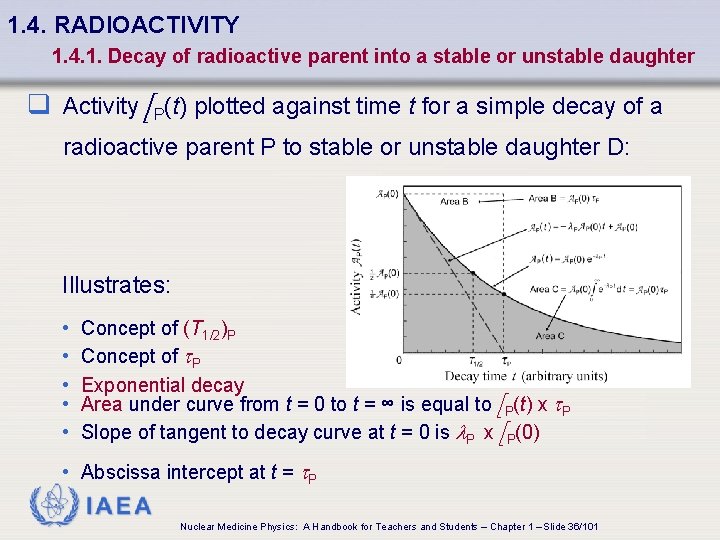
1. 4. RADIOACTIVITY 1. 4. 1. Decay of radioactive parent into a stable or unstable daughter q Activity A P(t) plotted against time t for a simple decay of a radioactive parent P to stable or unstable daughter D: Illustrates: • • • Concept of (T 1/2)P Concept of t. P Exponential decay Area under curve from t = 0 to t = ∞ is equal to A P(t) x t. P Slope of tangent to decay curve at t = 0 is l. P x A P(0) • Abscissa intercept at t = t. P IAEA Nuclear Medicine Physics: A Handbook for Teachers and Students – Chapter 1 – Slide 36/101
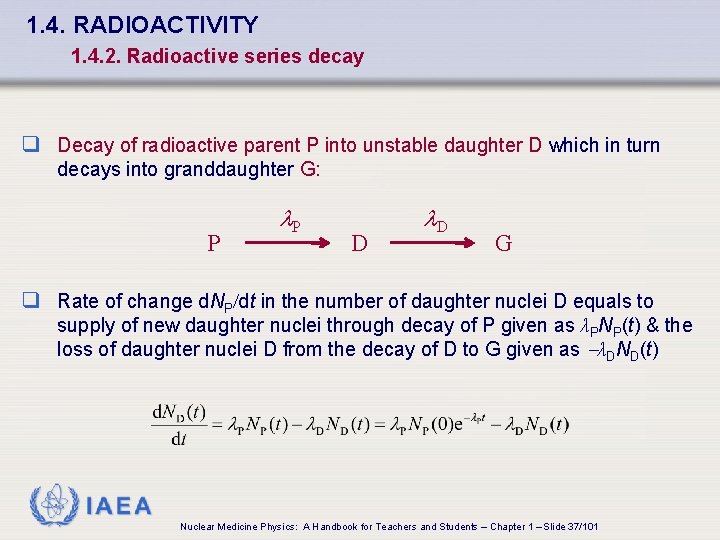
1. 4. RADIOACTIVITY 1. 4. 2. Radioactive series decay q Decay of radioactive parent P into unstable daughter D which in turn decays into granddaughter G: P l. P D l. D G q Rate of change d. NP/dt in the number of daughter nuclei D equals to supply of new daughter nuclei through decay of P given as λPNP(t) & the loss of daughter nuclei D from the decay of D to G given as -λDND(t) IAEA Nuclear Medicine Physics: A Handbook for Teachers and Students – Chapter 1 – Slide 37/101

1. 4. RADIOACTIVITY 1. 4. 2. Radioactive series decay q Number of daughter nuclei is, assuming no daughter D nuclei present initially, i. e. ND(0) = 0: q Activity of the daughter nuclei is: • AD(t) = activity at time t of daughter = l. DND(t) • AP(0) = initial activity of parent at time t = 0 • AP(t) = activity of parent at time t = l. PNP(t) IAEA Nuclear Medicine Physics: A Handbook for Teachers and Students – Chapter 1 – Slide 38/101
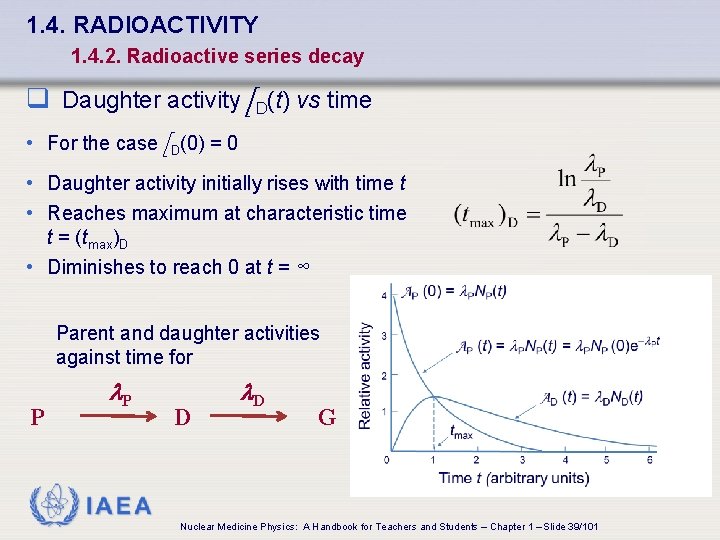
1. 4. RADIOACTIVITY 1. 4. 2. Radioactive series decay q Daughter activity A D(t) vs time • For the case A D(0) = 0 • Daughter activity initially rises with time t • Reaches maximum at characteristic time t = (tmax)D • Diminishes to reach 0 at t = ∞ Parent and daughter activities against time for P l. P D l. D G IAEA Nuclear Medicine Physics: A Handbook for Teachers and Students – Chapter 1 – Slide 39/101
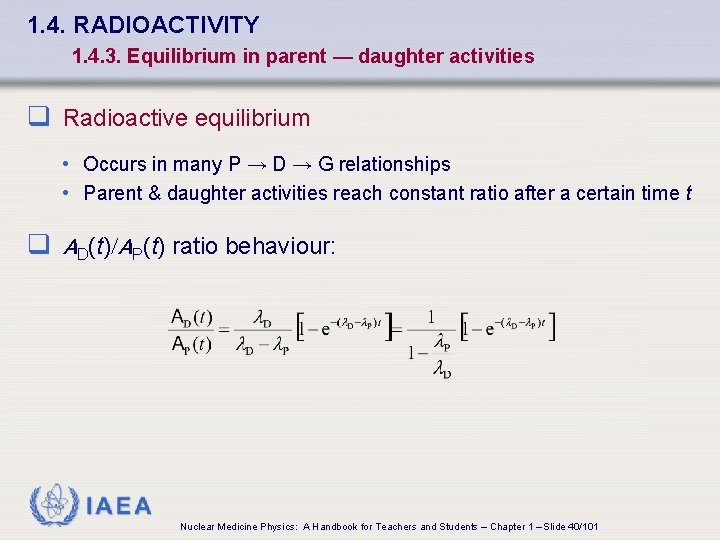
1. 4. RADIOACTIVITY 1. 4. 3. Equilibrium in parent — daughter activities q Radioactive equilibrium • Occurs in many P → D → G relationships • Parent & daughter activities reach constant ratio after a certain time t q AD(t)/AP(t) ratio behaviour: IAEA Nuclear Medicine Physics: A Handbook for Teachers and Students – Chapter 1 – Slide 40/101
1. 4. RADIOACTIVITY 1. 4. 4. Production of radionuclides (nuclear activation) q Nuclear activation • Bombardment of a stable nuclide with a suitable energetic particle or high energy photons to induce a nuclear transformation • Neutrons from nuclear reactors for neutron activation • Protons from cyclotrons or synchrotrons for proton activation • X rays from high energy linear accelerators for nuclear photoactivation IAEA Nuclear Medicine Physics: A Handbook for Teachers and Students – Chapter 1 – Slide 41/101
1. 4. RADIOACTIVITY 1. 4. 4. Production of radionuclides (nuclear activation) q Neutron activation important in production of radionuclides used for • • External beam radiotherapy Brachytherapy Therapeutic nuclear medicine Nuclear medicine imaging (molecular imaging) q Proton activation important in production of positron emitters used in • Positron emission tomography (PET) imaging q Nuclear photoactivation important from a radiation protection point of view • Components of high energy radiotherapy machines become activated during patient treatment • Potential radiation risk to staff using equipment IAEA Nuclear Medicine Physics: A Handbook for Teachers and Students – Chapter 1 – Slide 42/101
1. 4. RADIOACTIVITY 1. 4. 5. Modes of radioactive decay q Nucleons are bound together to form nucleus by strong nuclear force • At least two orders of magnitude larger than proton–proton Coulomb repulsive force • Extremely short range (a few femtometres) q A delicate equilibrium between number of protons and number of neutrons must exist to bind the nucleons into a stable nucleus • Configurations to form stable nuclei • For low A nuclei Z = N • For A ≥ 40 N > Z (in order to overcome proton-proton Coulomb repulsion) IAEA Nuclear Medicine Physics: A Handbook for Teachers and Students – Chapter 1 – Slide 43/101
1. 4. RADIOACTIVITY 1. 4. 5. Modes of radioactive decay q If there is no proton-neutron optimal equilibrium: • Nucleus is unstable (radioactive) • Nucleus decays with a specific decay constant l into more stable configuration that may also be unstable and decay further, forming a decay chain that eventually ends with a stable nuclide IAEA Nuclear Medicine Physics: A Handbook for Teachers and Students – Chapter 1 – Slide 44/101
1. 4. RADIOACTIVITY 1. 4. 5. Modes of radioactive decay q Radioactive decay is a process by which unstable (radioactive) nuclei reach a more stable configuration q Radioactive decay processes • Medically important • Alpha (a) decay • Beta (b) decay • Beta plus decay • Beta minus decay • Electron capture • Gamma (γ) decay • Pure gamma decay • Internal conversion • Less important • Spontaneous fission. IAEA Nuclear Medicine Physics: A Handbook for Teachers and Students – Chapter 1 – Slide 45/101
1. 4. RADIOACTIVITY 1. 4. 5. Modes of radioactive decay q Neutron-rich nuclides have excess number of neutrons q Proton-rich nuclides have excess number of protons q Decays: • Slight Proton–neutron imbalance: • Proton into a neutron in b+ decay • Neutron into a proton in b– decay • Large proton–neutron imbalance: • a particles in a decay OR protons in proton emission decay • Neutrons in neutron emission decay • Very large A nuclides (A > 230) • Spontaneous fission competing with a decay IAEA Nuclear Medicine Physics: A Handbook for Teachers and Students – Chapter 1 – Slide 46/101
1. 4. RADIOACTIVITY 1. 4. 5. Modes of radioactive decay q Excited nuclei decay to ground state via decay • Most of these occur immediately upon excited state production by a or b decay • A few have delayed decays governed by their own decay constants • Referred to as metastable states (e. g. 99 m. Tc) IAEA Nuclear Medicine Physics: A Handbook for Teachers and Students – Chapter 1 – Slide 47/101
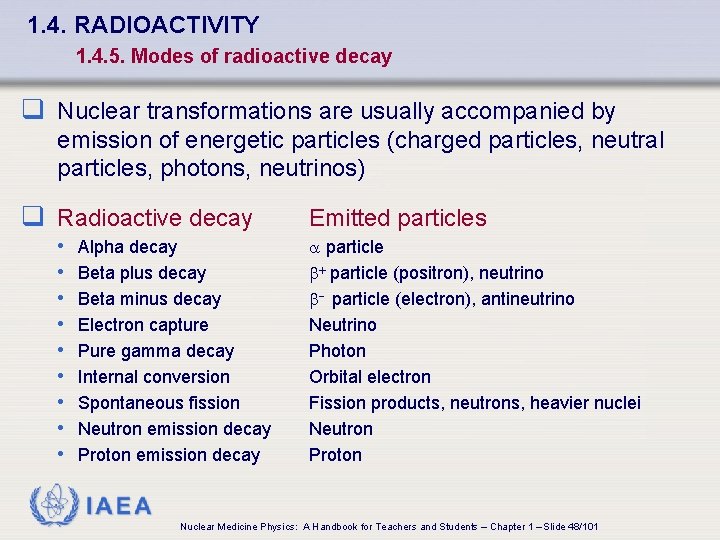
1. 4. RADIOACTIVITY 1. 4. 5. Modes of radioactive decay q Nuclear transformations are usually accompanied by emission of energetic particles (charged particles, neutral particles, photons, neutrinos) q Radioactive decay • • • Alpha decay Beta plus decay Beta minus decay Electron capture Pure gamma decay Internal conversion Spontaneous fission Neutron emission decay Proton emission decay Emitted particles a particle b+ particle (positron), neutrino b- particle (electron), antineutrino Neutrino Photon Orbital electron Fission products, neutrons, heavier nuclei Neutron Proton IAEA Nuclear Medicine Physics: A Handbook for Teachers and Students – Chapter 1 – Slide 48/101
1. 4. RADIOACTIVITY 1. 4. 5. Modes of radioactive decay q In each nuclear transformation a number of physical quantities must be conserved q The most important conserved physical quantities are: • • • Total energy Momentum Charge Atomic number Atomic mass number (number of nucleons) IAEA Nuclear Medicine Physics: A Handbook for Teachers and Students – Chapter 1 – Slide 49/101
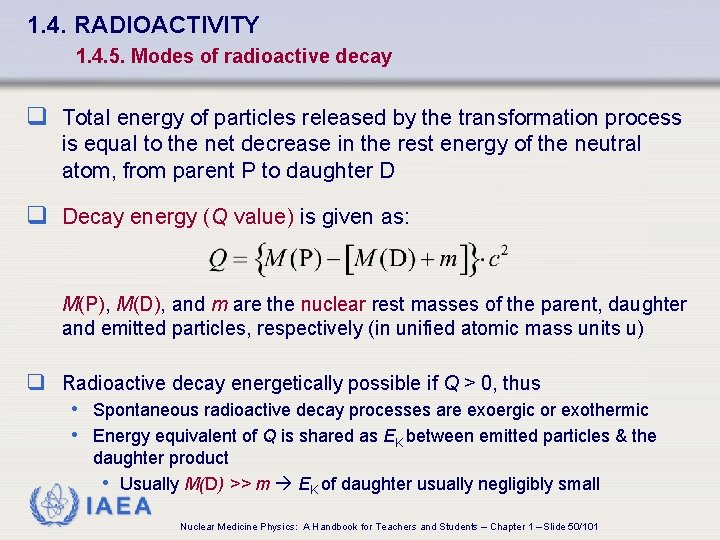
1. 4. RADIOACTIVITY 1. 4. 5. Modes of radioactive decay q Total energy of particles released by the transformation process is equal to the net decrease in the rest energy of the neutral atom, from parent P to daughter D q Decay energy (Q value) is given as: M(P), M(D), and m are the nuclear rest masses of the parent, daughter and emitted particles, respectively (in unified atomic mass units u) q Radioactive decay energetically possible if Q > 0, thus • Spontaneous radioactive decay processes are exoergic or exothermic • Energy equivalent of Q is shared as EK between emitted particles & the daughter product • Usually M(D) >> m EK of daughter usually negligibly small IAEA Nuclear Medicine Physics: A Handbook for Teachers and Students – Chapter 1 – Slide 50/101
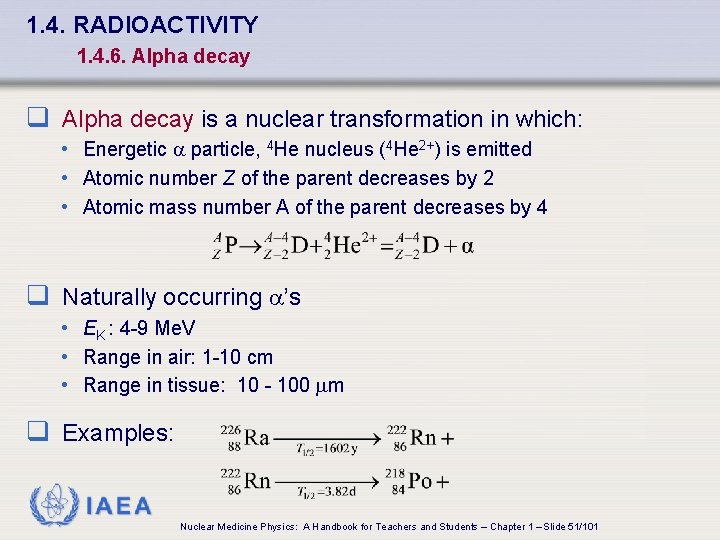
1. 4. RADIOACTIVITY 1. 4. 6. Alpha decay q Alpha decay is a nuclear transformation in which: • Energetic a particle, 4 He nucleus (4 He 2+) is emitted • Atomic number Z of the parent decreases by 2 • Atomic mass number A of the parent decreases by 4 q Naturally occurring a’s • EK : 4 -9 Me. V • Range in air: 1 -10 cm • Range in tissue: 10 - 100 m q Examples: IAEA Nuclear Medicine Physics: A Handbook for Teachers and Students – Chapter 1 – Slide 51/101
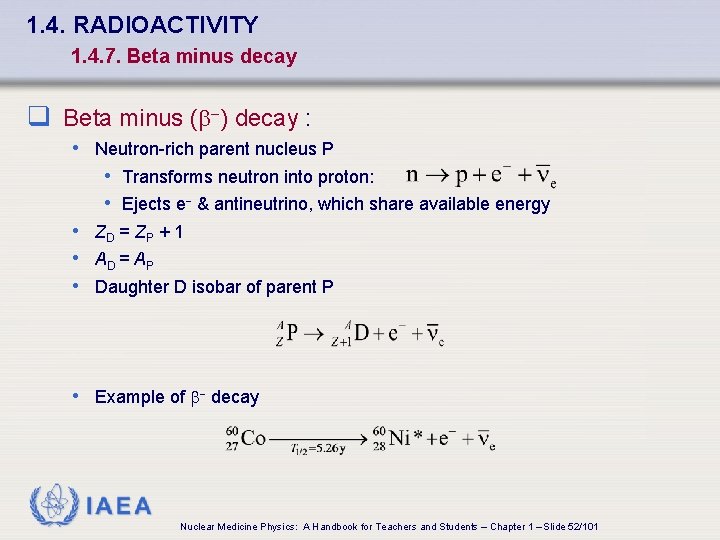
1. 4. RADIOACTIVITY 1. 4. 7. Beta minus decay q Beta minus (b-) decay : • Neutron-rich parent nucleus P • Transforms neutron into proton: • Ejects e- & antineutrino, which share available energy • ZD = ZP + 1 • AD = AP • Daughter D isobar of parent P • Example of b- decay IAEA Nuclear Medicine Physics: A Handbook for Teachers and Students – Chapter 1 – Slide 52/101
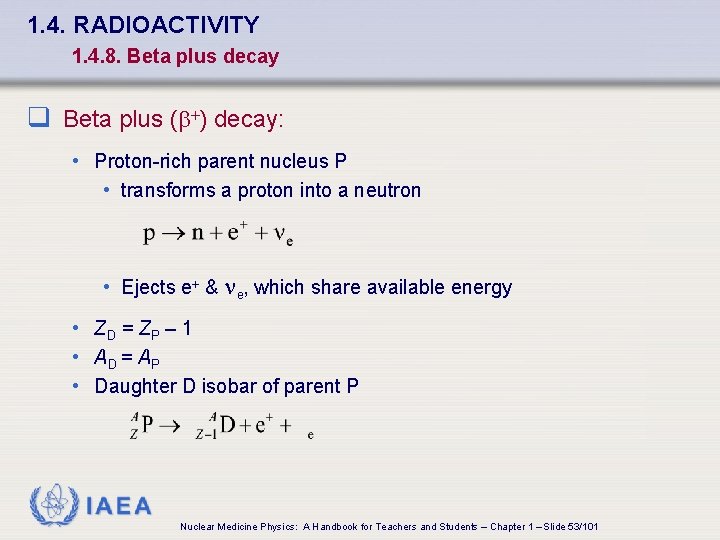
1. 4. RADIOACTIVITY 1. 4. 8. Beta plus decay q Beta plus (b+) decay: • Proton-rich parent nucleus P • transforms a proton into a neutron • Ejects e+ & ne, which share available energy • ZD = ZP – 1 • AD = AP • Daughter D isobar of parent P IAEA Nuclear Medicine Physics: A Handbook for Teachers and Students – Chapter 1 – Slide 53/101
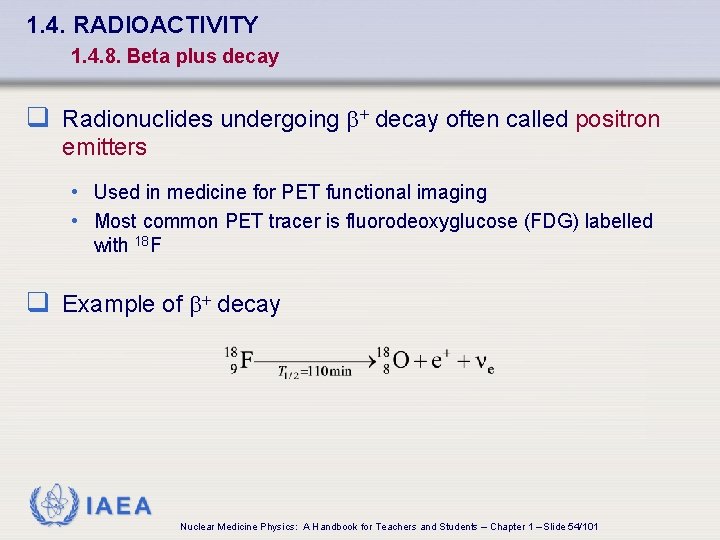
1. 4. RADIOACTIVITY 1. 4. 8. Beta plus decay q Radionuclides undergoing b+ decay often called positron emitters • Used in medicine for PET functional imaging • Most common PET tracer is fluorodeoxyglucose (FDG) labelled with 18 F q Example of b+ decay IAEA Nuclear Medicine Physics: A Handbook for Teachers and Students – Chapter 1 – Slide 54/101
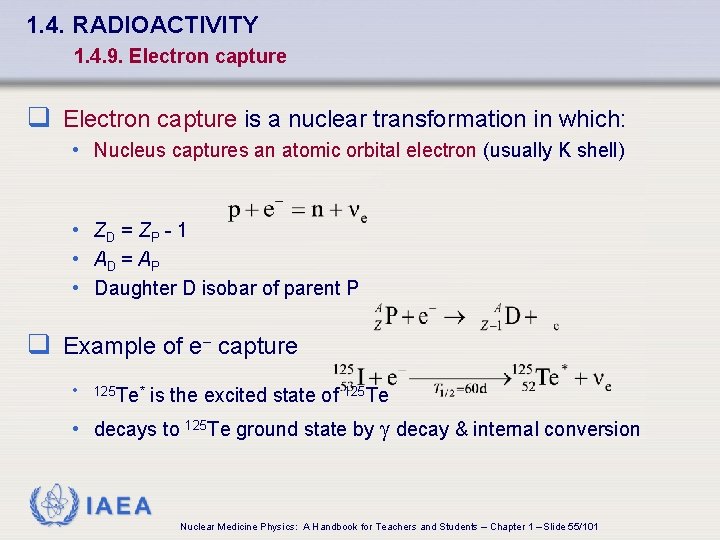
1. 4. RADIOACTIVITY 1. 4. 9. Electron capture q Electron capture is a nuclear transformation in which: • Nucleus captures an atomic orbital electron (usually K shell) • ZD = ZP - 1 • AD = AP • Daughter D isobar of parent P q Example of e- capture • 125 Te* is the excited state of 125 Te • decays to 125 Te ground state by decay & internal conversion IAEA Nuclear Medicine Physics: A Handbook for Teachers and Students – Chapter 1 – Slide 55/101
1. 4. RADIOACTIVITY 1. 4. 10. Gamma decay and internal conversion q a, b-, b+ and electron capture, may produce daughter (D) nucleus in excited state • Full amount of the decay energy available not expended • Will reach ground (de-excite) state by: • Emitting excitation energy as one or more • Internal conversion • Transfer of excitation energy to atomic orbital electrons (usually K shell) • Vacancy in shell filled by higher orbital electron • Resulting in characteristic X rays and/or Auger electrons IAEA Nuclear Medicine Physics: A Handbook for Teachers and Students – Chapter 1 – Slide 56/101
1. 4. RADIOACTIVITY 1. 4. 10. Gamma decay and internal conversion q In most a & b decays de-excitation is instantaneous • Thus, we refer to emitted 's as if produced by parent • e. g. 60 Co rays q Sometimes, D de-excites with time delay • Excited state of D is referred to as a metastable state • De-excitation called isomeric transition • e. g. 99 m. Tc IAEA Nuclear Medicine Physics: A Handbook for Teachers and Students – Chapter 1 – Slide 57/101
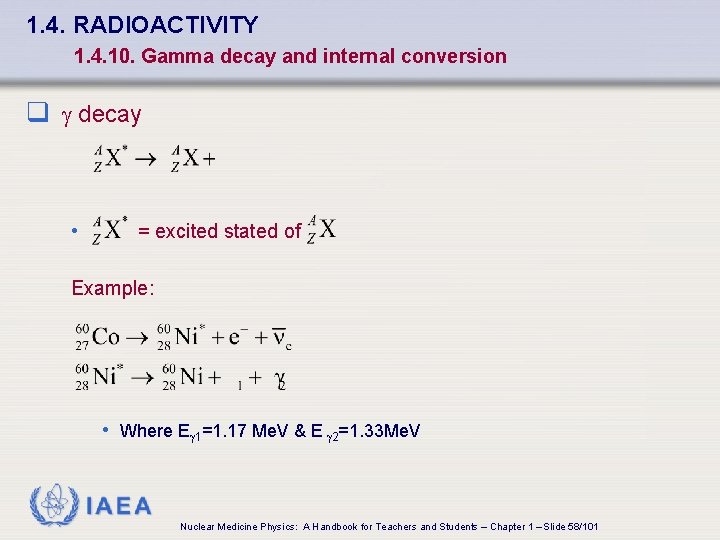
1. 4. RADIOACTIVITY 1. 4. 10. Gamma decay and internal conversion q decay • = excited stated of Example: • Where E 1=1. 17 Me. V & E 2=1. 33 Me. V IAEA Nuclear Medicine Physics: A Handbook for Teachers and Students – Chapter 1 – Slide 58/101
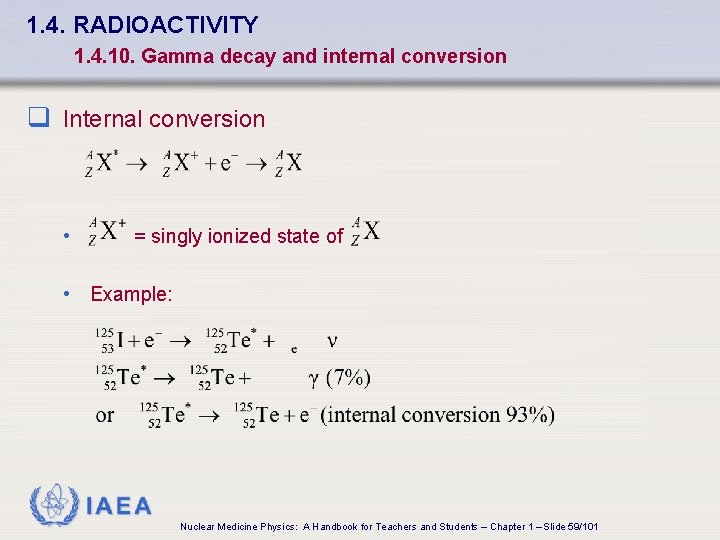
1. 4. RADIOACTIVITY 1. 4. 10. Gamma decay and internal conversion q Internal conversion • = singly ionized state of • Example: IAEA Nuclear Medicine Physics: A Handbook for Teachers and Students – Chapter 1 – Slide 59/101
1. 4. RADIOACTIVITY 1. 4. 11 Characteristic (fluorescence) X rays and Auger electrons q A large number of radionuclides used in nuclear medicine (e. g. 99 m. Tc, 123 I, 201 Tl, 64 Cu) decay by electron capture and/or internal conversion q Both processes leave the atom with a vacancy in an inner atomic shell • Most commonly the K shell • Inner shell vacancy filled by electron from higher level atomic shell • Binding energy difference between the two shells is emitted as • Characteristic X ray (fluorescence photon) • Or transferred to higher shell orbital electron • Then emitted from atom as Auger electron with EK equal to transferred energy minus the binding energy of the emitted Auger electron IAEA Nuclear Medicine Physics: A Handbook for Teachers and Students – Chapter 1 – Slide 60/101
1. 5. ELECTRON INTERACTIONS WITH MATTER q Energetic charged particles (e. g. e- or e+) undergo Coulomb interactions with absorber atoms, i. e. , with: • Atomic orbital electrons • Ionization loss • Atomic nuclei • Radiation loss q Through these collisions the electrons may: • Lose their kinetic energy (collision and radiation loss) • Change direction of motion (scattering) IAEA Nuclear Medicine Physics: A Handbook for Teachers and Students – Chapter 1 – Slide 61/101
1. 5. ELECTRON INTERACTIONS WITH MATTER q Interactions between the charged particle and absorber atom is characterized by a specific cross-section (probability) s q Energy loss depends on • Particle properties (mass, charge, velocity & energy) • Absorber properties (density & Z) IAEA Nuclear Medicine Physics: A Handbook for Teachers and Students – Chapter 1 – Slide 62/101
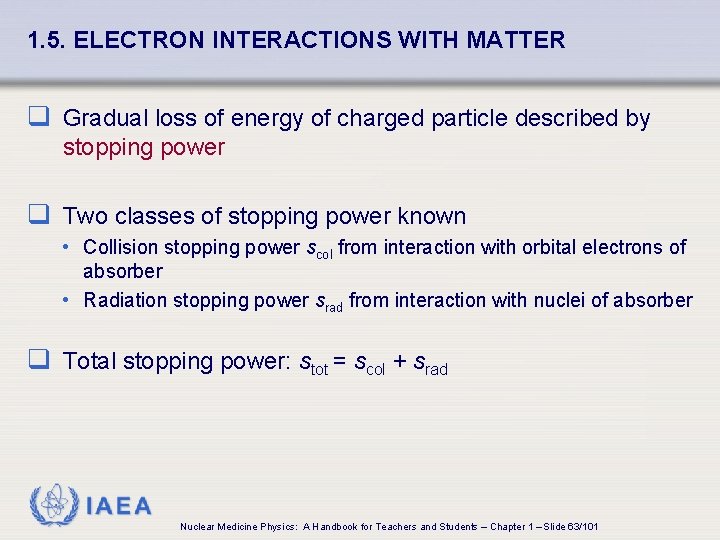
1. 5. ELECTRON INTERACTIONS WITH MATTER q Gradual loss of energy of charged particle described by stopping power q Two classes of stopping power known • Collision stopping power scol from interaction with orbital electrons of absorber • Radiation stopping power srad from interaction with nuclei of absorber q Total stopping power: stot = scol + srad IAEA Nuclear Medicine Physics: A Handbook for Teachers and Students – Chapter 1 – Slide 63/101
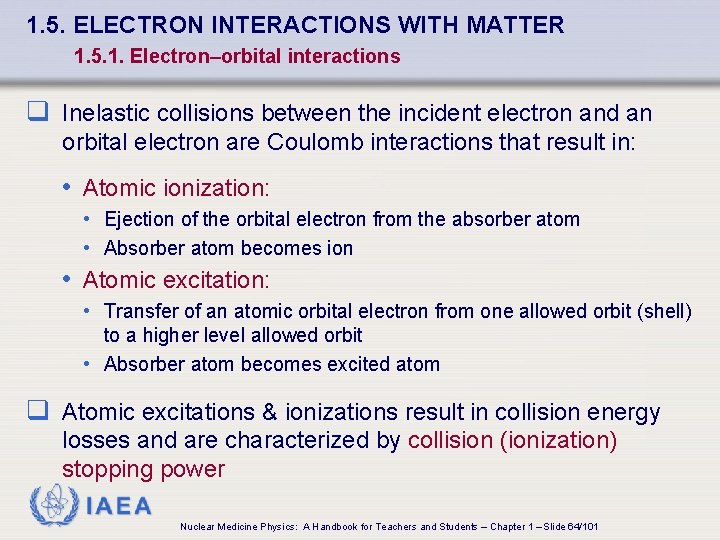
1. 5. ELECTRON INTERACTIONS WITH MATTER 1. 5. 1. Electron–orbital interactions q Inelastic collisions between the incident electron and an orbital electron are Coulomb interactions that result in: • Atomic ionization: • Ejection of the orbital electron from the absorber atom • Absorber atom becomes ion • Atomic excitation: • Transfer of an atomic orbital electron from one allowed orbit (shell) to a higher level allowed orbit • Absorber atom becomes excited atom q Atomic excitations & ionizations result in collision energy losses and are characterized by collision (ionization) stopping power IAEA Nuclear Medicine Physics: A Handbook for Teachers and Students – Chapter 1 – Slide 64/101
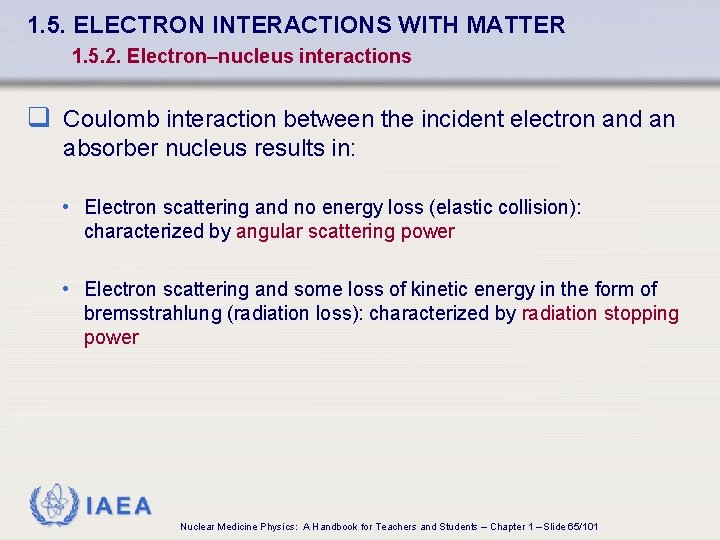
1. 5. ELECTRON INTERACTIONS WITH MATTER 1. 5. 2. Electron–nucleus interactions q Coulomb interaction between the incident electron and an absorber nucleus results in: • Electron scattering and no energy loss (elastic collision): characterized by angular scattering power • Electron scattering and some loss of kinetic energy in the form of bremsstrahlung (radiation loss): characterized by radiation stopping power IAEA Nuclear Medicine Physics: A Handbook for Teachers and Students – Chapter 1 – Slide 65/101
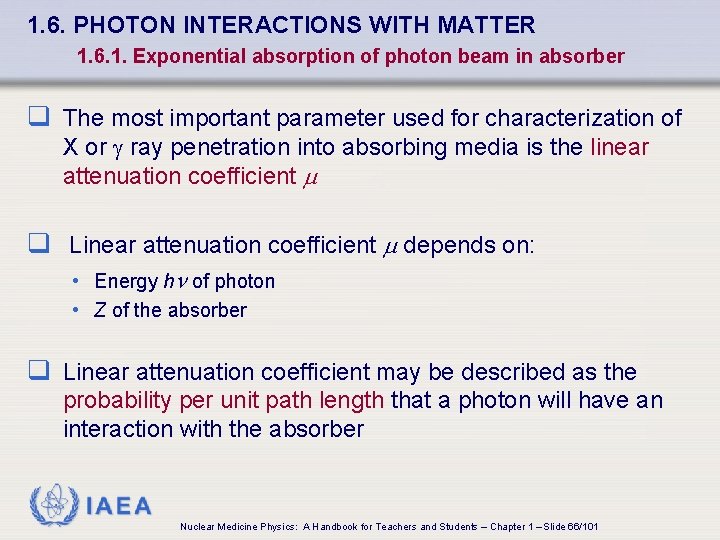
1. 6. PHOTON INTERACTIONS WITH MATTER 1. 6. 1. Exponential absorption of photon beam in absorber q The most important parameter used for characterization of X or ray penetration into absorbing media is the linear attenuation coefficient q Linear attenuation coefficient depends on: • Energy h of photon • Z of the absorber q Linear attenuation coefficient may be described as the probability per unit path length that a photon will have an interaction with the absorber IAEA Nuclear Medicine Physics: A Handbook for Teachers and Students – Chapter 1 – Slide 66/101
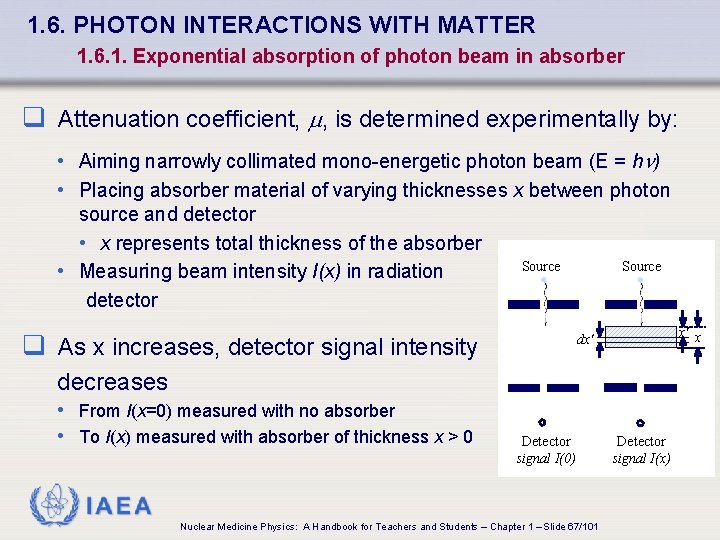
1. 6. PHOTON INTERACTIONS WITH MATTER 1. 6. 1. Exponential absorption of photon beam in absorber q Attenuation coefficient, , is determined experimentally by: • Aiming narrowly collimated mono-energetic photon beam (E = h ) • Placing absorber material of varying thicknesses x between photon source and detector • x represents total thickness of the absorber • Measuring beam intensity I(x) in radiation detector Source q As x increases, detector signal intensity Source x' x dx' decreases • From I(x=0) measured with no absorber • To I(x) measured with absorber of thickness x > 0 Detector signal I(0) IAEA Nuclear Medicine Physics: A Handbook for Teachers and Students – Chapter 1 – Slide 67/101 Detector signal I(x)
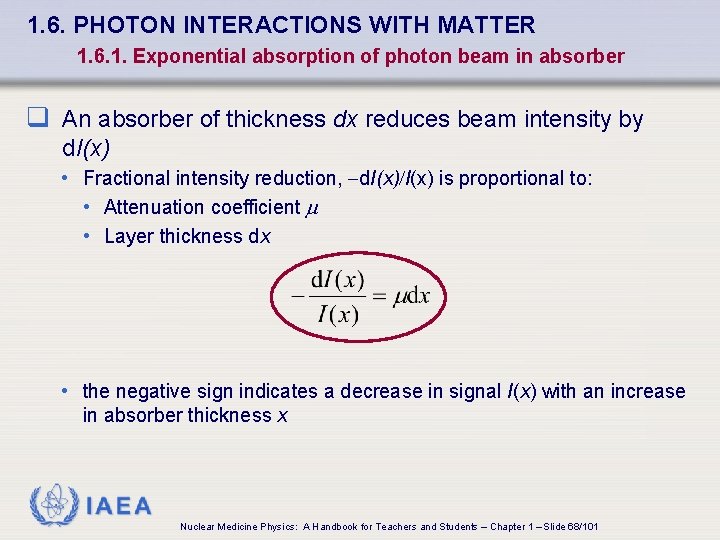
1. 6. PHOTON INTERACTIONS WITH MATTER 1. 6. 1. Exponential absorption of photon beam in absorber q An absorber of thickness dx reduces beam intensity by d. I(x) • Fractional intensity reduction, -d. I(x)/I(x) is proportional to: • Attenuation coefficient • Layer thickness dx • the negative sign indicates a decrease in signal I(x) with an increase in absorber thickness x IAEA Nuclear Medicine Physics: A Handbook for Teachers and Students – Chapter 1 – Slide 68/101
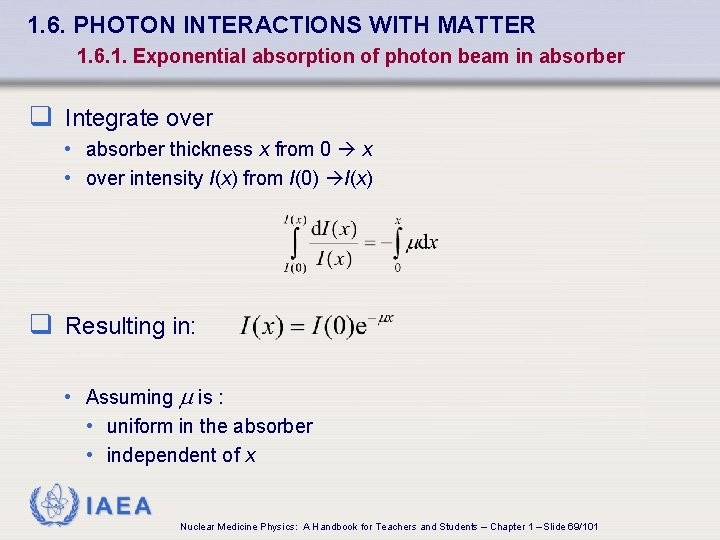
1. 6. PHOTON INTERACTIONS WITH MATTER 1. 6. 1. Exponential absorption of photon beam in absorber q Integrate over • absorber thickness x from 0 x • over intensity I(x) from I(0) I(x) q Resulting in: • Assuming is : • uniform in the absorber • independent of x IAEA Nuclear Medicine Physics: A Handbook for Teachers and Students – Chapter 1 – Slide 69/101
1. 6. PHOTON INTERACTIONS WITH MATTER 1. 6. 2. Characteristic absorber thicknesses q 3 special thicknesses used for characterization of photon beams: • Half-value layer (HVL or x 1/2) • Absorber thickness that attenuates original I(x) by 50 % • Mean free path (MFP or ) • Absorber thickness which attenuates beam intensity by 1/e = 36. 8% • Tenth-value layer (TVL or x 1/10) • Absorber thickness which attenuates beam intensity to 10% of original intensity IAEA Nuclear Medicine Physics: A Handbook for Teachers and Students – Chapter 1 – Slide 70/101
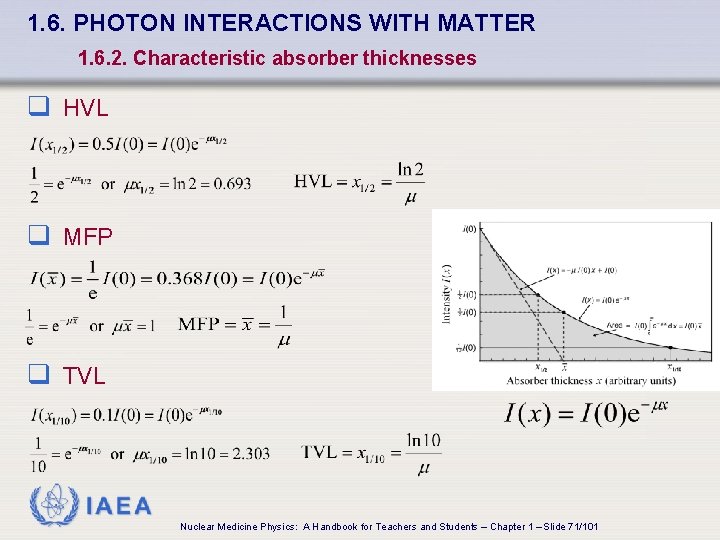
1. 6. PHOTON INTERACTIONS WITH MATTER 1. 6. 2. Characteristic absorber thicknesses q HVL q MFP q TVL IAEA Nuclear Medicine Physics: A Handbook for Teachers and Students – Chapter 1 – Slide 71/101
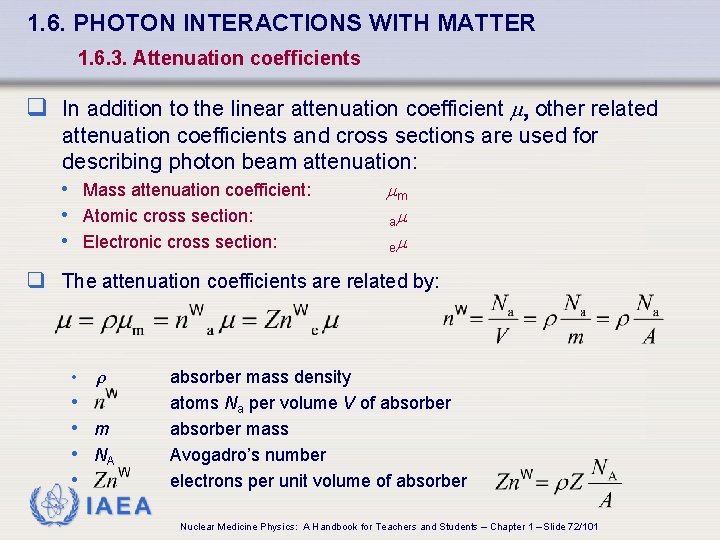
1. 6. PHOTON INTERACTIONS WITH MATTER 1. 6. 3. Attenuation coefficients q In addition to the linear attenuation coefficient , other related attenuation coefficients and cross sections are used for describing photon beam attenuation: • Mass attenuation coefficient: • Atomic cross section: • Electronic cross section: m a e q The attenuation coefficients are related by: • • • m • NA • absorber mass density atoms Na per volume V of absorber mass Avogadro’s number electrons per unit volume of absorber IAEA Nuclear Medicine Physics: A Handbook for Teachers and Students – Chapter 1 – Slide 72/101
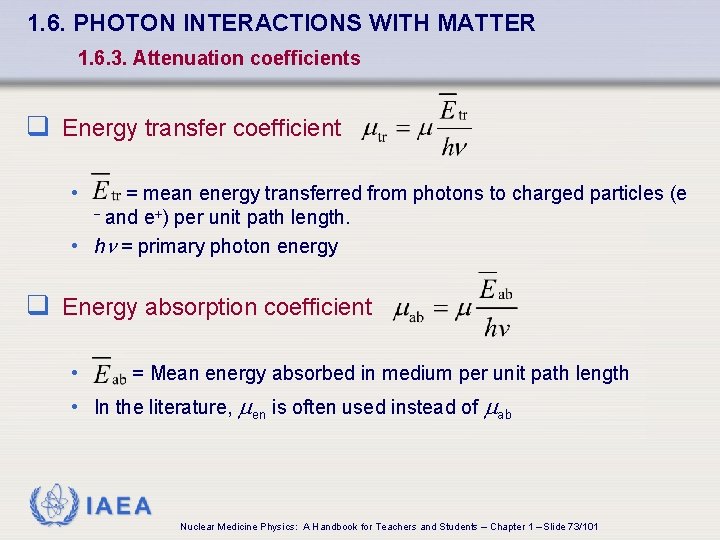
1. 6. PHOTON INTERACTIONS WITH MATTER 1. 6. 3. Attenuation coefficients q Energy transfer coefficient • = mean energy transferred from photons to charged particles (e - and e+) per unit path length. • h = primary photon energy q Energy absorption coefficient • = Mean energy absorbed in medium per unit path length • In the literature, en is often used instead of ab IAEA Nuclear Medicine Physics: A Handbook for Teachers and Students – Chapter 1 – Slide 73/101
1. 6. PHOTON INTERACTIONS WITH MATTER 1. 6. 3. Attenuation coefficients q Light charged particles (e- & e+) released/produced in absorbing medium through various photon interactions will either: • Deposit energy to medium via Coulomb interactions w/ orbital electrons of absorbing medium (collision loss also referred to as ionization loss) • Radiate EK away as photons through Coulomb interactions with nuclei of absorbing medium (radiation loss) IAEA Nuclear Medicine Physics: A Handbook for Teachers and Students – Chapter 1 – Slide 74/101
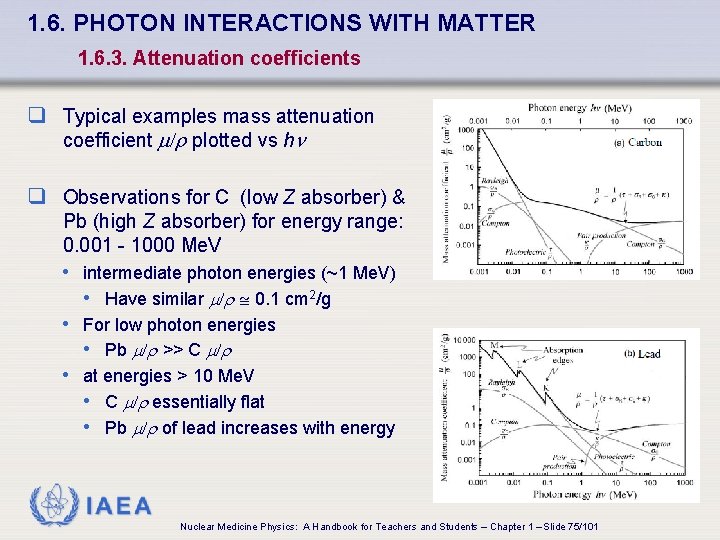
1. 6. PHOTON INTERACTIONS WITH MATTER 1. 6. 3. Attenuation coefficients q Typical examples mass attenuation coefficient /r plotted vs h q Observations for C (low Z absorber) & Pb (high Z absorber) for energy range: 0. 001 - 1000 Me. V • intermediate photon energies (~1 Me. V) • Have similar /r 0. 1 cm 2/g • For low photon energies • Pb /r >> C /r • at energies > 10 Me. V • C /r essentially flat • Pb /r of lead increases with energy IAEA Nuclear Medicine Physics: A Handbook for Teachers and Students – Chapter 1 – Slide 75/101
1. 6. PHOTON INTERACTIONS WITH MATTER 1. 6. 4. Photon interactions on the microscopic scale q Photons may experience various interactions with absorber atoms involving either of the following: • Absorber nuclei • Photonuclear reaction: direct photon - nucleus interactions • Nuclear pair production: photon - electrostatic field of the nucleus interactions • Orbital electrons of absorbing medium: • Compton effect, triplet production: photon - loosely bound electron interactions • Photoelectric effect, Rayleigh scattering: photon - tightly bound electron interactions IAEA Nuclear Medicine Physics: A Handbook for Teachers and Students – Chapter 1 – Slide 76/101
1. 6. PHOTON INTERACTIONS WITH MATTER 1. 6. 4. Photon interactions on the microscopic scale q Loosely bound electron • Binding energy EB << E = h • Interactions considered to be between photon and ‘free’ (i. e. unbound) electron q Tightly bound electron • EB comparable to, larger than or slightly smaller than E = h • Interactions occur if EB must be of the order of, but slightly smaller than E = h • i. e. EB ≤ h • Interactions considered to be between photon and atom as a whole IAEA Nuclear Medicine Physics: A Handbook for Teachers and Students – Chapter 1 – Slide 77/101
1. 6. PHOTON INTERACTIONS WITH MATTER 1. 6. 4. Photon interactions on the microscopic scale q Two possible outcomes for photon after interaction with atom • Photon disappears and is absorbed completely • Photoelectric effect • Nuclear pair production • Triplet production • Photonuclear reaction • Photon scattered and changes direction but keeps its energy (Rayleigh scattering) or loses part of its energy (Compton effect) IAEA Nuclear Medicine Physics: A Handbook for Teachers and Students – Chapter 1 – Slide 78/101
1. 6. PHOTON INTERACTIONS WITH MATTER 1. 6. 4. Photon interactions on the microscopic scale q The most important photon interactions with atoms of the absorber are • Those with energetic electrons released from absorber atoms (and electronic vacancies left): • Compton effect • Photoelectric effect • Electronic pair production (triplet production) • Those with portion of the incident photon energy used to produce free electrons and positrons • Nuclear pair production • Photonuclear reactions q All these light charged particles move through the absorber and either • Deposit EK in the absorber (dose) • Transform part EK into radiation bremsstrahlung radiation IAEA Nuclear Medicine Physics: A Handbook for Teachers and Students – Chapter 1 – Slide 79/101
1. 6. PHOTON INTERACTIONS WITH MATTER 1. 6. 4. Photon interactions on the microscopic scale q Electronic vacancies from photon interactions with absorber atoms • e- from higher shell fills lower shell vacancy • Transition energy emitted as one of the following: • Characteristic X ray (also called fluorescence photon) • Auger electron • This process continues until the vacancy migrates to the outer shell of the absorber atom • Free e- from environment eventually fills outer shell vacancy • Absorber ion reverts to neutral atom in ground state IAEA Nuclear Medicine Physics: A Handbook for Teachers and Students – Chapter 1 – Slide 80/101
1. 6. PHOTON INTERACTIONS WITH MATTER 1. 6. 4. Photon interactions on the microscopic scale q Auger effect: Auger e- emissions from excited atom • Each Auger transition converts 1 vacancy into 2 vacancies • Leads to cascade of low energy Auger e-'s emitted from atom • Auger e-'s have very short range in tissue • May produce ionization densities comparable to those in an alpha track • Biologically damaging IAEA Nuclear Medicine Physics: A Handbook for Teachers and Students – Chapter 1 – Slide 81/101
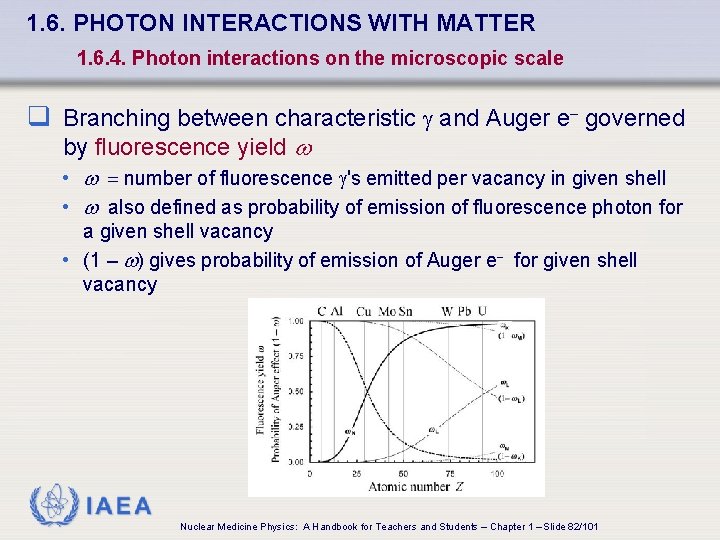
1. 6. PHOTON INTERACTIONS WITH MATTER 1. 6. 4. Photon interactions on the microscopic scale q Branching between characteristic and Auger e- governed by fluorescence yield w • w = number of fluorescence 's emitted per vacancy in given shell • w also defined as probability of emission of fluorescence photon for a given shell vacancy • (1 – w) gives probability of emission of Auger e- for given shell vacancy IAEA Nuclear Medicine Physics: A Handbook for Teachers and Students – Chapter 1 – Slide 82/101
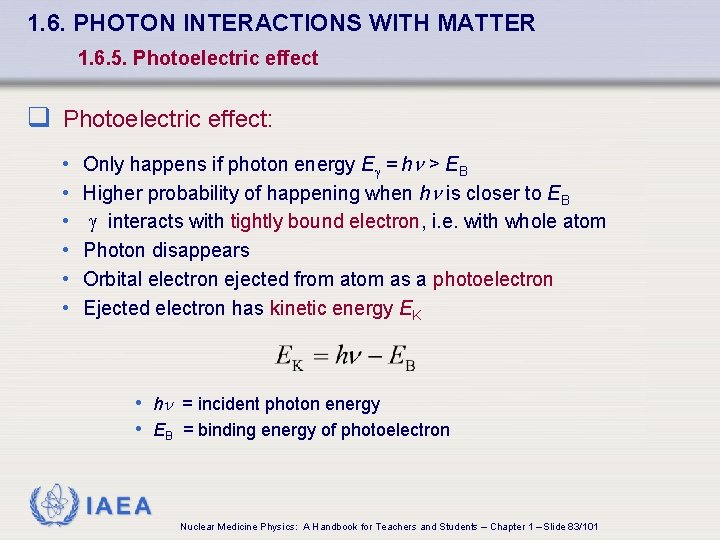
1. 6. PHOTON INTERACTIONS WITH MATTER 1. 6. 5. Photoelectric effect q Photoelectric effect: • • • Only happens if photon energy E = h > EB Higher probability of happening when h is closer to EB interacts with tightly bound electron, i. e. with whole atom Photon disappears Orbital electron ejected from atom as a photoelectron Ejected electron has kinetic energy EK • h = incident photon energy • EB = binding energy of photoelectron IAEA Nuclear Medicine Physics: A Handbook for Teachers and Students – Chapter 1 – Slide 83/101
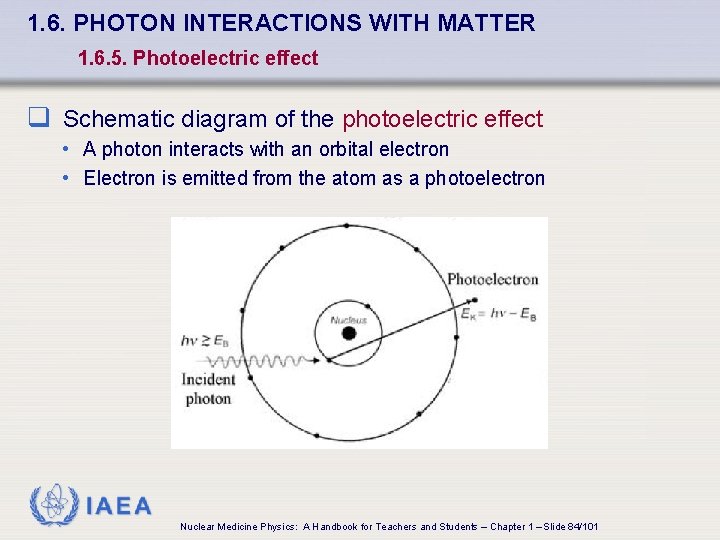
1. 6. PHOTON INTERACTIONS WITH MATTER 1. 6. 5. Photoelectric effect q Schematic diagram of the photoelectric effect • A photon interacts with an orbital electron • Electron is emitted from the atom as a photoelectron IAEA Nuclear Medicine Physics: A Handbook for Teachers and Students – Chapter 1 – Slide 84/101
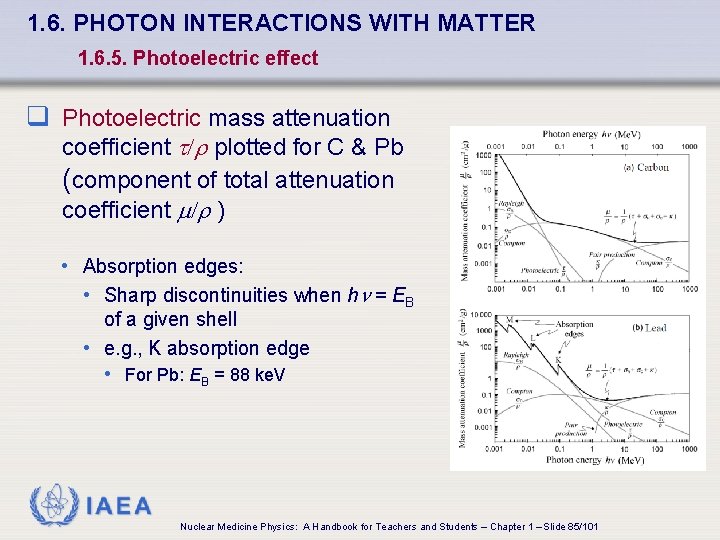
1. 6. PHOTON INTERACTIONS WITH MATTER 1. 6. 5. Photoelectric effect q Photoelectric mass attenuation coefficient t/r plotted for C & Pb (component of total attenuation coefficient /r ) • Absorption edges: • Sharp discontinuities when h = EB of a given shell • e. g. , K absorption edge • For Pb: EB = 88 ke. V IAEA Nuclear Medicine Physics: A Handbook for Teachers and Students – Chapter 1 – Slide 85/101
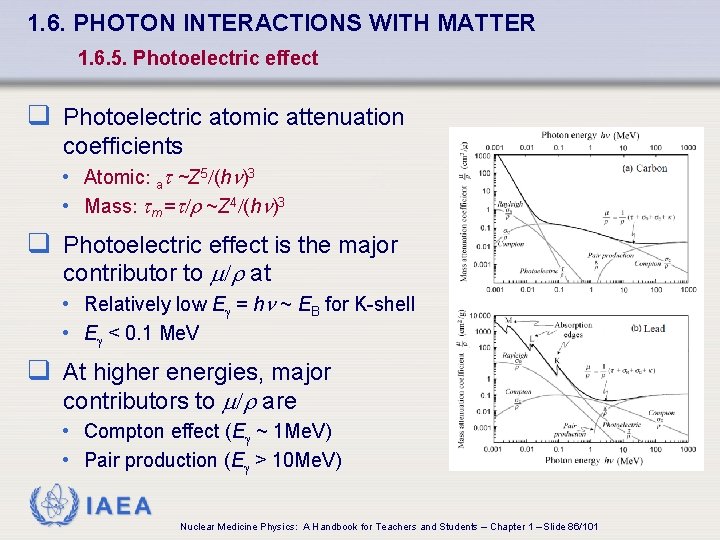
1. 6. PHOTON INTERACTIONS WITH MATTER 1. 6. 5. Photoelectric effect q Photoelectric atomic attenuation coefficients • Atomic: at ~Z 5/(h )3 • Mass: tm =t/r ~Z 4/(h )3 q Photoelectric effect is the major contributor to /r at • Relatively low E = h ~ EB for K-shell • E < 0. 1 Me. V q At higher energies, major contributors to /r are • Compton effect (E ~ 1 Me. V) • Pair production (E > 10 Me. V) IAEA Nuclear Medicine Physics: A Handbook for Teachers and Students – Chapter 1 – Slide 86/101
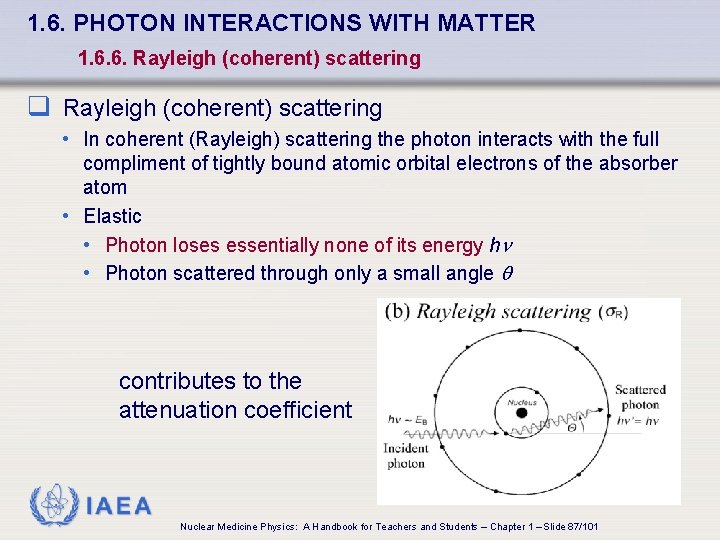
1. 6. PHOTON INTERACTIONS WITH MATTER 1. 6. 6. Rayleigh (coherent) scattering q Rayleigh (coherent) scattering • In coherent (Rayleigh) scattering the photon interacts with the full compliment of tightly bound atomic orbital electrons of the absorber atom • Elastic • Photon loses essentially none of its energy h • Photon scattered through only a small angle q contributes to the attenuation coefficient IAEA Nuclear Medicine Physics: A Handbook for Teachers and Students – Chapter 1 – Slide 87/101
1. 6. PHOTON INTERACTIONS WITH MATTER 1. 6. 6. Rayleigh (coherent) scattering q Rayleigh (coherent) scattering • Contributes /r through elastic scattering process • Rayleigh atomic attenuation coefficient • s ~ Z 2/(h )2 a R • Rayleigh mass attenuation coefficient • s. R /r ~ Z/(h )2 q Not important in radiation dosimetry because there’s no energy transfer from photons to charged particles in the absorber q Amounts to only a few per cent of the total /r, but should not be neglected in attenuation calculations IAEA Nuclear Medicine Physics: A Handbook for Teachers and Students – Chapter 1 – Slide 88/101
1. 6. PHOTON INTERACTIONS WITH MATTER 1. 6. 7. Compton effect ("incoherent scattering") q Compton effect ("incoherent scattering" or "Compton scattering") • Interaction between with E = h and a loosely bound (“free”) e • ‘free’ because E >> EB , i. e. loosely bound means essentially ‘free & stationary’ q Part of incident E = h transferred to “free” orbital electron which is emitted from the atom as the Compton (recoil) electron IAEA Nuclear Medicine Physics: A Handbook for Teachers and Students – Chapter 1 – Slide 89/101
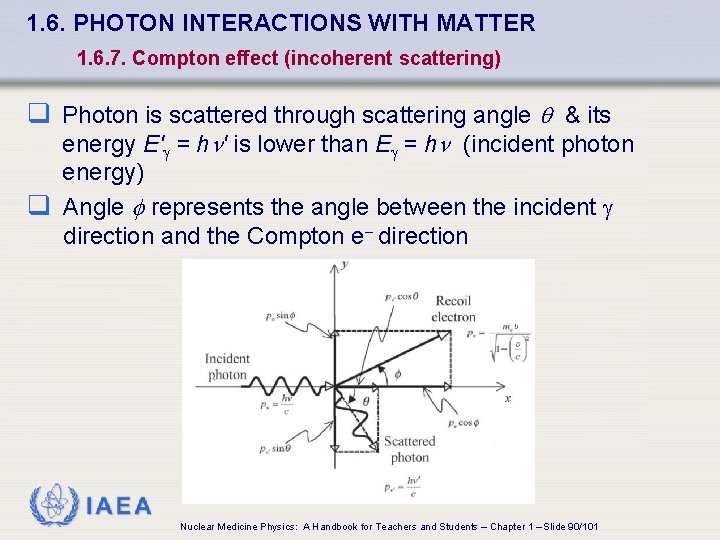
1. 6. PHOTON INTERACTIONS WITH MATTER 1. 6. 7. Compton effect (incoherent scattering) q Photon is scattered through scattering angle q & its energy E' = h ' is lower than E = h (incident photon energy) q Angle f represents the angle between the incident direction and the Compton e- direction IAEA Nuclear Medicine Physics: A Handbook for Teachers and Students – Chapter 1 – Slide 90/101
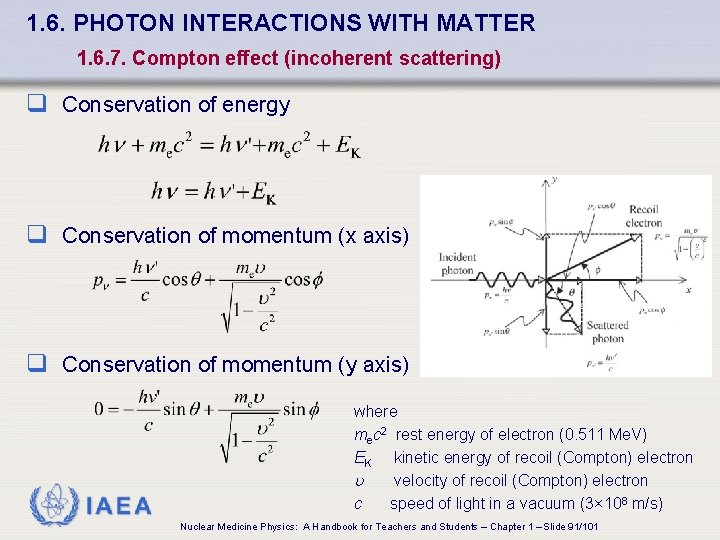
1. 6. PHOTON INTERACTIONS WITH MATTER 1. 6. 7. Compton effect (incoherent scattering) q Conservation of energy q Conservation of momentum (x axis) q Conservation of momentum (y axis) IAEA where mec 2 rest energy of electron (0. 511 Me. V) EK kinetic energy of recoil (Compton) electron velocity of recoil (Compton) electron c speed of light in a vacuum (3× 10⁸ m/s) Nuclear Medicine Physics: A Handbook for Teachers and Students – Chapter 1 – Slide 91/101
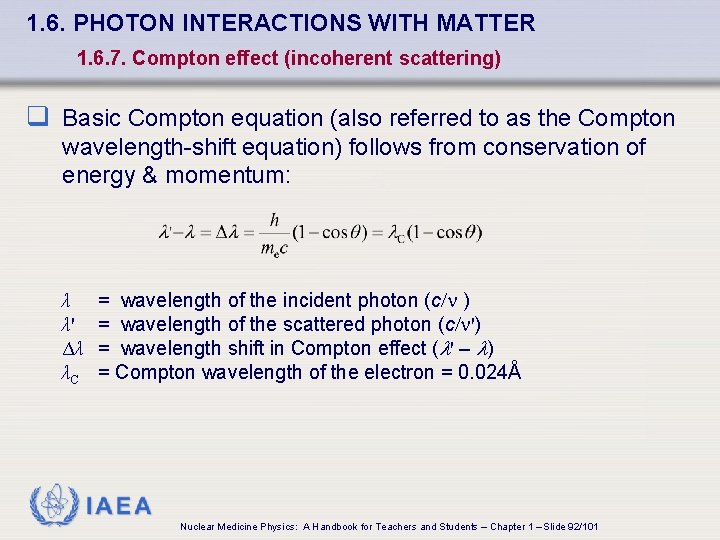
1. 6. PHOTON INTERACTIONS WITH MATTER 1. 6. 7. Compton effect (incoherent scattering) q Basic Compton equation (also referred to as the Compton wavelength-shift equation) follows from conservation of energy & momentum: λ λ' Δλ λC = wavelength of the incident photon (c/n ) = wavelength of the scattered photon (c/n') = wavelength shift in Compton effect (l' – l) = Compton wavelength of the electron = 0. 024Å IAEA Nuclear Medicine Physics: A Handbook for Teachers and Students – Chapter 1 – Slide 92/101
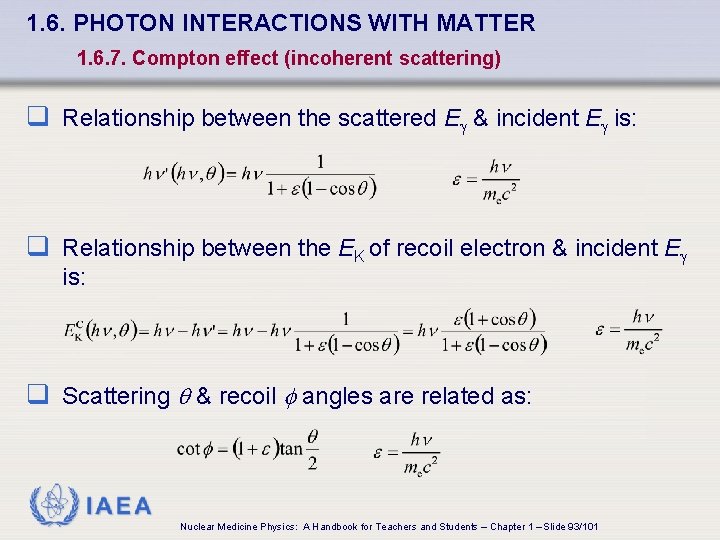
1. 6. PHOTON INTERACTIONS WITH MATTER 1. 6. 7. Compton effect (incoherent scattering) q Relationship between the scattered E & incident E is: q Relationship between the EK of recoil electron & incident E is: q Scattering q & recoil f angles are related as: IAEA Nuclear Medicine Physics: A Handbook for Teachers and Students – Chapter 1 – Slide 93/101
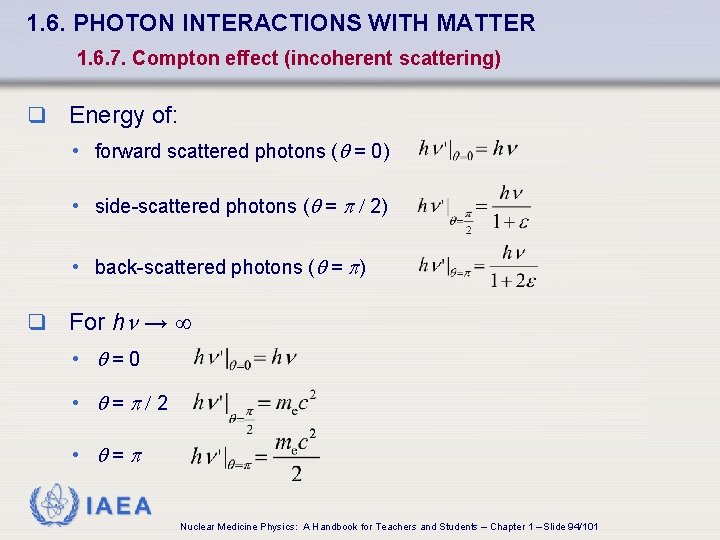
1. 6. PHOTON INTERACTIONS WITH MATTER 1. 6. 7. Compton effect (incoherent scattering) q Energy of: • forward scattered photons (q = 0) • side-scattered photons (q = p / 2) • back-scattered photons (q = p) q For h → • q=0 • q=p/2 • q=p IAEA Nuclear Medicine Physics: A Handbook for Teachers and Students – Chapter 1 – Slide 94/101
1. 6. PHOTON INTERACTIONS WITH MATTER 1. 6. 7. Compton effect (incoherent scattering) q (Compton electronic attenuation coefficient) • Steadily decreases with increasing h • Theoretical value = 0. 665 × 10– 24 cm 2/electron (Thomson crosssection) at low E • 0. 21 × 10– 24 cm 2/electron at h = 1 Me. V • 0. 51 × 10– 24 cm 2/electron at h = 10 Me. V • 0. 008 × 10– 24 cm 2/electron at h = 100 Me. V • Independent of Z • For C(Z = 6) and Pb(Z = 82) at E ~1 Me. V, where Compton effect predominates, both are 0. 1 cm 2/electron irrespective of Z q (Compton atomic attenuation coefficient ) • Depends linearly on absorber Z (because Compton interaction is with free electron) IAEA Nuclear Medicine Physics: A Handbook for Teachers and Students – Chapter 1 – Slide 95/101
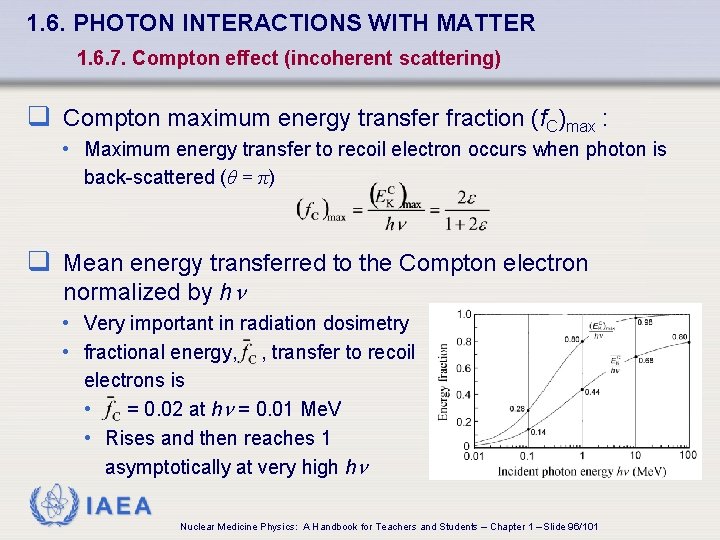
1. 6. PHOTON INTERACTIONS WITH MATTER 1. 6. 7. Compton effect (incoherent scattering) q Compton maximum energy transfer fraction (f. C)max : • Maximum energy transfer to recoil electron occurs when photon is back-scattered (θ = π) q Mean energy transferred to the Compton electron normalized by h • Very important in radiation dosimetry • fractional energy, , transfer to recoil electrons is • = 0. 02 at h = 0. 01 Me. V • Rises and then reaches 1 asymptotically at very high h IAEA Nuclear Medicine Physics: A Handbook for Teachers and Students – Chapter 1 – Slide 96/101
1. 6. PHOTON INTERACTIONS WITH MATTER 1. 6. 8. Pair production q Pair production • Production of e- - e+ pair + complete absorption of incident photon by absorber atom • Happens if : E = h > 2 mec 2 = 1. 022 Me. V, with mec 2 = rest energy of e- & e+ q Conserves: • Energy • Charge • Momentum IAEA Nuclear Medicine Physics: A Handbook for Teachers and Students – Chapter 1 – Slide 97/101
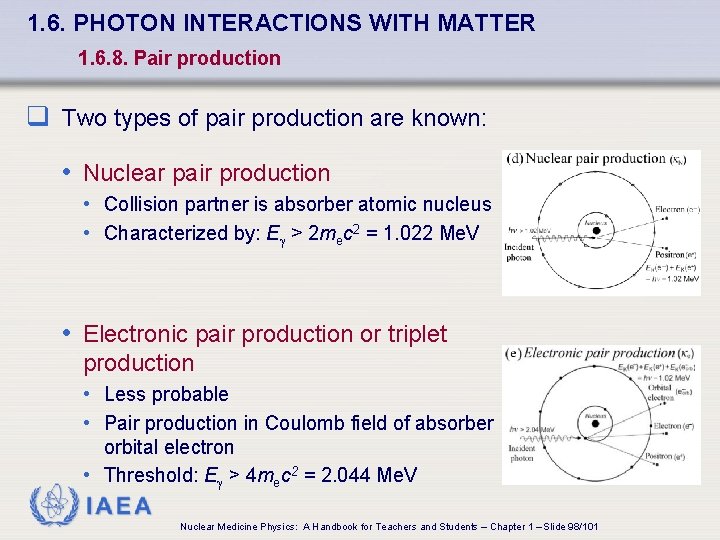
1. 6. PHOTON INTERACTIONS WITH MATTER 1. 6. 8. Pair production q Two types of pair production are known: • Nuclear pair production • Collision partner is absorber atomic nucleus • Characterized by: E > 2 mec 2 = 1. 022 Me. V • Electronic pair production or triplet production • Less probable • Pair production in Coulomb field of absorber orbital electron • Threshold: E > 4 mec 2 = 2. 044 Me. V IAEA Nuclear Medicine Physics: A Handbook for Teachers and Students – Chapter 1 – Slide 98/101
1. 6. PHOTON INTERACTIONS WITH MATTER 1. 6. 8. Pair production q Pair production attenuation coefficients • Usually as one parameter for nuclear & electronic • Nuclear pair production contributes > 90% • Pair production atomic attenuation coefficient ak • a k ~ Z 2 • Pair production mass attenuation coefficient k/r • k/r ~ Z q Pair production probability • Zero for E < 2 mec 2 = 1. 022 Me. V • Increases rapidly with E > threshold IAEA Nuclear Medicine Physics: A Handbook for Teachers and Students – Chapter 1 – Slide 99/101
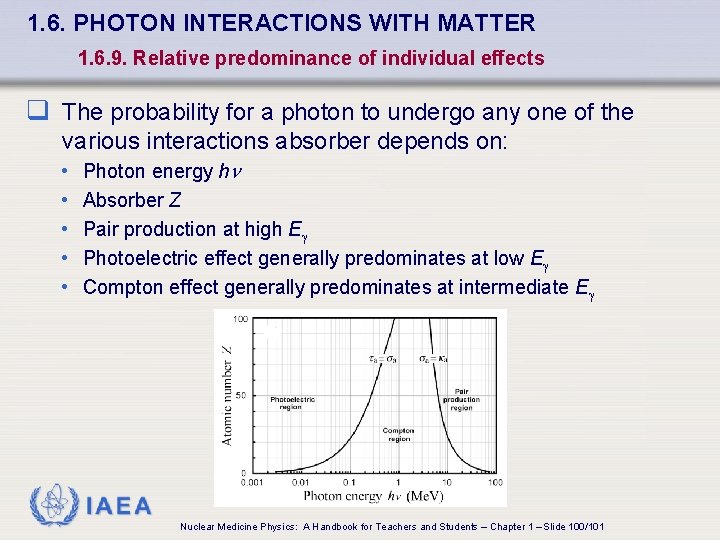
1. 6. PHOTON INTERACTIONS WITH MATTER 1. 6. 9. Relative predominance of individual effects q The probability for a photon to undergo any one of the various interactions absorber depends on: • • • Photon energy h Absorber Z Pair production at high E Photoelectric effect generally predominates at low E Compton effect generally predominates at intermediate E IAEA Nuclear Medicine Physics: A Handbook for Teachers and Students – Chapter 1 – Slide 100/101
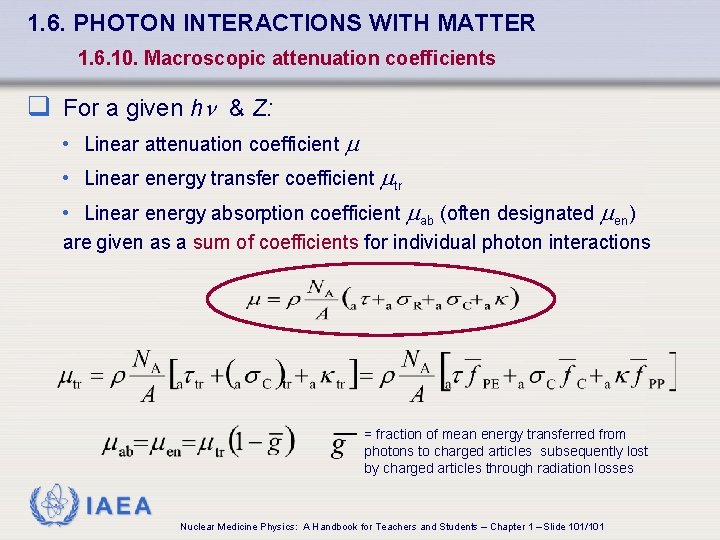
1. 6. PHOTON INTERACTIONS WITH MATTER 1. 6. 10. Macroscopic attenuation coefficients q For a given h & Z: • Linear attenuation coefficient • Linear energy transfer coefficient tr • Linear energy absorption coefficient ab (often designated en) are given as a sum of coefficients for individual photon interactions = fraction of mean energy transferred from photons to charged articles subsequently lost by charged articles through radiation losses IAEA Nuclear Medicine Physics: A Handbook for Teachers and Students – Chapter 1 – Slide 101/101
- Slides: 101