
Chapter 1 Basic Concepts Topics Covered Gas temperature

Chapter 1 Basic Concepts
Topics Covered Gas temperature Gas pressure Molecular weight and the mole Equation of state Viscosity Reynolds Number
Gas Temperature
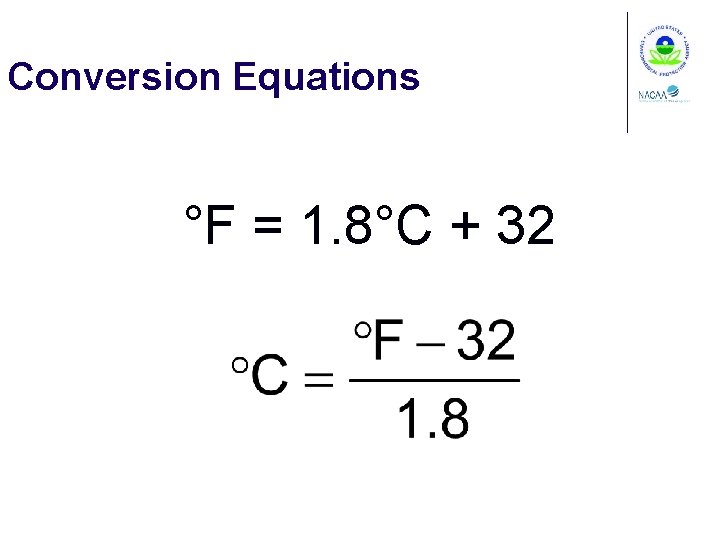
Conversion Equations °F = 1. 8°C + 32

Absolute Temperature Kelvin K = °C + 273 Rankine °R = °F + 460
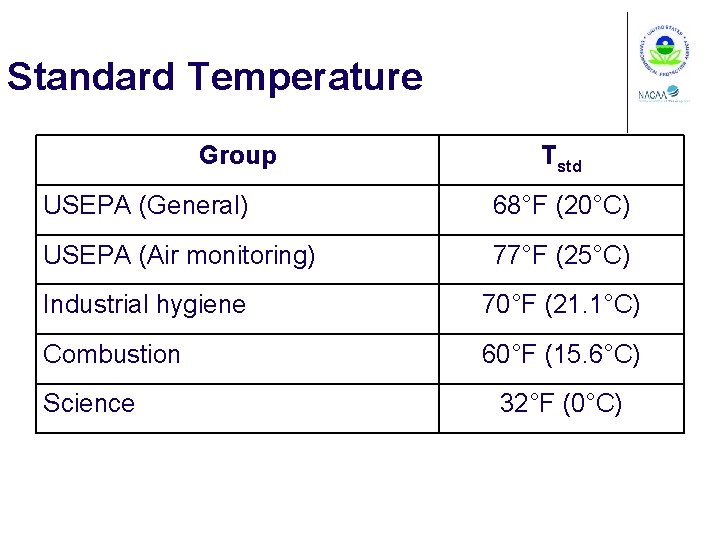
Standard Temperature Group Tstd USEPA (General) 68°F (20°C) USEPA (Air monitoring) 77°F (25°C) Industrial hygiene 70°F (21. 1°C) Combustion 60°F (15. 6°C) Science 32°F (0°C)
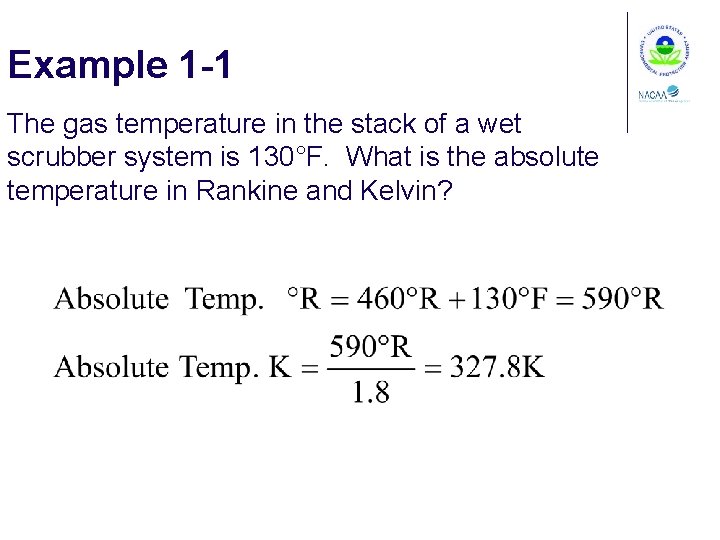
Example 1 -1 The gas temperature in the stack of a wet scrubber system is 130°F. What is the absolute temperature in Rankine and Kelvin?
Gas Pressure Barometric pressure Gauge pressure Absolute pressure
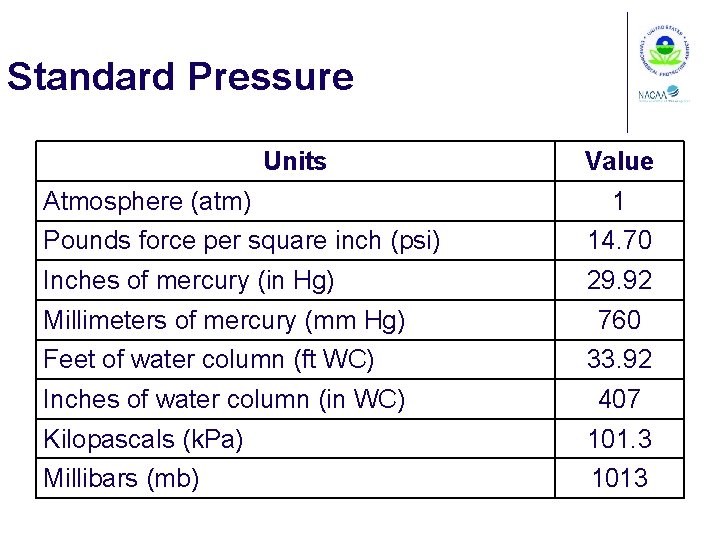
Standard Pressure Units Atmosphere (atm) Value 1 Pounds force per square inch (psi) 14. 70 Inches of mercury (in Hg) 29. 92 Millimeters of mercury (mm Hg) Feet of water column (ft WC) Inches of water column (in WC) 760 33. 92 407 Kilopascals (k. Pa) 101. 3 Millibars (mb) 1013
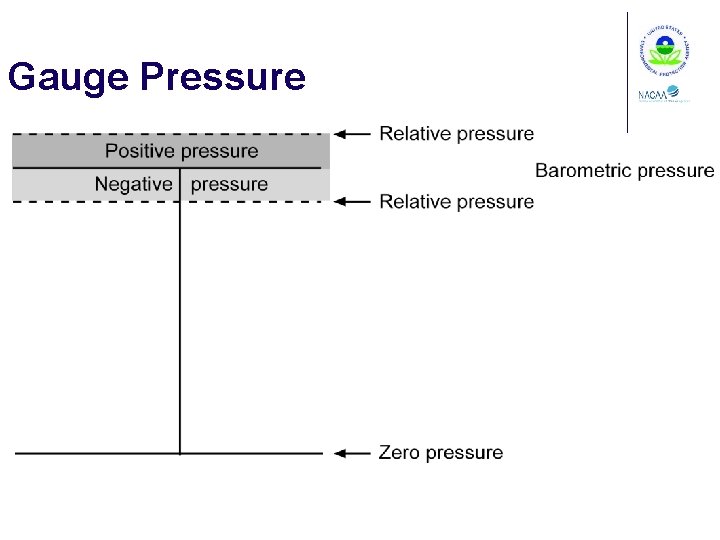
Gauge Pressure
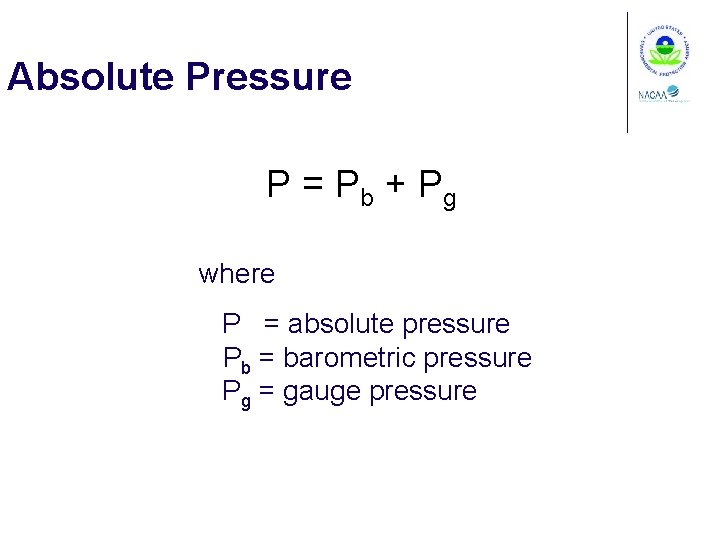
Absolute Pressure P = Pb + Pg where P = absolute pressure Pb = barometric pressure Pg = gauge pressure
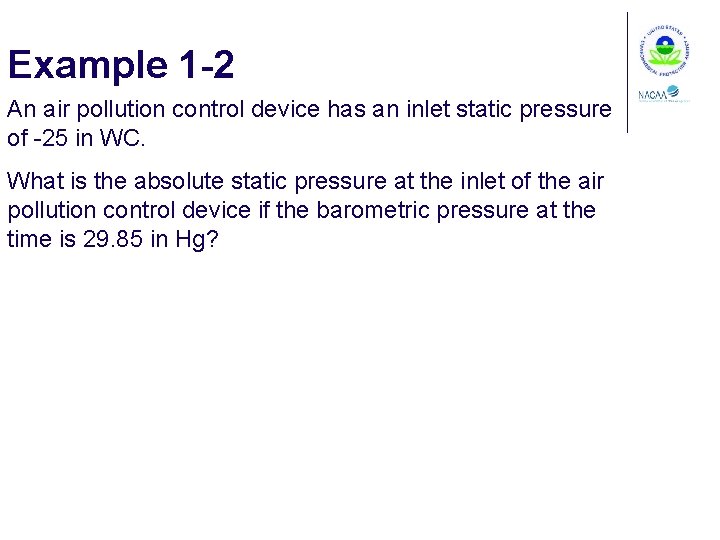
Example 1 -2 An air pollution control device has an inlet static pressure of -25 in WC. What is the absolute static pressure at the inlet of the air pollution control device if the barometric pressure at the time is 29. 85 in Hg?
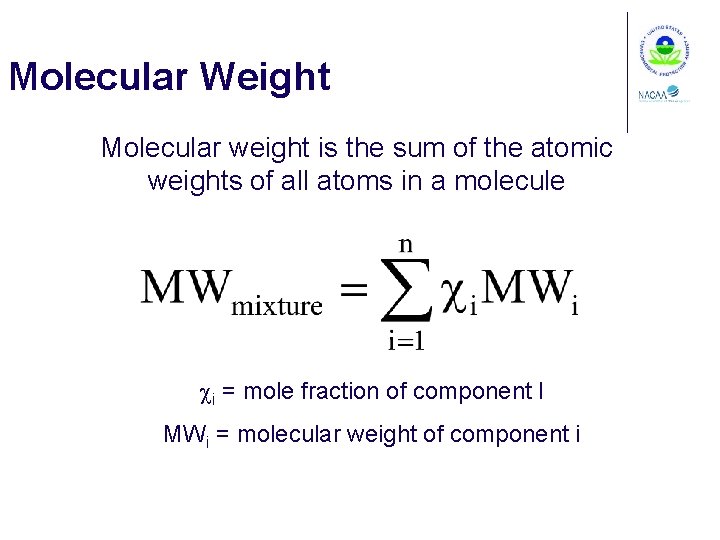
Molecular Weight Molecular weight is the sum of the atomic weights of all atoms in a molecule ci = mole fraction of component I MWi = molecular weight of component i
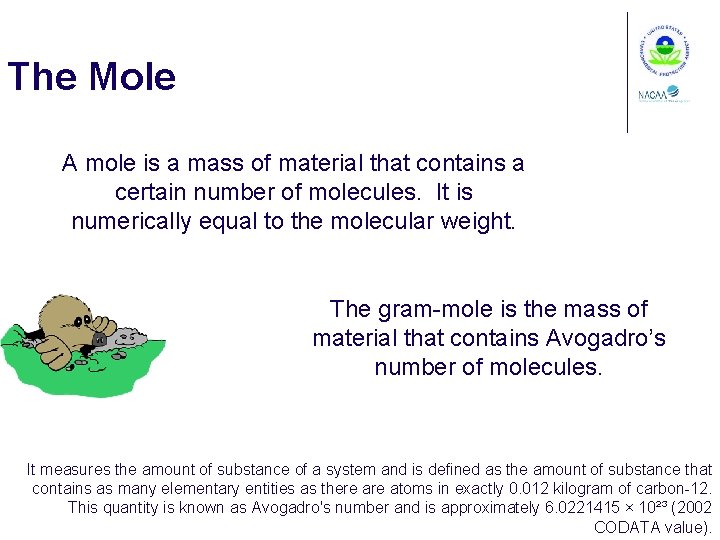
The Mole A mole is a mass of material that contains a certain number of molecules. It is numerically equal to the molecular weight. The gram-mole is the mass of material that contains Avogadro’s number of molecules. It measures the amount of substance of a system and is defined as the amount of substance that contains as many elementary entities as there atoms in exactly 0. 012 kilogram of carbon-12. This quantity is known as Avogadro's number and is approximately 6. 0221415 × 10²³ (2002 CODATA value).
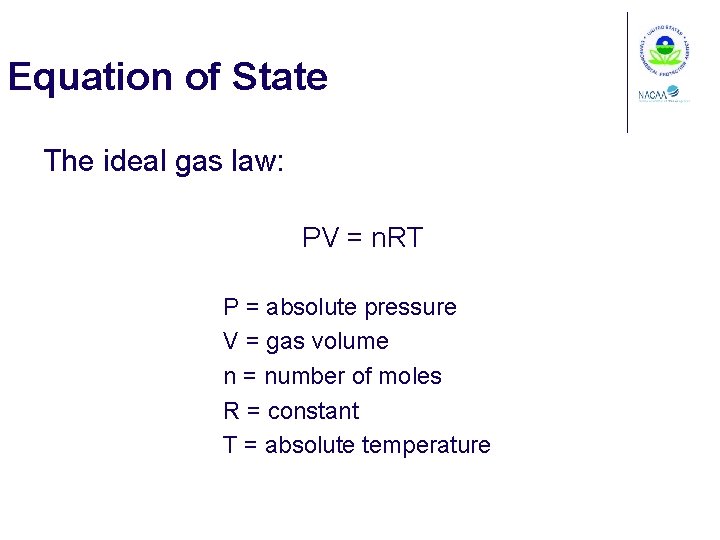
Equation of State The ideal gas law: PV = n. RT P = absolute pressure V = gas volume n = number of moles R = constant T = absolute temperature
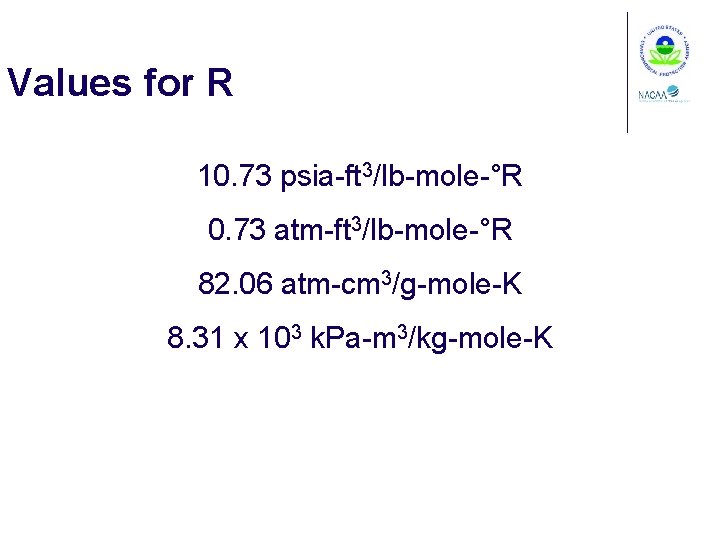
Values for R 10. 73 psia-ft 3/lb-mole-°R 0. 73 atm-ft 3/lb-mole-°R 82. 06 atm-cm 3/g-mole-K 8. 31 x 103 k. Pa-m 3/kg-mole-K
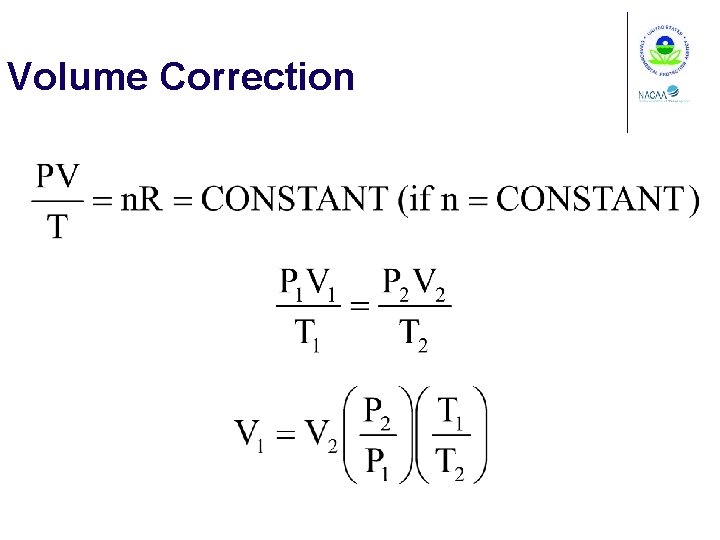
Volume Correction
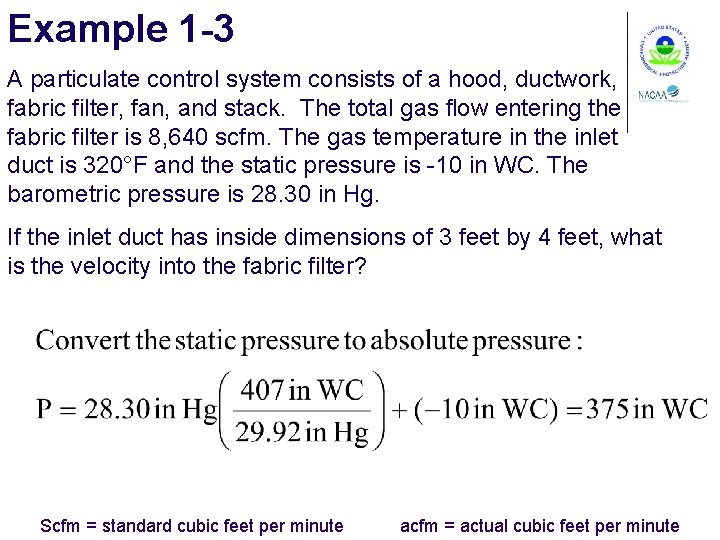
Example 1 -3 A particulate control system consists of a hood, ductwork, fabric filter, fan, and stack. The total gas flow entering the fabric filter is 8, 640 scfm. The gas temperature in the inlet duct is 320°F and the static pressure is -10 in WC. The barometric pressure is 28. 30 in Hg. If the inlet duct has inside dimensions of 3 feet by 4 feet, what is the velocity into the fabric filter? Scfm = standard cubic feet per minute acfm = actual cubic feet per minute

And then…
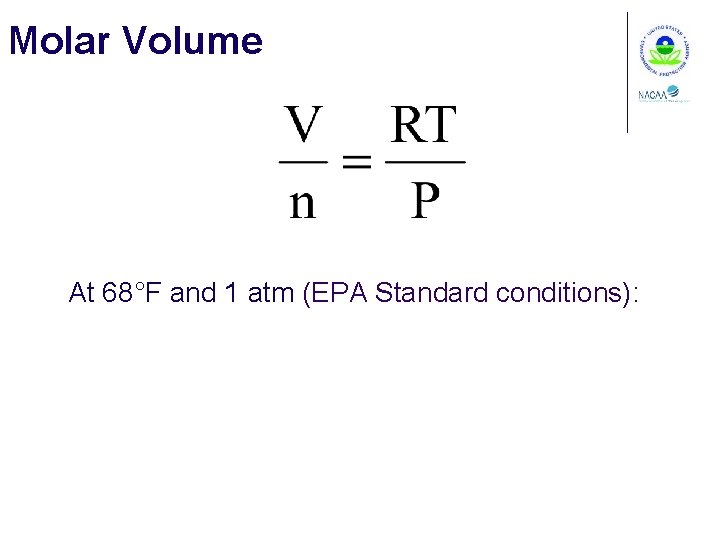
Molar Volume At 68°F and 1 atm (EPA Standard conditions):
Example 1 -4 What is the molar volume of an ideal gas at 200°F and 1 atm?

Solution…
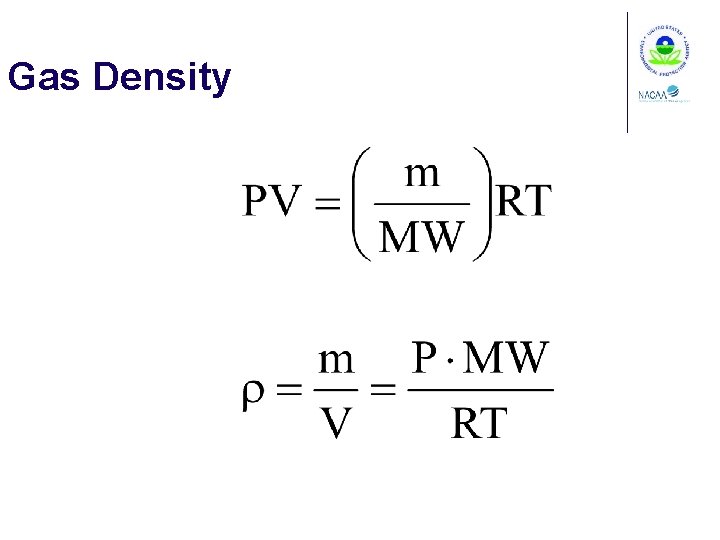
Gas Density
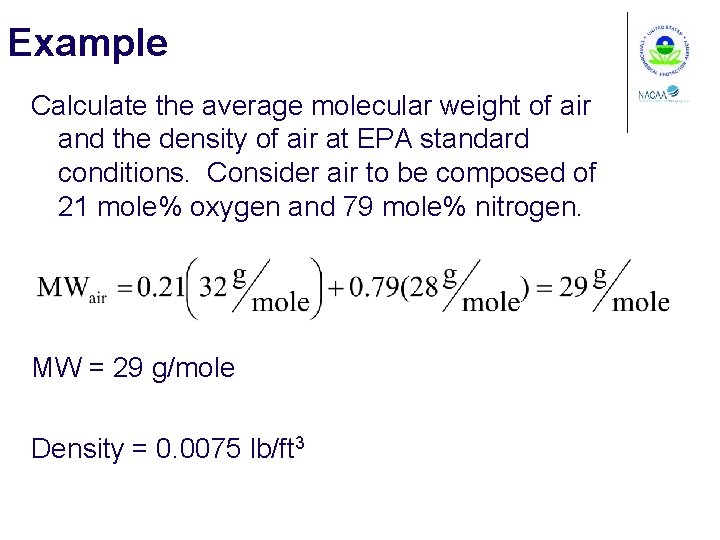
Example Calculate the average molecular weight of air and the density of air at EPA standard conditions. Consider air to be composed of 21 mole% oxygen and 79 mole% nitrogen. MW = 29 g/mole Density = 0. 0075 lb/ft 3
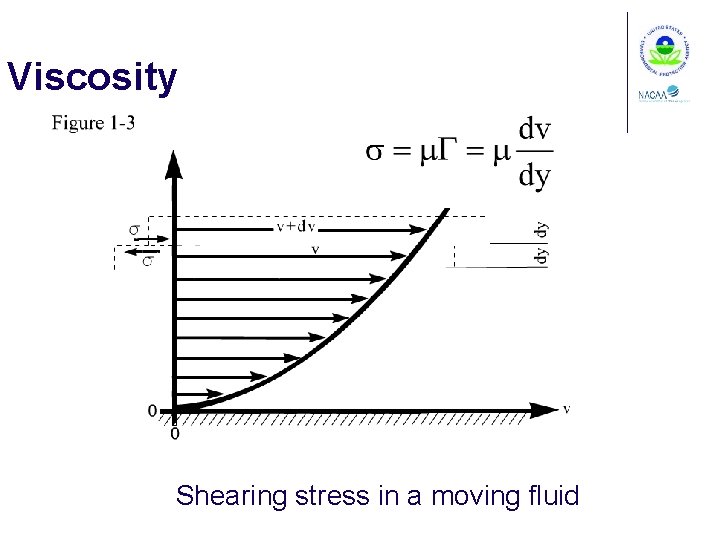
Viscosity Shearing stress in a moving fluid

Viscosity Intermolecular Momentum Cohesive Transfer Forces Between the Layers of Fluid
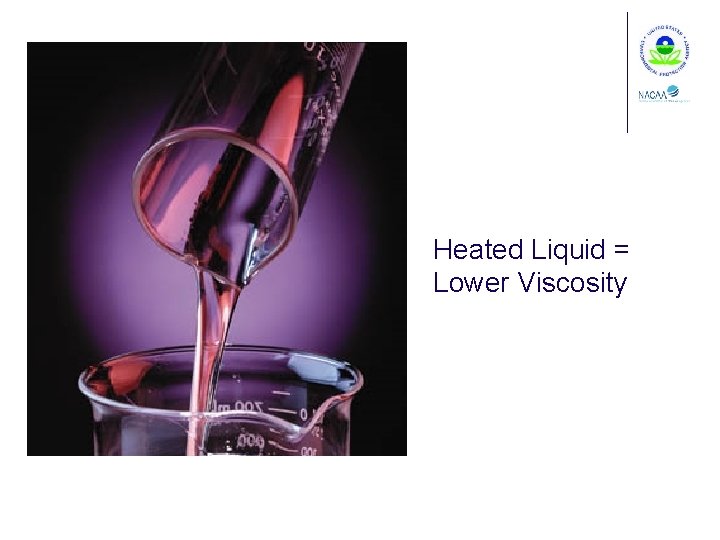
Heated Liquid = Lower Viscosity

Viscosity Intermolecular Momentum Cohesive Transfer Forces Between the Layers of Fluid
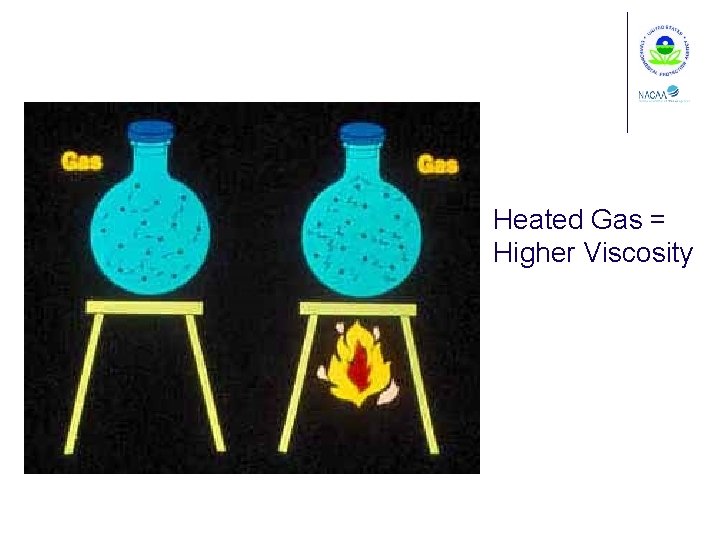
Heated Gas = Higher Viscosity
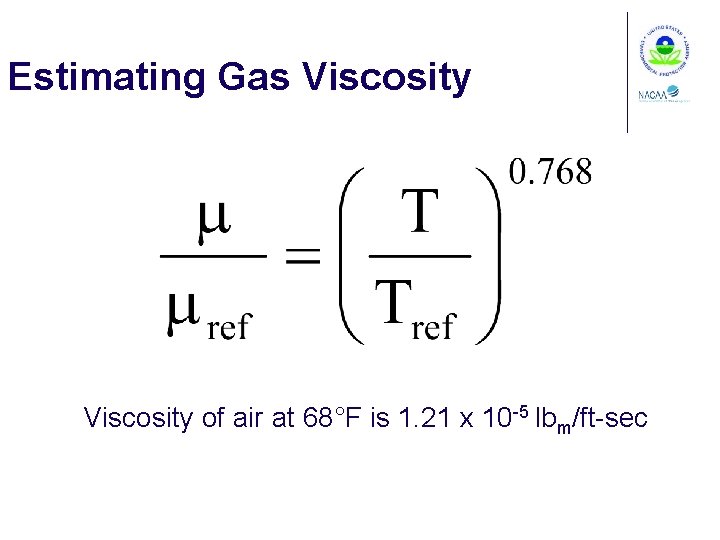
Estimating Gas Viscosity of air at 68°F is 1. 21 x 10 -5 lbm/ft-sec
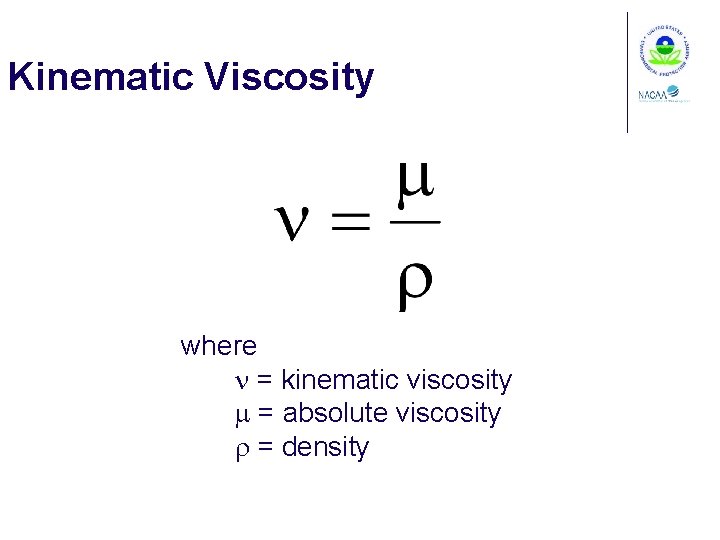
Kinematic Viscosity where n = kinematic viscosity m = absolute viscosity r = density
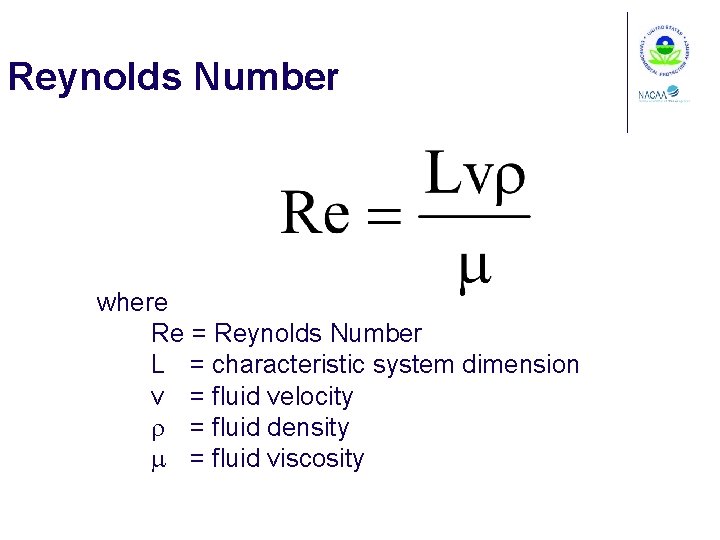
Reynolds Number where Re = Reynolds Number L = characteristic system dimension v = fluid velocity r = fluid density m = fluid viscosity
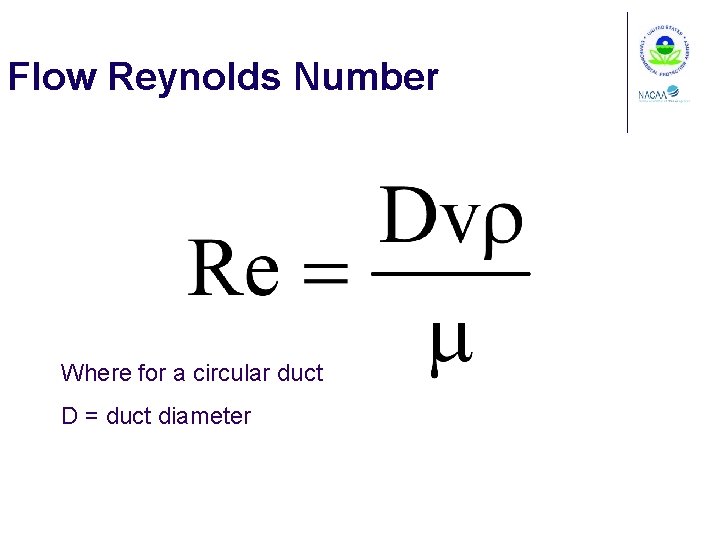
Flow Reynolds Number Where for a circular duct D = duct diameter
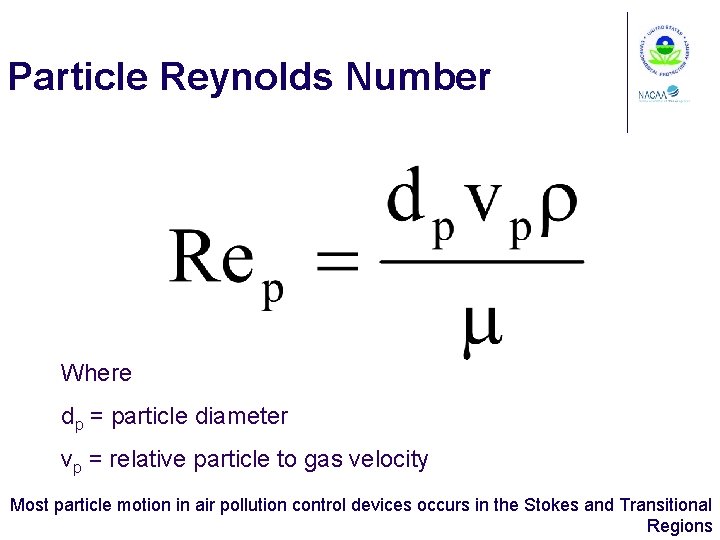
Particle Reynolds Number Where dp = particle diameter vp = relative particle to gas velocity Most particle motion in air pollution control devices occurs in the Stokes and Transitional Regions
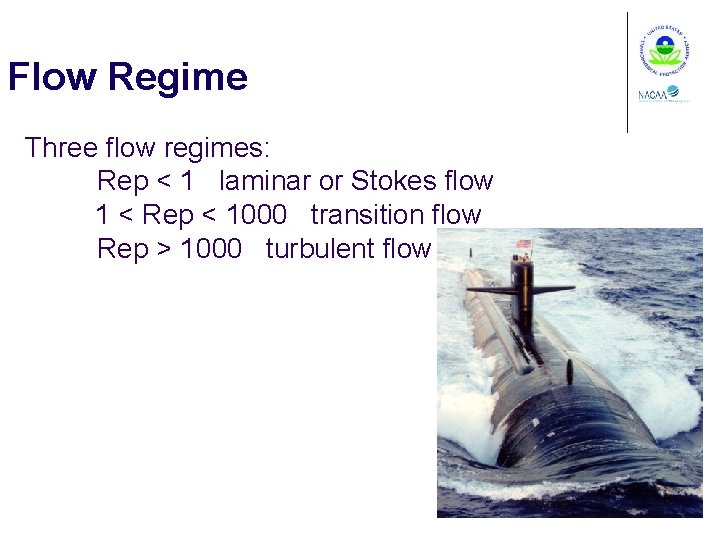
Flow Regime Three flow regimes: Rep < 1 laminar or Stokes flow 1 < Rep < 1000 transition flow Rep > 1000 turbulent flow
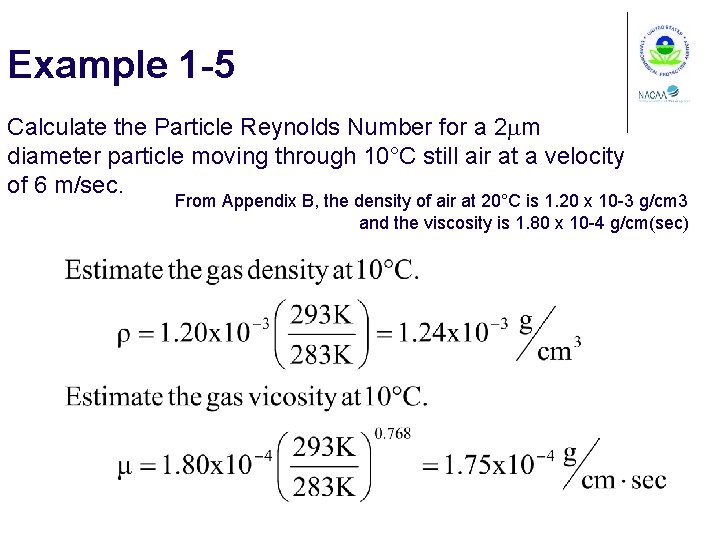
Example 1 -5 Calculate the Particle Reynolds Number for a 2 mm diameter particle moving through 10°C still air at a velocity of 6 m/sec. From Appendix B, the density of air at 20°C is 1. 20 x 10 -3 g/cm 3 and the viscosity is 1. 80 x 10 -4 g/cm(sec)
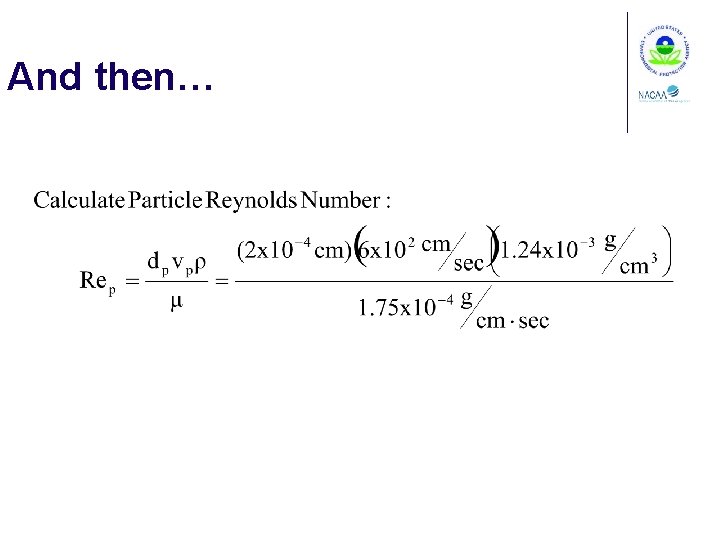
And then…
Example 1 -6 Calculate the Particle Reynolds Number for a gas stream moving through a 200 cm diameter duct at a velocity of 1, 500 cm/sec. • Assume that the particles are moving at the same velocity as the gas stream and are not settling due to gravity. • Assume a gas temperature of 20°C and standard pressure. Since there is no difference in velocity between the gas stream and the particle, the Particle Reynolds Number is zero.
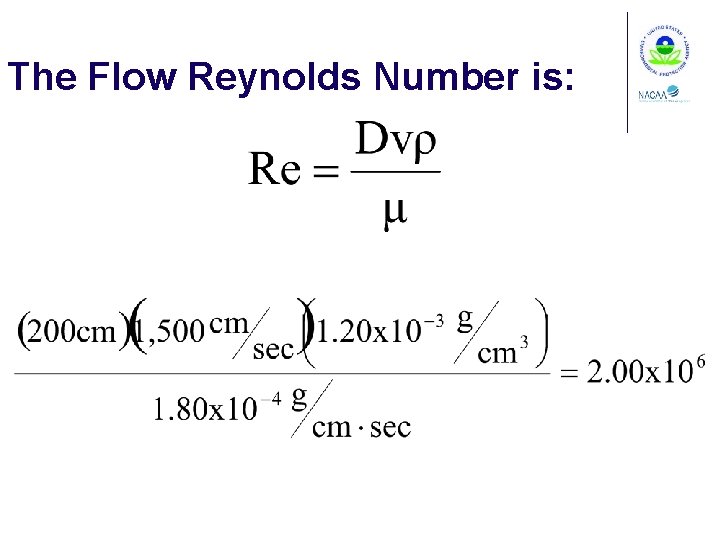
The Flow Reynolds Number is:
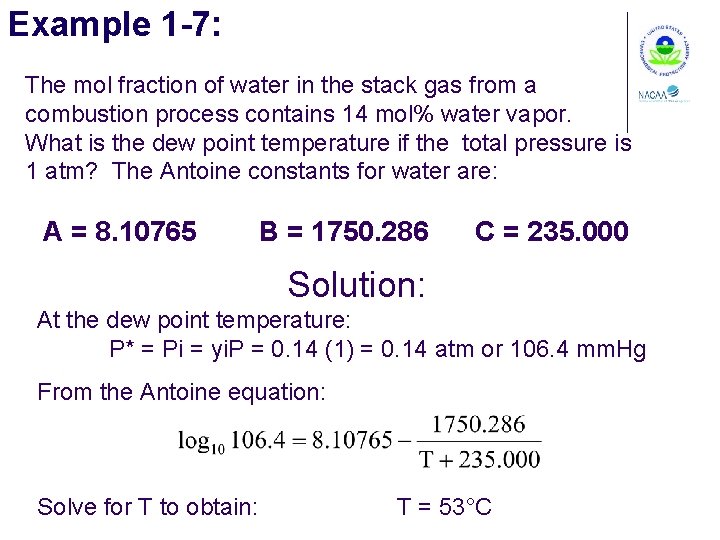
Example 1 -7: The mol fraction of water in the stack gas from a combustion process contains 14 mol% water vapor. What is the dew point temperature if the total pressure is 1 atm? The Antoine constants for water are: A = 8. 10765 B = 1750. 286 C = 235. 000 Solution: At the dew point temperature: P* = Pi = yi. P = 0. 14 (1) = 0. 14 atm or 106. 4 mm. Hg From the Antoine equation: Solve for T to obtain: T = 53°C
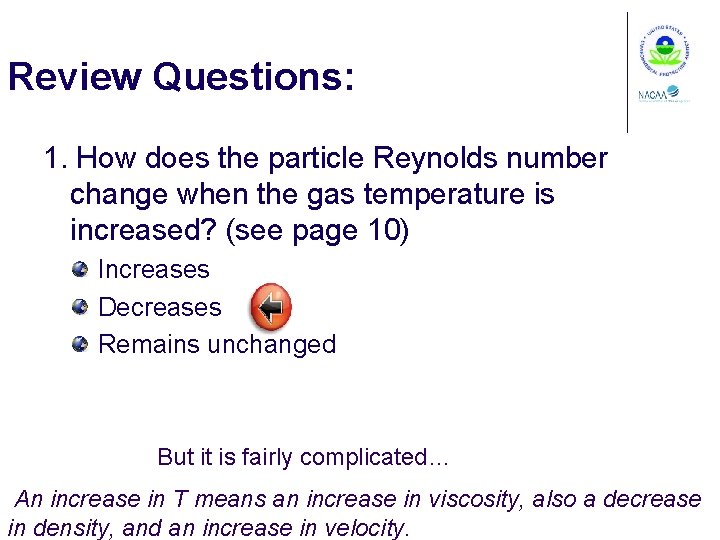
Review Questions: 1. How does the particle Reynolds number change when the gas temperature is increased? (see page 10) Increases Decreases Remains unchanged But it is fairly complicated… An increase in T means an increase in viscosity, also a decrease in density, and an increase in velocity.
Review Questions: 2. How does the gas viscosity change as the temperature is increased? (see page 9) Increases Decreases Remains unchanged
Review Problems 1. The flows from Ducts A and B are combined into a single Duct C. The flow rate in Duct A is 5, 000 scfm, the gas stream temperature is 350°F and the static pressure is -32 in WC. The flow rate in Duct B is 4, 000 acfm, the gas stream temperature is 400°F and the static pressure is -35 in WC. What is the flow rate in Duct C? Assume a barometric pressure of 29. 15 in Hg. (see page 6)

Solution #1
Review Problems 2. Calculate the Particle Reynolds Numbers for the following particles. Assume a gas temperature of 20°C and a pressure of 1 atm. (see page 10) 10 mm particle moving at 1 ft/sec relative to the gas stream 10 mm particle moving at 10 ft/sec relative to the gas stream 100 mm particle moving at 10 ft/sec relative to the gas stream
Solution #2 (a & b) a. 10 mm particle moving at 1 ft/sec relative to the gas stream b. 10 mm particle moving at 10 ft/sec relative to the gas stream
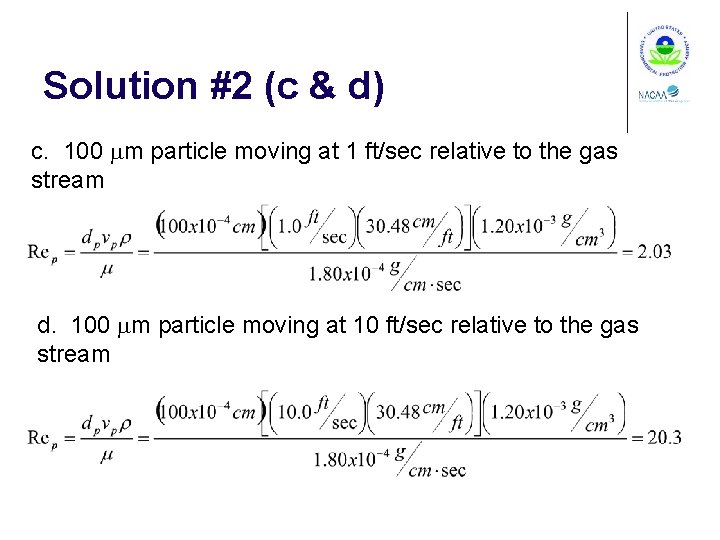
Solution #2 (c & d) c. 100 mm particle moving at 1 ft/sec relative to the gas stream d. 100 mm particle moving at 10 ft/sec relative to the gas stream
- Slides: 47