
Chapter 1 Basic Concepts Overview System Life Cycle
Chapter 1 Basic Concepts Overview: System Life Cycle Algorithm Specification Data Abstraction Performance Analysis Performance Measurement
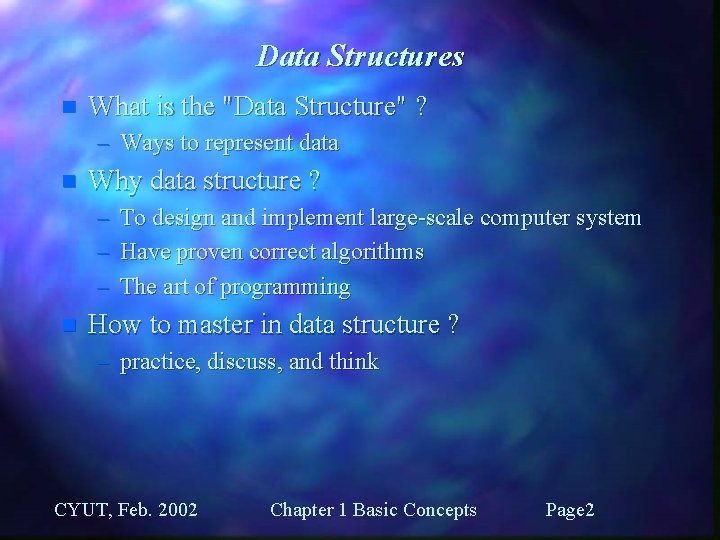
Data Structures n What is the "Data Structure" ? – Ways to represent data n Why data structure ? – – – n To design and implement large-scale computer system Have proven correct algorithms The art of programming How to master in data structure ? – practice, discuss, and think CYUT, Feb. 2002 Chapter 1 Basic Concepts Page 2
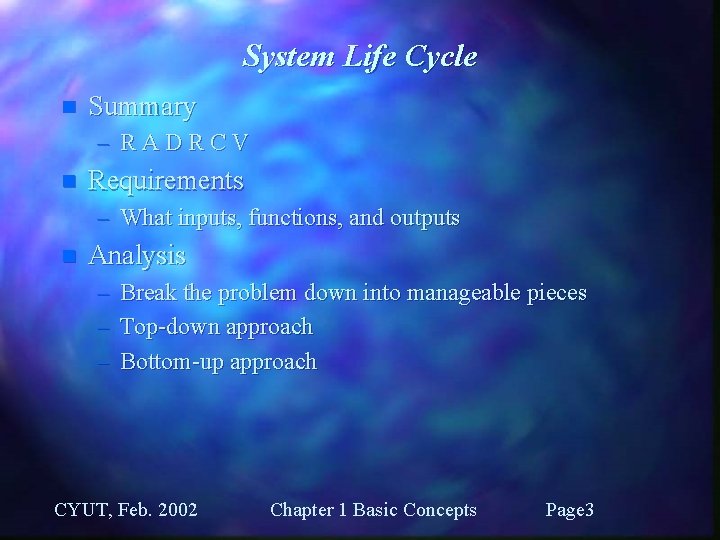
System Life Cycle n Summary – RADRCV n Requirements – What inputs, functions, and outputs n Analysis – – – Break the problem down into manageable pieces Top-down approach Bottom-up approach CYUT, Feb. 2002 Chapter 1 Basic Concepts Page 3
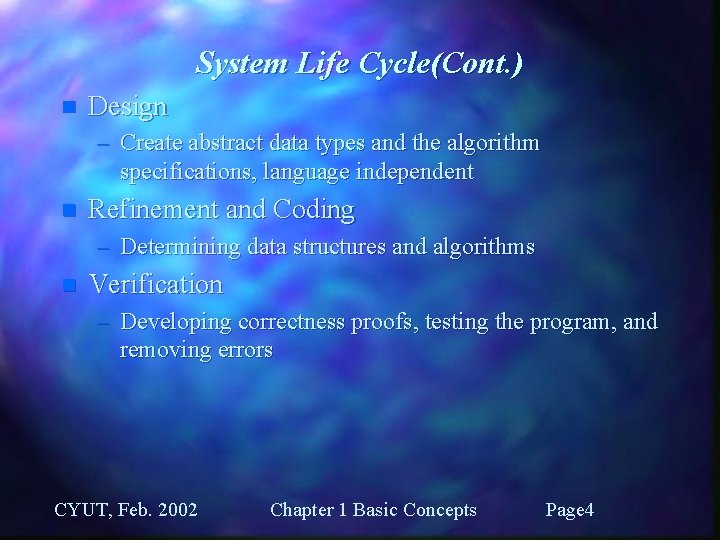
System Life Cycle(Cont. ) n Design – Create abstract data types and the algorithm specifications, language independent n Refinement and Coding – Determining data structures and algorithms n Verification – Developing correctness proofs, testing the program, and removing errors CYUT, Feb. 2002 Chapter 1 Basic Concepts Page 4
Verification n Correctness proofs – Prove program mathematically n time-consuming and difficult to develop for large system n Testing – Verify that every piece of code runs correctly n provide data including all possible scenarios n Error removal – Guarantee no new errors generated n Notes – Select a proven correct algorithm is important – Initial tests focus on verifying that a program runs correctly, then reduce the running time CYUT, Feb. 2002 Chapter 1 Basic Concepts Page 5
Chapter 1 Basic Concepts n n n Overview: System Life Cycle Algorithm Specification Data Abstraction Performance Analysis Performance Measurement CYUT, Feb. 2002 Chapter 1 Basic Concepts Page 6
Algorithm Specification n Definition – An algorithm is a finite set of instructions that, if followed, accomplishes a particular task. In addition, all algorithms must satisfy the following criteria: (1)Input. There are zero or more quantities that are externally supplied. (2)Output. At least one quantity is produced. (3)Definiteness. Each instruction is clear and unambiguous. (4)Finiteness. If we trace out the instructions of an algorithm, then for all cases, the algorithm terminates after a finite number of steps. (5)Effectiveness. Every instruction must be basic enough to be carried out, in principle, by a person using only pencil and paper. It is not enough that each operation be definite as in (3); it also must be feasible. CYUT, Feb. 2002 Chapter 1 Basic Concepts Page 7
Describing Algorithms n Natural language – English, Chinese n n Instructions must be definite and effectiveness Graphic representation – Flowchart n n work well only if the algorithm is small and simple Pseudo language – Readable – Instructions must be definite and effectiveness n Combining English and C++ – In this text CYUT, Feb. 2002 Chapter 1 Basic Concepts Page 8
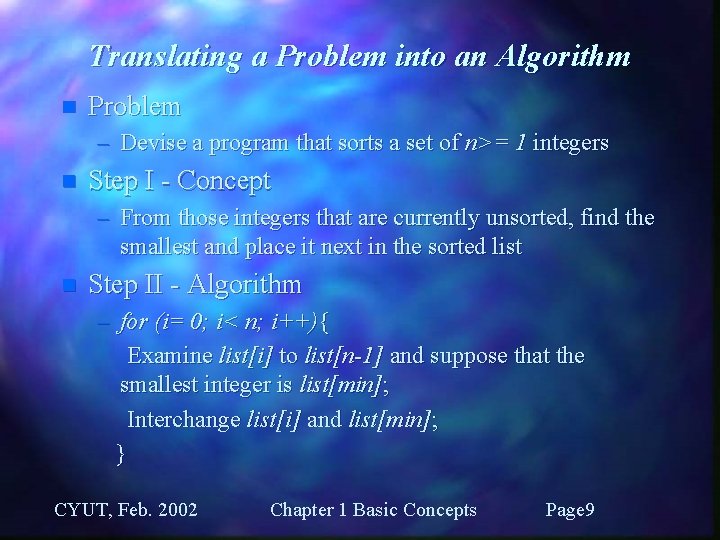
Translating a Problem into an Algorithm n Problem – Devise a program that sorts a set of n>= 1 integers n Step I - Concept – From those integers that are currently unsorted, find the smallest and place it next in the sorted list n Step II - Algorithm – for (i= 0; i< n; i++){ Examine list[i] to list[n-1] and suppose that the smallest integer is list[min]; Interchange list[i] and list[min]; } CYUT, Feb. 2002 Chapter 1 Basic Concepts Page 9
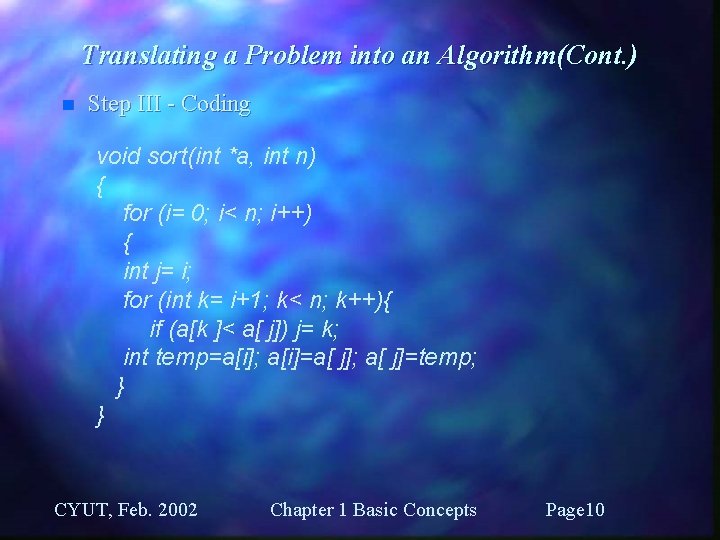
Translating a Problem into an Algorithm(Cont. ) n Step III - Coding void sort(int *a, int n) { for (i= 0; i< n; i++) { int j= i; for (int k= i+1; k< n; k++){ if (a[k ]< a[ j]) j= k; int temp=a[i]; a[i]=a[ j]; a[ j]=temp; } } CYUT, Feb. 2002 Chapter 1 Basic Concepts Page 10
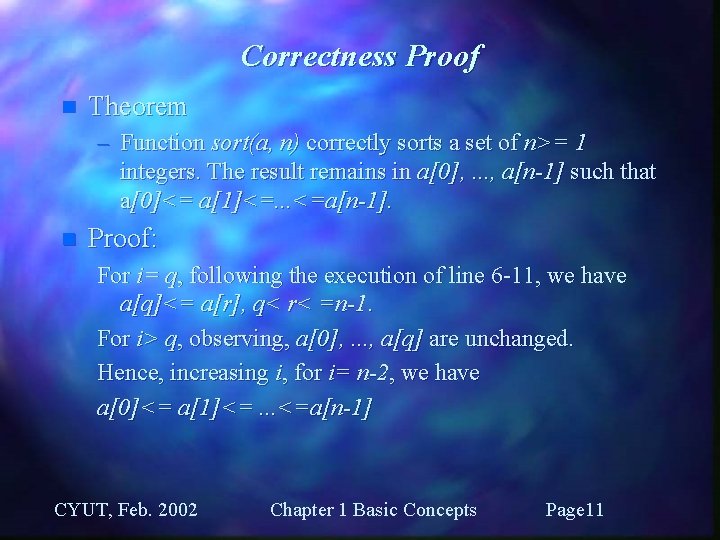
Correctness Proof n Theorem – Function sort(a, n) correctly sorts a set of n>= 1 integers. The result remains in a[0], . . . , a[n-1] such that a[0]<= a[1]<=. . . <=a[n-1]. n Proof: For i= q, following the execution of line 6 -11, we have a[q]<= a[r], q< r< =n-1. For i> q, observing, a[0], . . . , a[q] are unchanged. Hence, increasing i, for i= n-2, we have a[0]<= a[1]<=. . . <=a[n-1] CYUT, Feb. 2002 Chapter 1 Basic Concepts Page 11

Recursive Algorithms n Direct recursion – Functions call themselves n Indirect recursion – Functions call other functions that invoke the calling function again n When is recursion an appropriate mechanism? – – – n The problem itself is defined recursively Statements: if-else and while can be written recursively Art of programming Why recursive algorithms ? – Powerful, express an complex process very clearly CYUT, Feb. 2002 Chapter 1 Basic Concepts Page 12
![Recursive Implementation of Binary Search int binsearch(int list[], int searchnum, int left, int right)](http://slidetodoc.com/presentation_image_h/d981eb0e557b4aacdbff75cc20c525c5/image-13.jpg "Recursive Implementation of Binary Search int binsearch(int list[], int searchnum, int left, int right)")
Recursive Implementation of Binary Search int binsearch(int list[], int searchnum, int left, int right) {// search list[0]<= list[1]<=. . . <=list[n-1] for searchnum int middle; while (left<= right){ middle= (left+ right)/2; switch(compare(list[middle], searchnum)){ case -1: left= middle+ 1; break; int compare(int x, int y) { case 0: return middle; if (x< y) return -1; case 1: right= middle- 1; break; else if (x== y) return 0; }} else return 1; return -1; } } CYUT, Feb. 2002 Chapter 1 Basic Concepts Page 13
![Recursive Implementation of Binary Search int binsearch(int list[], int searchnum, int left, int right)](http://slidetodoc.com/presentation_image_h/d981eb0e557b4aacdbff75cc20c525c5/image-14.jpg "Recursive Implementation of Binary Search int binsearch(int list[], int searchnum, int left, int right)")
Recursive Implementation of Binary Search int binsearch(int list[], int searchnum, int left, int right) {// search list[0]<= list[1]<=. . . <=list[n-1] for searchnum int middle; while (left<= right){ middle= (left+ right)/2; switch(compare(list[middle], searchnum)){ case -1: return binsearch(list, searchnum, middle+1, right); case 0: return middle; case 1: return binsearch(list, searchnum, left, middle- 1); } } return -1; } CYUT, Feb. 2002 Chapter 1 Basic Concepts Page 14
Chapter 1 Basic Concepts n n n Overview: System Life Cycle Algorithm Specification Data Abstraction Performance Analysis Performance Measurement CYUT, Feb. 2002 Chapter 1 Basic Concepts Page 15
Data Abstraction n Types of data – All programming language provide at least minimal set of predefined data type, plus user defined types n Data types of C – Char, int, float, and double n may be modified by short, long, and unsigned – Array, struct, and pointer CYUT, Feb. 2002 Chapter 1 Basic Concepts Page 16
Data Type n Definition – A data type is a collection of objects and a set of operations that act on those objects n Example of "int" – Objects: 0, +1, -1, . . . , Int_Max, Int_Min – Operations: arithmetic(+, -, *, /, and %), testing(equality/inequality), assigns, functions n Define operations – Its name, possible arguments and results must be specified n The design strategy for representation of objects – Transparent to the user CYUT, Feb. 2002 Chapter 1 Basic Concepts Page 17
Abstract Data Type n Definition – An abstract data type(ADT) is a data type that is organized in such a way that the specification of the objects and the specification of the operations on the objects is separated from the representation of the objects and the implementation of the operation. # n Why abstract data type ? – implementation-independent CYUT, Feb. 2002 Chapter 1 Basic Concepts Page 18
Classifying the Functions of a Data Type n Creator/constructor: – Create a new instance of the designated type n Transformers – Also create an instance of the designated type by using one or more other instances n Observers/reporters – Provide information about an instance of the type, but they do not change the instance n Notes – An ADT definition will include at least one function from each of these three categories CYUT, Feb. 2002 Chapter 1 Basic Concepts Page 19
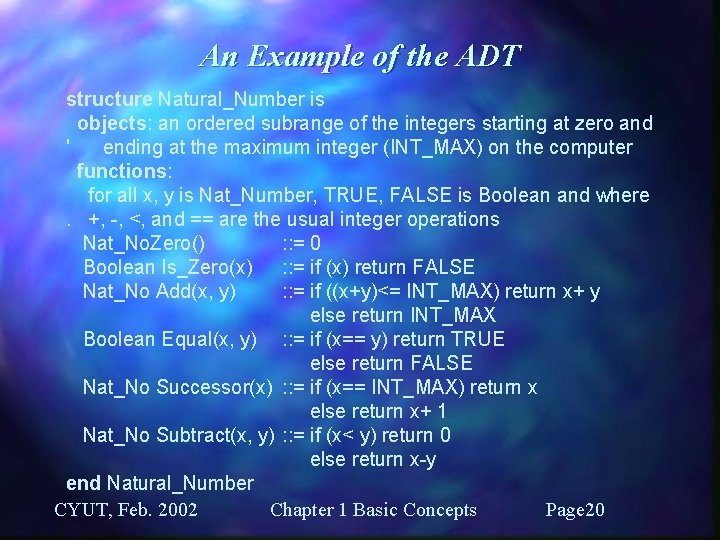
An Example of the ADT structure Natural_Number is objects: an ordered subrange of the integers starting at zero and ' ending at the maximum integer (INT_MAX) on the computer functions: for all x, y is Nat_Number, TRUE, FALSE is Boolean and where. +, -, <, and == are the usual integer operations Nat_No. Zero() : : = 0 Boolean Is_Zero(x) : : = if (x) return FALSE Nat_No Add(x, y) : : = if ((x+y)<= INT_MAX) return x+ y else return INT_MAX Boolean Equal(x, y) : : = if (x== y) return TRUE else return FALSE Nat_No Successor(x) : : = if (x== INT_MAX) return x else return x+ 1 Nat_No Subtract(x, y) : : = if (x< y) return 0 else return x-y end Natural_Number CYUT, Feb. 2002 Chapter 1 Basic Concepts Page 20
Chapter 1 Basic Concepts n n n Overview: System Life Cycle Algorithm Specification Data Abstraction Performance Analysis Performance Measurement CYUT, Feb. 2002 Chapter 1 Basic Concepts Page 21
Performance Analysis n Performance evaluation – Performance analysis – Performance measurement n Performance analysis - prior – – – n an important branch of CS, complexity theory estimate time and space machine independent Performance measurement -posterior – The actual time and space requirements – machine dependent CYUT, Feb. 2002 Chapter 1 Basic Concepts Page 22
Performance Analysis(Cont. ) n Space and time – Does the program efficiently use primary and secondary storage? – Is the program's running time acceptable for the task? n Evaluate a program generally – – – Does the program meet the original specifications of the task? Does it work correctly? Does the program contain documentation that show to use it and how it works? – Does the program effectively use functions to create logical units? – Is the program's code readable? CYUT, Feb. 2002 Chapter 1 Basic Concepts Page 23
Performance Analysis(Cont. ) n Evaluate a program – MWGWRERE Meet specifications, Work correctly, Good user-interface, Well-documentation, Readable, Effectively use functions, Running time acceptable, Efficiently use space n How to achieve them? – Good programming style, experience, and practice – Discuss and think CYUT, Feb. 2002 Chapter 1 Basic Concepts Page 24
Space Complexity n Definition – The space complexity of a program is the amount of memory that it needs to run to completion n The space needed is the sum of – Fixed space and Variable space n Fixed space – – n Includes the instructions, variables, and constants Independent of the number and size of I/O Variable space – Includes dynamic allocation, functions' recursion n Total space of any program – S(P)= c+ Sp(Instance) CYUT, Feb. 2002 Chapter 1 Basic Concepts Page 25
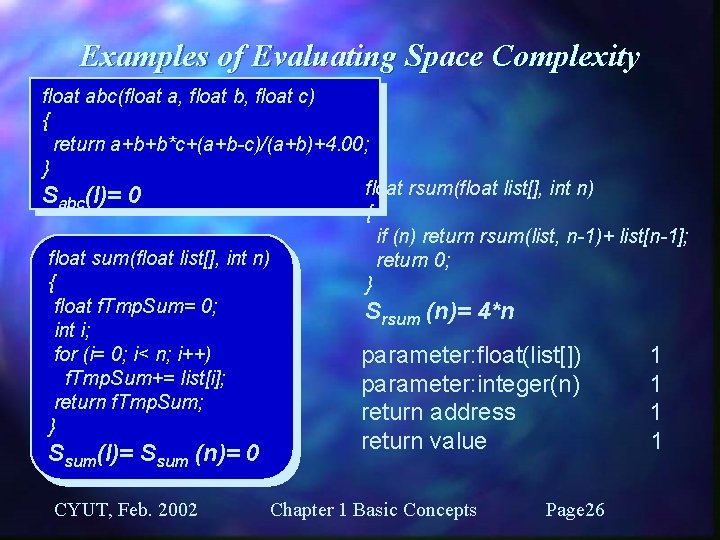
Examples of Evaluating Space Complexity float abc(float a, float b, float c) { return a+b+b*c+(a+b-c)/(a+b)+4. 00; } float rsum(float list[], int n) Sabc(I)= 0 { if (n) return rsum(list, n-1)+ list[n-1]; float sum(float list[], int n) return 0; { } float f. Tmp. Sum= 0; Srsum (n)= 4*n int i; for (i= 0; i< n; i++) parameter: float(list[]) 1 f. Tmp. Sum+= list[i]; parameter: integer(n) 1 return f. Tmp. Sum; return address 1 } Ssum(I)= Ssum (n)= 0 CYUT, Feb. 2002 return value Chapter 1 Basic Concepts 1 Page 26
q Definition Time Complexity q The time complexity, T(p), taken by a program P is the sum of the compile time and the run time q Total time q T(P)= compile time + run (or execution) time = c + tp(instance characteristics) Compile time does not depend on the instance characteristics q How to evaluate? q Use the system clock q Number of steps performed q q machine-independent Definition of a program step q A program step is a syntactically or semantically meaningful program segment whose execution time is independent of the instance characteristics (10 additions can be one step, 100 multiplications can also be one step) (p 33~p 35 有計算C++ 語法之 steps 之概述, 原則是一個表示式一步) CYUT, Feb. 2002 Chapter 1 Basic Concepts Page 27
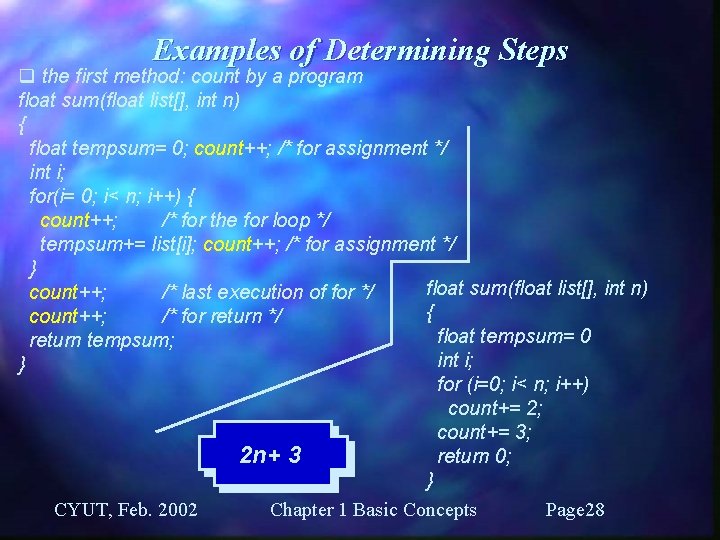
Examples of Determining Steps q the first method: count by a program float sum(float list[], int n) { float tempsum= 0; count++; /* for assignment */ int i; for(i= 0; i< n; i++) { count++; /* for the for loop */ tempsum+= list[i]; count++; /* for assignment */ } float sum(float list[], int n) count++; /* last execution of for */ { count++; /* for return */ float tempsum= 0 return tempsum; int i; } for (i=0; i< n; i++) count+= 2; count+= 3; 2 n+ 3 return 0; } CYUT, Feb. 2002 Chapter 1 Basic Concepts Page 28
![Examples of Determining Steps(Cont. ) trsum(0) = 2 float rsum(float list[], int n) {](http://slidetodoc.com/presentation_image_h/d981eb0e557b4aacdbff75cc20c525c5/image-29.jpg "Examples of Determining Steps(Cont. ) trsum(0) = 2 float rsum(float list[], int n) {")
Examples of Determining Steps(Cont. ) trsum(0) = 2 float rsum(float list[], int n) { trsum(n) = 2 + trsum(n-1) count ++; /* for if condition */ = 2 + trsum(n-2) if (n) { = 2*2 + trsum(n-2) count++; /* for return and rsum invocation */ =… return rsum(list, n-1)+ list[n-1]; = 2 n + trsum(0)= 2 n+2 } void add(int a[][Max. Size], int b[][Max. Size], count++; //return int c[][Max. Size], int rows, int cols) return list[0]; } { int i, j; for (i=0; i< rows; i++) 2 n+ 2 p. 39, program 1. 19 for (j=0; j< cols; j++) c[i][j]= a[i][j] + b[i][j]; 自行計算 } CYUT, Feb. 2002 2 rows*cols+ 2 rows+ 1 Chapter 1 Basic Concepts Page 29
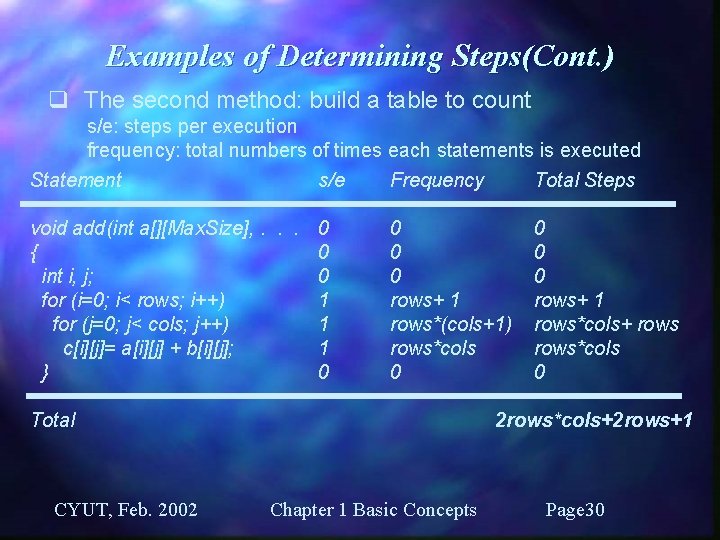
Examples of Determining Steps(Cont. ) q The second method: build a table to count s/e: steps per execution frequency: total numbers of times each statements is executed Statement s/e void add(int a[][Max. Size], . . . 0 { 0 int i, j; 0 for (i=0; i< rows; i++) 1 for (j=0; j< cols; j++) 1 c[i][j]= a[i][j] + b[i][j]; 1 } 0 Frequency Total Steps 0 0 0 rows+ 1 rows*(cols+1) rows*cols 0 0 rows+ 1 rows*cols+ rows*cols 0 Total CYUT, Feb. 2002 2 rows*cols+2 rows+1 Chapter 1 Basic Concepts Page 30
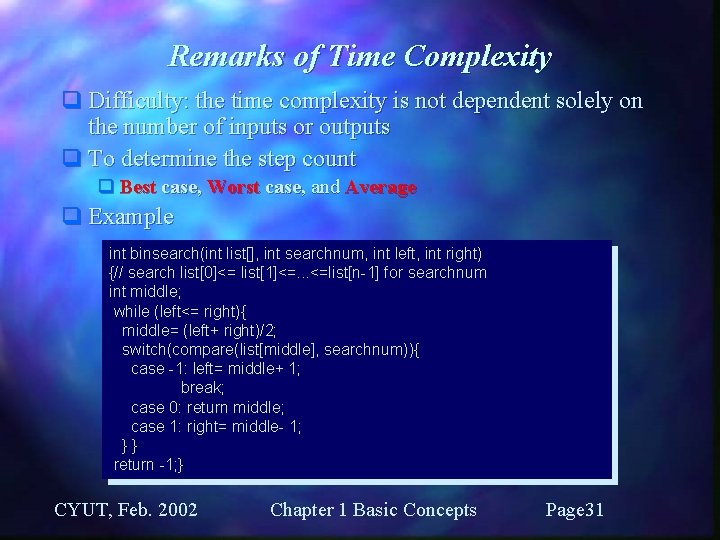
Remarks of Time Complexity q Difficulty: the time complexity is not dependent solely on the number of inputs or outputs q To determine the step count q Best case, Worst case, and Average q Example int binsearch(int list[], int searchnum, int left, int right) {// search list[0]<= list[1]<=. . . <=list[n-1] for searchnum int middle; while (left<= right){ middle= (left+ right)/2; switch(compare(list[middle], searchnum)){ case -1: left= middle+ 1; break; case 0: return middle; case 1: right= middle- 1; }} return -1; } CYUT, Feb. 2002 Chapter 1 Basic Concepts Page 31
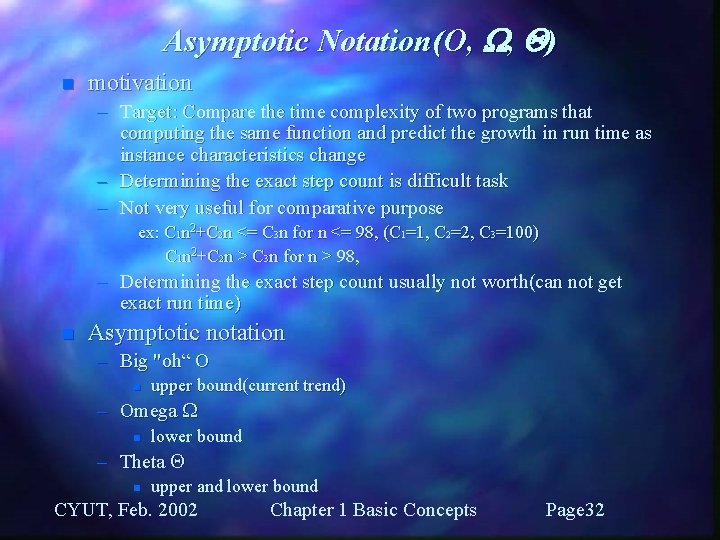
Asymptotic Notation(O, , ) n motivation – Target: Compare the time complexity of two programs that computing the same function and predict the growth in run time as instance characteristics change – Determining the exact step count is difficult task – Not very useful for comparative purpose ex: C 1 n 2+C 2 n <= C 3 n for n <= 98, (C 1=1, C 2=2, C 3=100) C 1 n 2+C 2 n > C 3 n for n > 98, – Determining the exact step count usually not worth(can not get exact run time) n Asymptotic notation – Big "oh“ O n upper bound(current trend) – Omega n lower bound – Theta n upper and lower bound CYUT, Feb. 2002 Chapter 1 Basic Concepts Page 32
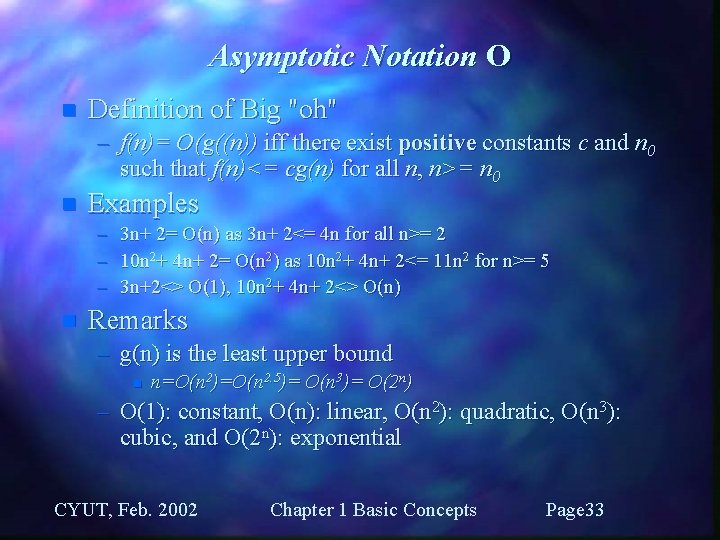
Asymptotic Notation O n Definition of Big "oh" – f(n)= O(g((n)) iff there exist positive constants c and n 0 such that f(n)<= cg(n) for all n, n>= n 0 n Examples – 3 n+ 2= O(n) as 3 n+ 2<= 4 n for all n>= 2 – 10 n 2+ 4 n+ 2= O(n 2) as 10 n 2+ 4 n+ 2<= 11 n 2 for n>= 5 – 3 n+2<> O(1), 10 n 2+ 4 n+ 2<> O(n) n Remarks – g(n) is the least upper bound n n=O(n 2)=O(n 2. 5)= O(n 3)= O(2 n) – O(1): constant, O(n): linear, O(n 2): quadratic, O(n 3): cubic, and O(2 n): exponential CYUT, Feb. 2002 Chapter 1 Basic Concepts Page 33
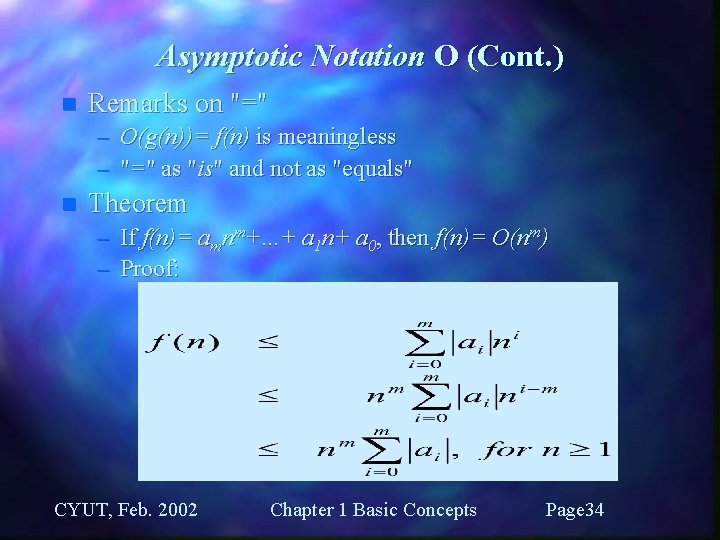
Asymptotic Notation O (Cont. ) n Remarks on "=" – O(g(n))= f(n) is meaningless – "=" as "is" and not as "equals" n Theorem – If f(n)= amnm+. . . + a 1 n+ a 0, then f(n)= O(nm) – Proof: CYUT, Feb. 2002 Chapter 1 Basic Concepts Page 34
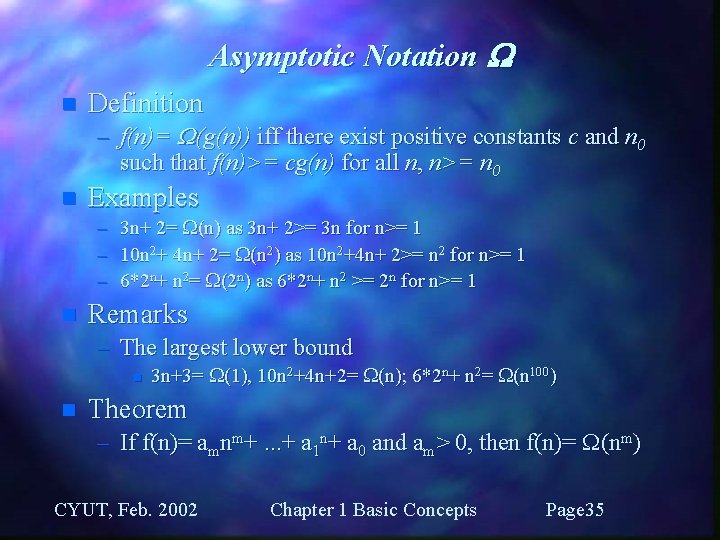
Asymptotic Notation n Definition – f(n)= (g(n)) iff there exist positive constants c and n 0 such that f(n)>= cg(n) for all n, n>= n 0 n Examples – – – n 3 n+ 2= (n) as 3 n+ 2>= 3 n for n>= 1 10 n 2+ 4 n+ 2= (n 2) as 10 n 2+4 n+ 2>= n 2 for n>= 1 6*2 n+ n 2= (2 n) as 6*2 n+ n 2 >= 2 n for n>= 1 Remarks – The largest lower bound n n 3 n+3= (1), 10 n 2+4 n+2= (n); 6*2 n+ n 2= (n 100) Theorem – If f(n)= amnm+. . . + a 1 n+ a 0 and am> 0, then f(n)= (nm) CYUT, Feb. 2002 Chapter 1 Basic Concepts Page 35
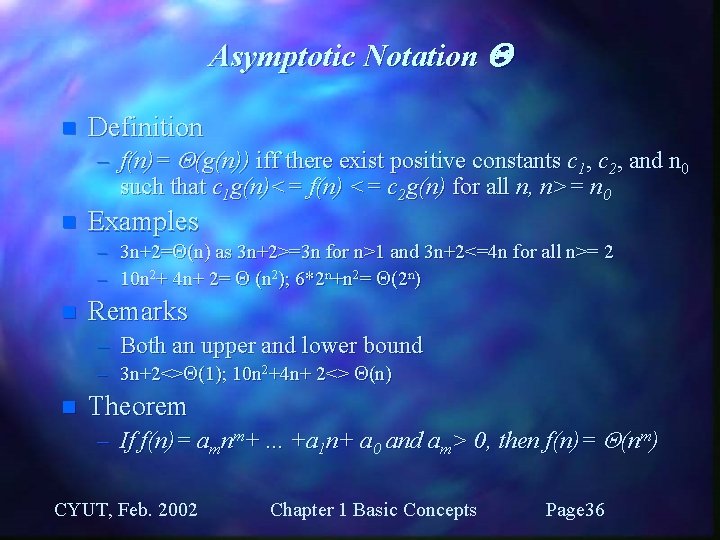
Asymptotic Notation n Definition – f(n)= (g(n)) iff there exist positive constants c 1, c 2, and n 0 such that c 1 g(n)<= f(n) <= c 2 g(n) for all n, n>= n 0 n Examples – 3 n+2= (n) as 3 n+2>=3 n for n>1 and 3 n+2<=4 n for all n>= 2 – 10 n 2+ 4 n+ 2= (n 2); 6*2 n+n 2= (2 n) n Remarks – Both an upper and lower bound – 3 n+2<> (1); 10 n 2+4 n+ 2<> (n) n Theorem – If f(n)= amnm+. . . +a 1 n+ a 0 and am> 0, then f(n)= (nm) CYUT, Feb. 2002 Chapter 1 Basic Concepts Page 36
![Example of Time Complexity Analysis Statement Asymptotic complexity void add(int a[][Max. . . .](http://slidetodoc.com/presentation_image_h/d981eb0e557b4aacdbff75cc20c525c5/image-37.jpg "Example of Time Complexity Analysis Statement Asymptotic complexity void add(int a[][Max. . . .")
Example of Time Complexity Analysis Statement Asymptotic complexity void add(int a[][Max. . . . ) { int i, j; for(i= 0; i< rows; i++) for(j=0; j< cols; j++) c[i][j]= a[i][j]+ b[i][j]; } 0 0 0 (rows) (rows*cols) 0 Total (rows*cols) CYUT, Feb. 2002 Chapter 1 Basic Concepts Page 37
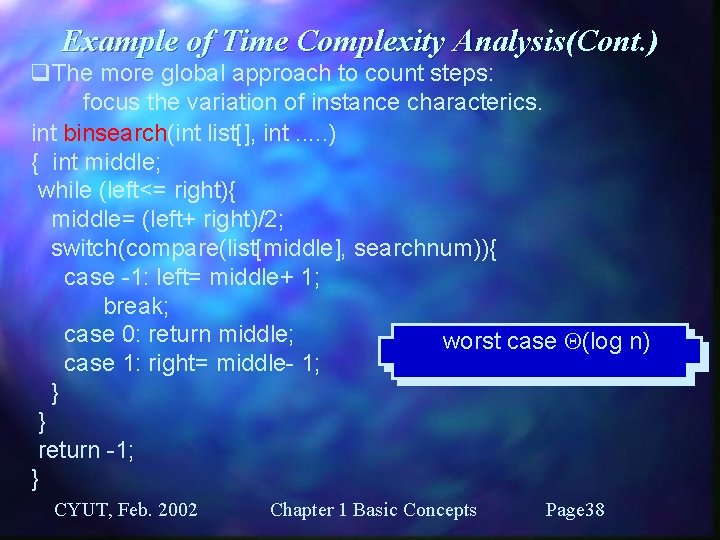
Example of Time Complexity Analysis(Cont. ) q. The more global approach to count steps: focus the variation of instance characterics. int binsearch(int list[], int. . . ) { int middle; while (left<= right){ middle= (left+ right)/2; switch(compare(list[middle], searchnum)){ case -1: left= middle+ 1; break; case 0: return middle; worst case (log n) case 1: right= middle- 1; } } return -1; } CYUT, Feb. 2002 Chapter 1 Basic Concepts Page 38
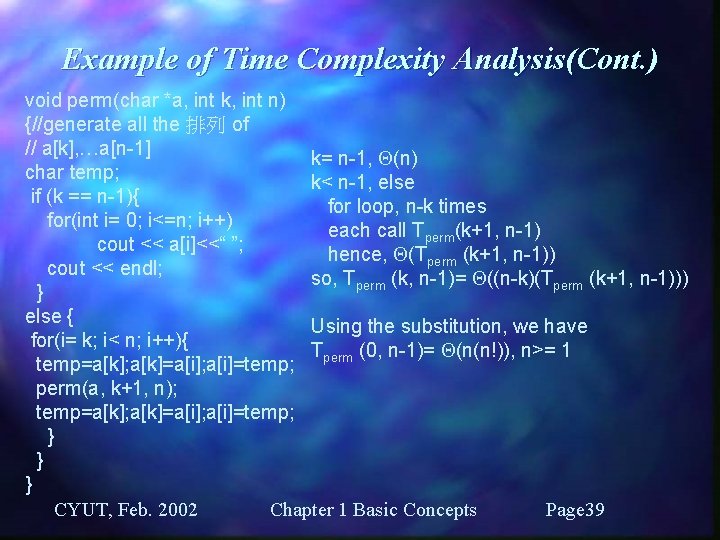
Example of Time Complexity Analysis(Cont. ) void perm(char *a, int k, int n) {//generate all the 排列 of // a[k], …a[n-1] k= n-1, (n) char temp; k< n-1, else if (k == n-1){ for loop, n-k times for(int i= 0; i<=n; i++) each call Tperm(k+1, n-1) cout << a[i]<<“ ”; hence, (Tperm (k+1, n-1)) cout << endl; so, Tperm (k, n-1)= ((n-k)(Tperm (k+1, n-1))) } else { Using the substitution, we have for(i= k; i< n; i++){ T (0, n-1)= (n(n!)), n>= 1 temp=a[k]; a[k]=a[i]; a[i]=temp; perm(a, k+1, n); temp=a[k]; a[k]=a[i]; a[i]=temp; } } } CYUT, Feb. 2002 Chapter 1 Basic Concepts Page 39
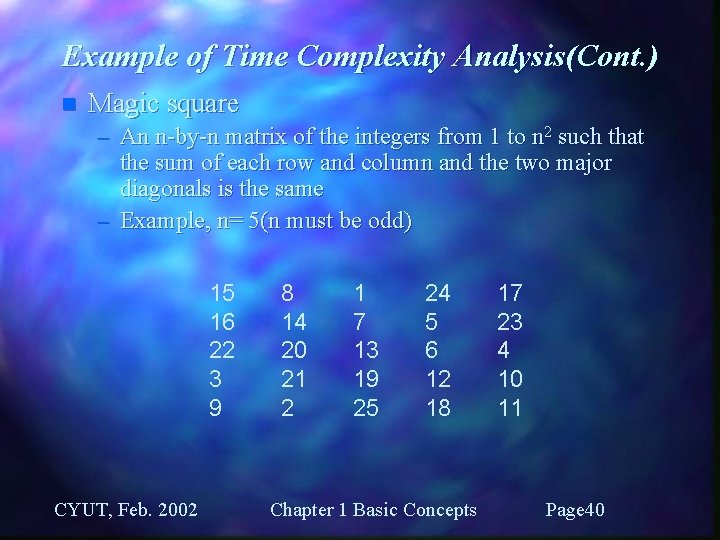
Example of Time Complexity Analysis(Cont. ) n Magic square – An n-by-n matrix of the integers from 1 to n 2 such that the sum of each row and column and the two major diagonals is the same – Example, n= 5(n must be odd) 15 16 22 3 9 CYUT, Feb. 2002 8 14 20 21 2 1 7 13 19 25 24 5 6 12 18 Chapter 1 Basic Concepts 17 23 4 10 11 Page 40
Magic Square (Cont. ) n Coxeter has given the simple rule – Put a one in the middle box of the top row. Go up and left assigning numbers in increasing order to empty boxes. If your move causes you to jump off the square, figure out where you would be if you landed on a box on the opposite side of the square. Continue with this box. If a box is occupied, go down instead of up and continue. CYUT, Feb. 2002 Chapter 1 Basic Concepts Page 41
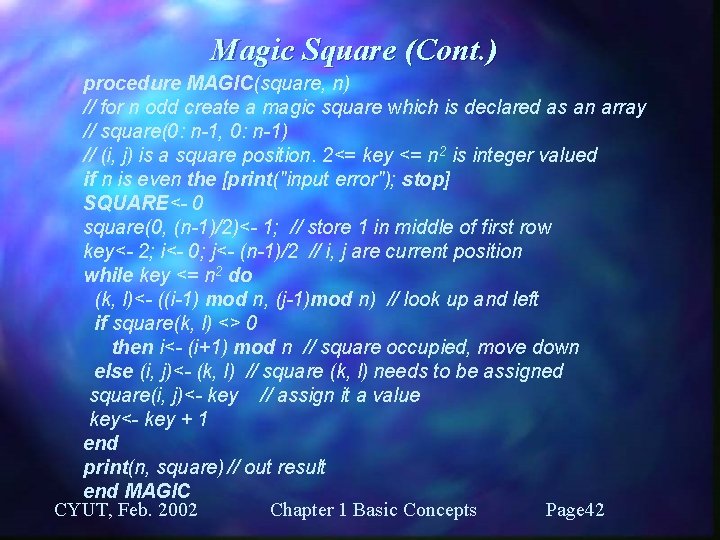
Magic Square (Cont. ) procedure MAGIC(square, n) // for n odd create a magic square which is declared as an array // square(0: n-1, 0: n-1) // (i, j) is a square position. 2<= key <= n 2 is integer valued if n is even the [print("input error"); stop] SQUARE<- 0 square(0, (n-1)/2)<- 1; // store 1 in middle of first row key<- 2; i<- 0; j<- (n-1)/2 // i, j are current position while key <= n 2 do (k, l)<- ((i-1) mod n, (j-1)mod n) // look up and left if square(k, l) <> 0 then i<- (i+1) mod n // square occupied, move down else (i, j)<- (k, l) // square (k, l) needs to be assigned square(i, j)<- key // assign it a value key<- key + 1 end print(n, square) // out result end MAGIC CYUT, Feb. 2002 Chapter 1 Basic Concepts Page 42
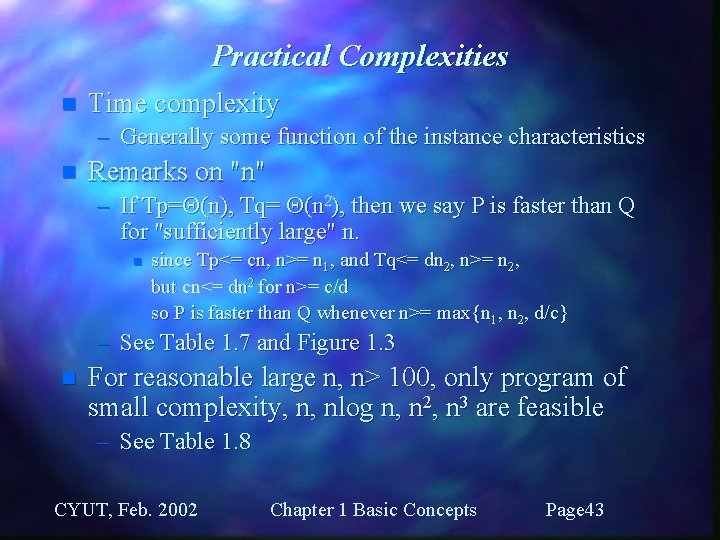
Practical Complexities n Time complexity – Generally some function of the instance characteristics n Remarks on "n" – If Tp= (n), Tq= (n 2), then we say P is faster than Q for "sufficiently large" n. n since Tp<= cn, n>= n 1, and Tq<= dn 2, n>= n 2, but cn<= dn 2 for n>= c/d so P is faster than Q whenever n>= max{n 1, n 2, d/c} – See Table 1. 7 and Figure 1. 3 n For reasonable large n, n> 100, only program of small complexity, n, nlog n, n 2, n 3 are feasible – See Table 1. 8 CYUT, Feb. 2002 Chapter 1 Basic Concepts Page 43
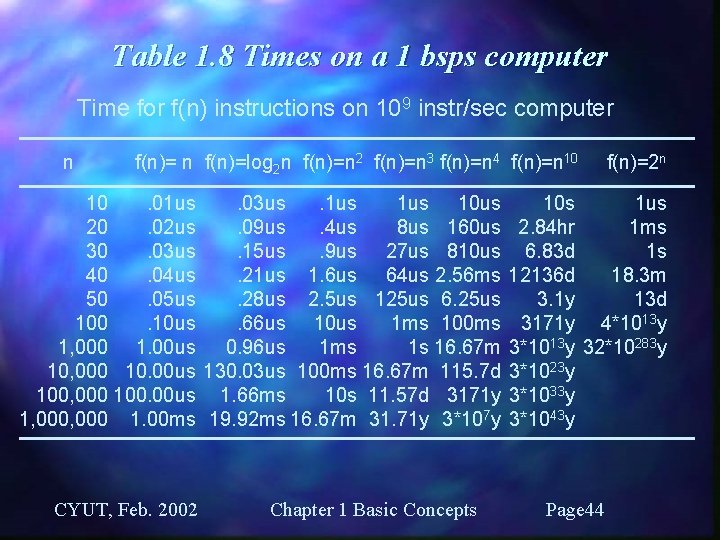
Table 1. 8 Times on a 1 bsps computer Time for f(n) instructions on 109 instr/sec computer n f(n)=log 2 n f(n)=n 2 f(n)=n 3 f(n)=n 4 f(n)=n 10 10. 01 us. 03 us. 1 us 10 us 20. 02 us. 09 us. 4 us 8 us 160 us 30. 03 us. 15 us. 9 us 27 us 810 us 40. 04 us. 21 us 1. 6 us 64 us 2. 56 ms 50. 05 us. 28 us 2. 5 us 125 us 6. 25 us 100. 10 us. 66 us 10 us 1 ms 100 ms 1, 000 1. 00 us 0. 96 us 1 ms 1 s 16. 67 m 10, 000 10. 00 us 130. 03 us 100 ms 16. 67 m 115. 7 d 100, 000 100. 00 us 1. 66 ms 10 s 11. 57 d 3171 y 1, 000 1. 00 ms 19. 92 ms 16. 67 m 31. 71 y 3*107 y CYUT, Feb. 2002 Chapter 1 Basic Concepts f(n)=2 n 1 us 10 s 1 ms 2. 84 hr 1 s 6. 83 d 18. 3 m 12136 d 13 d 3. 1 y 3171 y 4*1013 y 32*10283 y 3*1023 y 3*1033 y 3*1043 y Page 44
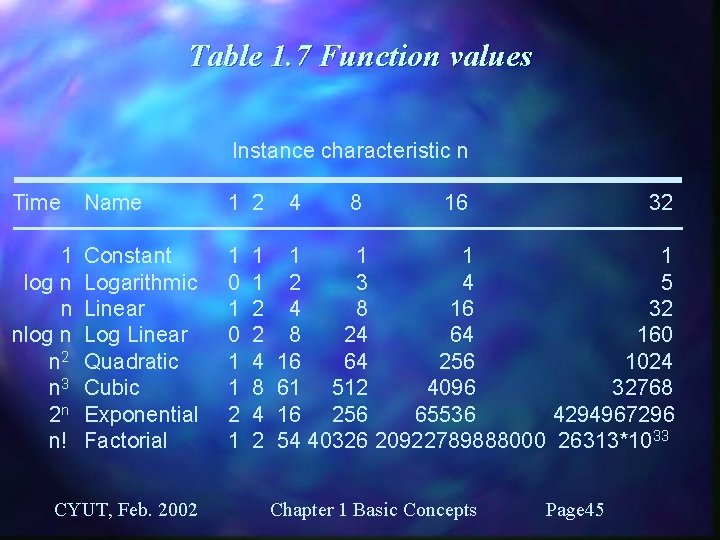
Table 1. 7 Function values Instance characteristic n Time Name 1 2 1 log n n nlog n n 2 n 3 2 n n! Constant Logarithmic Linear Log Linear Quadratic Cubic Exponential Factorial 1 0 1 1 2 1 CYUT, Feb. 2002 1 1 2 2 4 8 4 2 4 8 16 32 1 1 2 3 4 5 4 8 16 32 8 24 64 160 16 64 256 1024 61 512 4096 32768 16 256 65536 4294967296 54 40326 20922789888000 26313*1033 Chapter 1 Basic Concepts Page 45
Chapter 1 Basic Concepts n n n Overview: System Life Cycle Algorithm Specification Data Abstraction Performance Analysis Performance Measurement CYUT, Feb. 2002 Chapter 1 Basic Concepts Page 46
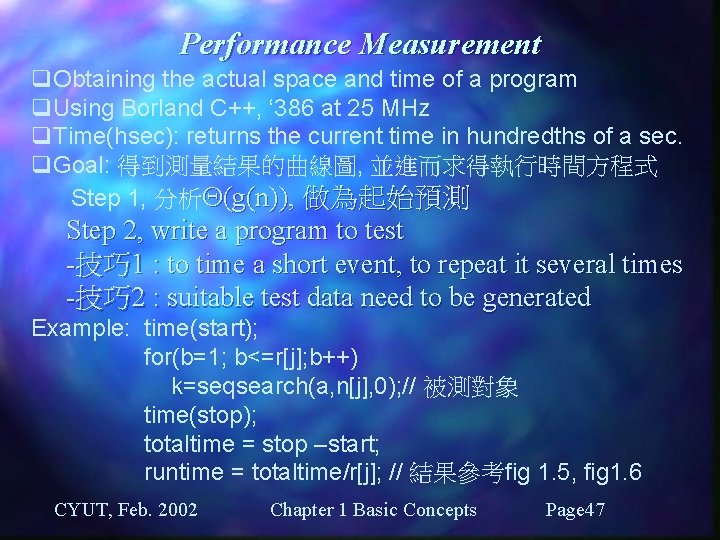
Performance Measurement q. Obtaining the actual space and time of a program q. Using Borland C++, ‘ 386 at 25 MHz q. Time(hsec): returns the current time in hundredths of a sec. q. Goal: 得到測量結果的曲線圖, 並進而求得執行時間方程式 Step 1, 分析 (g(n)), 做為起始預測 Step 2, write a program to test -技巧 1 : to time a short event, to repeat it several times -技巧 2 : suitable test data need to be generated Example: time(start); for(b=1; b<=r[j]; b++) k=seqsearch(a, n[j], 0); // 被測對象 time(stop); totaltime = stop –start; runtime = totaltime/r[j]; // 結果參考fig 1. 5, fig 1. 6 CYUT, Feb. 2002 Chapter 1 Basic Concepts Page 47
Summary n n Overview: System Life Cycle Algorithm Specification – Definition, Description n n Data Abstraction- ADT Performance Analysis – Time and Space n n n O(g(n)) Performance Measurement Generating Test Data - analyze the algorithm being tested to determine classes of data CYUT, Feb. 2002 Chapter 1 Basic Concepts Page 48
- Slides: 48