
Chapter 1 Basic Circuit Theory II Power and
Chapter 1 Basic Circuit Theory (II) Power and Energy Circuit Elements
Learning Goals! • Know and use the definitions of power and energy • Able to use the passive sign convention • Understand the symbols for and the behavior of the following ideal basic circuit elements: v Independent voltage and current sources v. Dependent voltage and current sources v. Resistors
Power Definition Power is the rate of using energy or doing work. “Using energy ” means that energy is being converted to a different form.
Power and Energy
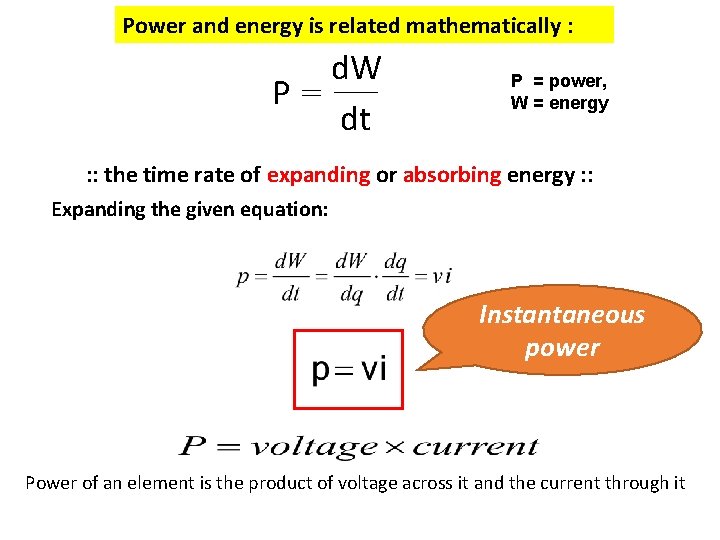
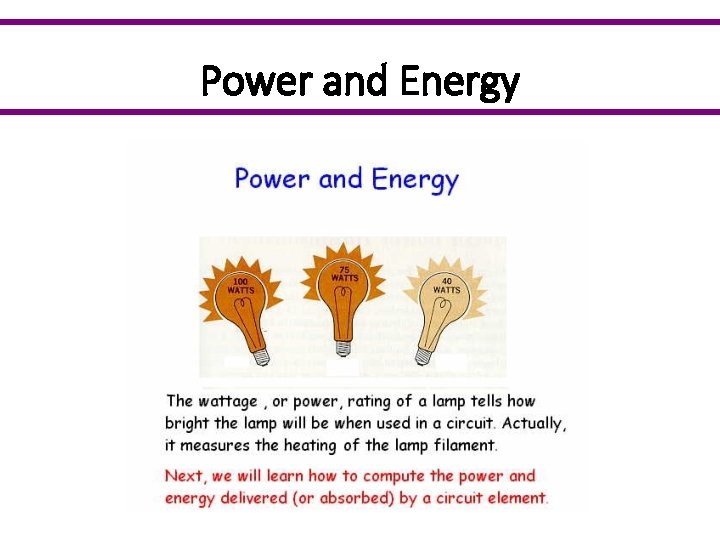
Power and energy is related mathematically : d. W P= dt P = power, W = energy : : the time rate of expanding or absorbing energy : : Expanding the given equation: Instantaneous power Power of an element is the product of voltage across it and the current through it
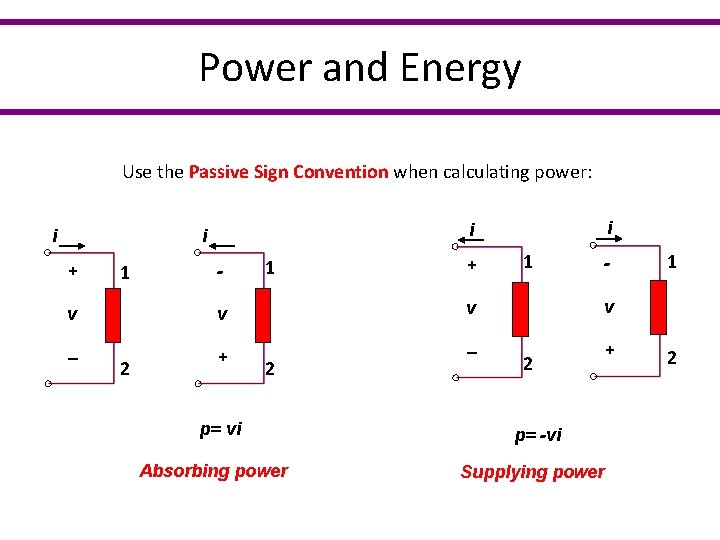
Power and Energy Use the Passive Sign Convention when calculating power: i + 1 i i i - 1 + 1 - v v + + 2 2 p= vi Absorbing power 2 p= -vi Supplying power 1 2
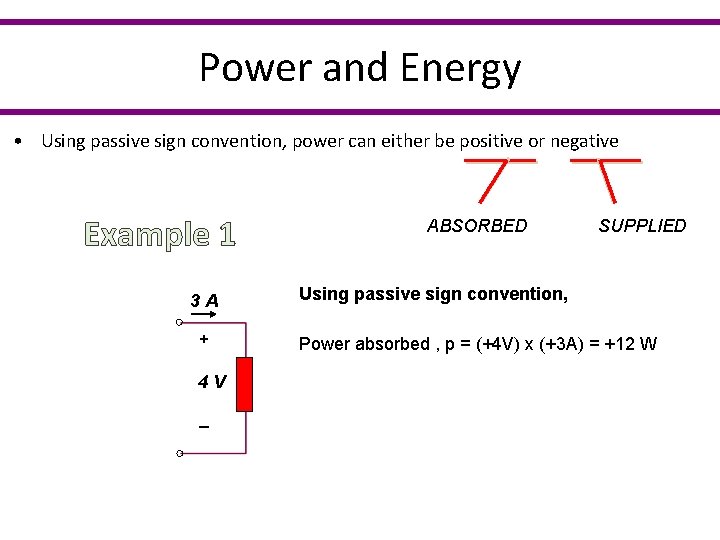
Power and Energy • Using passive sign convention, power can either be positive or negative Example 1 3 A + 4 V ABSORBED SUPPLIED Using passive sign convention, Power absorbed , p = (+4 V) x (+3 A) = +12 W
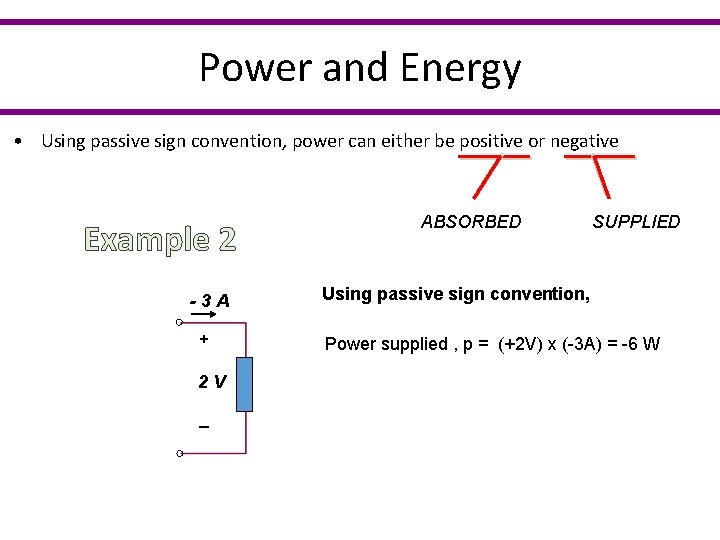
Power and Energy • Using passive sign convention, power can either be positive or negative Example 2 -3 A + 2 V ABSORBED SUPPLIED Using passive sign convention, Power supplied , p = (+2 V) x (-3 A) = -6 W
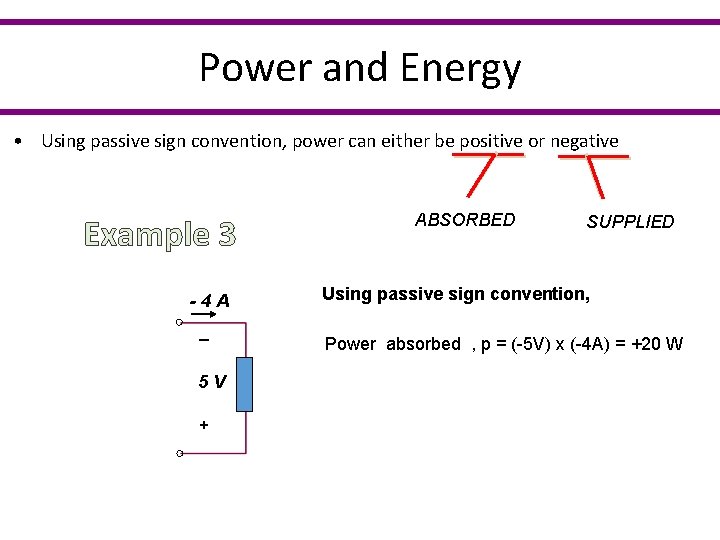
Power and Energy • Using passive sign convention, power can either be positive or negative Example 3 -4 A 5 V + ABSORBED SUPPLIED Using passive sign convention, Power absorbed , p = (-5 V) x (-4 A) = +20 W
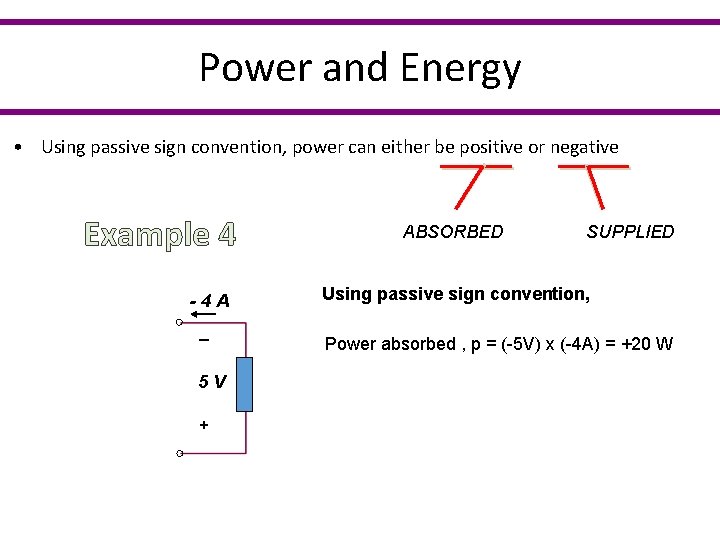
Power and Energy • Using passive sign convention, power can either be positive or negative Example 4 -4 A 5 V + ABSORBED SUPPLIED Using passive sign convention, Power absorbed , p = (-5 V) x (-4 A) = +20 W
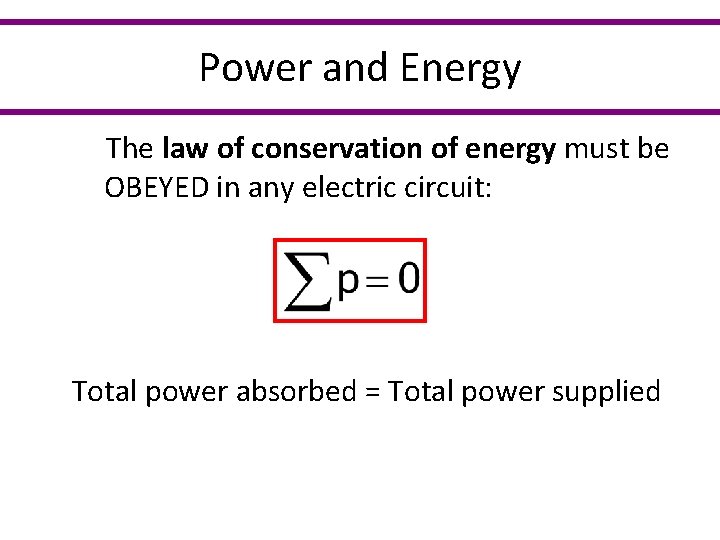
Power and Energy The law of conservation of energy must be OBEYED in any electric circuit: Total power absorbed = Total power supplied
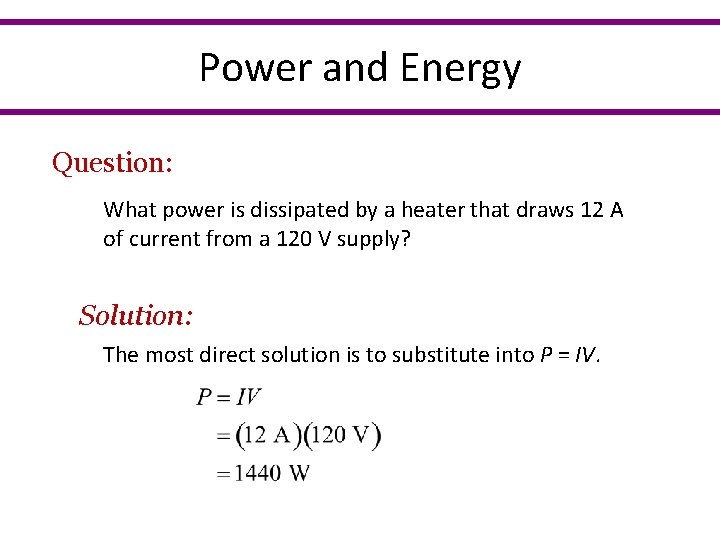
Power and Energy Question: What power is dissipated by a heater that draws 12 A of current from a 120 V supply? Solution: The most direct solution is to substitute into P = IV.
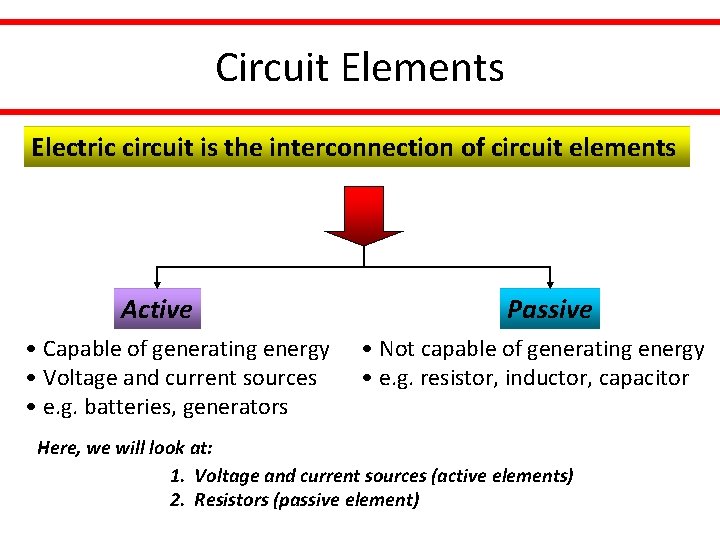
Circuit Elements Electric circuit is the interconnection of circuit elements Active • Capable of generating energy • Voltage and current sources • e. g. batteries, generators Passive • Not capable of generating energy • e. g. resistor, inductor, capacitor Here, we will look at: 1. Voltage and current sources (active elements) 2. Resistors (passive element)
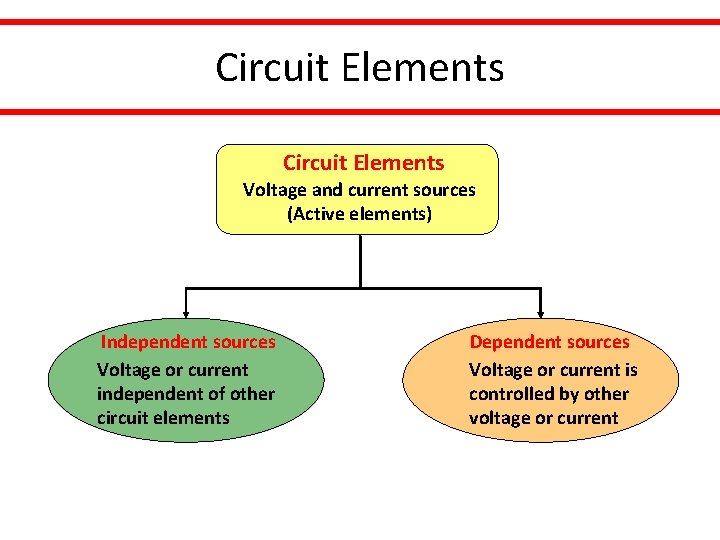
Circuit Elements Voltage and current sources (Active elements) Independent sources Voltage or current independent of other circuit elements Dependent sources Voltage or current is controlled by other voltage or current
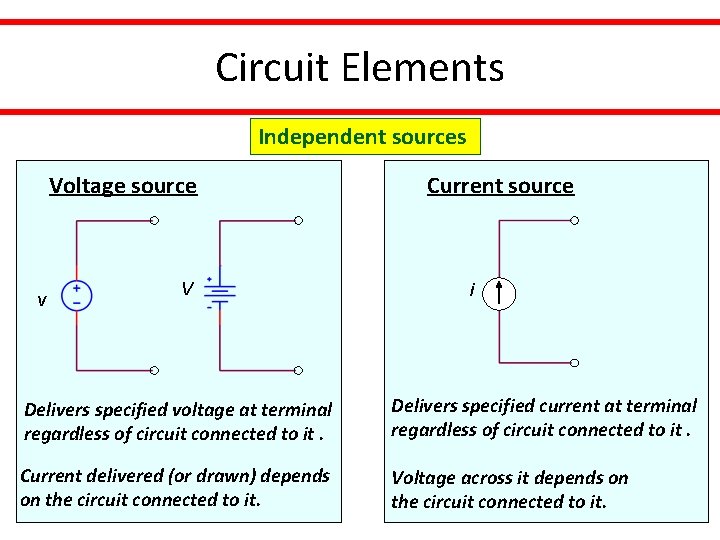
Circuit Elements Independent sources Voltage source v V Current source i Delivers specified voltage at terminal regardless of circuit connected to it. Delivers specified current at terminal regardless of circuit connected to it. Current delivered (or drawn) depends on the circuit connected to it. Voltage across it depends on the circuit connected to it.
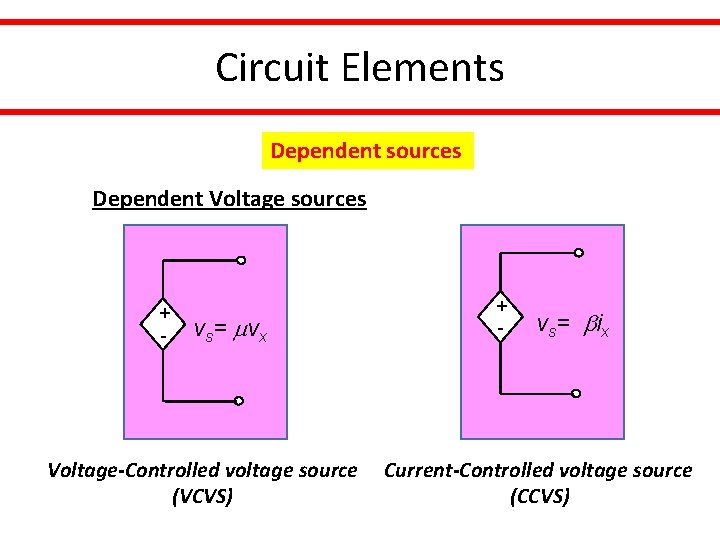
Circuit Elements Dependent sources Dependent Voltage sources + - vs= vx Voltage-Controlled voltage source (VCVS) + - vs= ix Current-Controlled voltage source (CCVS)
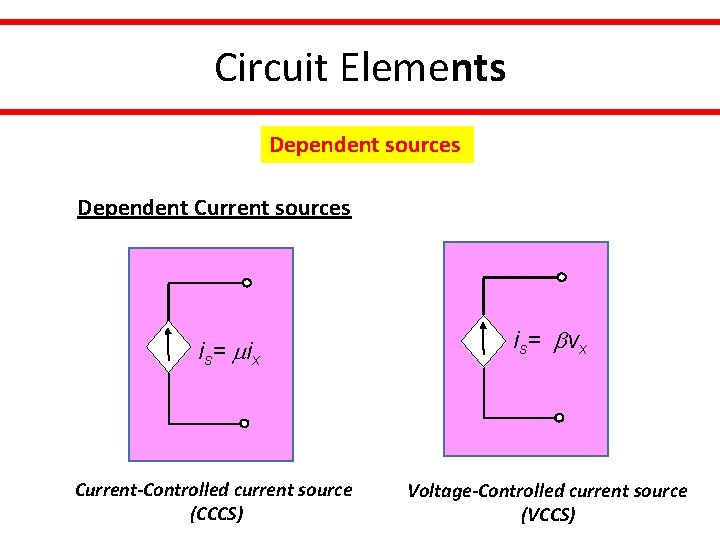
Circuit Elements Dependent sources Dependent Current sources is= ix Current-Controlled current source (CCCS) is= vx Voltage-Controlled current source (VCCS)
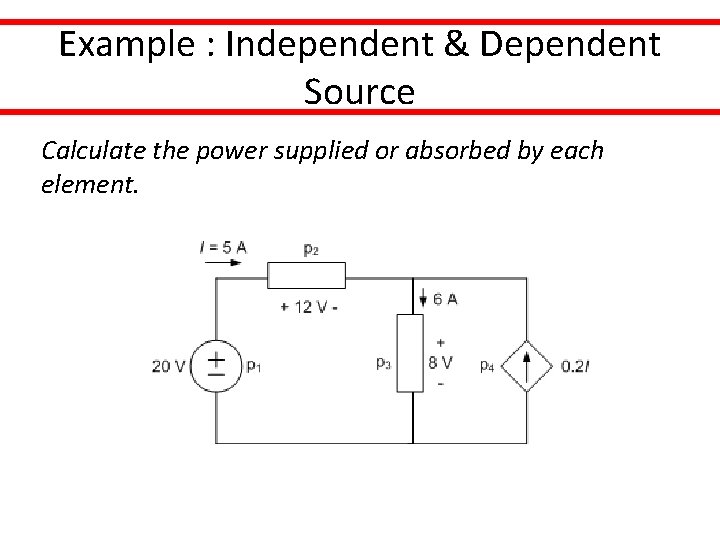
Example : Independent & Dependent Source Calculate the power supplied or absorbed by each element.
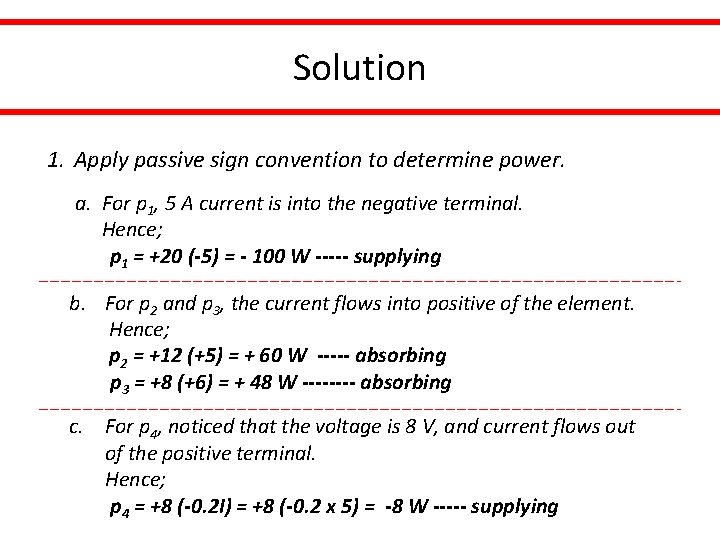
Solution 1. Apply passive sign convention to determine power. a. For p 1, 5 A current is into the negative terminal. Hence; p 1 = +20 (-5) = - 100 W ----- supplying b. For p 2 and p 3, the current flows into positive of the element. Hence; p 2 = +12 (+5) = + 60 W ----- absorbing p 3 = +8 (+6) = + 48 W ---- absorbing c. For p 4, noticed that the voltage is 8 V, and current flows out of the positive terminal. Hence; p 4 = +8 (-0. 2 I) = +8 (-0. 2 x 5) = -8 W ----- supplying
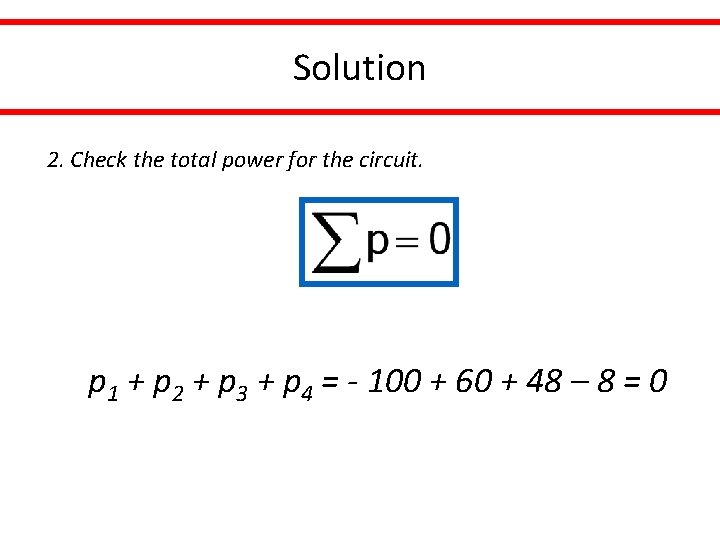
Solution 2. Check the total power for the circuit. p 1 + p 2 + p 3 + p 4 = - 100 + 60 + 48 – 8 = 0
- Slides: 20