
Chapter 1 B Section 1 2 and 1
Chapter 1 B Section 1. 2 and 1. 3

Section 1. 2 (Permutations) • Given a collection of n distinct (distinguishable) objects, any arrangements of these objects in a linear order is called a permutations.
Section 1. 2 (Permutations) • Let a, b, c be three distinct objects. – abc is a permutation – abc, acb, bac, bca, cab, cba are the six permutations of thee object. – The permutations are like list arrangements. (a, b, c), (a, c, a), (b, a, c), (b, c, a), (c, a, b), (c, b, a)
Section 1. 2 (Permutations) • Two key words we should be looking in the case of permutations or arrangements. – distinct (distinguishable objects) objects – order is important

Permutations Definition: A permutation of a set of distinct objects is an ordered arrangement of these objects. An ordered arrangement of r elements of a set is called an r-permutation.
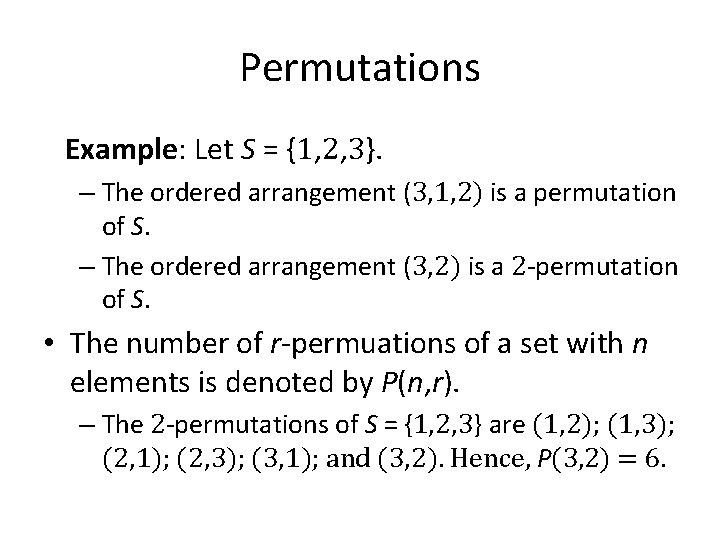
Permutations Example: Let S = {1, 2, 3}. – The ordered arrangement (3, 1, 2) is a permutation of S. – The ordered arrangement (3, 2) is a 2 -permutation of S. • The number of r-permuations of a set with n elements is denoted by P(n, r). – The 2 -permutations of S = {1, 2, 3} are (1, 2); (1, 3); (2, 1); (2, 3); (3, 1); and (3, 2). Hence, P(3, 2) = 6.

Formula for the Number of Permutations Theorem 1: If n is a positive integer and r is an integer with 1 ≤ r ≤ n, then there are P(n, r) = n(n − 1)(n − 2) ∙∙∙ (n − r + 1) r-permutations of a set with n distinct elements.
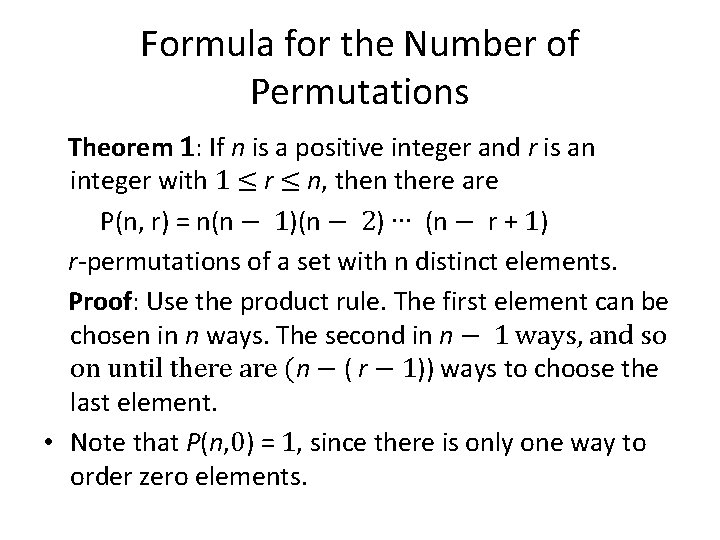
Formula for the Number of Permutations Theorem 1: If n is a positive integer and r is an integer with 1 ≤ r ≤ n, then there are P(n, r) = n(n − 1)(n − 2) ∙∙∙ (n − r + 1) r-permutations of a set with n distinct elements. Proof: Use the product rule. The first element can be chosen in n ways. The second in n − 1 ways, and so on until there are (n − ( r − 1)) ways to choose the last element. • Note that P(n, 0) = 1, since there is only one way to order zero elements.
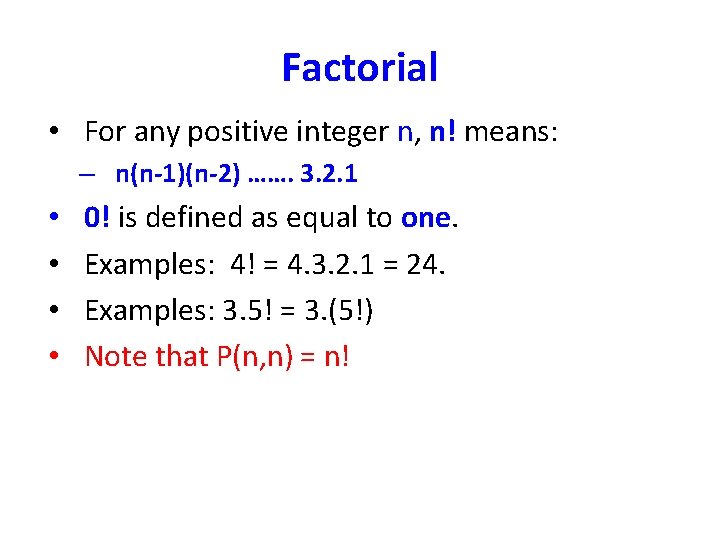
Factorial • For any positive integer n, n! means: – n(n-1)(n-2) ……. 3. 2. 1 • • 0! is defined as equal to one. Examples: 4! = 4. 3. 2. 1 = 24. Examples: 3. 5! = 3. (5!) Note that P(n, n) = n!
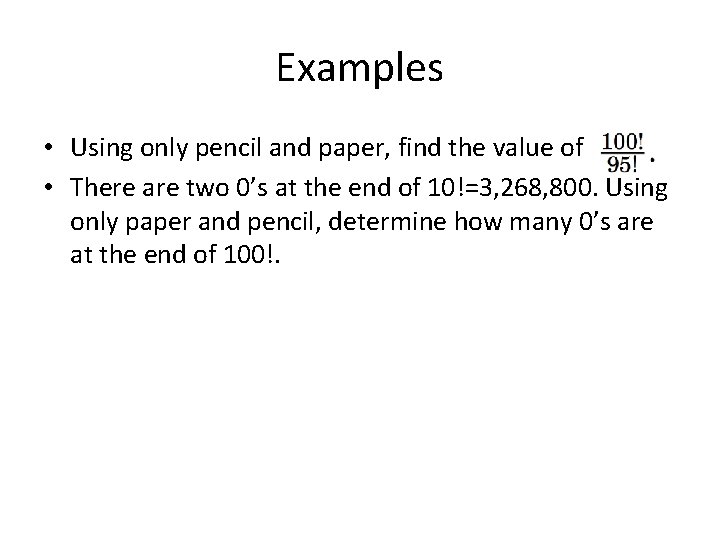
Examples • Using only pencil and paper, find the value of • There are two 0’s at the end of 10!=3, 268, 800. Using only paper and pencil, determine how many 0’s are at the end of 100!.
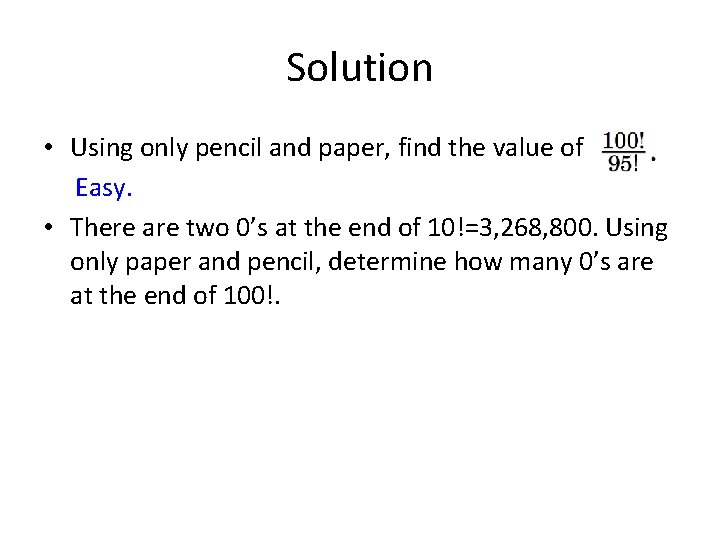
Solution • Using only pencil and paper, find the value of Easy. • There are two 0’s at the end of 10!=3, 268, 800. Using only paper and pencil, determine how many 0’s are at the end of 100!.
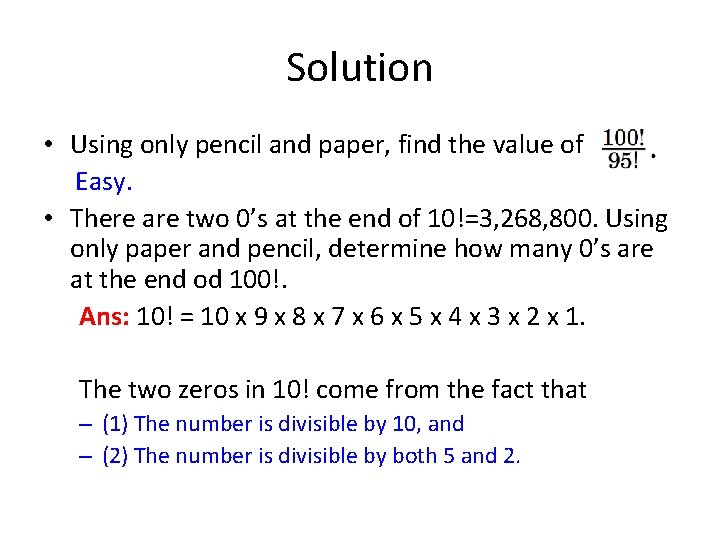
Solution • Using only pencil and paper, find the value of Easy. • There are two 0’s at the end of 10!=3, 268, 800. Using only paper and pencil, determine how many 0’s are at the end od 100!. Ans: 10! = 10 x 9 x 8 x 7 x 6 x 5 x 4 x 3 x 2 x 1. The two zeros in 10! come from the fact that – (1) The number is divisible by 10, and – (2) The number is divisible by both 5 and 2.
Solution Now 100! is divisible by 100*(95*92)* 90*(85*82)* …. . 10*(5*2).
Solution Now 100! is divisible by 100*(95*92)* 90*(85*82)* …. . 10*(5*2). – The number of trailing zeros in 100! is 21. The answer is not correct. We have missed some trailing zeros.
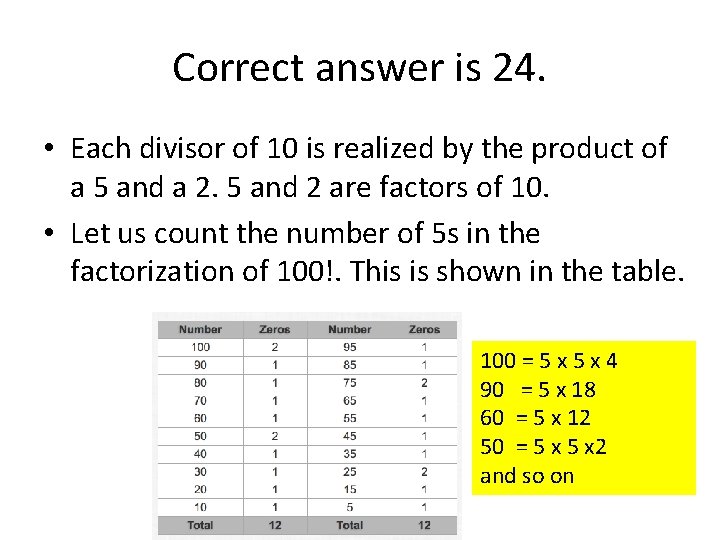
Correct answer is 24. • Each divisor of 10 is realized by the product of a 5 and a 2. 5 and 2 are factors of 10. • Let us count the number of 5 s in the factorization of 100!. This is shown in the table. 100 = 5 x 4 90 = 5 x 18 60 = 5 x 12 50 = 5 x 2 and so on
Correct answer is 24. • When a factor 5 is multiplied with an even number, we get a trailing zero in 100! • There at least 50 even numbers in the factorization of 100! • Therefore, twenty four (24) 5 s factorization of 100! will realize 24 trailing zeros in 100! when multiplied with even numbers.
Example • Compute how many 7 -digit numbers can be made from the digits 1, 2, 3, 4, 5, 6, 7 if there is no repetition and the odd digits must appear in an unbroken sequence. (3571264, 2413576 are valid, but not 7234615) • Ans:
Solution • Compute how many 7 -digit numbers can be made from the digits 1, 2, 3, 4, 5, 6, 7 if there is no repetition and the odd digits must appear in an unbroken sequence. (3571264, 2413576 are ok, but not 7234615) • Ans: – There are 4 odd digits. There are 4! length-4 lists of odd integers without repetition. – The 7 -digit valid number can be visualized as a list of length 4 using symbols 2, 4, 6, and a length-4 list of odd integers. There are 4! different such lists. – The total number of valid 7 -digit sequence is (4!)2.
Solving Counting Problems by Counting Permutations Example: How many ways are there to select a first-prize winner, a second prize winner, and a third-prize winner from 100 different people who have entered a contest? Solution: P(100, 3) = 100 ∙ 99 ∙ 98 = 970, 200
Solving Counting Problems by Counting Permutations Example: Suppose that a saleswoman has to visit eight different cities. She must begin her trip in a specified city, but she can visit the other seven cities in any order she wishes. How many possible orders can the saleswoman use when visiting these cities? Solution: The first city is chosen, and the rest are ordered arbitrarily. Hence the orders are: 7! = 7 ∙ 6 ∙ 5 ∙ 4 ∙ 3 ∙ 2 ∙ 1 = 5040 If she wants to find the tour with the shortest path that visits all the cities, she must consider 5040 paths!
Solving Counting Problems by Counting Permutations Example: How many permutations of the letters ABCDEFGH contain the string ABC ? Solution: count the permutations of six objects, ABC, D, E, F, G, and H. 6! = 6 ∙ 5 ∙ 4 ∙ 3 ∙ 2 ∙ 1 = 720
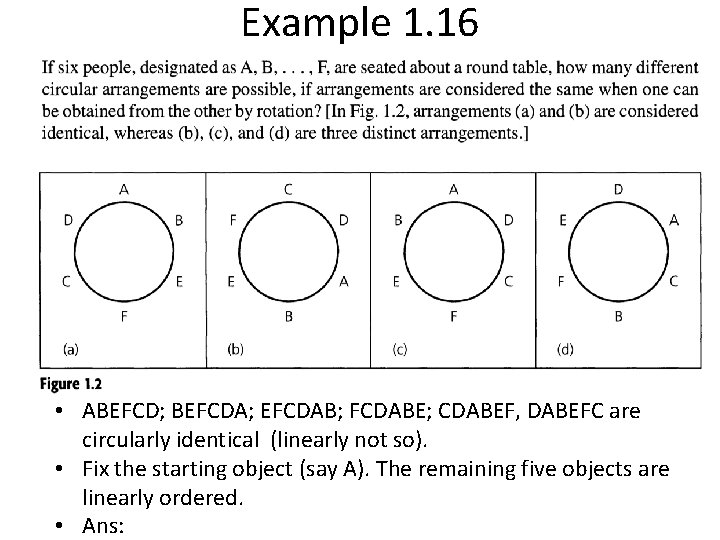
Example 1. 16 • ABEFCD; BEFCDA; EFCDAB; FCDABE; CDABEF, DABEFC are circularly identical (linearly not so). • Fix the starting object (say A). The remaining five objects are linearly ordered. • Ans:
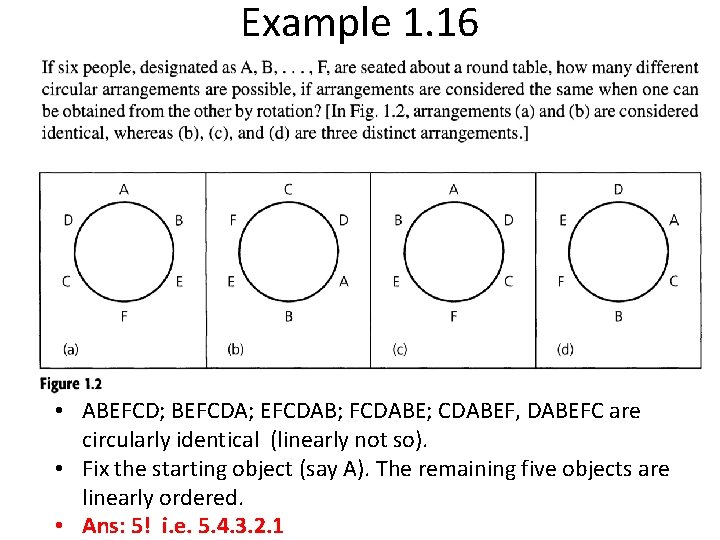
Example 1. 16 • ABEFCD; BEFCDA; EFCDAB; FCDABE; CDABEF, DABEFC are circularly identical (linearly not so). • Fix the starting object (say A). The remaining five objects are linearly ordered. • Ans: 5! i. e. 5. 4. 3. 2. 1
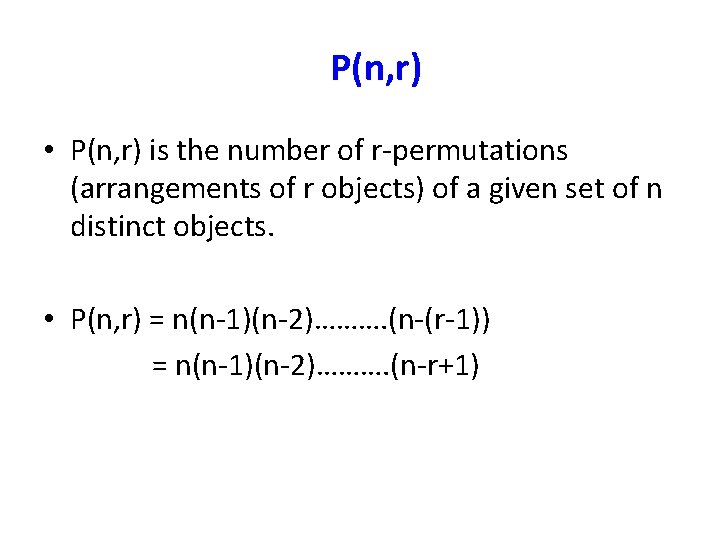
P(n, r) • P(n, r) is the number of r-permutations (arrangements of r objects) of a given set of n distinct objects. • P(n, r) = n(n-1)(n-2)………. (n-(r-1)) = n(n-1)(n-2)………. (n-r+1)
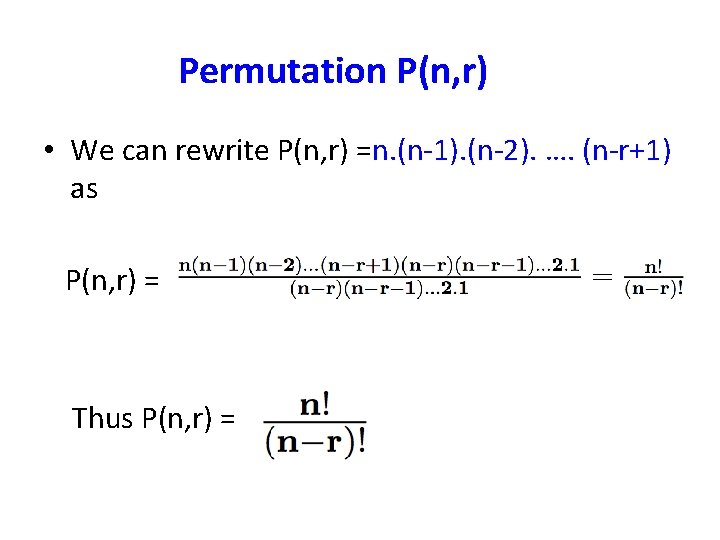
Permutation P(n, r) • We can rewrite P(n, r) =n. (n-1). (n-2). …. (n-r+1) as P(n, r) = Thus P(n, r) =
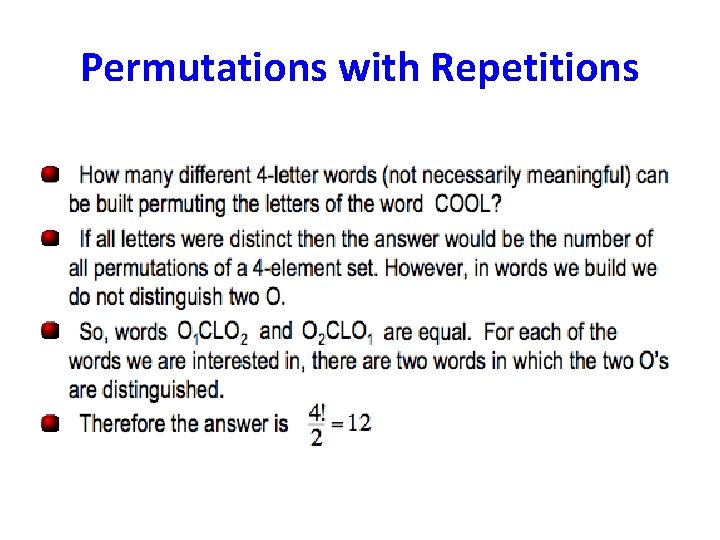
Permutations with Repetitions
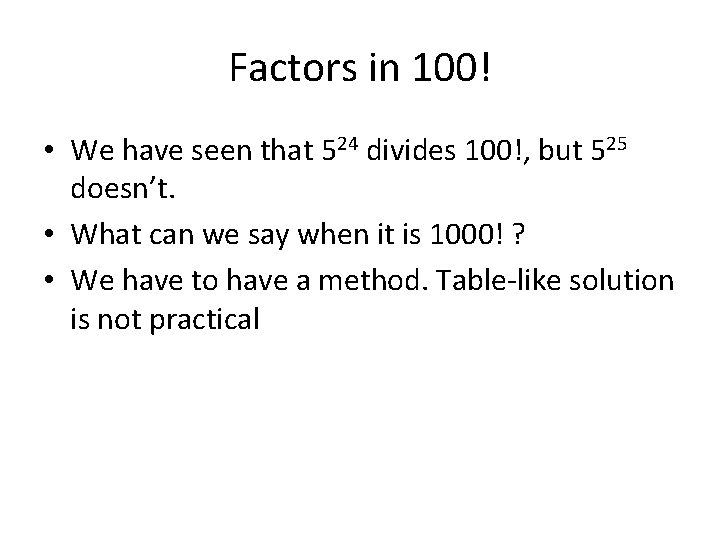
Factors in 100! • We have seen that 524 divides 100!, but 525 doesn’t. • What can we say when it is 1000! ? • We have to have a method. Table-like solution is not practical
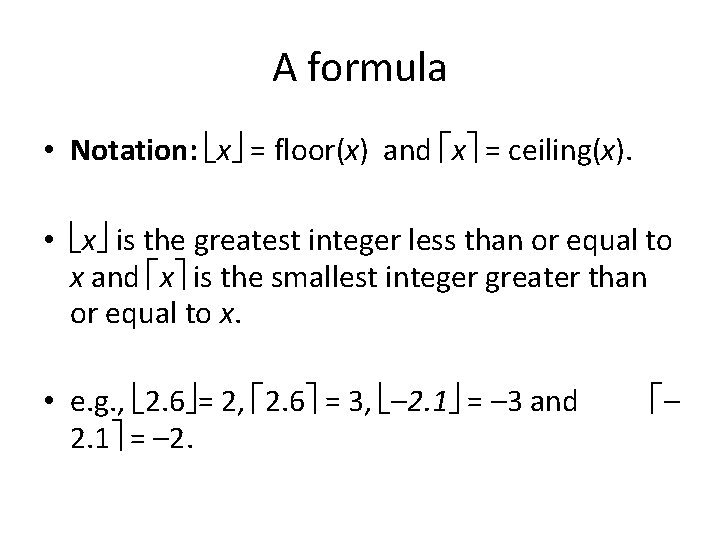
A formula • Notation: x = floor(x) and x = ceiling(x). • x is the greatest integer less than or equal to x and x is the smallest integer greater than or equal to x. • e. g. , 2. 6 = 2, 2. 6 = 3, – 2. 1 = – 3 and 2. 1 = – 2. –
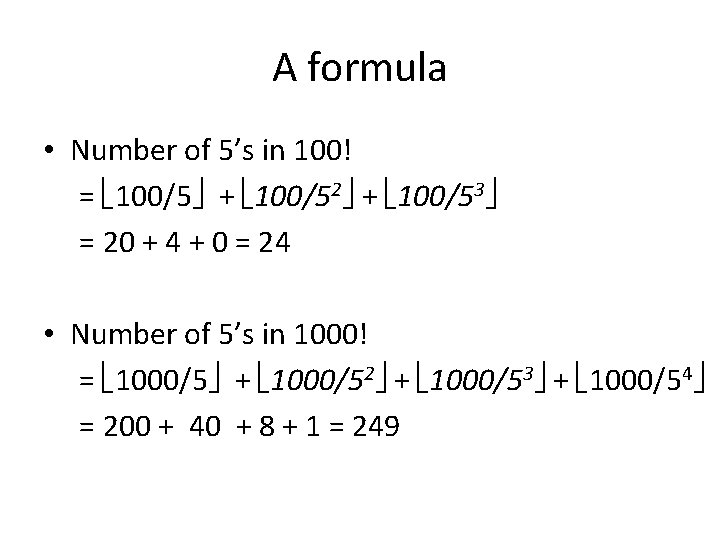
A formula • Number of 5’s in 100! = 100/5 + 100/52 + 100/53 = 20 + 4 + 0 = 24 • Number of 5’s in 1000! = 1000/5 + 1000/52 + 1000/53 + 1000/54 = 200 + 40 + 8 + 1 = 249
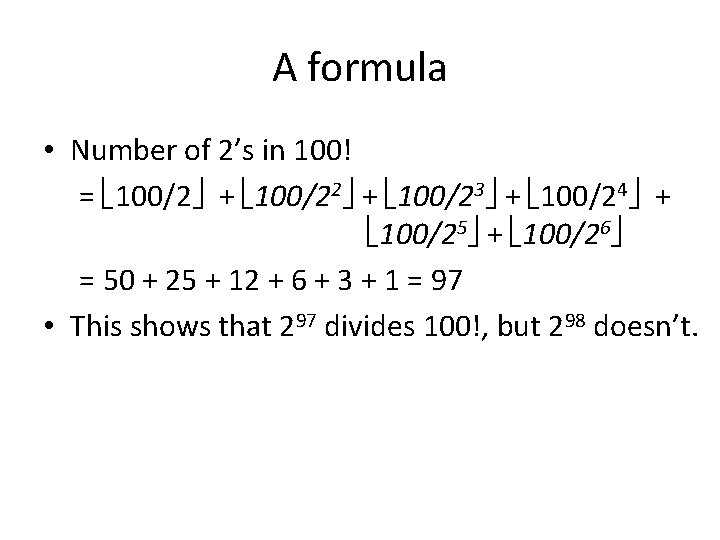
A formula • Number of 2’s in 100! = 100/2 + 100/23 + 100/24 + 100/25 + 100/26 = 50 + 25 + 12 + 6 + 3 + 1 = 97 • This shows that 297 divides 100!, but 298 doesn’t.
Permutations with Repetitions
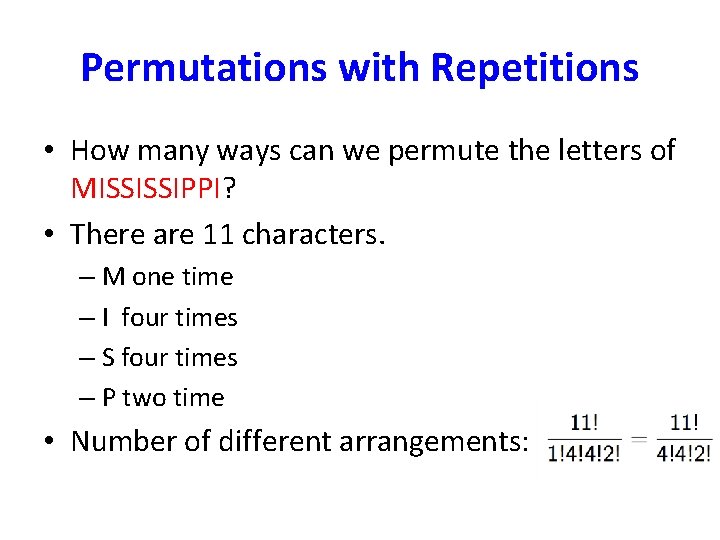
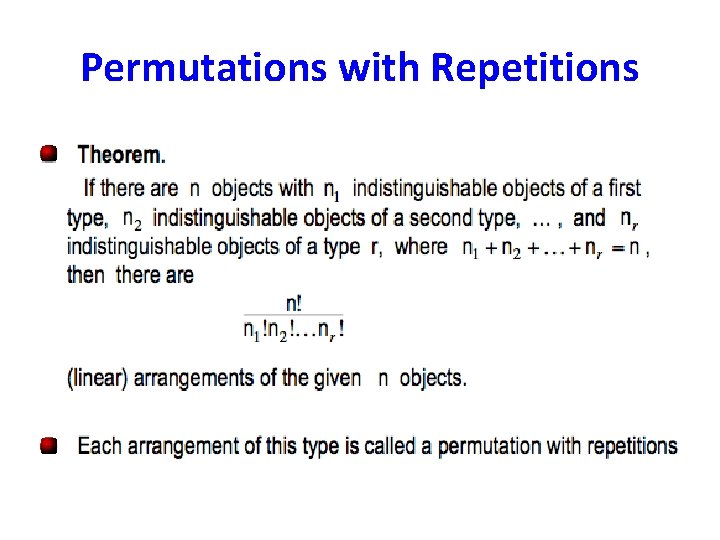
Permutations with Repetitions • How many ways can we permute the letters of MISSISSIPPI? • There are 11 characters. – M one time – I four times – S four times – P two time • Number of different arrangements:
Question 34 (page 14) • How many distinct 4 -digit integers can one make for the digits 1, 3, 3, 7, 7, 8? • First attempt: – Make the digits distinct: 1, 32, 71, 72, 8 – Number of 4 -permutations is P(6, 4) since the digits are all distinct. – Factor in the duplicates: P(6, 4)/(2! x 2!) = 90. The correct answer is 102.
Correct Answer • We break the solution into many cases: – (no 7’s: 1, 3, 3, 8) – (one 7 and 3: 1, 3, 7, 8) – (one 7 and two 3’s: 1, 3, 3, 7) – (one 7 and two 3’s: 3, 3, 7, 8) – (two 7’s and no 3’s: 1, 7, 7, 8) – (two 7’s and one 3: 1, 3, 7, 7) – (two 7’s and one 3: 3, 7, 7, 8) – (two 7’s and two 3’s: 3, 3, 7, 7)
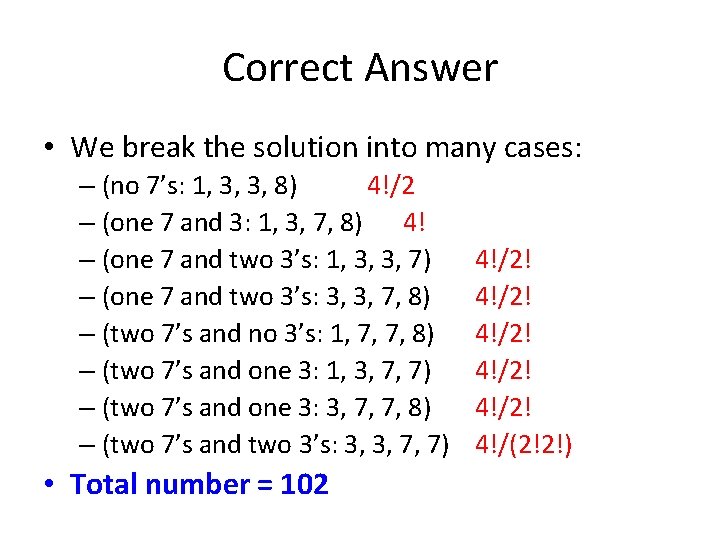
Correct Answer • We break the solution into many cases: – (no 7’s: 1, 3, 3, 8) 4!/2 – (one 7 and 3: 1, 3, 7, 8) 4! – (one 7 and two 3’s: 1, 3, 3, 7) – (one 7 and two 3’s: 3, 3, 7, 8) – (two 7’s and no 3’s: 1, 7, 7, 8) – (two 7’s and one 3: 1, 3, 7, 7) – (two 7’s and one 3: 3, 7, 7, 8) – (two 7’s and two 3’s: 3, 3, 7, 7) • Total number = 102 4!/2! 4!/2! 4!/(2!2!)
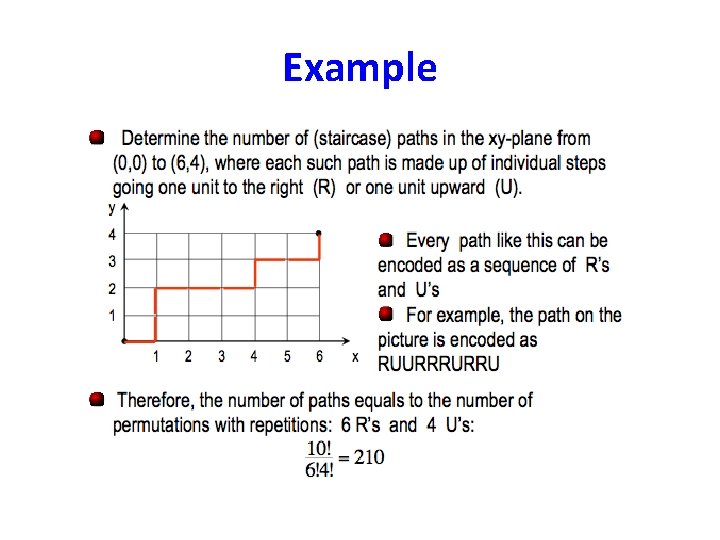
Example
Combinations • How many committees of three students can be formed from a group of four students? • Solution: To answer this question, we need only to find the number of subsets with three elements from the set containing four elements. As is easily seen, there are four such subsets. Note that order in which these students are chosen does not matter.
Counting Subsets • In counting the number of length-k lists from a set of n possible objects, the order of the objects were very important. • What happens when the order is not important? • Now we select size-k subsets from a set of n possible objects. • How many such size-k subsets are there?
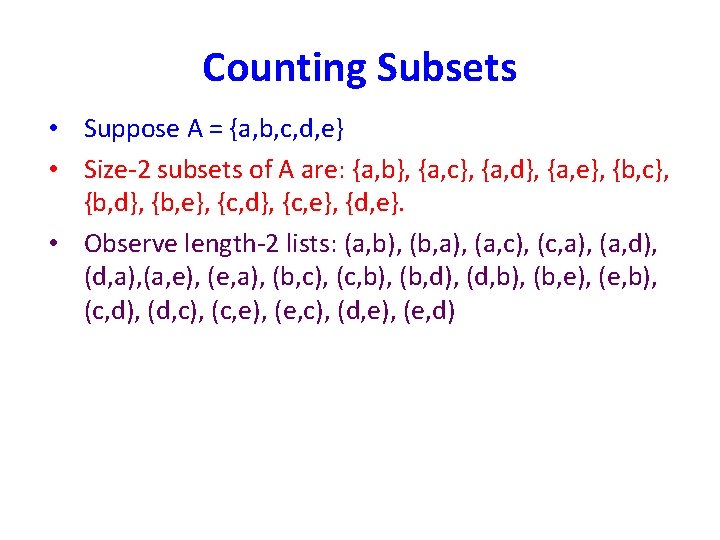
Counting Subsets • Suppose A = {a, b, c, d, e} • Size-2 subsets of A are: {a, b}, {a, c}, {a, d}, {a, e}, {b, c}, {b, d}, {b, e}, {c, d}, {c, e}, {d, e}. • Observe length-2 lists: (a, b), (b, a), (a, c), (c, a), (a, d), (d, a), (a, e), (e, a), (b, c), (c, b), (b, d), (d, b), (b, e), (e, b), (c, d), (d, c), (c, e), (e, c), (d, e), (e, d)
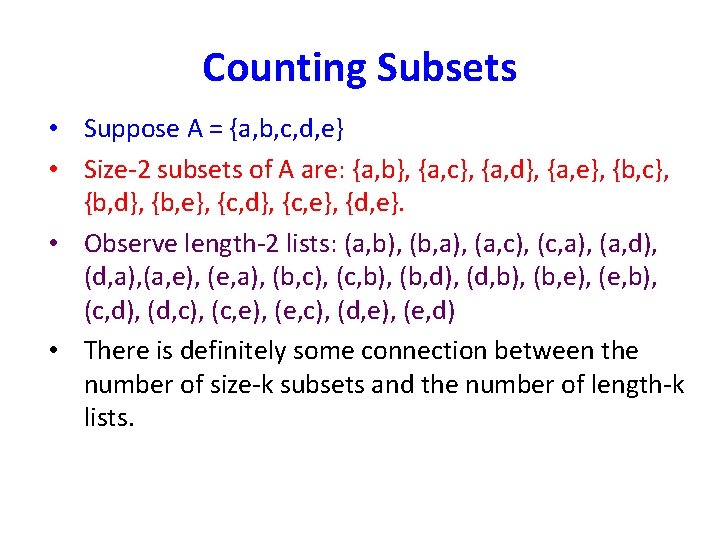
Counting Subsets • Suppose A = {a, b, c, d, e} • Size-2 subsets of A are: {a, b}, {a, c}, {a, d}, {a, e}, {b, c}, {b, d}, {b, e}, {c, d}, {c, e}, {d, e}. • Observe length-2 lists: (a, b), (b, a), (a, c), (c, a), (a, d), (d, a), (a, e), (e, a), (b, c), (c, b), (b, d), (d, b), (b, e), (e, b), (c, d), (d, c), (c, e), (e, c), (d, e), (e, d) • There is definitely some connection between the number of size-k subsets and the number of length-k lists.
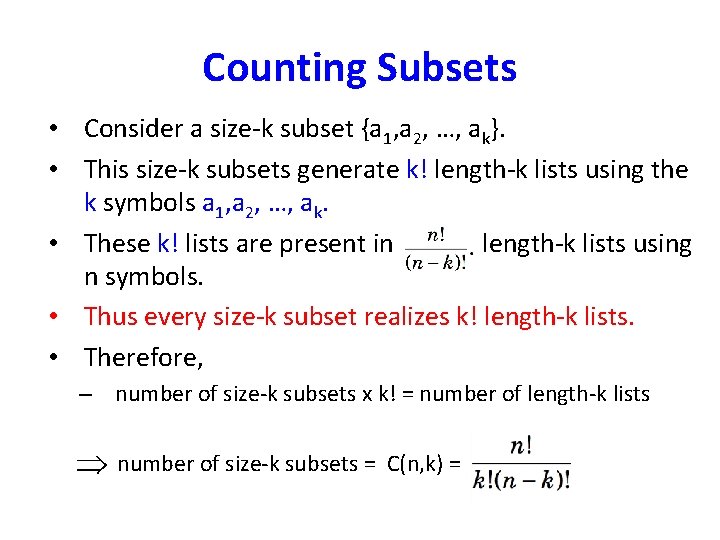
Counting Subsets • Consider a size-k subset {a 1, a 2, …, ak}. • This size-k subsets generate k! length-k lists using the k symbols a 1, a 2, …, ak. • These k! lists are present in length-k lists using n symbols. • Thus every size-k subset realizes k! length-k lists. • Therefore, – number of size-k subsets x k! = number of length-k lists number of size-k subsets = C(n, k) =
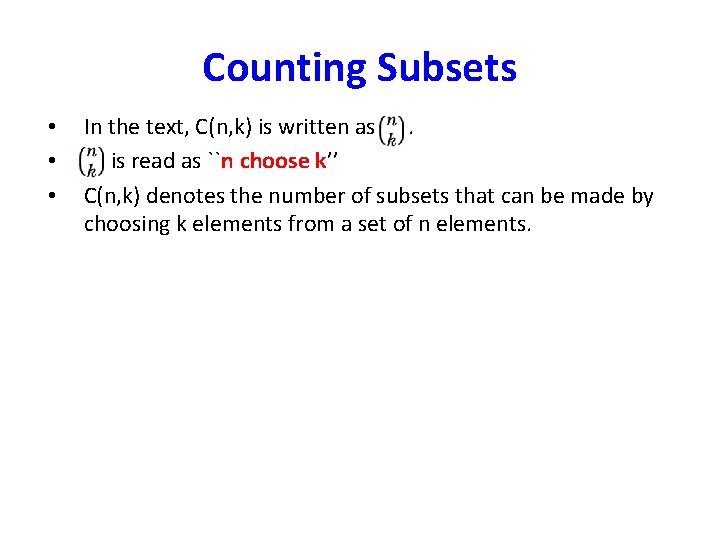
Counting Subsets • • • In the text, C(n, k) is written as. is read as ``n choose k’’ C(n, k) denotes the number of subsets that can be made by choosing k elements from a set of n elements.
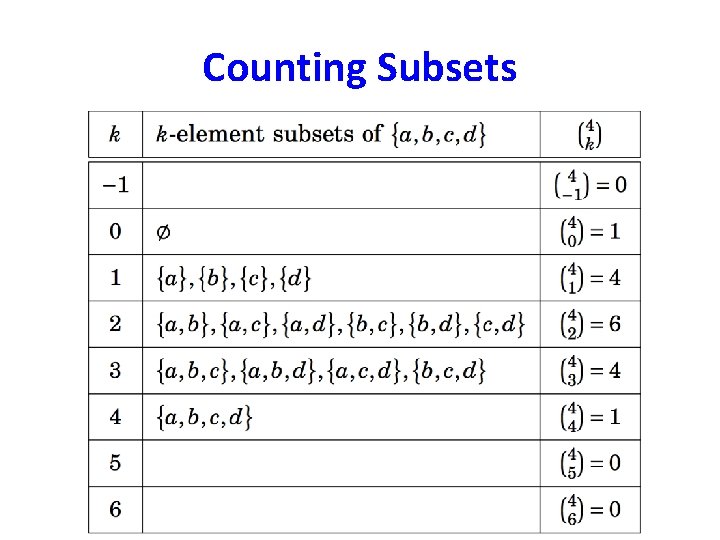
Counting Subsets
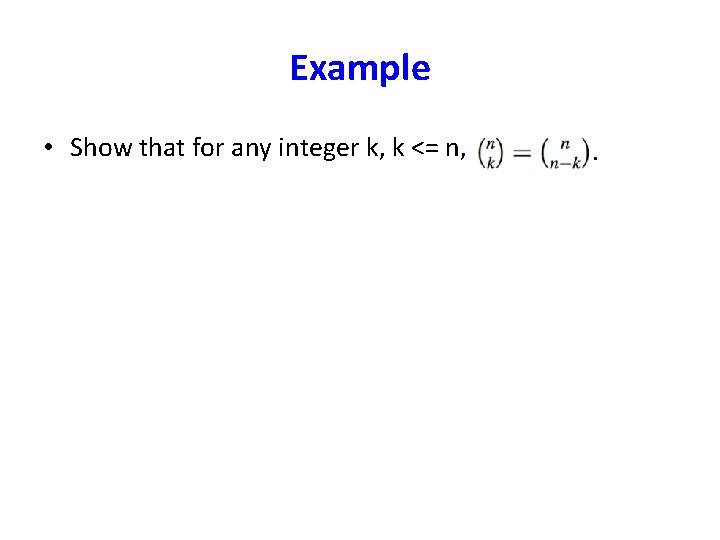
Example • Show that for any integer k, k <= n,
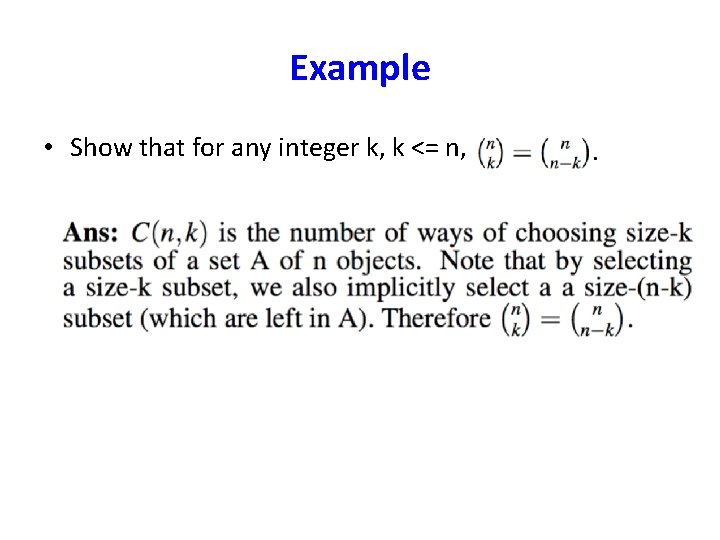
Example • Show that for any integer k, k <= n,
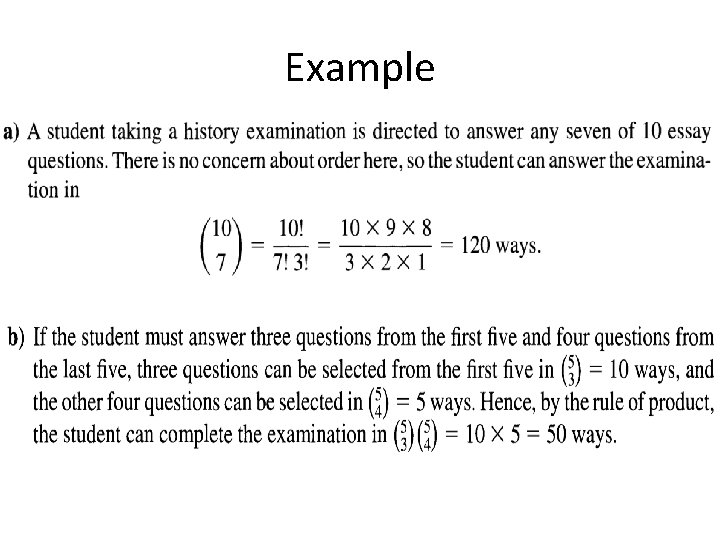
Example • How many 5 -card hands are there in which two of the cards are clubs and three are hearts? • Ans: Note that order is not important. How many ways can we select two club cards? How many ways can we select three hearts?
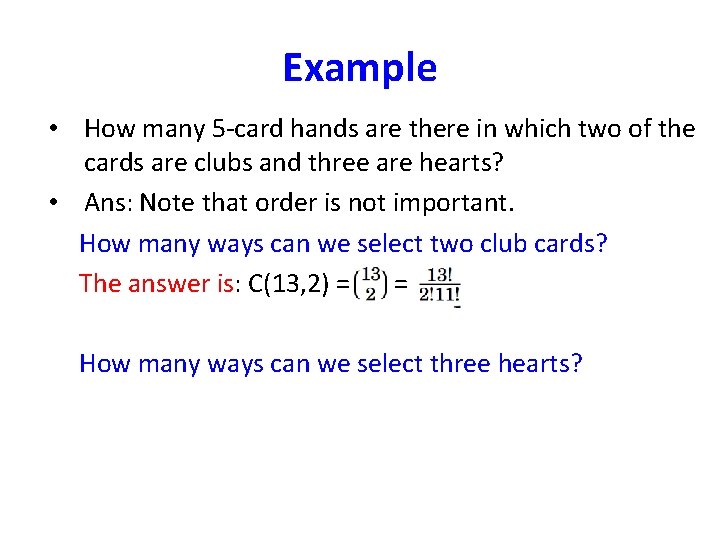
Example • How many 5 -card hands are there in which two of the cards are clubs and three are hearts? • Ans: Note that order is not important. How many ways can we select two club cards? The answer is: C(13, 2) = = How many ways can we select three hearts?
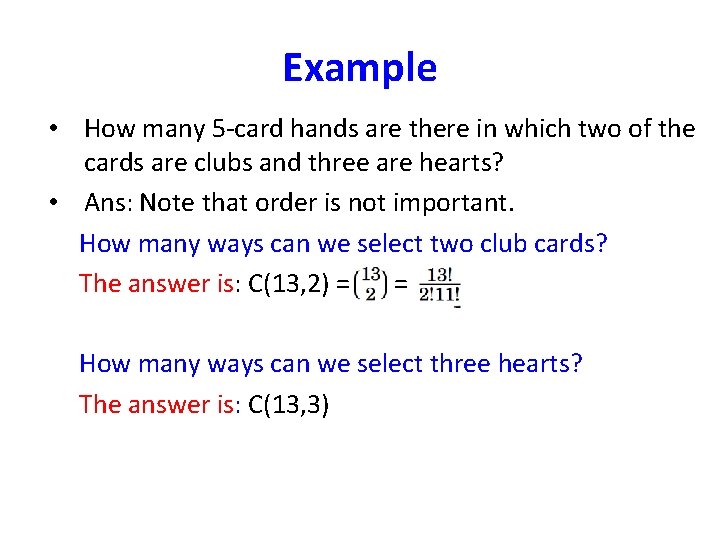
Example • How many 5 -card hands are there in which two of the cards are clubs and three are hearts? • Ans: Note that order is not important. How many ways can we select two club cards? The answer is: C(13, 2) = = How many ways can we select three hearts? The answer is: C(13, 3)
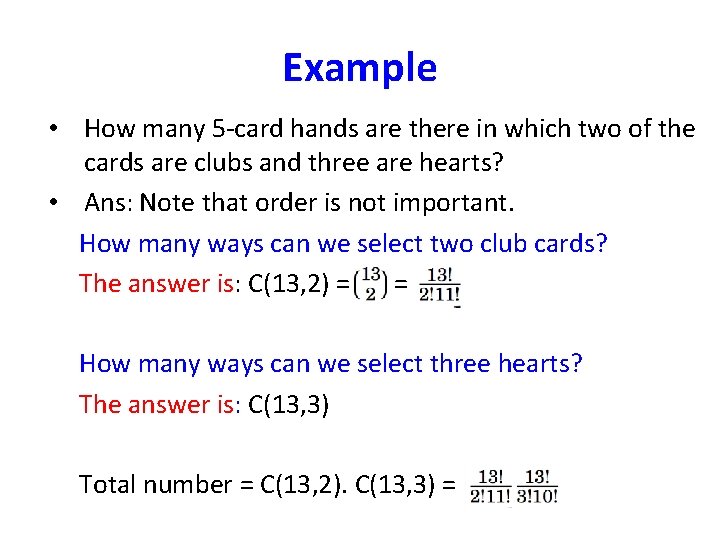
Example • How many 5 -card hands are there in which two of the cards are clubs and three are hearts? • Ans: Note that order is not important. How many ways can we select two club cards? The answer is: C(13, 2) = = How many ways can we select three hearts? The answer is: C(13, 3) Total number = C(13, 2). C(13, 3) =
Example • In how many ways a gambler draw five cards from a standard deck and get – – – – (a) a flush (five card of the same suit)? (b) four aces? (c) four of a kind? (d) three aces and two jacks? (e) three aces and a pair? (f) a full house (three of a kind a pair)? (g) thee of a kind? (h) two pairs?
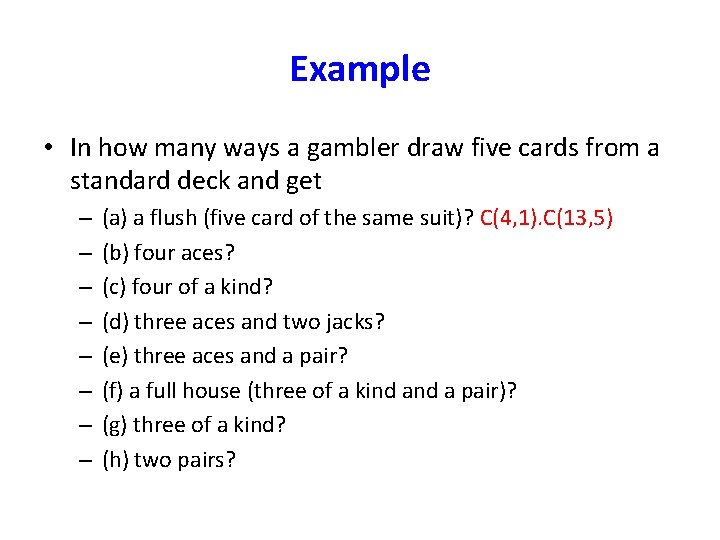
Example • In how many ways a gambler draw five cards from a standard deck and get – – – – (a) a flush (five card of the same suit)? C(4, 1). C(13, 5) (b) four aces? (c) four of a kind? (d) three aces and two jacks? (e) three aces and a pair? (f) a full house (three of a kind a pair)? (g) three of a kind? (h) two pairs?
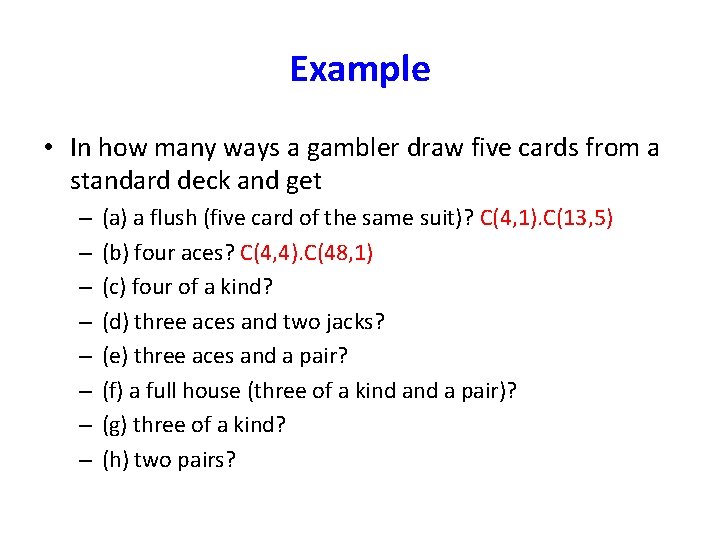
Example • In how many ways a gambler draw five cards from a standard deck and get – – – – (a) a flush (five card of the same suit)? C(4, 1). C(13, 5) (b) four aces? C(4, 4). C(48, 1) (c) four of a kind? (d) three aces and two jacks? (e) three aces and a pair? (f) a full house (three of a kind a pair)? (g) three of a kind? (h) two pairs?
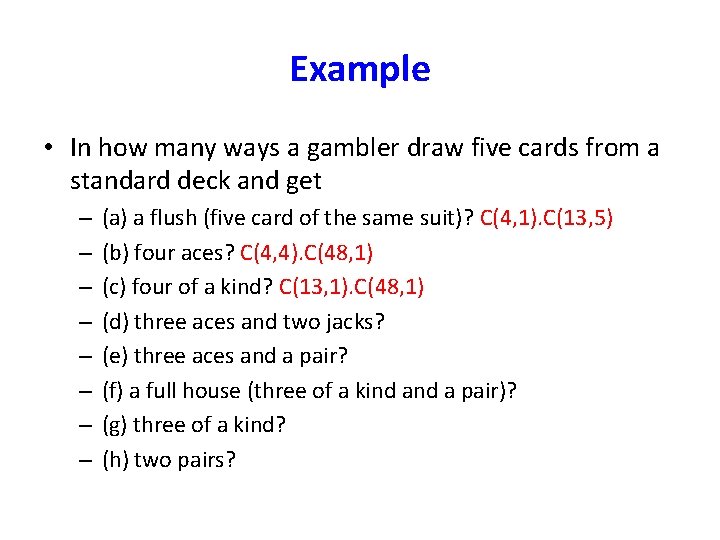
Example • In how many ways a gambler draw five cards from a standard deck and get – – – – (a) a flush (five card of the same suit)? C(4, 1). C(13, 5) (b) four aces? C(4, 4). C(48, 1) (c) four of a kind? C(13, 1). C(48, 1) (d) three aces and two jacks? (e) three aces and a pair? (f) a full house (three of a kind a pair)? (g) three of a kind? (h) two pairs?
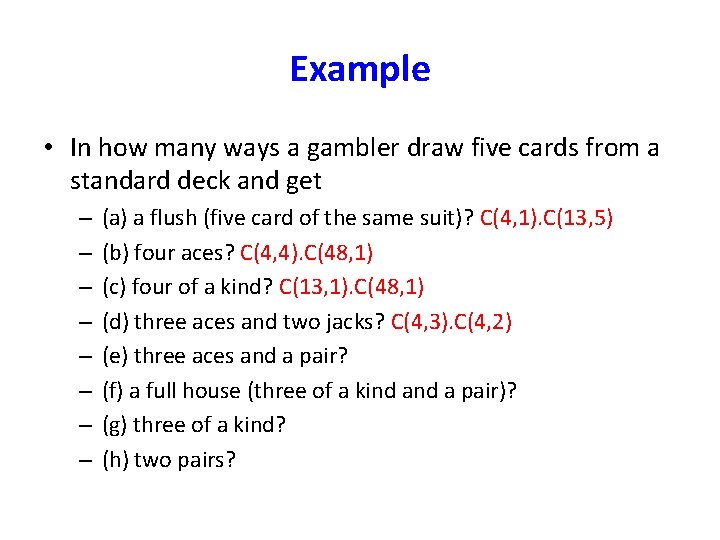
Example • In how many ways a gambler draw five cards from a standard deck and get – – – – (a) a flush (five card of the same suit)? C(4, 1). C(13, 5) (b) four aces? C(4, 4). C(48, 1) (c) four of a kind? C(13, 1). C(48, 1) (d) three aces and two jacks? C(4, 3). C(4, 2) (e) three aces and a pair? (f) a full house (three of a kind a pair)? (g) three of a kind? (h) two pairs?
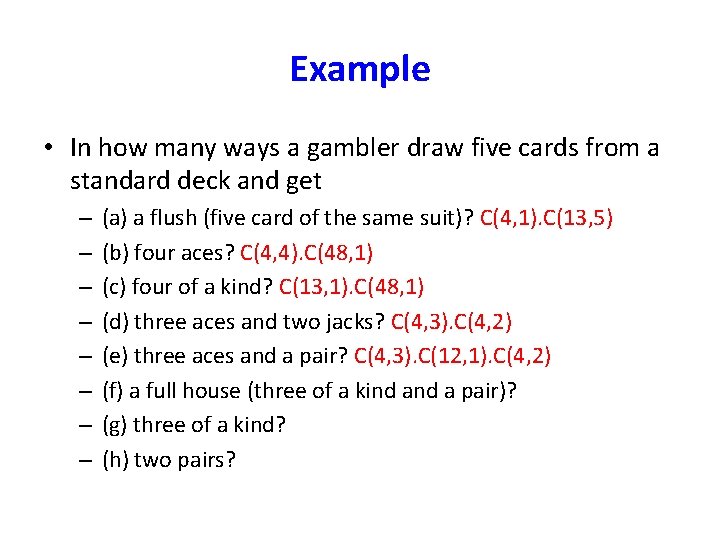
Example • In how many ways a gambler draw five cards from a standard deck and get – – – – (a) a flush (five card of the same suit)? C(4, 1). C(13, 5) (b) four aces? C(4, 4). C(48, 1) (c) four of a kind? C(13, 1). C(48, 1) (d) three aces and two jacks? C(4, 3). C(4, 2) (e) three aces and a pair? C(4, 3). C(12, 1). C(4, 2) (f) a full house (three of a kind a pair)? (g) three of a kind? (h) two pairs?
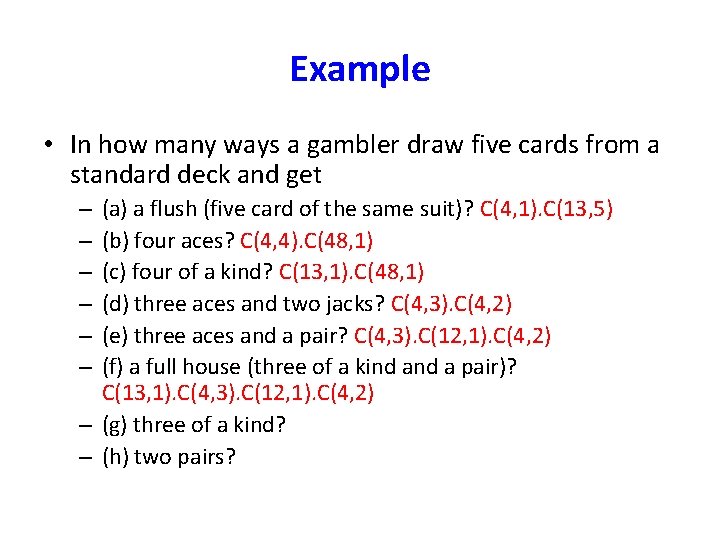
Example • In how many ways a gambler draw five cards from a standard deck and get (a) a flush (five card of the same suit)? C(4, 1). C(13, 5) (b) four aces? C(4, 4). C(48, 1) (c) four of a kind? C(13, 1). C(48, 1) (d) three aces and two jacks? C(4, 3). C(4, 2) (e) three aces and a pair? C(4, 3). C(12, 1). C(4, 2) (f) a full house (three of a kind a pair)? C(13, 1). C(4, 3). C(12, 1). C(4, 2) – (g) three of a kind? – (h) two pairs? – – –
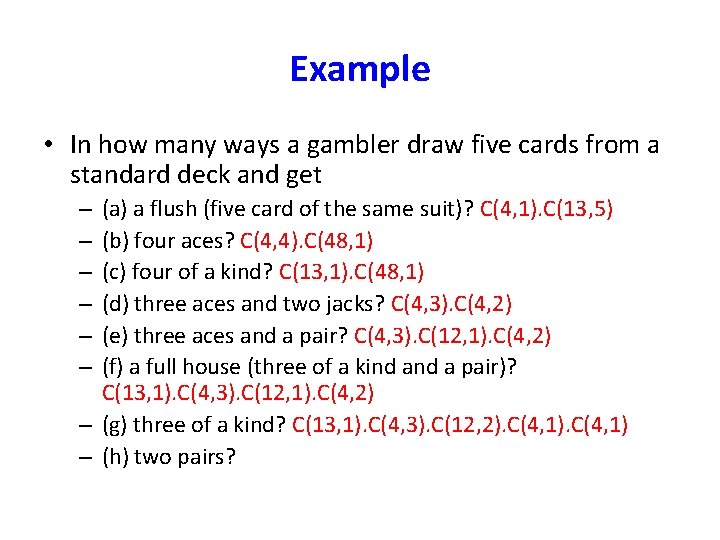
Example • In how many ways a gambler draw five cards from a standard deck and get (a) a flush (five card of the same suit)? C(4, 1). C(13, 5) (b) four aces? C(4, 4). C(48, 1) (c) four of a kind? C(13, 1). C(48, 1) (d) three aces and two jacks? C(4, 3). C(4, 2) (e) three aces and a pair? C(4, 3). C(12, 1). C(4, 2) (f) a full house (three of a kind a pair)? C(13, 1). C(4, 3). C(12, 1). C(4, 2) – (g) three of a kind? C(13, 1). C(4, 3). C(12, 2). C(4, 1) – (h) two pairs? – – –
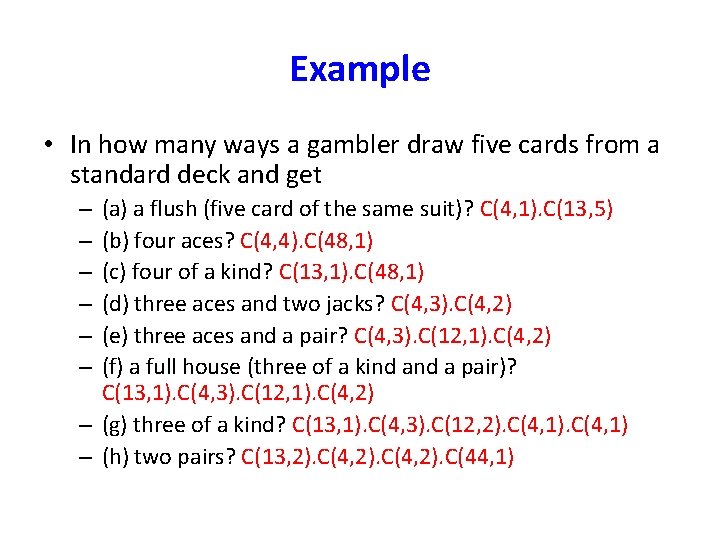
Example • In how many ways a gambler draw five cards from a standard deck and get (a) a flush (five card of the same suit)? C(4, 1). C(13, 5) (b) four aces? C(4, 4). C(48, 1) (c) four of a kind? C(13, 1). C(48, 1) (d) three aces and two jacks? C(4, 3). C(4, 2) (e) three aces and a pair? C(4, 3). C(12, 1). C(4, 2) (f) a full house (three of a kind a pair)? C(13, 1). C(4, 3). C(12, 1). C(4, 2) – (g) three of a kind? C(13, 1). C(4, 3). C(12, 2). C(4, 1) – (h) two pairs? C(13, 2). C(4, 2). C(44, 1) – – –
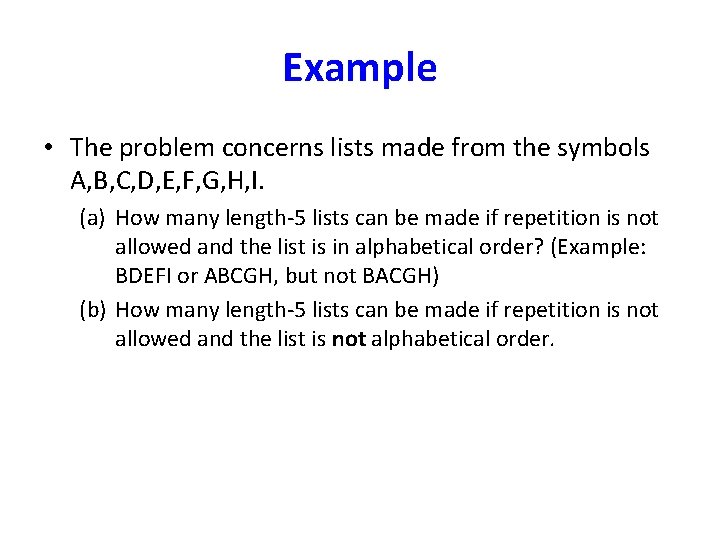
Example • The problem concerns lists made from the symbols A, B, C, D, E, F, G, H, I. (a) How many length-5 lists can be made if repetition is not allowed and the list is in alphabetical order? (Example: BDEFI or ABCGH, but not BACGH) (b) How many length-5 lists can be made if repetition is not allowed and the list is not alphabetical order.
Example • The problem concerns lists made from the symbols A, B, C, D, E, F, G, H, I. (a) How many length-5 lists can be made if repetition is not allowed and the list is in alphabetical order? (Example: BDEFI or ABCGH, but not BACGH) • Observe that size-5 subset realizes one length-5 list in alphabetical order, and one length-5 list realizes one size-5 subset. Therefore, the number od length-5 alphabetically ordered list is the same as the number of size-5 subsets. Hence the number is C(9, 5). (b) How many length-5 lists can be made if repetition is not allowed and the list is not alphabetical order.
Example • The problem concerns lists made from the symbols A, B, C, D, E, F, G, H, I. (a) How many length-5 lists can be made if repetition is not allowed and the list is in alphabetical order? (Example: BDEFI or ABCGH, but not BACGH) • Observe that size-5 subset realizes one length-5 list in alphabetical order, and one length-5 list realizes one size-5 subset. Therefore, the number od length-5 alphabetically ordered list is the same as the number of size-5 subsets. Hence the number is C(9, 5). (b) How many length-5 lists can be made if repetition is not allowed and the list is not alphabetical order. • Ans: 9 x 8 x 7 x 6 x 5 – C(9, 5).
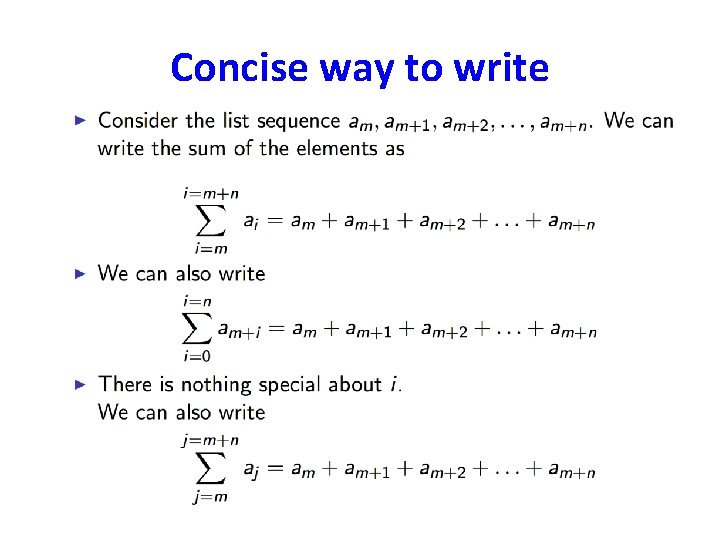
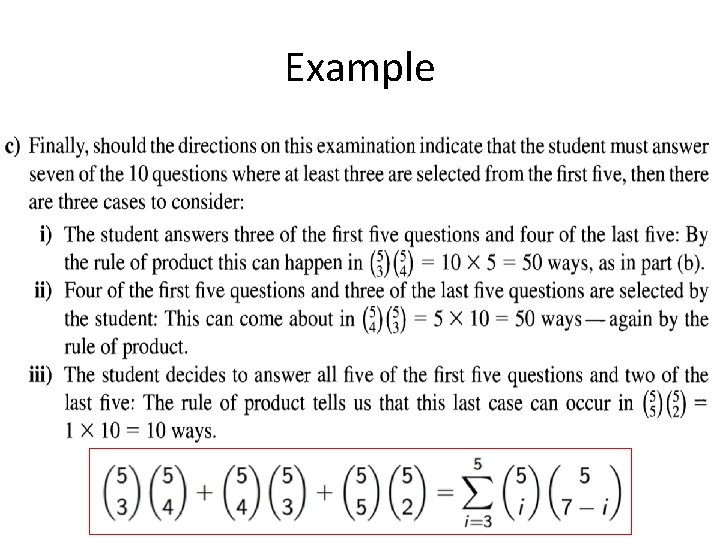
Concise way to write
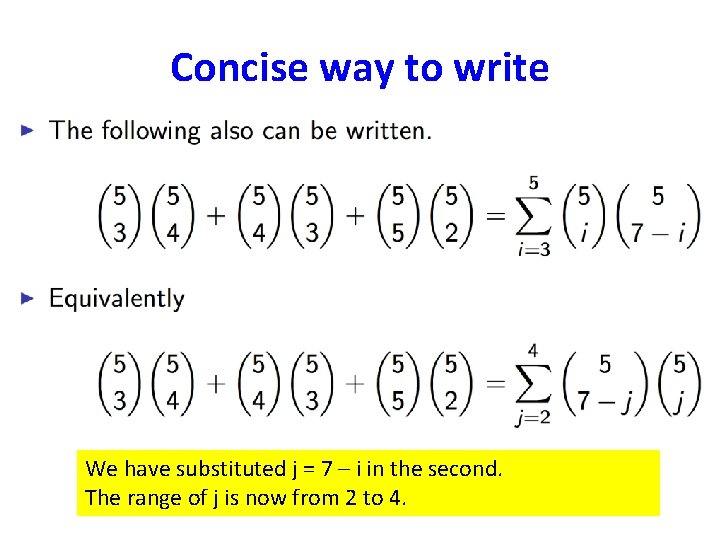
Concise way to write We have substituted j = 7 – i in the second. The range of j is now from 2 to 4.
Example
Example
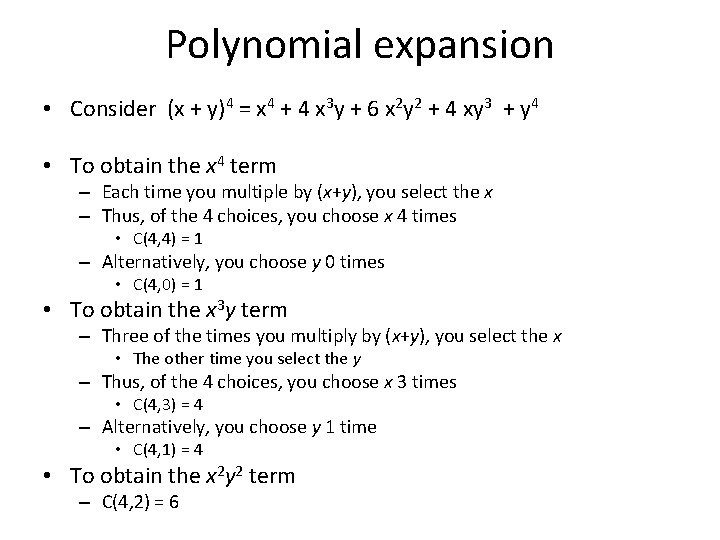
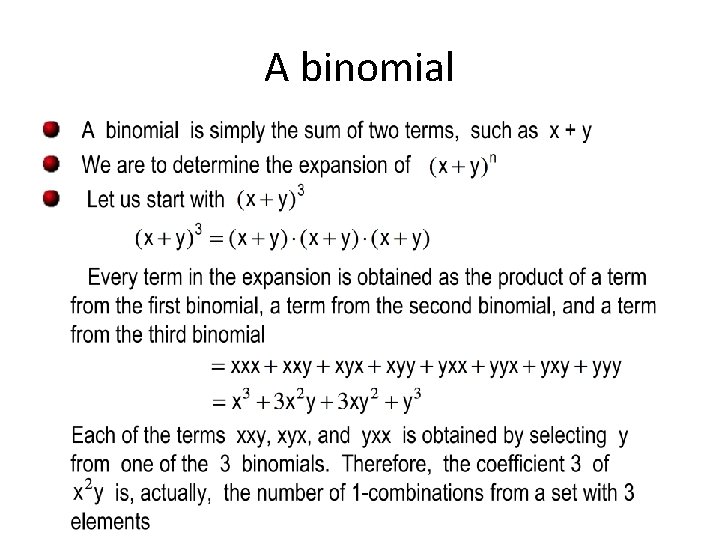
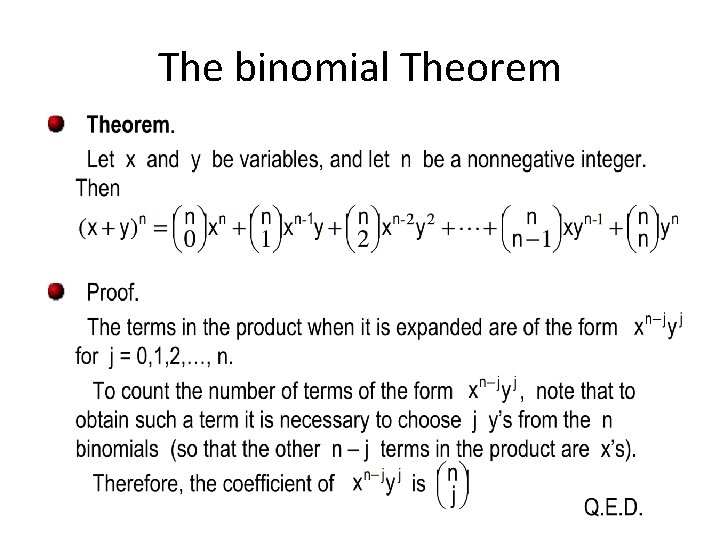
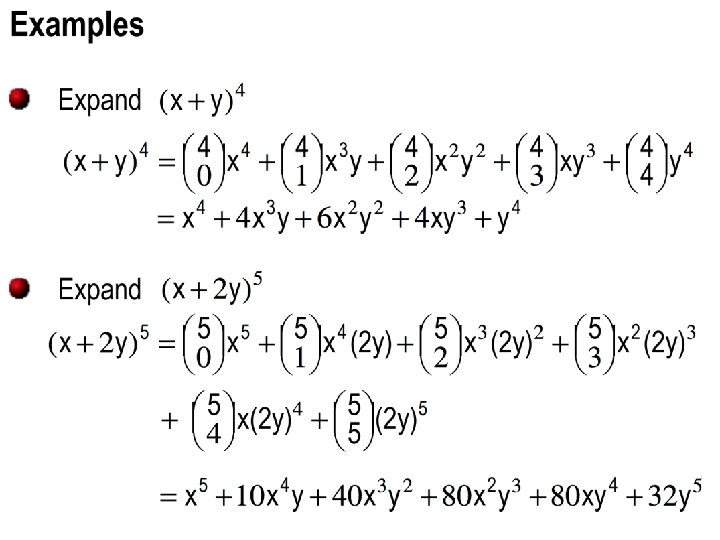
Polynomial expansion • Consider (x + y)4 = x 4 + 4 x 3 y + 6 x 2 y 2 + 4 xy 3 + y 4 • To obtain the x 4 term – Each time you multiple by (x+y), you select the x – Thus, of the 4 choices, you choose x 4 times • C(4, 4) = 1 – Alternatively, you choose y 0 times • C(4, 0) = 1 • To obtain the x 3 y term – Three of the times you multiply by (x+y), you select the x • The other time you select the y – Thus, of the 4 choices, you choose x 3 times • C(4, 3) = 4 – Alternatively, you choose y 1 time • C(4, 1) = 4 • To obtain the x 2 y 2 term – C(4, 2) = 6
A binomial
The binomial Theorem
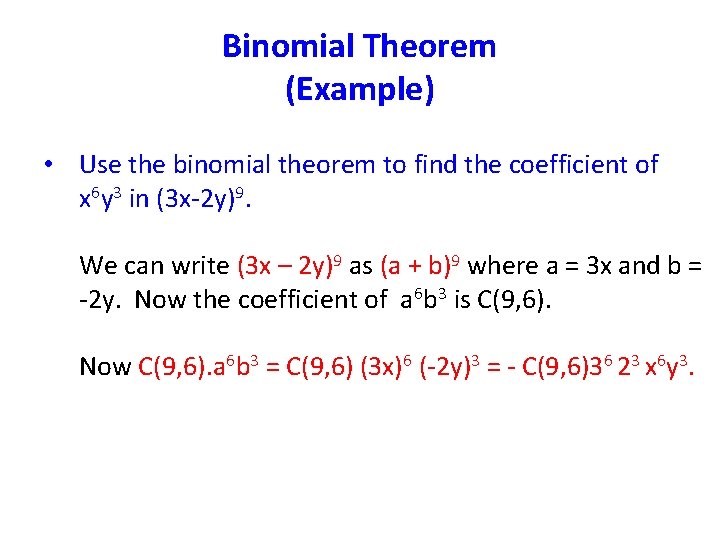
Binomial Theorem (Example) • Use the binomial theorem to find the coefficient of x 6 y 3 in (3 x-2 y)9. We can write (3 x – 2 y)9 as (a + b)9 where a = 3 x and b = -2 y. Now the coefficient of a 6 b 3 is C(9, 6). Now C(9, 6). a 6 b 3 = C(9, 6) (3 x)6 (-2 y)3 = - C(9, 6)36 23 x 6 y 3.
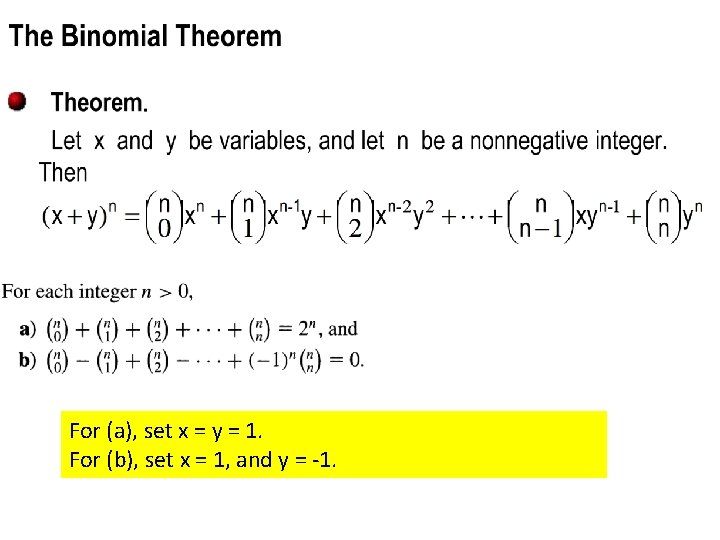
For (a), set x = y = 1. For (b), set x = 1, and y = -1.
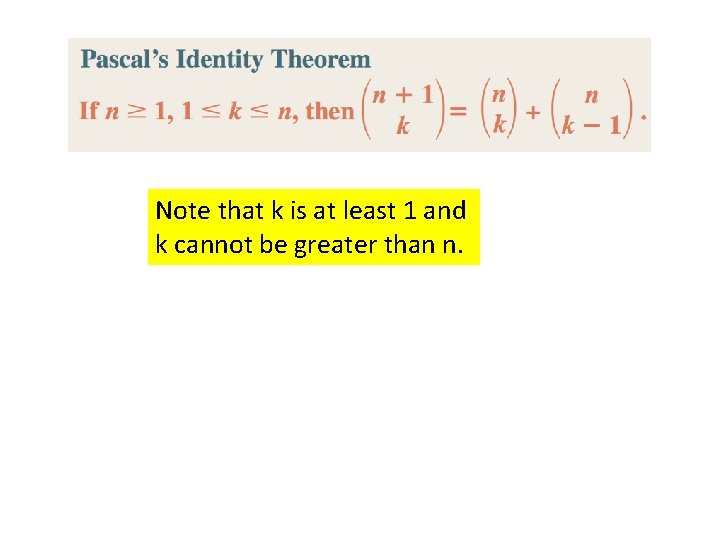
Note that k is at least 1 and k cannot be greater than n.
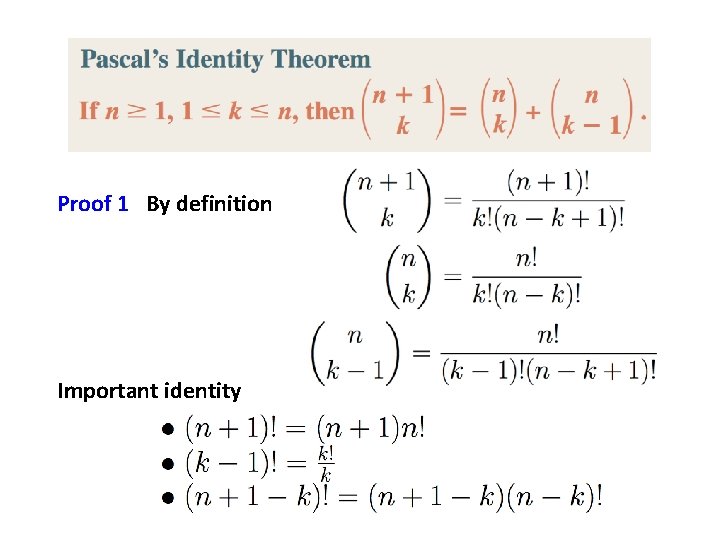
Proof 1 By definition Important identity
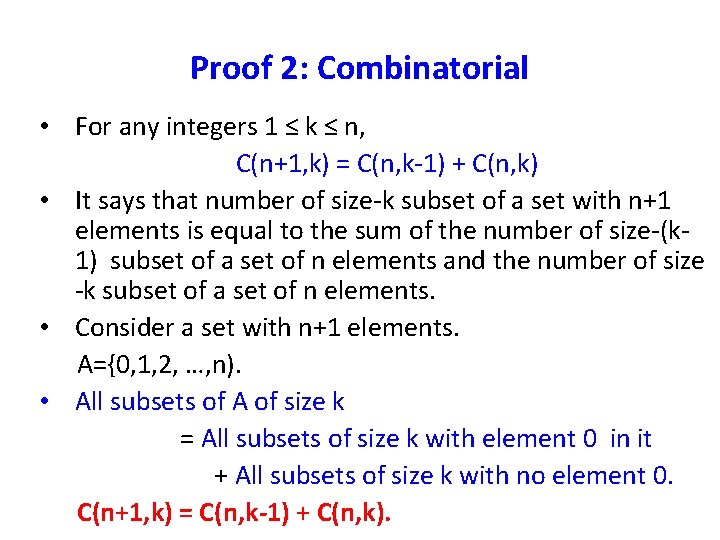
Proof 2: Combinatorial • For any integers 1 ≤ k ≤ n, C(n+1, k) = C(n, k-1) + C(n, k) • It says that number of size-k subset of a set with n+1 elements is equal to the sum of the number of size-(k 1) subset of a set of n elements and the number of size -k subset of a set of n elements. • Consider a set with n+1 elements. A={0, 1, 2, …, n). • All subsets of A of size k = All subsets of size k with element 0 in it + All subsets of size k with no element 0. C(n+1, k) = C(n, k-1) + C(n, k).
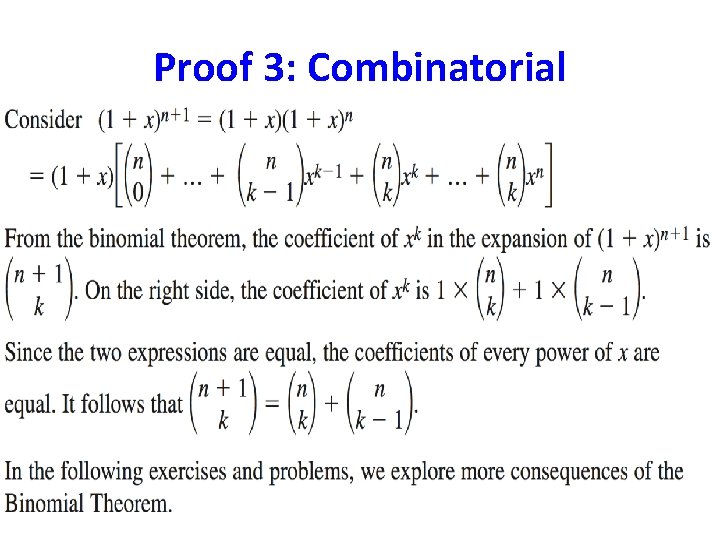
Proof 3: Combinatorial
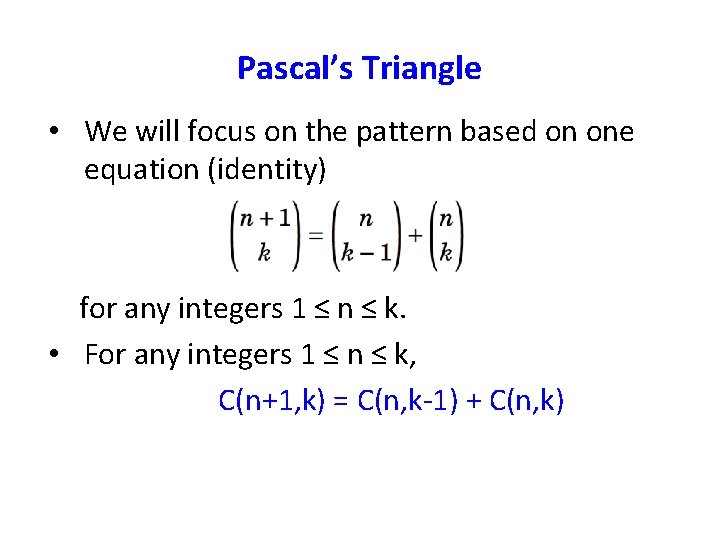
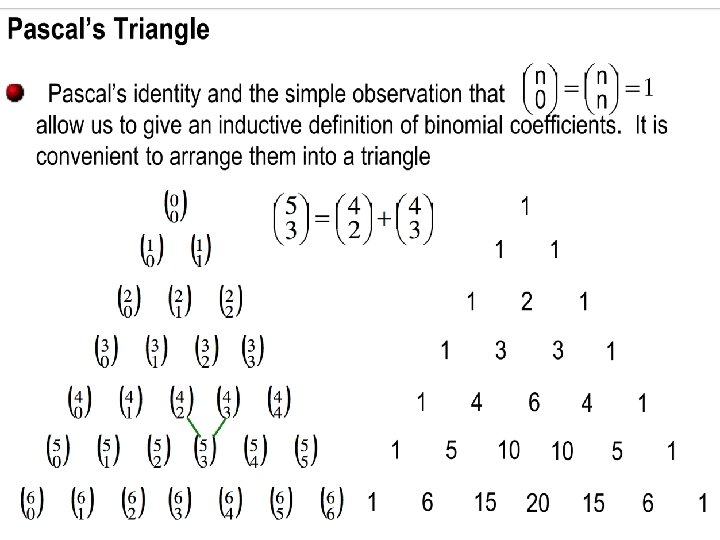
Pascal’s Triangle • We will focus on the pattern based on one equation (identity) for any integers 1 ≤ n ≤ k. • For any integers 1 ≤ n ≤ k, C(n+1, k) = C(n, k-1) + C(n, k)
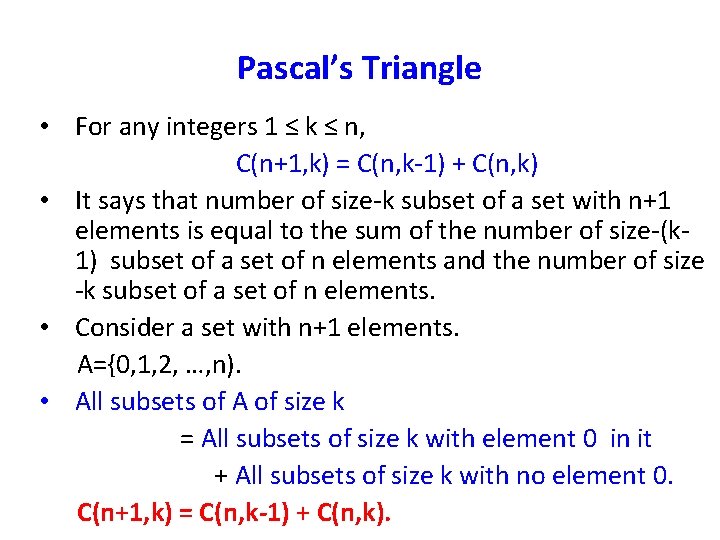
Pascal’s Triangle • For any integers 1 ≤ k ≤ n, C(n+1, k) = C(n, k-1) + C(n, k) • It says that number of size-k subset of a set with n+1 elements is equal to the sum of the number of size-(k 1) subset of a set of n elements and the number of size -k subset of a set of n elements. • Consider a set with n+1 elements. A={0, 1, 2, …, n). • All subsets of A of size k = All subsets of size k with element 0 in it + All subsets of size k with no element 0. C(n+1, k) = C(n, k-1) + C(n, k).
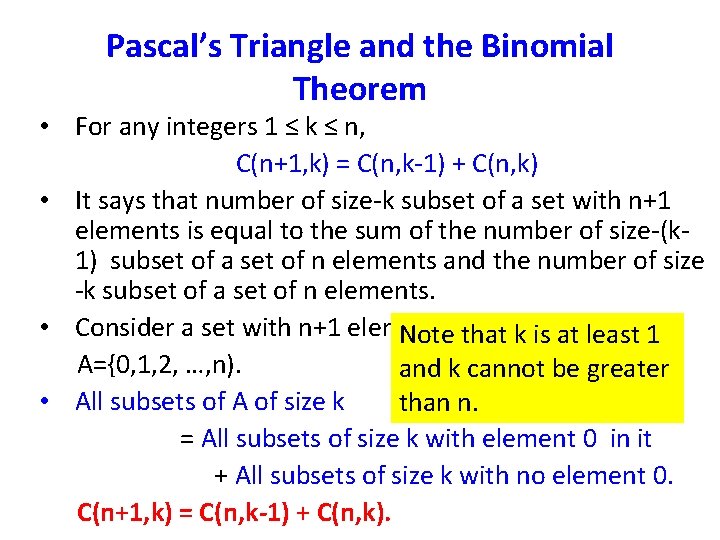
Pascal’s Triangle and the Binomial Theorem • For any integers 1 ≤ k ≤ n, C(n+1, k) = C(n, k-1) + C(n, k) • It says that number of size-k subset of a set with n+1 elements is equal to the sum of the number of size-(k 1) subset of a set of n elements and the number of size -k subset of a set of n elements. • Consider a set with n+1 elements. Note that k is at least 1 A={0, 1, 2, …, n). and k cannot be greater • All subsets of A of size k than n. = All subsets of size k with element 0 in it + All subsets of size k with no element 0. C(n+1, k) = C(n, k-1) + C(n, k).
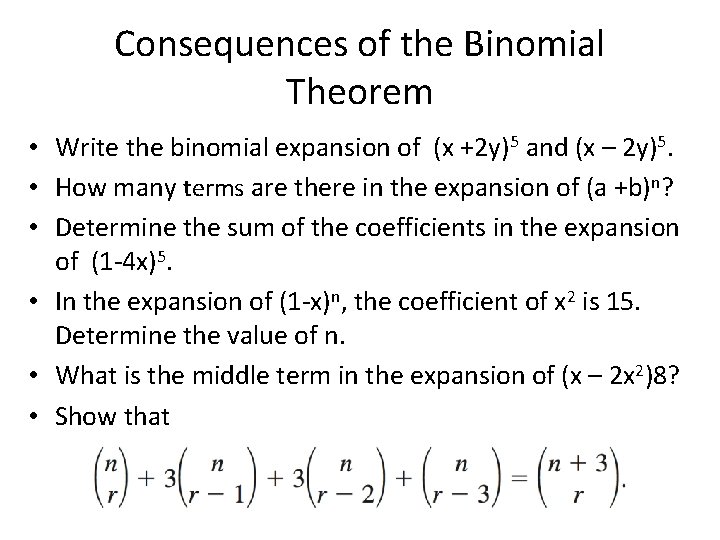
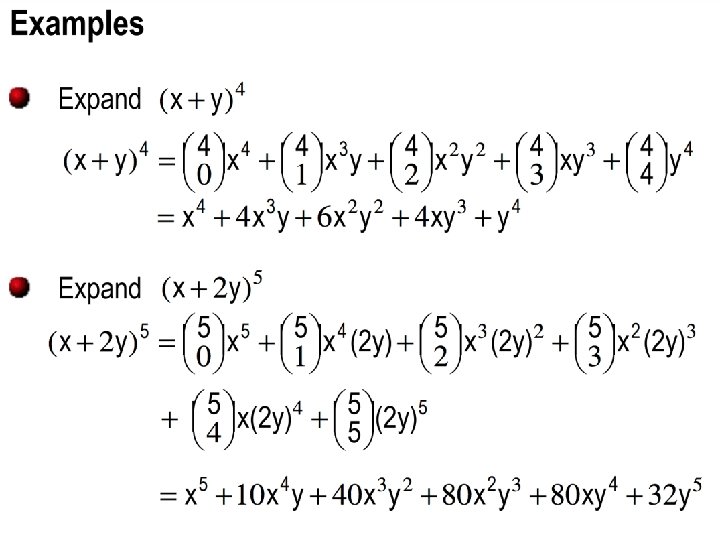
Consequences of the Binomial Theorem • Write the binomial expansion of (x +2 y)5 and (x – 2 y)5. • How many terms are there in the expansion of (a +b)n? • Determine the sum of the coefficients in the expansion of (1 -4 x)5. • In the expansion of (1 -x)n, the coefficient of x 2 is 15. Determine the value of n. • What is the middle term in the expansion of (x – 2 x 2)8? • Show that
- Slides: 81