
CHAPTER 1 Audit Sampling Concepts Copyright 2003 Pearson
- Slides: 123
CHAPTER 1 Audit Sampling Concepts Copyright 2003 Pearson Education Canada Inc. 11 - 1
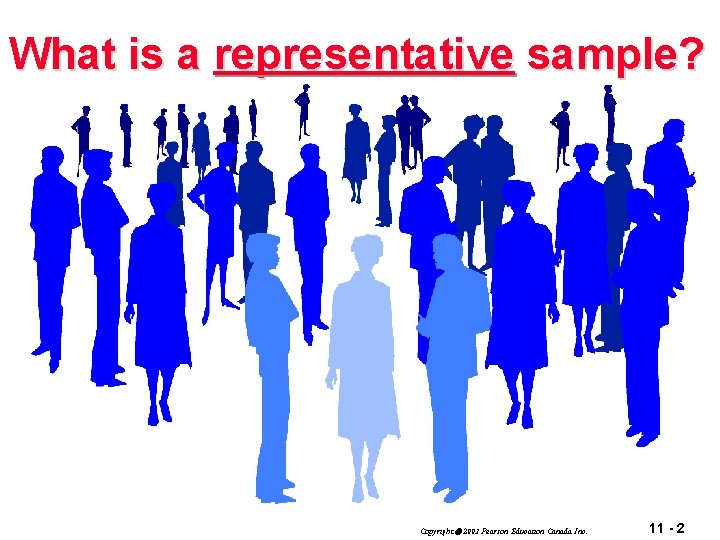
What is a representative sample? Copyright 2003 Pearson Education Canada Inc. 11 - 2
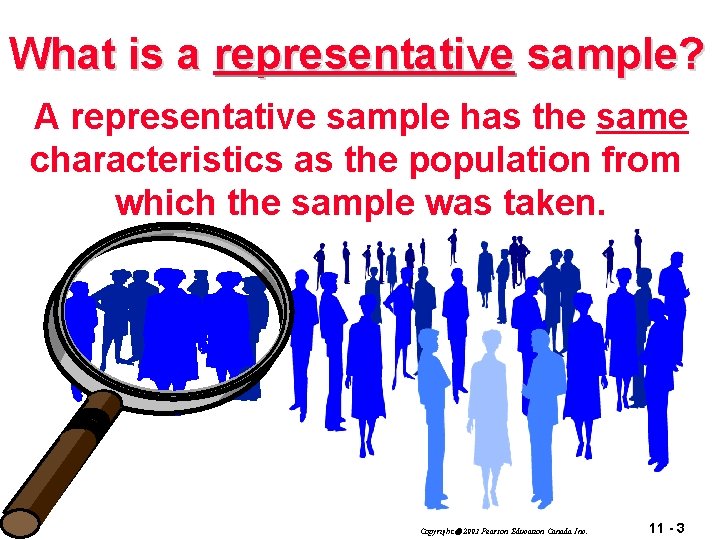
What is a representative sample? A representative sample has the same characteristics as the population from which the sample was taken. Copyright 2003 Pearson Education Canada Inc. 11 - 3
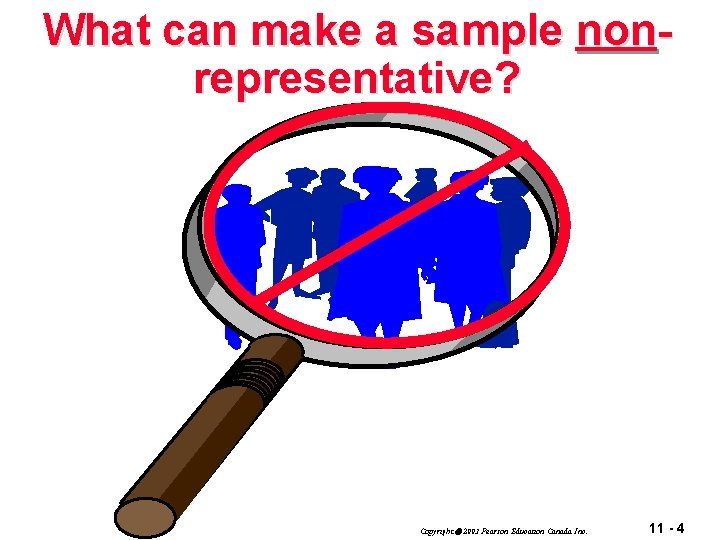
What can make a sample nonrepresentative? Copyright 2003 Pearson Education Canada Inc. 11 - 4
What can make a sample nonrepresentative? - sampling errors ? Copyright 2003 Pearson Education Canada Inc. 11 - 5
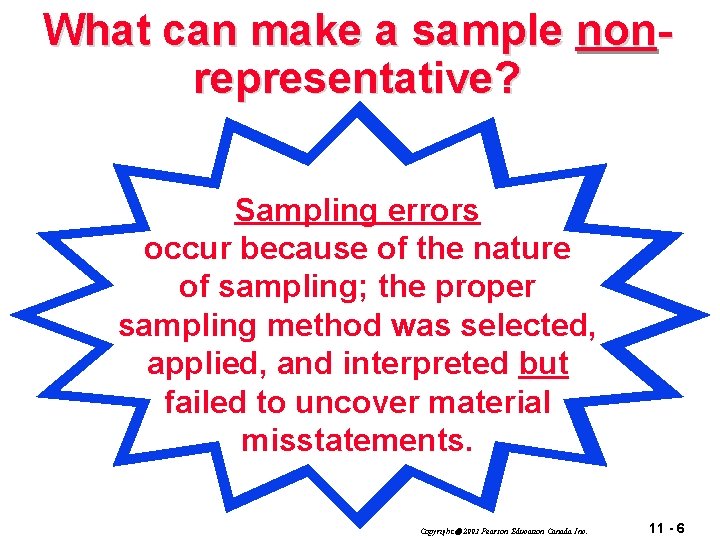
What can make a sample nonrepresentative? Sampling errors occur because of the nature of sampling; the proper sampling method was selected, applied, and interpreted but failed to uncover material misstatements. Copyright 2003 Pearson Education Canada Inc. 11 - 6
What can an auditor do to reduce the risk of sampling errors? Copyright 2003 Pearson Education Canada Inc. 11 - 7
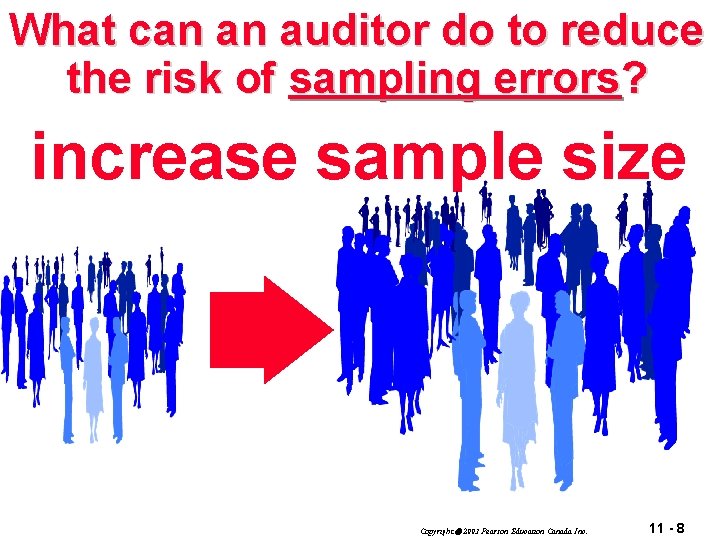
What can an auditor do to reduce the risk of sampling errors? increase sample size Copyright 2003 Pearson Education Canada Inc. 11 - 8
What can make a sample nonrepresentative? - sampling errors - nonsampling errors ? Copyright 2003 Pearson Education Canada Inc. 11 - 9
What can make a sample nonrepresentative? - sampling errors - nonsampling errors result from auditor failure to recognize errors or exceptions or from the selection of ineffective or inappropriate procedures oops! Copyright 2003 Pearson Education Canada Inc. 11 - 10
What can an auditor do to reduce the risk of nonsampling errors? Copyright 2003 Pearson Education Canada Inc. 11 - 11
What can an auditor do to reduce the risk of nonsampling errors? increase auditor competence Continuing Professional Education Copyright 2003 Pearson Education Canada Inc. 11 - 12
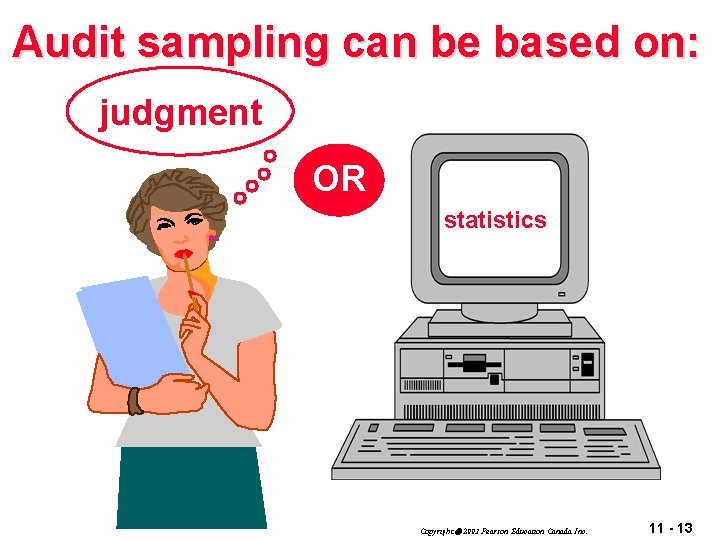
Audit sampling can be based on: judgment OR statistics Copyright 2003 Pearson Education Canada Inc. 11 - 13
nonstatistical sampling Copyright 2003 Pearson Education Canada Inc. 11 - 14
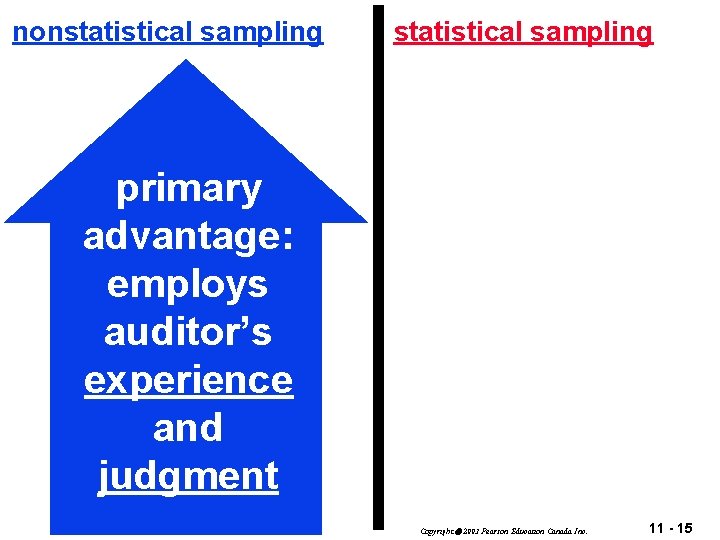
nonstatistical sampling primary advantage: employs auditor’s experience and judgment statistical sampling primary advantage: the audit risk can be quantified Copyright 2003 Pearson Education Canada Inc. 11 - 15
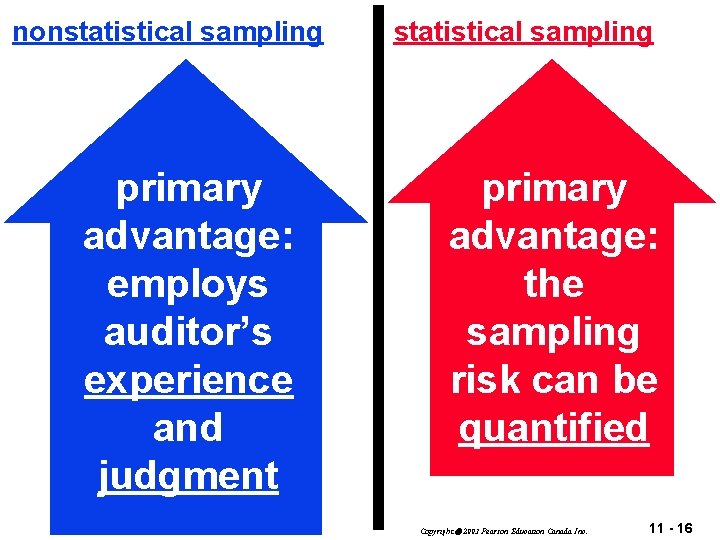
nonstatistical sampling primary advantage: employs auditor’s experience and judgment statistical sampling primary advantage: the sampling risk can be quantified Copyright 2003 Pearson Education Canada Inc. 11 - 16
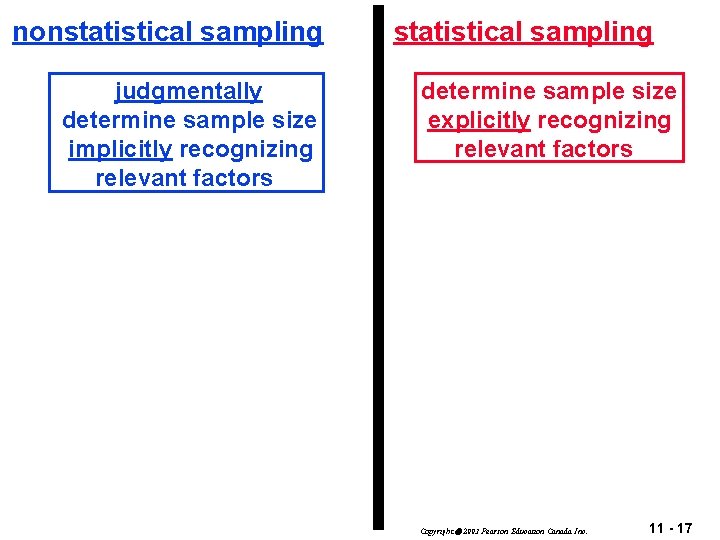
nonstatistical sampling judgmentally determine sample size implicitly recognizing relevant factors statistical sampling determine sample size explicitly recognizing relevant factors Copyright 2003 Pearson Education Canada Inc. 11 - 17
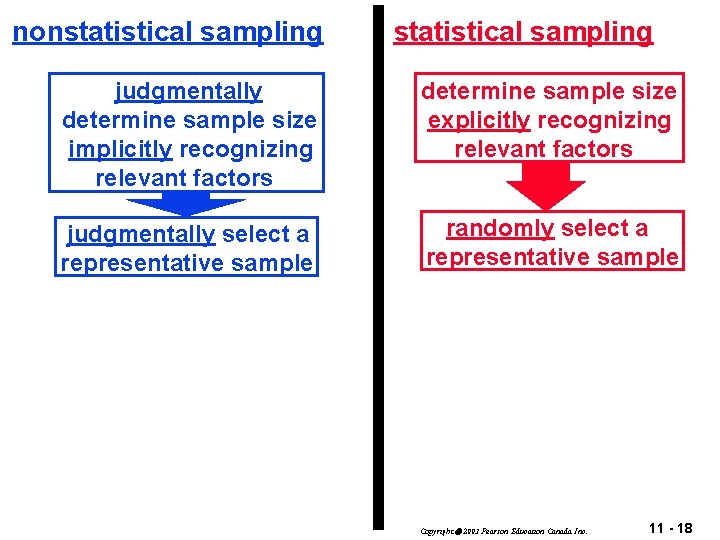
nonstatistical sampling judgmentally determine sample size implicitly recognizing relevant factors determine sample size explicitly recognizing relevant factors judgmentally select a representative sample randomly select a representative sample Copyright 2003 Pearson Education Canada Inc. 11 - 18
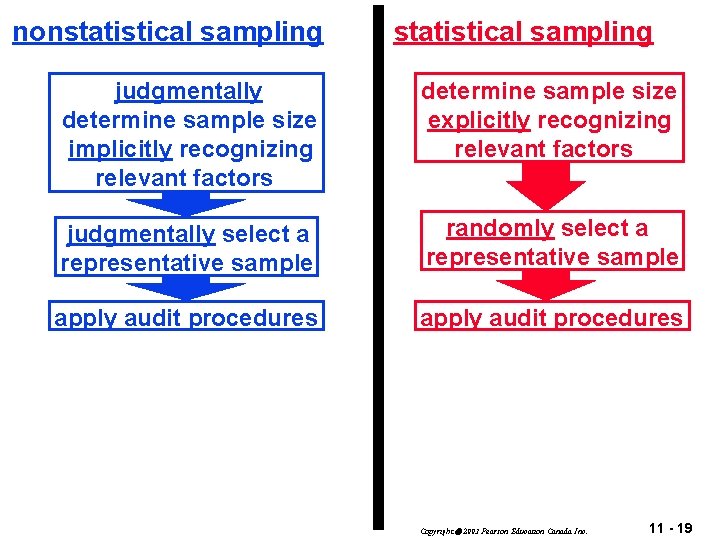
nonstatistical sampling judgmentally determine sample size implicitly recognizing relevant factors determine sample size explicitly recognizing relevant factors judgmentally select a representative sample randomly select a representative sample apply audit procedures Copyright 2003 Pearson Education Canada Inc. 11 - 19
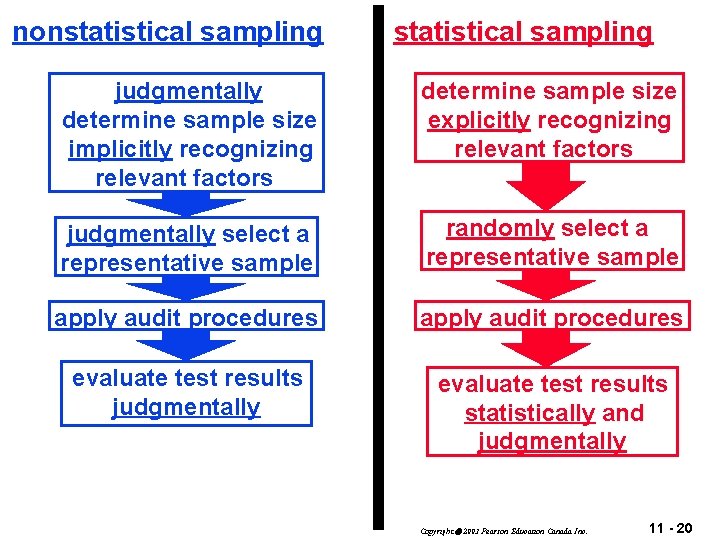
nonstatistical sampling judgmentally determine sample size implicitly recognizing relevant factors determine sample size explicitly recognizing relevant factors judgmentally select a representative sample randomly select a representative sample apply audit procedures evaluate test results judgmentally evaluate test results statistically and judgmentally Copyright 2003 Pearson Education Canada Inc. 11 - 20
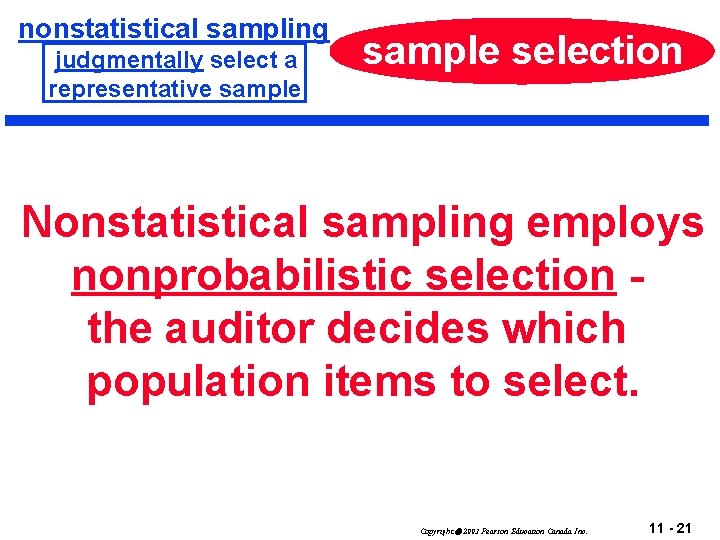
nonstatistical sampling judgmentally select a representative sample selection Nonstatistical sampling employs nonprobabilistic selection the auditor decides which population items to select. Copyright 2003 Pearson Education Canada Inc. 11 - 21
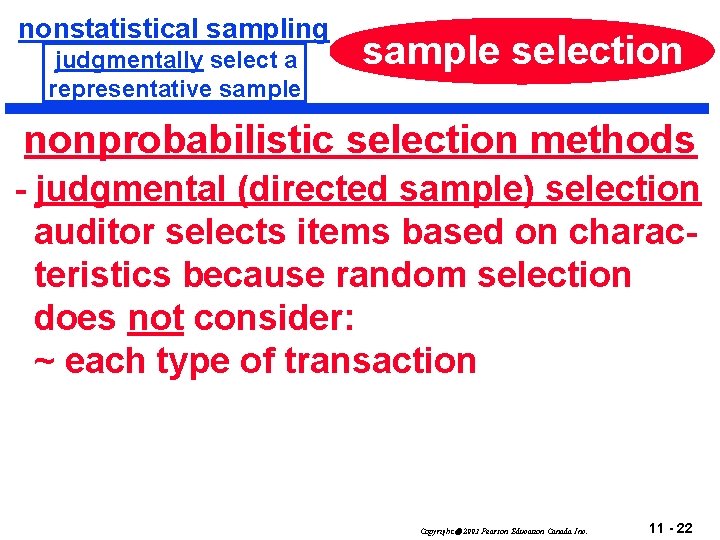
nonstatistical sampling judgmentally select a representative sample selection nonprobabilistic selection methods - judgmental (directed sample) selection auditor selects items based on characteristics because random selection does not consider: ~ each type of transaction Copyright 2003 Pearson Education Canada Inc. 11 - 22
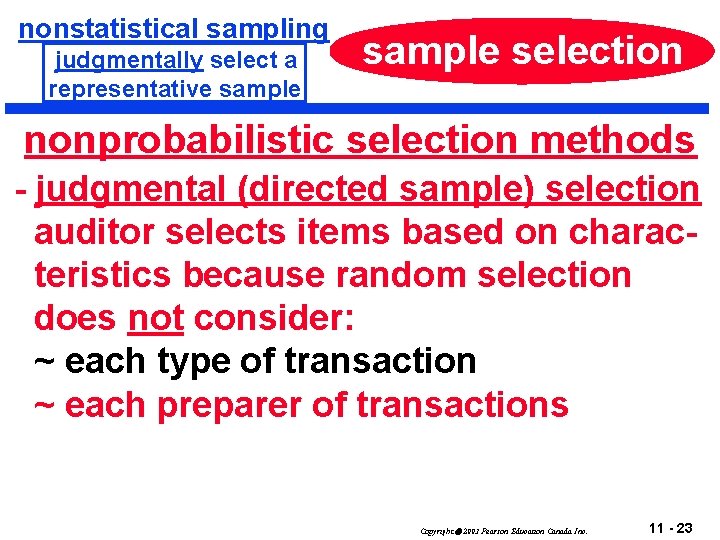
nonstatistical sampling judgmentally select a representative sample selection nonprobabilistic selection methods - judgmental (directed sample) selection auditor selects items based on characteristics because random selection does not consider: ~ each type of transaction ~ each preparer of transactions Copyright 2003 Pearson Education Canada Inc. 11 - 23
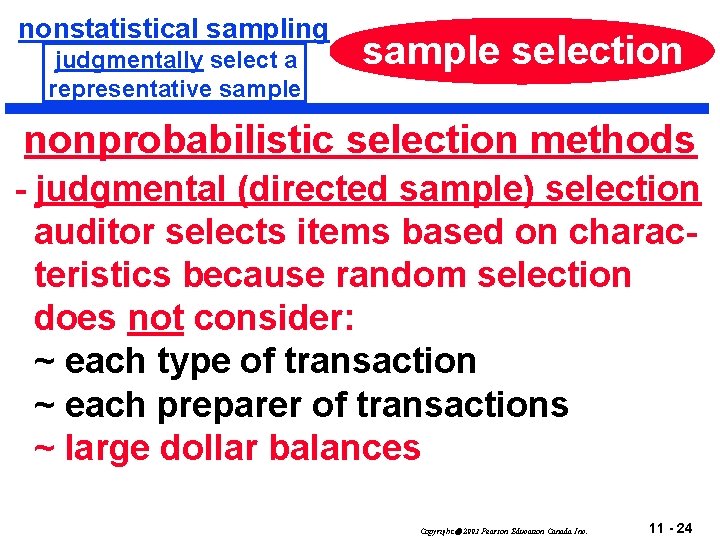
nonstatistical sampling judgmentally select a representative sample selection nonprobabilistic selection methods - judgmental (directed sample) selection auditor selects items based on characteristics because random selection does not consider: ~ each type of transaction ~ each preparer of transactions ~ large dollar balances Copyright 2003 Pearson Education Canada Inc. 11 - 24
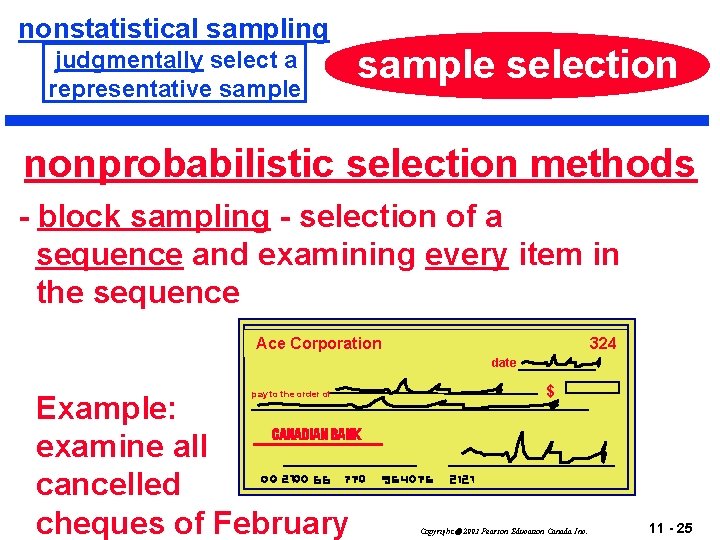
nonstatistical sampling judgmentally select a representative sample selection nonprobabilistic selection methods - block sampling - selection of a sequence and examining every item in the sequence Ace Corporation 324 date pay to the order of Example: CANADIAN BANK examine all cancelled cheques of February $ Copyright 2003 Pearson Education Canada Inc. 11 - 25
nonstatistical sampling judgmentally select a representative sample selection nonprobabilistic selection methods - haphazard selection - auditor selects items without regard to characteristics Beware of bias! Copyright 2003 Pearson Education Canada Inc. 11 - 26
statistical sampling randomly select a representative sample selection Statistical sampling employs probabilistic selection - every population item has a known chance of being selected. Copyright 2003 Pearson Education Canada Inc. 11 - 27
statistical sampling randomly select a representative sample selection probabilistic selection methods - simple random sample selection used to sample populations that are not segmented for audit purposes Copyright 2003 Pearson Education Canada Inc. 11 - 28
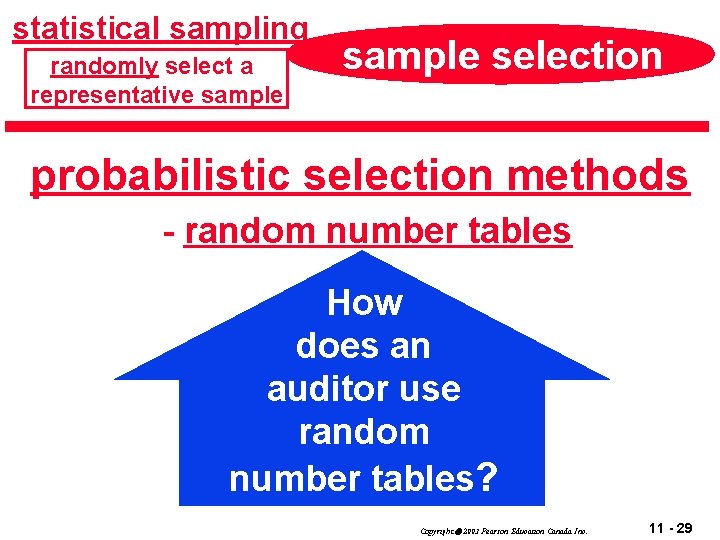
statistical sampling randomly select a representative sample selection probabilistic selection methods - random number tables How does an auditor use random number tables? Copyright 2003 Pearson Education Canada Inc. 11 - 29
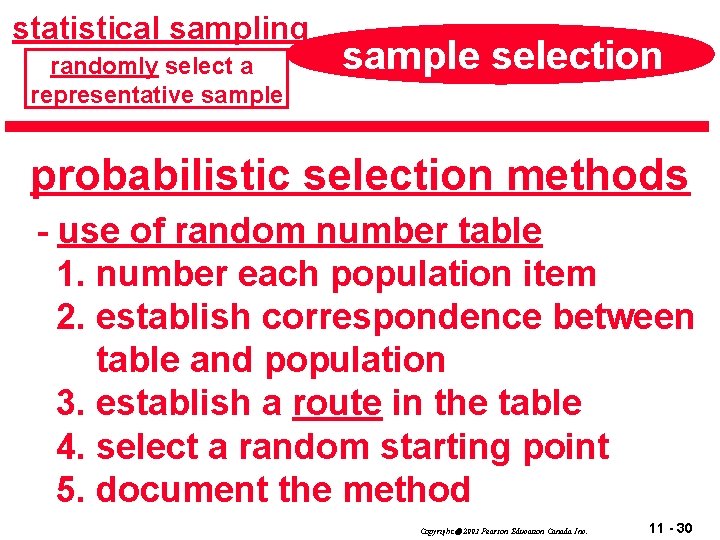
statistical sampling randomly select a representative sample selection probabilistic selection methods - use of random number table 1. number each population item 2. establish correspondence between table and population 3. establish a route in the table 4. select a random starting point 5. document the method Copyright 2003 Pearson Education Canada Inc. 11 - 30
statistical sampling randomly select a representative sample selection probabilistic selection methods - computer generation of random numbers Copyright 2003 Pearson Education Canada Inc. 11 - 31
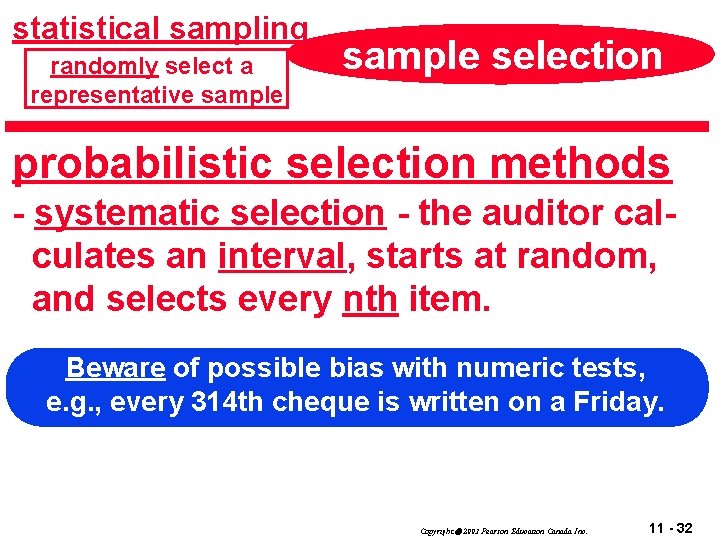
statistical sampling randomly select a representative sample selection probabilistic selection methods - systematic selection - the auditor calculates an interval, starts at random, and selects every nth item. Beware of possible bias with numeric tests, e. g. , every 314 th cheque is written on a Friday. Copyright 2003 Pearson Education Canada Inc. 11 - 32
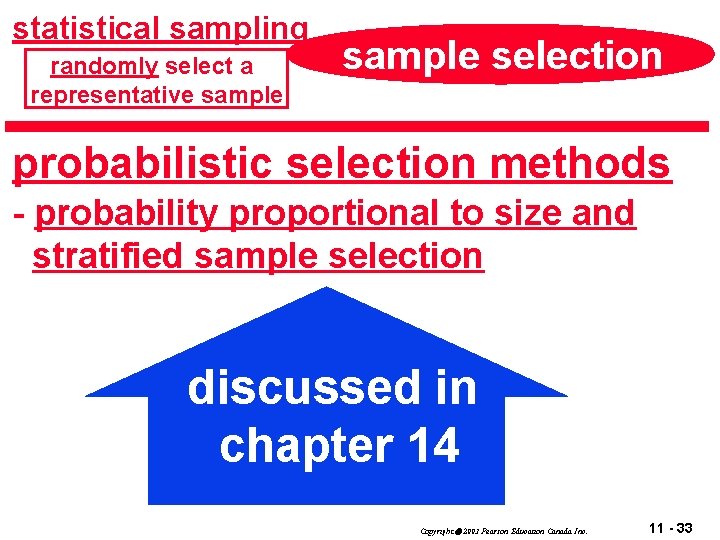
statistical sampling randomly select a representative sample selection probabilistic selection methods - probability proportional to size and stratified sample selection discussed in chapter 14 Copyright 2003 Pearson Education Canada Inc. 11 - 33
Audit Sampling ? Copyright 2003 Pearson Education Canada Inc. 11 - 34
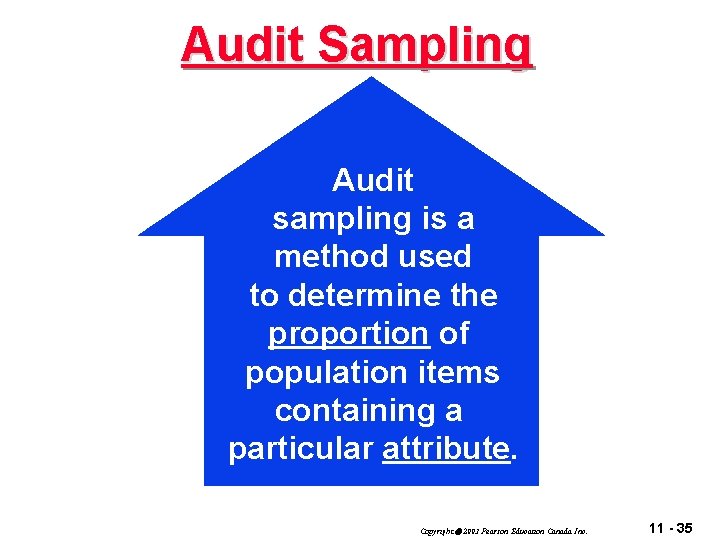
Audit Sampling Audit sampling is a method used to determine the proportion of population items containing a particular attribute. Copyright 2003 Pearson Education Canada Inc. 11 - 35
When is audit sampling appropriate? Copyright 2003 Pearson Education Canada Inc. 11 - 36
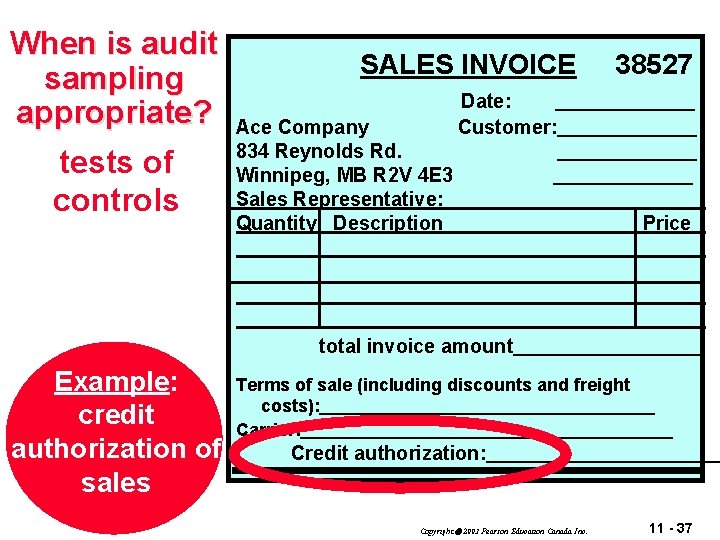
When is audit sampling appropriate? tests of controls SALES INVOICE Ace Company 834 Reynolds Rd. Winnipeg, MB R 2 V 4 E 3 Sales Representative: Quantity Description 38527 Date: Customer: Price total invoice amount Example: credit authorization of sales Terms of sale (including discounts and freight costs): Carrier: Credit authorization: Copyright 2003 Pearson Education Canada Inc. 11 - 37
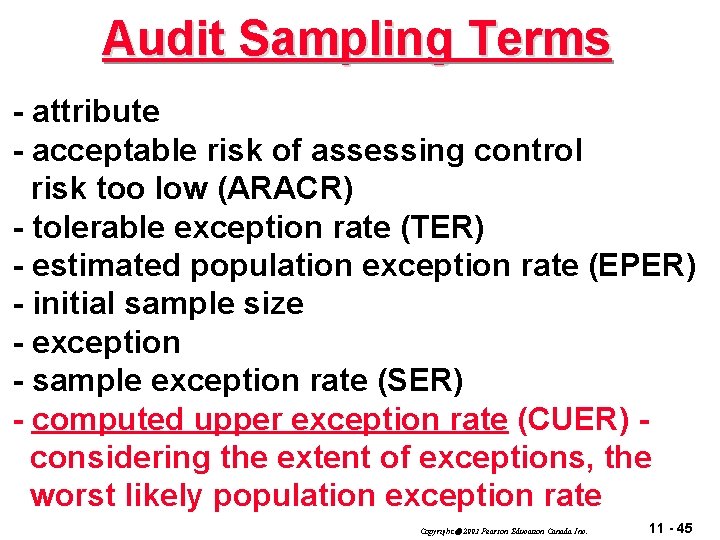
Audit Sampling Terms - attribute - the tested characteristic Copyright 2003 Pearson Education Canada Inc. 11 - 38
Audit Sampling Terms - attribute - acceptable risk of assessing control risk too low (ARACR)- the risk that the auditor is willing to accept that controls are accepted as effective, but the actual population exception rate is greater than the TER Copyright 2003 Pearson Education Canada Inc. 11 - 39
Audit Sampling Terms - attribute - acceptable risk of assessing control risk too low (ARACR) - tolerable exception rate (TER) - the population exception rate the auditor will permit and still be willing to use the assessed control risk and/or the amount of monetary misstatements in the transactions established during planning Copyright 2003 Pearson Education Canada Inc. 11 - 40
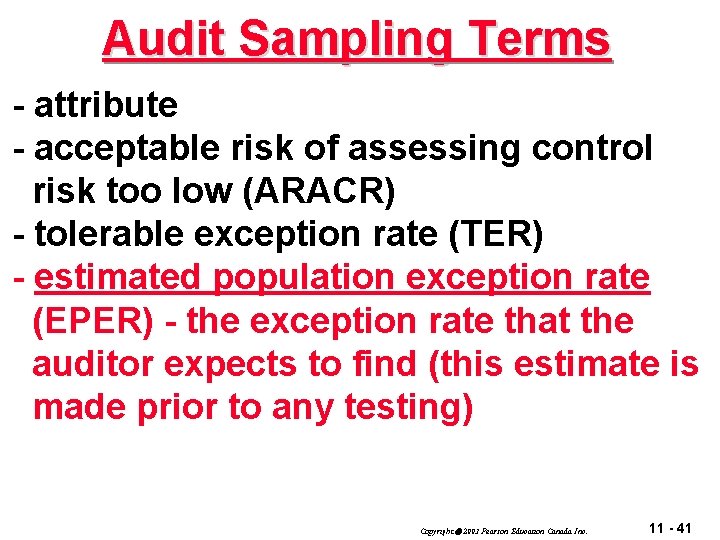
Audit Sampling Terms - attribute - acceptable risk of assessing control risk too low (ARACR) - tolerable exception rate (TER) - estimated population exception rate (EPER) - the exception rate that the auditor expects to find (this estimate is made prior to any testing) Copyright 2003 Pearson Education Canada Inc. 11 - 41
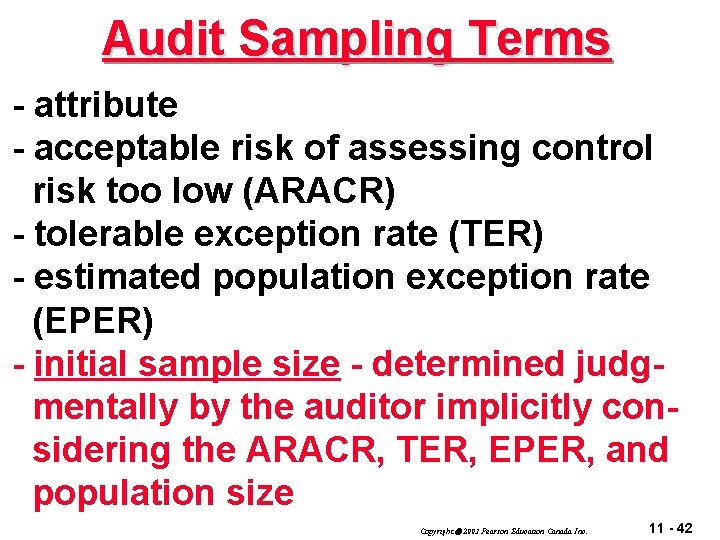
Audit Sampling Terms - attribute - acceptable risk of assessing control risk too low (ARACR) - tolerable exception rate (TER) - estimated population exception rate (EPER) - initial sample size - determined judgmentally by the auditor implicitly considering the ARACR, TER, EPER, and population size Copyright 2003 Pearson Education Canada Inc. 11 - 42
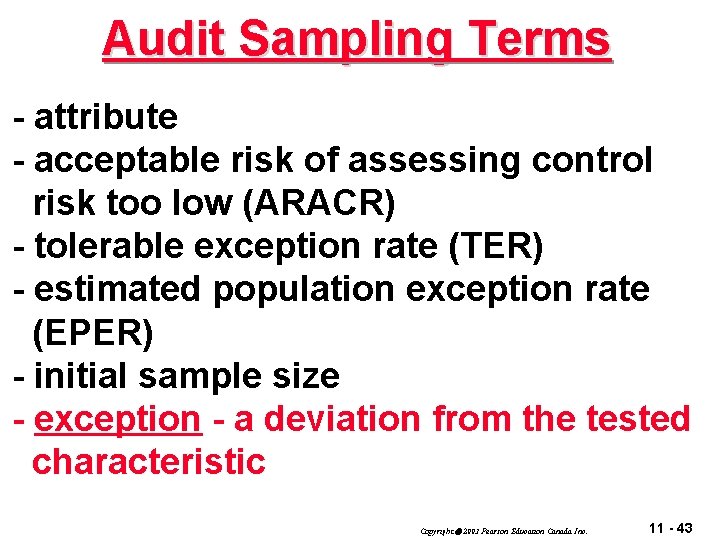
Audit Sampling Terms - attribute - acceptable risk of assessing control risk too low (ARACR) - tolerable exception rate (TER) - estimated population exception rate (EPER) - initial sample size - exception - a deviation from the tested characteristic Copyright 2003 Pearson Education Canada Inc. 11 - 43
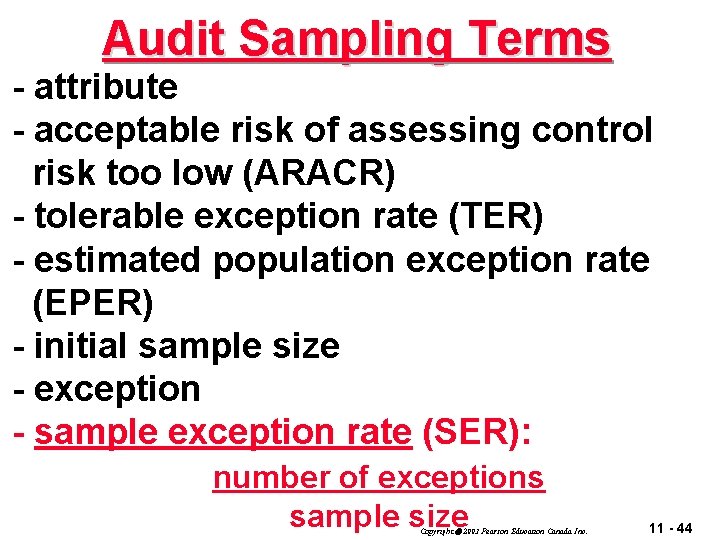
Audit Sampling Terms - attribute - acceptable risk of assessing control risk too low (ARACR) - tolerable exception rate (TER) - estimated population exception rate (EPER) - initial sample size - exception - sample exception rate (SER): number of exceptions sample size Copyright 2003 Pearson Education Canada Inc. 11 - 44
Audit Sampling Terms - attribute - acceptable risk of assessing control risk too low (ARACR) - tolerable exception rate (TER) - estimated population exception rate (EPER) - initial sample size - exception - sample exception rate (SER) - computed upper exception rate (CUER) considering the extent of exceptions, the worst likely population exception rate Copyright 2003 Pearson Education Canada Inc. 11 - 45
Audit Sampling Sequence ? Copyright 2003 Pearson Education Canada Inc. 11 - 46
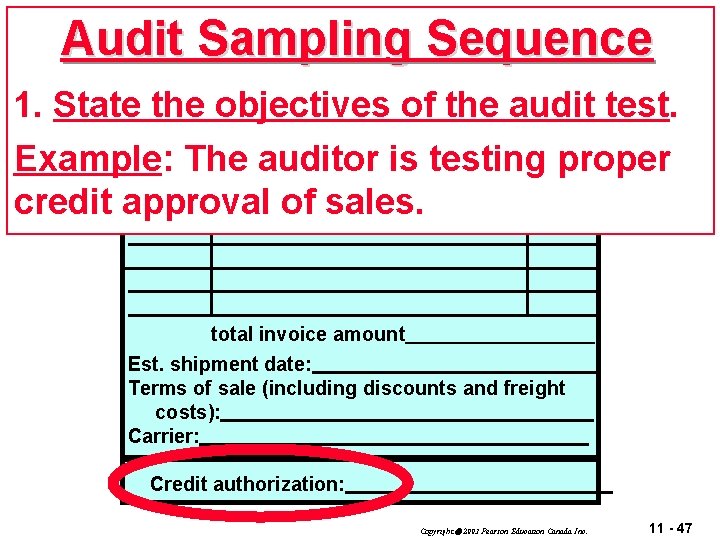
Audit Sampling Sequence SALES INVOICE 38527 Date: Customer: 1. State. Acme the objectives of the audit test. Company 834 Reynolda Rd. Winnipeg, MB R 2 V 4 E 3 Sales Representative: Quantity Description Example: The auditor is testing proper credit approval of sales. Price total invoice amount Est. shipment date: Terms of sale (including discounts and freight costs): Carrier: Credit authorization: Copyright 2003 Pearson Education Canada Inc. 11 - 47
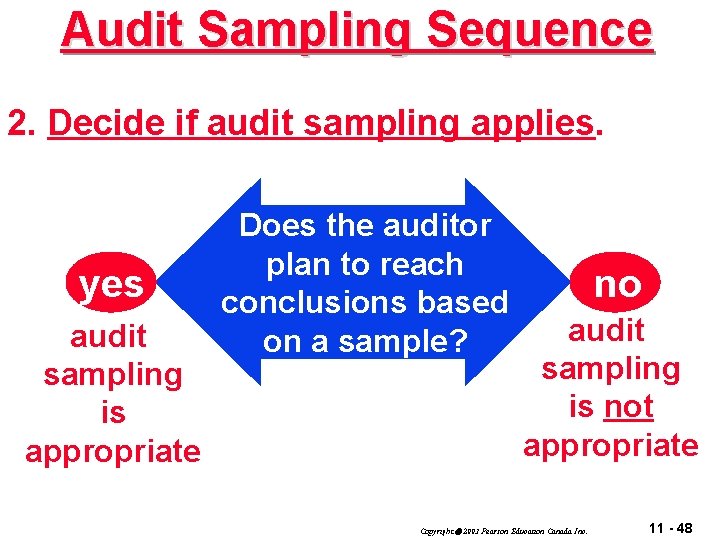
Audit Sampling Sequence 2. Decide if audit sampling applies. yes audit sampling is appropriate Does the auditor plan to reach conclusions based on a sample? no audit sampling is not appropriate Copyright 2003 Pearson Education Canada Inc. 11 - 48
Audit Sampling Sequence 3. Define attributes and exception conditions. In the example, what is the attribute? Copyright 2003 Pearson Education Canada Inc. 11 - 49
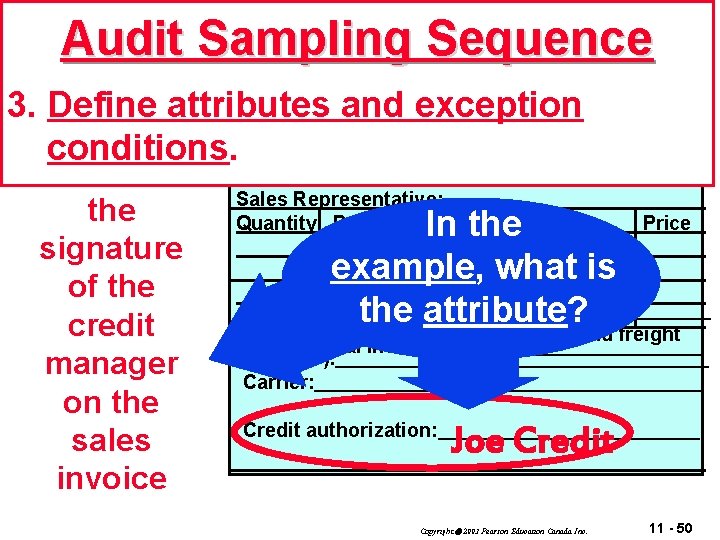
Audit Sampling Sequence SALES INVOICE 38527 Date: 3. Define attributes and exception Acme Company Customer: conditions. 834 Reynolda Rd. the signature of the credit manager on the sales invoice Winnipeg, MB R 2 V 4 E 3 Sales Representative: Quantity Description In the example, what is Est. shipment date: attribute? the Price Terms of sale (including discounts and freight total invoice amount costs): Carrier: Credit authorization: Joe Credit Copyright 2003 Pearson Education Canada Inc. 11 - 50
Audit Sampling Sequence 3. Define attributes and exception conditions. In the example, what is the exception condition? Copyright 2003 Pearson Education Canada Inc. 11 - 51
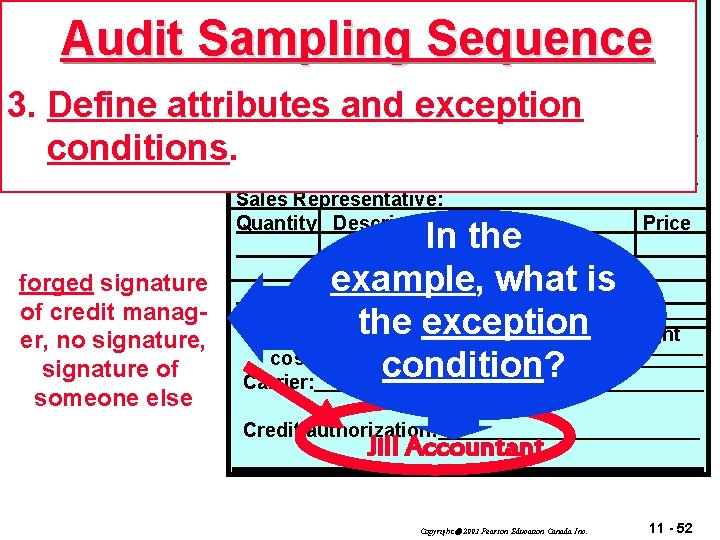
Audit Sampling Sequence SALES INVOICE 38527 Date: 3. Define attributes and exception Acme Company Customer: conditions. 834 Reynolda Rd. Winnipeg, MB R 2 V 4 E 3 Sales Representative: Quantity Description forged signature of credit manager, no signature, signature of someone else Price In the example, what is Est. shipment date: the exception Terms of sale (including discounts and freight total invoice amount costs): condition? Carrier: Credit authorization: Jill Accountant Copyright 2003 Pearson Education Canada Inc. 11 - 52
audit sampling sequence 4. Define the population. In the example, what is the population? Copyright 2003 Pearson Education Canada Inc. 11 - 53
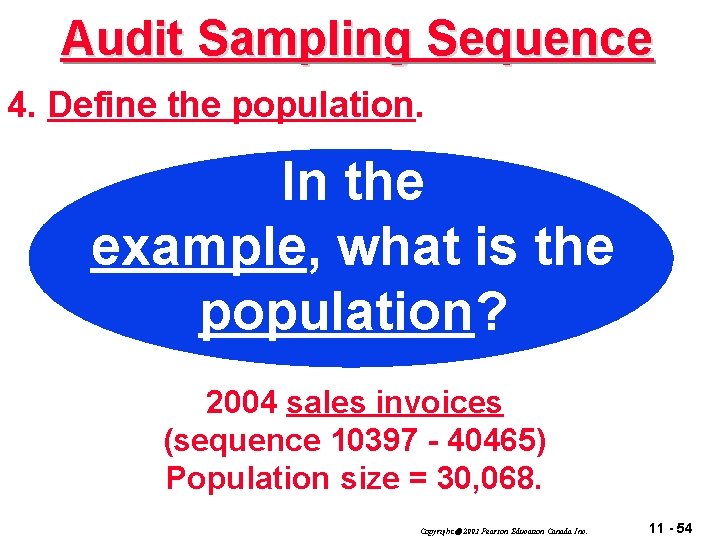
Audit Sampling Sequence 4. Define the population. In the example, what is the population? 2004 sales invoices (sequence 10397 - 40465) Population size = 30, 068. Copyright 2003 Pearson Education Canada Inc. 11 - 54
Audit Sampling Sequence 5. Define the sampling unit. In the example, what is the sampling unit? Copyright 2003 Pearson Education Canada Inc. 11 - 55
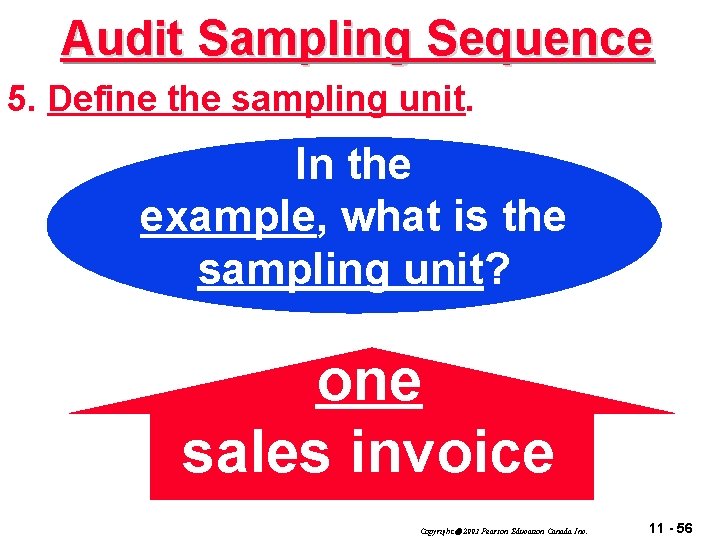
Audit Sampling Sequence 5. Define the sampling unit. In the example, what is the sampling unit? one sales invoice Copyright 2003 Pearson Education Canada Inc. 11 - 56
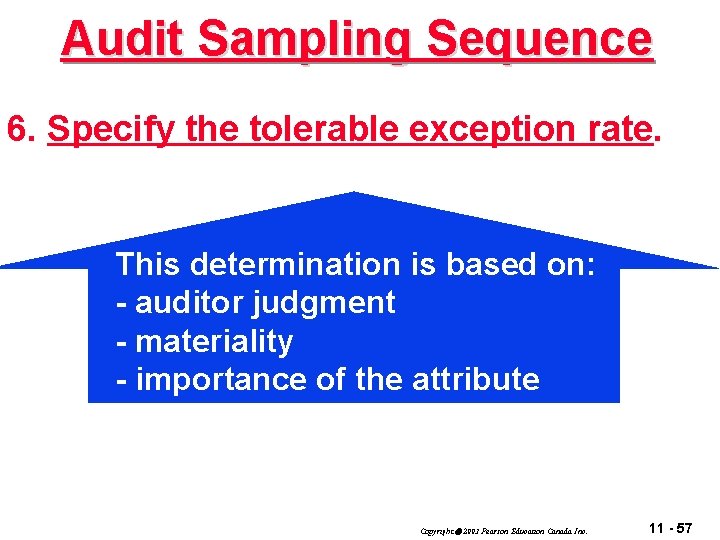
Audit Sampling Sequence 6. Specify the tolerable exception rate. This determination is based on: - auditor judgment - materiality - importance of the attribute Copyright 2003 Pearson Education Canada Inc. 11 - 57
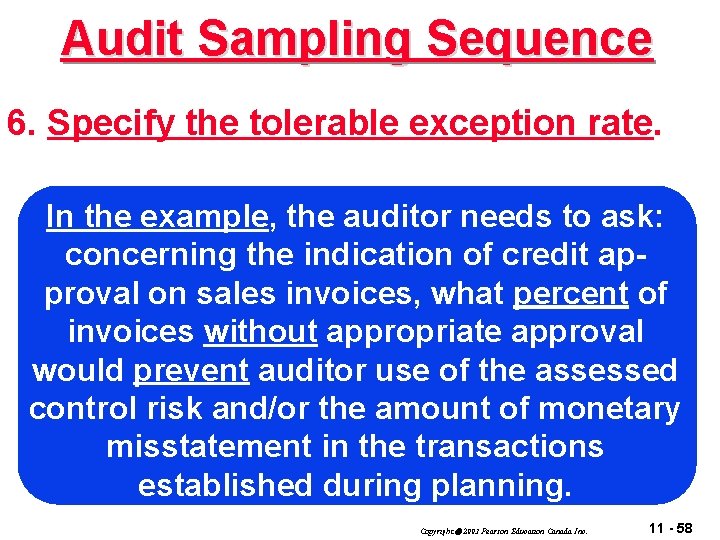
Audit Sampling Sequence 6. Specify the tolerable exception rate. In the example, the auditor needs to ask: concerning the indication of credit approval on sales invoices, what percent of invoices without appropriate approval would prevent auditor use of the assessed control risk and/or the amount of monetary misstatement in the transactions established during planning. Copyright 2003 Pearson Education Canada Inc. 11 - 58
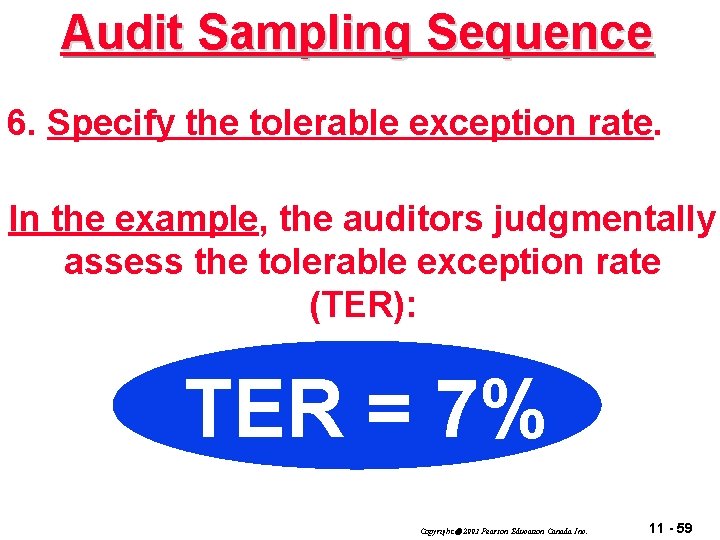
Audit Sampling Sequence 6. Specify the tolerable exception rate. In the example, the auditors judgmentally assess the tolerable exception rate (TER): TER = 7% Copyright 2003 Pearson Education Canada Inc. 11 - 59
Audit Sampling Sequence 6. Specify the tolerable exception rate. When would the auditor establish a low TER? Copyright 2003 Pearson Education Canada Inc. 11 - 60
Audit Sampling Sequence 6. Specify the tolerable exception rate. When would the auditor establish a low TER? when the auditor is less willing to accept exceptions (e. g. , cash controls) Copyright 2003 Pearson Education Canada Inc. 11 - 61
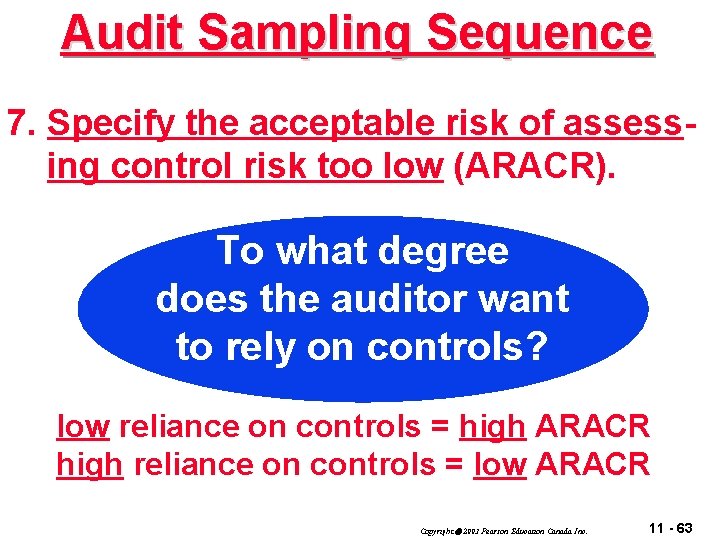
Audit Sampling Sequence 7. Specify the acceptable risk of assessing control risk too low (ARACR). To what degree does the auditor want to rely on controls? Copyright 2003 Pearson Education Canada Inc. 11 - 62
Audit Sampling Sequence 7. Specify the acceptable risk of assessing control risk too low (ARACR). To what degree does the auditor want to rely on controls? low reliance on controls = high ARACR high reliance on controls = low ARACR Copyright 2003 Pearson Education Canada Inc. 11 - 63
Audit Sampling Sequence 7. Specify the acceptable risk of assessing control risk too low (ARACR). To what degree does the auditor want to rely on controls? In the example, the auditors judgmentally assess the acceptable risk of assessing control risk too low: ARACR = medium Copyright 2003 Pearson Education Canada Inc. 11 - 64
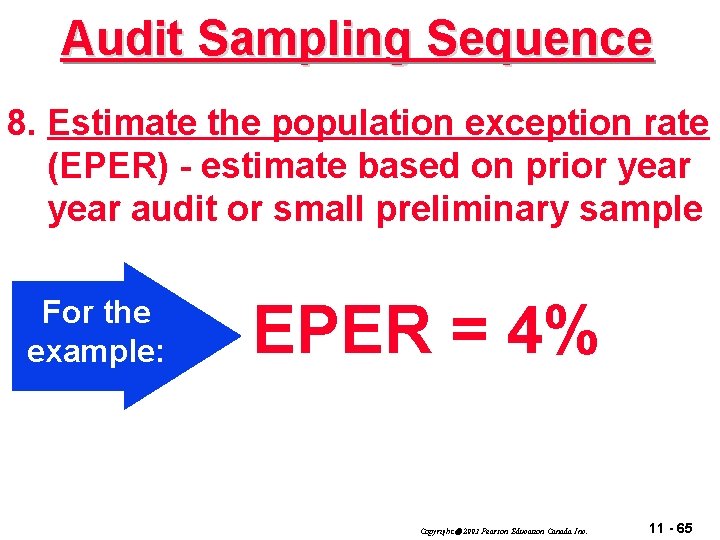
Audit Sampling Sequence 8. Estimate the population exception rate (EPER) - estimate based on prior year audit or small preliminary sample For the example: EPER = 4% Copyright 2003 Pearson Education Canada Inc. 11 - 65
Audit Sampling Sequence 9. Determine the initial sample size (SS). considered initial because the auditor may later decide to sample more Copyright 2003 Pearson Education Canada Inc. 11 - 66
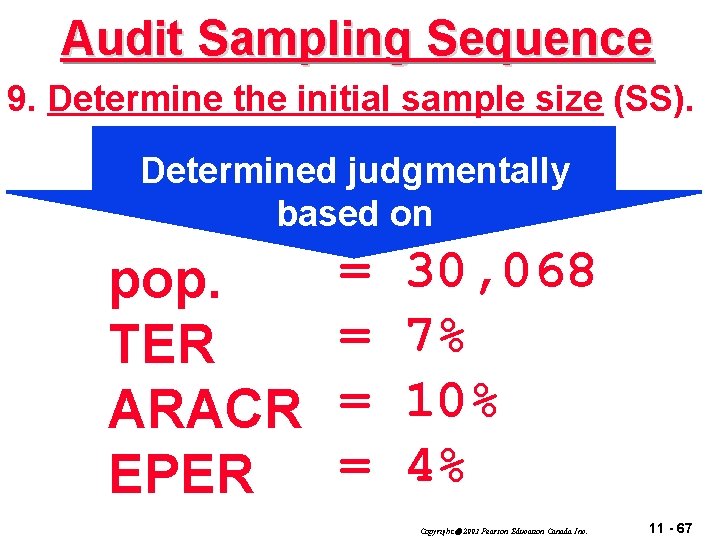
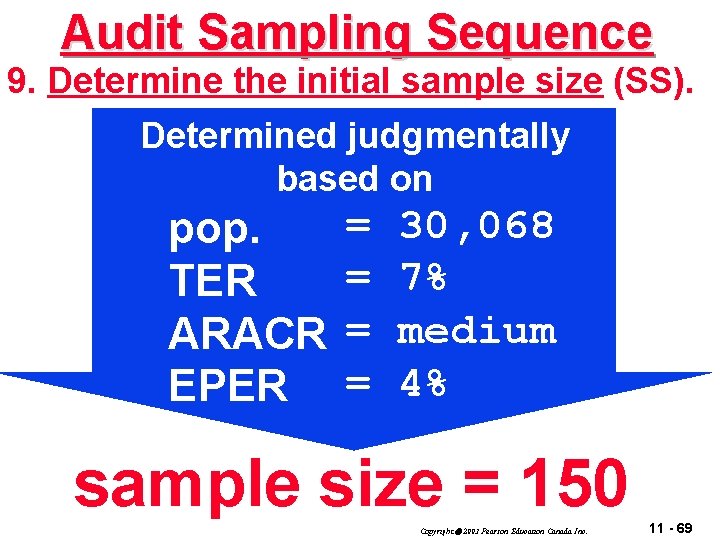
Audit Sampling Sequence 9. Determine the initial sample size (SS). Determined judgmentally based on pop. TER ARACR EPER = = 30, 068 7% 10% 4% Copyright 2003 Pearson Education Canada Inc. 11 - 67
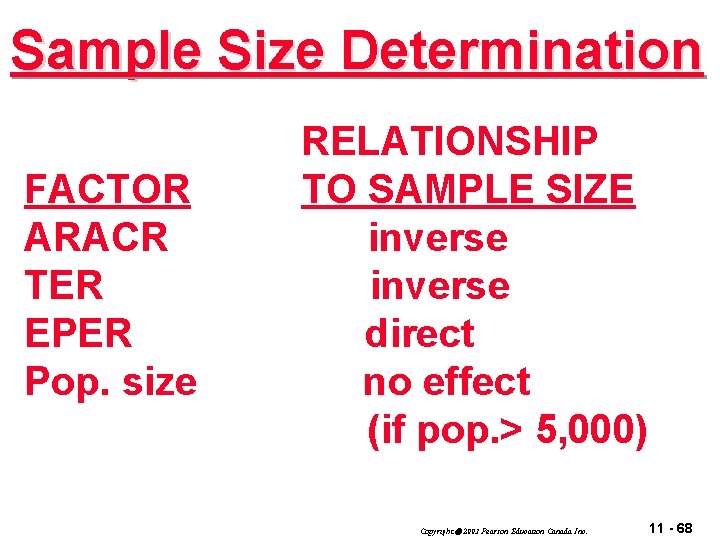
Sample Size Determination FACTOR ARACR TER EPER Pop. size RELATIONSHIP TO SAMPLE SIZE inverse direct no effect (if pop. > 5, 000) Copyright 2003 Pearson Education Canada Inc. 11 - 68
Audit Sampling Sequence 9. Determine the initial sample size (SS). Determined judgmentally based on pop. TER ARACR EPER = = 30, 068 7% medium 4% sample size = 150 Copyright 2003 Pearson Education Canada Inc. 11 - 69
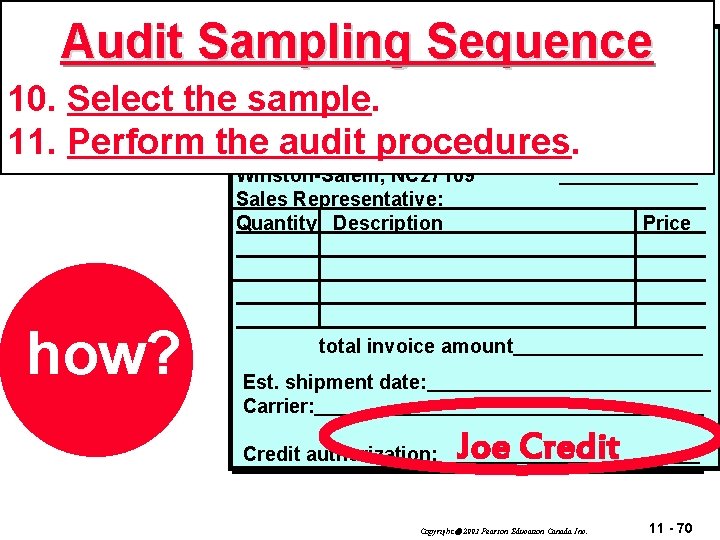
Audit Sampling Sequence SALES INVOICE 38527 Date: 10. Select the sample. Acme Company Customer: 11. Perform the audit Rd. procedures. 834 Reynolda Winston-Salem, NC 27109 Sales Representative: Quantity Description how? Price total invoice amount Est. shipment date: Carrier: Credit authorization: Joe Credit Copyright 2003 Pearson Education Canada Inc. 11 - 70
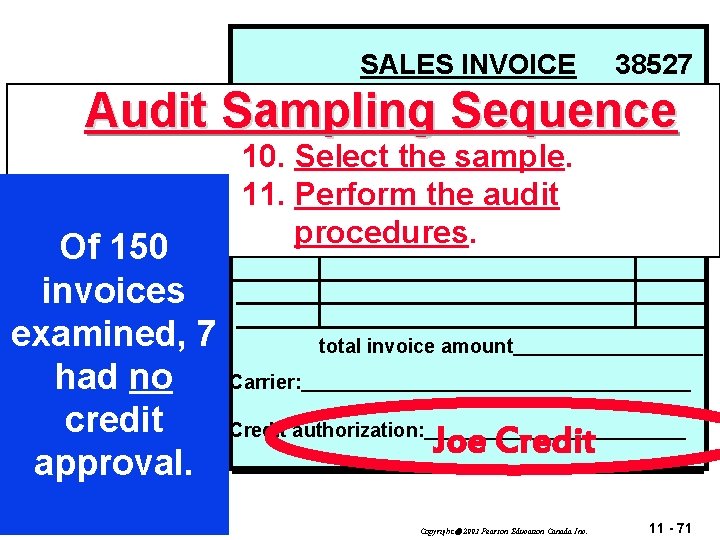
SALES INVOICE 38527 Audit Sampling Sequence Acme Company Date: Customer: Of 150 invoices examined, 7 had no credit approval. 10. Select the sample. 11. Perform the audit procedures. 834 Reynolda Rd. Winston-Salem, NC 27109 Sales Representative: Quantity Description Price total invoice amount Carrier: Credit authorization: Joe Credit Copyright 2003 Pearson Education Canada Inc. 11 - 71
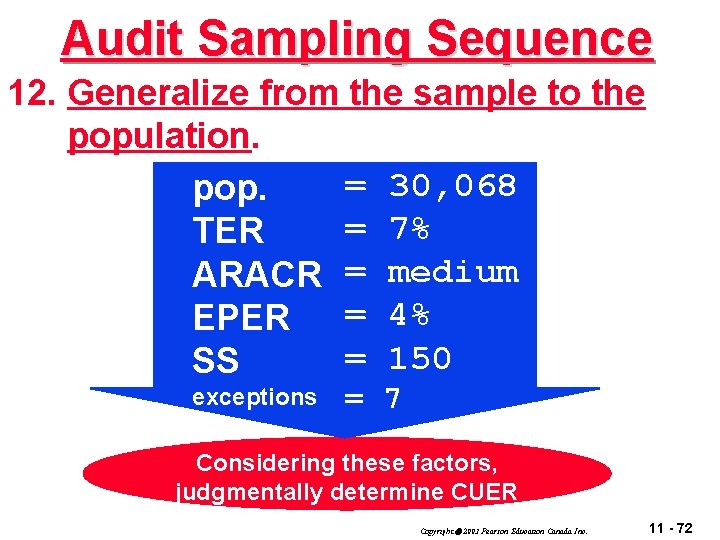
Audit Sampling Sequence 12. Generalize from the sample to the population. = 30, 068 pop. = 7% TER ARACR = medium = 4% EPER = 150 SS exceptions = 7 Considering these factors, judgmentally determine CUER Copyright 2003 Pearson Education Canada Inc. 11 - 72
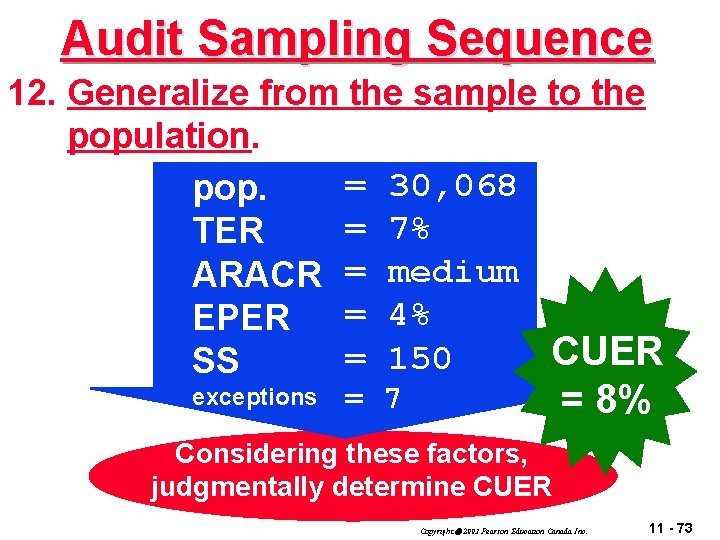
Audit Sampling Sequence 12. Generalize from the sample to the population. = 30, 068 pop. = 7% TER ARACR = medium = 4% EPER CUER = 150 SS exceptions = 8% = 7 Considering these factors, judgmentally determine CUER Copyright 2003 Pearson Education Canada Inc. 11 - 73
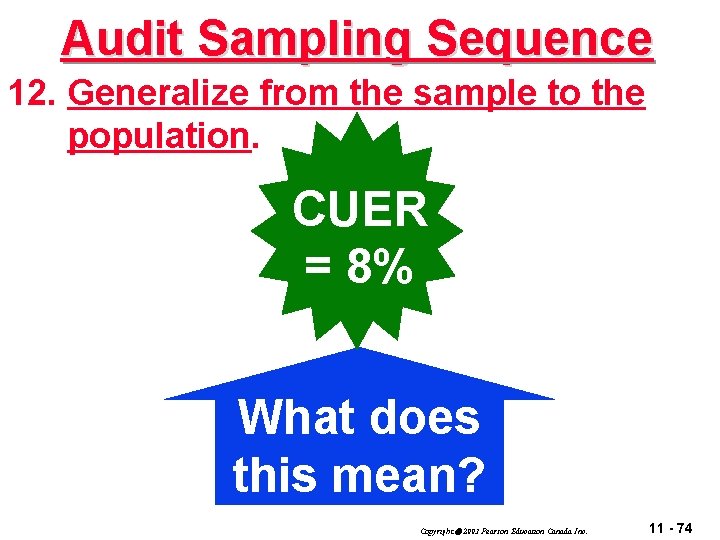
Audit Sampling Sequence 12. Generalize from the sample to the population. CUER = 8% What does this mean? Copyright 2003 Pearson Education Canada Inc. 11 - 74
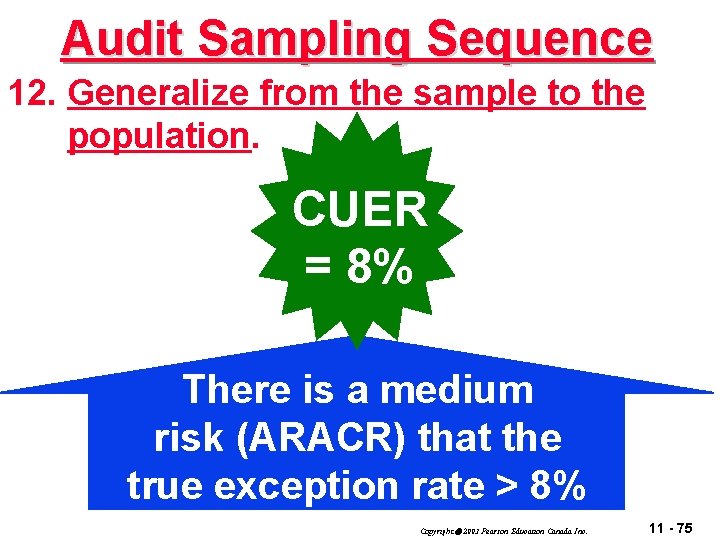
Audit Sampling Sequence 12. Generalize from the sample to the population. CUER = 8% There is a medium risk (ARACR) that the true exception rate > 8% Copyright 2003 Pearson Education Canada Inc. 11 - 75
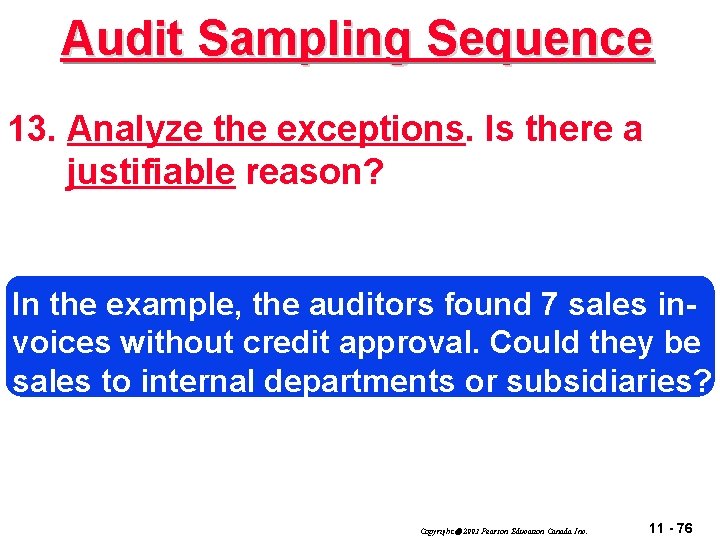
Audit Sampling Sequence 13. Analyze the exceptions. Is there a justifiable reason? In the example, the auditors found 7 sales invoices without credit approval. Could they be sales to internal departments or subsidiaries? Copyright 2003 Pearson Education Canada Inc. 11 - 76
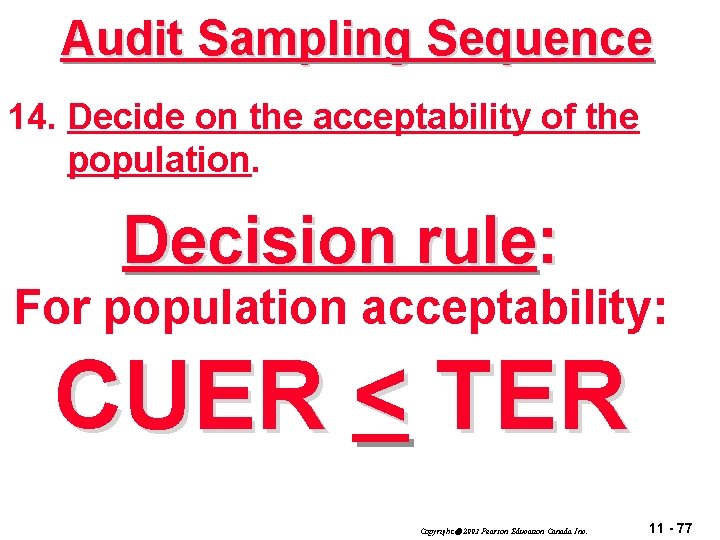
Audit Sampling Sequence 14. Decide on the acceptability of the population. Decision rule: For population acceptability: CUER < TER Copyright 2003 Pearson Education Canada Inc. 11 - 77
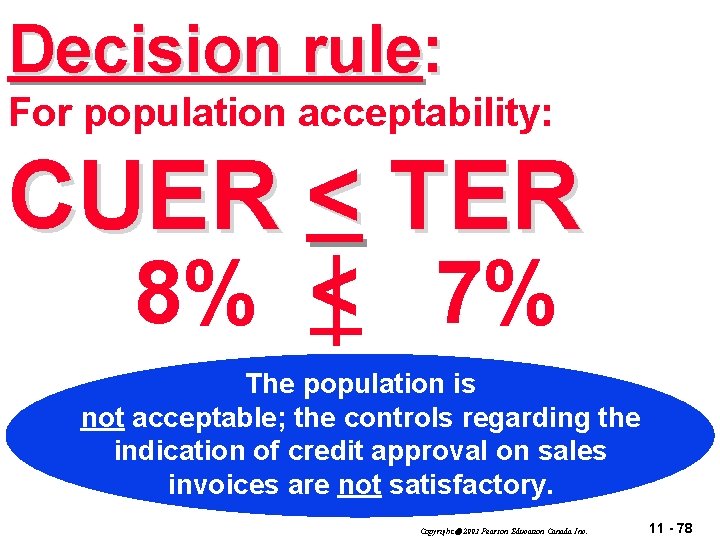
Decision rule: For population acceptability: CUER < TER 8% < 7% The population is not acceptable; the controls regarding the indication of credit approval on sales invoices are not satisfactory. Copyright 2003 Pearson Education Canada Inc. 11 - 78
When an internal control is judged unacceptable, what options does the auditor have? Copyright 2003 Pearson Education Canada Inc. 11 - 79
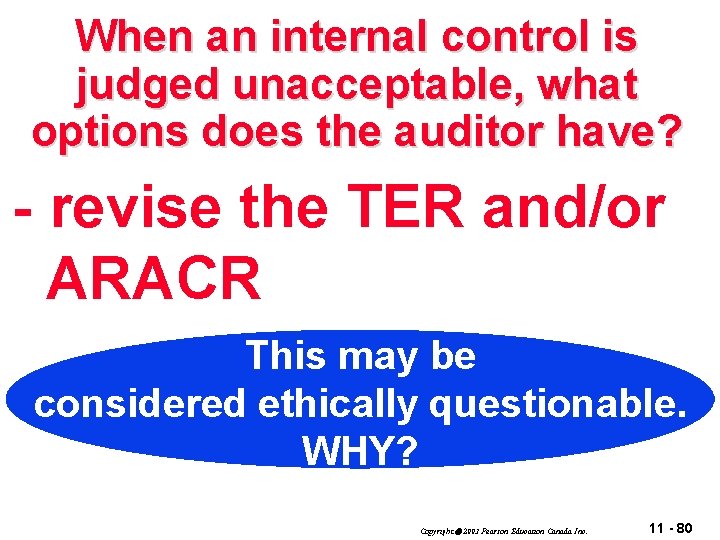
When an internal control is judged unacceptable, what options does the auditor have? - revise the TER and/or ARACR This may be considered ethically questionable. WHY? Copyright 2003 Pearson Education Canada Inc. 11 - 80
When an internal control is judged unacceptable, what options does the auditor have? - expand the sample size When is this appropriate? Copyright 2003 Pearson Education Canada Inc. 11 - 81
When an internal control is judged unacceptable, what options does the auditor have? - expand the sample size This is only appropriate if the auditor believes that the sample was not representative of the population. Copyright 2003 Pearson Education Canada Inc. 11 - 82
When an internal control is judged unacceptable, what options does the auditor have? - revise the assessed control risk upward, and increase tests of details of balances for related accounts (a/r, sales, bad debt expense, allowance for doubtful accounts) Copyright 2003 Pearson Education Canada Inc. 11 - 83
When an internal control is judged unacceptable, the auditor is required to communicate this weakness to management, and may inform the audit committee as well. Copyright 2003 Pearson Education Canada Inc. 11 - 84
Audit Sampling Sequence 1. State the objectives of the audit test. Copyright 2003 Pearson Education Canada Inc. 11 - 85
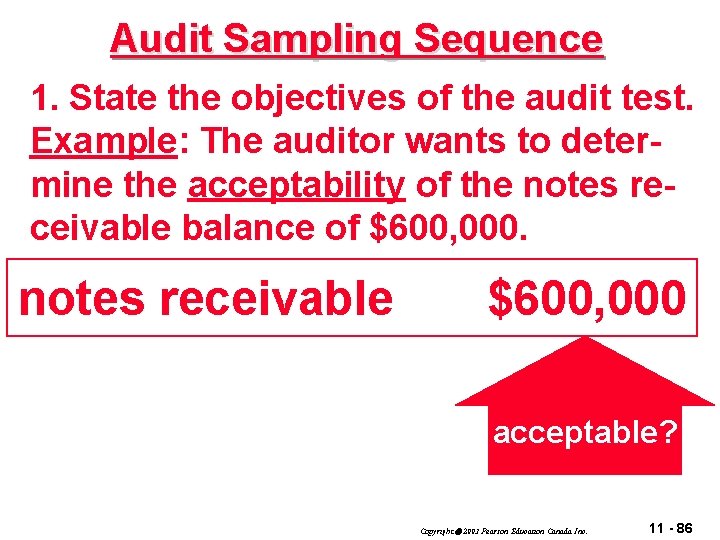
Audit Sampling Sequence 1. State the objectives of the audit test. Example: The auditor wants to determine the acceptability of the notes receivable balance of $600, 000. notes receivable $600, 000 acceptable? Copyright 2003 Pearson Education Canada Inc. 11 - 86
Audit Sampling Sequence 1. Determine the objectives of the test. 2. Decide if audit sampling applies. Does the auditor plan to reach conclusions based on a sample? Copyright 2003 Pearson Education Canada Inc. 11 - 87
Audit Sampling Sequence 1. Determine the objectives of the test. 2. Decide if audit sampling applies. 3. Define misstatement conditions. ? Copyright 2003 Pearson Education Canada Inc. 11 - 88
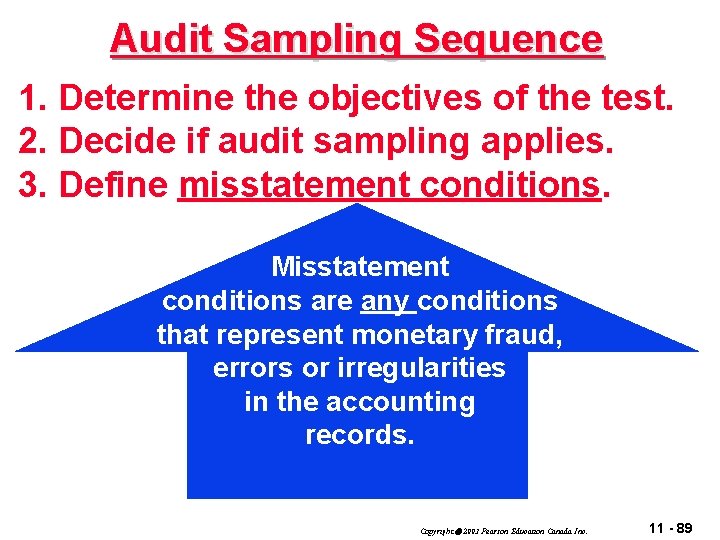
Audit Sampling Sequence 1. Determine the objectives of the test. 2. Decide if audit sampling applies. 3. Define misstatement conditions. Misstatement conditions are any conditions that represent monetary fraud, errors or irregularities in the accounting records. Copyright 2003 Pearson Education Canada Inc. 11 - 89
Audit Sampling Sequence 1. Determine the objectives of the test. 2. Decide if audit sampling applies. 3. Define misstatement conditions. 4. Define the population. ? Copyright 2003 Pearson Education Canada Inc. 11 - 90
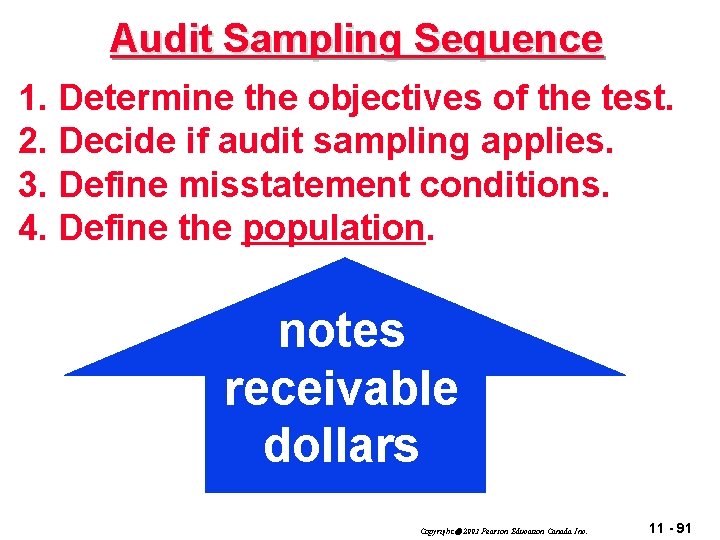
Audit Sampling Sequence 1. Determine the objectives of the test. 2. Decide if audit sampling applies. 3. Define misstatement conditions. 4. Define the population. notes receivable dollars Copyright 2003 Pearson Education Canada Inc. 11 - 91
Audit Sampling Sequence 1. Determine the objectives of the test. 2. Decide if audit sampling applies. 3. Define misstatement conditions. 4. Define the population. 5. Define the sampling unit. ? Copyright 2003 Pearson Education Canada Inc. 11 - 92
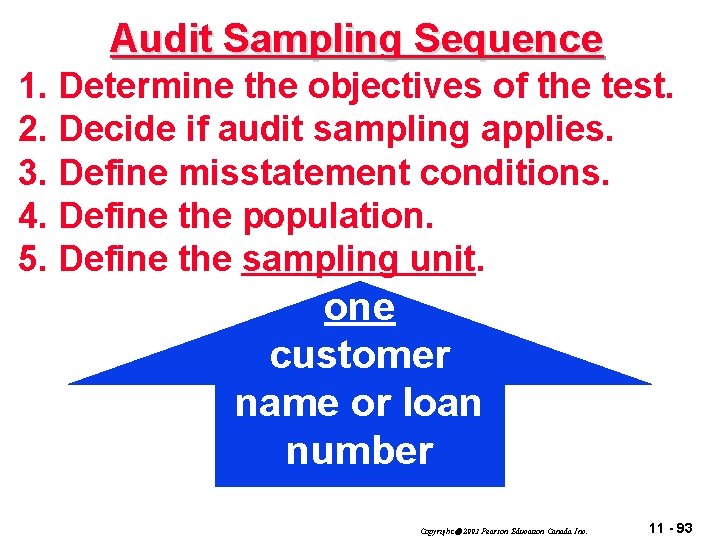
Audit Sampling Sequence 1. Determine the objectives of the test. 2. Decide if audit sampling applies. 3. Define misstatement conditions. 4. Define the population. 5. Define the sampling unit. one customer name or loan number Copyright 2003 Pearson Education Canada Inc. 11 - 93
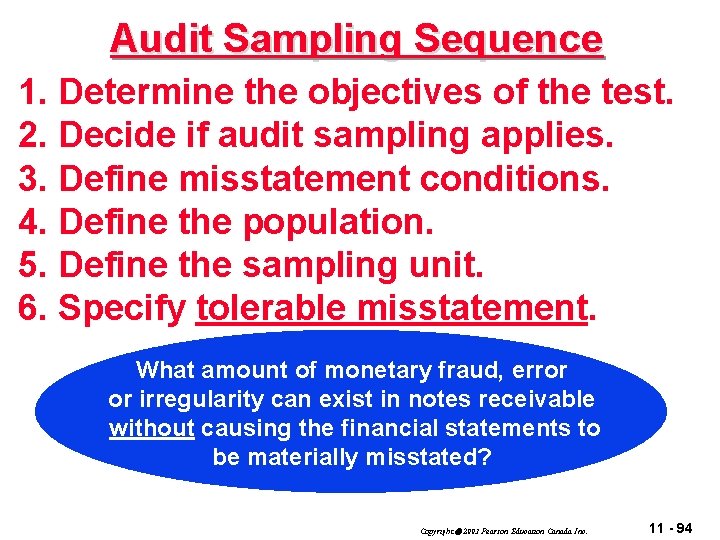
Audit Sampling Sequence 1. Determine the objectives of the test. 2. Decide if audit sampling applies. 3. Define misstatement conditions. 4. Define the population. 5. Define the sampling unit. 6. Specify tolerable misstatement. What amount of monetary fraud, error or irregularity can exist in notes receivable without causing the financial statements to be materially misstated? Copyright 2003 Pearson Education Canada Inc. 11 - 94
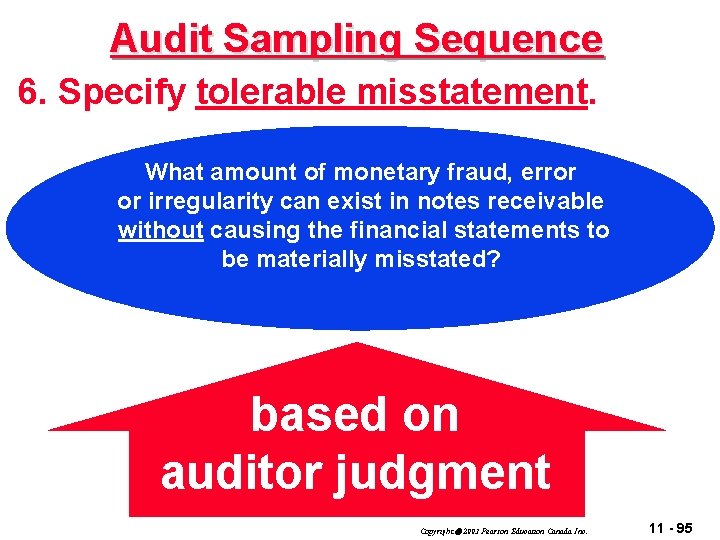
Audit Sampling Sequence 6. Specify tolerable misstatement. What amount of monetary fraud, error or irregularity can exist in notes receivable without causing the financial statements to be materially misstated? based on auditor judgment Copyright 2003 Pearson Education Canada Inc. 11 - 95
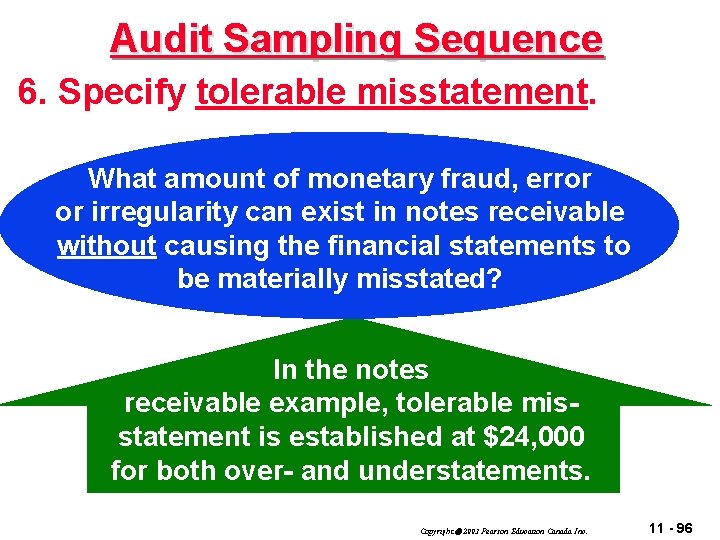
Audit Sampling Sequence 6. Specify tolerable misstatement. What amount of monetary fraud, error or irregularity can exist in notes receivable without causing the financial statements to be materially misstated? In the notes receivable example, tolerable misstatement is established at $24, 000 for both over- and understatements. Copyright 2003 Pearson Education Canada Inc. 11 - 96
Audit Sampling Sequence 7. Specify acceptable risk of incorrect acceptance. What level of risk is the auditor willing to take of concluding that the account balance is not materially misstated when, in fact, it is materially misstated. Copyright 2003 Pearson Education Canada Inc. 11 - 97
Audit Sampling Sequence 7. Specify acceptable risk of incorrect acceptance. What level of risk is the auditor willing to take of concluding that the account balance is not materially misstated when, in fact, it is materially misstated. also based on auditor judgment Copyright 2003 Pearson Education Canada Inc. 11 - 98
Audit Sampling Sequence 7. Specify acceptable risk of incorrect acceptance. What level of risk is the auditor willing to take of concluding that the account balance is not materially misstated when, in fact, it is materially misstated. In the notes receivable example, ARIA is established at 5%. Copyright 2003 Pearson Education Canada Inc. 11 - 99
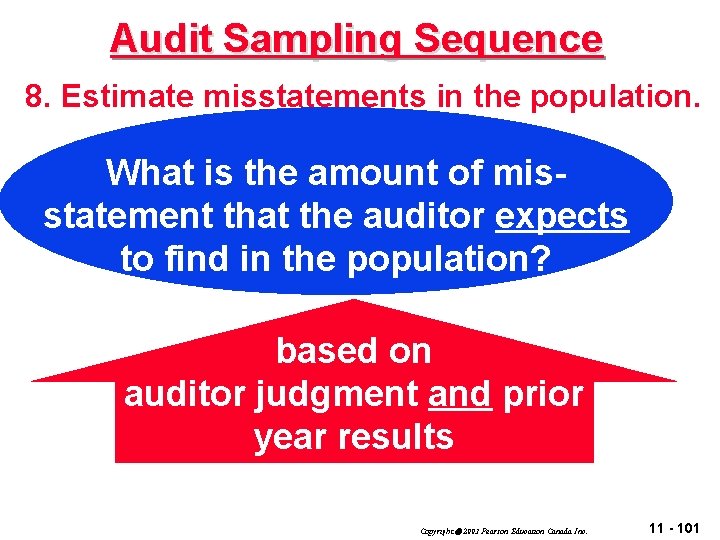
Audit Sampling Sequence 8. Estimate misstatements in the population. What is the amount of misstatement that the auditor expects to find in the population? Copyright 2003 Pearson Education Canada Inc. 11 - 100
Audit Sampling Sequence 8. Estimate misstatements in the population. What is the amount of misstatement that the auditor expects to find in the population? based on auditor judgment and prior year results Copyright 2003 Pearson Education Canada Inc. 11 - 101
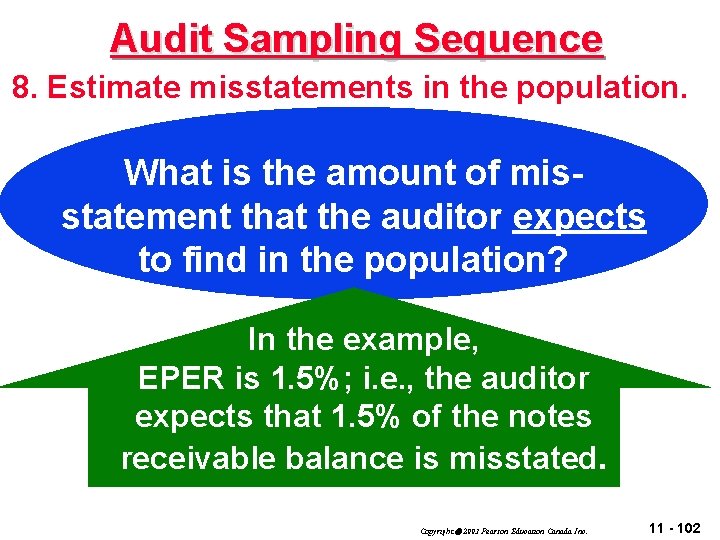
Audit Sampling Sequence 8. Estimate misstatements in the population. What is the amount of misstatement that the auditor expects to find in the population? In the example, EPER is 1. 5%; i. e. , the auditor expects that 1. 5% of the notes receivable balance is misstated. Copyright 2003 Pearson Education Canada Inc. 11 - 102
Audit Sampling Sequence 9. Determine the initial sample size. For nonstatistical sampling, professional judgment of auditor is used to determine initial sample size. Copyright 2003 Pearson Education Canada Inc. 11 - 103
Audit Sampling Sequence 9. Determine the initial sample size. For statistical sampling of test of controls, population size, TER, ARACR, and EPER are all factors used to determine initial sample size. Copyright 2003 Pearson Education Canada Inc. 11 - 104
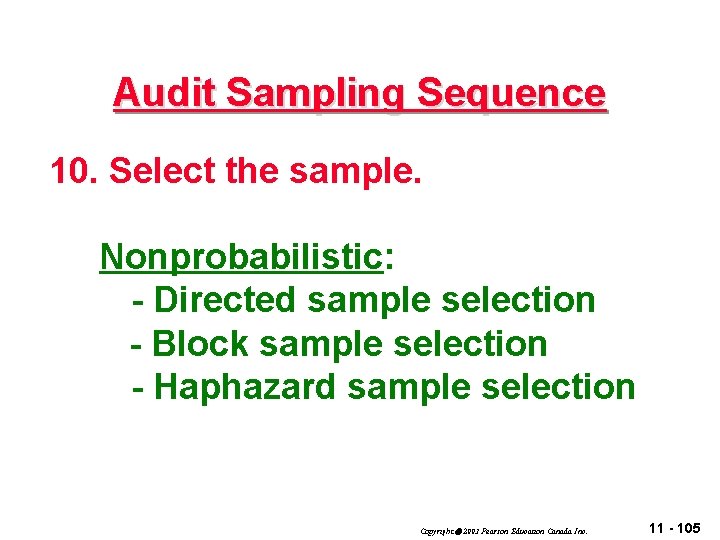
Audit Sampling Sequence 10. Select the sample. Nonprobabilistic: - Directed sample selection - Block sample selection - Haphazard sample selection Copyright 2003 Pearson Education Canada Inc. 11 - 105
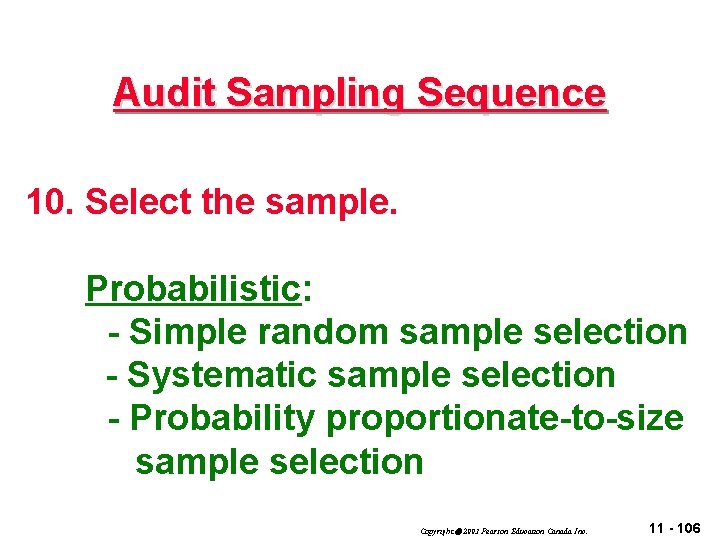
Audit Sampling Sequence 10. Select the sample. Probabilistic: - Simple random sample selection - Systematic sample selection - Probability proportionate-to-size sample selection Copyright 2003 Pearson Education Canada Inc. 11 - 106
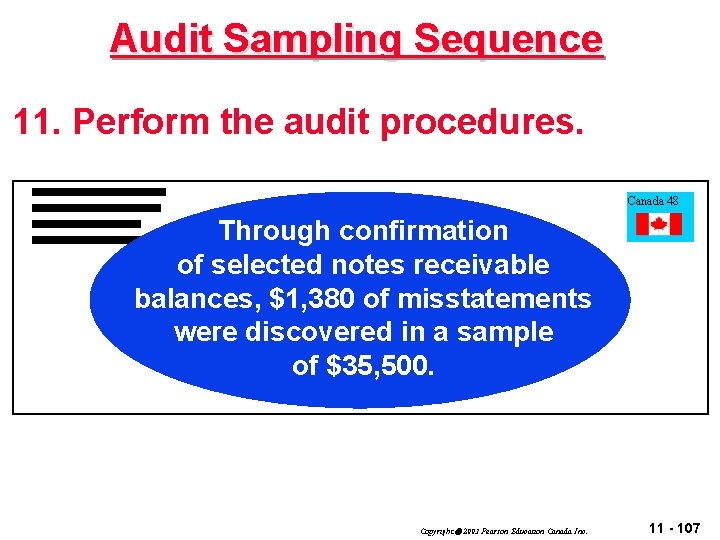
Audit Sampling Sequence 11. Perform the audit procedures. Canada 48 Through confirmation of selected notes receivable balances, $1, 380 of misstatements were discovered in a sample of $35, 500. Copyright 2003 Pearson Education Canada Inc. 11 - 107
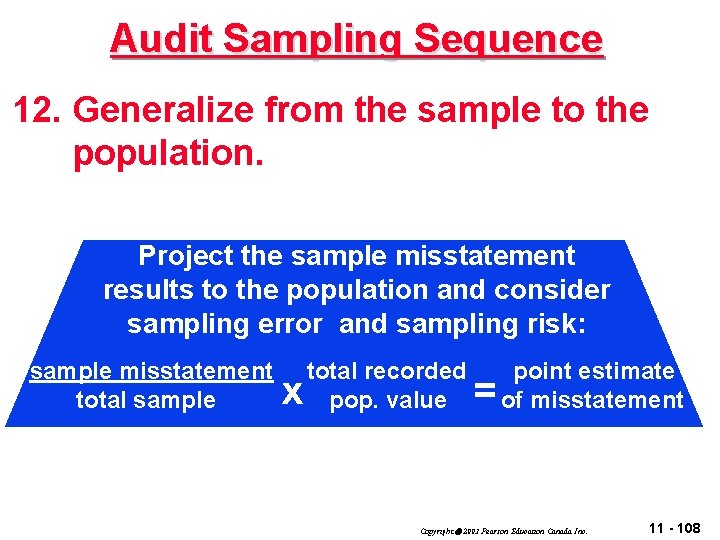
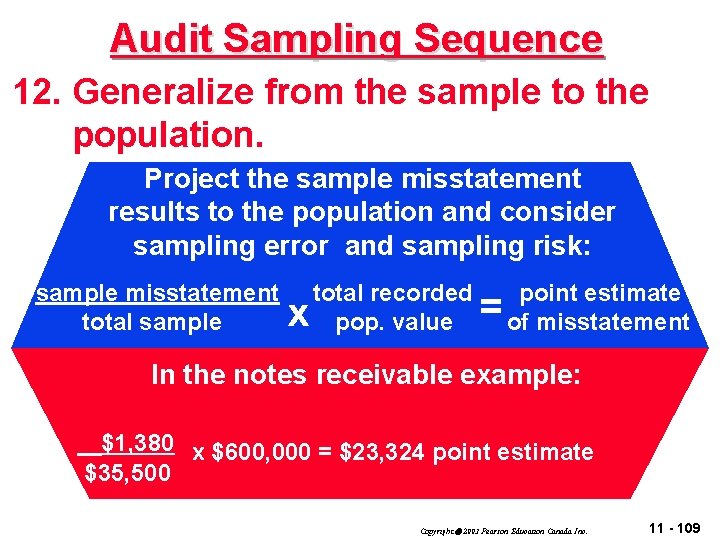
Audit Sampling Sequence 12. Generalize from the sample to the population. Project the sample misstatement results to the population and consider sampling error and sampling risk: sample misstatement total sample x total recorded pop. value = point estimate of misstatement Copyright 2003 Pearson Education Canada Inc. 11 - 108
Audit Sampling Sequence 12. Generalize from the sample to the population. Project the sample misstatement results to the population and consider sampling error and sampling risk: sample misstatement total sample x total recorded pop. value = point estimate of misstatement In the notes receivable example: $1, 380 x $600, 000 = $23, 324 point estimate $35, 500 Copyright 2003 Pearson Education Canada Inc. 11 - 109
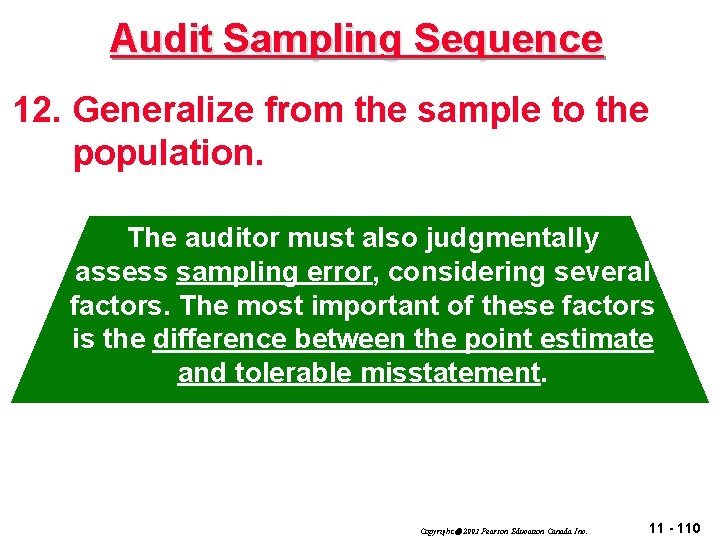
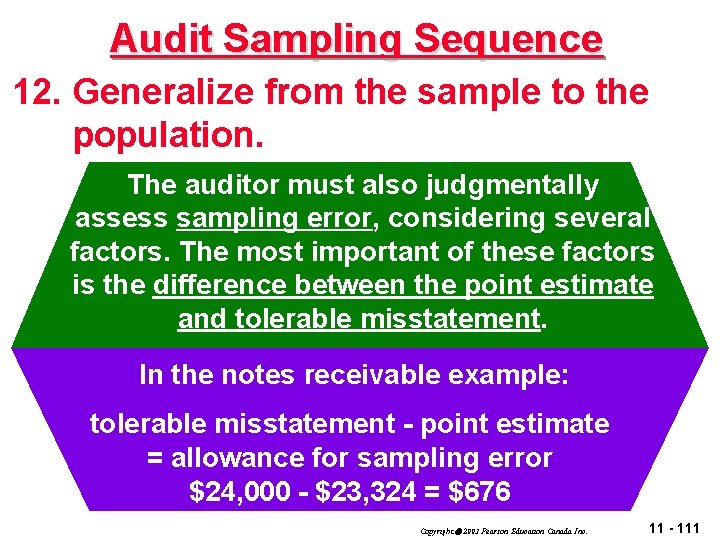
Audit Sampling Sequence 12. Generalize from the sample to the population. The auditor must also judgmentally assess sampling error, considering several factors. The most important of these factors is the difference between the point estimate and tolerable misstatement - point estimate = allowance for sampling error $24, 000 - $23, 324 = $676 Copyright 2003 Pearson Education Canada Inc. 11 - 110
Audit Sampling Sequence 12. Generalize from the sample to the population. The auditor must also judgmentally assess sampling error, considering several factors. The most important of these factors is the difference between the point estimate and tolerable misstatement. In the notes receivable example: tolerable misstatement - point estimate = allowance for sampling error $24, 000 - $23, 324 = $676 Copyright 2003 Pearson Education Canada Inc. 11 - 111
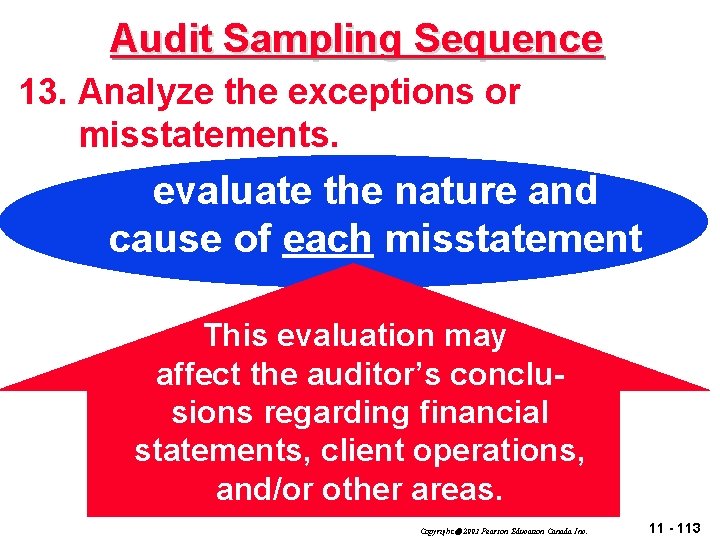
Audit Sampling Sequence 13. Analyze exceptions or misstatements. evaluate the nature and cause of each misstatement Copyright 2003 Pearson Education Canada Inc. 11 - 112
Audit Sampling Sequence 13. Analyze the exceptions or misstatements. evaluate the nature and cause of each misstatement This evaluation may affect the auditor’s conclusions regarding financial statements, client operations, and/or other areas. Copyright 2003 Pearson Education Canada Inc. 11 - 113
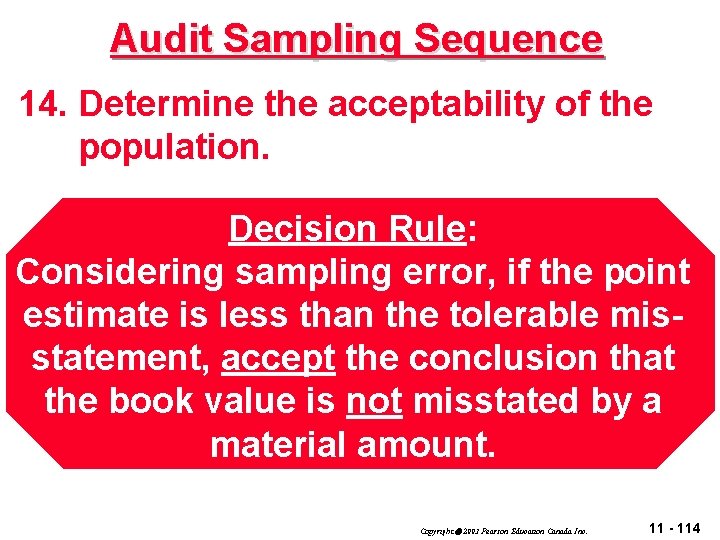
Audit Sampling Sequence 14. Determine the acceptability of the population. Decision Rule: Considering sampling error, if the point estimate is less than the tolerable misstatement, accept the conclusion that the book value is not misstated by a material amount. Copyright 2003 Pearson Education Canada Inc. 11 - 114
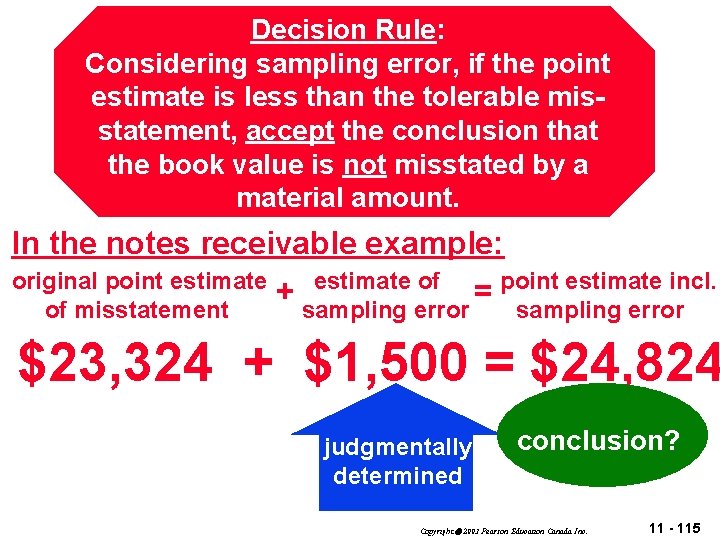
Decision Rule: Considering sampling error, if the point estimate is less than the tolerable misstatement, accept the conclusion that the book value is not misstated by a material amount. In the notes receivable example: original point estimate + estimate of = point estimate incl. of misstatement sampling error $23, 324 + $1, 500 = $24, 824 judgmentally determined conclusion? Copyright 2003 Pearson Education Canada Inc. 11 - 115
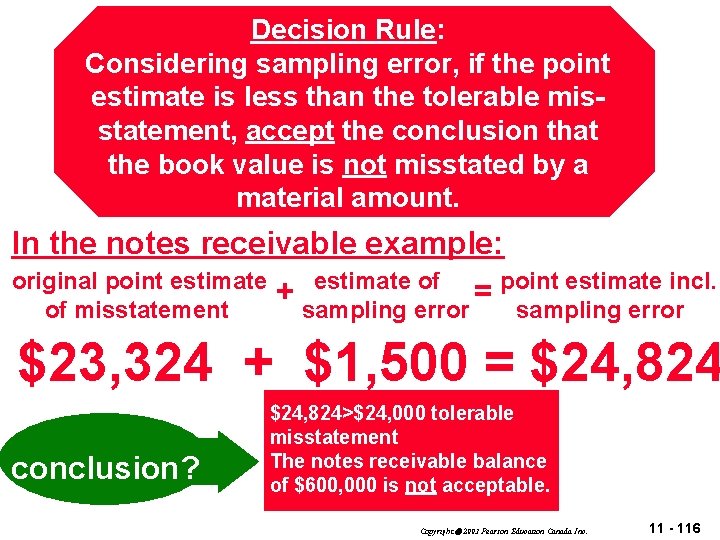
Decision Rule: Considering sampling error, if the point estimate is less than the tolerable misstatement, accept the conclusion that the book value is not misstated by a material amount. In the notes receivable example: original point estimate + estimate of = point estimate incl. of misstatement sampling error $23, 324 + $1, 500 = $24, 824 conclusion? $24, 824>$24, 000 tolerable misstatement The notes receivable balance of $600, 000 is not acceptable. Copyright 2003 Pearson Education Canada Inc. 11 - 116
book value is not acceptable What are the auditor’s options? Copyright 2003 Pearson Education Canada Inc. 11 - 117
book value is not acceptable What are the auditor’s options? - take no action until tests of other audit areas are completed Copyright 2003 Pearson Education Canada Inc. 11 - 118
book value is not acceptable What are the auditor’s options? - take no action until tests of other audit areas are completed - perform expanded audit tests in specific areas Copyright 2003 Pearson Education Canada Inc. 11 - 119
book value is not acceptable What are the auditor’s options? - take no action until tests of other audit areas are completed - perform expanded audit tests in specific areas - increase sample size Copyright 2003 Pearson Education Canada Inc. 11 - 120
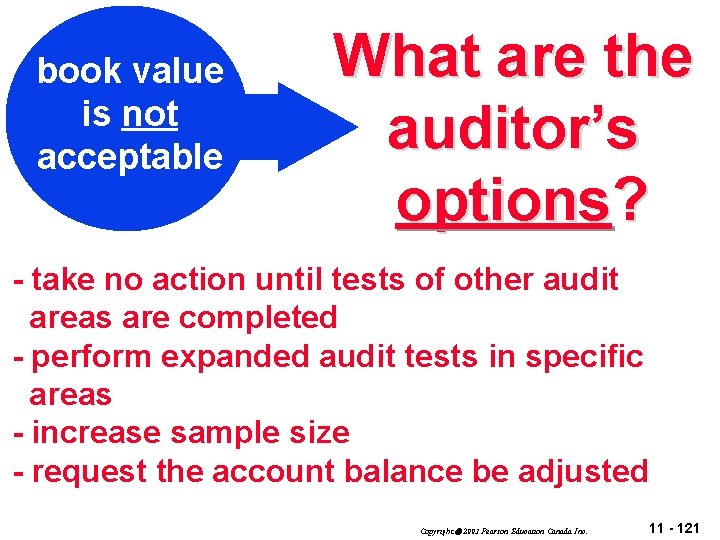
book value is not acceptable What are the auditor’s options? - take no action until tests of other audit areas are completed - perform expanded audit tests in specific areas - increase sample size - request the account balance be adjusted Copyright 2003 Pearson Education Canada Inc. 11 - 121
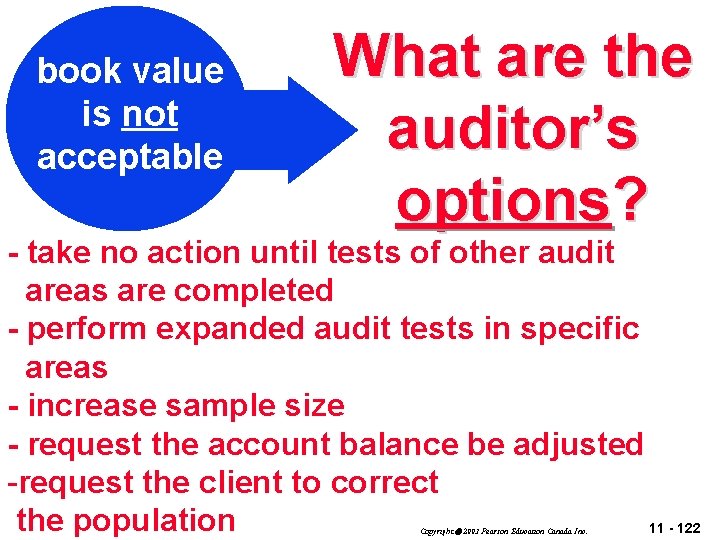
book value is not acceptable What are the auditor’s options? - take no action until tests of other audit areas are completed - perform expanded audit tests in specific areas - increase sample size - request the account balance be adjusted -request the client to correct the population 11 - 122 Copyright 2003 Pearson Education Canada Inc.
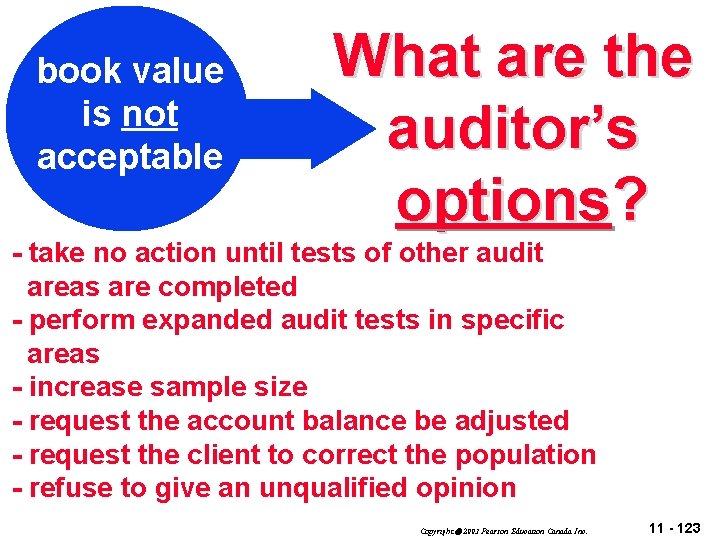
book value is not acceptable What are the auditor’s options? - take no action until tests of other audit areas are completed - perform expanded audit tests in specific areas - increase sample size - request the account balance be adjusted - request the client to correct the population - refuse to give an unqualified opinion Copyright 2003 Pearson Education Canada Inc. 11 - 123