
Chapter 1 Arithmetic Prealgebra Section 1 1 Rounding
Chapter 1: Arithmetic & Prealgebra Section 1. 1: Rounding, Decimals & Order of Operations APPLIED MATHEMATICS, FOURTH EDITION, MATOVINA & YATES
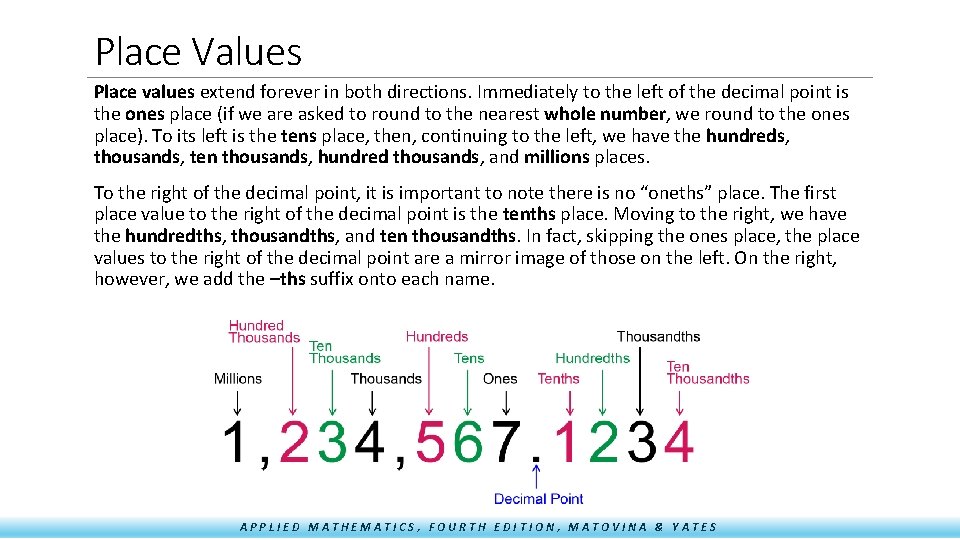
Place Values Place values extend forever in both directions. Immediately to the left of the decimal point is the ones place (if we are asked to round to the nearest whole number, we round to the ones place). To its left is the tens place, then, continuing to the left, we have the hundreds, thousands, ten thousands, hundred thousands, and millions places. To the right of the decimal point, it is important to note there is no “oneths” place. The first place value to the right of the decimal point is the tenths place. Moving to the right, we have the hundredths, thousandths, and ten thousandths. In fact, skipping the ones place, the place values to the right of the decimal point are a mirror image of those on the left. On the right, however, we add the –ths suffix onto each name. APPLIED MATHEMATICS, FOURTH EDITION, MATOVINA & YATES
Estimation vs. Rounding Estimation is a process in which we determine an approximate value of a calculation. Some specific methodologies for estimations exist, but, unless directed to use a specific method, the degree of precision is up to the individual. Estimations can be done to the desired place value. 194. 8 is approximately 195 or 200, depending on the desire of the one doing the estimation. Rounding is a process in which we follow a directive to make a quantity easier to visualize. In rounding, however, we MUST be given a specific place value to which to round. If no place value is indicated, it is improper to round. If there is no directive to round to a specified place value, it is incorrect to do so. If no place value is mentioned, we cannot assume one out of convenience. APPLIED MATHEMATICS, FOURTH EDITION, MATOVINA & YATES

Rounding Steps The formal procedure for the traditional rounding of a number is as follows. 1. First, determine the round-off digit, which is the digit in the specified place value column. 2. If the first digit to the right of the round-off digit is less than 5, do not change the round-off digit, but delete all the remaining digits to its right. If you are rounding to a whole number, such as tens or hundreds, all the digits between the round-off digit and the decimal point should become zeros, and no digits will appear after the decimal point. 3. If the first digit to the right of the round-off digit is 5 or more, increase the round-off digit by 1, and delete all the remaining digits to its right. Again, if you are rounding to a nondecimal number, such as tens or hundreds, all the digits between the round-off digit and the decimal point should become zeros, and no digits will appear after the decimal point. 4. For decimals, double-check to make sure the right-most digit of the decimal falls in the place value column to which you were directed to round, and there are no other digits to its right. Be sure to pay attention to the directive, and for rounding to place values to the right of the decimal point, make sure the last digit of the answer lies in the designated place value. APPLIED MATHEMATICS, FOURTH EDITION, MATOVINA & YATES

Rounding - Examples: Round 2578. 3491 to the nearest Hundred Ø 2600 Tenth Ø 2578. 3 Ten Thousand Ø 0 Whole Number Ø 2578 APPLIED MATHEMATICS, FOURTH EDITION, MATOVINA & YATES
Arithmetic with Decimals Adding, subtracting, multiplying and dividing decimals is almost exactly like doing so with whole numbers. The only extra step is the proper placement of the decimal point in the answer. With addition and subtraction, we set up the problem vertically and align the decimal points in the problem. We also may need to include extra zeros in the numbers in the problem statement to have the same place value agreement (e. g. 3. 4 is the same as 3. 4000). In multiplication, realize the number of decimal places in the answer must be the same as the total number of decimal places in the numbers being multiplied together. In long division, move the decimal points in the divisor and the dividend the same number of places so that divisor is a whole number. Line up the place values in the quotient and the dividend. APPLIED MATHEMATICS, FOURTH EDITION, MATOVINA & YATES
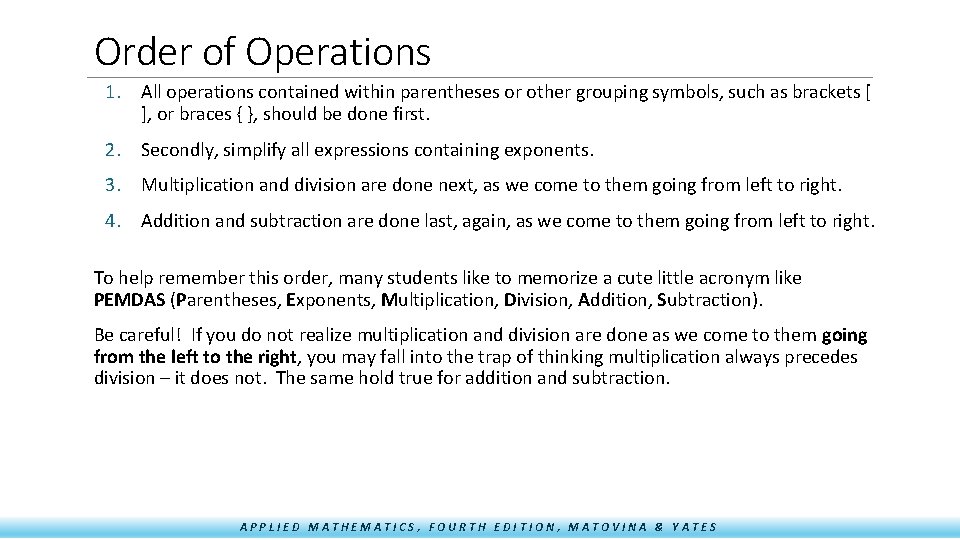
Order of Operations 1. All operations contained within parentheses or other grouping symbols, such as brackets [ ], or braces { }, should be done first. 2. Secondly, simplify all expressions containing exponents. 3. Multiplication and division are done next, as we come to them going from left to right. 4. Addition and subtraction are done last, again, as we come to them going from left to right. To help remember this order, many students like to memorize a cute little acronym like PEMDAS (Parentheses, Exponents, Multiplication, Division, Addition, Subtraction). Be careful! If you do not realize multiplication and division are done as we come to them going from the left to the right, you may fall into the trap of thinking multiplication always precedes division – it does not. The same hold true for addition and subtraction. APPLIED MATHEMATICS, FOURTH EDITION, MATOVINA & YATES
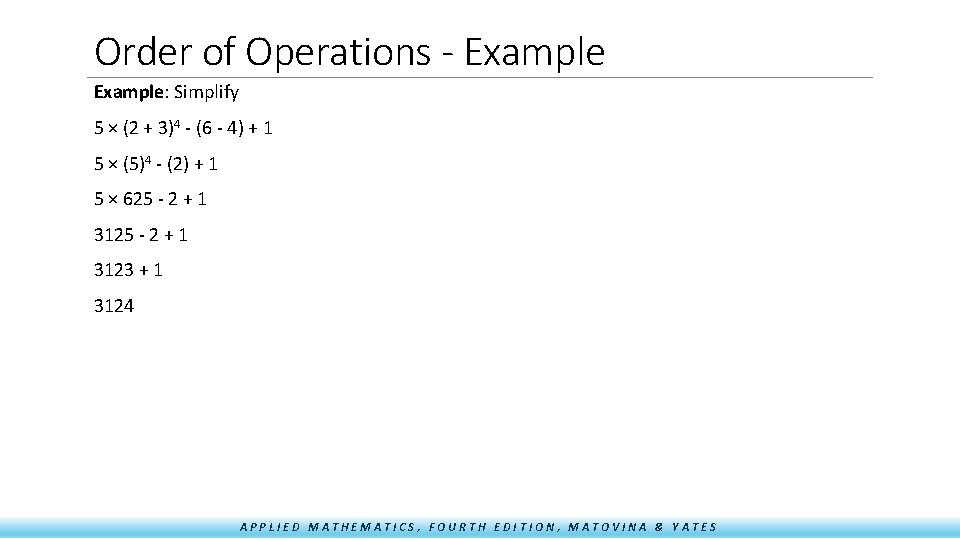
Order of Operations - Example: Simplify 5 × (2 + 3)4 - (6 - 4) + 1 5 × (5)4 - (2) + 1 5 × 625 - 2 + 1 3123 + 1 3124 APPLIED MATHEMATICS, FOURTH EDITION, MATOVINA & YATES
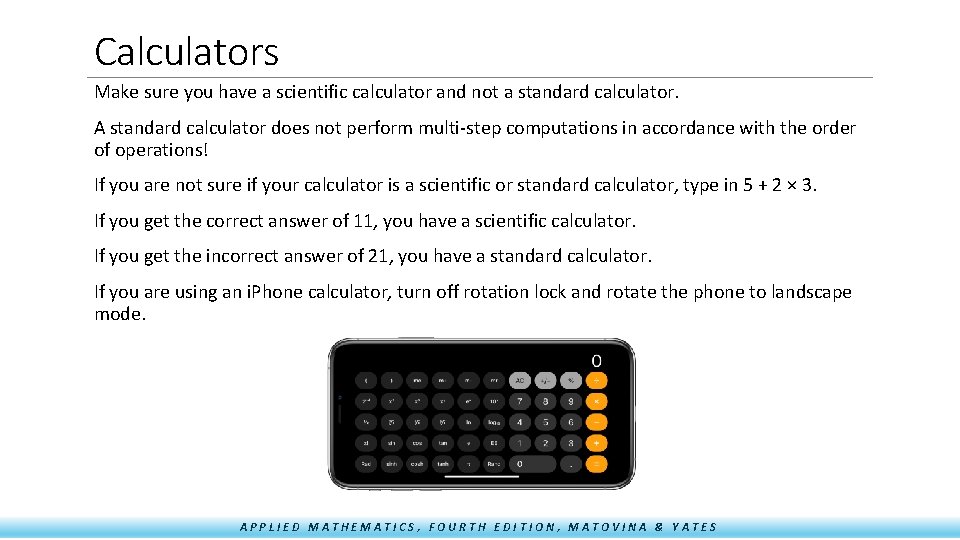
Calculators Make sure you have a scientific calculator and not a standard calculator. A standard calculator does not perform multi-step computations in accordance with the order of operations! If you are not sure if your calculator is a scientific or standard calculator, type in 5 + 2 × 3. If you get the correct answer of 11, you have a scientific calculator. If you get the incorrect answer of 21, you have a standard calculator. If you are using an i. Phone calculator, turn off rotation lock and rotate the phone to landscape mode. APPLIED MATHEMATICS, FOURTH EDITION, MATOVINA & YATES
- Slides: 9