
Chapter 1 Aqueous and Non Aqueous Solvents MSC
- Slides: 11
Chapter# 1 Aqueous and Non Aqueous Solvents MSC. IIIrd Semester Additional written 1
Lecture 1 Inorganic nonaqueous solvent • An inorganic nonaqueous solvent is a solvent other than water, that is not an organic compound. Common examples are liquid ammonia, liquid sulfur dioxide, sulfuryl chloride and sulfuryl chloride fluoride, phosphoryl chloride, dinitrogen tetroxide, antimony trichloride, bromine pentafluoride, hydrogen fluoride, pure sulfuric acid and other inorganic acids. These solvents are used in chemical research and industry for reactions that cannot occur in aqueous solutions or require a special environment.
Nonaqueous solvents • Although acid–base properties have been investigated most thoroughly in aqueous solutions, partly because of their practical importance, water is in many respects an abnormal solvent. In particular, it has a higher dielectric constant (a measure of the ability of the medium to reduce the force between two electric charges) than most other liquids, and it is able itself to act either as an acid or as a base. The behaviour of acids and bases in several other solvents will be described briefly here.
• The effect of the solvent on the dissociation of acids or bases depends largely upon the basic or acidic properties of the solvent, respectively. Since many acid–base reactions involve an increase or decrease in the number of ions, they are also influenced by the dielectric constant of the solvent, for a higher dielectric constant favours the formation of ions. Finally, the specific solvation (or close association with the solvent) of particular ions (excluding the solvation of the proton to give SH 2+, which is already included in the basicity of the solvent) may be important. It is usually not easy to separate these three effects and, in particular, the effects of dielectric constant and solvation merge into one another.
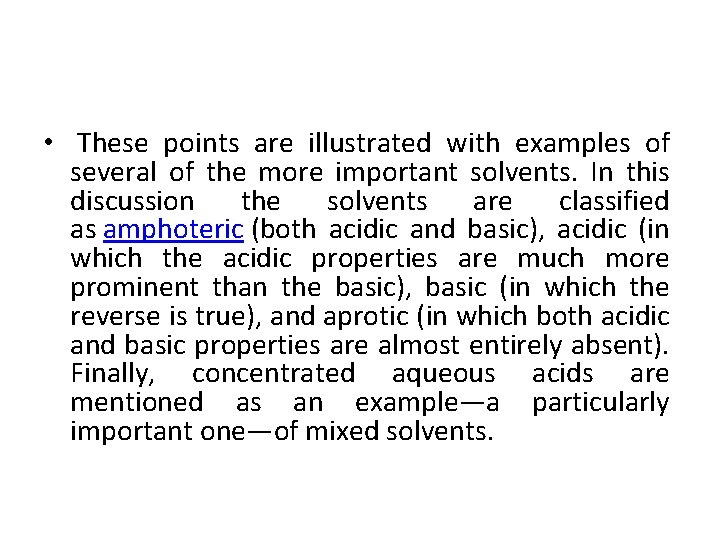
• These points are illustrated with examples of several of the more important solvents. In this discussion the solvents are classified as amphoteric (both acidic and basic), acidic (in which the acidic properties are much more prominent than the basic), basic (in which the reverse is true), and aprotic (in which both acidic and basic properties are almost entirely absent). Finally, concentrated aqueous acids are mentioned as an example—a particularly important one—of mixed solvents.
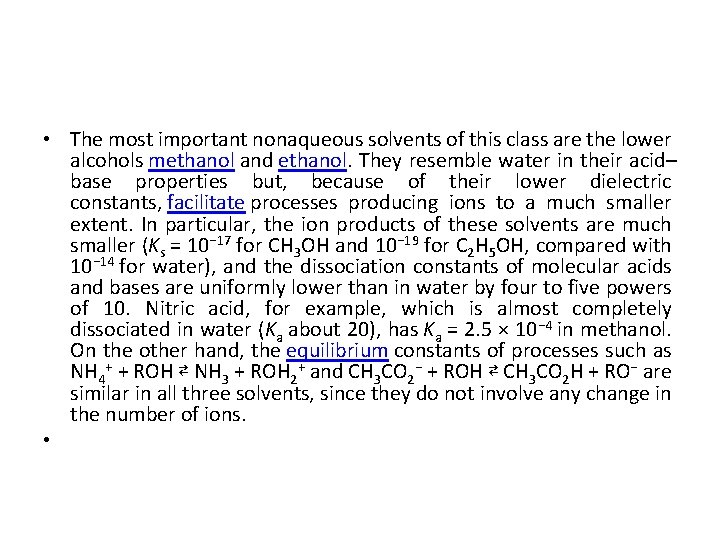
• The most important nonaqueous solvents of this class are the lower alcohols methanol and ethanol. They resemble water in their acid– base properties but, because of their lower dielectric constants, facilitate processes producing ions to a much smaller extent. In particular, the ion products of these solvents are much smaller (Ks = 10− 17 for CH 3 OH and 10− 19 for C 2 H 5 OH, compared with 10− 14 for water), and the dissociation constants of molecular acids and bases are uniformly lower than in water by four to five powers of 10. Nitric acid, for example, which is almost completely dissociated in water (Ka about 20), has Ka = 2. 5 × 10− 4 in methanol. On the other hand, the equilibrium constants of processes such as NH 4+ + ROH ⇄ NH 3 + ROH 2+ and CH 3 CO 2− + ROH ⇄ CH 3 CO 2 H + RO− are similar in all three solvents, since they do not involve any change in the number of ions. •
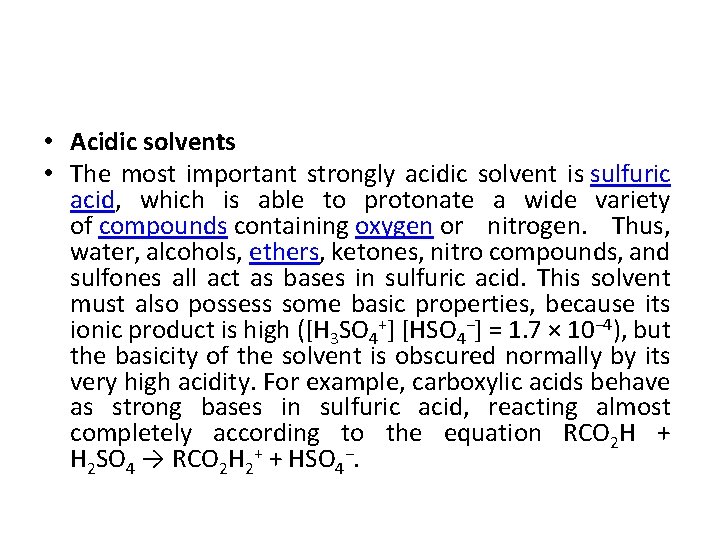
• Acidic solvents • The most important strongly acidic solvent is sulfuric acid, which is able to protonate a wide variety of compounds containing oxygen or nitrogen. Thus, water, alcohols, ethers, ketones, nitro compounds, and sulfones all act as bases in sulfuric acid. This solvent must also possess some basic properties, because its ionic product is high ([H 3 SO 4+] [HSO 4−] = 1. 7 × 10− 4), but the basicity of the solvent is obscured normally by its very high acidity. For example, carboxylic acids behave as strong bases in sulfuric acid, reacting almost completely according to the equation RCO 2 H + H 2 SO 4 → RCO 2 H 2+ + HSO 4−.
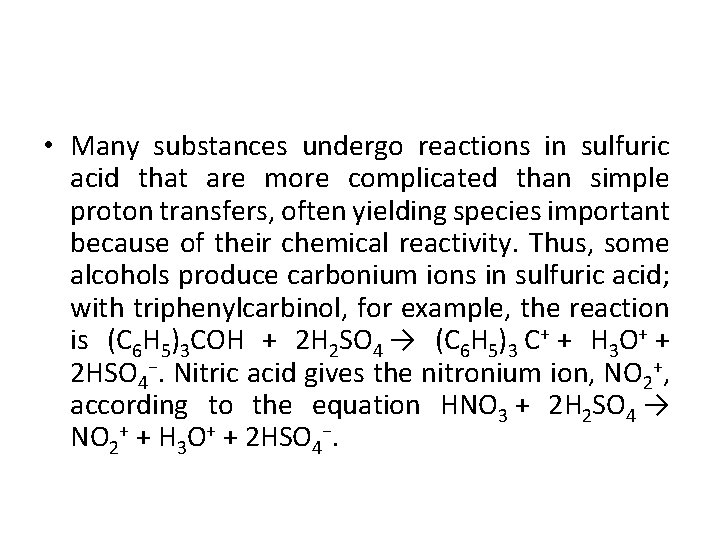
• Many substances undergo reactions in sulfuric acid that are more complicated than simple proton transfers, often yielding species important because of their chemical reactivity. Thus, some alcohols produce carbonium ions in sulfuric acid; with triphenylcarbinol, for example, the reaction is (C 6 H 5)3 COH + 2 H 2 SO 4 → (C 6 H 5)3 C+ + H 3 O+ + 2 HSO 4−. Nitric acid gives the nitronium ion, NO 2+, according to the equation HNO 3 + 2 H 2 SO 4 → NO 2+ + H 3 O+ + 2 HSO 4−.
• This ion frequently is the active agent in the nitration of organic compounds. Hydrogen fluoride has solvent properties resembling those of sulfuric acid but is less acidic and has negligible basic properties. Acetic acid is another acidic solvent that has been extensively studied. Because of its low dielectric constant, ions exist in it largely in the form of ion pairs, and more complex associates are frequently formed. For this reason a quantitative interpretation of acid–base equilibria in acetic acid is often difficult, but some general conclusions can be drawn. In particular, it can be seen that all substances more basic in water solution than aniline react completely with acetic acid according to the equation B + CH 3 CO 2 H → BH+ + CH 3 CO 2−.
• All such bases therefore give solutions with indistinguishable acid–base properties; this is often referred to as a levelling effect of the solvent. The converse is true for acids; for example, the strong mineral acids, nitric, hydrochloric, sulfuric, hydrobromic, and perchloric (HNO 3, HCl, H 2 SO 4, HBr, and HCl. O 4) are “levelled” in aqueous solution by complete conversion to the hydronium ion, but in acetic acid they are differentiated as weak acids with strengths in the approximate ratio 1: 9: 30: 160: 400.
• Basic solvents • The only basic solvent that has been investigated in any detail is liquid ammonia, which has the very low ion product [NH 4+] [NH 2−] = 10− 33. As might be expected, this solvent has a marked levelling effect upon acids; thus, for example, acetic, benzoic, nitric, and hydrochloric acids all give solutions with identical acidic properties, owing to the ion NH 4+, although, of course, in water they behave very differently.