
Chapter 1 An Orientation to the Human Body
Chapter 1: An Orientation to the Human Body Copyright © 2012 Wolters Kluwer Health | Lippincott Williams & Wilkins
Introduction • Anatomy – Study of: • External & internal structures of body • Physical relationship between parts of body – Answers questions “What? ” & “Where? ” • Physiology – Study of functions of various parts of body – Answers questions “Why? ” & “How? ” Copyright © 2012 Wolters Kluwer Health | Lippincott Williams & Wilkins

Navigating the Body • Planes of division Copyright © 2012 Wolters Kluwer Health | Lippincott Williams & Wilkins
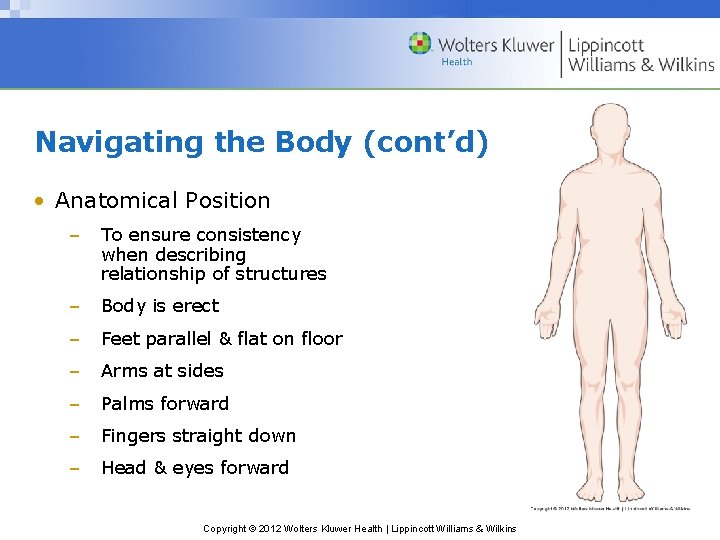
Navigating the Body (cont’d) • Anatomical Position – To ensure consistency when describing relationship of structures – Body is erect – Feet parallel & flat on floor – Arms at sides – Palms forward – Fingers straight down – Head & eyes forward Copyright © 2012 Wolters Kluwer Health | Lippincott Williams & Wilkins

Navigating the Body (cont’d) • Directional References Superior/cephalic= Top/toward head Inferior/caudal = Bottom/below head Anterior/ventral = In front of Posterior/dorsal = In back of/behind Medial = Near midline Lateral = Away from midline Deep/internal = Away from surface Superior/external= Close to surface Proximal = Close to trunk Distal = Away from trunk Copyright © 2012 Wolters Kluwer Health | Lippincott Williams & Wilkins
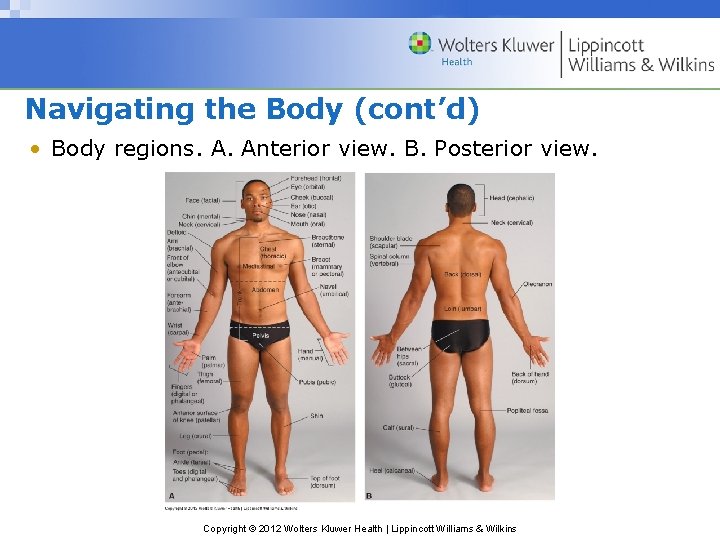
Navigating the Body (cont’d) • Body regions. A. Anterior view. B. Posterior view. Copyright © 2012 Wolters Kluwer Health | Lippincott Williams & Wilkins
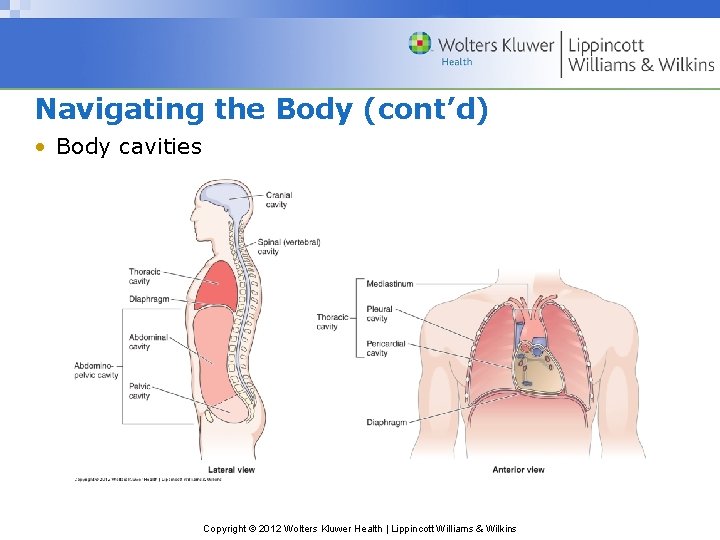
Navigating the Body (cont’d) • Body cavities Copyright © 2012 Wolters Kluwer Health | Lippincott Williams & Wilkins
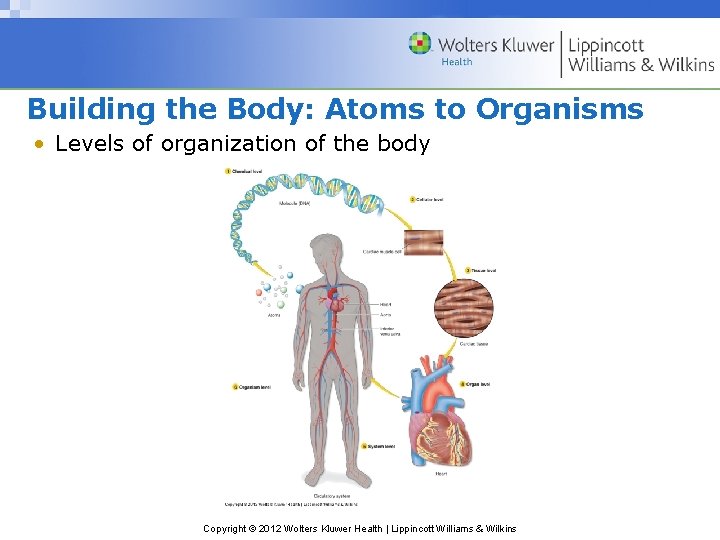
Building the Body: Atoms to Organisms • Levels of organization of the body Copyright © 2012 Wolters Kluwer Health | Lippincott Williams & Wilkins
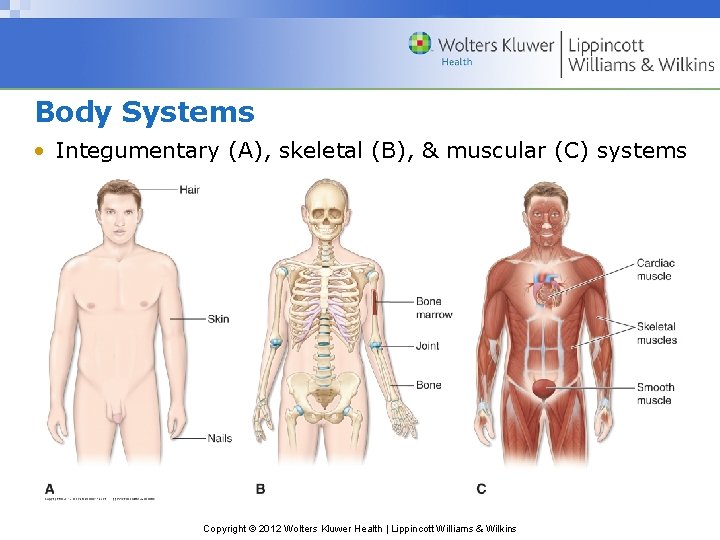
Body Systems • Integumentary (A), skeletal (B), & muscular (C) systems Copyright © 2012 Wolters Kluwer Health | Lippincott Williams & Wilkins
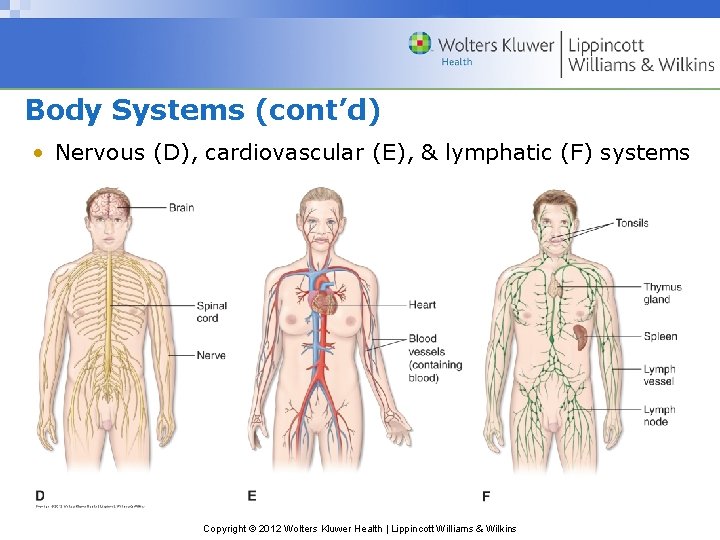
Body Systems (cont’d) • Nervous (D), cardiovascular (E), & lymphatic (F) systems Copyright © 2012 Wolters Kluwer Health | Lippincott Williams & Wilkins
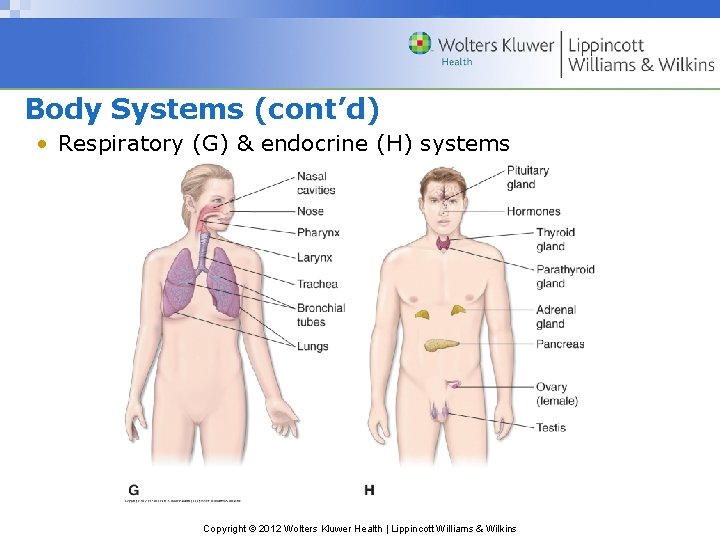
Body Systems (cont’d) • Respiratory (G) & endocrine (H) systems Copyright © 2012 Wolters Kluwer Health | Lippincott Williams & Wilkins
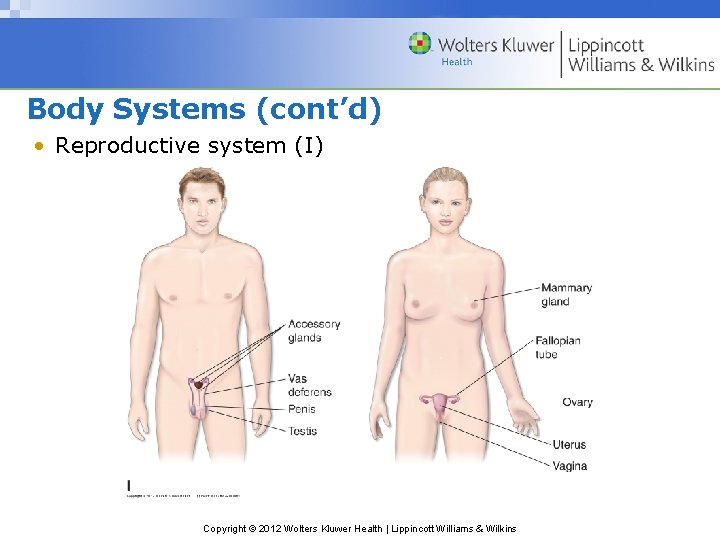
Body Systems (cont’d) • Reproductive system (I) Copyright © 2012 Wolters Kluwer Health | Lippincott Williams & Wilkins
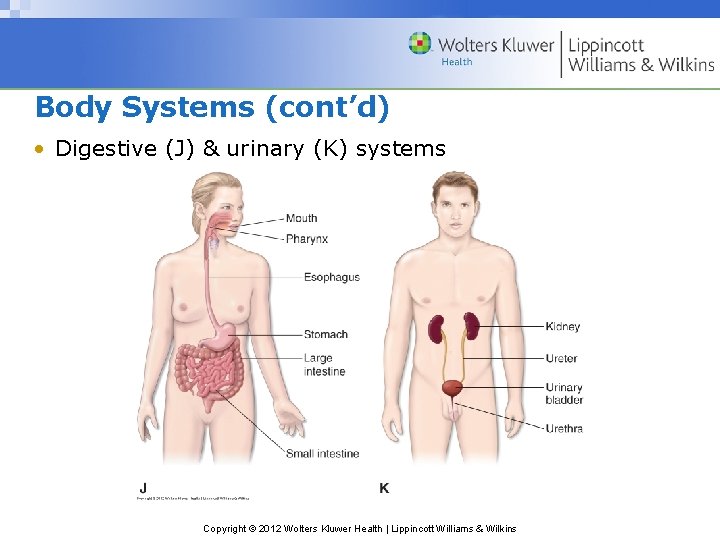
Body Systems (cont’d) • Digestive (J) & urinary (K) systems Copyright © 2012 Wolters Kluwer Health | Lippincott Williams & Wilkins
Preserving Life: Necessary Functions Metabolism Chemical reactions between cells of body Responsiveness Voluntary or involuntary reactions of body to internal or external environment Movement • External: muscles allow walking & running • Internal: circulation of blood & lymph Digestion Breaking food down into nutrients & infusing them into blood to be circulated throughout body Excretion Removing waste from body Reproduction • Creating a new human being • New cell growth & repair Growth Increase in size of organism or structure Copyright © 2012 Wolters Kluwer Health | Lippincott Williams & Wilkins
Maintaining Homeostasis • Homeostasis – A state of equilibrium or stability in the internal environment – Maintained by each system continuously altering its active state – Detectors throughout body monitor & make adjustments in: • Calcium, hydrogen, & sodium levels • Volume of blood • Blood pressure • Hormone levels • Body temperature Copyright © 2012 Wolters Kluwer Health | Lippincott Williams & Wilkins
Maintaining Homeostasis (cont’d) • Feedback System – A system designed to maintain homeostasis – Constantly monitors a particular variable – Increases or decreases level of variable to maintain normal range – Controlled condition: variable – Stimulus: any factor that changes level of variable – Receptor: monitors variable & sends input to brain – Effectors: structures that help nullify effect – Negative feedback: feedback loop nullifies change that occurs – Positive feedback: feedback loop intensifies change Copyright © 2012 Wolters Kluwer Health | Lippincott Williams & Wilkins
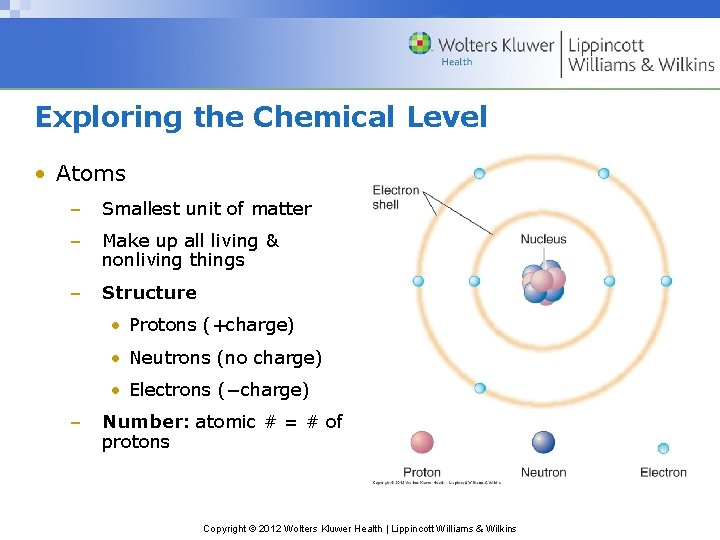
Exploring the Chemical Level • Atoms – Smallest unit of matter – Make up all living & nonliving things – Structure • Protons (+charge) • Neutrons (no charge) • Electrons (−charge) – Number: atomic # = # of protons Copyright © 2012 Wolters Kluwer Health | Lippincott Williams & Wilkins
Exploring the Chemical Level (cont’d) • Elements – Groups to which atoms are assigned based on atomic # – Can’t be split into simpler substances by normal chemical means – 92 occur in nature • Isotopes – Atoms of the same element that have different #’s of neutrons – Referred to by mass #: combined # of protons & neutrons – Radioisotopes: isotopes that contain nuclei that spontaneously emit subatomic particles Copyright © 2012 Wolters Kluwer Health | Lippincott Williams & Wilkins
Exploring the Chemical Level (cont’d) • Molecules and Compounds – Molecule: atoms held together by sharing electrons – Compound: a new substance formed when interacting atoms of different elements join together • Chemical Bonds – Ionic: atom loses or gains electron to another – Covalent: atoms share electrons – Hydrogen: hydrogen atom involved in polar covalent bond is attracted to another molecule Copyright © 2012 Wolters Kluwer Health | Lippincott Williams & Wilkins
Exploring the Chemical Level (cont’d) • Chemical Reactions • Chemical Compounds – Inorganic – Synthesis – Decomposition • Water – Exchange • Salts – Reversible • Acids, bases, & p. H – Organic • Carbohydrates • Lipids • Proteins • Nucleic acids & ATP Copyright © 2012 Wolters Kluwer Health | Lippincott Williams & Wilkins
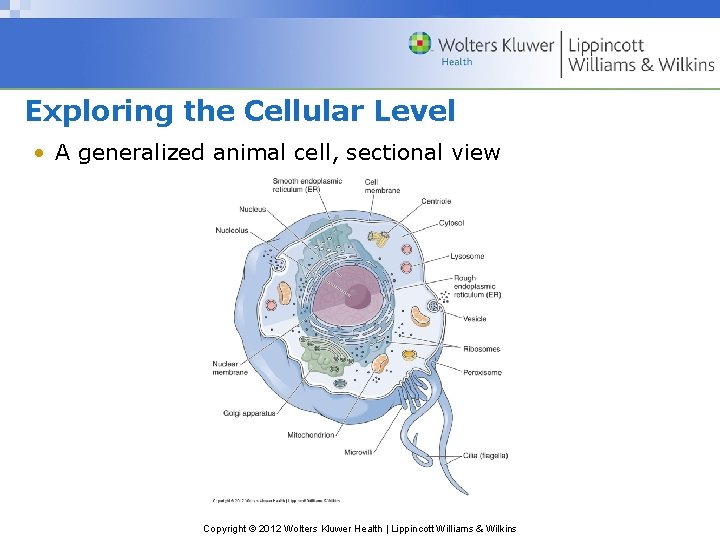
Exploring the Cellular Level • A generalized animal cell, sectional view Copyright © 2012 Wolters Kluwer Health | Lippincott Williams & Wilkins
Exploring the Cellular Level (cont’d) • Cell Membrane Transport – Passive: transport of substances across cell membrane without use of energy • Diffusion • Osmosis • Filtration • Carrier-mediated transport – Active: transport of substances across cell membrane using energy – Vesicular: substances enter (endocytosis) & exit (exocytosis) cell in vesicles Copyright © 2012 Wolters Kluwer Health | Lippincott Williams & Wilkins
Exploring the Cellular Level (cont’d) • Cell Division: The Cell Life Cycle – Interphase – Division • Mitosis: chromosome separates into 2 identical nuclei 1. Prophase 2. Metaphase 3. Anaphase 4. Telophase • Meiosis: daughter cells end up w. half the # of chromosomes Copyright © 2012 Wolters Kluwer Health | Lippincott Williams & Wilkins
Exploring the Tissue Level • Epithelial Tissue – – Functions • Simple: 1 layer of cells • Covers surfaces exposed to environment (skin) • Lines internal passages & chambers • Forms glands Types: # of cell layers • Stratified: multiple layers – Types: cell shape • Squamous • Exocrine • Cuboidal • Endocrine • Transitional • Columnar Copyright © 2012 Wolters Kluwer Health | Lippincott Williams & Wilkins
Exploring the Tissue Level (cont’d) • Connective Tissue – – – Functions Cells • Framework • Fibroblasts • Transport • Mesenchymal cells • Protection • Adipocytes • Storage • Macrophages • Sensors • Microphages Extracellular matrix • Mast cells • Ground substance • Lymphocytes • Fibers • Platelets Copyright © 2012 Wolters Kluwer Health | Lippincott Williams & Wilkins
Exploring the Tissue Level (cont’d) • Connective Tissue – – Common properties – Types • Fluidity & thixotropy • Superficial & deep fascia • Adhesion • Bone Density of tissue • Cartilage • Loose • Blood • Dense • Membranes Copyright © 2012 Wolters Kluwer Health | Lippincott Williams & Wilkins
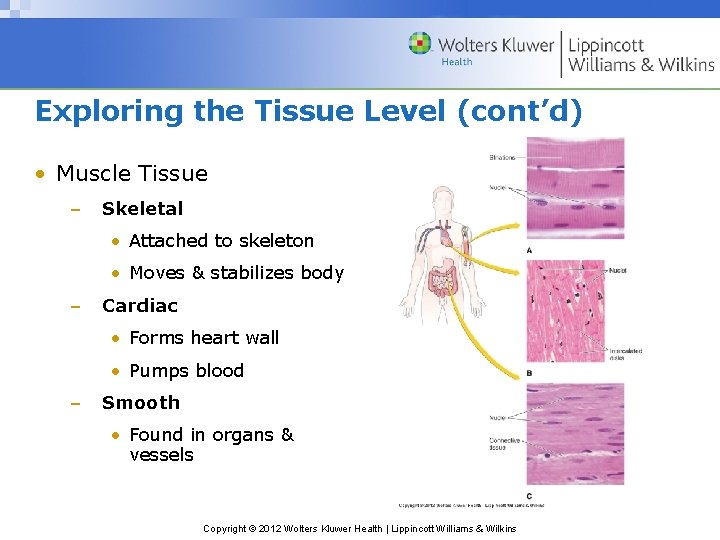
Exploring the Tissue Level (cont’d) • Muscle Tissue – Skeletal • Attached to skeleton • Moves & stabilizes body – Cardiac • Forms heart wall • Pumps blood – Smooth • Found in organs & vessels Copyright © 2012 Wolters Kluwer Health | Lippincott Williams & Wilkins
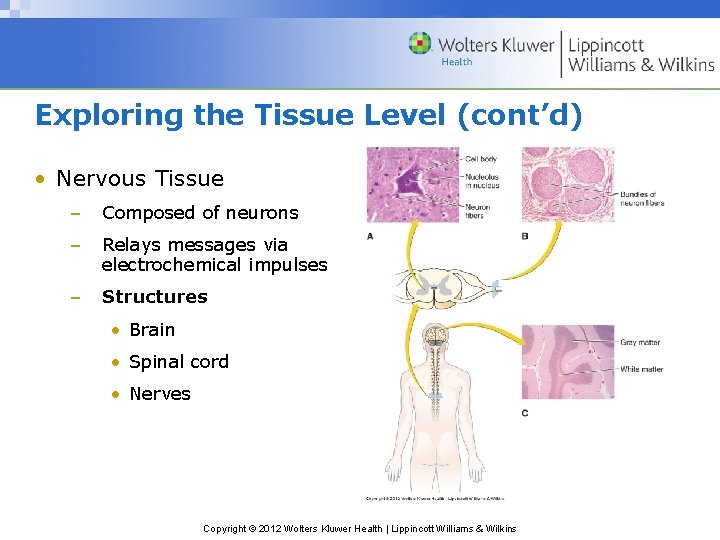
Exploring the Tissue Level (cont’d) • Nervous Tissue – Composed of neurons – Relays messages via electrochemical impulses – Structures • Brain • Spinal cord • Nerves Copyright © 2012 Wolters Kluwer Health | Lippincott Williams & Wilkins
The Massage Connection • Effleurage, pétrissage, & tapotement – Affect fluid component of tissue by: • Increasing blood & lymph flow • Reducing edema • Friction – Effective in treating adherent connective tissue – Realigns collagen fibers during remodeling phase of healing • Skin rolling, friction, & myofascial trigger & direct fascial – Affect underlying connective tissue Copyright © 2012 Wolters Kluwer Health | Lippincott Williams & Wilkins
- Slides: 29