
Chapter 1 An Introduction to the Human Body
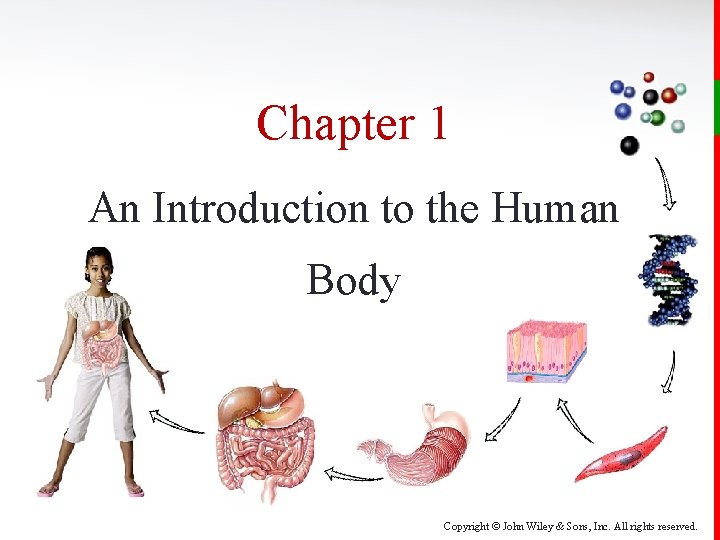
Chapter 1 An Introduction to the Human Body Copyright © John Wiley & Sons, Inc. All rights reserved.
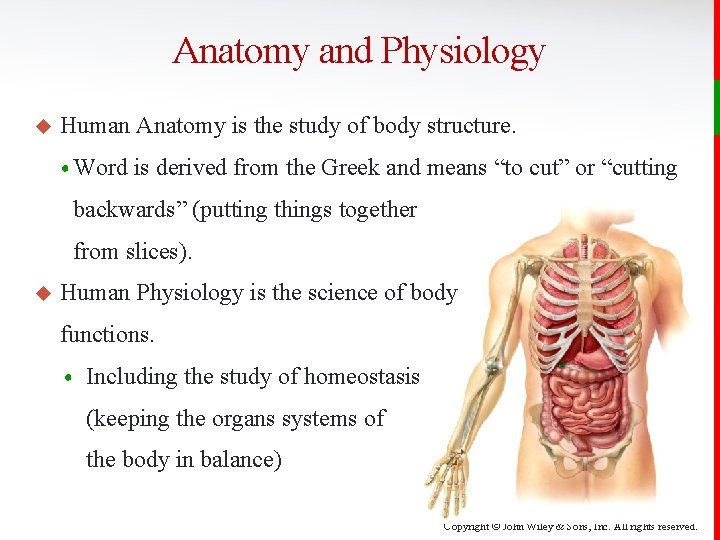
Anatomy and Physiology u Human Anatomy is the study of body structure. • Word is derived from the Greek and means “to cut” or “cutting backwards” (putting things together from slices). u Human Physiology is the science of body functions. • Including the study of homeostasis (keeping the organs systems of the body in balance) Copyright © John Wiley & Sons, Inc. All rights reserved.
Anatomy and Physiology u Structure and function of the body are closely related: Structure mirrors function § Bones of the skull are heavy and secure to protect brain function. § The thin air sacs of the lungs permit movement of gases from the lungs to the blood. Copyright © John Wiley & Sons, Inc. All rights reserved.
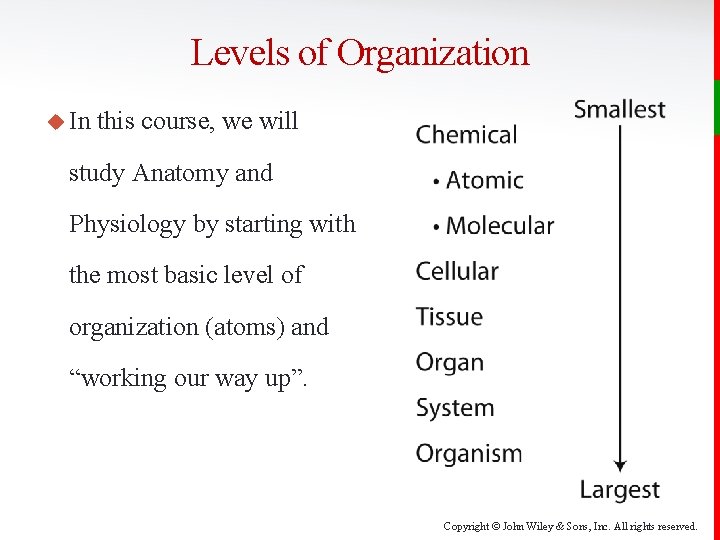
Levels of Organization u In this course, we will study Anatomy and Physiology by starting with the most basic level of organization (atoms) and “working our way up”. Copyright © John Wiley & Sons, Inc. All rights reserved.
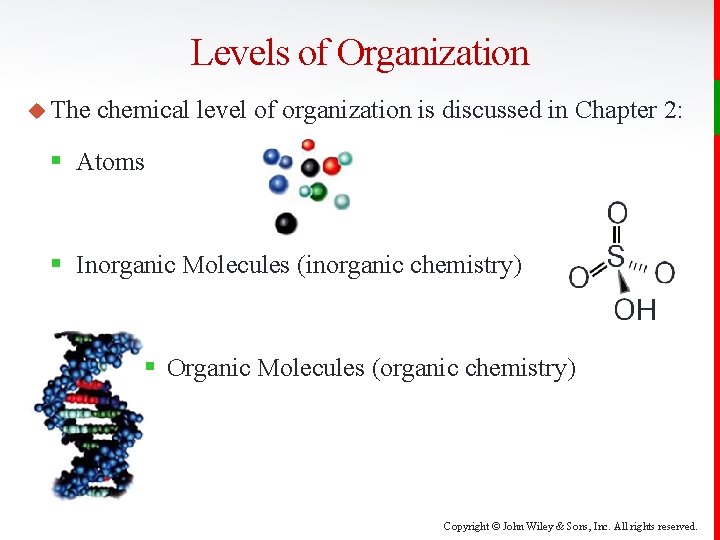
Levels of Organization u The chemical level of organization is discussed in Chapter 2: § Atoms § Inorganic Molecules (inorganic chemistry) § Organic Molecules (organic chemistry) Copyright © John Wiley & Sons, Inc. All rights reserved.
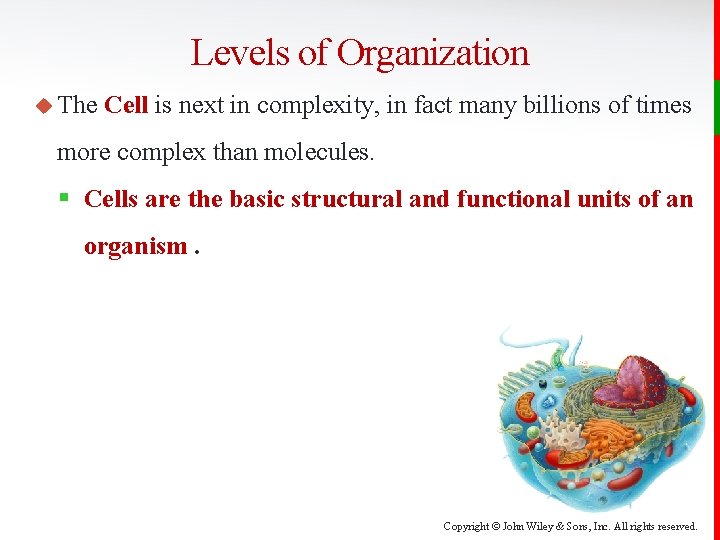
Levels of Organization u The Cell is next in complexity, in fact many billions of times more complex than molecules. § Cells are the basic structural and functional units of an organism. Copyright © John Wiley & Sons, Inc. All rights reserved.
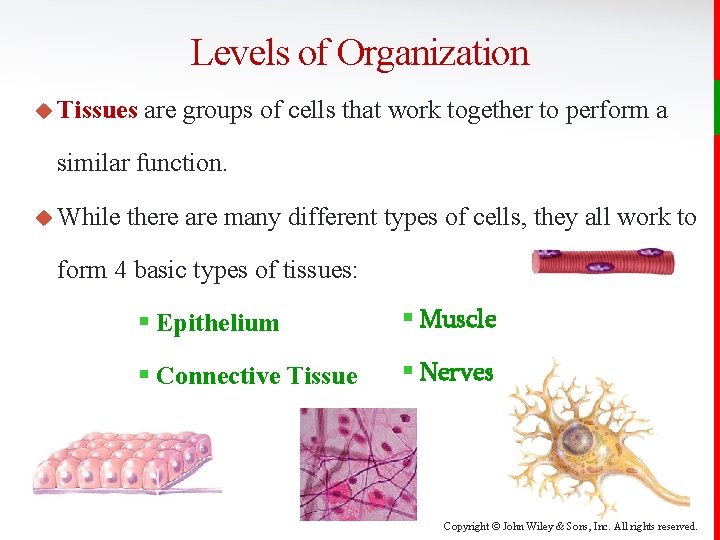
Levels of Organization u Tissues are groups of cells that work together to perform a similar function. u While there are many different types of cells, they all work to form 4 basic types of tissues: § Epithelium § Muscle § Connective Tissue § Nerves Copyright © John Wiley & Sons, Inc. All rights reserved.
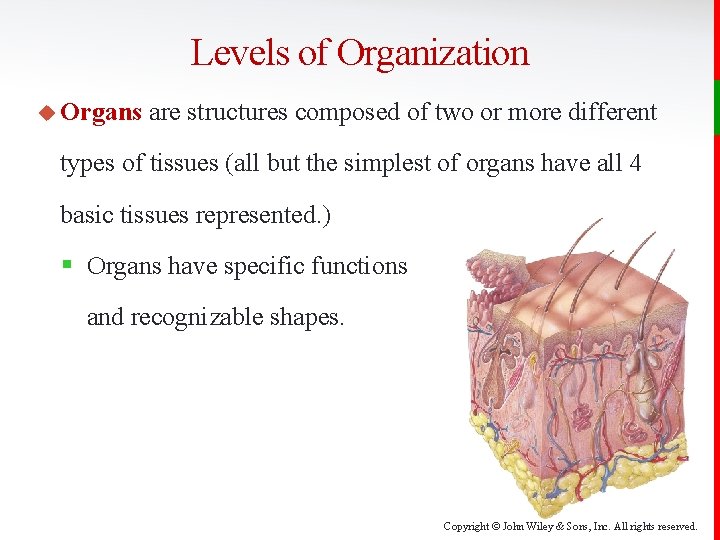
Levels of Organization u Organs are structures composed of two or more different types of tissues (all but the simplest of organs have all 4 basic tissues represented. ) § Organs have specific functions and recognizable shapes. Copyright © John Wiley & Sons, Inc. All rights reserved.
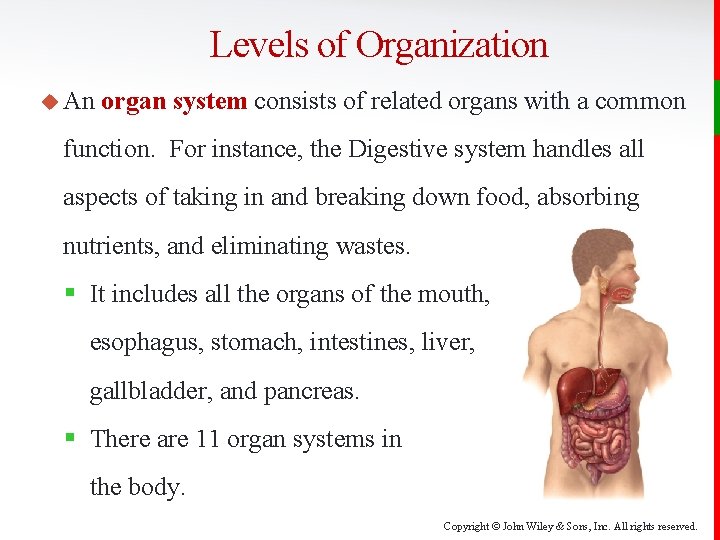
Levels of Organization u An organ system consists of related organs with a common function. For instance, the Digestive system handles all aspects of taking in and breaking down food, absorbing nutrients, and eliminating wastes. § It includes all the organs of the mouth, esophagus, stomach, intestines, liver, gallbladder, and pancreas. § There are 11 organ systems in the body. Copyright © John Wiley & Sons, Inc. All rights reserved.
Levels of Organization u An organism consists of a collection of organ systems. § Six important life processes: • Metabolism • Responsiveness • Movement • Growth • Differentiation • Reproduction u In health, all parts of the body must be functioning together in a process called homeostasis. Copyright © John Wiley & Sons, Inc. All rights reserved.
Essential Life Processes u Metabolism is the sum of all the catabolic (breaking down) and anabolic (building up) chemical processes that occur in the body. u Responsiveness is the body’s ability to detect and respond to changes which might represent an opportunity… or a threat! § Decrease in body temperature § Responding to sound § Nerve (electrical signals) and muscle cells (contracting) Copyright © John Wiley & Sons, Inc. All rights reserved.
Essential Life Processes u Movement is any motion, including movement of tiny subcellular structures, or movement inside cells or organs. § Leg muscles move the body from one place to another. u Growth involves an increase in body size due to an increase in existing cells, number of cells, or both. § In bone growth, materials between cells increase. Copyright © John Wiley & Sons, Inc. All rights reserved.
Essential Life Processes u Differentiation is the development of a cell from an unspecialized to specialized state. Cells have specialized structures and functions that differ from precursor cells. § Stem cells give rise to cells that undergo differentiation. u Reproduction is the formation of new cells (growth, repair, or replacement) or the production of a new individual. Copyright © John Wiley & Sons, Inc. All rights reserved.
Homeostasis u. A condition of equilibrium (balance) in the body’s internal environment. It is a dynamic condition meant to keep body functions in the narrow range compatible with maintaining life. § Blood glucose levels range between 70 and 110 mg of glucose/d. L of blood. Copyright © John Wiley & Sons, Inc. All rights reserved.
Homeostasis u Body fluids are defined as dilute, watery solutions containing dissolved chemicals inside or outside of the cell. Maintaining the volume and composition of body fluids is important. § Intracellular Fluid (ICF) is the fluid within cells § Extracellular Fluid (ECF) is the fluid outside cells • Interstitial fluid is ECF between cells and tissues Copyright © John Wiley & Sons, Inc. All rights reserved.
Homeostasis u Some important body fluids: § Blood Plasma is the ECF within blood vessels. § Lymph is the ECF within lymphatic vessels. § Cerebrospinal fluid (CSF) is the ECF in the brain and spinal cord. § Synovial fluid is the ECF in joints. § Aqueous humor is the ECF in eyes. Copyright © John Wiley & Sons, Inc. All rights reserved.
Homeostasis u Cellular function depends on the regulation of the composition of the interstitial fluid. § Composition of interstitial fluid changes as substances move between plasma and the interstitial fluid. § Movement back and forth across capillary walls provides nutrients (glucose, oxygen, ions) to tissue cells and removes waste (carbon dioxide). Copyright © John Wiley & Sons, Inc. All rights reserved.
Homeostasis u Control of homeostasis is constantly being challenged by: § Physical insults such as intense heat or lack of oxygen § Changes in the internal environment such as a drop in blood glucose due to lack of food § Physiological stress such as demands of work or school u Disruptions u Intense are mild if balance is quickly restored. disruptions are often prolonged and result in disease (poisoning or severe infections) or death. Copyright © John Wiley & Sons, Inc. All rights reserved.
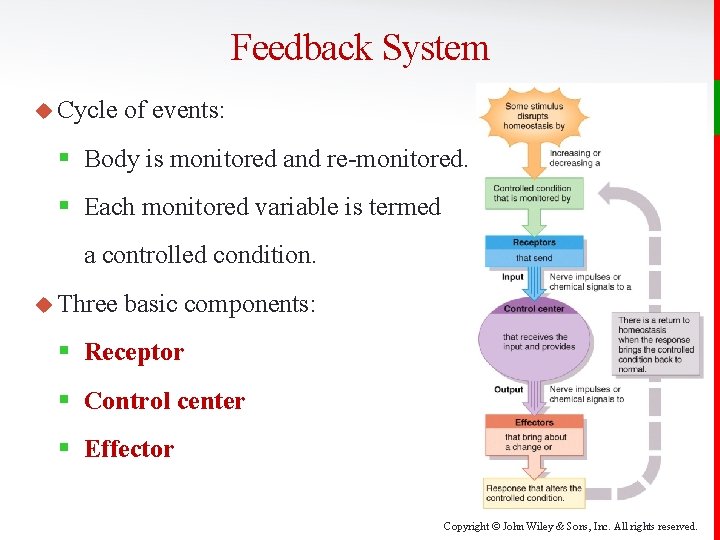
Feedback System u Cycle of events: § Body is monitored and re-monitored. § Each monitored variable is termed a controlled condition. u Three basic components: § Receptor § Control center § Effector Copyright © John Wiley & Sons, Inc. All rights reserved.
Feedback System u Negative Feedback systems: § Reverses a change in a controlled condition • Regulation of blood pressure u Positive Feedback systems: § Strengthens or reinforces a change in one of the body’s controlled conditions • Normal child birth Copyright © John Wiley & Sons, Inc. All rights reserved.
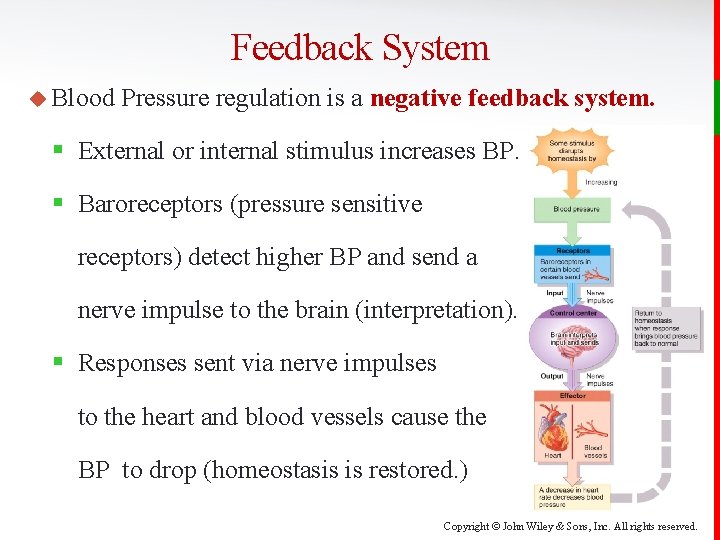
Feedback System u Blood Pressure regulation is a negative feedback system. § External or internal stimulus increases BP. § Baroreceptors (pressure sensitive receptors) detect higher BP and send a nerve impulse to the brain (interpretation). § Responses sent via nerve impulses to the heart and blood vessels cause the BP to drop (homeostasis is restored. ) Copyright © John Wiley & Sons, Inc. All rights reserved.
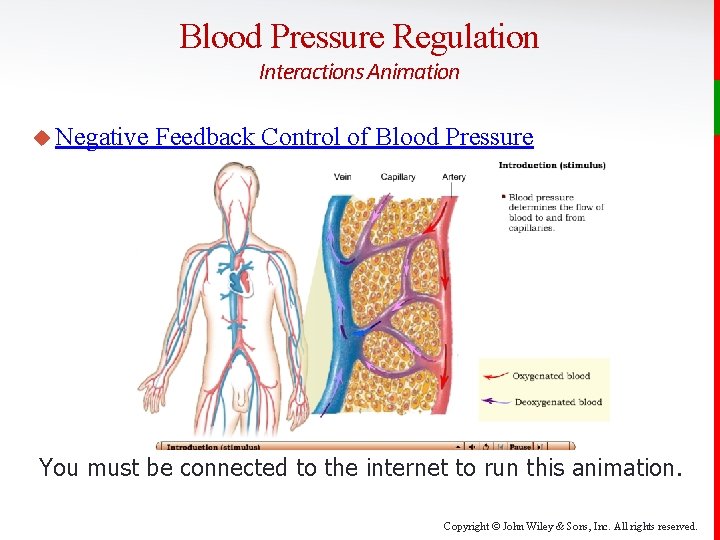
Blood Pressure Regulation Interactions Animation u Negative Feedback Control of Blood Pressure You must be connected to the internet to run this animation. Copyright © John Wiley & Sons, Inc. All rights reserved.
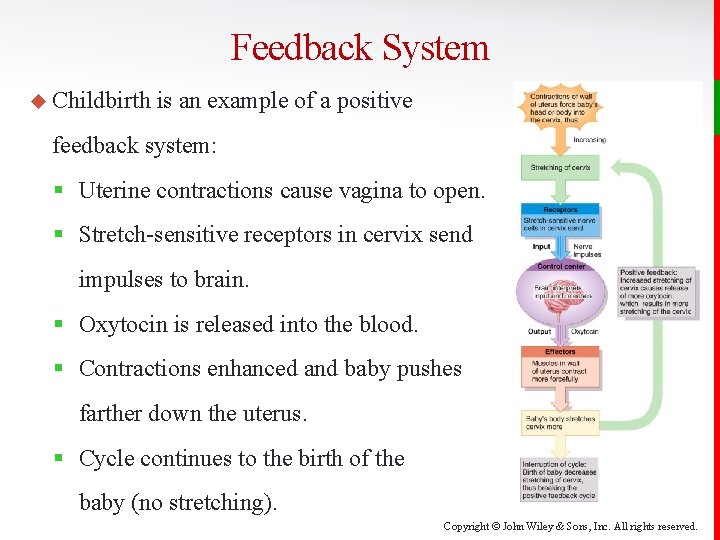
Feedback System u Childbirth is an example of a positive feedback system: § Uterine contractions cause vagina to open. § Stretch-sensitive receptors in cervix send impulses to brain. § Oxytocin is released into the blood. § Contractions enhanced and baby pushes farther down the uterus. § Cycle continues to the birth of the baby (no stretching). Copyright © John Wiley & Sons, Inc. All rights reserved.
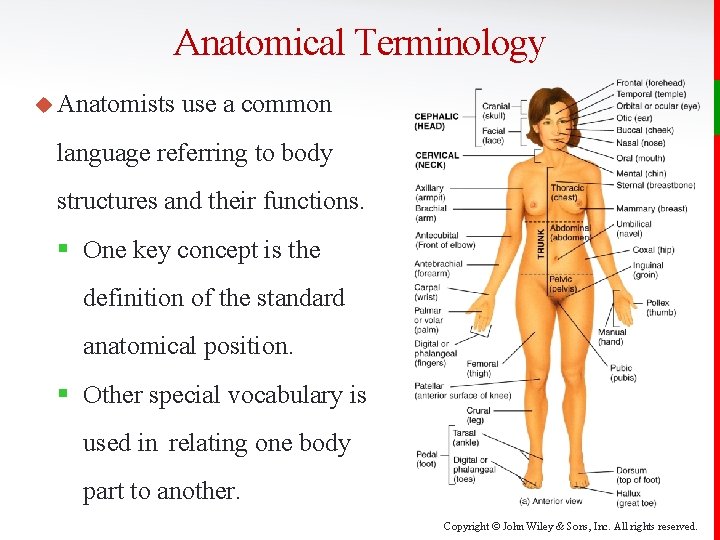
Anatomical Terminology u Anatomists use a common language referring to body structures and their functions. § One key concept is the definition of the standard anatomical position. § Other special vocabulary is used in relating one body part to another. Copyright © John Wiley & Sons, Inc. All rights reserved.
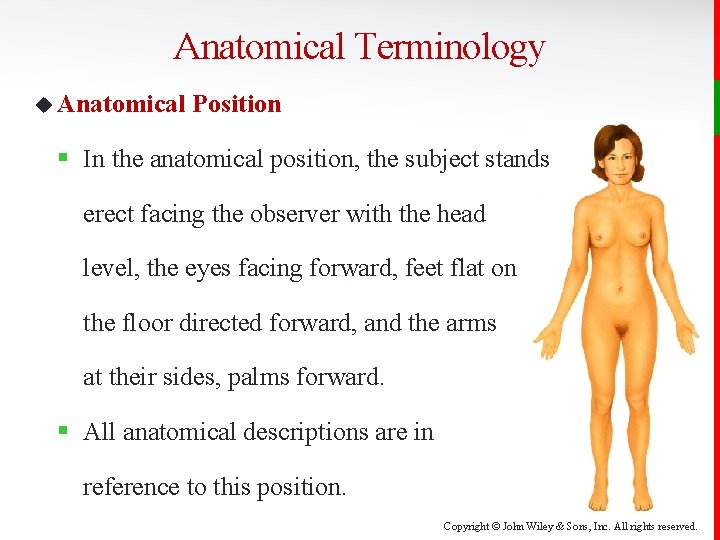
Anatomical Terminology u Anatomical Position § In the anatomical position, the subject stands erect facing the observer with the head level, the eyes facing forward, feet flat on the floor directed forward, and the arms at their sides, palms forward. § All anatomical descriptions are in reference to this position. Copyright © John Wiley & Sons, Inc. All rights reserved.
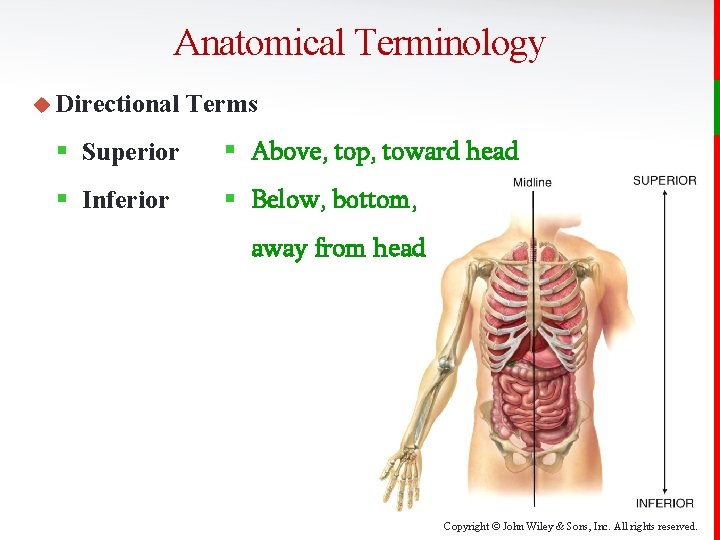
Anatomical Terminology u Directional Terms § Superior § Above, top, toward head § Inferior § Below, bottom, away from head Copyright © John Wiley & Sons, Inc. All rights reserved.
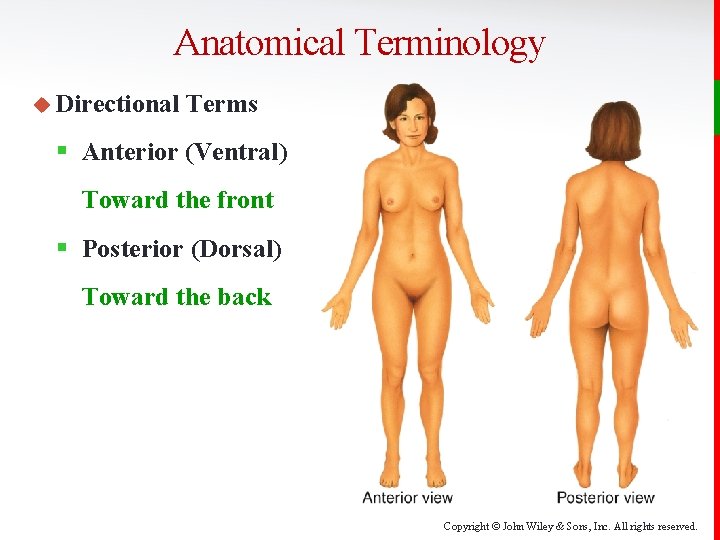
Anatomical Terminology u Directional Terms § Anterior (Ventral) Toward the front § Posterior (Dorsal) Toward the back Copyright © John Wiley & Sons, Inc. All rights reserved.
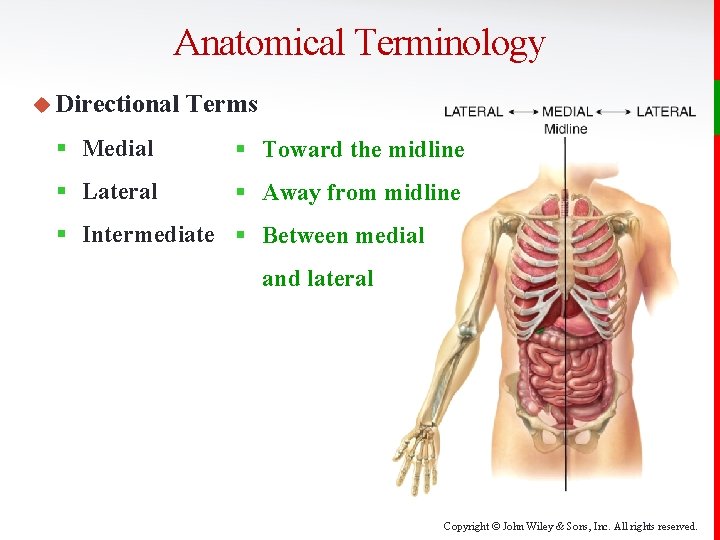
Anatomical Terminology u Directional Terms § Medial § Toward the midline § Lateral § Away from midline § Intermediate § Between medial and lateral Copyright © John Wiley & Sons, Inc. All rights reserved.
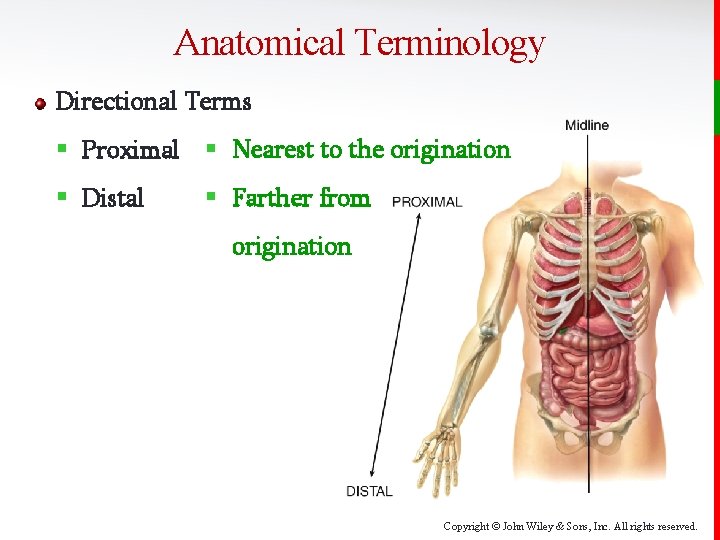
Anatomical Terminology Directional Terms § Proximal § Nearest to the origination § Distal § Farther from origination Copyright © John Wiley & Sons, Inc. All rights reserved.
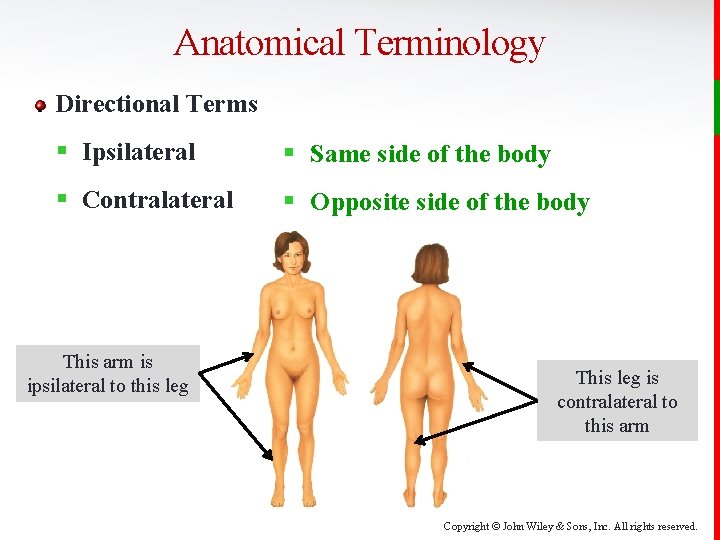
Anatomical Terminology Directional Terms § Ipsilateral § Same side of the body § Contralateral § Opposite side of the body This arm is ipsilateral to this leg This leg is contralateral to this arm Copyright © John Wiley & Sons, Inc. All rights reserved.
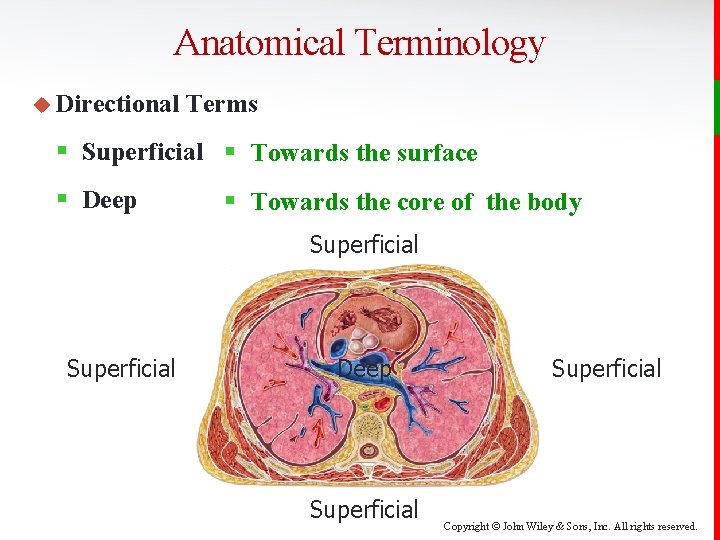
Anatomical Terminology u Directional Terms § Superficial § Towards the surface § Deep § Towards the core of the body Superficial Deep Superficial Copyright © John Wiley & Sons, Inc. All rights reserved.
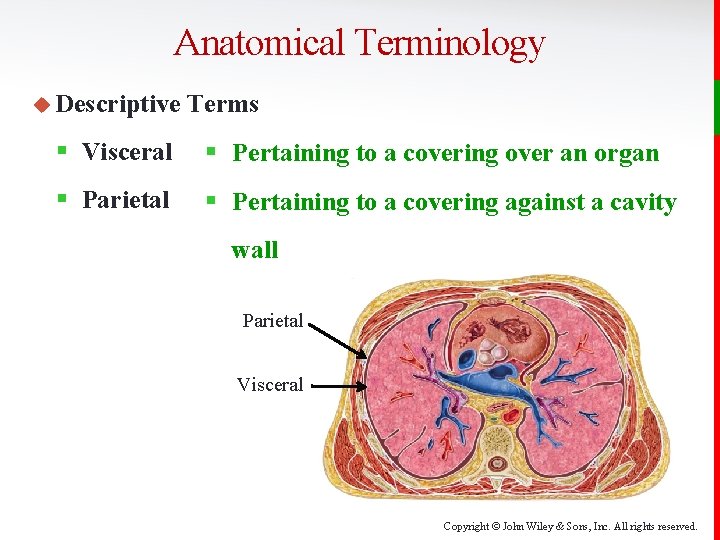
Anatomical Terminology u Descriptive Terms § Visceral § Pertaining to a covering over an organ § Parietal § Pertaining to a covering against a cavity wall Parietal Visceral Copyright © John Wiley & Sons, Inc. All rights reserved.
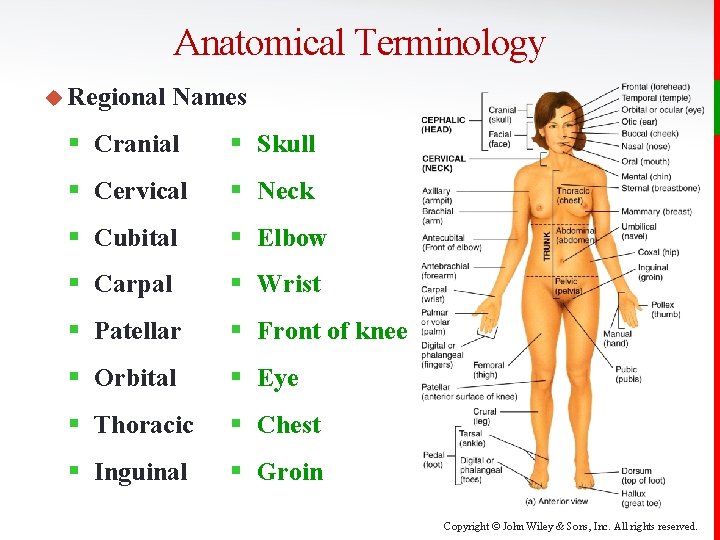
Anatomical Terminology u Regional Names § Cranial § Skull § Cervical § Neck § Cubital § Elbow § Carpal § Wrist § Patellar § Front of knee § Orbital § Eye § Thoracic § Chest § Inguinal § Groin Copyright © John Wiley & Sons, Inc. All rights reserved.
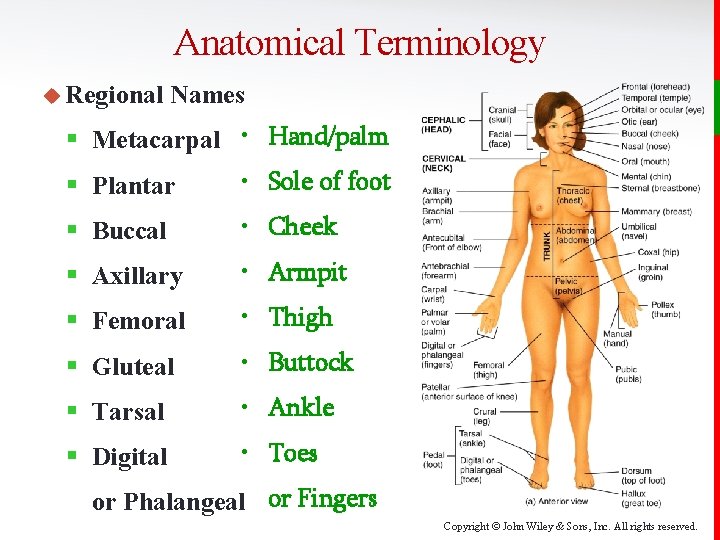
Anatomical Terminology u Regional Names § Metacarpal • Hand/palm § Plantar • Sole of foot § Buccal • Cheek § Axillary • Armpit § Femoral • Thigh § Gluteal • Buttock § Tarsal • Ankle § Digital • Toes or Phalangeal or Fingers Copyright © John Wiley & Sons, Inc. All rights reserved.
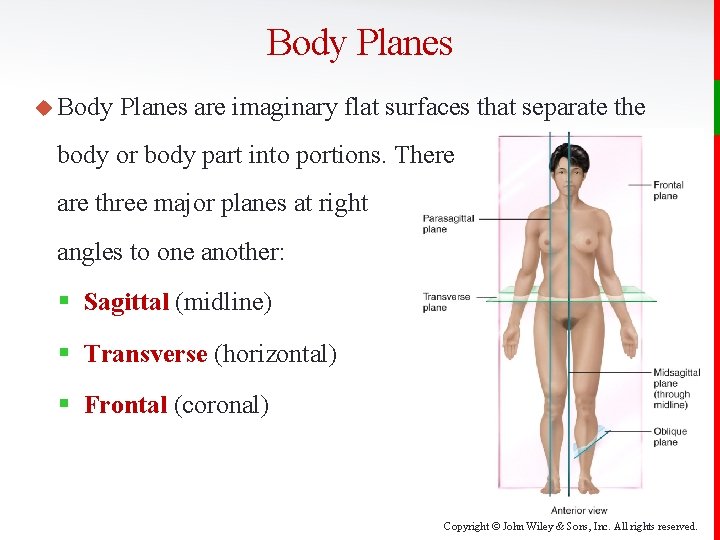
Body Planes u Body Planes are imaginary flat surfaces that separate the body or body part into portions. There are three major planes at right angles to one another: § Sagittal (midline) § Transverse (horizontal) § Frontal (coronal) Copyright © John Wiley & Sons, Inc. All rights reserved.
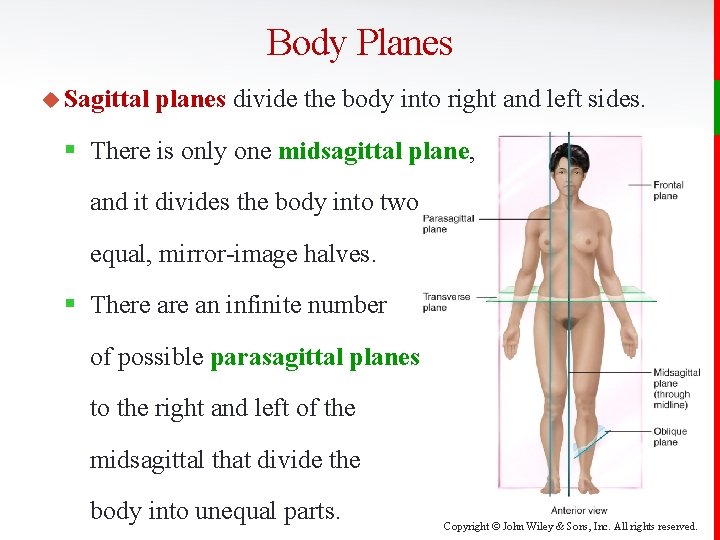
Body Planes u Sagittal planes divide the body into right and left sides. § There is only one midsagittal plane, and it divides the body into two equal, mirror-image halves. § There an infinite number of possible parasagittal planes to the right and left of the midsagittal that divide the body into unequal parts. Copyright © John Wiley & Sons, Inc. All rights reserved.
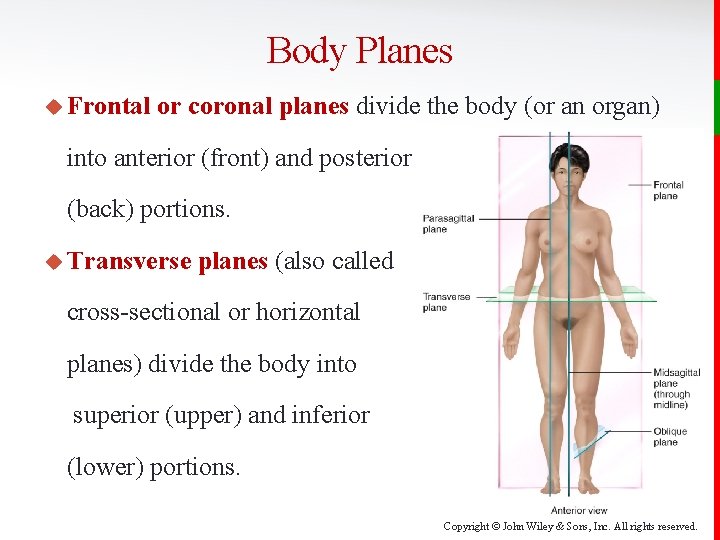
Body Planes u Frontal or coronal planes divide the body (or an organ) into anterior (front) and posterior (back) portions. u Transverse planes (also called cross-sectional or horizontal planes) divide the body into superior (upper) and inferior (lower) portions. Copyright © John Wiley & Sons, Inc. All rights reserved.
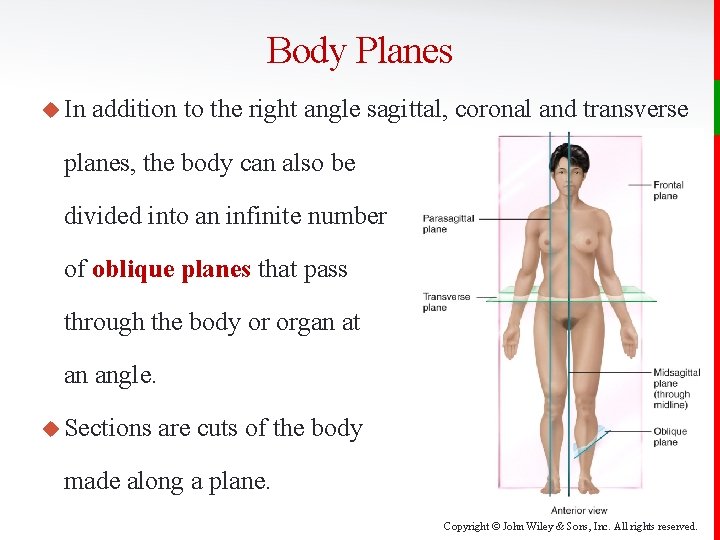
Body Planes u In addition to the right angle sagittal, coronal and transverse planes, the body can also be divided into an infinite number of oblique planes that pass through the body or organ at an angle. u Sections are cuts of the body made along a plane. Copyright © John Wiley & Sons, Inc. All rights reserved.
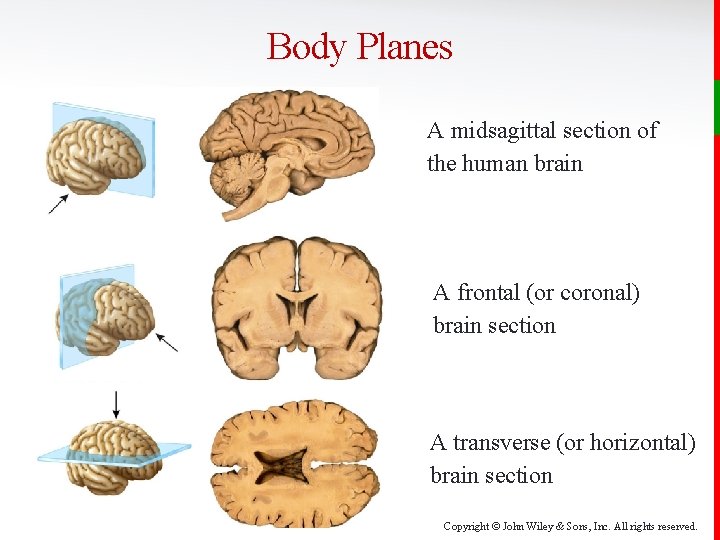
Body Planes A midsagittal section of the human brain A frontal (or coronal) brain section A transverse (or horizontal) brain section Copyright © John Wiley & Sons, Inc. All rights reserved.
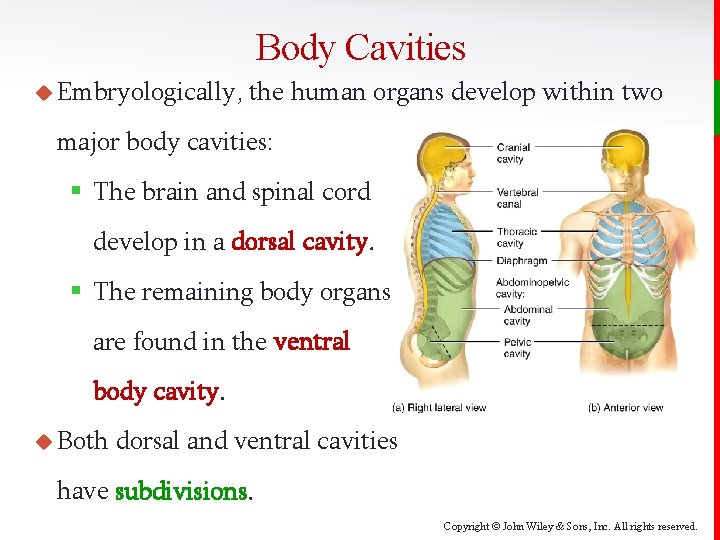
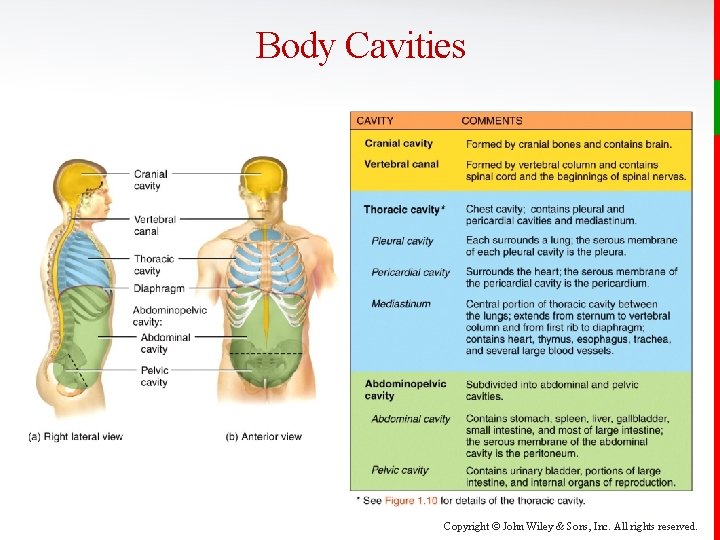
Body Cavities u Embryologically, the human organs develop within two major body cavities: § The brain and spinal cord develop in a dorsal cavity. § The remaining body organs are found in the ventral body cavity. u Both dorsal and ventral cavities have subdivisions. Copyright © John Wiley & Sons, Inc. All rights reserved.
Body Cavities Copyright © John Wiley & Sons, Inc. All rights reserved.
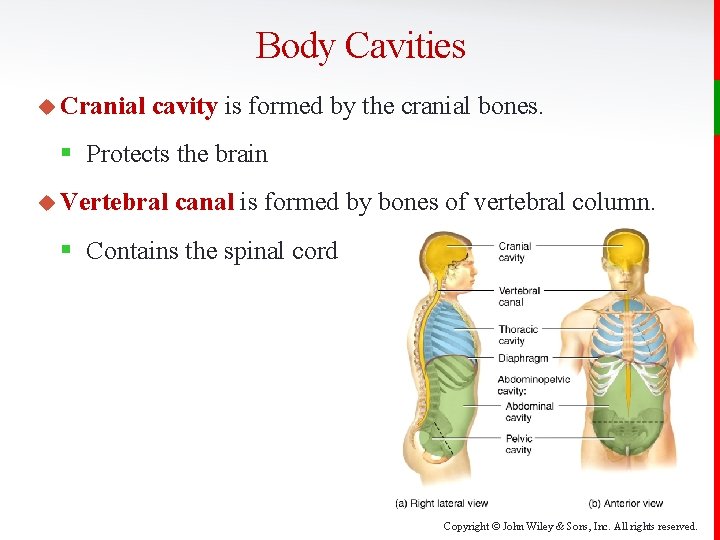
Body Cavities u Cranial cavity is formed by the cranial bones. § Protects the brain u Vertebral canal is formed by bones of vertebral column. § Contains the spinal cord Copyright © John Wiley & Sons, Inc. All rights reserved.
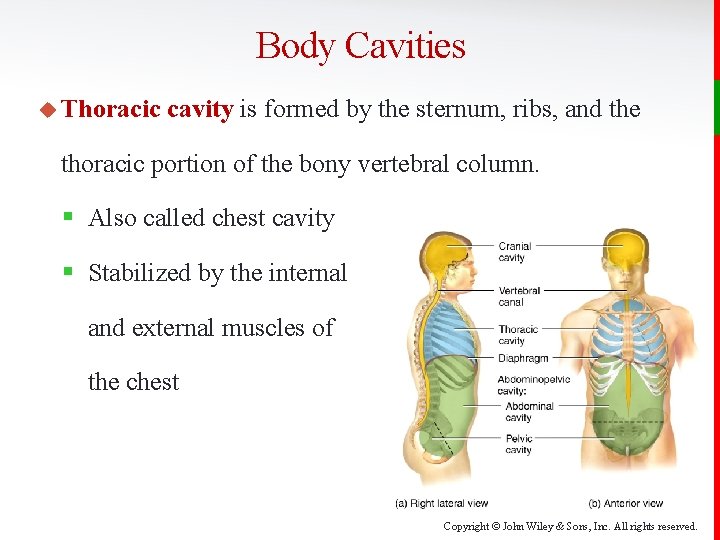
Body Cavities u Thoracic cavity is formed by the sternum, ribs, and the thoracic portion of the bony vertebral column. § Also called chest cavity § Stabilized by the internal and external muscles of the chest Copyright © John Wiley & Sons, Inc. All rights reserved.
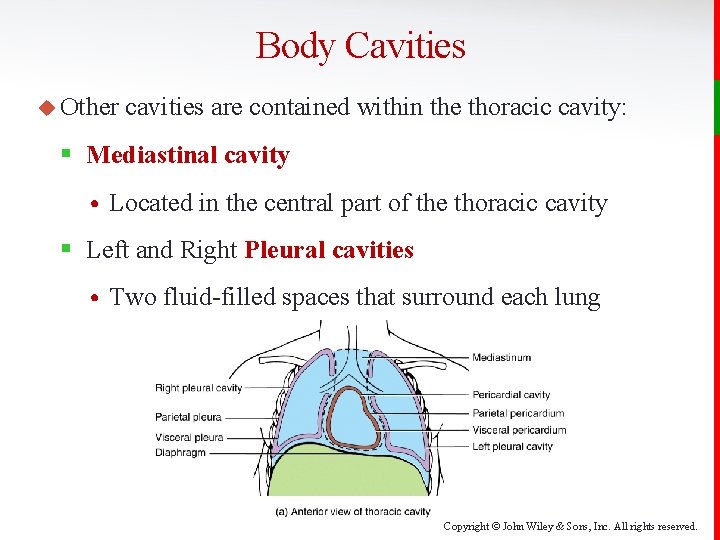
Body Cavities u Other cavities are contained within the thoracic cavity: § Mediastinal cavity • Located in the central part of the thoracic cavity § Left and Right Pleural cavities • Two fluid-filled spaces that surround each lung Copyright © John Wiley & Sons, Inc. All rights reserved.
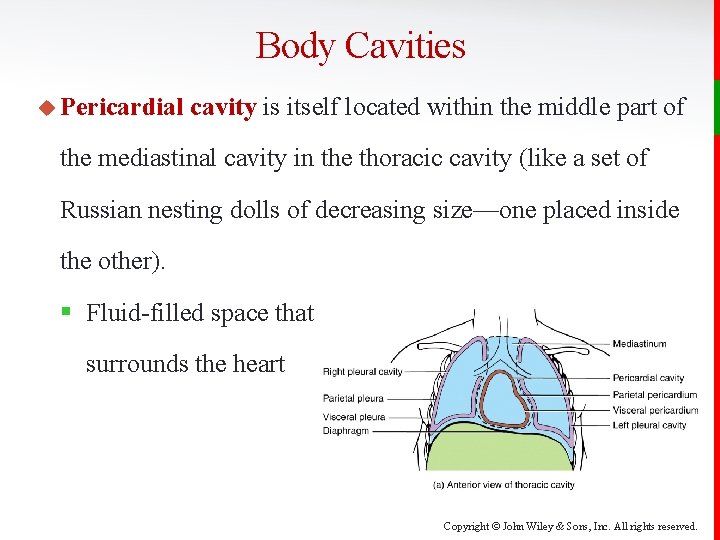
Body Cavities u Pericardial cavity is itself located within the middle part of the mediastinal cavity in the thoracic cavity (like a set of Russian nesting dolls of decreasing size—one placed inside the other). § Fluid-filled space that surrounds the heart Copyright © John Wiley & Sons, Inc. All rights reserved.
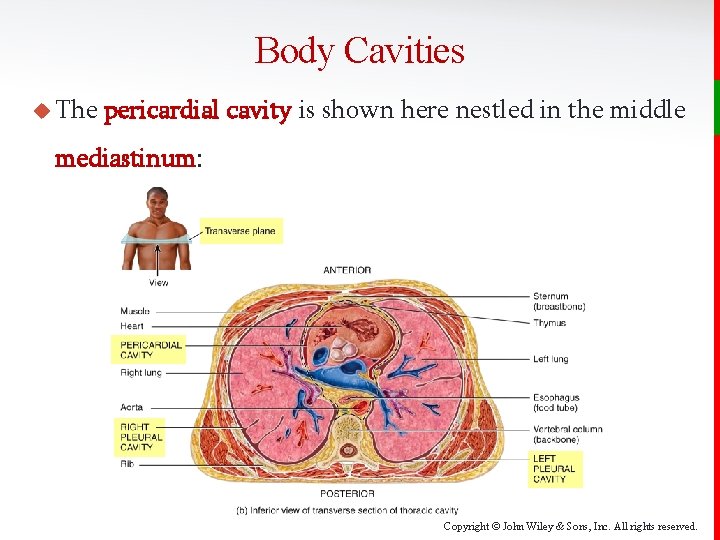
Body Cavities u The pericardial cavity is shown here nestled in the middle mediastinum: Copyright © John Wiley & Sons, Inc. All rights reserved.
Body Cavities u Abdominopelvic Cavity extends from the diaphragm to the groin and is encircled by the abdominal wall and bones and muscles of the pelvis. § Divided into two portions: • Abdominal cavity contains the stomach, spleen, liver, gallbladder, small and large intestines. • Pelvic cavity contains the urinary bladder, internal organs of reproductive system, and portions of the large intestine. Copyright © John Wiley & Sons, Inc. All rights reserved.
Abdominopelvic Quadrants & Regions Copyright © John Wiley & Sons, Inc. All rights reserved.
Body Cavities u Other body cavities § Oral (mouth) cavity contains the tongue and teeth. § Nasal cavity is part of the upper airways § Orbital cavities contain the eyeballs and various nerves and blood vessels. § Middle ear cavities contain the small bones of the middle ear. § Synovial cavities are found in freely moveable joints like the large joints of the shoulder and hip. Copyright © John Wiley & Sons, Inc. All rights reserved.
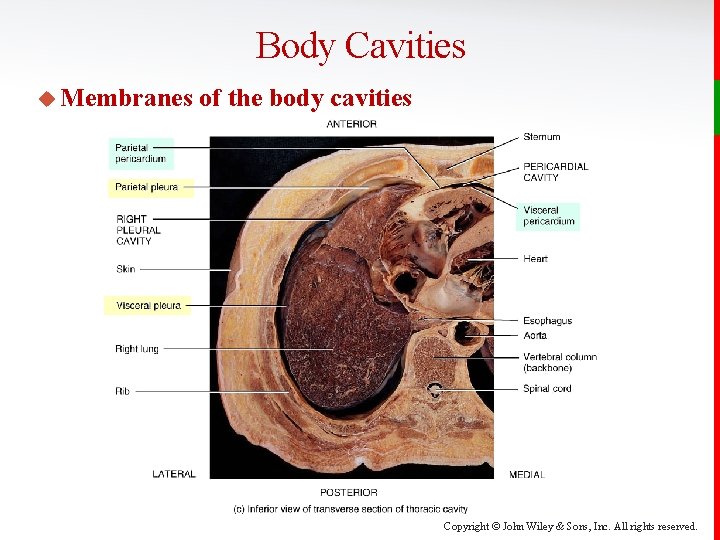
Body Cavities u Membranes of the body cavities § The thoracic and abdominal body cavities are lined by thin, slippery, double-layered membranes called serous membranes. § These membranes adhere to the outer surface of the organs or “viscera”, and then double-back on themselves to line the body cavity wall. • Visceral layer covers the organs within the cavities • Parietal layer lines the cavity walls Copyright © John Wiley & Sons, Inc. All rights reserved.
Body Cavities u Membranes of the body cavities § The right and left pleural membranes are the serous membranes that covers the lungs (visceral pleura) and the walls of the pleural cavity (parietal pleura). § The pericardial membrane is the serous membrane that covers the heart (visceral pericardium) and the pericardial cavity walls (parietal pericardium). § The peritoneal membrane is the serous membrane that covers the abdominal organs (visceral peritoneum) and the abdominal cavity walls (parietal peritoneum). Copyright © John Wiley & Sons, Inc. All rights reserved.
Body Cavities u Membranes of the body cavities Copyright © John Wiley & Sons, Inc. All rights reserved.
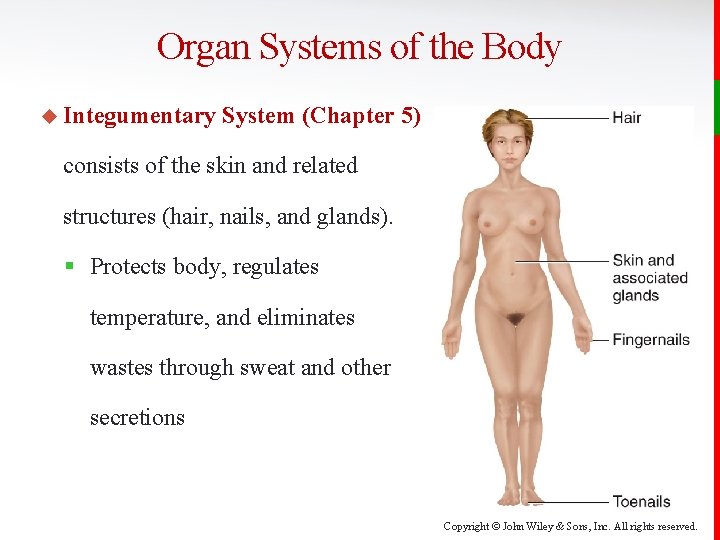
Organ Systems of the Body u Integumentary System (Chapter 5) consists of the skin and related structures (hair, nails, and glands). § Protects body, regulates temperature, and eliminates wastes through sweat and other secretions Copyright © John Wiley & Sons, Inc. All rights reserved.
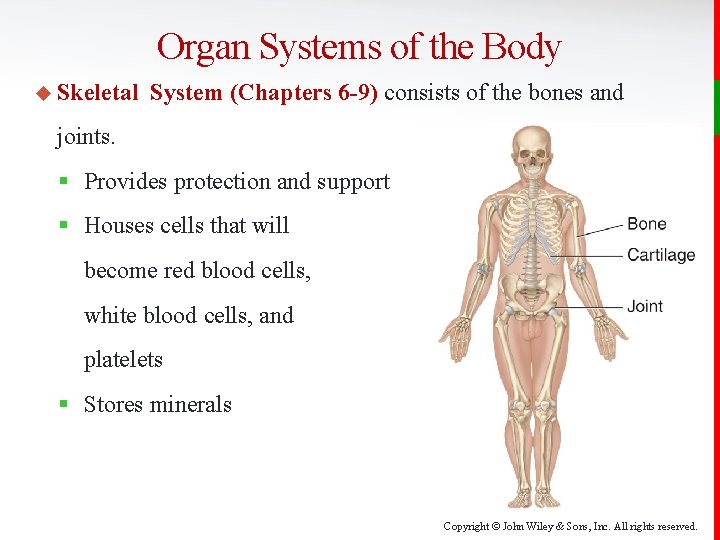
Organ Systems of the Body u Skeletal System (Chapters 6 -9) consists of the bones and joints. § Provides protection and support § Houses cells that will become red blood cells, white blood cells, and platelets § Stores minerals Copyright © John Wiley & Sons, Inc. All rights reserved.
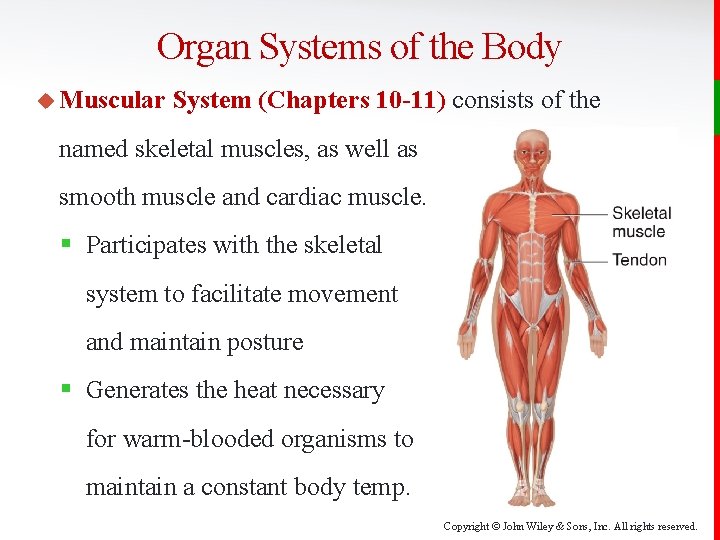
Organ Systems of the Body u Muscular System (Chapters 10 -11) consists of the named skeletal muscles, as well as smooth muscle and cardiac muscle. § Participates with the skeletal system to facilitate movement and maintain posture § Generates the heat necessary for warm-blooded organisms to maintain a constant body temp. Copyright © John Wiley & Sons, Inc. All rights reserved.
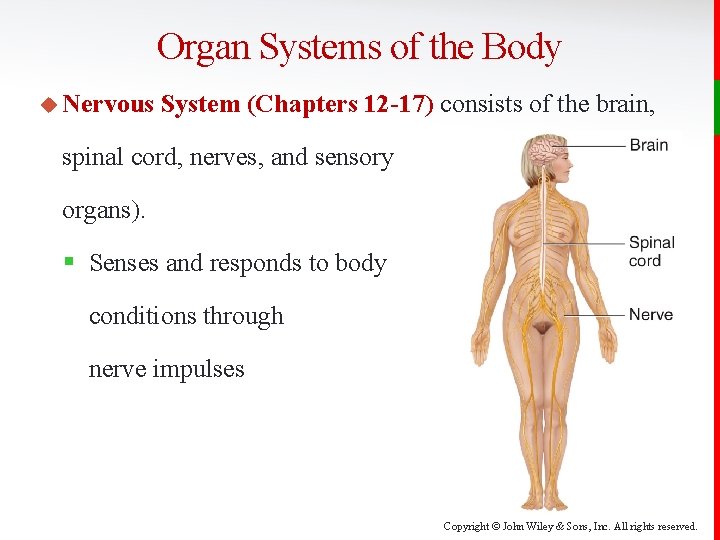
Organ Systems of the Body u Nervous System (Chapters 12 -17) consists of the brain, spinal cord, nerves, and sensory organs). § Senses and responds to body conditions through nerve impulses Copyright © John Wiley & Sons, Inc. All rights reserved.
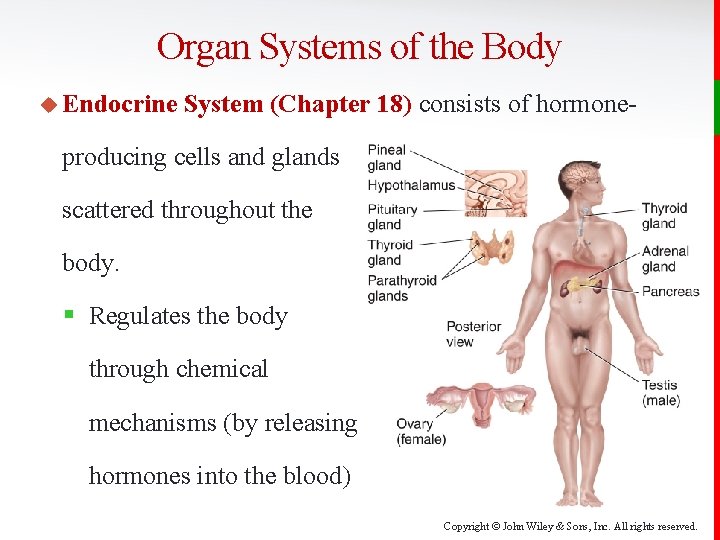
Organ Systems of the Body u Endocrine System (Chapter 18) consists of hormone- producing cells and glands scattered throughout the body. § Regulates the body through chemical mechanisms (by releasing hormones into the blood) Copyright © John Wiley & Sons, Inc. All rights reserved.
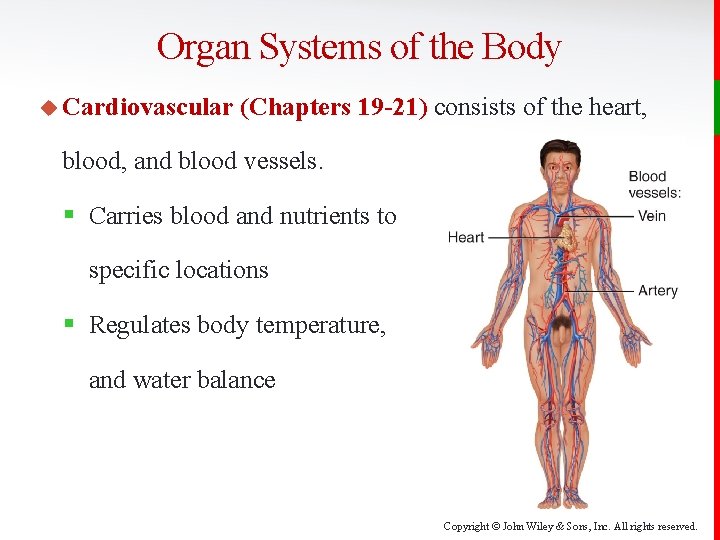
Organ Systems of the Body u Cardiovascular (Chapters 19 -21) consists of the heart, blood, and blood vessels. § Carries blood and nutrients to specific locations § Regulates body temperature, and water balance Copyright © John Wiley & Sons, Inc. All rights reserved.
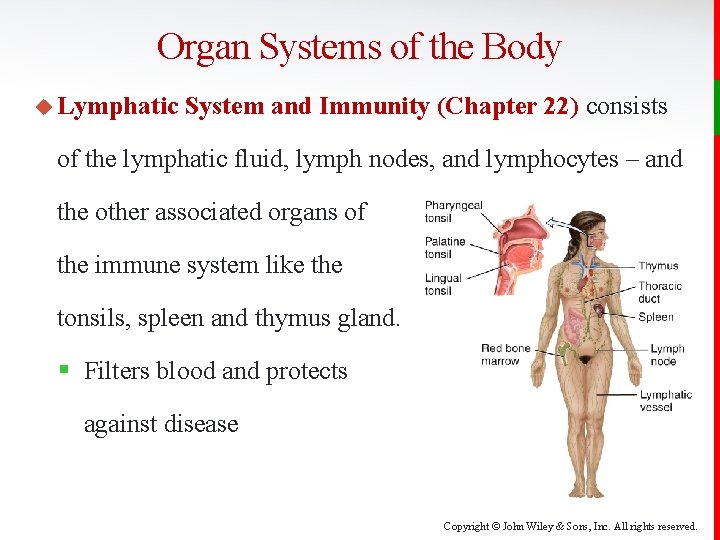
Organ Systems of the Body u Lymphatic System and Immunity (Chapter 22) consists of the lymphatic fluid, lymph nodes, and lymphocytes – and the other associated organs of the immune system like the tonsils, spleen and thymus gland. § Filters blood and protects against disease Copyright © John Wiley & Sons, Inc. All rights reserved.
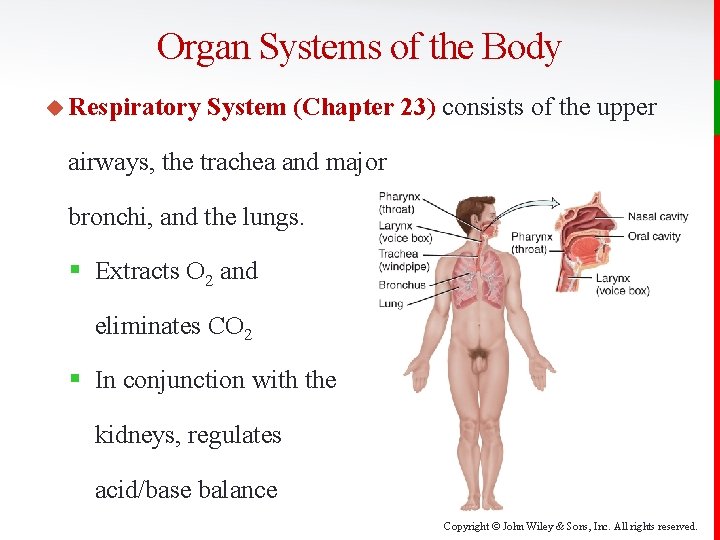
Organ Systems of the Body u Respiratory System (Chapter 23) consists of the upper airways, the trachea and major bronchi, and the lungs. § Extracts O 2 and eliminates CO 2 § In conjunction with the kidneys, regulates acid/base balance Copyright © John Wiley & Sons, Inc. All rights reserved.
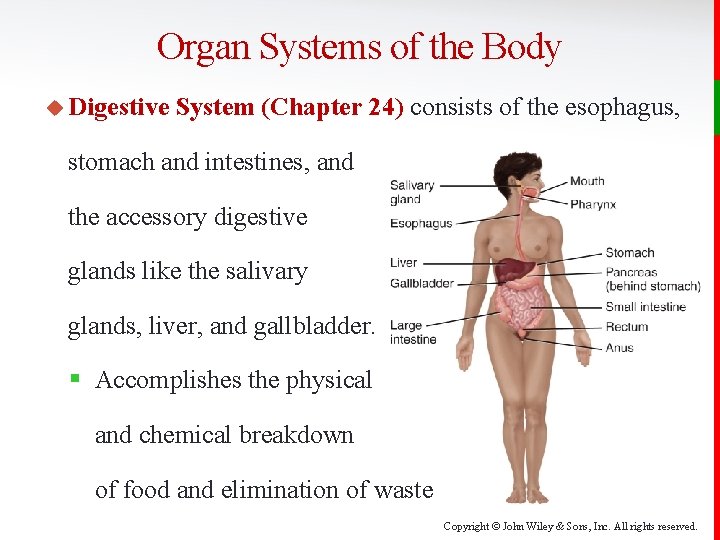
Organ Systems of the Body u Digestive System (Chapter 24) consists of the esophagus, stomach and intestines, and the accessory digestive glands like the salivary glands, liver, and gallbladder. § Accomplishes the physical and chemical breakdown of food and elimination of waste Copyright © John Wiley & Sons, Inc. All rights reserved.
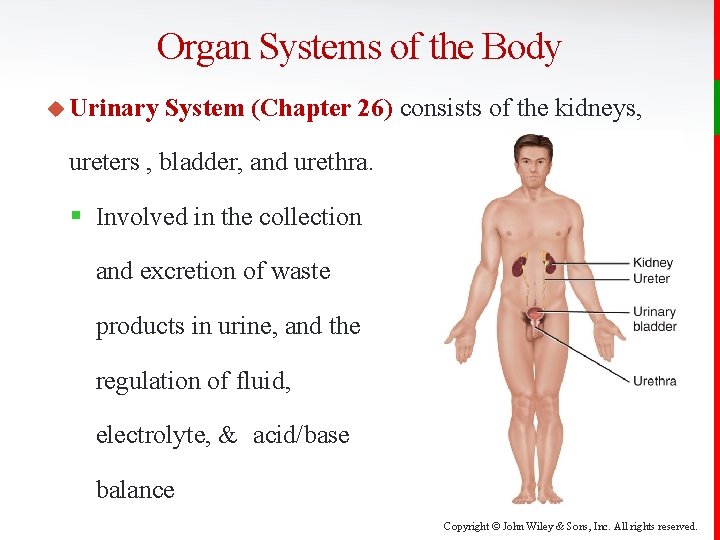
Organ Systems of the Body u Urinary System (Chapter 26) consists of the kidneys, ureters , bladder, and urethra. § Involved in the collection and excretion of waste products in urine, and the regulation of fluid, electrolyte, & acid/base balance Copyright © John Wiley & Sons, Inc. All rights reserved.
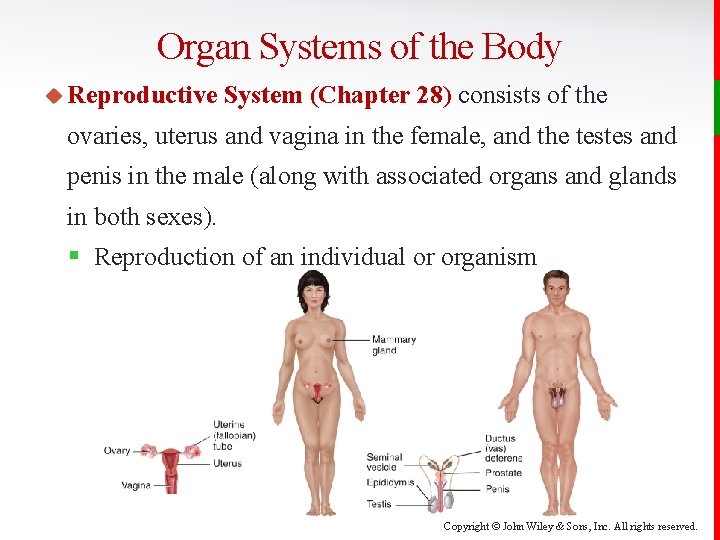
Organ Systems of the Body u Reproductive System (Chapter 28) consists of the ovaries, uterus and vagina in the female, and the testes and penis in the male (along with associated organs and glands in both sexes). § Reproduction of an individual or organism Copyright © John Wiley & Sons, Inc. All rights reserved.
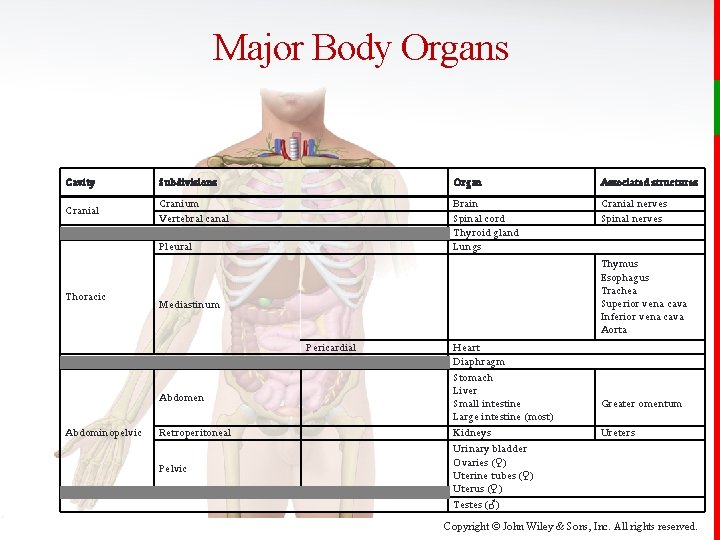
Major Body Organs Cavity Subdivisions Organ Associated structures Cranial Cranium Vertebral canal Brain Spinal cord Thyroid gland Lungs Cranial nerves Spinal nerves Pleural Thoracic Thymus Esophagus Trachea Superior vena cava Inferior vena cava Aorta Mediastinum Pericardial Abdomen Abdominopelvic Retroperitoneal Pelvic Heart Diaphragm Stomach Liver Small intestine Large intestine (most) Kidneys Urinary bladder Ovaries (♀) Uterine tubes (♀) Uterus (♀) Testes (♂) Greater omentum Ureters Copyright © John Wiley & Sons, Inc. All rights reserved.
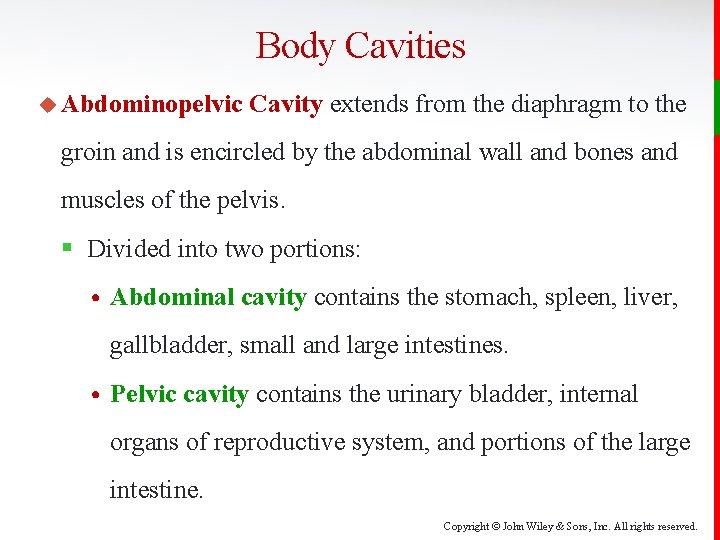
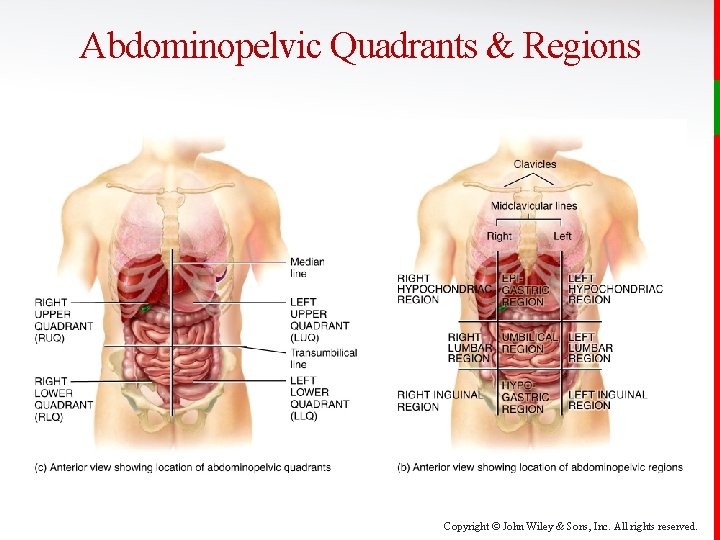
Abdominopelvic Quadrants & Regions u Identification of quadrants and regions in the abdominopelvic cavity helps clinicians describe the location of the many abdominal and pelvic organs. u There are 4 abdominopelvic quadrants and 9 regions. § The dividing lines between these are centered on the umbilicus (“belly button”). Copyright © John Wiley & Sons, Inc. All rights reserved.
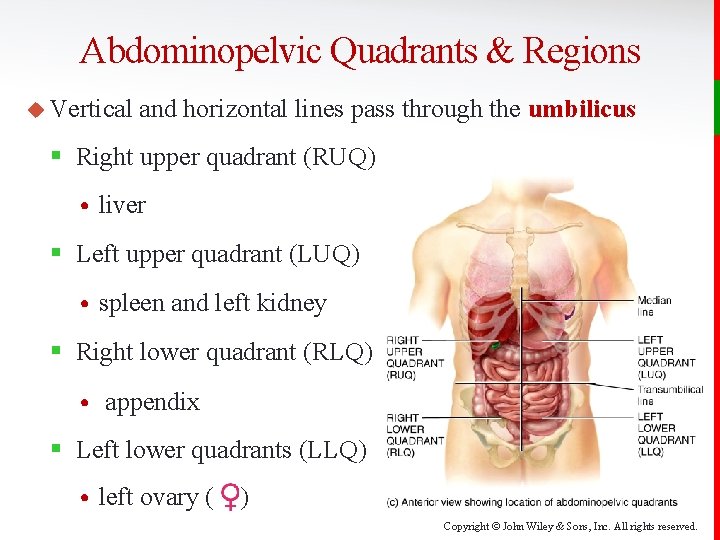
Abdominopelvic Quadrants & Regions u Vertical and horizontal lines pass through the umbilicus § Right upper quadrant (RUQ) • liver § Left upper quadrant (LUQ) • spleen and left kidney § Right lower quadrant (RLQ) • appendix § Left lower quadrants (LLQ) • left ovary ( ) Copyright © John Wiley & Sons, Inc. All rights reserved.
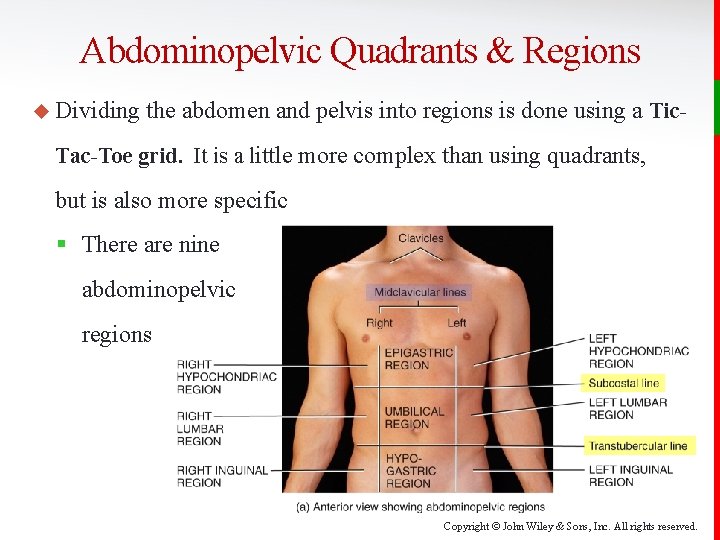
Abdominopelvic Quadrants & Regions u Dividing the abdomen and pelvis into regions is done using a Tic- Tac-Toe grid. It is a little more complex than using quadrants, but is also more specific § There are nine abdominopelvic regions Copyright © John Wiley & Sons, Inc. All rights reserved.
Medical Imaging u Techniques and procedures used to create images of the human body § Allow visualization of structures inside the body § Diagnosis of anatomical and physiological disorders § Conventional radiography (X-rays) have been in use since the late 1940’s Copyright © John Wiley & Sons, Inc. All rights reserved.
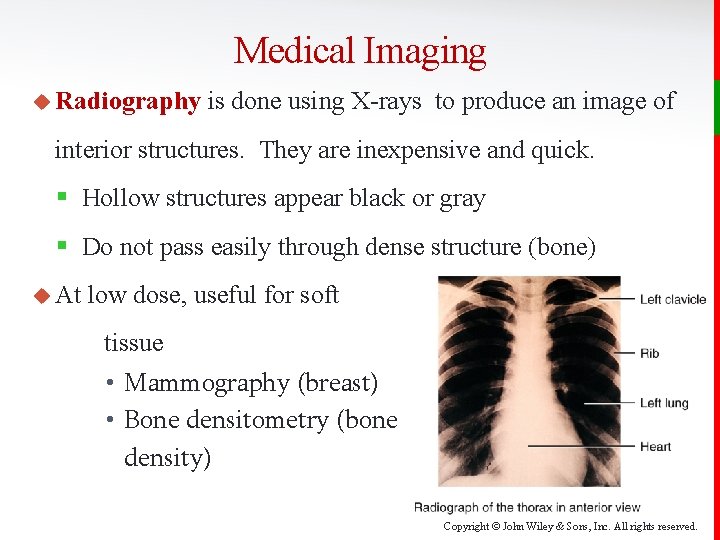
Medical Imaging u Radiography is done using X-rays to produce an image of interior structures. They are inexpensive and quick. § Hollow structures appear black or gray § Do not pass easily through dense structure (bone) u At low dose, useful for soft tissue • Mammography (breast) • Bone densitometry (bone density) Copyright © John Wiley & Sons, Inc. All rights reserved.
Medical Imaging u Magnetic Resonance Imaging (MRI) is done using an extremely powerful magnetic field. It is a safe procedure but cannot be used on patients containing metal. § Protons in body fluid align with field § Used for differentiating normal and abnormal tissues (tumors, brain abnormalities, blood flow) § 2 D and 3 D color images can be viewed on a video monitor. Copyright © John Wiley & Sons, Inc. All rights reserved.
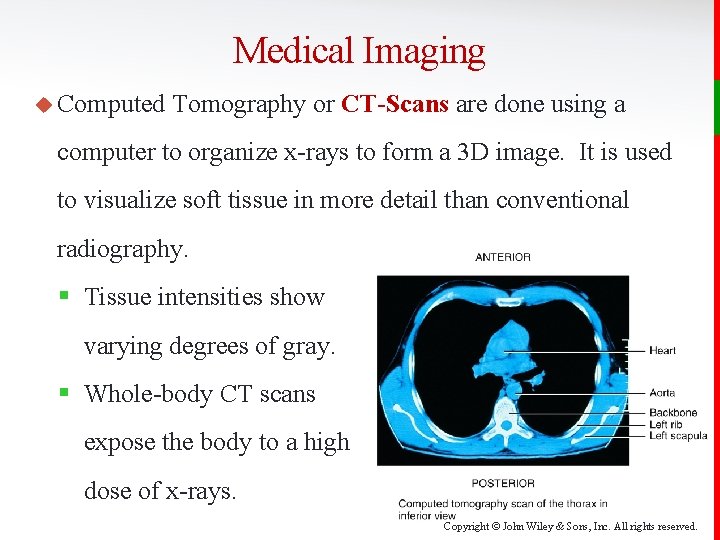
Medical Imaging u Computed Tomography or CT-Scans are done using a computer to organize x-rays to form a 3 D image. It is used to visualize soft tissue in more detail than conventional radiography. § Tissue intensities show varying degrees of gray. § Whole-body CT scans expose the body to a high dose of x-rays. Copyright © John Wiley & Sons, Inc. All rights reserved.
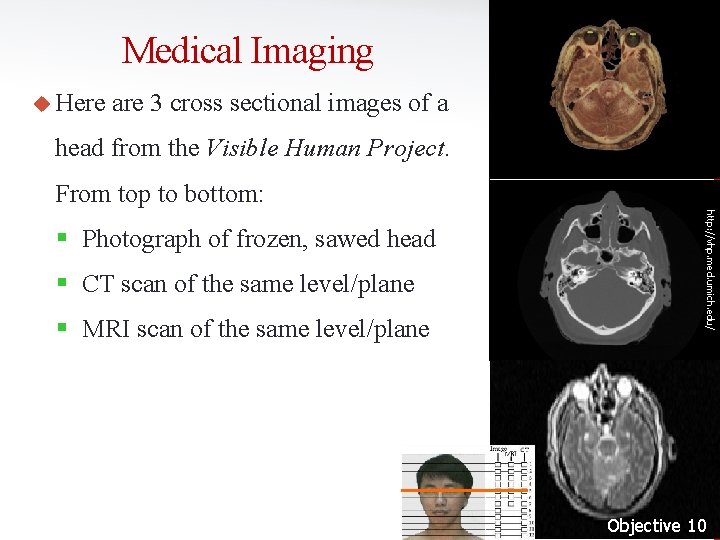
Medical Imaging u Here are 3 cross sectional images of a head from the Visible Human Project. From top to bottom: http: //vhp. med. umich. edu/ § Photograph of frozen, sawed head § CT scan of the same level/plane § MRI scan of the same level/plane Objective 10 Copyright © John Wiley & Sons, Inc. All rights reserved.
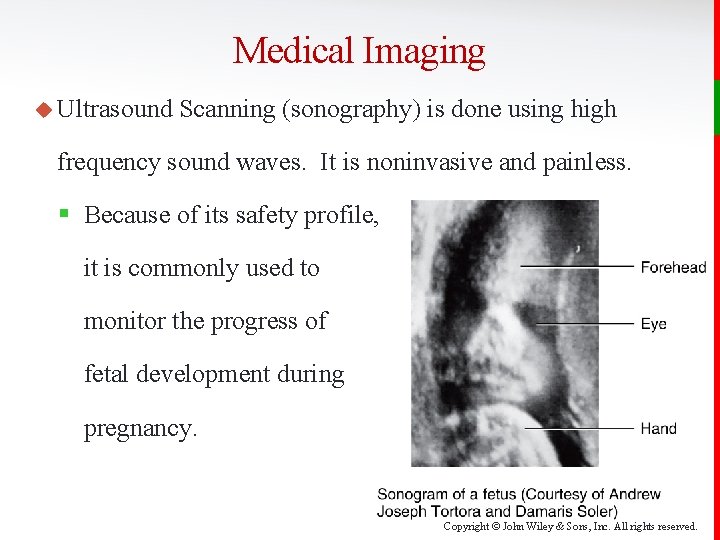
Medical Imaging u Ultrasound Scanning (sonography) is done using high frequency sound waves. It is noninvasive and painless. § Because of its safety profile, it is commonly used to monitor the progress of fetal development during pregnancy. Copyright © John Wiley & Sons, Inc. All rights reserved.
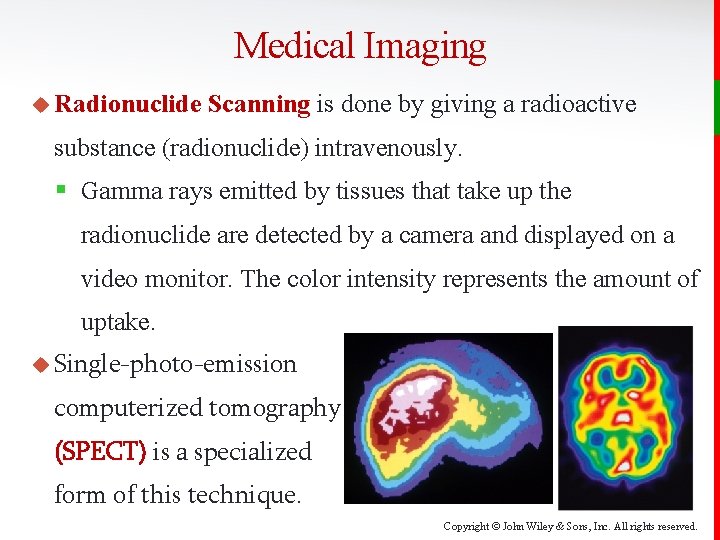
Medical Imaging u Radionuclide Scanning is done by giving a radioactive substance (radionuclide) intravenously. § Gamma rays emitted by tissues that take up the radionuclide are detected by a camera and displayed on a video monitor. The color intensity represents the amount of uptake. u Single-photo-emission computerized tomography (SPECT) is a specialized form of this technique. Copyright © John Wiley & Sons, Inc. All rights reserved.
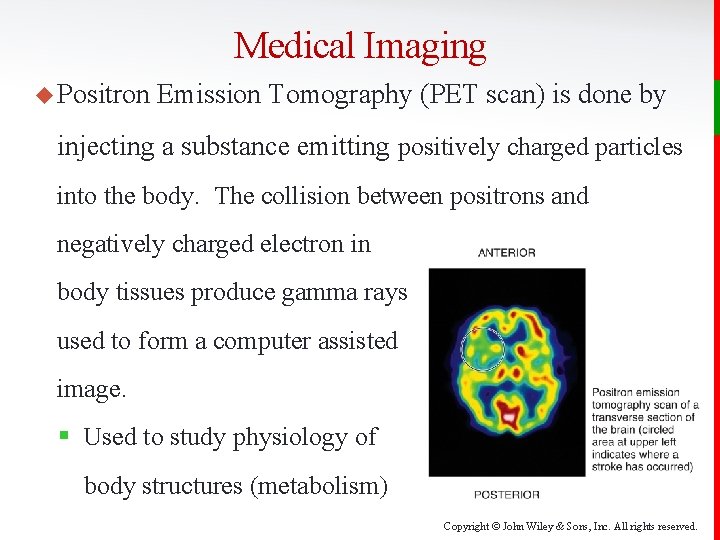
Medical Imaging u Positron Emission Tomography (PET scan) is done by injecting a substance emitting positively charged particles into the body. The collision between positrons and negatively charged electron in body tissues produce gamma rays used to form a computer assisted image. § Used to study physiology of body structures (metabolism) Copyright © John Wiley & Sons, Inc. All rights reserved.
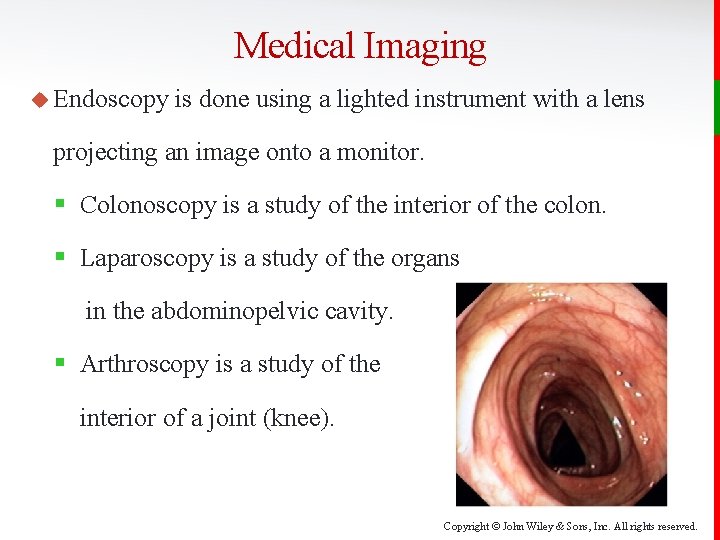
Medical Imaging u Endoscopy is done using a lighted instrument with a lens projecting an image onto a monitor. § Colonoscopy is a study of the interior of the colon. § Laparoscopy is a study of the organs in the abdominopelvic cavity. § Arthroscopy is a study of the interior of a joint (knee). Copyright © John Wiley & Sons, Inc. All rights reserved.
Clinical Connection u Noninvasive Diagnostic Techniques are used to inspect different aspects of the body: § Is often done to access structure and function and to search for the presence of disease. • Palpation is gently touching body surfaces with hands. • Auscultation is listening to body sounds (stethoscope). • Percussion is tapping on the body surface with fingertips and listening to echoes. Copyright © John Wiley & Sons, Inc. All rights reserved.
- Slides: 77