
Chapter 1 An Introduction to Crime Scene Investigation

- Slides: 43
Chapter 1 An Introduction to Crime Scene Investigation
Learning Objectives • • • Understand the definition of crime scene investigation Understand the objectives of CSI Understand the types of evidence Understand the value of physical evidence Define the scientific crime method Know how to establish a proper chain of custody
Common Terminology • Investigate: make a systematic examination or to conduct an official inquiry • Crime: act or commission of an act that is forbidden by a public law and that makes the offender liable tp punishment by that law • Crime Scene Investigation (CSI): process associated with the investigation of a criminal event, which involves a systematic process of documenting, collecting, preserving and interpreting physical evidence.
Common Terminology (continued) • Trier of fact: the determination of guilt or innocence left up to the judge/magistrate or jury of peers • Criminalistics: the analysis of physical evidence • Important to note that criminalistics and CSI are not the same
Who is Responsible? • The first tier of the investigation process is the first responder • First responder: typically the police officer who is dispatched to the initial scene • The duty of the first responder is to secure the scene and begin securing and preserving the physical evidence
Who is Responsible? (continued) • The second tier of the investigation process is the detective/investigator • This is a specialized police officer with significant experience in investigations • The detective process information given to him/her and determines if there needs to be any additional investigation. He/she will also collect testimonial evidence
Who is Responsible? (continued) • The third tier of the investigation process is the crime scene investigator/crime scene technician • The CSI has advanced training in documentation, collection, and preservation of physical evidence • The CSI processes the scene and transports the evidence into booking
Who is Responsible? (continued) • The fourth tier involved in the investigation process is the criminalist • Responsibilities of the criminalist include: analyze and interpret the evidence using the latest scientific instrumentation • The courts are considered the fifth tier of the investigation process • This process involves the prosecution, defense, judge/magistrate and jury in determining if enough evidence was presented to show that a crime was committed
Objectives of Crime Scene Investigation • Determine whether a crime has been committed • Discovery and documentation of all facts • Identify and eliminate suspects by collecting physical and testimonial evidence • Locate and apprehend the perpetrator • Maintain a proper chain of custody • Effectively testify as a witness
What is a Crime Scene? • Crime Scene: anywhere that evidence may be located that will help explain the events; location at which the crime was committed • Primary scene: the first scene where evidence is located • Secondary scene: any subsequent scenes to the primary • Every crime scene is unique and dynamic
Types of Evidence • Testimonial evidence: vocal statements that most commonly are made by a person who is under oath • Examples: witness statements, victim statements, & spontaneous utterance by suspects • It is important to note that all testimonial evidence is considered to be a lie until corroborated by other physical evidence or testimonial evidence • Real or physical evidence: any type of evidence with an objective existence, that is, anything with size, shape and dimension
Types of Evidence (continued) • Examples: Gases, fingerprints, glass, paint, hair, blood, soil and drugs • Direct evidence: proves a fact without the necessity of an inference or a presumption • Circumstantial evidence: involves a series of facts, that although not the fact at issue, tend, through inference, to prove a fact at issue • Direct or circumstantial evidence can be involved with either testimonial or physical evidence
Value of Physical Evidence • It can prove that a crime has been committed or establish key elements of a crime • It can establish the identity of persons associated with the crime • It can place the suspect in contact with the victim or with the crime scene • It can exonerate the innocent • It can corroborate the victims testimony • Court decisions have made physical evidence more important • Juries expect physical evidence
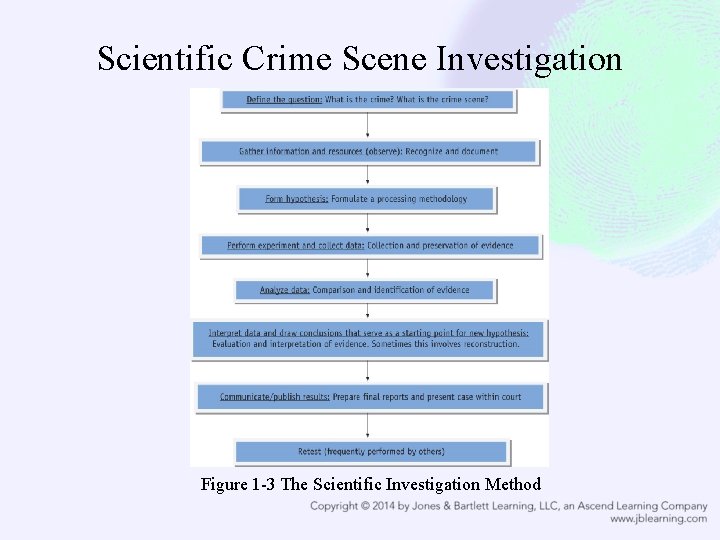
Scientific Crime Scene Investigation Figure 1 -3 The Scientific Investigation Method
Collection and Preservation of Physical Evidence • If the evidence is found to be illegally collected then it will be inadmissible in court. (Fruit of the Poisonous Tree Doctrine) • All evidence must be collected, handled and stored in a way that will ensure its integrity. • Items should be packaged separately • Known or control samples are needed • Paper is preferred packaging material • Sealable/airtight containers are necessary • Avoid contamination
What and How Much to Collect? • A crime scene investigator must ensure that all necessary evidence has been collected. “More is better than less” • Crime scene personnel should consider the proper collection method that will ensure the proper amount of evidence has been collected, which will result in the least amount of storage-related issues • Example: king sized mattress at a homicide scene
Chain of Custody • Chain of custody: shows who had contact with the evidence, at what time, under what circumstances, and what changes • What is needed to establish a chain of custody? • Name/initials of the individual collecting the evidence • Dates the item was collected and transferred • Agency, case number, and type of crime • Brief description of the item • Evidence must be properly booked and stored as well
Teamwork • Successful CSI involves a team approach • Crime scene team: group of professionals, each trained in specific disciplines • The common goal of the team is to locate and document all of the associated evidence at the scene • Teamwork is important because no one person can operate independently at a crime scene • Training for each member is mandatory • A successful investigation includes a well-trained, experienced and cohesive unit
Attributes of a Successful Crime Scene Investigator • • Intuition Eye for detail Good communication skills Knowledge of methods for location and preserving evidence • Enjoyment of continuing education
Mistakes and Errors • Mistakes will be made, but need to be limited • Learn from these mistakes and do not repeat them • It is important to adopt a systematic approach to crime scene processing to help minimize errors • Defense attorneys will do what they can to show that the initial handling of physical evidence was faulty • The best thing to do is consider all ramifications before embarking on any action
Chapter 2 The CSI Effect
Learning Objectives • Understand the “CSI effect” • Know how to overcome the CSI effect
Birth of a problem • • • 1950’s: Perry Mason (U. S. court systems) 1976 -1983: Quincy of M. E. (forensic pathology) 2000’s: CSI (physical evidence) CSI aired on October 6, 2000 Forensic Files aired in October 2001 CSI is currently the most influential TV show in the world and portrays “infotainment” • Infotainment: a highly stylized, edited and formatted form of entertainment that is disguised as informative or realistic, but in fact is not scientifically correct
The CSI Effect • CSI effect: phenomenon whereby forensic drama television has created unreasonable expectations in many areas of forensic science • CSI programs lead to a singular correct answer • Reality: Forensic conclusions are only as good as the technicians who retrieve the evidence, test it, and draw conclusions from it • CSI programs show no concerns of human error • Reality: Numerous professionals have lied under oath, faked their credentials and fabricated evidence
Impact of the CSI Effect • Population believes TV shows are realistic • Prosecutors say that juries expect scientific evidence in every case • In reality, not all criminal cases call for such evidence • Defense uses this to their advantage, they suggest that fingerprints or DNA should have been presented, creating controversy that it was an incomplete investigation
Impact of CSI Effect (continued) • CSI effect has some positive impacts, including: an increase in the publics awareness of forensics, and increased funding resources • It has also created a profound interest in forensic science and crime scene work • Jurors have a better knowledge of what a crime scene technician does, and are able to understand follow expert witness testimony better
Impact on Law Enforcement • Police departments and crime labs have spent much of their annual budgets to acquire modern technology and training • Thousands of dollars being spent on DNA technology or trace evidence collection • Fingerprint or footwear evidence is being overlooked • Departments believe they need to improve their forensic capabilities • There is more collection and booking of evidence
Impact on Crime Labs • Quantity of evidence being sent to the labs is increasing at an enormous rate • Police expect miracles from crime labs • Police are now sending more samples to be analyzed • As samples increase, so does the backlog of the crime lab • For example, in the crime lab in Westchester, NY, handles nearly 1, 000 DNA tests, which is up from 400 just five years ago
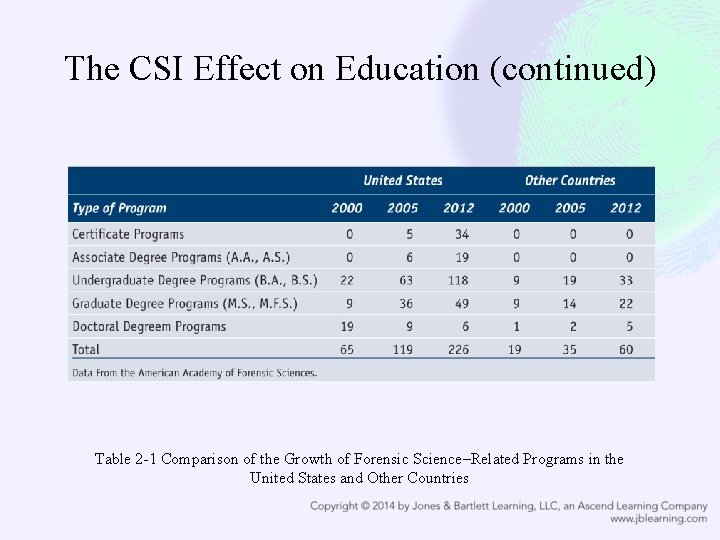
The CSI Effect on Education (continued) Table 2 -1 Comparison of the Growth of Forensic Science–Related Programs in the United States and Other Countries
Influence on the Criminal Mind • The CSI effect may be altering how crimes are committed • Increases in criminal cases in which suspects burn or tamper with evidence • Ex: using bleach to destroy DNA evidence in attempt to carefully clean the crime scene of trace evidence • Certain viewers use these shows as a training ground on how to cover up their own tracks • Case example: Jermaine “Maniac” Mc. Kinney, Ohio
Overcoming the CSI Myths • Myth: crime labs do not lie • Reality: there are sample degrades, tests are inconclusive, and lab technicians make mistakes • Myth: some of the science is state-of-the-art and can only be performed by real lab technicians • Reality: many techniques on the shows do not exist conceptually, meaning they have not been invented • One forensic scientist estimates that 40% of the socalled “science” on CSI does not exist
Overcoming the CSI Myths • Crimes do not take an hour to solve, especially homicides • Myth: a forensic scientist is a combination of a police officer, crime investigator, and forensic scientist • Reality: different professionals fulfill each role • Should crime drama shows issue a type of warning at the beginning of each episode, stating that some of the technology used in the program is fictional?
Chapter 3 Ethics in Crime Scene Investigation
Learning Objectives • Define and apply ethics in crime scene investigation • Understand the ethical concerns governing retention and disposition of crime scene artifact • Define and distinguish between an expert witness and a lay witness • Understand research unethical practices involving crime scene work and forensic analysis
What are Ethics? • A crime scene investigator must not only do technical things correctly, they must do ethically correct things • Ethics: the study of moral standards and how they affect conduct • Greek word ethos: emphasizes the perfection of the individual and the community in which he or she is defined • Ethics are usually codified by a group of people or organization • Ethics are internally defined and self-imposed
What are Ethics? (continued) • Do not confuse ethics with values or morals • Values: beliefs of an individual or group, for or against something in which there is some emotional investment • Typically values are the rules by which an individual or group makes decisions as to what is right or next • Morals: relate to how individuals should behave, but can be determined from personal conscience and/or common standards of justice to do good
Revisiting the Basics • • Ethics is about right and wrong Ethics is about virtue and vice Ethics is about benefit and harm Ethics is simply about the “fixed, universal rules of right conduct that are contingent on neither time nor culture nor circumstance • Ethics is also about character, “the traits, qualities, and established reputation that define who one is and what one stands for in the eyes of others” • Lastly, it is “an established pattern of conduct worthy of emulation
Ethics Involves What? • Ethics is the way values are practiced • It is both a process of inquiry (deciding how to decide) and a code of conduct • Code of conduct: a set of standards governing behavior • Critical thinking: the conscious use of reason • When dealing with ethics, “the well-being of someone or something beyond ourselves is always at stake”
The Road to Unethical Behavior • “Traversing down the slippery slope” • Ways to minimize the instances of corruption are included in five steps for any department 1. Ensure thorough background investigations of all employees 2. Ensure a high-quality field training program for new crime scene investigators 3. Ensure consistent and fair accountability for employee actions 4. Conduct effective ethics training 5. Implement an effective employee intervention process
Ethics in Crime Scene Investigation • Majority of forensic specialists realize that is its illegal to remove objects from a crime scene without proper authorization • Crime scene investigators and officers must maintain the spirit of the law as well as the letter of the law • Guidelines are necessary • Example: removing or selling artifacts from a crime scene • Education, training, experience, skills and opinions on technical matters are of considerable importance during a criminal investigation • Crime scene personnel may never be biased
Ethics in Crime Scene Investigation (continued) • Their obligation is to serve the aims of justice • Forensic personnel have an obligation not to overstate, or understate scientific findings • Some departments have implemented the code of ethics that all employees must sign and adhere by • The obligation to be truthful is paramount above all else • Acts of commission (intentional) and omission (unintentional) are not permitted • Crime scene investigators must remain neutral and preserve the chain of custody
Expert Witnesses • Expert witness: someone who is often called to answer questions on the stand in the court of law in order to provide specialized information relevant to the case being tried • A person can be considered an “expert” when they have sufficient skills, knowledge, or experience • The duty of the expert witness is to educate the jury and provide testimony using terminology that is easily explainable and not misunderstood • Some essential elements of an expert witness include: clarity, simplicity, and honesty
Qualifying an Expert Witness • Credentials: this refers to a certificate, letter, experience, or anything that provides authentication for a claim or qualifies somebody to do something • Hearsay: unfounded information that is heard from other people • Perjury: telling of a lie within a court of law by somebody who has taken an oath to tell the truth