
Chapter 1 An Introduction to Computers and Visual
- Slides: 53
Chapter 1 • An Introduction to Computers and Visual Basic. NET Chapter 1 - VB. NET by Schneider 1
Outline and Objectives • • • Introduction to Computers Using Windows Files and Folders An Introduction to Visual Basic. NET Biographical History of Computing Chapter 1 - VB. NET by Schneider 2
Introduction to Computers • Personal computer • Generally, a computer that is operated by one person at a time Chapter 1 - VB. NET by Schneider 3
Computer uses in Society • • Banking – customer transactions Airlines – reservations system NASA – control satellites Internet – email, research, shopping Chapter 1 - VB. NET by Schneider 4
Programs Students Will Create in This Text • Create and manage a list of friends' addresses and phone numbers • Calculate loan payments and amortization • Computations to support other course work Chapter 1 - VB. NET by Schneider 5
Communicating with the Computer • Machine language – low level, 0 and 1, hard for humans to understand • VB. NET – high level, understood by humans, consists of instructions such as Click, If, Do Chapter 1 - VB. NET by Schneider 6
Computers and Complicated Tasks • Tasks are broken down into instructions that can be expressed by a computer language • A program is a sequence of instructions • Programs can be only a few instructions or millions of lines of instructions Chapter 1 - VB. NET by Schneider 7
Servers • A server can be almost any computer • A server provides resources to other computers • Files • Internet • Printers Chapter 1 - VB. NET by Schneider 8
All Programs Have in Common: • Take data and manipulate it to produce a result • Input – Process – Output • Input – from files, the keyboard, or other input device • Output – to the monitor, printer, file, or other output device Chapter 1 - VB. NET by Schneider 9
Hardware and Software • Hardware – the physical components of a computer • Keyboard • Disk drive • Monitor • Software – The instructions that tell the computer what to do Chapter 1 - VB. NET by Schneider 10
Programmer and User • Programmer – the person who solves the problem and writes the instructions for the computer • User – any person who uses the program written by the programmer Chapter 1 - VB. NET by Schneider 11
Problem Solving • Developing the solution to a problem • Algorithm – a step by step series of instructions to solve a problem Chapter 1 - VB. NET by Schneider 12
Types of Problems in this Text • • Business computations Managing records Managing lists And more Chapter 1 - VB. NET by Schneider 13
VB. NET • BASIC developed at Dartmouth in the early 1960 s • Visual Basic created by Microsoft in 1991 • VB. NET similar to Visual Basic, but more powerful Chapter 1 - VB. NET by Schneider 14
Internet • A connection of thousands of networks around the world – each network has • A computer and one or more routers • Router is a device or computer connected to two or more networks • All use TCP/IP Chapter 1 - VB. NET by Schneider 15
World Wide Web vs. Internet • World Wide Web is a collection of information stored on servers throughout the Internet known as Web servers. • HTTP – Hyper. Text Transfer Protocol enabled researchers to share data – creating a "web" of information • Internet is used to access documents on the World Wide Web Chapter 1 - VB. NET by Schneider 16
1. 2 Using Windows Chapter 1 - VB. NET by Schneider 17
Mouse Actions: • • • Pointing Hovering Clicking Double-Clicking Dragging Chapter 1 - VB. NET by Schneider 18
Windows and Its Little Windows • Title Bar • Active window Chapter 1 - VB. NET by Schneider 19
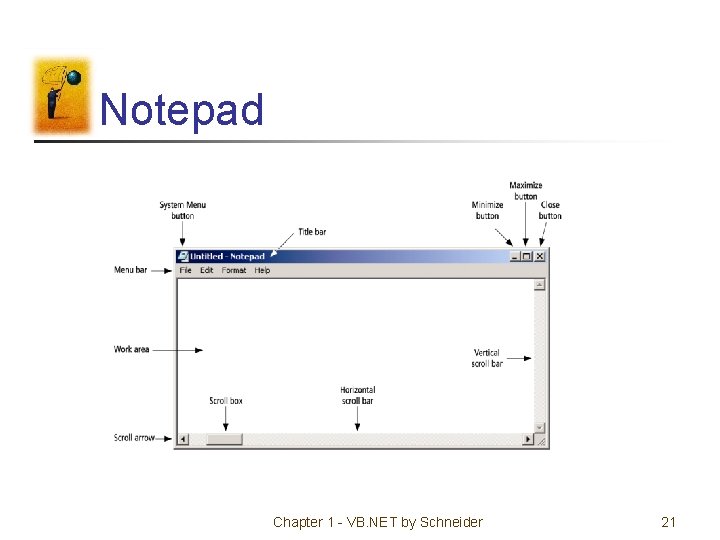
Using the Notepad • Reviewing Notepad to learn more about Windows application • Notepad is an item in the Accessories menu • Notepad can be used to create simple data files Chapter 1 - VB. NET by Schneider 20
Notepad Chapter 1 - VB. NET by Schneider 21
Parts of the Window • • Restore button Vertical scroll bar Horizontal scroll bar Menu bar Chapter 1 - VB. NET by Schneider 22
1. 3 Files & Folders: • • Disk is a permanent storage. A disk can store thousands of files. A disk drive is identified by a letter. To organize your files you have to store them in different folders (directories). Chapter 1 - VB. NET by Schneider 23
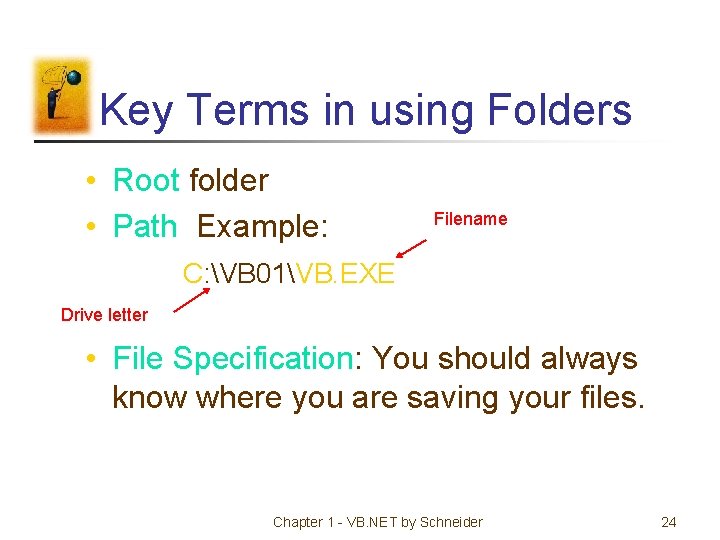
Key Terms in using Folders • Root folder • Path Example: Filename C: VB 01VB. EXE Drive letter • File Specification: You should always know where you are saving your files. Chapter 1 - VB. NET by Schneider 24
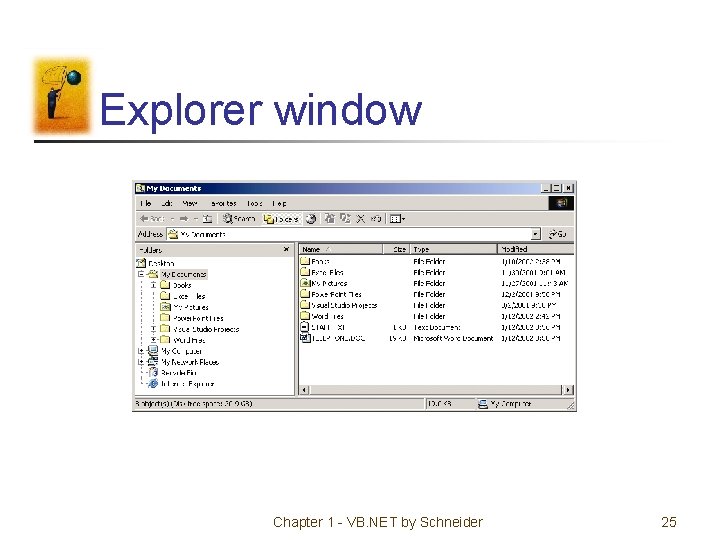
Explorer window Chapter 1 - VB. NET by Schneider 25
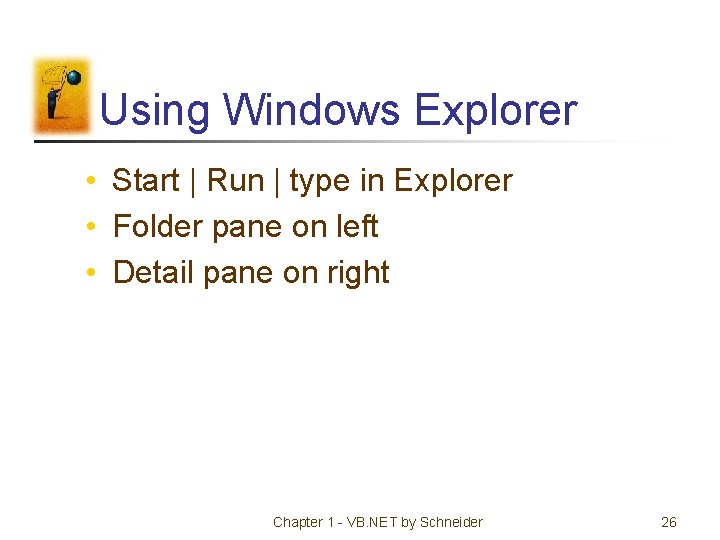
Using Windows Explorer • Start | Run | type in Explorer • Folder pane on left • Detail pane on right Chapter 1 - VB. NET by Schneider 26
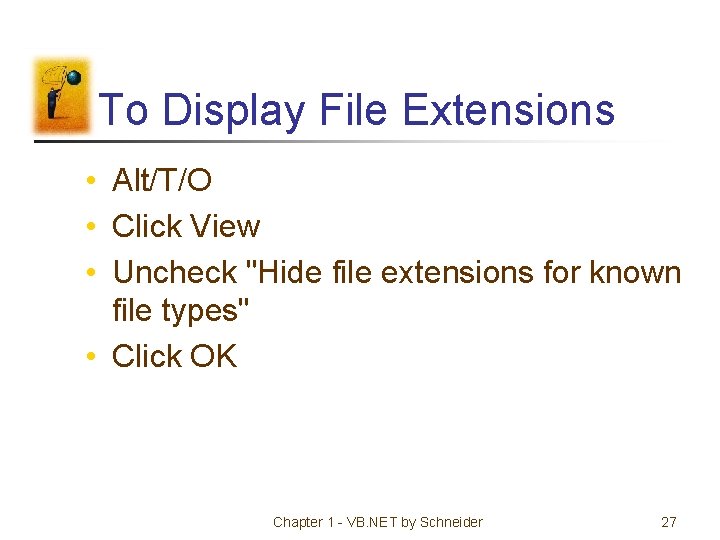
To Display File Extensions • Alt/T/O • Click View • Uncheck "Hide file extensions for known file types" • Click OK Chapter 1 - VB. NET by Schneider 27
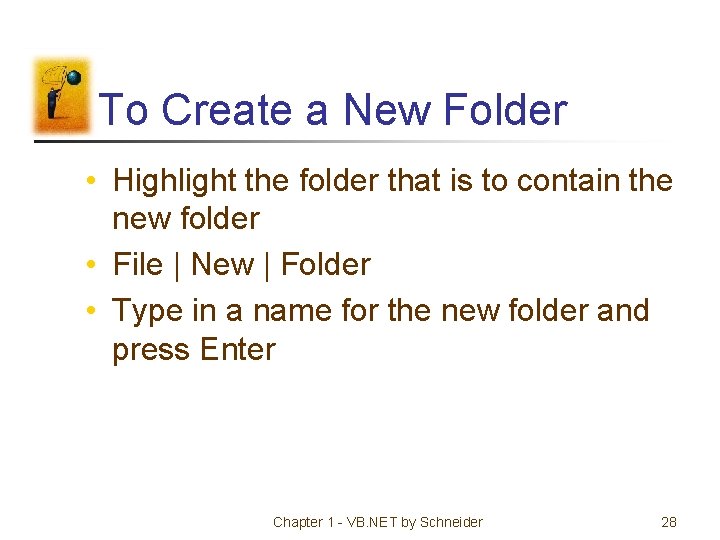
To Create a New Folder • Highlight the folder that is to contain the new folder • File | New | Folder • Type in a name for the new folder and press Enter Chapter 1 - VB. NET by Schneider 28
To Rename a Folder or File • Right click on the folder or file • Click on Rename • Type in a new name (or alter the current name) and press Enter Chapter 1 - VB. NET by Schneider 29
To Delete a Folder or File • Right click on the folder • Click on Delete • Click on Yes Chapter 1 - VB. NET by Schneider 30
To Copy a Folder or File • Right click on the folder file • Click on copy • Open the folder where the copy is to be placed • Right click on the second folder • Click on Paste Chapter 1 - VB. NET by Schneider 31
To Move a Folder or File • Right click on the folder or file • Click on Cut • Open the folder where the copy is to be moved • Click on the second folder with the right mouse button • Click on Paste Chapter 1 - VB. NET by Schneider 32
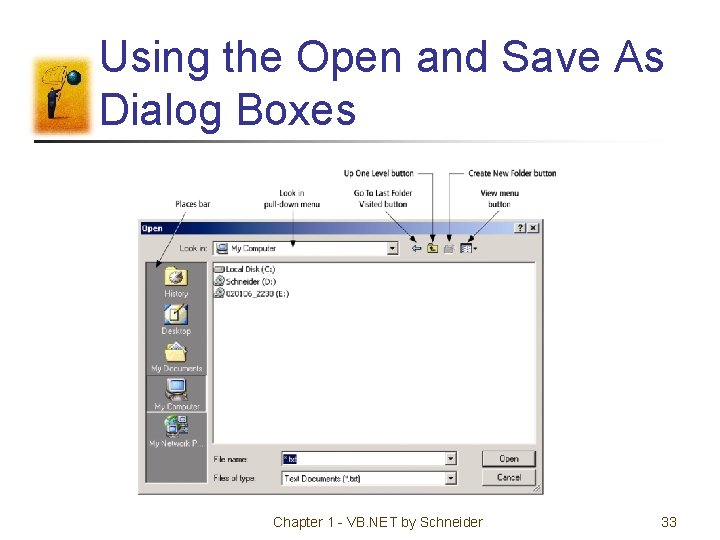
Using the Open and Save As Dialog Boxes Chapter 1 - VB. NET by Schneider 33
Read-Only Attribute • Folders and files copied from a CD or DVD onto a hard disk are read-only • To turn off the read-only • • • Right click on the file or folder Click on Properties Click on the General tab In the Attributes section, uncheck read-only Click OK button Chapter 1 - VB. NET by Schneider 34
Introduction to Visual Basic. NET: • Language used to create Windows application. • Provides a Graphical User Interface or GUI. • The sequence of instructions executed in the program is controlled by events. Chapter 1 - VB. NET by Schneider 35
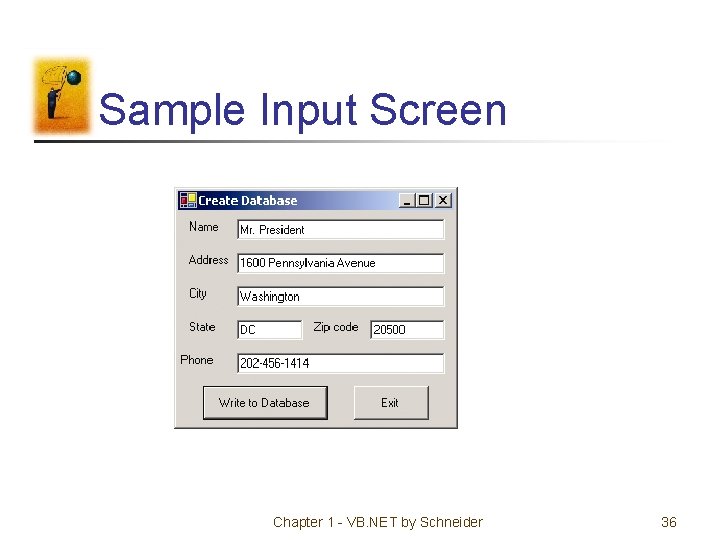
Sample Input Screen Chapter 1 - VB. NET by Schneider 36
How to Develop a VB. NET Application • Design the Interface for the user. • Determine which events the controls on the window should recognize. • Write the event procedures for those events. Chapter 1 - VB. NET by Schneider 37
Different Versions of Visual Basic • • Version 1. 0 – 1991 Version 2. 0 – 1992 Version 3. 0 – 1993 Version 4. 0 – 1995 Version 5. 0 – 1997 Version 6. 0 – 1998 VB. NET – 2002 – NOT BACKWARD COMPATIBLE WITH EARLIER VERSIONS OF VISUAL BASIC Chapter 1 - VB. NET by Schneider 38
1. 5 Biographical History of Computing Chapter 1 - VB. NET by Schneider 39
1800 s • George Boole – devised Boolean algebra • Charles Babbage – created "analytical engine" • Augusta Ada Byron – first computer programmer • Herman Hollerith – founder of company that would become IBM Chapter 1 - VB. NET by Schneider 40
1930 s • Alan Turing – deciphered German code in WWII; father of artificial intelligence • John V. Atanasoff – inventor of first electronic digital special purpose computer Chapter 1 - VB. NET by Schneider 41
1940 s • Howard Aiken – built large scale digital computer, Mark I • Grace M. Hopper – originated term "debugging"; pioneered development and use of COBOL • John Mauchley and J. Presper Eckert – built first large scale general purpose computer, ENIAC Chapter 1 - VB. NET by Schneider 42
1940 s continued • John von Neumann – developed stored program concept • Maurice V. Wilkes – built EDSAC, first computer to use stored program concept • John Bardeen, Walter Brattain, and William Shockley – developed transistor that replaced vacuum tubes Chapter 1 - VB. NET by Schneider 43
1950 s • John Backus – created Fortran; early user of interpreters and compilers • Reynold B. Johnson – invented the disk drive • Donald L. Shell – developed efficient sorting algorithm Chapter 1 - VB. NET by Schneider 44
1960 s • John G. Kemeny and Thomas E. Kurtz – invented BASIC • Corrado Bohm and Guiseppe Jacopini – proved that any program can be written with only 3 structures: sequence, decision, and loops • Edsger W. Dijkstra – stimulated move to structured programming by declaring "GOTO" harmful Chapter 1 - VB. NET by Schneider 45
1960 s continued • Harlan B. Mills – advocated use of structured programming • Donald E. Knuth – wrote definitive work on algorithms • Ted Hoff, Stan Mazer, Robert Noyce, and Frederico Faggin – developed first microporcessor Chapter 1 - VB. NET by Schneider 46
1960 s continued • Douglas Engelbart – invented computer mouse Chapter 1 - VB. NET by Schneider 47
1970 s • Ted Codd - software architect; laid the groundwork for relational databases • Paul Allen and Bill Gates - cofounders of Microsoft Corporation • Stephen Wozniak and Stephen Jobs cofounders of Apple Computer Inc. • Dan Bricklin and Dan Fylstra - wrote Visi. Calc, the first electronic spreadsheet program Chapter 1 - VB. NET by Schneider 48
1970 s continued • Dennis Ritchie - creator of the C programming language. • Ken Thompson - created the Unix operating system • Alan Kay – developer of Smalltalk, a pure object-oriented language • Don Chamberlain - created a database programming language, later known as SQL, Chapter 1 - VB. NET by Schneider 49
1980 s • Phillip “Don” Estridge - at IBM directly responsible for the success of the personal computer. • Mitchell D. Kapor - cofounder of Lotus Corporation • Tom Button - group product manager for applications programmability at Microsoft; • headed the team that developed Quick. Basic, QBasic, and Visual Basic. Chapter 1 - VB. NET by Schneider 50
1980 s continued • Alan Cooper - considered the father of Visual Basic. • Tim Berners–Lee - father of the World Wide Web. • Charles Simonyi - the “father of Word. ” • Bjarne Stroustrup - creator of the C++ programming language. • Richard M. Stallman - founded Free Software Foundation Chapter 1 - VB. NET by Schneider 51
1990 s • Marc Andreessen - inventor of the Web browser. • James Gosling – creator of Java. • Linus Torvalds - developed the popular Linux operating system. Chapter 1 - VB. NET by Schneider 52
1990 s continued • Brain Behlendorf, Rob Mc. Cool, and Roy Fielding - developers of the Apache HTTP server, an open-source Web server that can scale up quickly to handle high volumes of traffic. Chapter 1 - VB. NET by Schneider 53