
Chapter 1 An Introduction to Computer Science Learning
- Slides: 34
Chapter 1 An Introduction to Computer Science
Learning Objectives • • • Understand the definition of the term algorithm Understand the formal definition of computer science Write down everyday algorithms Determine if an algorithm is ambiguous or not effectively computable Understand the roots of modern computer science in mathematics and mechanical machines Summarize the key points in the historical development of modern electronic computers
Introduction • Common misconceptions about computer science: – Computer science is the study of computers. – Computer science is the study of how to write computer programs. – Computer science is the study of the uses and applications of computers and software.
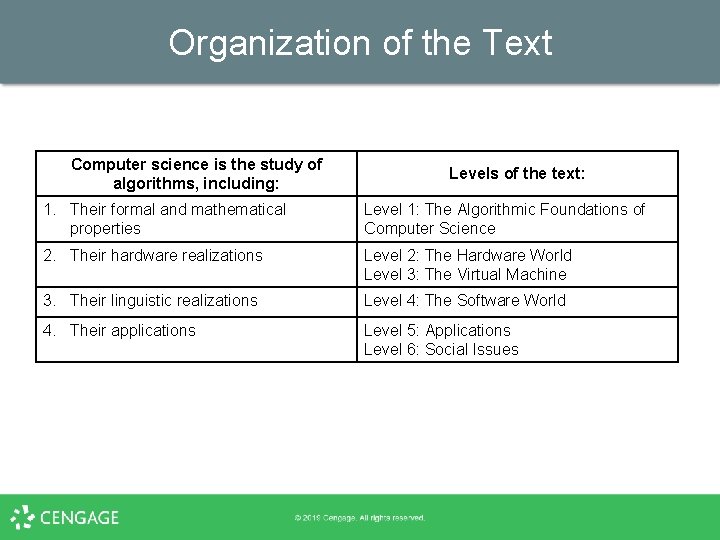
The Definition of Computer Science (1 of 4) • Computer science is the study of algorithms, including: – – Their formal and mathematical properties Their hardware realizations Their linguistic realizations Their applications
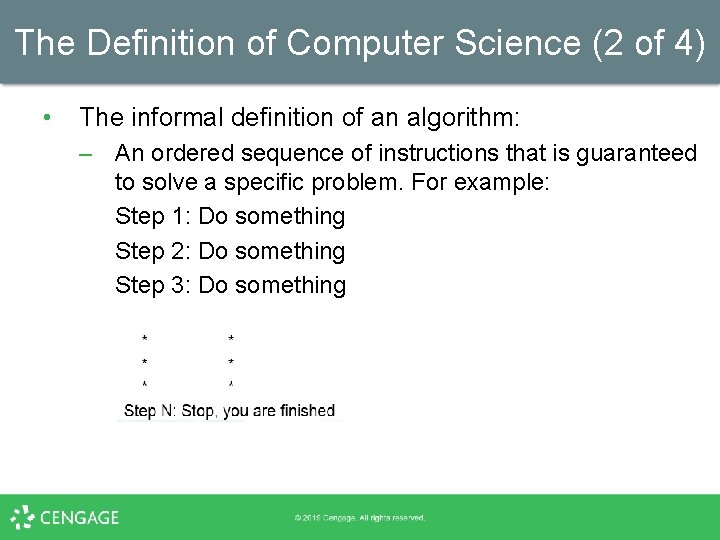
The Definition of Computer Science (2 of 4) • The informal definition of an algorithm: – An ordered sequence of instructions that is guaranteed to solve a specific problem. For example: Step 1: Do something Step 2: Do something Step 3: Do something
The Definition of Computer Science (3 of 4) • Operations used to construct algorithms: – Sequential operations § Carries out a single well-defined task – Conditional operations § Ask a question and the next operation is then selected on the basis of the answer to that question – Iterative operations § Looping instructions that tell not to go on but go back and repeat the execution of a previous block of instructions
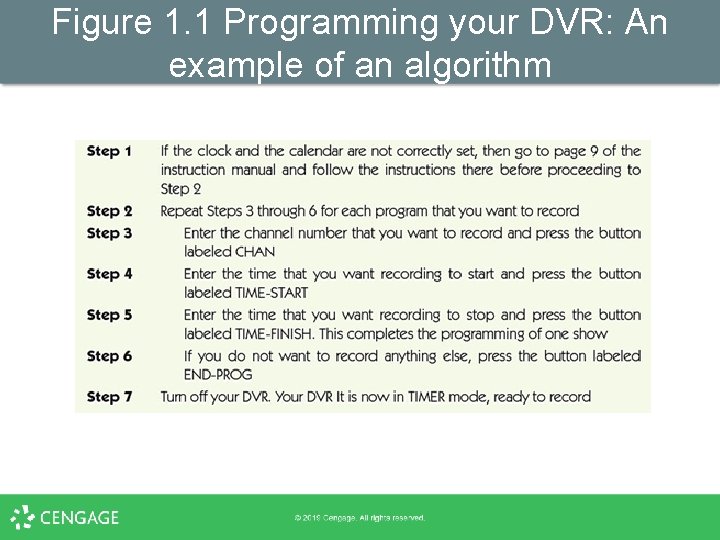
Figure 1. 1 Programming your DVR: An example of an algorithm
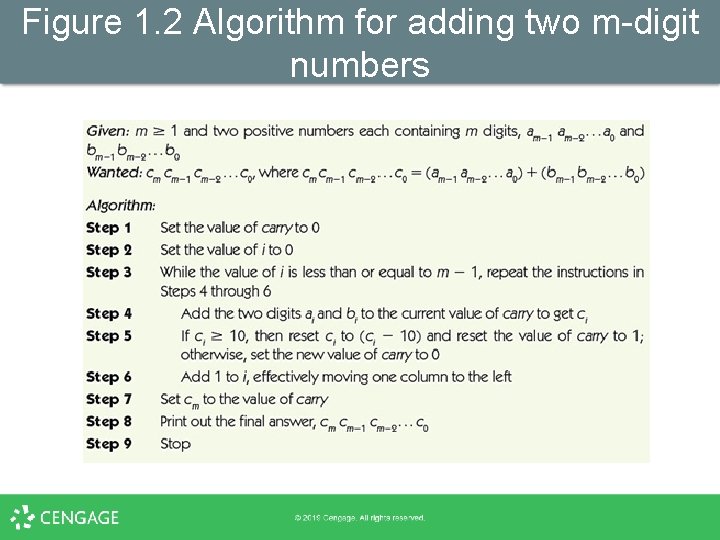
Figure 1. 2 Algorithm for adding two m-digit numbers
The Definition of Computer Science (4 of 4) • Why are formal algorithms so important in computer science? – If we can specify an algorithm to solve a problem, then we can automate its solution • Computing agent – Machine, robot, person, or thing carrying out the steps of the algorithm • Unsolved problems – Some problems are unsolvable, some solutions are too slow, and some solutions are not yet known
Algorithms (1 of 5) • The Formal Definition of an Algorithm: – A well-ordered collection of unambiguous and effectively computable operations that, when executed, produces a result and halts in a finite amount of time
Algorithms (2 of 5) • Well-ordered collection – Upon completion of an operation, we always know which operation to do next • Unambiguous and effectively computable operations – It is not enough for an operation to be understandable, it must also be doable (effectively computable) – Ambiguous statements § § Go back and do it again (Do what again? ) Start over (From where? )
Algorithms (3 of 5) • Produces a result and halts in a finite amount of time – To know whether a solution is correct, an algorithm must produce a result that is observable to a user: § § § A numerical answer A new object A change in the environment
Algorithms (4 of 5) • Unambiguous operation, or primitive – Can be understood by the computing agent without having to be further defined or simplified • It is not enough for an operation to be understandable – It must also be doable (effectively computable) by the computing agent • Infinite loop – Runs forever – Usually a mistake
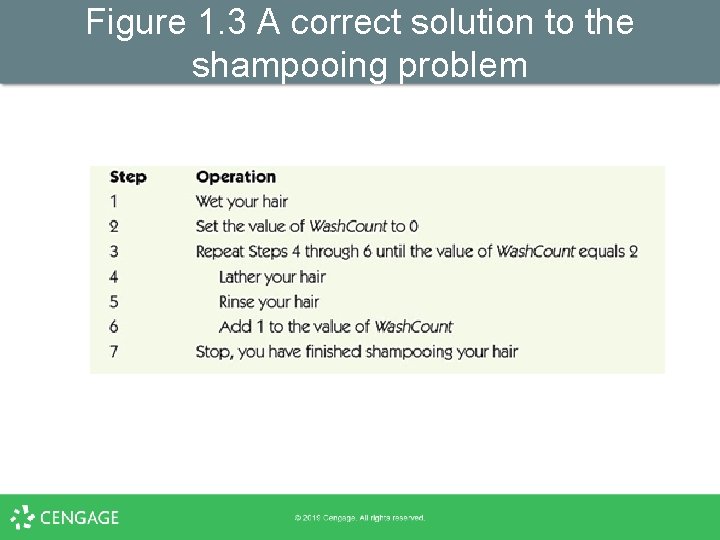
Figure 1. 3 A correct solution to the shampooing problem
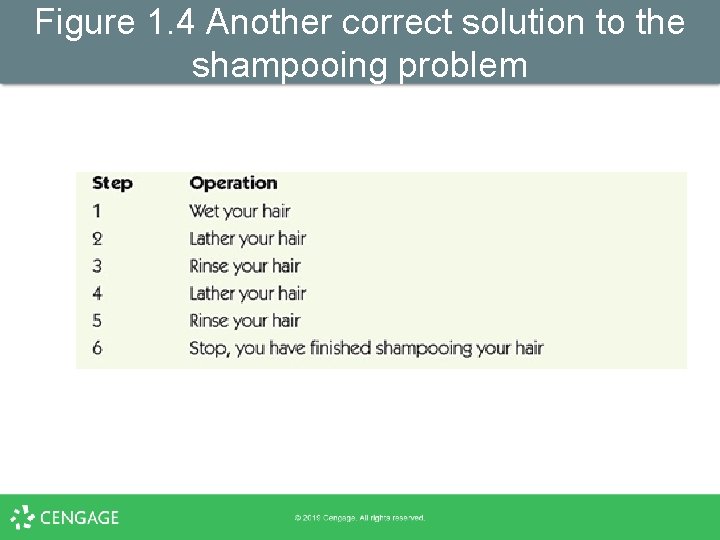
Figure 1. 4 Another correct solution to the shampooing problem
Algorithms (5 of 5) • The Importance of Algorithmic Problem Solving – “Industrial revolution” of the nineteenth century § Mechanized and automated repetitive physical tasks – “Computer revolution” of the twentieth and twenty-first centuries § § Mechanized and automated repetitive mental tasks Used algorithms and computer hardware
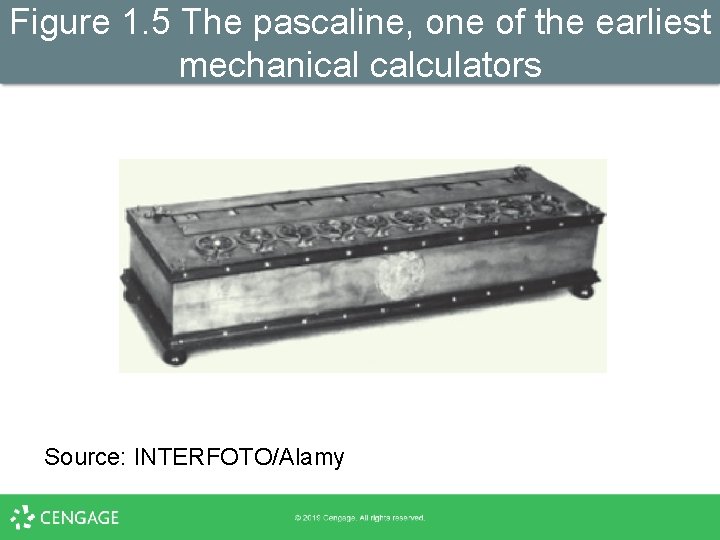
A Brief History of Computing The Early Period: Up to 1940 (1 of 7) • Seventeenth century: automation/simplification of arithmetic for scientific research: – John Napier invented logarithms as a way to simplify difficult mathematical computations (1614). – The first slide rule appeared around 1622. – Blaise Pascal designed and built a mechanical calculator named the Pascaline (1642). – Gottfried Leibnitz constructed a mechanical calculator called Leibnitz’s Wheel (1673).
Figure 1. 5 The pascaline, one of the earliest mechanical calculators Source: INTERFOTO/Alamy
A Brief History of Computing The Early Period: Up to 1940 (2 of 7) • Seventeenth century devices: – – Could represent numbers Could perform arithmetic operations on numbers Did not have a memory to store information Were not programmable (a user could not provide a sequence of actions to be executed by the device)
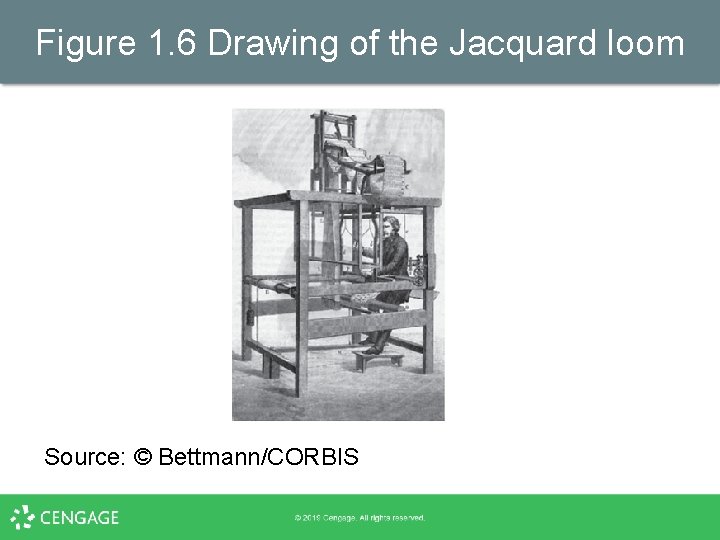
A Brief History of Computing The Early Period: Up to 1940 (3 of 7) • Nineteenth-century devices: – Joseph Jacquard designed an automated loom that used punched cards to create patterns (1801) – Herman Hollerith (1880 s onward) § § Designed and built programmable card-processing machines to read, tally, and sort data on punched cards for the U. S. Census Bureau Founded a company that became IBM in 1924
Figure 1. 6 Drawing of the Jacquard loom Source: © Bettmann/CORBIS
A Brief History of Computing The Early Period: Up to 1940 (4 of 7) • Luddites – Originally opposed to the new manufacturing technology introduced by the Jacquard Loom – Now a term used to describe any group that is frightened or angered by the latest developments in any branch of science and technology, including computers
A Brief History of Computing The Early Period: Up to 1940 (5 of 7) • Charles Babbage – Difference Engine designed and built in 1823 § § Could do addition, subtraction, multiplication, and division to six significant digits Could solve polynomial equations and other complex mathematical problems
A Brief History of Computing The Early Period: Up to 1940 (6 of 7) • Charles Babbage – Analytical Engine § § Designed but never built Mechanical, programmable machine with parts that mirror that of a modern-day computer: o o Mill: Arithmetic/logic unit Store: Memory Operator: Processor Output Unit: Input/Output
A Brief History of Computing The Early Period: Up to 1940 (7 of 7) • Nineteenth-century devices: – Were mechanical, not electrical – Had many features of modern computers: § § Representation of numbers or other data Operations to manipulate the data Memory to store values in a machine-readable form Programmable: sequences of instructions could be predesigned for complex operations
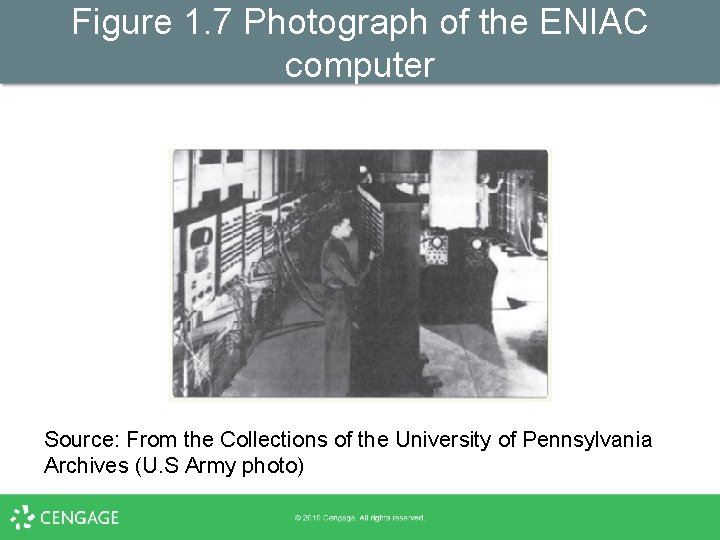
A Brief History of Computing The Birth of Computers: 1940– 1950 (1 of 5) • Mark I (1944) – Electromechanical computer used a mix of relays, magnets, and gears to process and store data • Colossus (1943) – General-purpose computer built by Alan Turing for the British Enigma project • ENIAC (Electronic Numerical Integrator and Calculator) (1946) – First publicly known fully electronic computer
Figure 1. 7 Photograph of the ENIAC computer Source: From the Collections of the University of Pennsylvania Archives (U. S Army photo)
A Brief History of Computing The Birth of Computers: 1940– 1950 (2 of 5) • John Von Neumann – Proposed a radically different computer design based on a model called the stored program computer – Research group at the University of Pennsylvania built one of the first stored program computers, called EDVAC, in 1949 – UNIVAC I, a version of EDVAC, the first commercially sold computer – Nearly all modern computers use the Von Neumann architecture
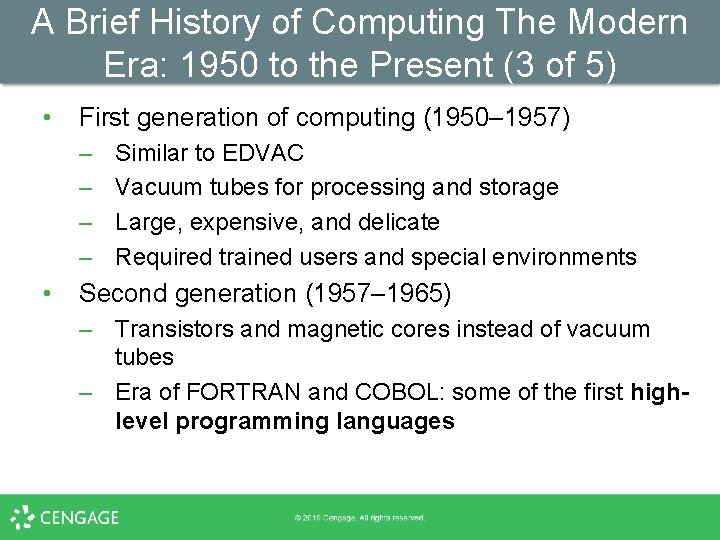
A Brief History of Computing The Modern Era: 1950 to the Present (3 of 5) • First generation of computing (1950– 1957) – – • Similar to EDVAC Vacuum tubes for processing and storage Large, expensive, and delicate Required trained users and special environments Second generation (1957– 1965) – Transistors and magnetic cores instead of vacuum tubes – Era of FORTRAN and COBOL: some of the first highlevel programming languages
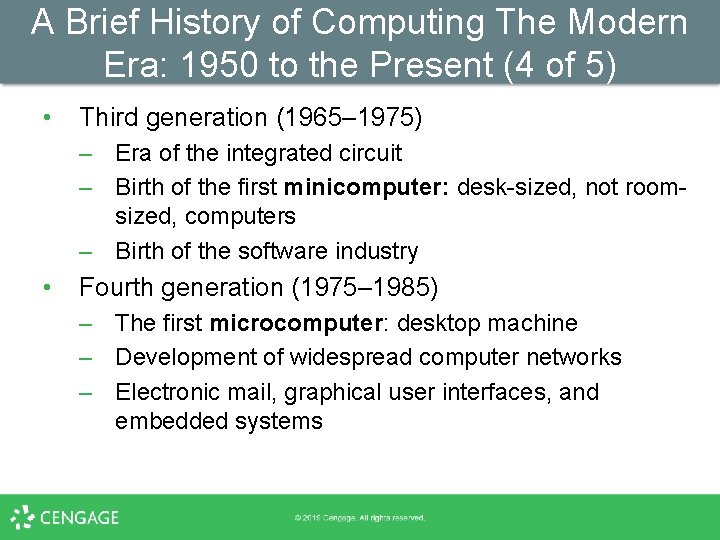
A Brief History of Computing The Modern Era: 1950 to the Present (4 of 5) • Third generation (1965– 1975) – Era of the integrated circuit – Birth of the first minicomputer: desk-sized, not roomsized, computers – Birth of the software industry • Fourth generation (1975– 1985) – The first microcomputer: desktop machine – Development of widespread computer networks – Electronic mail, graphical user interfaces, and embedded systems
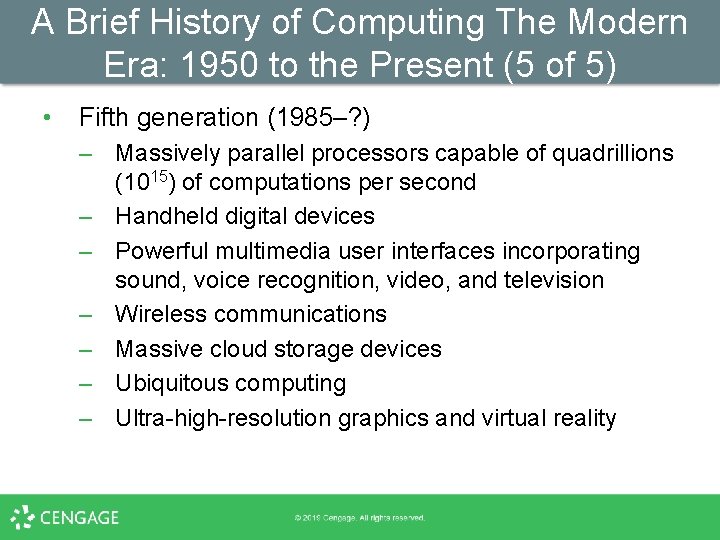
A Brief History of Computing The Modern Era: 1950 to the Present (5 of 5) • Fifth generation (1985–? ) – Massively parallel processors capable of quadrillions (1015) of computations per second – Handheld digital devices – Powerful multimedia user interfaces incorporating sound, voice recognition, video, and television – Wireless communications – Massive cloud storage devices – Ubiquitous computing – Ultra-high-resolution graphics and virtual reality
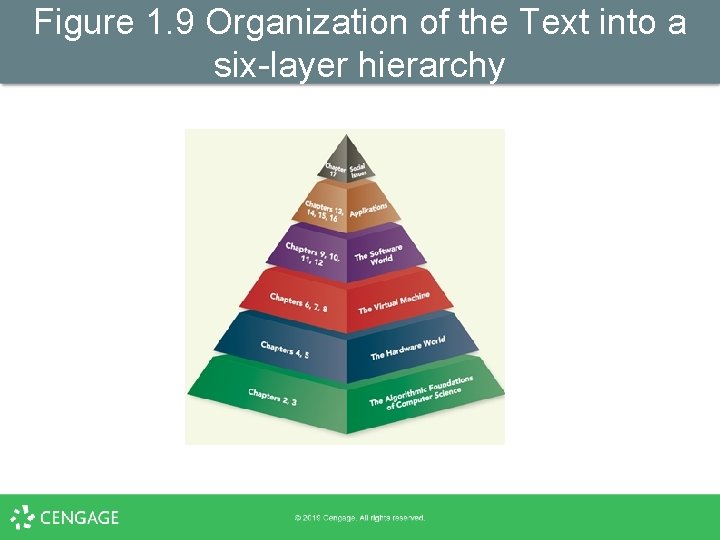
Organization of the Text Computer science is the study of algorithms, including: Levels of the text: 1. Their formal and mathematical properties Level 1: The Algorithmic Foundations of Computer Science 2. Their hardware realizations Level 2: The Hardware World Level 3: The Virtual Machine 3. Their linguistic realizations Level 4: The Software World 4. Their applications Level 5: Applications Level 6: Social Issues
Figure 1. 9 Organization of the Text into a six-layer hierarchy
Summary • Computer science is the study of algorithms. • An algorithm is a well-ordered collection of unambiguous and effectively computable operations that, when executed, produces a result and halts in a finite amount of time. • If we can specify an algorithm to solve a problem, then we can automate its solution. • Computers developed from mechanical calculating devices to modern electronic marvels of miniaturization.