
Chapter 1 An Introduction to Anatomy and Physiology
- Slides: 29
Chapter 1 An Introduction to Anatomy and Physiology LAB © 2012 Pearson Education, Inc.
Introduction to Studying the Human Body • Humans are vertebrates- having a segmented vertebral column • Anatomy • The study of the relationship of body parts to one another • Body structure is concrete- it can be seen, felt, and examined • Location, composition • Is the oldest medical science (1600 B. C) • Physiology • Is the study of function • Explains how the body works and accomplishes its life-sustaining activities • Anatomical information provides clues about functions and physiological mechanisms can be explained only in terms of the underlying anatomy. • Homeostasis • A state of equilibrium and balance, maintained by self-regulating processes. The goal of physiological regulation and the key to survival in a changing environment. © 2012 Pearson Education, Inc.
Anatomy Gross/Macroscopic anatomy: examines large, visible structures • Surface anatomy: exterior features • Regional anatomy: body areas • Systemic anatomy: organ systems • Developmental anatomy: from conception to death • Clinical § Physical examination § Inspection- vital signs, Palpation, Auscultation, Percussion § Lab tests § Medical imaging (CT scan, MRI, Radiology-x-rays, PET scan) § Pathology - Study of structural changes associated with disease Microscopic anatomy examines cells and molecules • Cytology (cyt- = cell) : study of cells and their struct • Histology: study of tissues and their structures © 2012 Pearson Education, Inc.
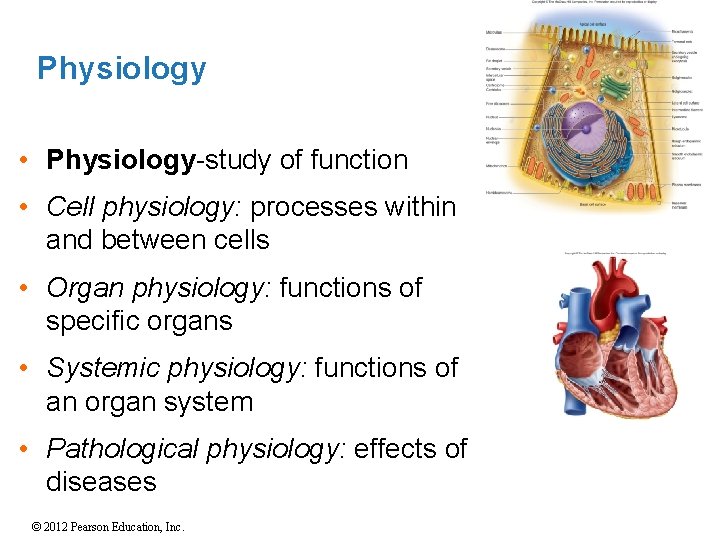
Physiology • Physiology-study of function • Cell physiology: processes within and between cells • Organ physiology: functions of specific organs • Systemic physiology: functions of an organ system • Pathological physiology: effects of diseases © 2012 Pearson Education, Inc.
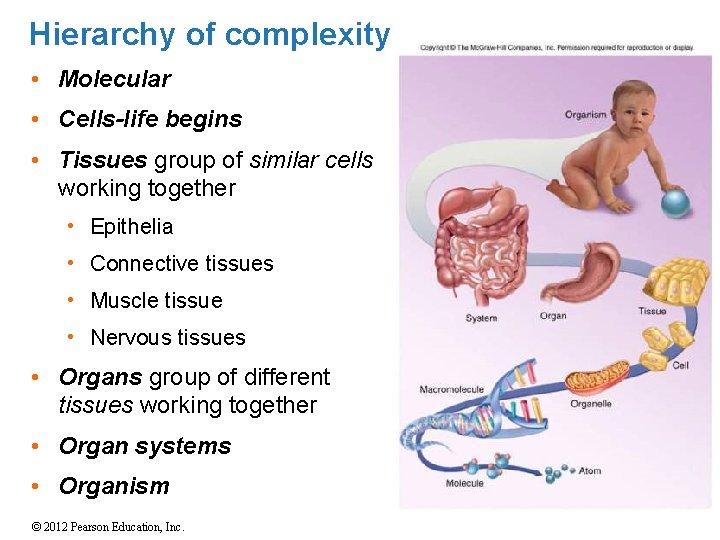
Hierarchy of complexity • Molecular • Cells-life begins • Tissues group of similar cells working together • Epithelia • Connective tissues • Muscle tissue • Nervous tissues • Organs group of different tissues working together • Organ systems • Organism © 2012 Pearson Education, Inc. 5
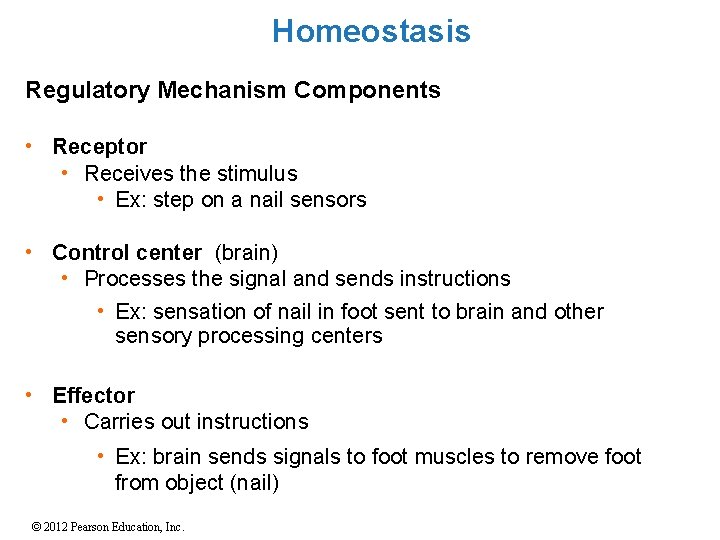
Homeostasis Regulatory Mechanism Components • Receptor • Receives the stimulus • Ex: step on a nail sensors • Control center (brain) • Processes the signal and sends instructions • Ex: sensation of nail in foot sent to brain and other sensory processing centers • Effector • Carries out instructions • Ex: brain sends signals to foot muscles to remove foot from object (nail) © 2012 Pearson Education, Inc.
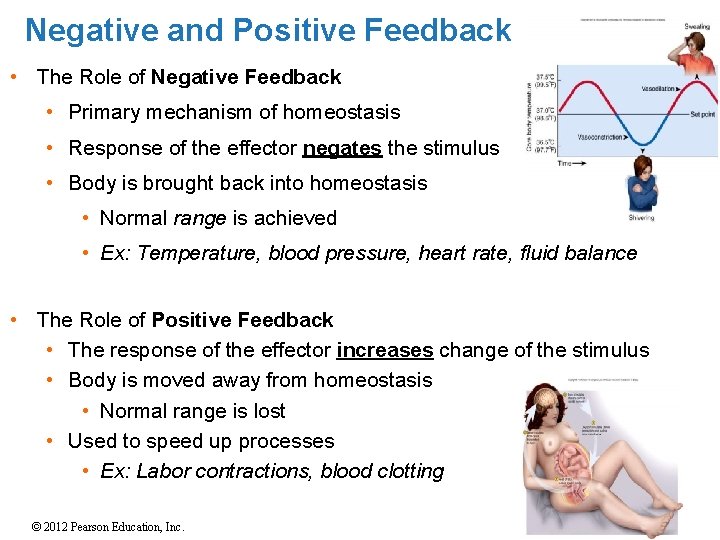
Negative and Positive Feedback • The Role of Negative Feedback • Primary mechanism of homeostasis • Response of the effector negates the stimulus • Body is brought back into homeostasis • Normal range is achieved • Ex: Temperature, blood pressure, heart rate, fluid balance • The Role of Positive Feedback • The response of the effector increases change of the stimulus • Body is moved away from homeostasis • Normal range is lost • Used to speed up processes • Ex: Labor contractions, blood clotting © 2012 Pearson Education, Inc.
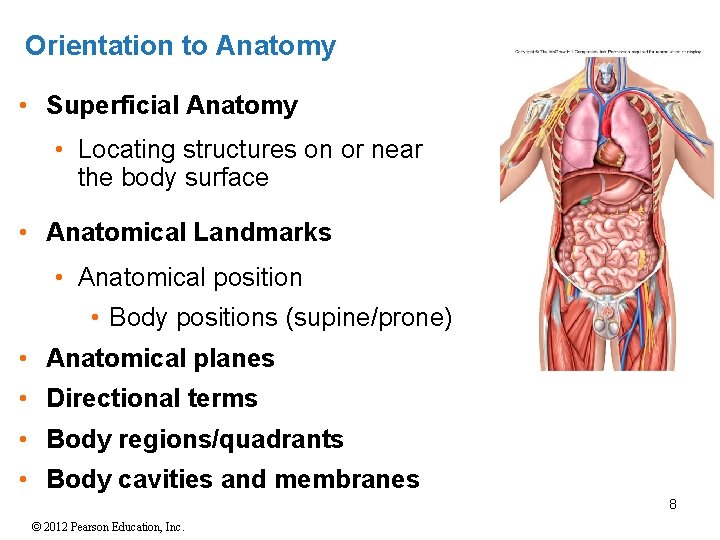
Orientation to Anatomy • Superficial Anatomy • Locating structures on or near the body surface • Anatomical Landmarks • Anatomical position • Body positions (supine/prone) • Anatomical planes • Directional terms • Body regions/quadrants • Body cavities and membranes 8 © 2012 Pearson Education, Inc.
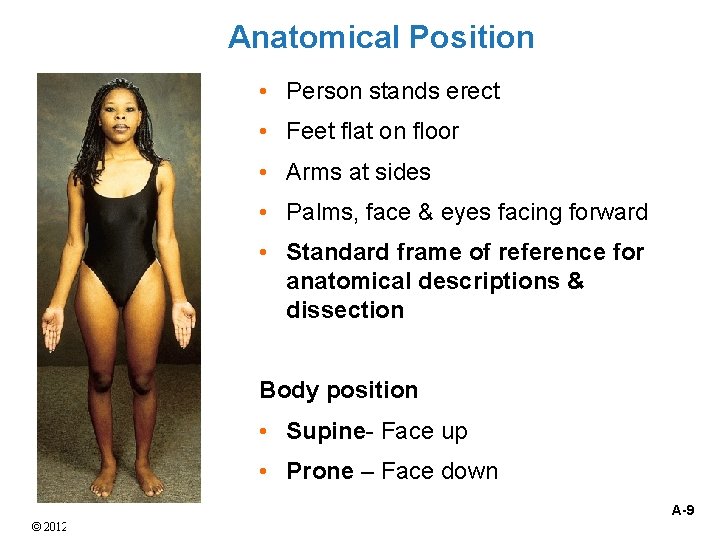
Anatomical Position • Person stands erect • Feet flat on floor • Arms at sides • Palms, face & eyes facing forward • Standard frame of reference for anatomical descriptions & dissection Body position • Supine- Face up • Prone – Face down A-9 © 2012 Pearson Education, Inc.
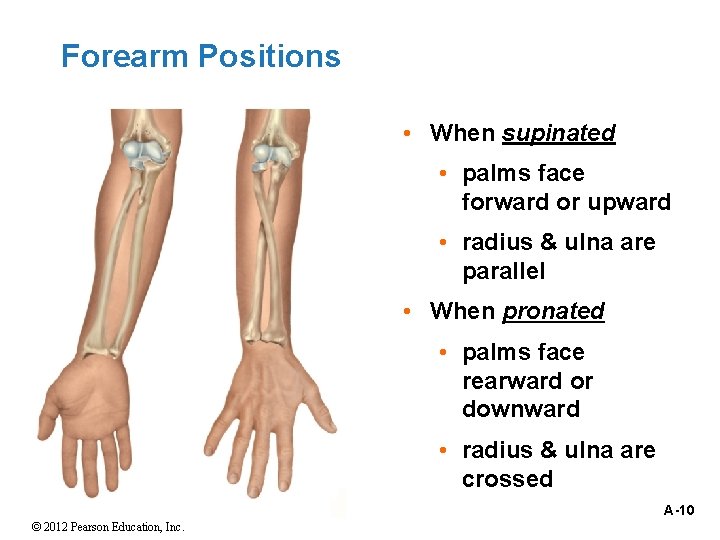
Forearm Positions • When supinated • palms face forward or upward • radius & ulna are parallel • When pronated • palms face rearward or downward • radius & ulna are crossed A-10 © 2012 Pearson Education, Inc.
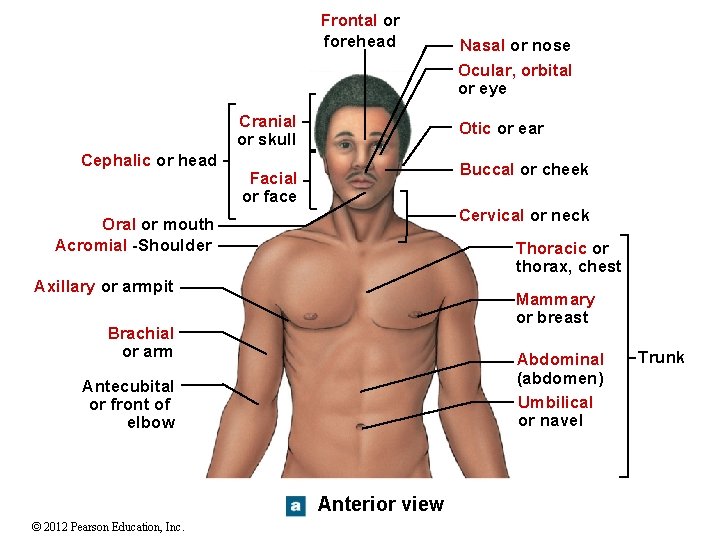
Frontal or forehead Cranial or skull Cephalic or head Otic or ear Buccal or cheek Facial or face Cervical or neck Oral or mouth Acromial -Shoulder Thoracic or thorax, chest Axillary or armpit Mammary or breast Brachial or arm Abdominal (abdomen) Umbilical or navel Antecubital or front of elbow Anterior view © 2012 Pearson Education, Inc. Nasal or nose Ocular, orbital or eye Trunk
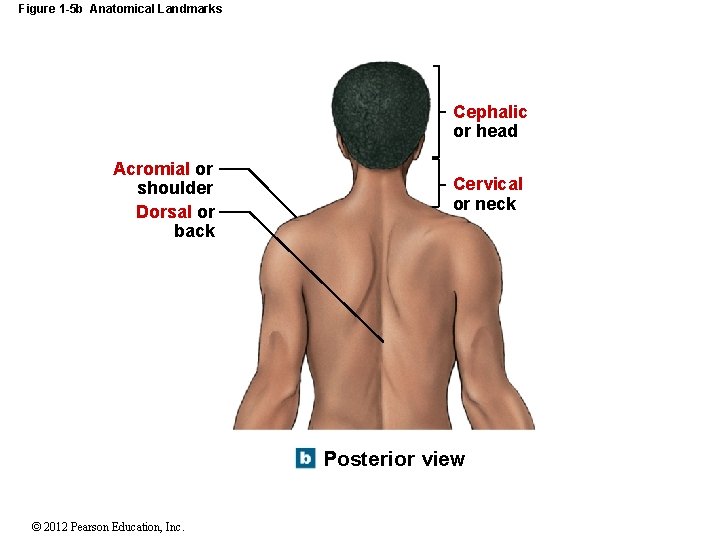
Figure 1 -5 b Anatomical Landmarks Cephalic or head Acromial or shoulder Dorsal or back Cervical or neck Posterior view © 2012 Pearson Education, Inc.
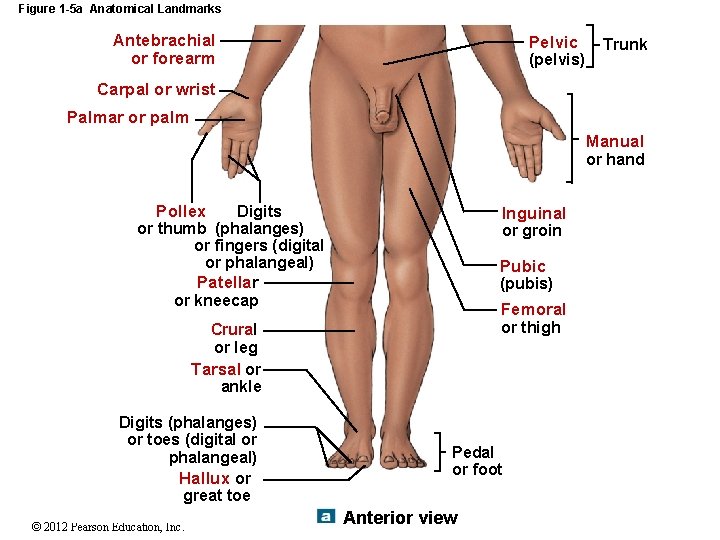
Figure 1 -5 a Anatomical Landmarks Antebrachial or forearm Pelvic (pelvis) Trunk Carpal or wrist Palmar or palm Manual or hand Pollex Digits or thumb (phalanges) or fingers (digital or phalangeal) Inguinal or groin Pubic Patellar (pubis) or kneecap Femoral or thigh Crural or leg Tarsal or ankle Digits (phalanges) or toes (digital or phalangeal) Hallux or great toe © 2012 Pearson Education, Inc. Pedal or foot Anterior view
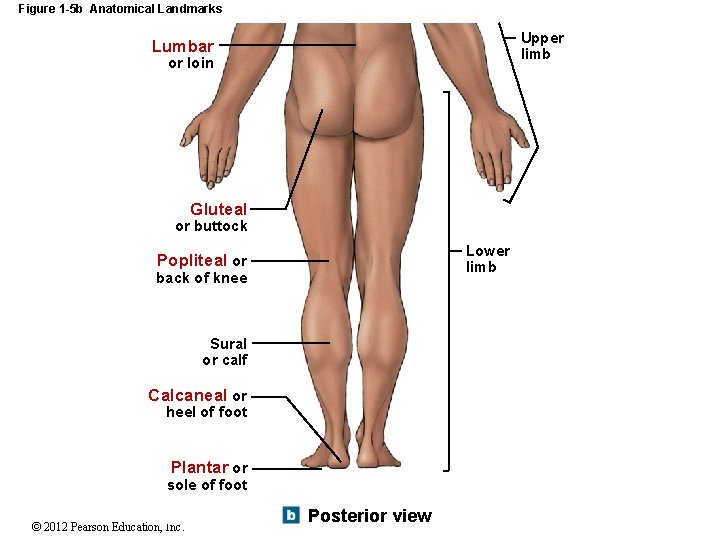
Figure 1 -5 b Anatomical Landmarks Upper limb Lumbar or loin Gluteal or buttock Lower limb Popliteal or back of knee Sural or calf Calcaneal or heel of foot Plantar or sole of foot © 2012 Pearson Education, Inc. Posterior view
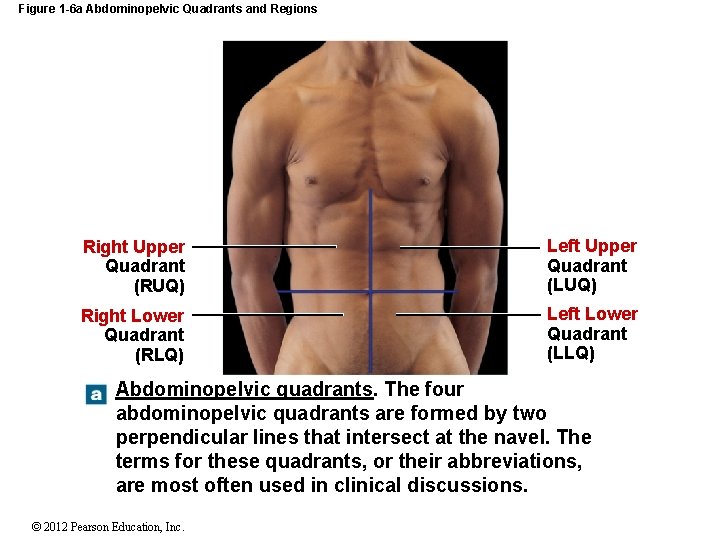
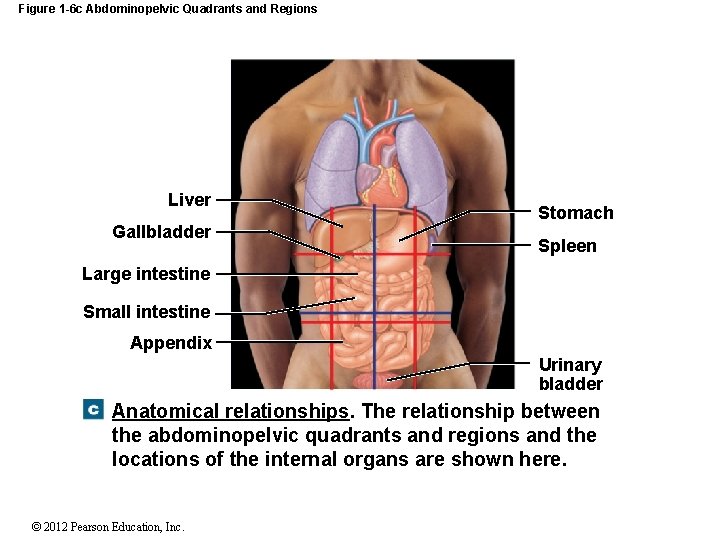
Figure 1 -6 a Abdominopelvic Quadrants and Regions Right Upper Quadrant (RUQ) Left Upper Quadrant (LUQ) Right Lower Quadrant (RLQ) Left Lower Quadrant (LLQ) Abdominopelvic quadrants. The four abdominopelvic quadrants are formed by two perpendicular lines that intersect at the navel. The terms for these quadrants, or their abbreviations, are most often used in clinical discussions. © 2012 Pearson Education, Inc.
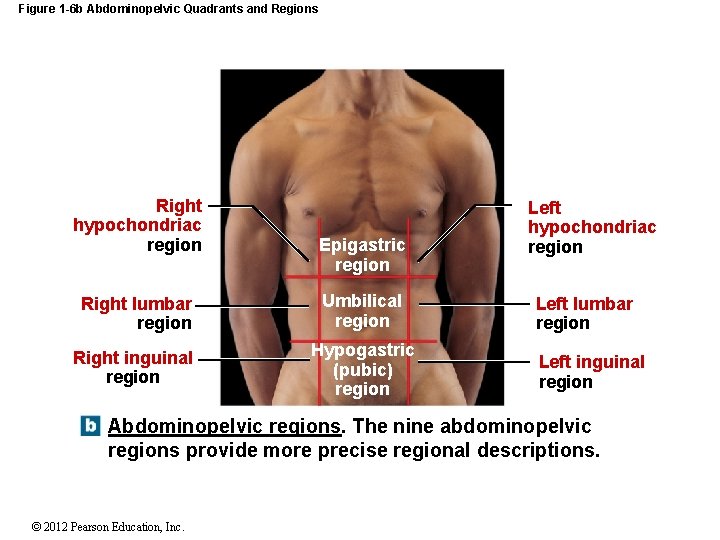
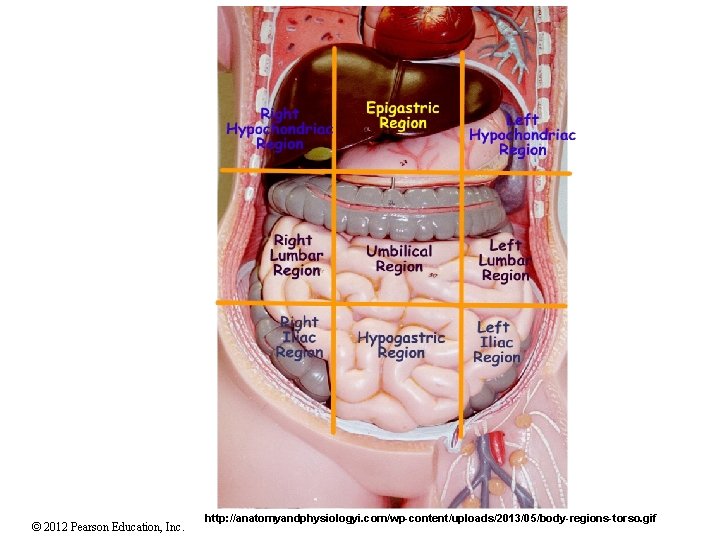
Figure 1 -6 b Abdominopelvic Quadrants and Regions Right hypochondriac region Epigastric region Right lumbar region Umbilical region Right inguinal region Hypogastric (pubic) region Left hypochondriac region Left lumbar region Left inguinal region Abdominopelvic regions. The nine abdominopelvic regions provide more precise regional descriptions. © 2012 Pearson Education, Inc.
© 2012 Pearson Education, Inc. http: //anatomyandphysiologyi. com/wp-content/uploads/2013/05/body-regions-torso. gif
Figure 1 -6 c Abdominopelvic Quadrants and Regions Liver Gallbladder Stomach Spleen Large intestine Small intestine Appendix Urinary bladder Anatomical relationships. The relationship between the abdominopelvic quadrants and regions and the locations of the internal organs are shown here. © 2012 Pearson Education, Inc.
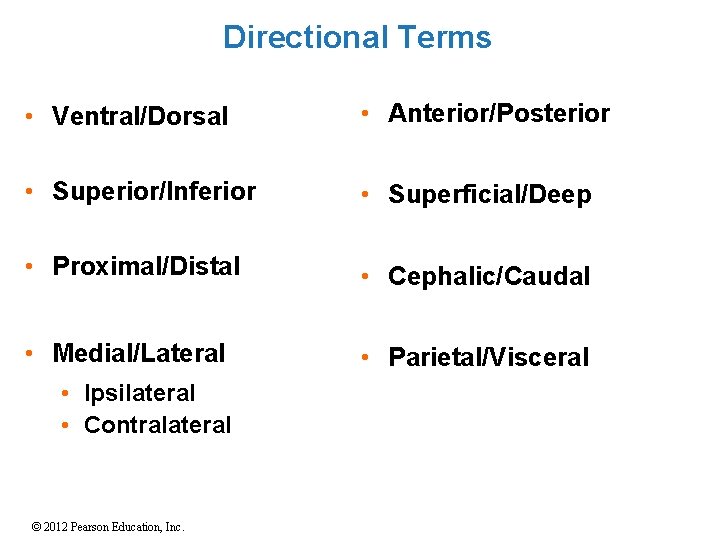
Directional Terms • Ventral/Dorsal • Anterior/Posterior • Superior/Inferior • Superficial/Deep • Proximal/Distal • Cephalic/Caudal • Medial/Lateral • Parietal/Visceral • Ipsilateral • Contralateral © 2012 Pearson Education, Inc.
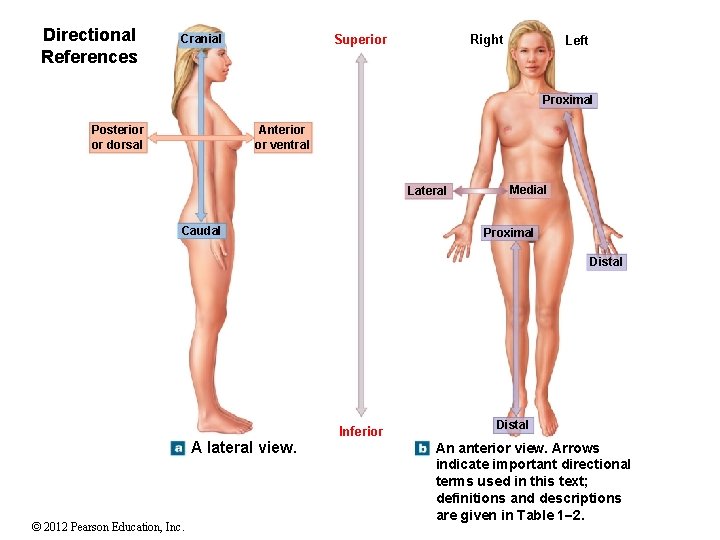
Directional References Superior Cranial Right Left Proximal Anterior or ventral Posterior or dorsal Lateral Caudal Medial Proximal Distal Inferior A lateral view. © 2012 Pearson Education, Inc. Distal An anterior view. Arrows indicate important directional terms used in this text; definitions and descriptions are given in Table 1 2.
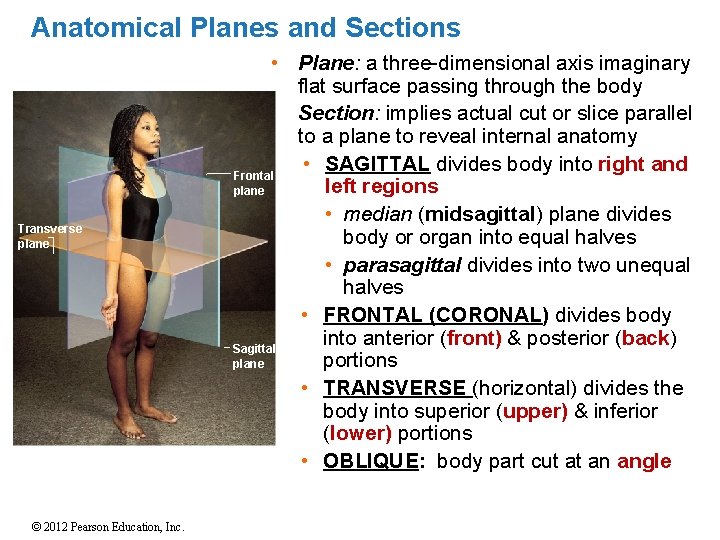
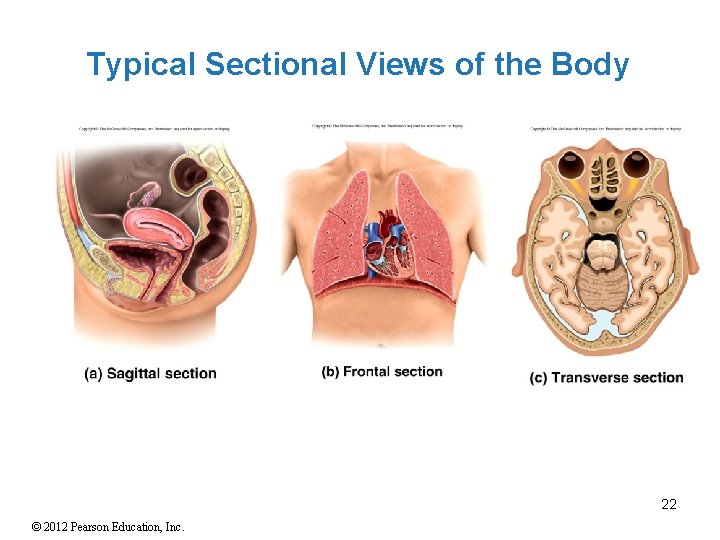
Anatomical Planes and Sections Transverse plane © 2012 Pearson Education, Inc. • Plane: a three-dimensional axis imaginary flat surface passing through the body • Section: implies actual cut or slice parallel to a plane to reveal internal anatomy • SAGITTAL divides body into right and Frontal left regions plane • median (midsagittal) plane divides body or organ into equal halves • parasagittal divides into two unequal halves • FRONTAL (CORONAL) divides body into anterior (front) & posterior (back) Sagittal portions plane • TRANSVERSE (horizontal) divides the body into superior (upper) & inferior (lower) portions • OBLIQUE: body part cut at an angle
Typical Sectional Views of the Body 22 © 2012 Pearson Education, Inc.
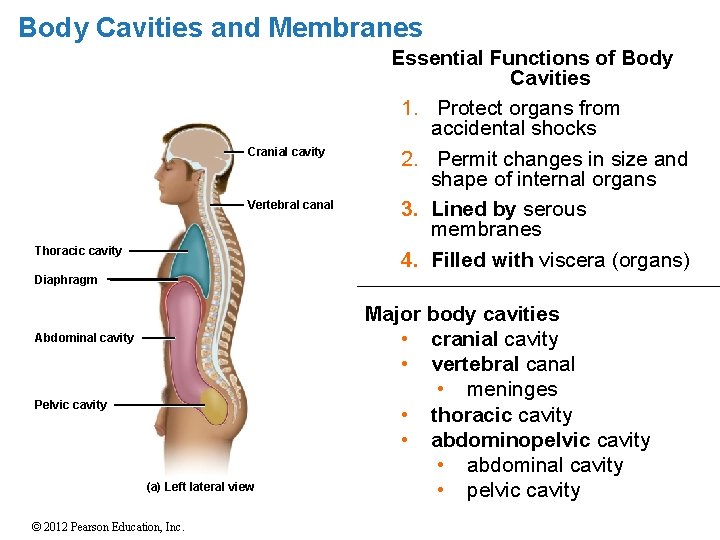
Body Cavities and Membranes Cranial cavity Vertebral canal Thoracic cavity Essential Functions of Body Cavities 1. Protect organs from accidental shocks 2. Permit changes in size and shape of internal organs 3. Lined by serous membranes 4. Filled with viscera (organs) Diaphragm Abdominal cavity Pelvic cavity (a) Left lateral view © 2012 Pearson Education, Inc. Major body cavities • cranial cavity • vertebral canal • meninges • thoracic cavity • abdominopelvic cavity • abdominal cavity • pelvic cavity
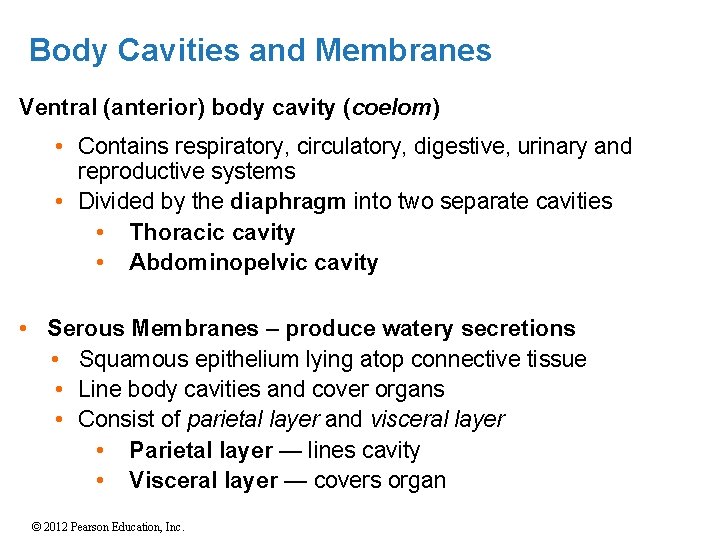
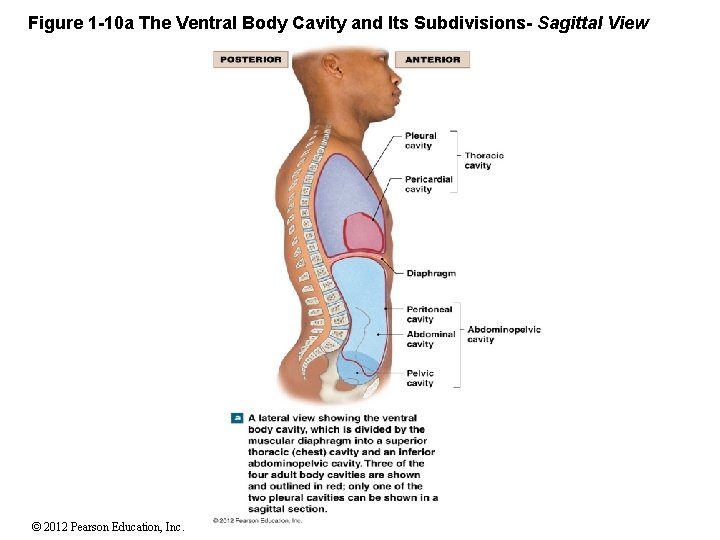
Body Cavities and Membranes Ventral (anterior) body cavity (coelom) • Contains respiratory, circulatory, digestive, urinary and reproductive systems • Divided by the diaphragm into two separate cavities • Thoracic cavity • Abdominopelvic cavity • Serous Membranes – produce watery secretions • Squamous epithelium lying atop connective tissue • Line body cavities and cover organs • Consist of parietal layer and visceral layer • Parietal layer — lines cavity • Visceral layer — covers organ © 2012 Pearson Education, Inc.
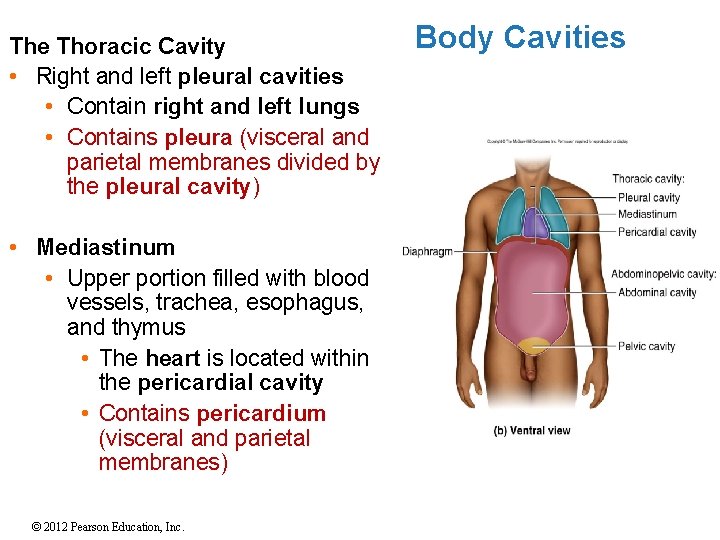
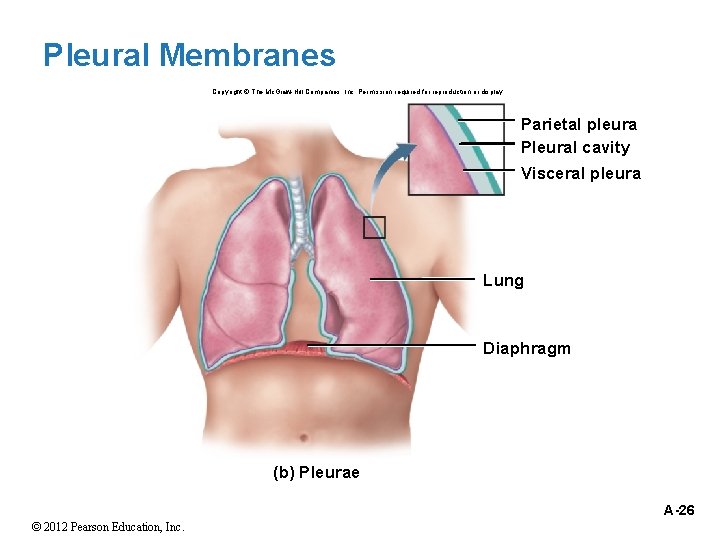
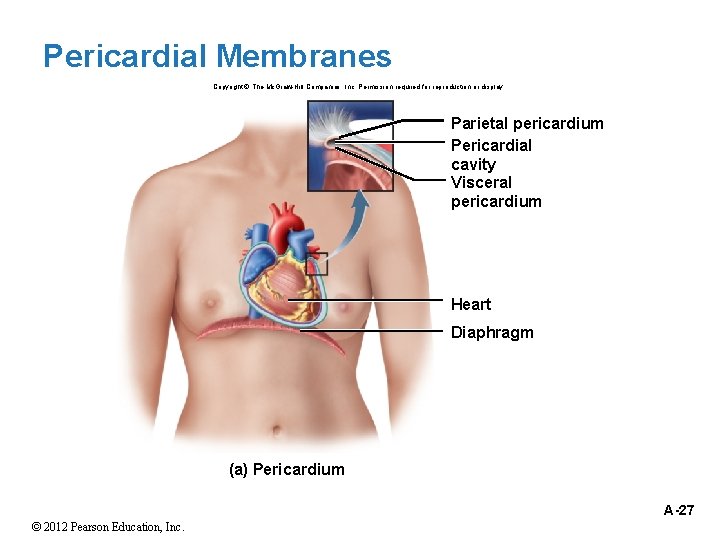
The Thoracic Cavity • Right and left pleural cavities • Contain right and left lungs • Contains pleura (visceral and parietal membranes divided by the pleural cavity) • Mediastinum • Upper portion filled with blood vessels, trachea, esophagus, and thymus • The heart is located within the pericardial cavity • Contains pericardium (visceral and parietal membranes) © 2012 Pearson Education, Inc. Body Cavities
Pleural Membranes Copyright © The Mc. Graw-Hill Companies, Inc. Permission required for reproduction or display. Parietal pleura Pleural cavity Visceral pleura Lung Diaphragm (b) Pleurae A-26 © 2012 Pearson Education, Inc.
Pericardial Membranes Copyright © The Mc. Graw-Hill Companies, Inc. Permission required for reproduction or display. Parietal pericardium Pericardial cavity Visceral pericardium Heart Diaphragm (a) Pericardium A-27 © 2012 Pearson Education, Inc.
Body Cavities • The Abdominopelvic Cavity • Peritoneal cavity: • Parietal peritoneum: lines the internal body wall • Visceral peritoneum: covers the organs • Abdominal cavity — superior portion • Diaphragm to top of pelvic bones • Contains digestive organs • Retroperitoneal space • Area posterior to peritoneum and anterior to muscular body wall • Contains pancreas, kidneys, ureters, and parts of the digestive tract • Pelvic cavity — inferior portion • Within pelvic bones • Contains reproductive organs, rectum, and bladder © 2012 Pearson Education, Inc.
Figure 1 -10 a The Ventral Body Cavity and Its Subdivisions- Sagittal View © 2012 Pearson Education, Inc.