
Chapter 1 Abnormal Psychology Past and Present Slides
Chapter 1 Abnormal Psychology: Past and Present Slides & Handouts by Karen Clay Rhines, Ph. D. Seton Hall University
Abnormal Psychology: Past and Present ¨ What is abnormal psychology? • The scientific study of abnormal behavior in order to describe, predict, explain, and change abnormal patterns of functioning • Workers may be: • Clinical Scientists • Clinical Practitioners Slide 2
What Is Psychological Abnormality? ¨ Many definitions have been proposed, yet none are universally accepted ¨ Most definitions, however, share some common features… • “The Four Ds” • Deviance – Different, extreme, unusual • Distress – Unpleasant & upsetting • Dysfunction – Causes interference with life • Danger – Poses risk of harm Slide 3
Deviance ¨ From what? • From behaviors, thoughts, and emotions considered normal in a specific place and time and by specific people • From social norms • Stated and unstated rules for proper conduct in a given society or culture • Examples? ¨ Judgments of deviance also depend on specific circumstances (i. e. , social context) Slide 4

Distress ¨ According to many clinical guidelines, behavior must be personally distressing before it can be labeled abnormal • Not always the case • Examples? Slide 5
Dysfunction ¨ Abnormal behavior tends to be dysfunctional – it interferes with daily functioning ¨ Culture has an influence on determinations of dysfunction as well ¨ Dysfunction alone does not mean abnormality Slide 6
Danger ¨ Abnormal behavior may become dangerous to oneself or others • Behavior may be careless, hostile, or confused ¨ Although cited as a feature of psychological abnormality, dangerousness is an exception rather than a rule Slide 7
The Elusive Nature of Abnormality ¨ Ultimately, a society selects the general criteria for defining abnormality and then uses those criteria to judge particular cases • Szasz argues that, because of the influence of culture, the whole concept of mental illness is invalid • Deviations called “abnormal” are only “problems of living” • Societies use the concept of mental illness to control those who threaten social order Slide 8
The Elusive Nature of Abnormality ¨ Even if we agree with the concept of abnormality, it is often applied inconsistently • Examples: • Diagnosis of alcohol problems in colleges • Diagnosis of the poor versus the wealthy • Issue of abnormality versus eccentricity • Eccentric = a person who deviates from common behavior patterns or displays odd or whimsical behavior (A CLOSER LOOK) Slide 9
The Elusive Nature of Abnormality ¨ In sum, while abnormality is generally defined as behavior that is deviant, distressful, dysfunctional, and dangerous, these criteria often are vague and subjective • When is a pattern of behavior “enough” to be considered abnormal? Slide 10
What Is Treatment? ¨ Once abnormality is determined, clinicians attempt to treat it • Treatment (therapy) is a procedure to change abnormal behavior into more normal behavior • It is related to the definition of abnormality • There are various types of treatment, but according to Frank, all have three essential features… Slide 11
What Is Treatment? 1. A sufferer who seeks relief from the healer 2. A trained, socially acceptable healer, whose expertise is accepted by the sufferer and his or her social group 3. A series of contacts between the healer and the sufferer, through which the healer tries to produce certain changes in the sufferer’s emotional state, attitudes, and behavior Slide 12
What Is Treatment? ¨ Despite the clarity of the definition, clinical therapy is surrounded by confusion and conflict • Lack of agreement about goals or aims • Lack of agreement about successful outcomes • Lack of agreement about failure • Are clinicians seeking to cure? To teach? • Are sufferers patients (ill) or clients (having difficulty)? ¨ Despite these disagreements, most clinicians agree that large numbers of people need therapy • And research indicates that therapy often is helpful! Slide 13
How Was Abnormality Viewed and Treated in the Past? ¨ In any given year in the US, 30% of adults and 20% of children display serious psychological disturbances and are in need of treatment ¨ In addition, most people have difficulty coping at various times in their lives ¨ Is this the fault of modern society? • Not entirely; historical records demonstrate that every society has witnessed psychological abnormality and had its own form of treatment… Slide 14
How Was Abnormality Viewed and Treated in the Past? ¨ Much of today’s thinking about abnormal psychology is built on past approaches and ideas, rather than being a rejection of these ideas ¨ Theories and themes about abnormal psychology occur again and again; progress has not been a steady movement forward Slide 15
Ancient Views and Treatment ¨ Most of our knowledge of prehistoric societies has been acquired indirectly, is based on inferences from archaeological findings, and is limited ¨ Most historians believe that prehistoric societies regarded abnormal behavior as the work of evil spirits • May have begun as far back as the Stone Age ¨ The cure for abnormality was to force the demons from the body through trephination and exorcism Slide 16
Greek and Roman Views and Treatments ¨ 500 B. C. to A. D. 500 A. D. ¨ Many psychological disorders were identified ¨ Hippocrates believed that abnormality had natural causes and resulted from internal physical problems • He looked to an unbalance of the four humors • His suggested treatment attempted to “rebalance” • Warm baths, massage, blood letting Slide 17
Europe in the Middle Ages: Demonology Returns ¨ A. D. 500 – 1350 ¨ With the rise of clergy came the downplay of science • Abnormality was again seen as a conflict between good & evil • The incidence of abnormality increased dramatically as outbreaks of mass madness occurred • Earlier (largely discarded) treatments such as exorcism reemerged ¨ At the close of the Middle Ages, demonology began to lose favor again Slide 18
The Renaissance and the Rise of Asylums ¨ A. D. 1400 – 1700 ¨ German physician Johann Weyer argued that the mind was susceptible to illness, just like the body • Weyer is considered the founder of modern study of psychopathology ¨ Patient care improved as demonological views declined Slide 19
The Renaissance and the Rise of Asylums ¨ Shrines devoted to loving care of the mentally ill were established and one, at Gheel, became a community mental health program of sorts ¨ This time also saw a rise of asylums – institutions whose primary purpose was care of the mentally ill • The intention was good care, but with overcrowding came “warehousing” of patients Slide 20
The Nineteenth Century: Reform and Moral Treatment ¨ As 1800 approached, asylums were reformed into places of care • Pinel (France) and Tuke (England) advocated moral treatment – care that emphasized humane and respectful treatment • In the US, Benjamin Rush (father of American psychiatry), Dorothea Dix (Boston schoolteacher) Slide 21
The Nineteenth Century: Reform and Moral Treatment ¨ By 1850 s, there was a reversal of the moral treatment movement due to several factors: • Money and staff shortages • Declining recovery rates • Lack of more effective treatment for severely mentally ill ¨ Long-term hospitalization became the rule once again Slide 22
The Early Twentieth Century: Dual Perspectives ¨ As the moral movement was declining in the late 1800 s, two opposing perspectives emerged: • The Somatogenic Perspective • Abnormal functioning has physical causes • The Psychogenic Perspective • Abnormal functioning has psychological causes Slide 23
The Early Twentieth Century: The Somatogenic Perspective ¨ Two factors responsible for reemergence: • Emil Kraepelin’s textbook argued that physical factors (like fatigue) lead to mental dysfunction • Several biological discoveries were made, such as the link between untreated syphilis & general paresis ¨ This approach, while creating optimism, lead to few positive results until the 1950 s Slide 24
The Early Twentieth Century: The Psychogenic Perspective ¨ Rise in popularity of this model was based on work with hypnotism: • Friedrich Mesmer and hysterical disorders • Sigmund Freud: father of psychoanalysis • Unconscious processes cause abnormality ¨ This approach was primarily applied to those not requiring hospitalization (outpatients) Slide 25
Current Trends ¨ Have we come a long way? • 43% of people interviewed believe that people bring mental health disorders on themselves • 35% consider mental health disorders to be caused by sinful behavior • However, the last 50 years have brought major changes in the assessment, diagnosis, and treatment of mental health disorders but scientists and practitioners are still struggling to make a difference… Slide 26
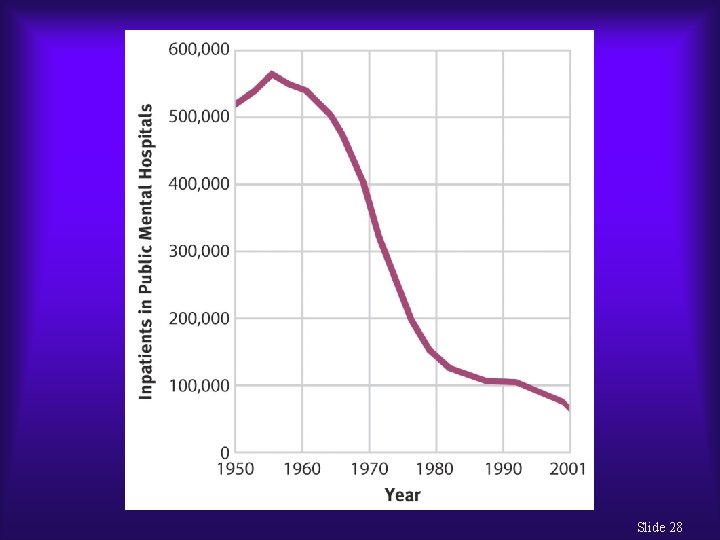
How Are People with Severe Disturbances Treated? ¨ 1950 s – Psychotropic medications discovered • Antipsychotics • Antidepressants • Anxiolytics (antianxiety drugs) ¨ These discoveries led to deinstitutionalization and a rise in outpatient care • This change in care was not without problems Slide 27
Slide 28
How Are People with Severe Disturbances Treated? ¨ Outpatient care is now the primary mode of treatment • When patients do need greater care, they are usually given short-term hospitalizations or outpatient psychotherapy and medication in community settings • Unfortunately, there are too few community programs available; only 40% of those with severe disturbances receive treatment of any kind Slide 29
How Are People with Less Severe Disturbances Treated? ¨ Since the 1950 s, there has been an increase in outpatient care • While this type of care was once exclusively private psychotherapy, it now includes various settings as well as specialty care ¨ In any given year, 1 in 6 adults receive some type of mental health care Slide 30
A Growing Emphasis on Preventing Disorders and Promoting Mental Health ¨ The community mental health approach has given rise to the prevention movement • Many of today’s programs are trying to: • Correct the social conditions associated with psychological problems • Identify those at risk for developing disorders ¨ Prevention programs have also been energized by the rise of positive psychology – the study and promotion of positive feelings, traits, and abilities Slide 31
The Growing Influence of Insurance Companies ¨ Today the dominant form of insurance coverage for mental health care is the managed care program – a program in which the insurance company determines key care issues • ~ 75% of all privately insured persons in the US are enrolled in managed care programs • At issue are the duration of therapy, the push for medication treatment, and the relatively low rates of reimbursement for care Slide 32
What Are Today’s Leading Theories? ¨ One important development in the field of abnormal psychology is the growth of theoretical perspectives (orientations), including: • Psychoanalytic • Biological • Behavioral • Cognitive • Humanistic-existential • Sociocultural ¨ No one perspective dominates Slide 33
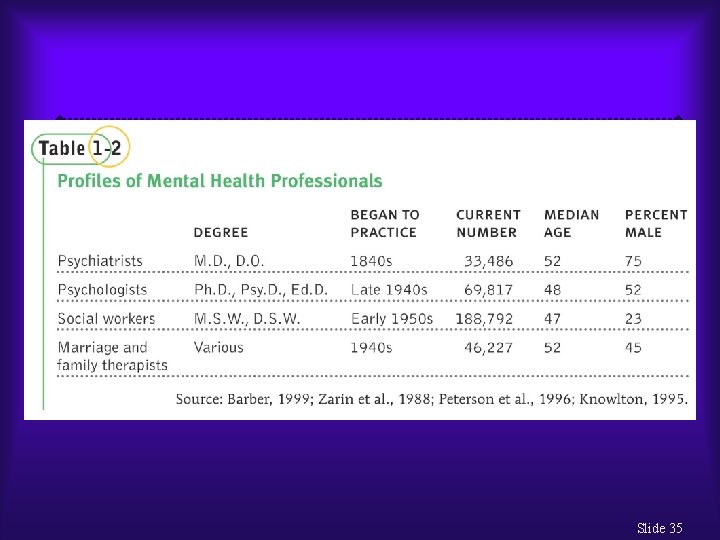
What Are Today’s Leading Professions? ¨ In addition to multiple perspectives, there also are a variety of professionals now available to offer help Slide 34
Slide 35
What Are Today’s Leading Professions? ¨ One final development in the study and treatment of mental disorders is a growing appreciation for clinical research • Clinical researchers attempt to examine which concepts and theories best explain and predict abnormal behavior, which treatments are most effective, and what kinds of changes may be required Slide 36
- Slides: 36