
Chapter 1 A Physics Toolkit Chapter 1 What

- Slides: 42
Chapter 1 A Physics Toolkit
Chapter 1 What is Physics? Write your answer on the slip of paper. Don’t put your name on it.
Chapter 1 A Physics Toolkit In this chapter you will: Use mathematical tools to measure and predict. Apply accuracy and precision when measuring. Display and evaluate data graphically.
Section 1. 1 Mathematics and Physics In this section you will: Be able to answer the question, what is physics? Review the algebra required for this class. Learn the GUESS problem solving strategy. Use and do conversions with SI units. Evaluate answers using dimensional analysis. Perform arithmetic operations using scientific notation. Use and practice the rules for rounding.
Section 1. 1 a Mathematics and Physics What is Physics? Physics is a branch of science that involves the study of the physical world: energy, matter, and how they are related. Learning physics will help you to understand the physical world. Physics is considered the basis for all other sciences: - Biology, Chemistry, Astronomy, Geology, etc. Physics is the fundamental science.
Section 1. 1 Mathematics and Physics What does one do as a physicist? Many research physicists work in environments where they perform basic research in industry, research universities, and astronomical observations. Physicists who find new ways to use physics are often employed by engineering, business, law, and consulting firms. Physicists are also extremely valuable in areas such as computer science, medicine, communications, and publishing. Finally, many physicists who love to see young people get excited about physics become teachers.
Section Mathematics and Physics 1. 1 What jobs do non-physicists hold that use physics every day? Every job has some relation to physics! Athletes - The laws of motion to lift, throw, push, hit, tackle, run, drag, jump, and crawl. - The more an athlete and coach understand use their knowledge of physics in their sport, the better the athlete will become.
Section 1. 1 Mathematics and Physics Automotive mechanics ◦ areas such as optics, electricity and magnetism, thermodynamics, and mechanics play greater roles as vehicles become more and more complex. CAT scan, computed tomography, and magnetic resonance imaging (MRI) ◦ technicians in hospitals and medical clinics who use such technology must have an understanding of what Xrays and magnetic resonance imaging are, how they behave, and how such high-tech instruments are to be used.
Section 1. 1 Mathematics and Physics Please Do Now Write three lines describing a job where knowledge of physics would be helpful.
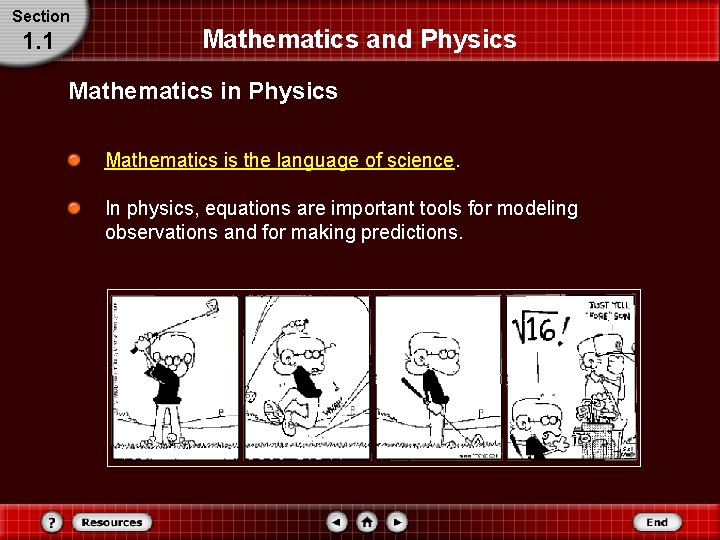
Section 1. 1 Mathematics and Physics Mathematics in Physics Mathematics is the language of science. In physics, equations are important tools for modeling observations and for making predictions.
Section Mathematics and Physics 1. 1 Order Of Operations Simply: 2 + 5 x √ Correct: 2 + 5 x X Incorrect: ( 2 + 5 ) x = 7 x
Section Mathematics and Physics 1. 1 Order Of Operations : PEMA P arentheses and Brackets E xponents M ultiplication and Division (from left to right) A ddition and Subtraction (from left to right)
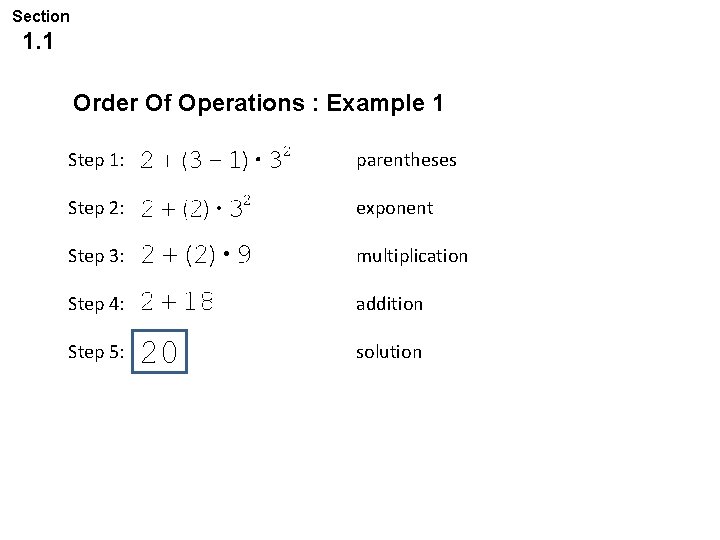
Section Mathematics and Physics 1. 1 Order Of Operations : Example 1 Step 1: parentheses Step 2: exponent Step 3: multiplication Step 4: addition Step 5: solution
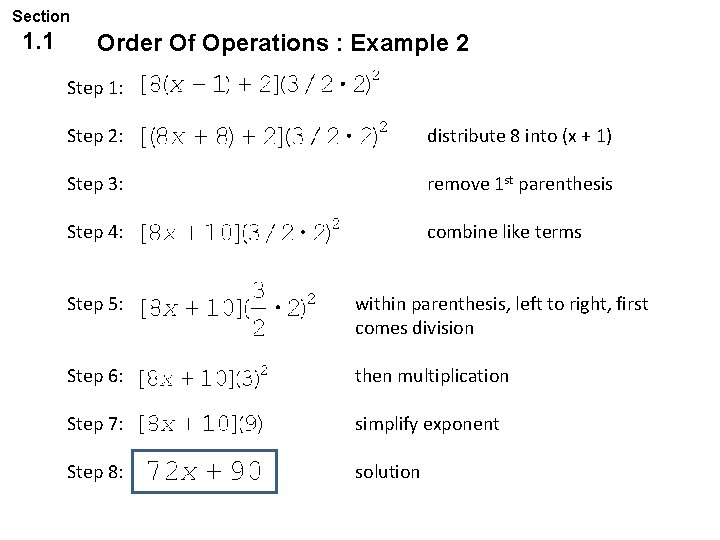
Section 1. 1 Order Of Operations : Example 2 Step 1: Step 2: distribute 8 into (x + 1) Step 3: remove 1 st parenthesis Step 4: combine like terms Step 5: within parenthesis, left to right, first comes division Step 6: then multiplication Step 7: simplify exponent Step 8: solution
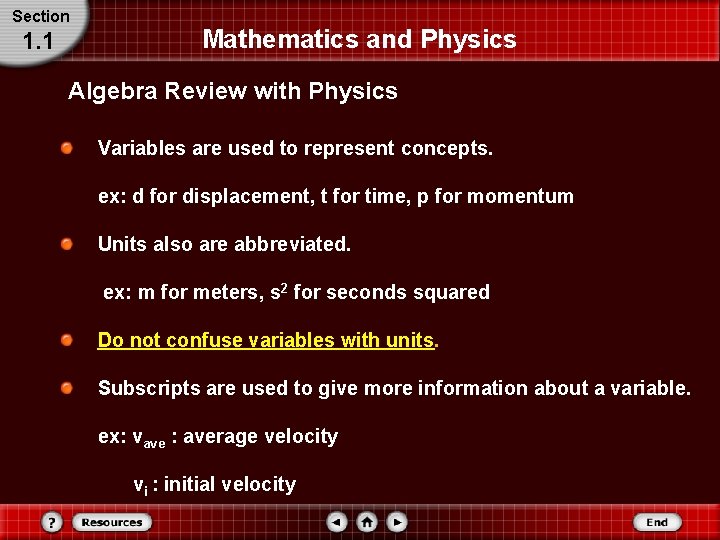
Section 1. 1 Mathematics and Physics Algebra Review with Physics Variables are used to represent concepts. ex: d for displacement, t for time, p for momentum Units also are abbreviated. ex: m for meters, s 2 for seconds squared Do not confuse variables with units. Subscripts are used to give more information about a variable. ex: vave : average velocity vi : initial velocity
Section 1. 1 Mathematics and Physics Please Do Now What strategies do you use when given a math word problem to solve? List 3 strategies.
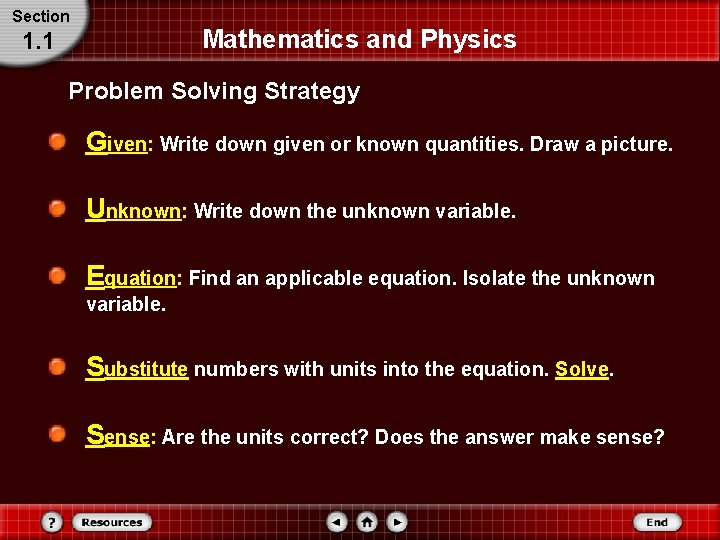
Section Mathematics and Physics 1. 1 Problem Solving Strategy Given: Write down given or known quantities. Draw a picture. Unknown: Write down the unknown variable. Equation: Find an applicable equation. Isolate the unknown variable. Substitute numbers with units into the equation. Solve. Sense: Are the units correct? Does the answer make sense?
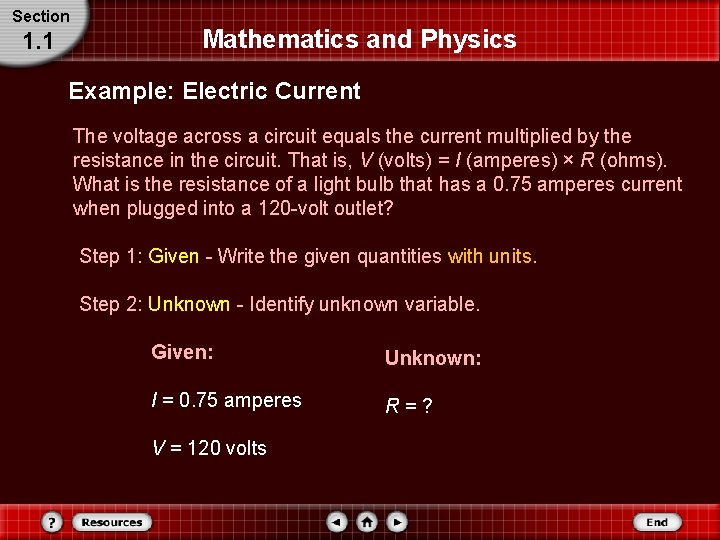
Section 1. 1 Mathematics and Physics Example: Electric Current The voltage across a circuit equals the current multiplied by the resistance in the circuit. That is, V (volts) = I (amperes) × R (ohms). What is the resistance of a light bulb that has a 0. 75 amperes current when plugged into a 120 -volt outlet? Step 1: Given - Write the given quantities with units. Step 2: Unknown - Identify unknown variable. Given: Unknown: I = 0. 75 amperes R=? V = 120 volts
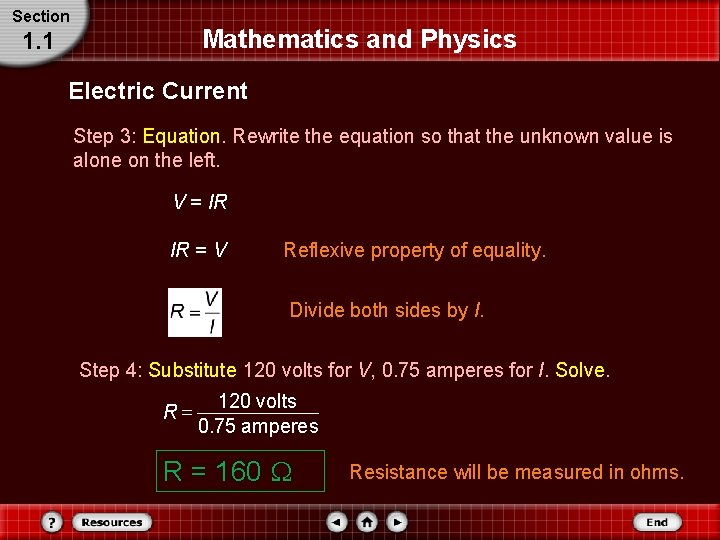
Section Mathematics and Physics 1. 1 Electric Current Step 3: Equation. Rewrite the equation so that the unknown value is alone on the left. V = IR IR = V Reflexive property of equality. Divide both sides by I. Step 4: Substitute 120 volts for V, 0. 75 amperes for I. Solve. R= 120 volts 0. 75 amperes R = 160 Resistance will be measured in ohms.
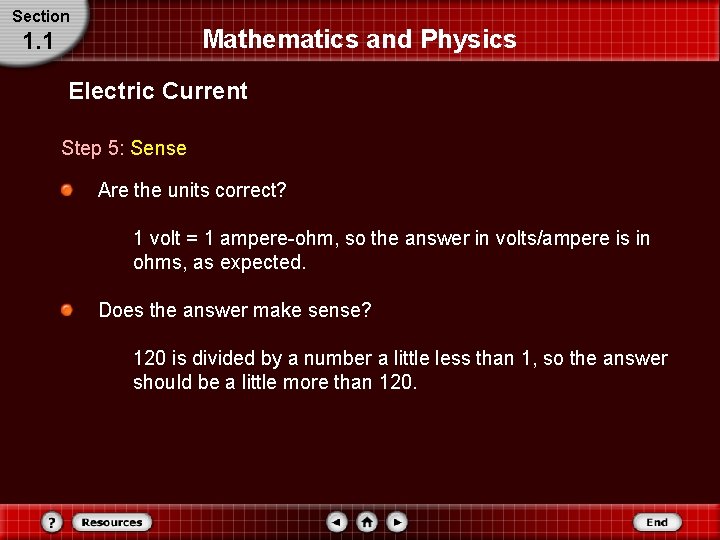
Section Mathematics and Physics 1. 1 Electric Current Step 5: Sense Are the units correct? 1 volt = 1 ampere-ohm, so the answer in volts/ampere is in ohms, as expected. Does the answer make sense? 120 is divided by a number a little less than 1, so the answer should be a little more than 120.
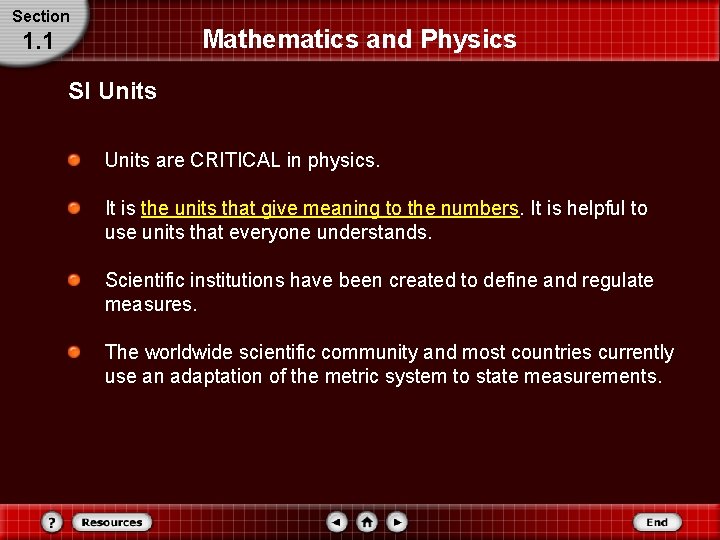
Section Mathematics and Physics 1. 1 SI Units are CRITICAL in physics. It is the units that give meaning to the numbers. It is helpful to use units that everyone understands. Scientific institutions have been created to define and regulate measures. The worldwide scientific community and most countries currently use an adaptation of the metric system to state measurements.
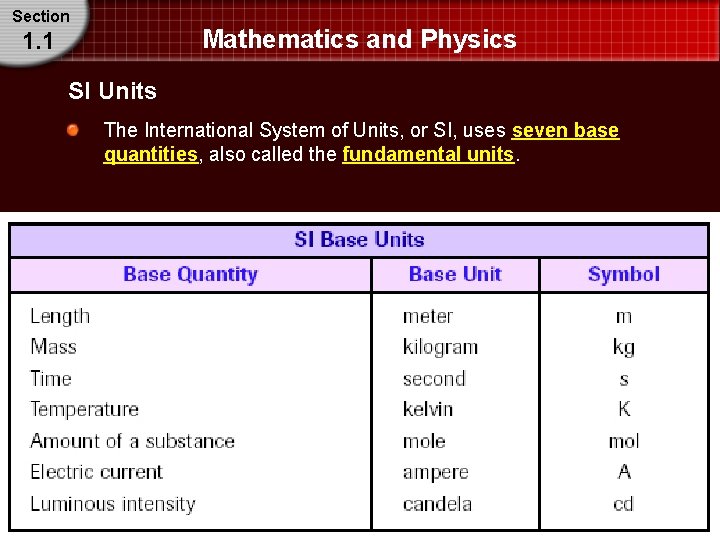
Section Mathematics and Physics 1. 1 SI Units The International System of Units, or SI, uses seven base quantities, also called the fundamental units.
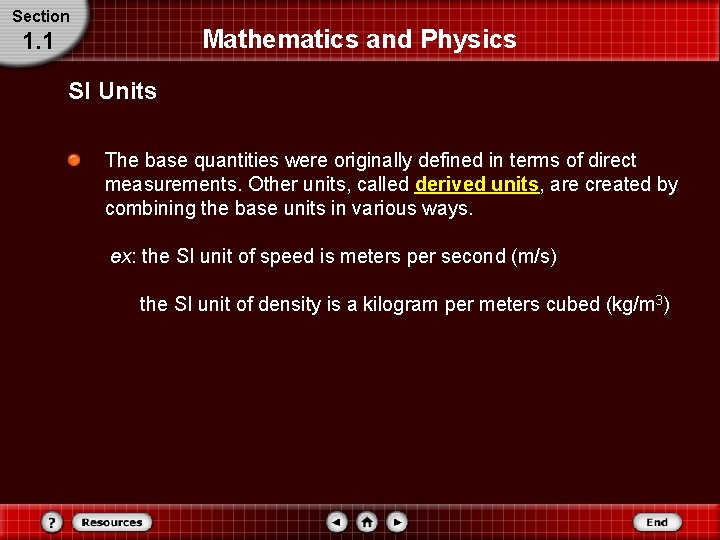
Section Mathematics and Physics 1. 1 SI Units The base quantities were originally defined in terms of direct measurements. Other units, called derived units, are created by combining the base units in various ways. ex: the SI unit of speed is meters per second (m/s) the SI unit of density is a kilogram per meters cubed (kg/m 3)
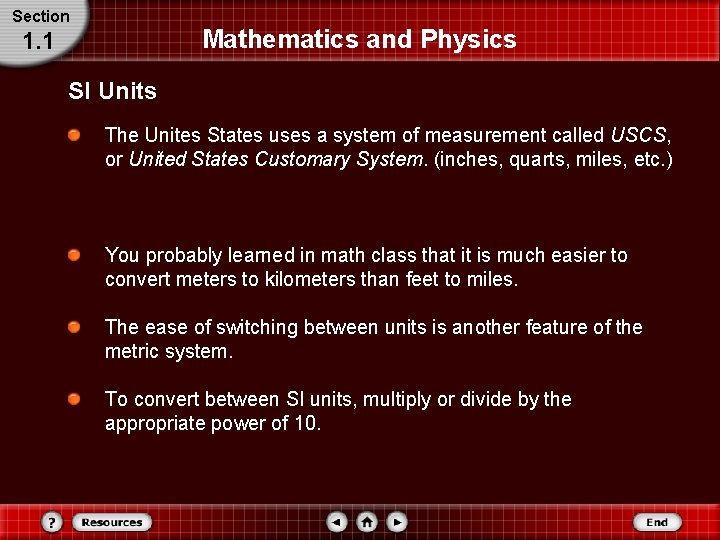
Section Mathematics and Physics 1. 1 SI Units The Unites States uses a system of measurement called USCS, or United States Customary System. (inches, quarts, miles, etc. ) You probably learned in math class that it is much easier to convert meters to kilometers than feet to miles. The ease of switching between units is another feature of the metric system. To convert between SI units, multiply or divide by the appropriate power of 10.
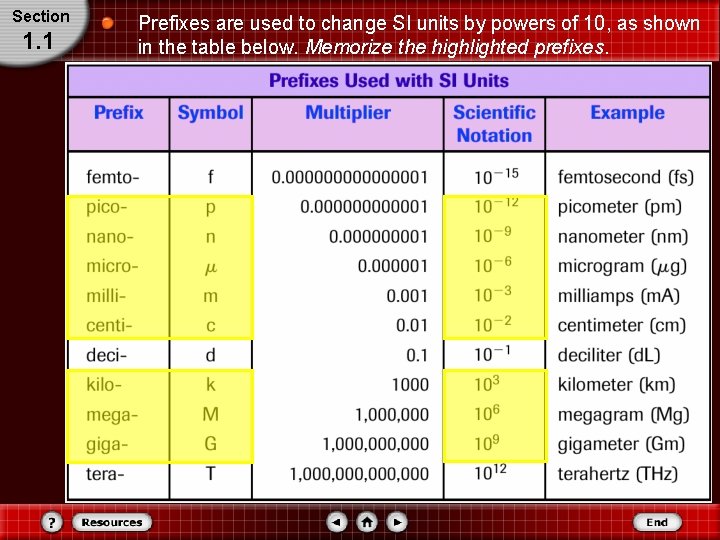
Section 1. 1 Prefixes are used to change SI units by powers of 10, as shown in the table below. Memorize the highlighted prefixes.
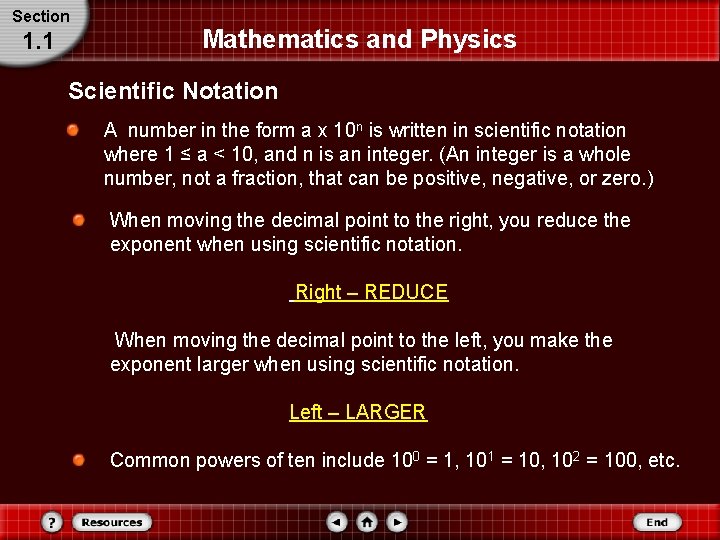
Section 1. 1 Mathematics and Physics Scientific Notation A number in the form a x 10 n is written in scientific notation where 1 ≤ a < 10, and n is an integer. (An integer is a whole number, not a fraction, that can be positive, negative, or zero. ) When moving the decimal point to the right, you reduce the exponent when using scientific notation. Right – REDUCE When moving the decimal point to the left, you make the exponent larger when using scientific notation. Left – LARGER Common powers of ten include 100 = 1, 101 = 10, 102 = 100, etc.
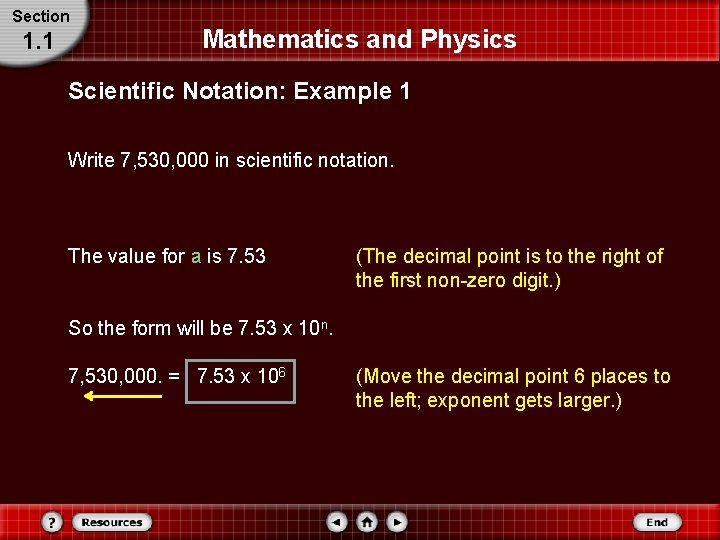
Section 1. 1 Mathematics and Physics Scientific Notation: Example 1 Write 7, 530, 000 in scientific notation. The value for a is 7. 53 (The decimal point is to the right of the first non-zero digit. ) So the form will be 7. 53 x 10 n. 7, 530, 000. = 7. 53 x 106 (Move the decimal point 6 places to the left; exponent gets larger. )
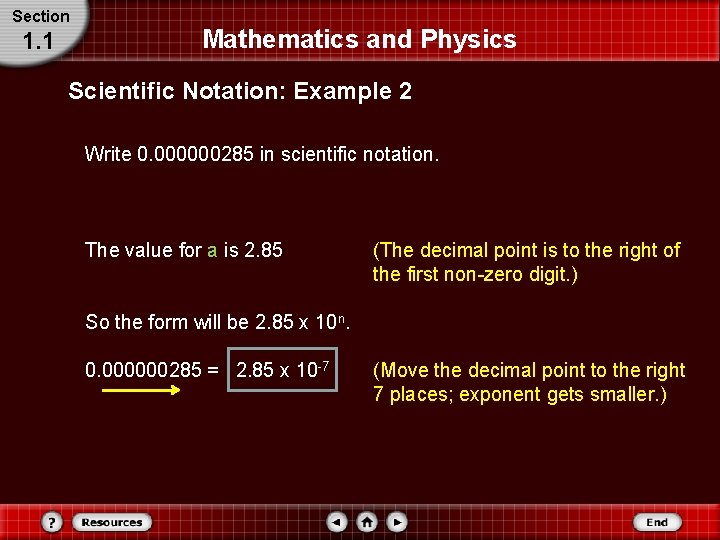
Section 1. 1 Mathematics and Physics Scientific Notation: Example 2 Write 0. 000000285 in scientific notation. The value for a is 2. 85 (The decimal point is to the right of the first non-zero digit. ) So the form will be 2. 85 x 10 n. 0. 000000285 = 2. 85 x 10 -7 (Move the decimal point to the right 7 places; exponent gets smaller. )
Section 1. 1 Please Do Now Where in the real world (other than Physics class) might you need to convert units? Write (3) lines describing the situation.
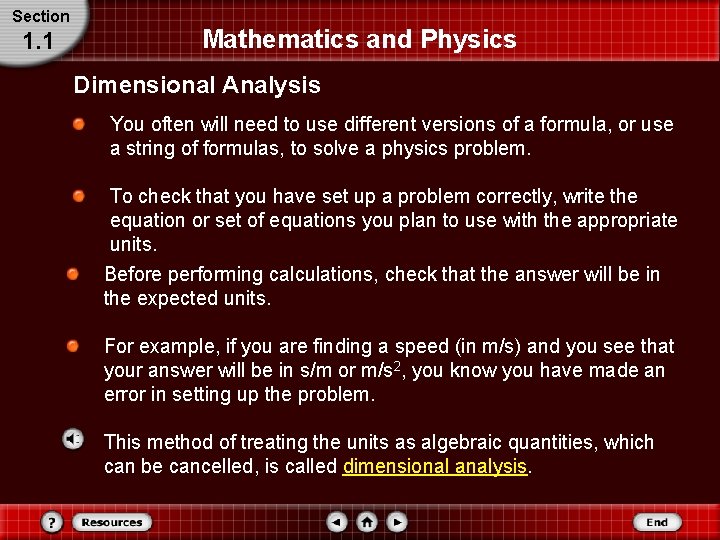
Section 1. 1 Mathematics and Physics Dimensional Analysis You often will need to use different versions of a formula, or use a string of formulas, to solve a physics problem. To check that you have set up a problem correctly, write the equation or set of equations you plan to use with the appropriate units. Before performing calculations, check that the answer will be in the expected units. For example, if you are finding a speed (in m/s) and you see that your answer will be in s/m or m/s 2, you know you have made an error in setting up the problem. This method of treating the units as algebraic quantities, which can be cancelled, is called dimensional analysis.
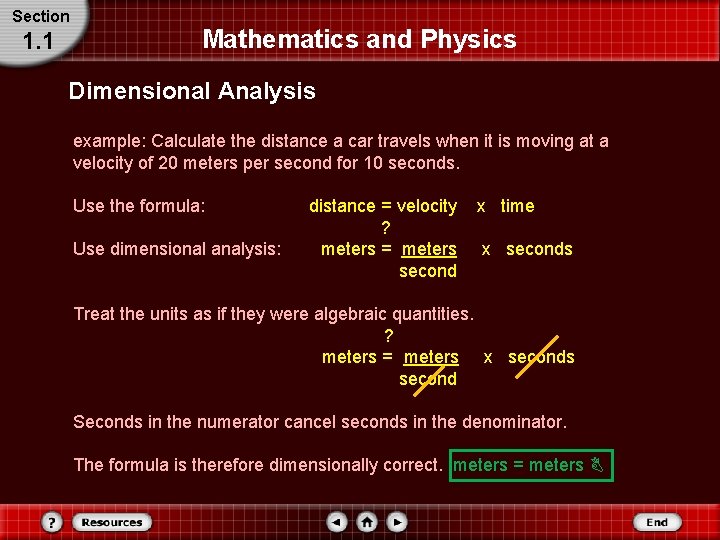
Section 1. 1 Mathematics and Physics Dimensional Analysis example: Calculate the distance a car travels when it is moving at a velocity of 20 meters per second for 10 seconds. Use the formula: Use dimensional analysis: distance = velocity ? meters = meters second x time x seconds Treat the units as if they were algebraic quantities. ? meters = meters x seconds second Seconds in the numerator cancel seconds in the denominator. The formula is therefore dimensionally correct. meters = meters
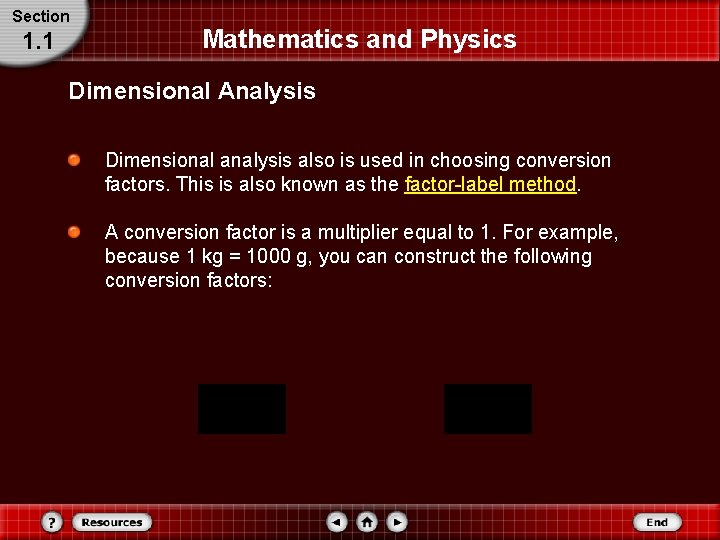
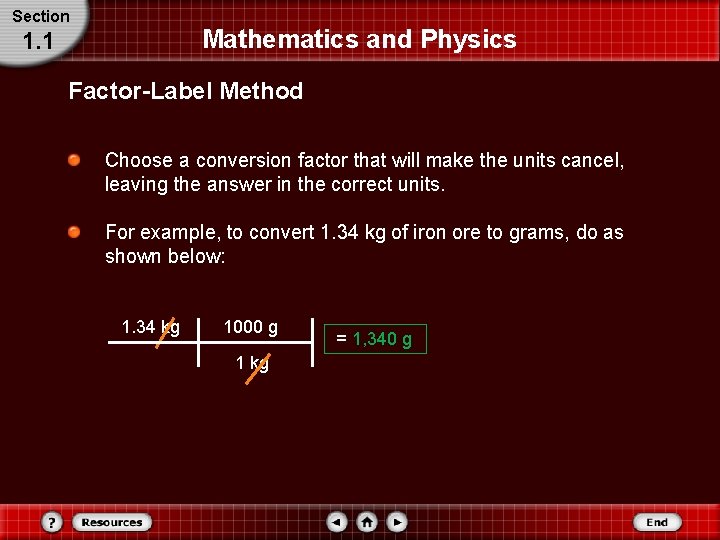
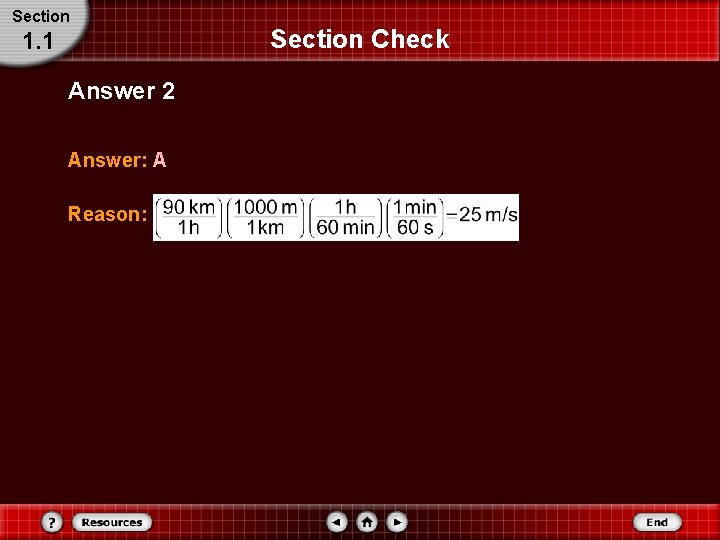
Section 1. 1 Mathematics and Physics Dimensional Analysis Dimensional analysis also is used in choosing conversion factors. This is also known as the factor-label method. A conversion factor is a multiplier equal to 1. For example, because 1 kg = 1000 g, you can construct the following conversion factors:
Section Mathematics and Physics 1. 1 Factor-Label Method Choose a conversion factor that will make the units cancel, leaving the answer in the correct units. For example, to convert 1. 34 kg of iron ore to grams, do as shown below: 1. 34 kg 1000 g 1 kg = 1, 340 g
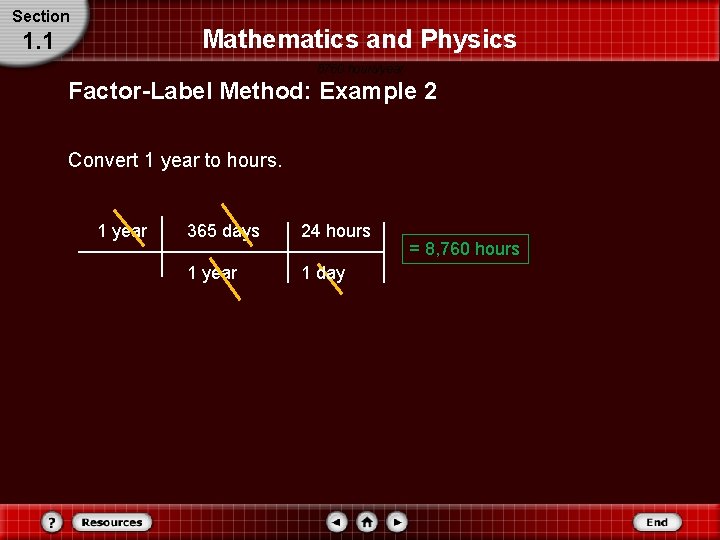
Section Mathematics and Physics 1. 1 8760 hours/year Factor-Label Method: Example 2 Convert 1 year to hours. 1 year 365 days 24 hours 1 year 1 day = 8, 760 hours
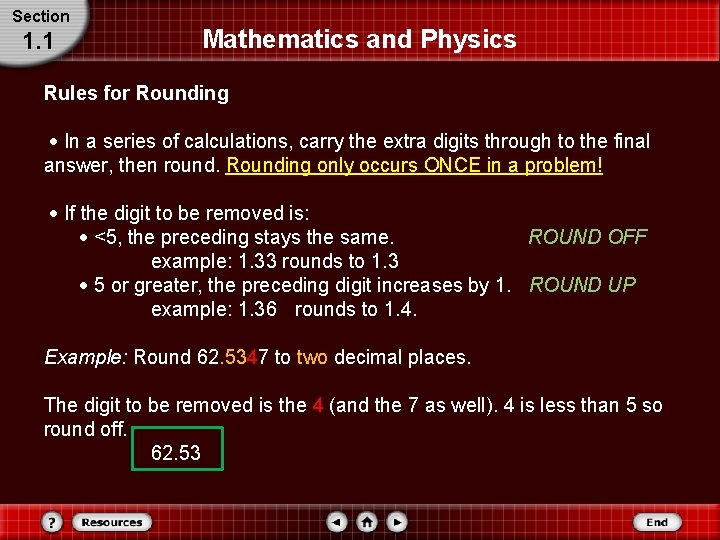
Section 1. 1 Mathematics and Physics Rules for Rounding In a series of calculations, carry the extra digits through to the final answer, then round. Rounding only occurs ONCE in a problem! If the digit to be removed is: <5, the preceding stays the same. ROUND OFF example: 1. 33 rounds to 1. 3 5 or greater, the preceding digit increases by 1. ROUND UP example: 1. 36 rounds to 1. 4. Example: Round 62. 5347 to two decimal places. The digit to be removed is the 4 (and the 7 as well). 4 is less than 5 so round off. 62. 53
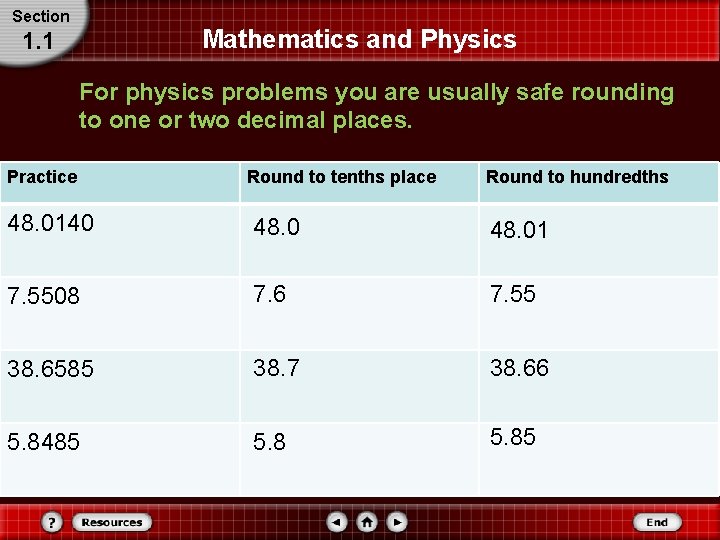
Section Mathematics and Physics 1. 1 For physics problems you are usually safe rounding to one or two decimal places. Practice Round to tenths place Round to hundredths 48. 0140 48. 01 7. 5508 7. 6 7. 55 38. 6585 38. 7 38. 66 5. 8485 5. 85
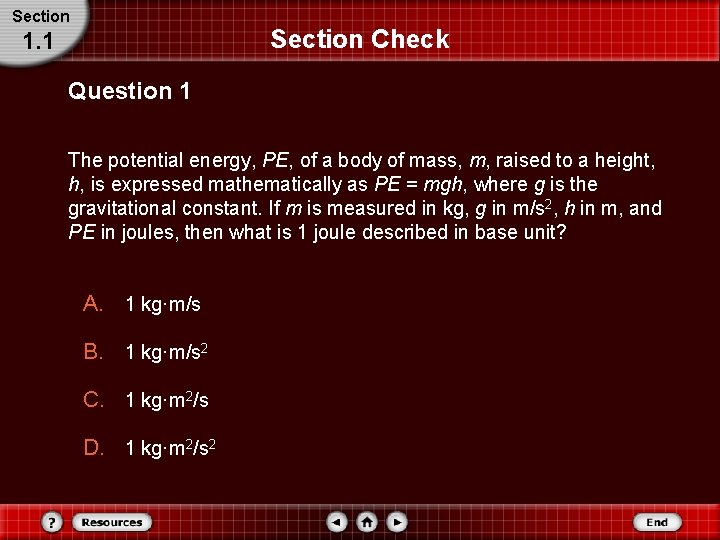
Section Check 1. 1 Question 1 The potential energy, PE, of a body of mass, m, raised to a height, h, is expressed mathematically as PE = mgh, where g is the gravitational constant. If m is measured in kg, g in m/s 2, h in m, and PE in joules, then what is 1 joule described in base unit? A. 1 kg·m/s B. 1 kg·m/s 2 C. 1 kg·m 2/s D. 1 kg·m 2/s 2
Section 1. 1 Answer: D Reason: Section Check
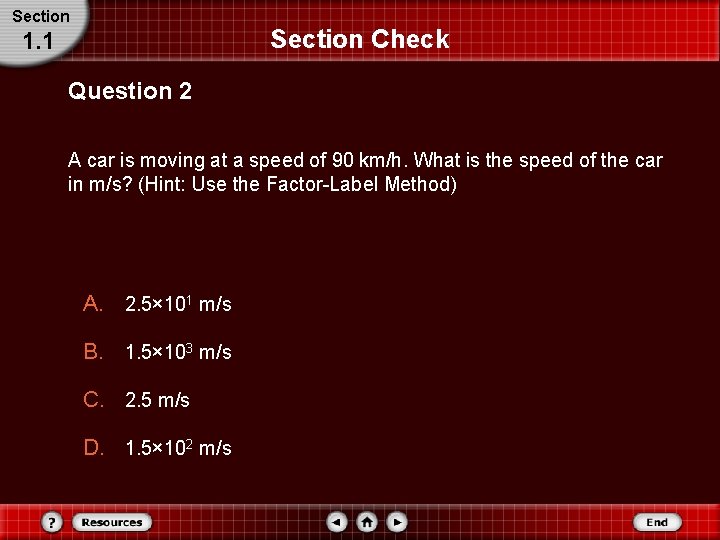
Section Check 1. 1 Question 2 A car is moving at a speed of 90 km/h. What is the speed of the car in m/s? (Hint: Use the Factor-Label Method) A. 2. 5× 101 m/s B. 1. 5× 10³ m/s C. 2. 5 m/s D. 1. 5× 10² m/s
Section 1. 1 Answer 2 Answer: A Reason: Section Check
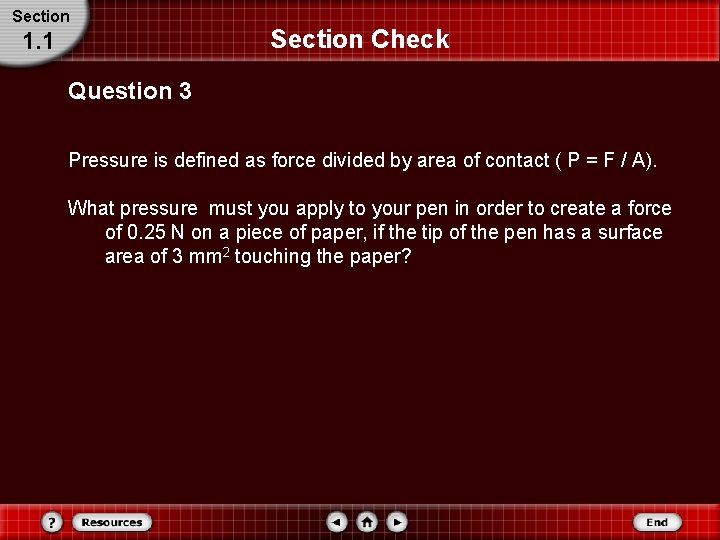
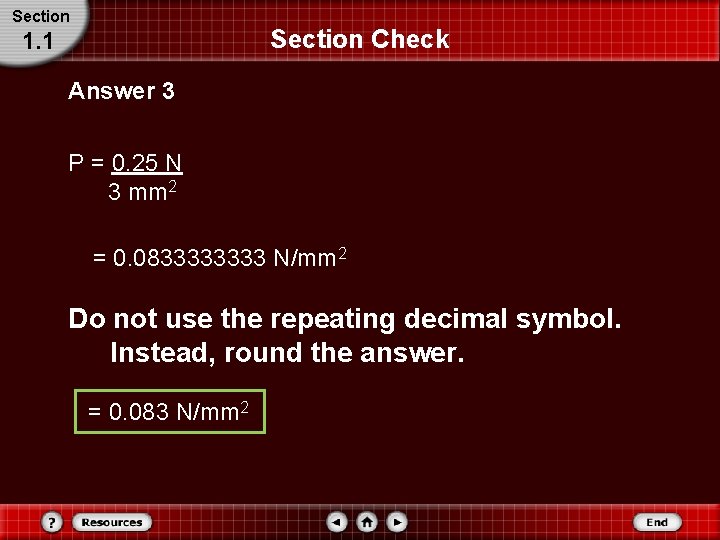
Section 1. 1 Section Check Question 3 Pressure is defined as force divided by area of contact ( P = F / A). What pressure must you apply to your pen in order to create a force of 0. 25 N on a piece of paper, if the tip of the pen has a surface area of 3 mm 2 touching the paper?
Section Check 1. 1 Answer 3 P = 0. 25 N 3 mm 2 = 0. 083333 N/mm 2 Do not use the repeating decimal symbol. Instead, round the answer. = 0. 083 N/mm 2