
Chapter 1 A PHYSICS TOOLKIT Chapter 1 Section
- Slides: 22
Chapter 1 A PHYSICS TOOLKIT
Chapter 1 Section 1 Mathematics and Physics
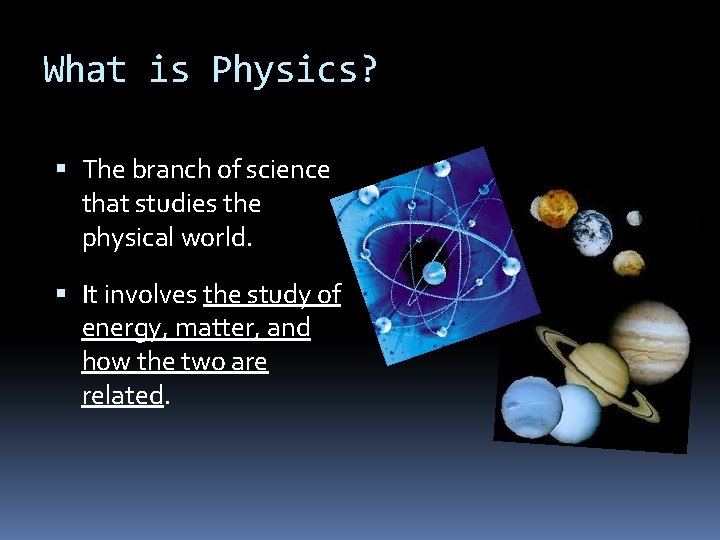
What is Physics? The branch of science that studies the physical world. It involves the study of energy, matter, and how the two are related.
Scientific Methods Scientific Law Scientific Theories A rule of nature that sums up related observations to describe a pattern in nature. An explanation based on many observations supported by experimental results. Laws do not explain WHY these phenomena occur, they simply describe them. Ex. The Law of Universal Gravitation Theories may serve as explanations for laws. Ex. Theory of Universal Gravitation
Mathematics in Physics often uses mathematics as its language. This chapter offers a set of math skills you will be useful throughout the course.
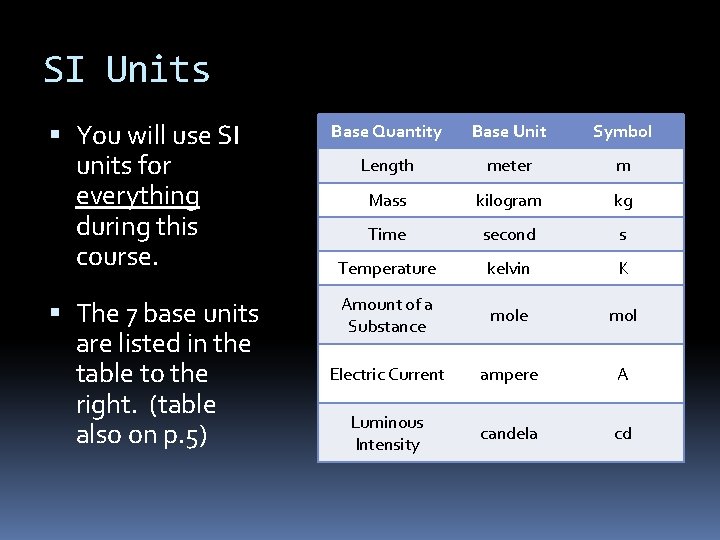
SI Units You will use SI units for everything during this course. The 7 base units are listed in the table to the right. (table also on p. 5) Base Quantity Base Unit Symbol Length meter m Mass kilogram kg Time second s Temperature kelvin K Amount of a Substance mol Electric Current ampere A Luminous Intensity candela cd
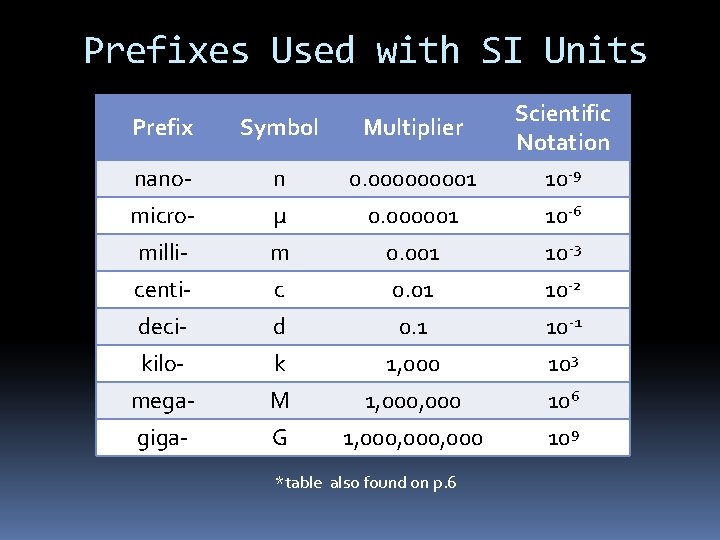
Prefixes Used with SI Units Prefix Symbol Multiplier Scientific Notation nano- n 0. 00001 10 -9 micro- μ 0. 000001 10 -6 milli- m 0. 001 10 -3 centi- c 0. 01 10 -2 deci- d 0. 1 10 -1 kilo- k 1, 000 103 mega- M 1, 000 106 giga- G 1, 000, 000 109 *table also found on p. 6
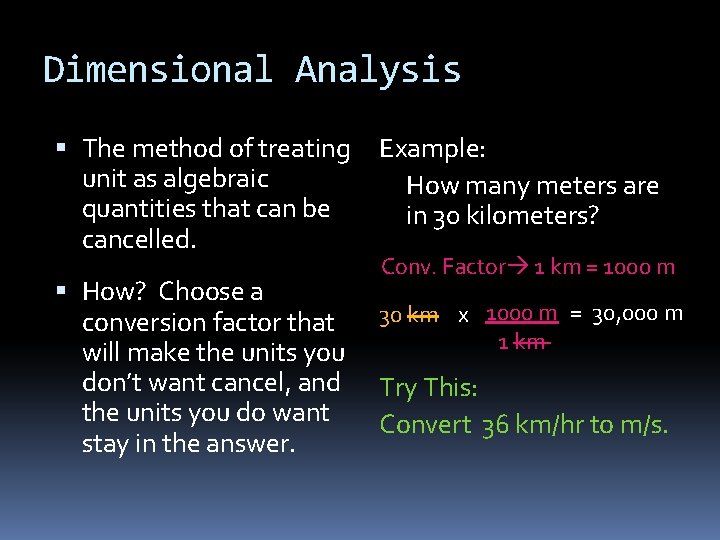
Dimensional Analysis The method of treating unit as algebraic quantities that can be cancelled. How? Choose a conversion factor that will make the units you don’t want cancel, and the units you do want stay in the answer. Example: How many meters are in 30 kilometers? Conv. Factor 1 km = 1000 m 30 km x 1000 m = 30, 000 m 1 km Try This: Convert 36 km/hr to m/s.
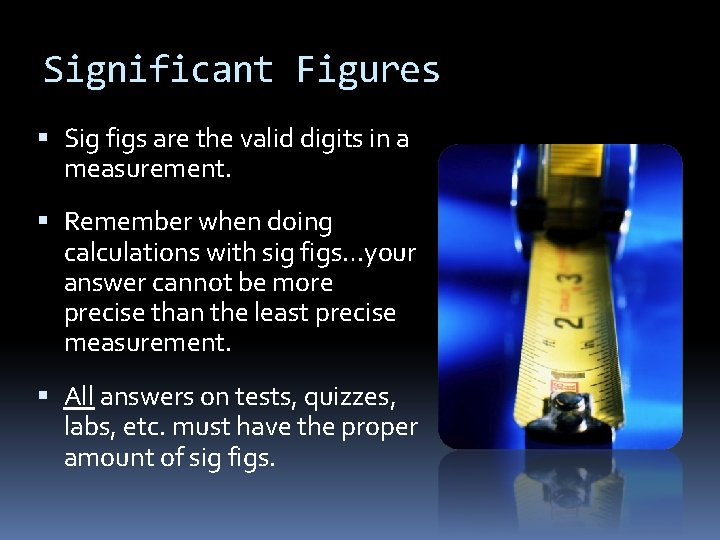
Significant Figures Sig figs are the valid digits in a measurement. Remember when doing calculations with sig figs…your answer cannot be more precise than the least precise measurement. All answers on tests, quizzes, labs, etc. must have the proper amount of sig figs.
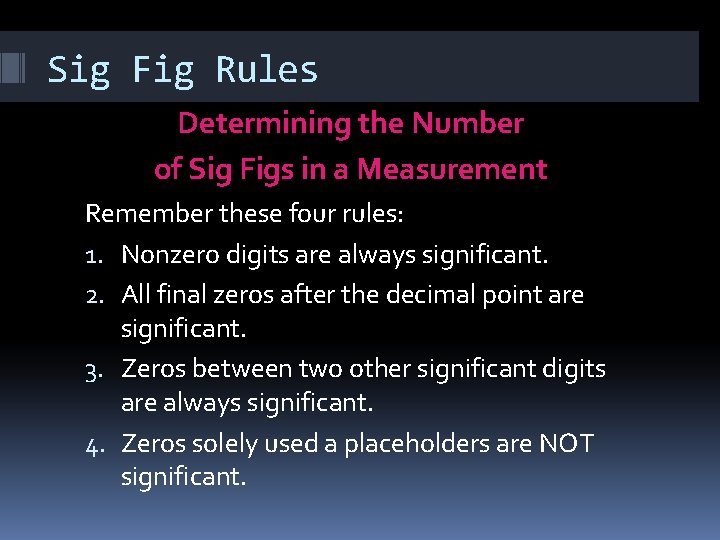
Sig Fig Rules Determining the Number of Sig Figs in a Measurement Remember these four rules: 1. Nonzero digits are always significant. 2. All final zeros after the decimal point are significant. 3. Zeros between two other significant digits are always significant. 4. Zeros solely used a placeholders are NOT significant.
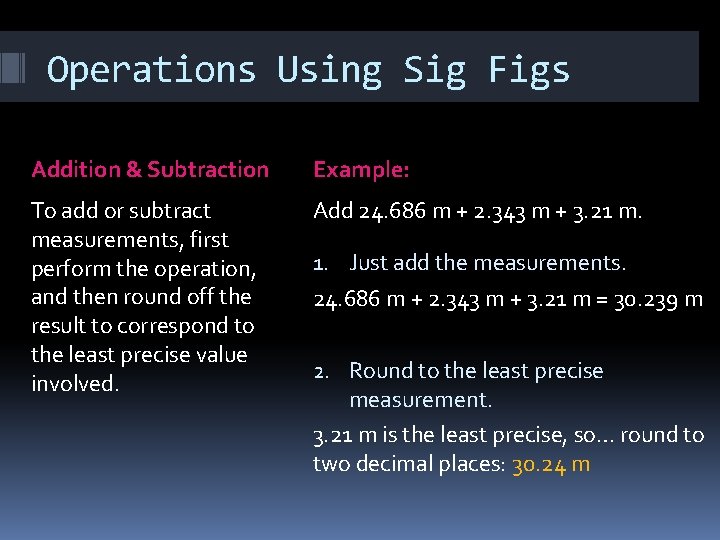
Operations Using Sig Figs Addition & Subtraction Example: To add or subtract measurements, first perform the operation, and then round off the result to correspond to the least precise value involved. Add 24. 686 m + 2. 343 m + 3. 21 m. 1. Just add the measurements. 24. 686 m + 2. 343 m + 3. 21 m = 30. 239 m 2. Round to the least precise measurement. 3. 21 m is the least precise, so… round to two decimal places: 30. 24 m
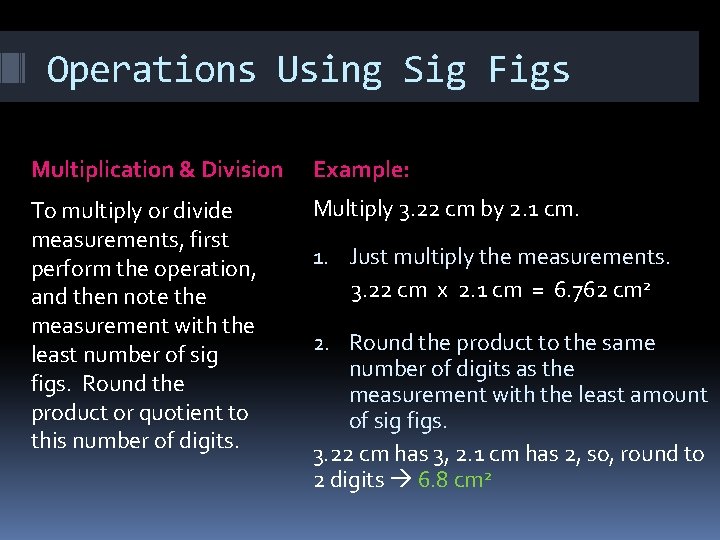
Operations Using Sig Figs Multiplication & Division Example: To multiply or divide measurements, first perform the operation, and then note the measurement with the least number of sig figs. Round the product or quotient to this number of digits. Multiply 3. 22 cm by 2. 1 cm. 1. Just multiply the measurements. 3. 22 cm x 2. 1 cm = 6. 762 cm 2 2. Round the product to the same number of digits as the measurement with the least amount of sig figs. 3. 22 cm has 3, 2. 1 cm has 2, so, round to 2 digits 6. 8 cm 2
Homework pg. 7 , 5 -8 pg. 8, 9 -12 (*use the correct # of sig figs)
Chapter 1 Section 2 Measurement
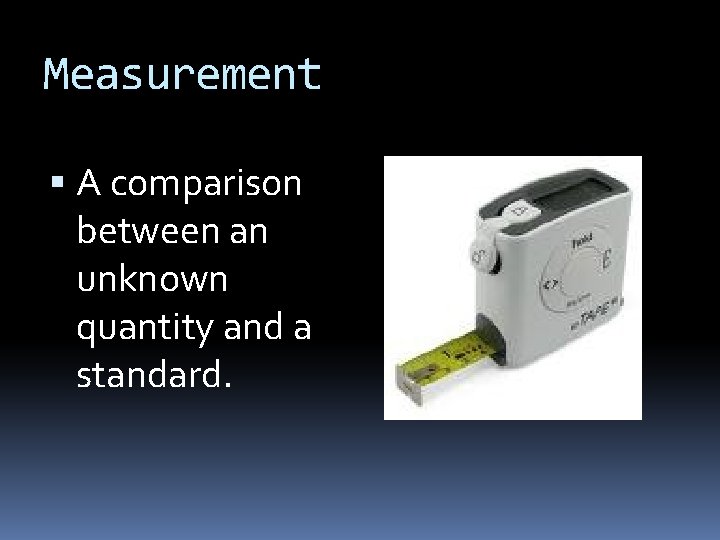
Measurement A comparison between an unknown quantity and a standard.
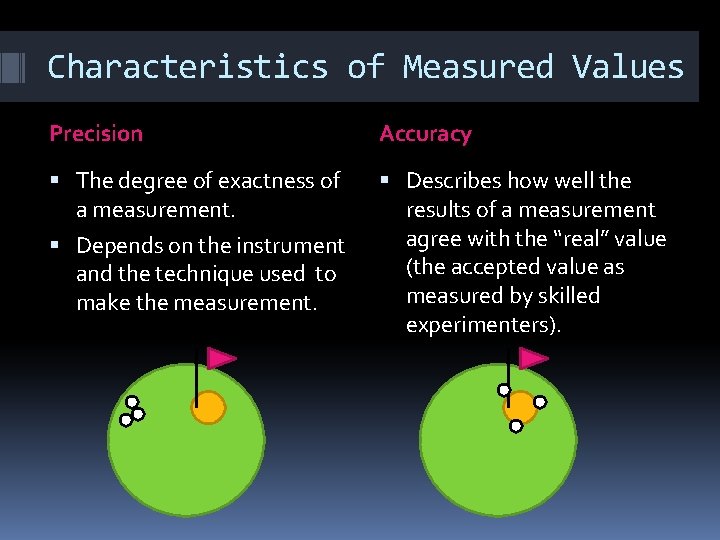
Characteristics of Measured Values Precision Accuracy The degree of exactness of a measurement. Describes how well the results of a measurement agree with the “real” value (the accepted value as measured by skilled experimenters). Depends on the instrument and the technique used to make the measurement.
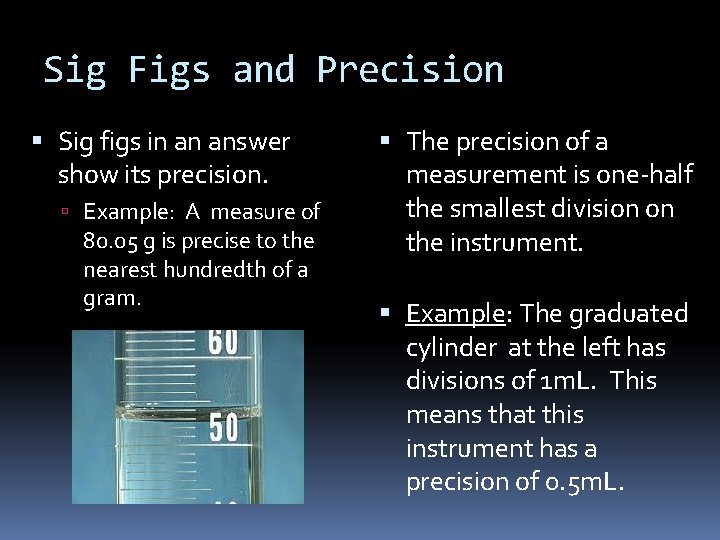
Sig Figs and Precision Sig figs in an answer show its precision. Example: A measure of 80. 05 g is precise to the nearest hundredth of a gram. The precision of a measurement is one-half the smallest division on the instrument. Example: The graduated cylinder at the left has divisions of 1 m. L. This means that this instrument has a precision of 0. 5 m. L.
Techniques of Good Measurement Know how to use the instrument you are using to obtain measurements. Use the instrument correctly. Handle instruments with care, to avoid damage. Always “zero” the instrument if necessary. Look straight at the markings at eye-level to avoid a parallax. Parallax – the apparent shift in the position of an object when it is viewed from different angles.
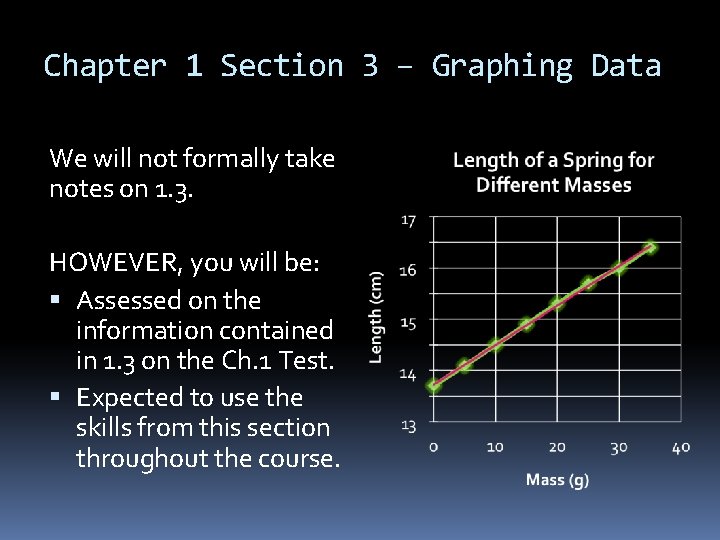
Chapter 1 Section 3 – Graphing Data We will not formally take notes on 1. 3. HOWEVER, you will be: Assessed on the information contained in 1. 3 on the Ch. 1 Test. Expected to use the skills from this section throughout the course.
What You Need To Know from 1. 3 It is expected that you already know how to do the following: Please make sure you know the following key terms from 1. 3: Graph the relationship between independent and dependent variables. Be able to interpret graphs. Be able to recognize common relationships in graphs. independent variable line of best fit linear relationship quadratic relationship inverse relationship slope
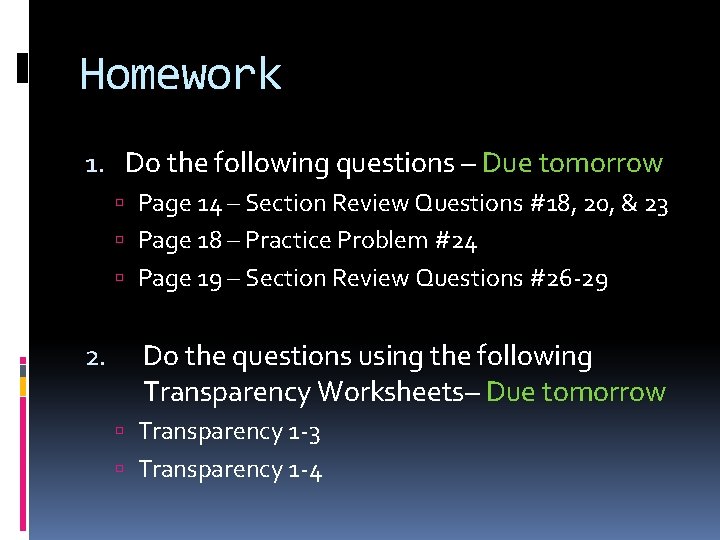
Homework 1. Do the following questions – Due tomorrow Page 14 – Section Review Questions #18, 20, & 23 Page 18 – Practice Problem #24 Page 19 – Section Review Questions #26 -29 2. Do the questions using the following Transparency Worksheets– Due tomorrow Transparency 1 -3 Transparency 1 -4
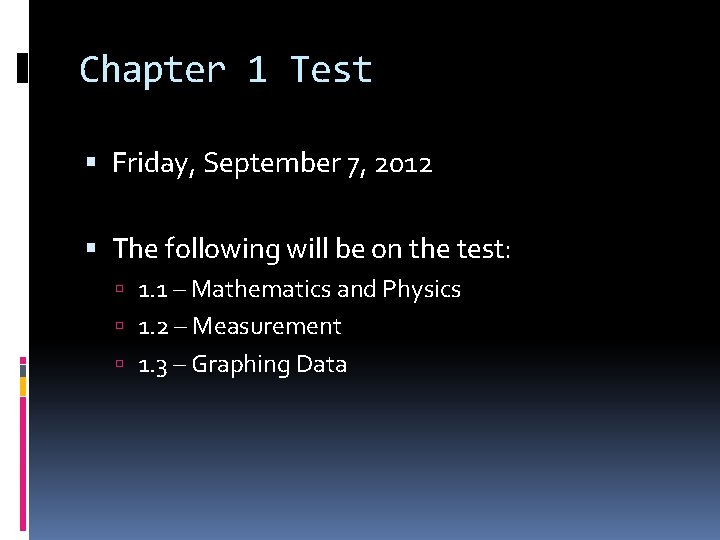
Chapter 1 Test Friday, September 7, 2012 The following will be on the test: 1. 1 – Mathematics and Physics 1. 2 – Measurement 1. 3 – Graphing Data