
Chapter 1 8 Principles of Balanced Literacy Instruction
Chapter 1 8 Principles of Balanced Literacy Instruction Literacy for the 21 st Century, 6 th ed. Gail E. Tompkins 3 © 2014 Pearson Education, Inc. All rights reserved.
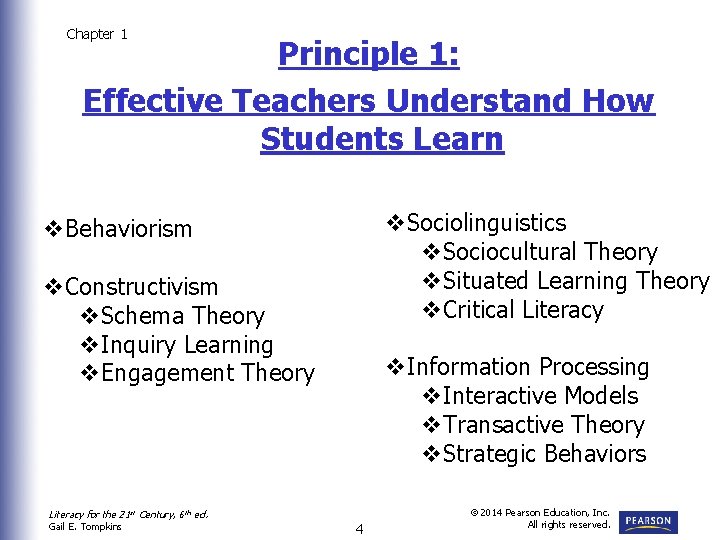
Chapter 1 Principle 1: Effective Teachers Understand How Students Learn v. Sociolinguistics v. Sociocultural Theory v. Situated Learning Theory v. Critical Literacy v. Behaviorism v. Constructivism v. Schema Theory v. Inquiry Learning v. Engagement Theory Literacy for the 21 st Century, 6 th ed. Gail E. Tompkins v. Information Processing v. Interactive Models v. Transactive Theory v. Strategic Behaviors 4 © 2014 Pearson Education, Inc. All rights reserved.
Chapter 1 Principle 2: Effective Teachers Support Students’ Use of the Cueing Systems Ø Ø The The Phonological System Syntactic System Semantic System Pragmatic System Literacy for the 21 st Century, 6 th ed. Gail E. Tompkins 5 © 2014 Pearson Education, Inc. All rights reserved.
Chapter 1 Principle 3: Effective Teachers Create a Community of Learners Ø Ø Safety Respect High Expectations Ø Risk Taking Ø Collaboration Ø Choice Ø Responsibility Family and community Involvement Literacy for the 21 st Century, 6 th ed. Gail E. Tompkins 6 © 2014 Pearson Education, Inc. All rights reserved.
Chapter 1 Principle 4: Effective Teachers Adopt a Balanced Approach to Instruction Ø Ø Ø Characteristics of a balanced approach Components of a balanced approach Common Core State Standards Literacy for the 21 st Century, 6 th ed. Gail E. Tompkins 7 © 2014 Pearson Education, Inc. All rights reserved.
Chapter 1 Principle 5: Effective Teachers Scaffold Students’ Reading and Writing Ø Ø Ø Modeled Reading and Writing Shared Reading and Writing Interactive Reading and Writing Guided Reading and Writing Independent Reading and Writing Literacy for the 21 st Century, 6 th ed. Gail E. Tompkins 8 © 2014 Pearson Education, Inc. All rights reserved.
Chapter 1 Principle 6: Effective Teachers Organize for Literacy Instruction Ø Ø Ø Basal Reading Programs Literature Focus Units Literature Circles Reading and Writing Workshop Nurturing English Learners Literacy for the 21 st Century, 6 th ed. Gail E. Tompkins 9 © 2014 Pearson Education, Inc. All rights reserved.
Chapter 1 Principle 7: Effective Teachers Differentiate Instruction Ø Ø Ø Differentiating the Content Differentiating the Process Differentiating the Products Literacy for the 21 st Century, 6 th ed. Gail E. Tompkins 10 © 2014 Pearson Education, Inc. All rights reserved.
Chapter 1 Ø Ø Ø Principle 8: Effective Teachers Link Instruction and Assessment 4 steps to link instruction and assessment Ø Planning Ø Monitoring Ø Evaluating Ø Reflecting Classroom Assessment Tools High Stakes Tests Literacy for the 21 st Century, 6 th ed. Gail E. Tompkins 11 © 2014 Pearson Education, Inc. All rights reserved.
Chapter 1 How Effective Teachers Teach Reading and Writing n n n Teachers apply learning theories as they teach reading and writing. Teachers create a community of learners in their classrooms. Teachers adopt the balanced approach to literacy instruction. Teachers differentiate instruction so all students can be successful. Teachers link instruction and assessment. Literacy for the 21 st Century, 6 th ed. Gail E. Tompkins 12 © 2014 Pearson Education, Inc. All rights reserved.
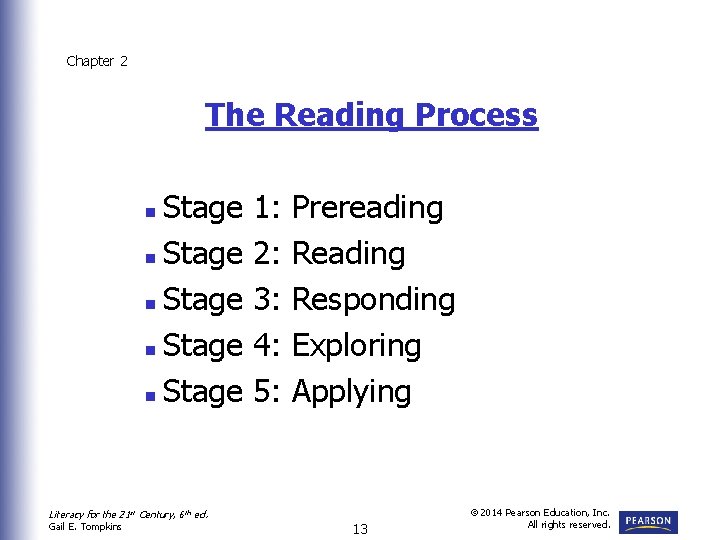
Chapter 2 The Reading Process Stage n Stage n Literacy for the 21 st Century, 6 th ed. Gail E. Tompkins 1: 2: 3: 4: 5: Prereading Responding Exploring Applying 13 © 2014 Pearson Education, Inc. All rights reserved.
Chapter 2 How Effective Teachers Teach the Reading and Writing Process n n n Teachers use the reading process—prereading, responding, exploring, and applying—to ensure that students comprehend books they read. Teachers provide opportunities for students to use varied types of reading, including independent reading, guided reading, and interactive read-alouds. Teachers teach students how to use the writing process—prewriting, drafting, revising, editing, and publishing—to write and refine their compositions. Teachers teach students about the writer’s craft. Including the six traits. Teachers integrate reading and writing because they’re reciprocal meaning-making processes. Literacy for the 21 st Century, 6 th ed. Gail E. Tompkins 14 © 2014 Pearson Education, Inc. All rights reserved.
- Slides: 14