
Chapter 1 1 NOTES What is Science Definition

- Slides: 14
Chapter 1. 1 NOTES: What is Science?
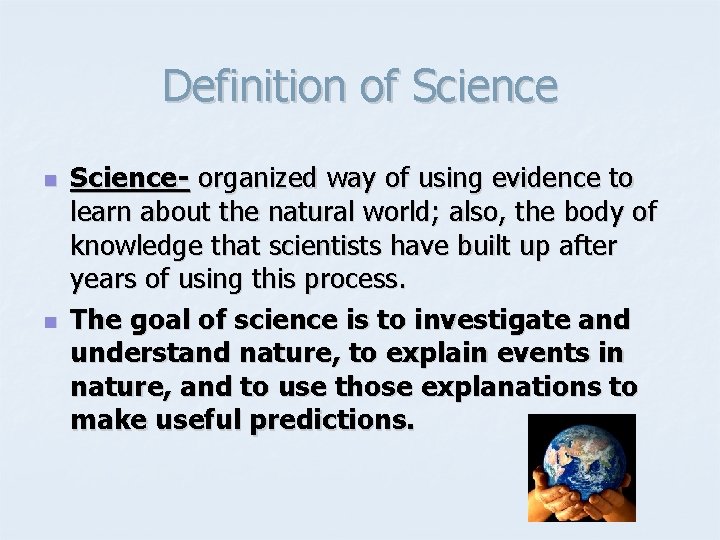
Definition of Science n n Science- organized way of using evidence to learn about the natural world; also, the body of knowledge that scientists have built up after years of using this process. The goal of science is to investigate and understand nature, to explain events in nature, and to use those explanations to make useful predictions.
What does not science study? n Science does not address questions that can’t be tested, such as whether and object is beautiful or this action is legal.
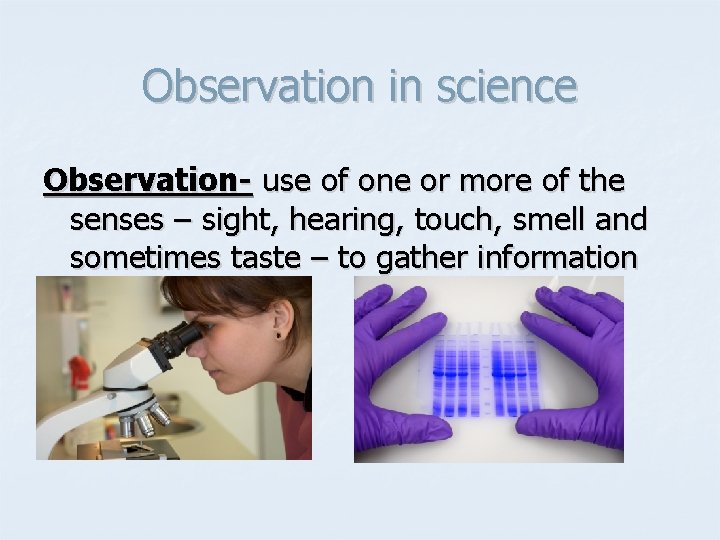
Observation in science Observation- use of one or more of the senses – sight, hearing, touch, smell and sometimes taste – to gather information
Data- evidence, information gathered from observations 1. Quantitative data - involve numbers ex: counting or measuring objects. 2. Qualitative data – involve characteristics that cannot be easily measured or counted, such as color or texture.
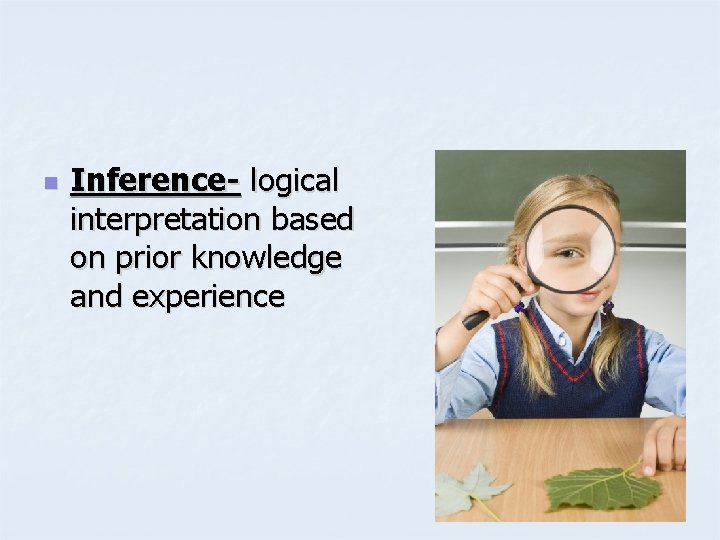
n Inference- logical interpretation based on prior knowledge and experience
What is a hypothesis? n Hypothesis- is a possible explanation for a set of observations or possible answer to a scientific question. A hypothesis is useful only if it can be tested. Hypotheses may arise from prior knowledge, logical inferences, or imaginative guesses. Whenever a hypothesis is wrong, it still have value in science because it helps researchers to advance scientific knowledge.
Science and Human Values Science contributes to health, disease, genes, stem cells and so much more. Science alone can’t answer all these questions. Answering questions requires the involvement of society. Some questions can be very sticky. Scientists alone can’t make decisions. Scientists need society to make decisions. That’s why; it is important to understand what science is, what is can do, and what it cannot do.
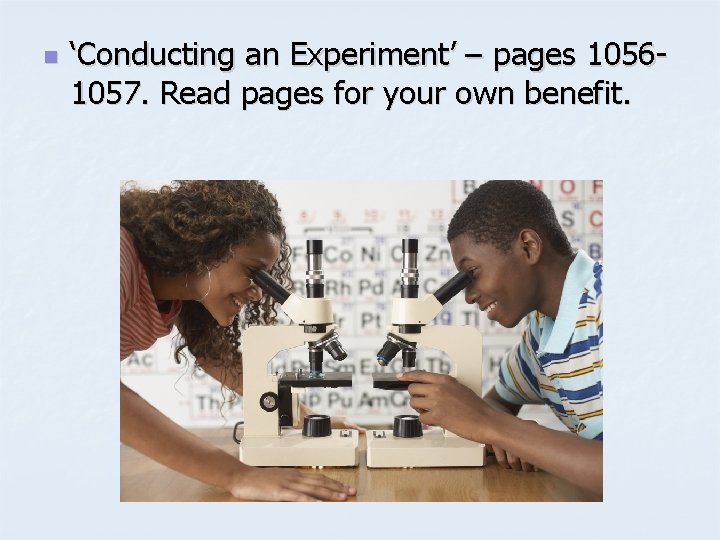
n ‘Conducting an Experiment’ – pages 10561057. Read pages for your own benefit.
1. What does science study? What does it not study?
2. What does it mean to describe a scientist as skeptical? Why is skepticism considered a valuable quality in a scientist?
3. What is the main difference between qualitative and quantitative observations?
4. Is a scientific hypothesis accepted if there is no way to prove that the hypothesis is wrong? Explain your answer.
5. Critical Thinking: Suppose a community proposes a law to require the wearing of seatbelts in all moving vehicles. How could science play a role in the decision?