
Chapter 1 0 The Information Age Digital Computers
- Slides: 40
Chapter 1. 0 The Information Age & Digital Computers
Programming Concepts • Part 1 : Computers – 1. 0. Information age and Digital Computers – 1. 1. Digital Computers : Hardware organization – 1. 2. Digital Computers : Operating Systems – 1. 3. Computer Networks – 1. 4. Programming Languages and Programming – 1. 5. History of Computing Devices
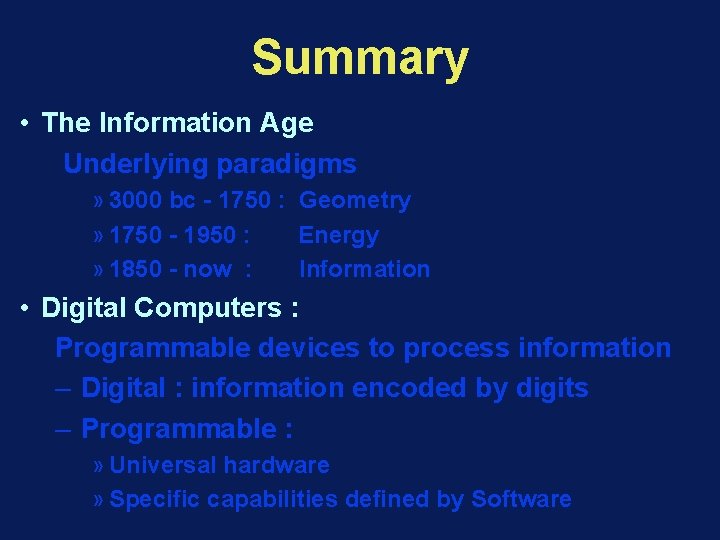
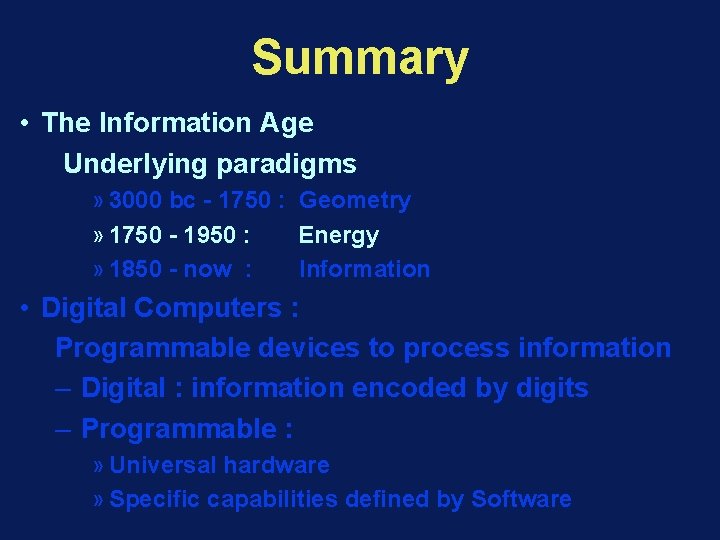
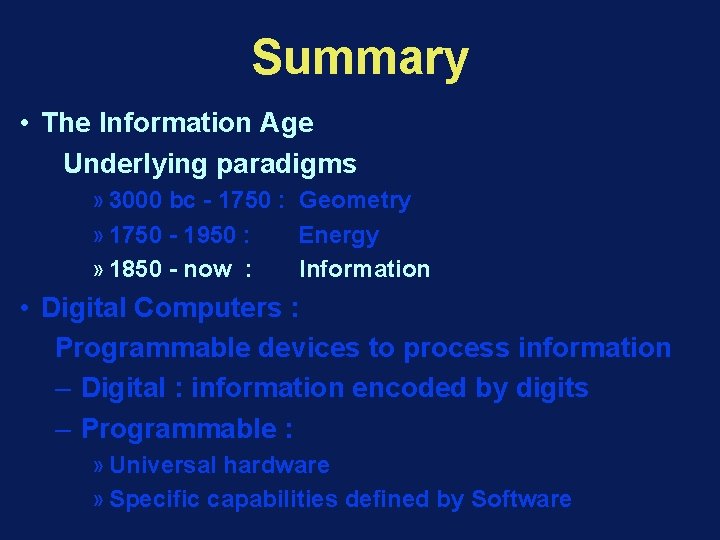
Summary • The Information Age Underlying paradigms » 3000 bc - 1750 : Geometry » 1750 - 1950 : Energy » 1850 - now : Information • Digital Computers : Programmable devices to process information – Digital : information encoded by digits – Programmable : » Universal hardware » Specific capabilities defined by Software
Summary • The Information Age Underlying paradigms » 3000 bc - 1750 : Geometry » 1750 - 1950 : Energy » 1850 - now : Information • Digital Computers : Programmable devices to process information – Digital : information encoded by digits – Programmable : » Universal hardware » Specific capabilities defined by Software
Geometry • Initiated 3000 bc in Egypt for practical purposes • Evolved into science in Middle East and Greece • Considerable influence on art and architecture • Many attempts to model universe by purely geometric constructs
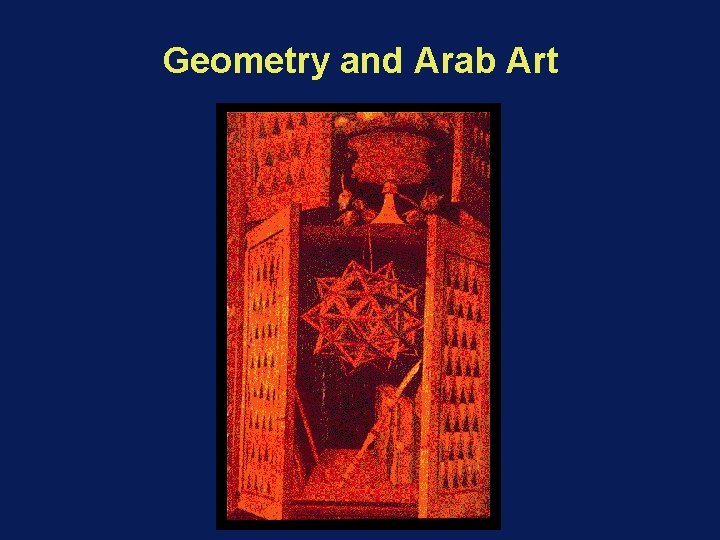
Geometry and Arab Art
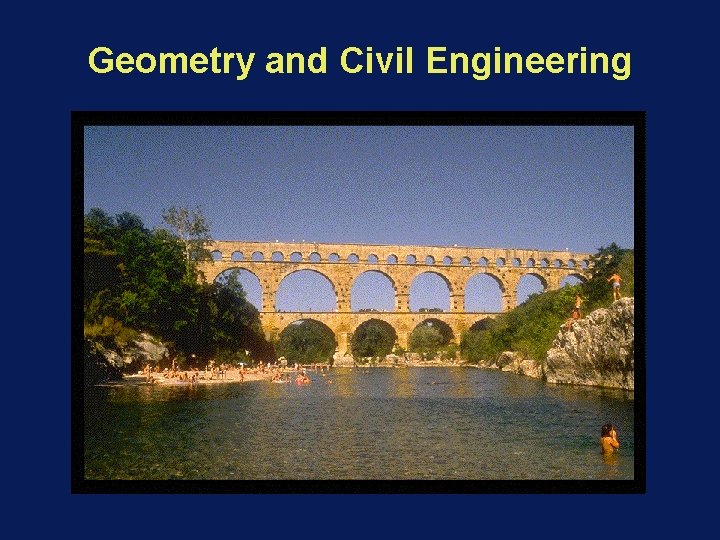
Geometry and Civil Engineering
Geometry • Initiated 3000 bc in Egypt for practical purposes • Evolved into science in Middle East and Greece • Considerable influence on art and architecture • Many attempts to model universe by purely geometric constructs
Summary • The Information Age Underlying paradigms » 3000 bc - 1750 : Geometry » 1750 - 1950 : Energy » 1850 - now : Information • Digital Computers : Programmable devices to process information – Digital : information encoded by digits – Programmable : » Universal hardware » Specific capabilities defined by Software
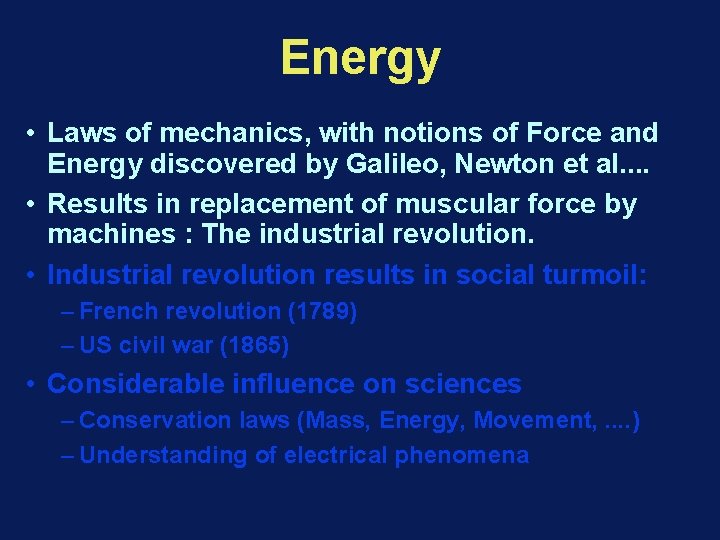
Energy • Laws of mechanics, with notions of Force and Energy discovered by Galileo, Newton et al. . • Results in replacement of muscular force by machines : The industrial revolution. • Industrial revolution results in social turmoil: – French revolution (1789) – US civil war (1865) • Considerable influence on sciences – Conservation laws (Mass, Energy, Movement, . . ) – Understanding of electrical phenomena
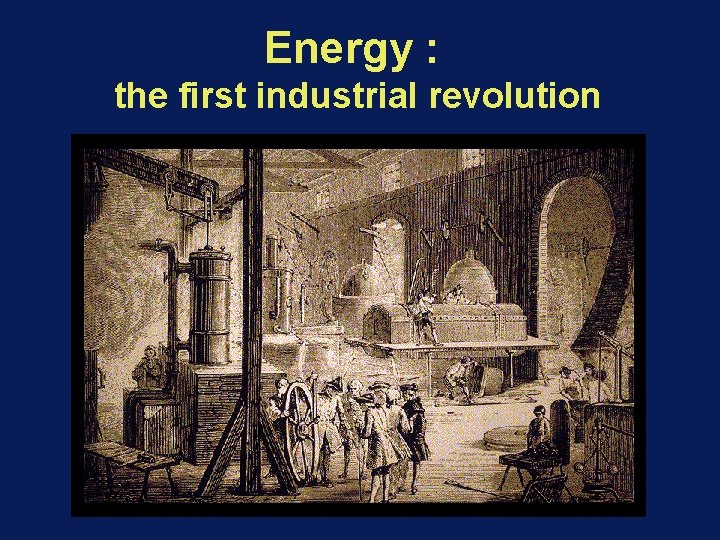
Energy : the first industrial revolution
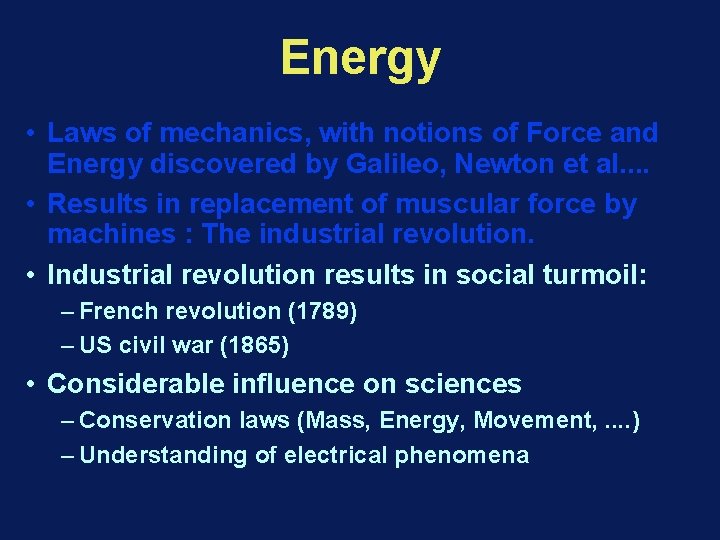
Energy • Laws of mechanics, with notions of Force and Energy discovered by Galileo, Newton et al. . • Results in replacement of muscular force by machines : The industrial revolution. • Industrial revolution results in social turmoil: – French revolution (1789) – US civil war (1865) • Considerable influence on sciences – Conservation laws (Mass, Energy, Movement, . . ) – Understanding of electrical phenomena
Summary • The Information Age Underlying paradigms » 3000 bc - 1750 : Geometry » 1750 - 1950 : Energy » 1850 - now : Information • Digital Computers : Programmable devices to process information – Digital : information encoded by digits – Programmable : » Universal hardware » Specific capabilities defined by Software
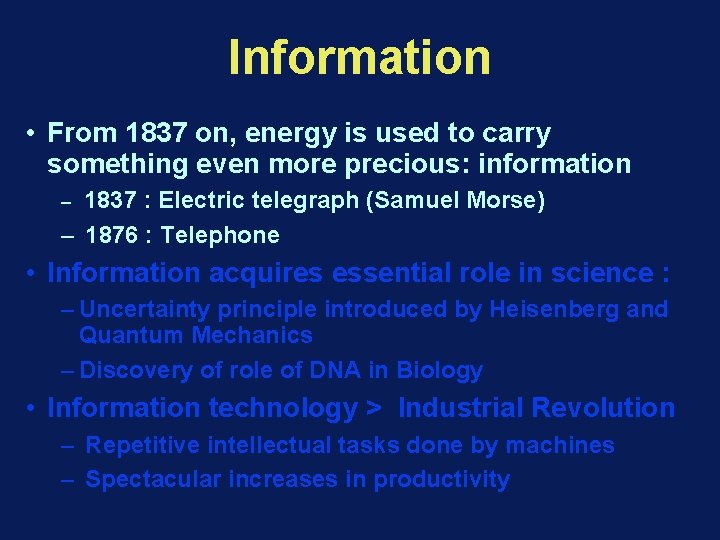
Information • From 1837 on, energy is used to carry something even more precious: information 1837 : Electric telegraph (Samuel Morse) – 1876 : Telephone – • Information acquires essential role in science : – Uncertainty principle introduced by Heisenberg and Quantum Mechanics – Discovery of role of DNA in Biology • Information technology > Industrial Revolution – Repetitive intellectual tasks done by machines – Spectacular increases in productivity
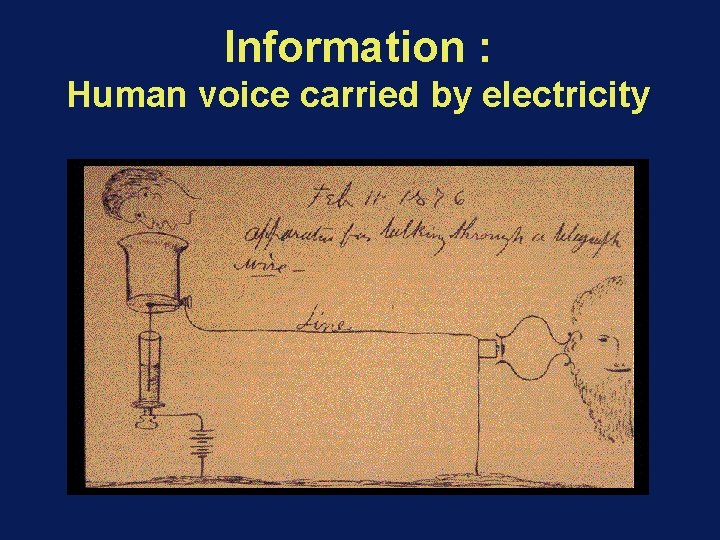
Information : Human voice carried by electricity
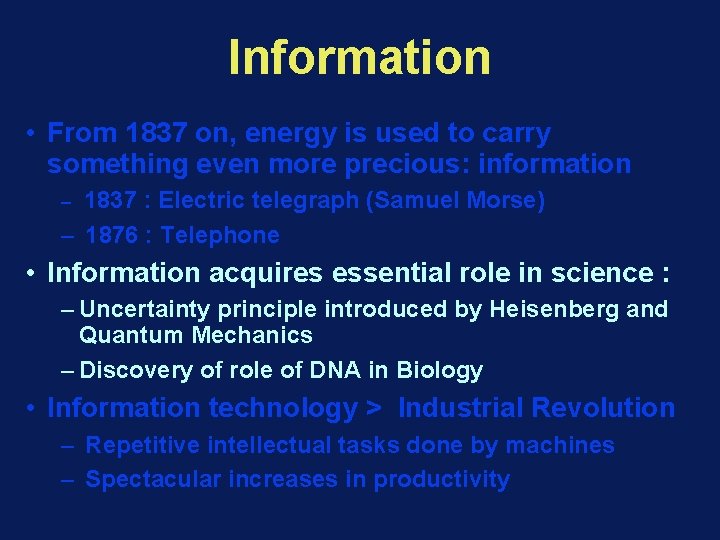
Information • From 1837 on, energy is used to carry something even more precious: information 1837 : Electric telegraph (Samuel Morse) – 1876 : Telephone – • Information acquires essential role in science : – Uncertainty principle introduced by Heisenberg and Quantum Mechanics – Discovery of role of DNA in Biology • Information technology > Industrial Revolution – Repetitive intellectual tasks done by machines – Spectacular increases in productivity
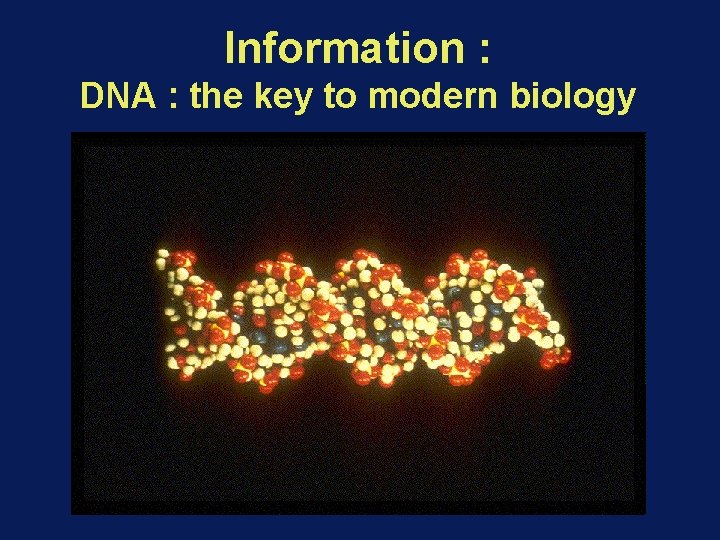
Information : DNA : the key to modern biology
Information • From 1837 on, energy is used to carry something even more precious: information 1837 : Electric telegraph (Samuel Morse) – 1876 : Telephone – • Information acquires essential role in science : – Uncertainty principle introduced by Heisenberg and Quantum Mechanics – Discovery of role of DNA in Biology • Information technology > Industrial Revolution – Repetitive intellectual tasks done by machines – Spectacular increases in productivity
Summary • The Information Age Underlying paradigms » 3000 bc - 1750 : Geometry » 1750 - 1950 : Energy » 1850 - now : Information • Digital Computers : Programmable devices to process information – Digital : information encoded by digits – Programmable : » Universal hardware » Specific capabilities defined by Software
Summary • The Information Age Underlying paradigms » 3000 bc - 1750 : Geometry » 1750 - 1950 : Energy » 1850 - now : Information • Digital Computers : Programmable devices to process information – Digital : information encoded by digits – Programmable : » Universal hardware » Specific capabilities defined by Software
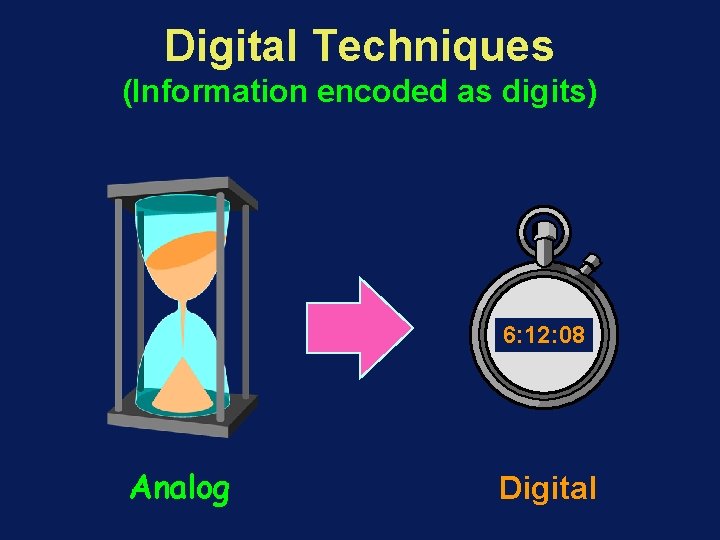
Digital Techniques (Information encoded as digits) 6: 12: 08 Analog Digital
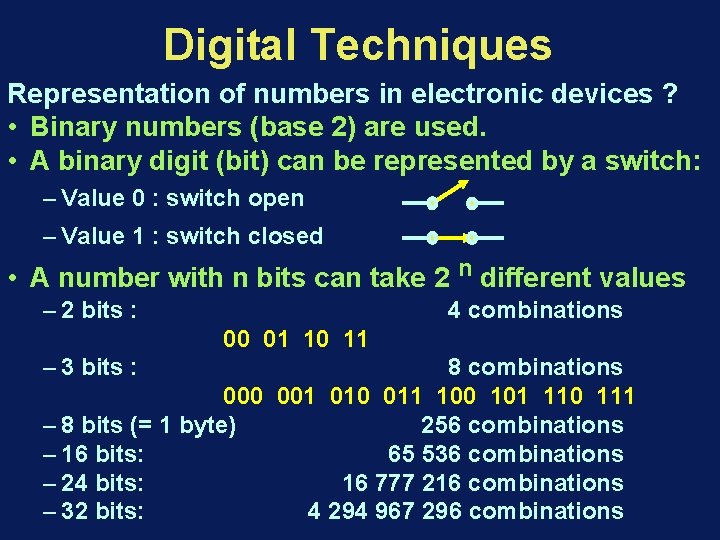
Digital Techniques Representation of numbers in electronic devices ? • Binary numbers (base 2) are used. • A binary digit (bit) can be represented by a switch: – Value 0 : switch open – Value 1 : switch closed • A number with n bits can take 2 n different values – 2 bits : 4 combinations 00 01 10 11 – 3 bits : 8 combinations 000 001 010 011 100 101 110 111 – 8 bits (= 1 byte) 256 combinations – 16 bits: 65 536 combinations – 24 bits: 16 777 216 combinations – 32 bits: 4 294 967 296 combinations
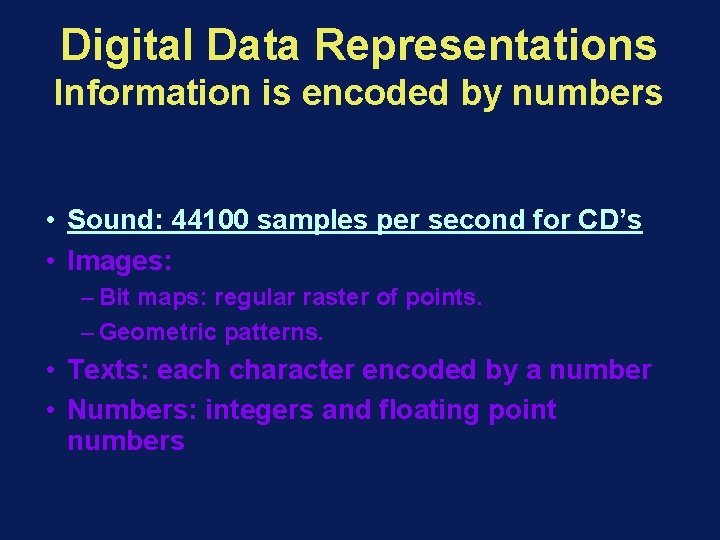
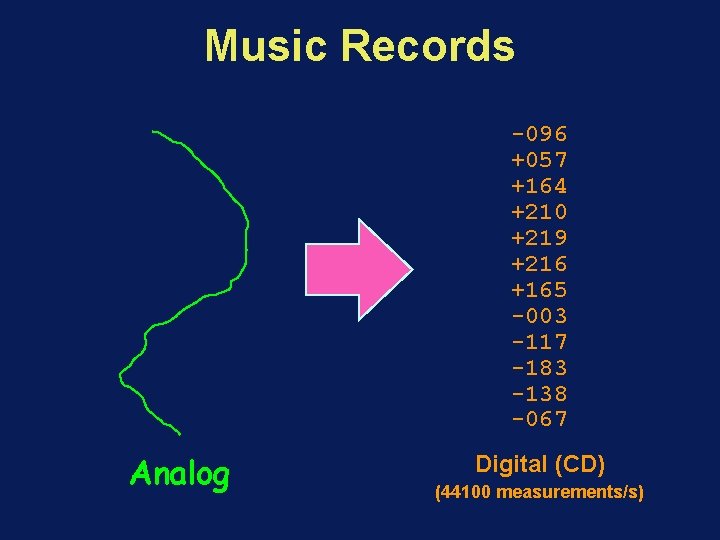
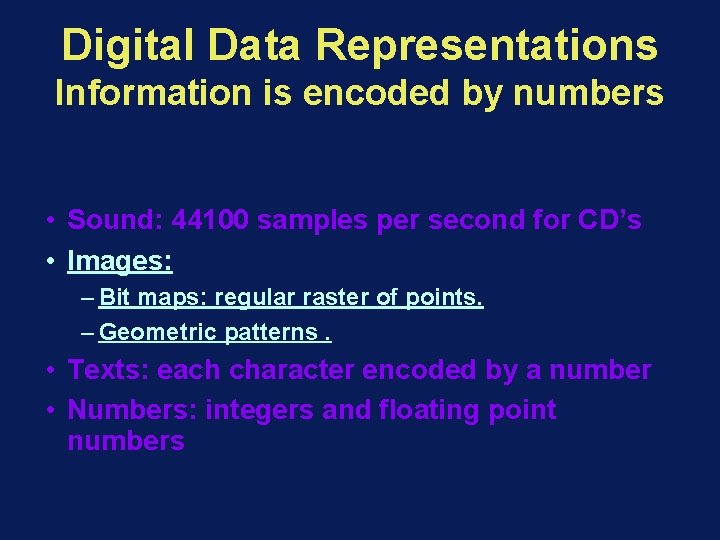
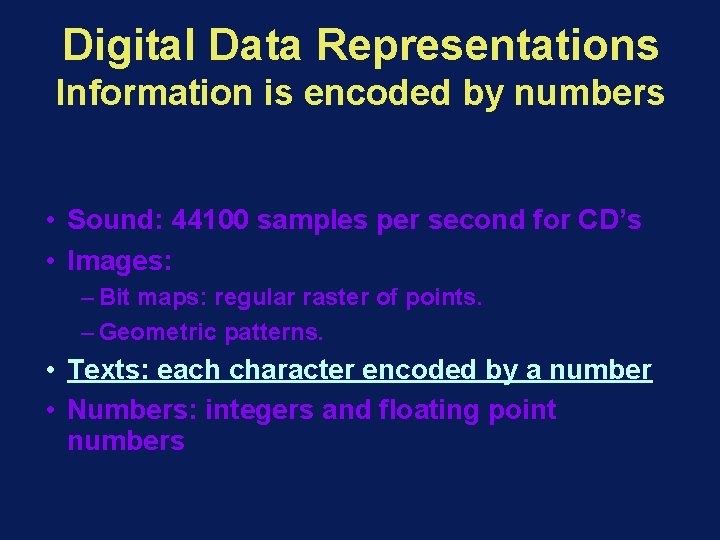
Digital Data Representations Information is encoded by numbers • Sound: 44100 samples per second for CD’s • Images: – Bit maps: regular raster of points. – Geometric patterns. • Texts: each character encoded by a number • Numbers: integers and floating point numbers
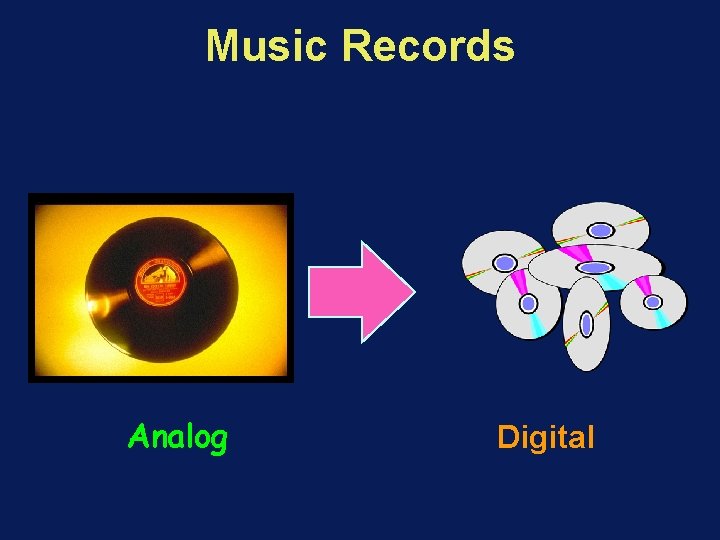
Music Records Analog Digital
Music Records -096 +057 +164 +210 +219 +216 +165 -003 -117 -183 -138 -067 Analog Digital (CD) (44100 measurements/s)
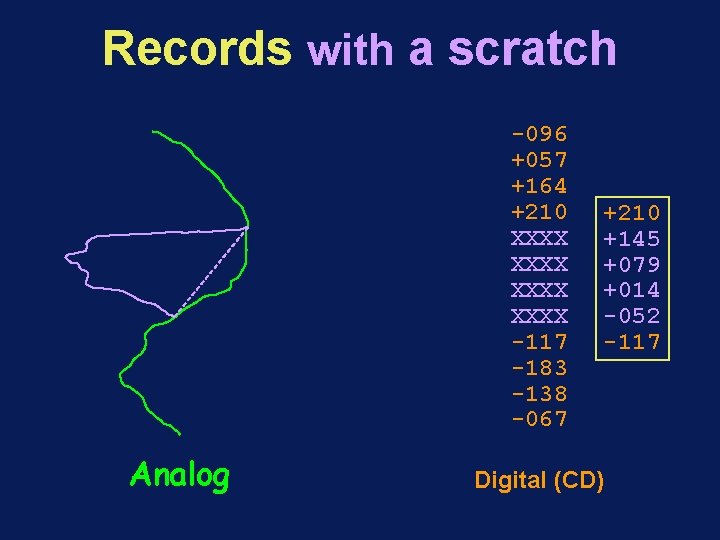
Records with a scratch -096 +057 +164 +210 XXXX -117 -183 -138 -067 Analog +210 +145 +079 +014 -052 -117 Digital (CD)
Digital Data Representations Information is encoded by numbers • Sound: 44100 samples per second for CD’s • Images: – Bit maps: regular raster of points. – Geometric patterns. • Texts: each character encoded by a number • Numbers: integers and floating point numbers
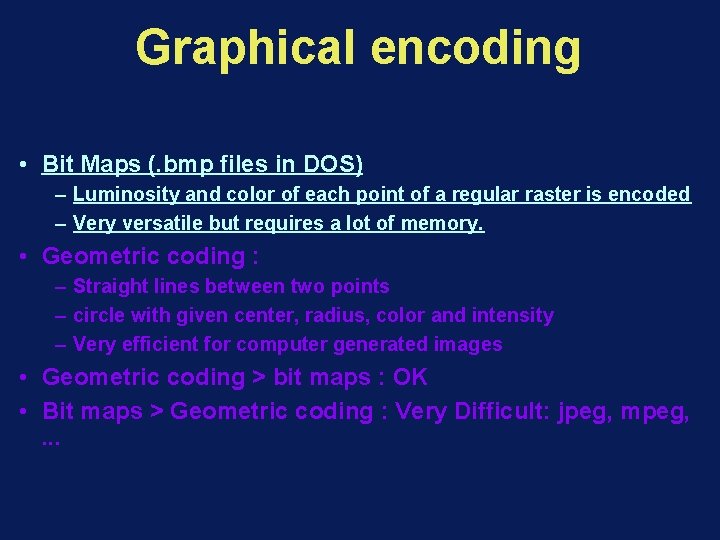
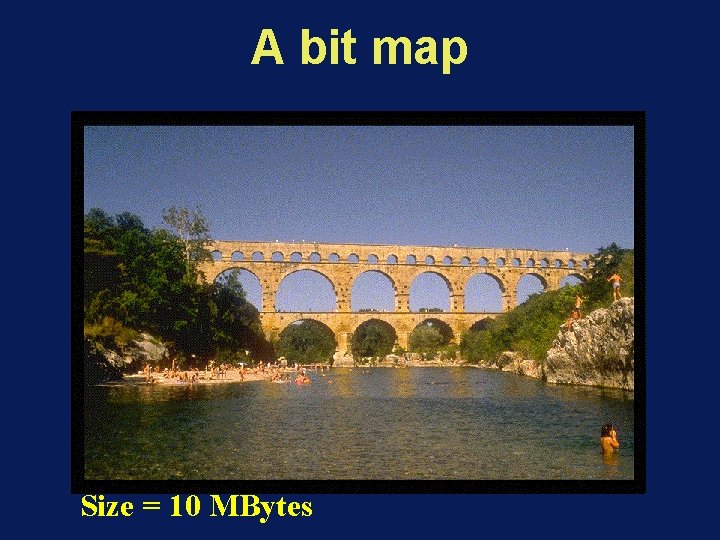
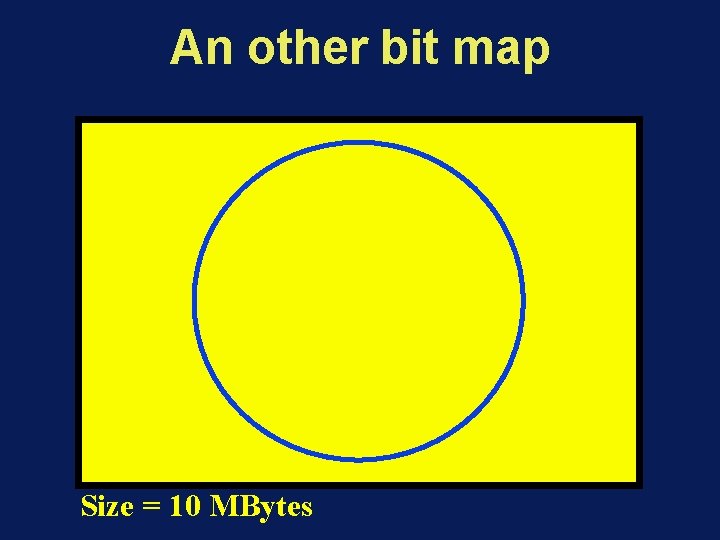
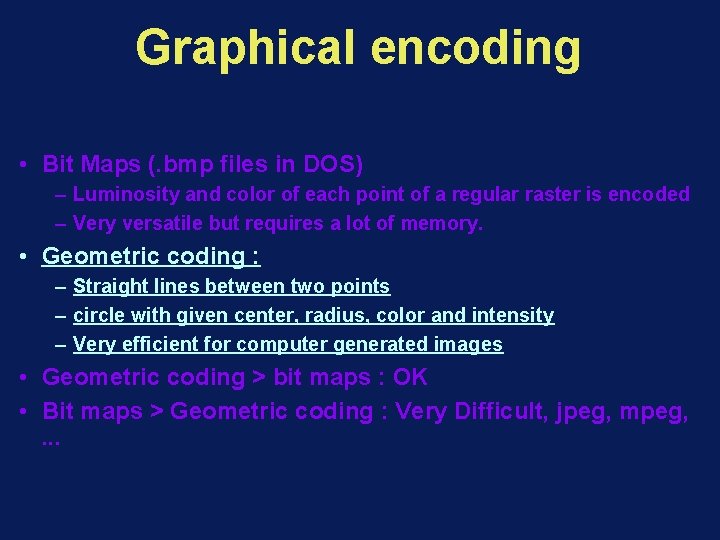
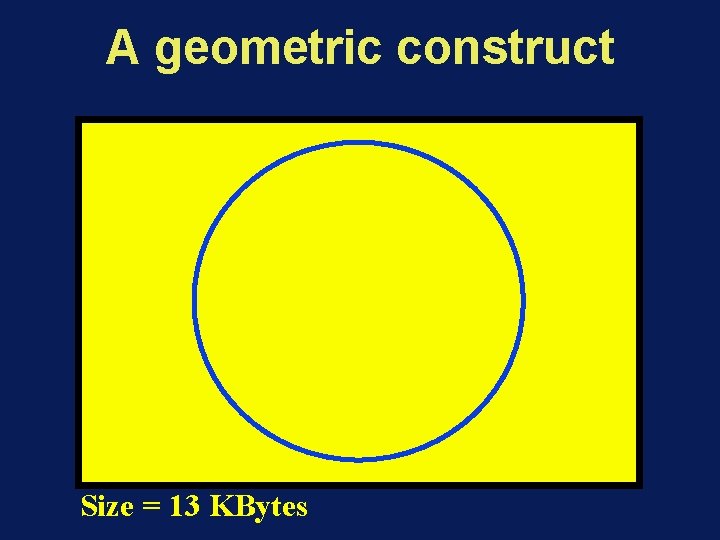
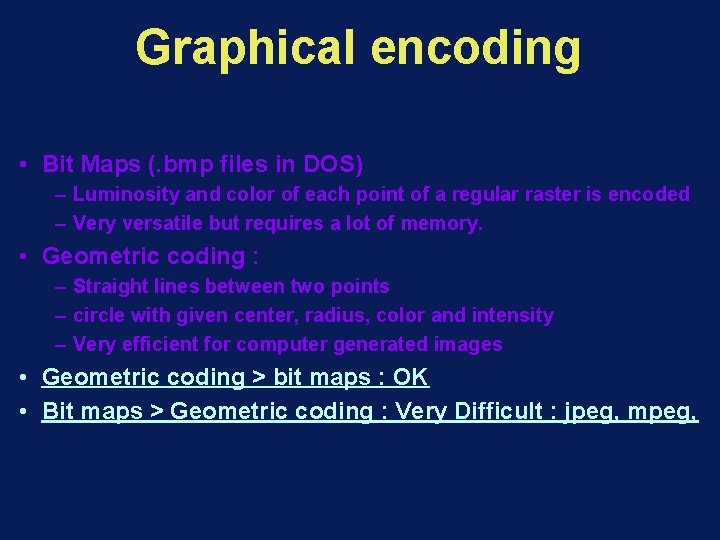
Graphical encoding • Bit Maps (. bmp files in DOS) – Luminosity and color of each point of a regular raster is encoded – Very versatile but requires a lot of memory. • Geometric coding : – Straight lines between two points – circle with given center, radius, color and intensity – Very efficient for computer generated images • Geometric coding > bit maps : OK • Bit maps > Geometric coding : Very Difficult: jpeg, mpeg, . . .
A bit map Size = 10 MBytes
An other bit map Size = 10 MBytes
Graphical encoding • Bit Maps (. bmp files in DOS) – Luminosity and color of each point of a regular raster is encoded – Very versatile but requires a lot of memory. • Geometric coding : – Straight lines between two points – circle with given center, radius, color and intensity – Very efficient for computer generated images • Geometric coding > bit maps : OK • Bit maps > Geometric coding : Very Difficult, jpeg, mpeg, . . .
A geometric construct Size = 13 KBytes
Graphical encoding • Bit Maps (. bmp files in DOS) – Luminosity and color of each point of a regular raster is encoded – Very versatile but requires a lot of memory. • Geometric coding : – Straight lines between two points – circle with given center, radius, color and intensity – Very efficient for computer generated images • Geometric coding > bit maps : OK • Bit maps > Geometric coding : Very Difficult : jpeg, mpeg,
Digital Data Representations Information is encoded by numbers • Sound: 44100 samples per second for CD’s • Images: – Bit maps: regular raster of points. – Geometric patterns. • Texts: each character encoded by a number • Numbers: integers and floating point numbers
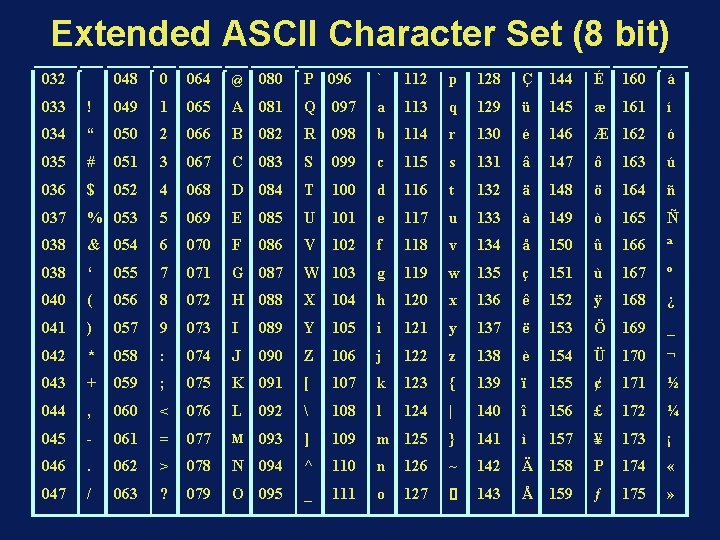
Extended ASCII Character Set (8 bit) 032 048 0 064 @ 080 P 096 ` 112 p 128 Ç 144 É 160 á 033 ! 049 1 065 A 081 Q 097 a 113 q 129 ü 145 æ 161 í 034 “ 050 2 066 B R 098 b 114 r 130 é 146 Æ 162 ó 035 # 051 3 067 C 083 S 099 c 115 s 131 â 147 ô 163 ú 036 $ 052 4 068 D 084 T 100 d 116 t 132 ä 148 ö 164 ñ 037 % 053 5 069 E 085 U 101 e 117 u 133 à 149 ò 165 Ñ 038 & 054 6 070 F 086 V 102 f 118 v 134 å 150 û 166 ª 038 ‘ 055 7 071 G 087 W 103 g 119 w 135 ç 151 ù 167 º 040 ( 056 8 072 H 088 X 104 h 120 x 136 ê 152 ÿ 168 ¿ 041 ) 057 9 073 I 089 Y 105 i 121 y 137 ë 153 Ö 169 _ 042 * 058 : 074 J 090 Z 106 j 122 z 138 è 154 Ü 170 ¬ 043 + 059 ; 075 K 091 [ 107 k 123 { 139 ï 155 ¢ 171 ½ 044 , 060 < 076 L 092 108 l 124 | 140 î 156 £ 172 ¼ 045 - 061 = 077 M 093 ] 109 m 125 } 141 ì 157 ¥ 173 ¡ 046 . 062 > 078 N 094 ^ 110 n 126 ~ 142 Ä 158 P 174 « 047 / 063 ? 079 O 095 _ 111 o 127 143 Å 159 ƒ 175 » 082
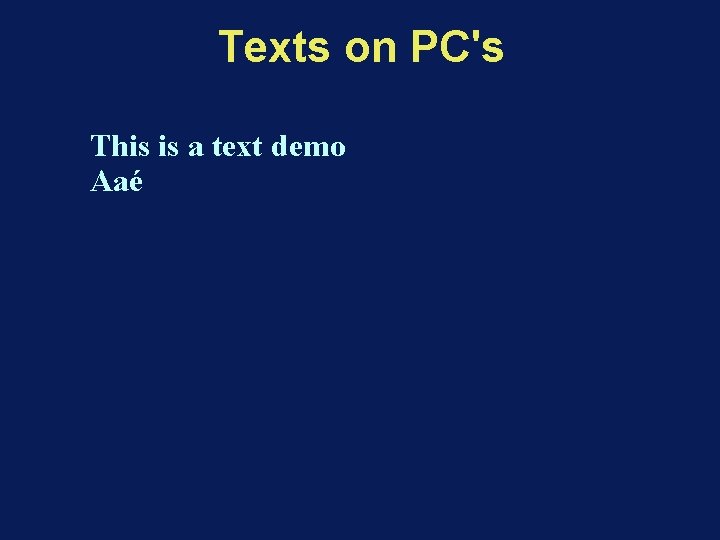
Texts on PC's This is a text demo Aaé
Digital Data Representations Information is encoded by numbers • Sound: 44100 samples per second for CD’s • Images: – Bit maps: regular raster of points. – Geometric patterns. • Texts: each character encoded by a number • Numbers: integers and floating point numbers
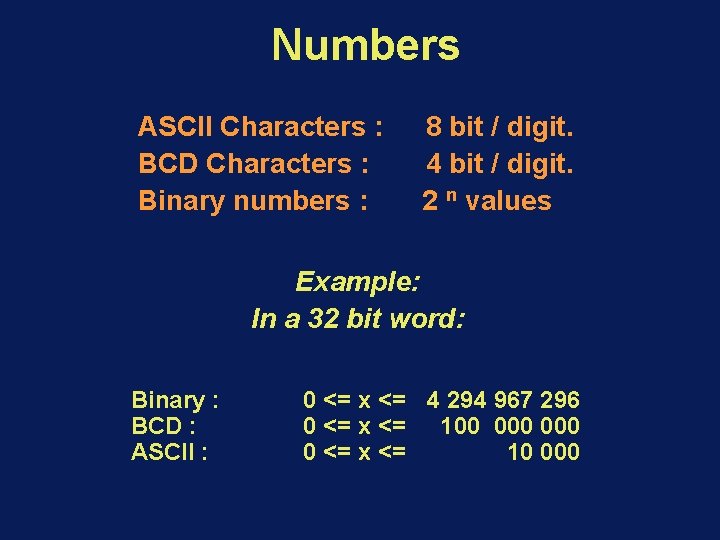
Numbers ASCII Characters : BCD Characters : Binary numbers : 8 bit / digit. 4 bit / digit. 2 n values Example: In a 32 bit word: Binary : BCD : ASCII : 0 <= x <= 4 294 967 296 0 <= x <= 100 000 0 <= x <= 10 000
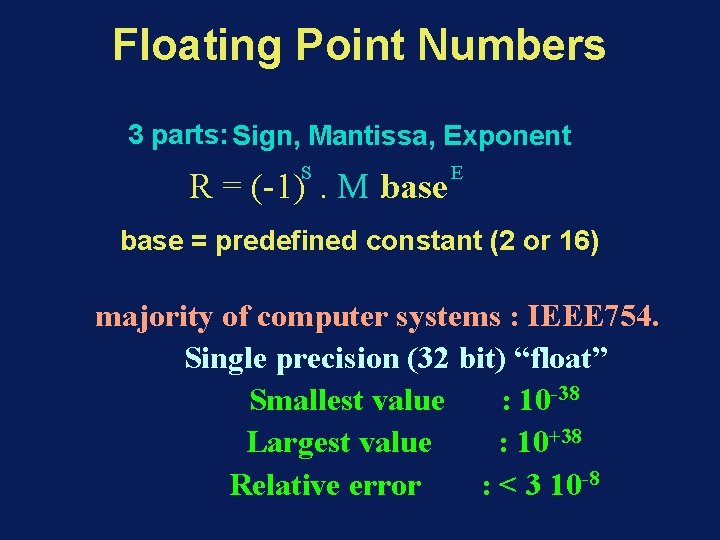
Floating Point Numbers 3 parts: Sign, Mantissa, Exponent S R = (-1). M. base E base = predefined constant (2 or 16) majority of computer systems : IEEE 754. Single precision (32 bit) “float” Smallest value : 10 -38 Largest value : 10+38 Relative error : < 3 10 -8
Summary • The Information Age Underlying paradigms » 3000 bc - 1750 : Geometry » 1750 - 1950 : Energy » 1850 - now : Information • Digital Computers : Programmable devices to process information – Digital : information encoded by digits – Programmable : » Universal hardware » Specific capabilities defined by Software