
Chapter 07 Performance Management and Appraisal Lecturer SENG
- Slides: 26
Chapter 07 Performance Management and Appraisal Lecturer: SENG THEARA, MBA-Management © 2011 South-Western, Cengage Learning Ch 07 -1
Chapter Objectives 1. Nature of performance management 2. Identifying and measuring employee performance 3. Performance appraisals 4. Who conducts appraisal? 5. Tools for appraisal performance 6. Appraisal feedback © 2011 South-Western, Cengage Learning Ch 07 -2
Nature of Performance Management v. Performance Management Ø Ø Processes used to identify, encourage, measure, evaluate, improve, and reward employee performance. An effective performance management system should do following: � Make clear what the organization expects � Provide performance information to employees � Identify areas of success and needed development � Document performance for personnel records � Provide rewards for achieving performance objectives. © 2011 South-Western, Cengage Learning Ch 07 -3
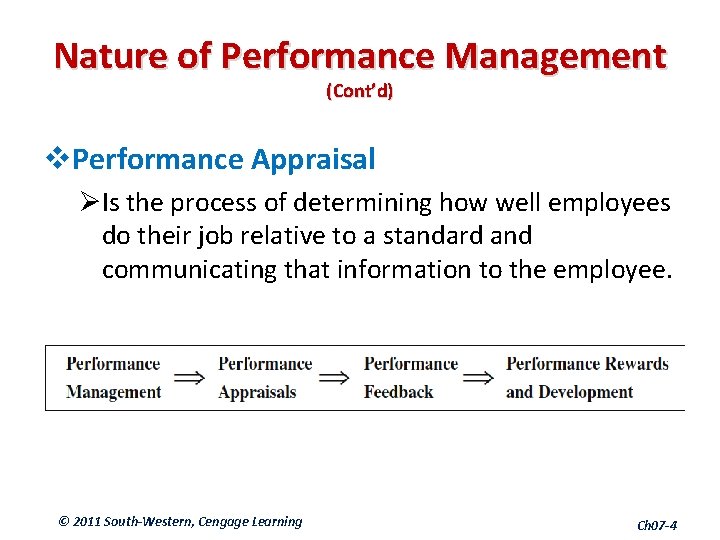
Nature of Performance Management (Cont’d) v. Performance Appraisal ØIs the process of determining how well employees do their job relative to a standard and communicating that information to the employee. © 2011 South-Western, Cengage Learning Ch 07 -4
Identifying & Measuring Employee Performance v. The most critical performance criteria vary from job to job, but the employee performance measures common to most jobs include the following: ØQuantity of output ØQuality of output ØTimeliness of output ØPresence at work © 2011 South-Western, Cengage Learning Ch 07 -5
Identifying & Measuring Employee Performance (Cont’d) v. Types of Performance Information ØManagers can use three different types of information about employee performance. 1. Trait-based information—identifies a character trait of the employee—attitude, initiative, or creativity. 2. Behavior-based information—focus on specific behaviors that lead to job success—verbal persuasion, timeliness of response, and decision making. 3. Result-based information—considers employee accomplishments—sale made, customer satisfaction, and cost reduction. © 2011 South-Western, Cengage Learning Ch 07 -6
Identifying & Measuring Employee Performance (Cont’d) v. Performance Standards ØDefines the expected levels of employee performance. ØCharacteristics of well-defined standards üRealistic üMeasurable üClearly understood ØPerformance standards define what satisfactory job performance is, so performance standards should be established before work is done. © 2011 South-Western, Cengage Learning Ch 07 -7
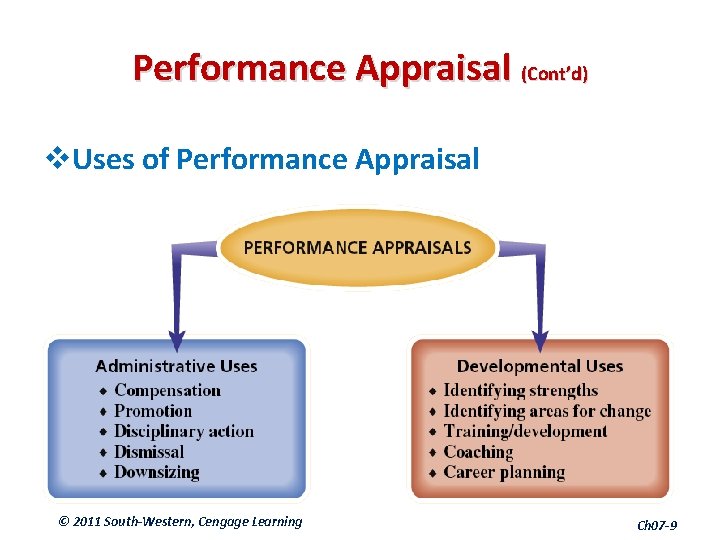
Performance Appraisal v. Performance Appraisal ØPerformance appraisals are used to assess an employee’s performance and to communicate that performance to the employee. ØPerformance appraisal are widely used for administering wages and salaries, giving performance feedback, and identifying individual employee strengths and weaknesses. © 2011 South-Western, Cengage Learning Ch 07 -8
Performance Appraisal (Cont’d) v. Uses of Performance Appraisal © 2011 South-Western, Cengage Learning Ch 07 -9
Performance Appraisal (Cont’d) v. Performance Appraisal Process ØAppraisal responsibilities ü HR unit typically designs a performance appraisal system. ü Operating manager use this performance appraisal system. ü Effective employee performance can be developed to be even better, and poor employee performance can be improved or poor performers can be removed from organization. © 2011 South-Western, Cengage Learning Ch 07 -10
Performance Appraisal (Cont’d) v. Performance Appraisal Process ØInformal & System Appraisal üInformal appraisal –day-to-day working relationship between a manger and an employee offers an opportunity for the employee’s performance to be evaluated. üSystematic appraisal • Used when the contact between a manager and employee is formal. • Regular time interval and appraised by HR and directed manger © 2011 South-Western, Cengage Learning Ch 07 -11
Performance Appraisal (Cont’d) v. Performance Appraisal Process ØInformal & System Appraisal üTiming of Appraisal • Most companies requires managers to conduct appraisal one or twice a year and most often annually. • Employees commonly receive an appraisal 60 to 90 days after hiring, again at 6 months and annually. • Introductory employees, who are new and in a trial period, should be informally evaluated often—weekly for the first month; and monthly thereafter until the end of the introductory period. © 2011 South-Western, Cengage Learning Ch 07 -12
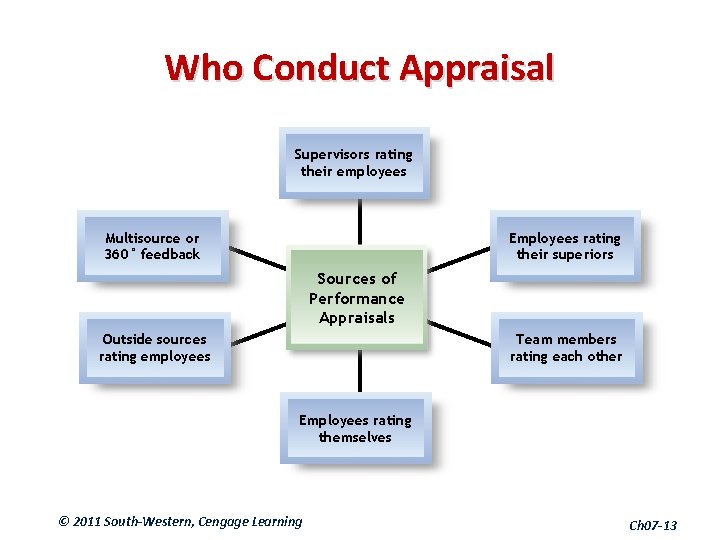
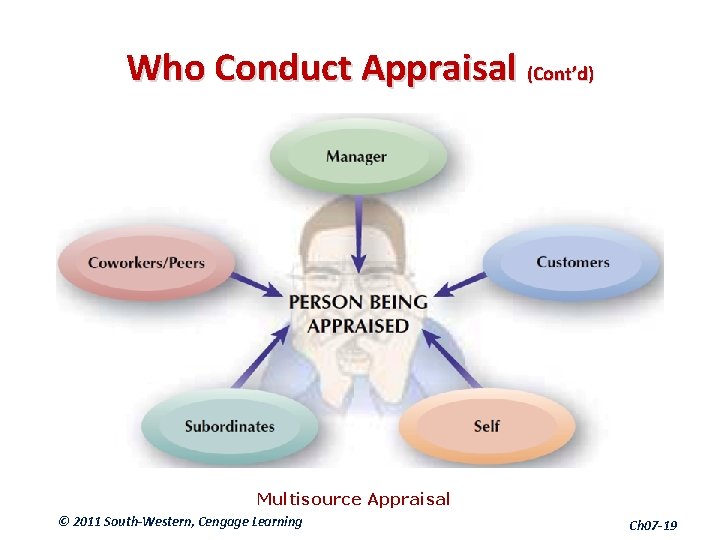
Who Conduct Appraisal Supervisors rating their employees Multisource or 360° feedback Employees rating their superiors Sources of Performance Appraisals Outside sources rating employees Team members rating each other Employees rating themselves © 2011 South-Western, Cengage Learning Ch 07 -13
Who Conduct Appraisal (Cont’d) v. Supervisors Rating to their Employees ØRating employees is based on the assumption that the immediate supervisor is the person most qualified to evaluate an employee’s performance realistically and fairly. ØTo help themselves provide accurate evaluations, some supervisors keep performance logs notice their employees’ accomplishments. © 2011 South-Western, Cengage Learning Ch 07 -14
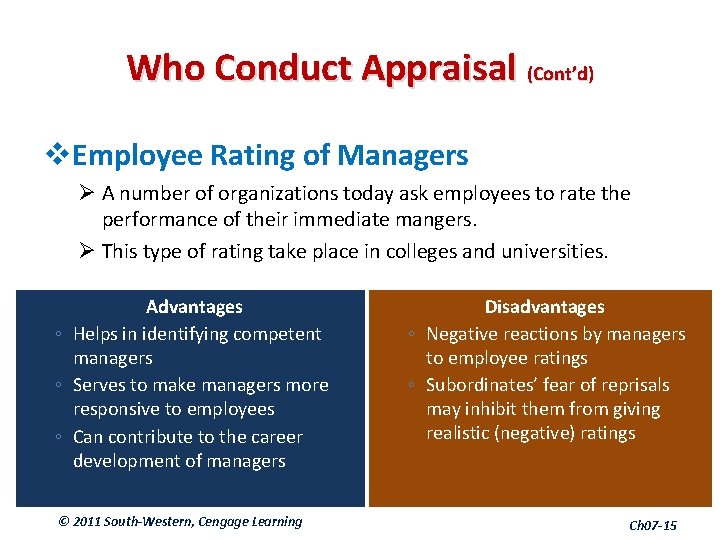
Who Conduct Appraisal (Cont’d) v. Employee Rating of Managers Ø A number of organizations today ask employees to rate the performance of their immediate mangers. Ø This type of rating take place in colleges and universities. Advantages ◦ Helps in identifying competent managers ◦ Serves to make managers more responsive to employees ◦ Can contribute to the career development of managers © 2011 South-Western, Cengage Learning Disadvantages ◦ Negative reactions by managers to employee ratings ◦ Subordinates’ fear of reprisals may inhibit them from giving realistic (negative) ratings Ch 07 -15
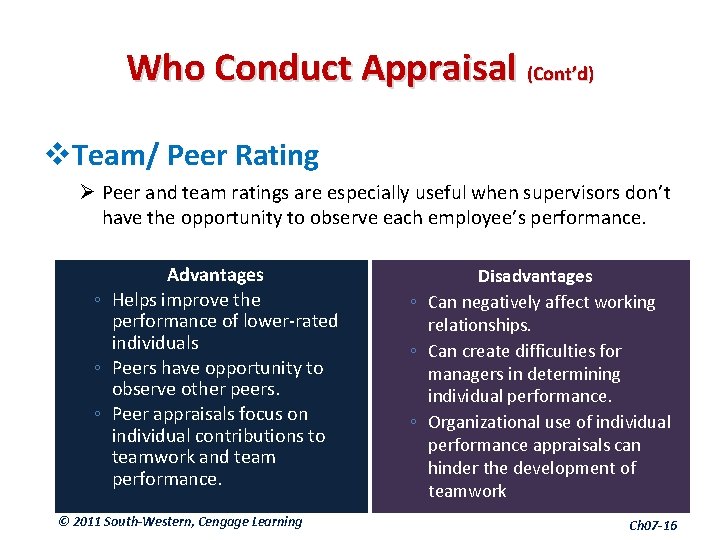
Who Conduct Appraisal (Cont’d) v. Team/ Peer Rating Ø Peer and team ratings are especially useful when supervisors don’t have the opportunity to observe each employee’s performance. Advantages ◦ Helps improve the performance of lower-rated individuals ◦ Peers have opportunity to observe other peers. ◦ Peer appraisals focus on individual contributions to teamwork and team performance. © 2011 South-Western, Cengage Learning Disadvantages ◦ Can negatively affect working relationships. ◦ Can create difficulties for managers in determining individual performance. ◦ Organizational use of individual performance appraisals can hinder the development of teamwork Ch 07 -16
Who Conduct Appraisal (Cont’d) v. Self-Rating ØRequires employees to think about their strengths and weaknesses and set goals for improvement. ØGood rating is for employee held unique skill because of they are only ones qualified to rate themselves. ØEmployees may be more lenient when rating themselves. © 2011 South-Western, Cengage Learning Ch 07 -17
Who Conduct Appraisal (Cont’d) v. Outsider Rating ØPeople outside the immediate work group may be called in to conduct performance reviews—HR department or independent organizational outsider as reviewers. v. Multisource/ 360 -Degree Feedback ØHas growth in popularity in organizations. ØCross department, organizational and even global boundaries. © 2011 South-Western, Cengage Learning Ch 07 -18
Who Conduct Appraisal (Cont’d) Multisource Appraisal © 2011 South-Western, Cengage Learning Ch 07 -19
Tools for Appraising Performance v. Category Rating Method ØGraphic rating scale allows the rater to mark an employee’s performance on a continuum indicating low to high levels of a particular characteristic. üDescriptive categories: quality of work and attendance…. üJob duties: taken from the job description üBehavior dimensions: decision making, employee development and communication. © 2011 South-Western, Cengage Learning Ch 07 -20
Tools for Appraising Performance (Cont’d) v. Comparative Method Ø Comparative methods require that managers directly compare the performance of their employees against one another. üRanking • Consists of listing all employees from highest to lowest in performance. • Employees are ranked in groups. üPaired comparison • Managers compare every employee with every other employee in the work group. © 2011 South-Western, Cengage Learning Ch 07 -21
Tools for Appraising Performance (Cont’d) v. Narrative Method Ø Critical incident—manager keeps a written record of highly favorable and unfavorable employee actions performed by an employee. Ø Essay—manager writes a short essay describing an employee’s performance during the rating period about highly detailed and useful information about an employees’ job performance. © 2011 South-Western, Cengage Learning Ch 07 -22
Tools for Appraising Performance (Cont’d) v. Management by Objective Method Ø Specifying the performance goals that an individual and his or her manager agree the employee will to try to attain within an appropriate length of time. Ø MBO process üJob review and agreement üDevelopment of performance standard üSetting of objectives üContinuing performance discussion © 2011 South-Western, Cengage Learning Ch 07 -23
Appraisal Feedback v. Appraisal Interviews ØThe appraisal interview presents both an opportunity and a danger. ØManager must communicate both praise and constructive criticism. ØIf the interview is handled poorly, the employee may feel resentment, which could lead to future conflict. © 2011 South-Western, Cengage Learning Ch 07 -24
Appraisal Feedback (cont’d) v. Reactions of Managers ØManagers feel that their role calls on them to assist, encourage, coach, and counsel employees to improve their performance. ØManagers have to providing negative and positive feedback to an employee in an appraisal interview. © 2011 South-Western, Cengage Learning Ch 07 -25
Appraisal Feedback (cont’d) v. Reactions of Appraised Employees ØEmployees may well see the appraisal process as a threat and feel that the only way for them to get a higher rating is for someone else to receive a low rating. ØEmployees will view appraisals done well as what they are meant to be—constructive feedback. © 2011 South-Western, Cengage Learning Ch 07 -26