
Chapter 07 Lecture Outline See separate Power Point
- Slides: 27
Chapter 07 Lecture Outline See separate Power. Point slides for all figures and tables preinserted into Power. Point without notes. Copyright © Mc. Graw-Hill Education. Permission required for reproduction or display. 1
Introduction • Bones are the organs of the skeletal system and are composed of many tissues: bone tissue, cartilage, dense connective tissue, blood and nervous tissue • Bones are alive and multifunctional: • • Support and protect softer tissues Provide points of attachment for muscles House blood-producing cells Store inorganic salts 2
7. 1: Bone Shape and Structure • Bones of the skeletal system vary greatly in these ways: - Size - Shape • Bones are similar in these features: - Structure - Development - Function 3
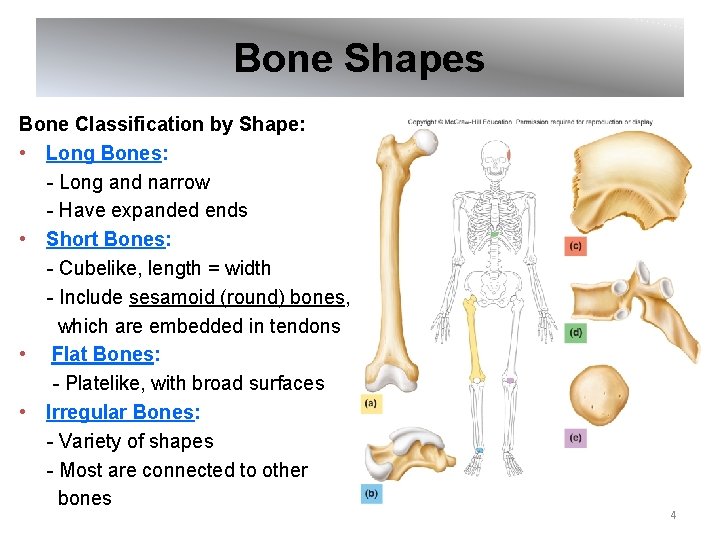
Bone Shapes Bone Classification by Shape: • Long Bones: - Long and narrow - Have expanded ends • Short Bones: - Cubelike, length = width - Include sesamoid (round) bones, which are embedded in tendons • Flat Bones: - Platelike, with broad surfaces • Irregular Bones: - Variety of shapes - Most are connected to other bones 4
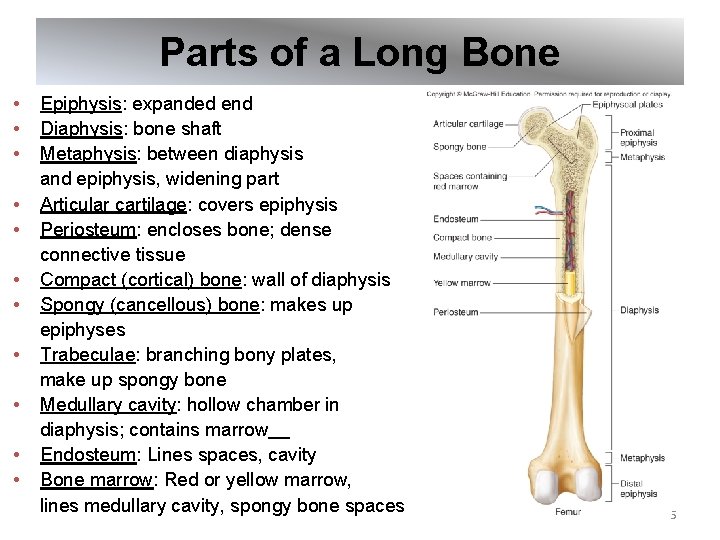
Parts of a Long Bone • • • Epiphysis: expanded end Diaphysis: bone shaft Metaphysis: between diaphysis and epiphysis, widening part Articular cartilage: covers epiphysis Periosteum: encloses bone; dense connective tissue Compact (cortical) bone: wall of diaphysis Spongy (cancellous) bone: makes up epiphyses Trabeculae: branching bony plates, make up spongy bone Medullary cavity: hollow chamber in diaphysis; contains marrow Endosteum: Lines spaces, cavity Bone marrow: Red or yellow marrow, lines medullary cavity, spongy bone spaces 5
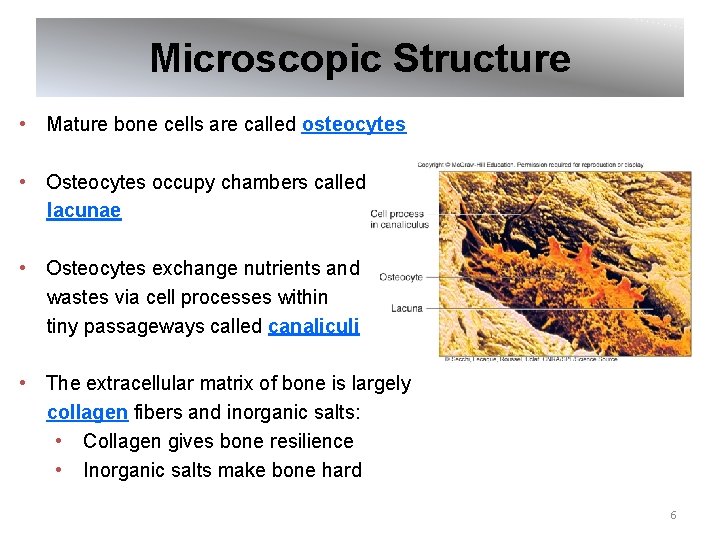
Microscopic Structure • Mature bone cells are called osteocytes • Osteocytes occupy chambers called lacunae • Osteocytes exchange nutrients and wastes via cell processes within tiny passageways called canaliculi • The extracellular matrix of bone is largely collagen fibers and inorganic salts: • Collagen gives bone resilience • Inorganic salts make bone hard 6
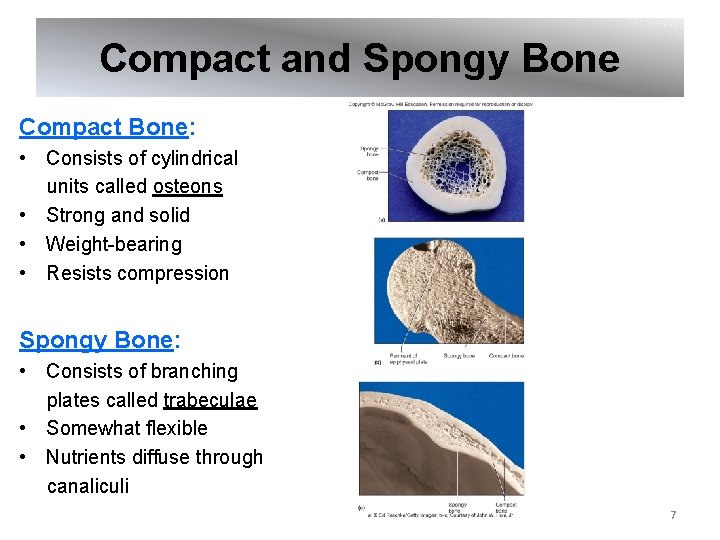
Compact and Spongy Bone Compact Bone: • Consists of cylindrical units called osteons • Strong and solid • Weight-bearing • Resists compression Spongy Bone: • Consists of branching plates called trabeculae • Somewhat flexible • Nutrients diffuse through canaliculi 7
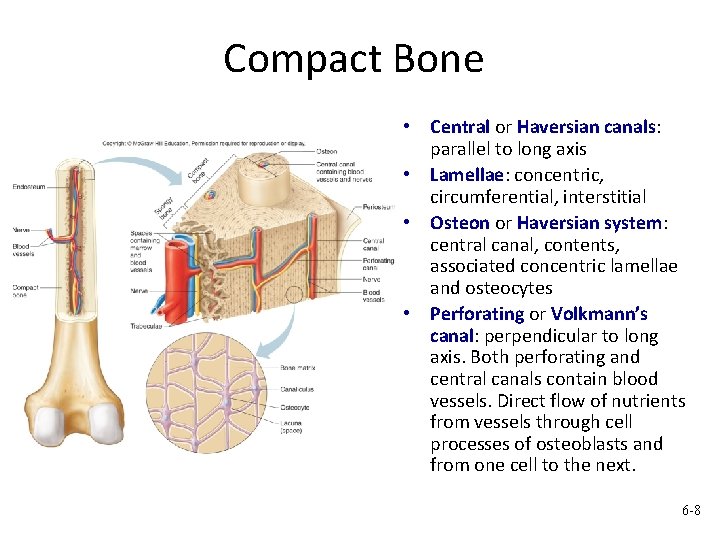
Compact Bone . • Central or Haversian canals: parallel to long axis • Lamellae: concentric, circumferential, interstitial • Osteon or Haversian system: central canal, contents, associated concentric lamellae and osteocytes • Perforating or Volkmann’s canal: perpendicular to long axis. Both perforating and central canals contain blood vessels. Direct flow of nutrients from vessels through cell processes of osteoblasts and from one cell to the next. 6 -8
Compact Bone • Osteons (Haversian systems) – Blood vessel-filled central canal (Haversian canal) – Concentric lamellae of bone surround central canal – Lacunae and canaliculi contain osteocytes and fluid • Circumferential lamellae on the periphery of a bone • Interstitial lamellae between osteons. Remnants of osteons replaced through remodeling 6 -9
7. 2: Bone Development and Growth • Parts of the skeletal system begin to develop during the first few weeks of prenatal development • Some bones continue to grow and develop into adulthood • Bones form when bone tissue replaces existing connective tissue in 1 of 2 ways: • As intramembranous bones • As endochondral bones 10
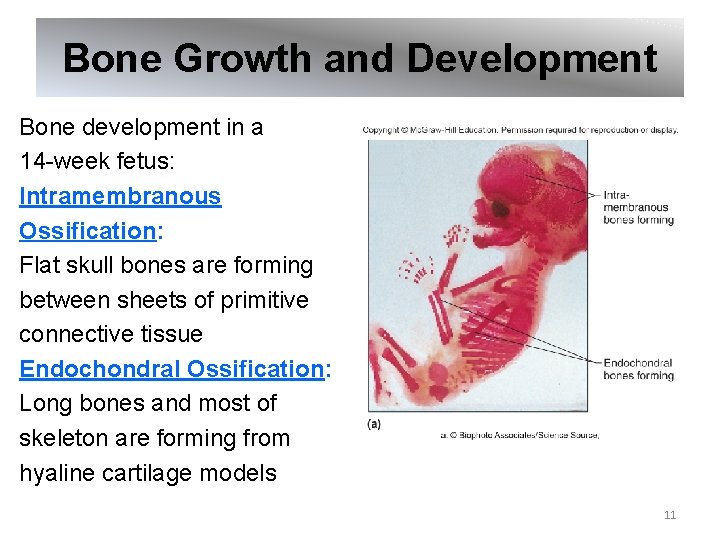
Bone Growth and Development Bone development in a 14 -week fetus: Intramembranous Ossification: Flat skull bones are forming between sheets of primitive connective tissue Endochondral Ossification: Long bones and most of skeleton are forming from hyaline cartilage models 11
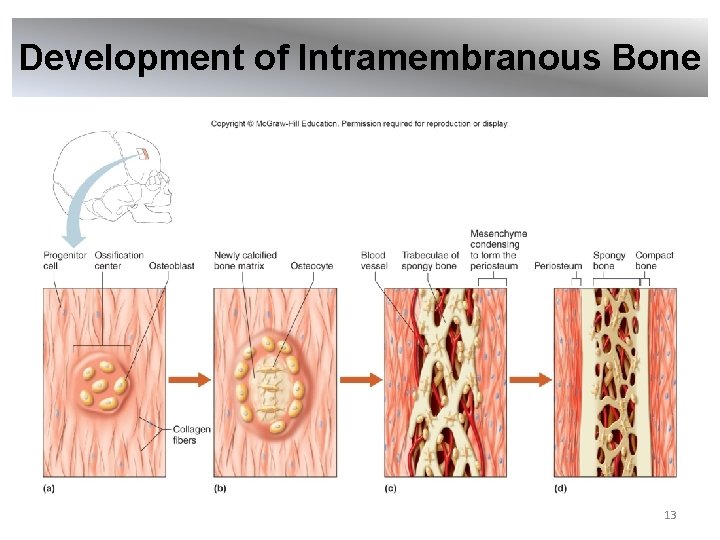
Intramembranous Bones: • Originate within sheetlike layers of connective tissue • Broad, flat bones • Examples: Flat bones of the skull, clavicles, sternum, and some facial bones (mandible, maxilla, zygomatic) Intramembranous Ossification: Process of replacing embryonic connective tissue to form intramembranous bone: • Mesenchymal cells in primitive tissue differentiate into osteoblasts • Osteoblasts: bone-forming cells that deposit bone matrix around themselves • When osteoblasts are completely surrounded by matrix, they are now osteocytes in lacunae • Mesenchyme on outside forms periosteum 12
Development of Intramembranous Bone 13
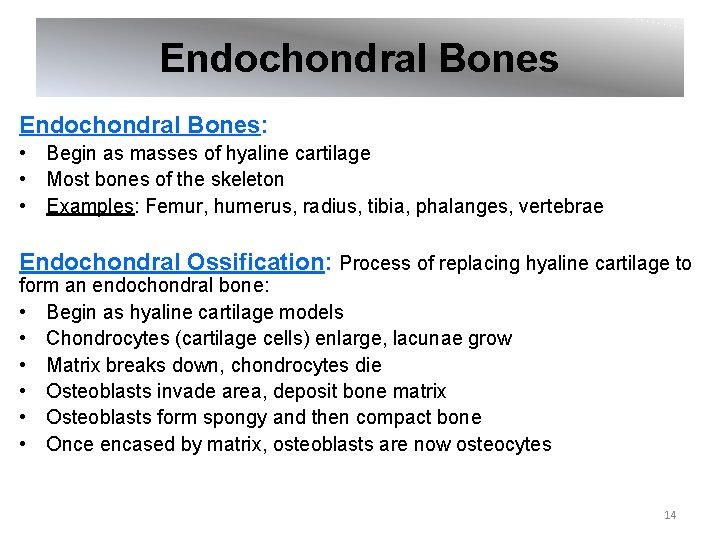
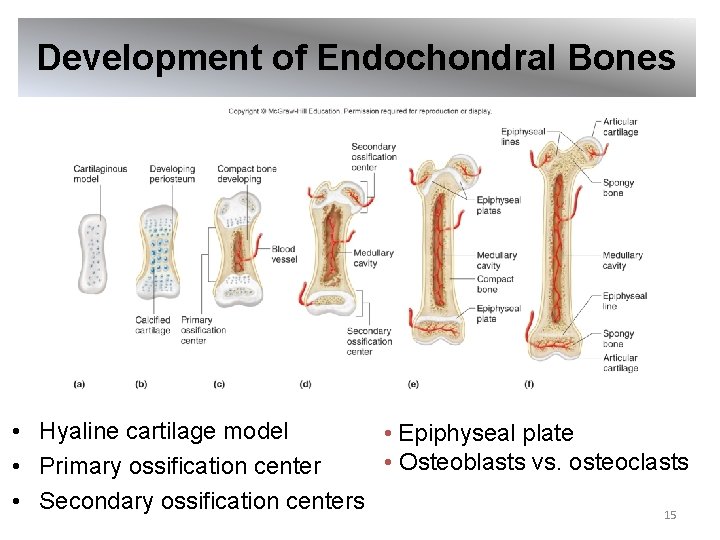
Endochondral Bones: • Begin as masses of hyaline cartilage • Most bones of the skeleton • Examples: Femur, humerus, radius, tibia, phalanges, vertebrae Endochondral Ossification: Process of replacing hyaline cartilage to form an endochondral bone: • Begin as hyaline cartilage models • Chondrocytes (cartilage cells) enlarge, lacunae grow • Matrix breaks down, chondrocytes die • Osteoblasts invade area, deposit bone matrix • Osteoblasts form spongy and then compact bone • Once encased by matrix, osteoblasts are now osteocytes 14
Development of Endochondral Bones • Hyaline cartilage model • Epiphyseal plate • Osteoblasts vs. osteoclasts • Primary ossification center • Secondary ossification centers 15
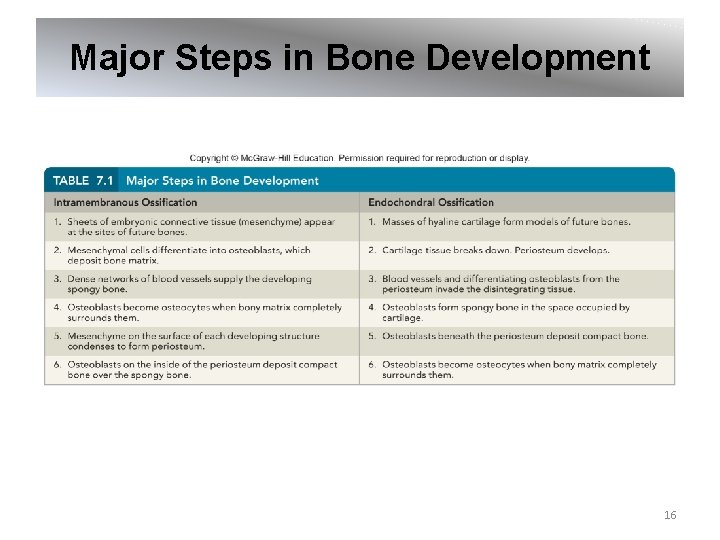
Major Steps in Bone Development 16
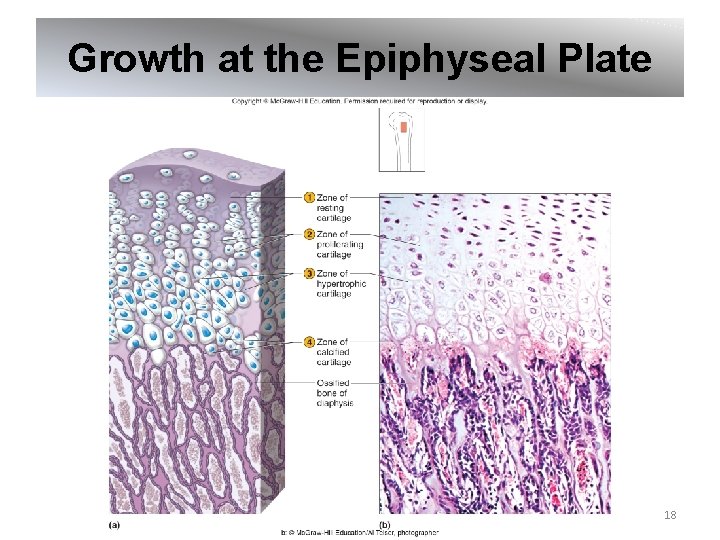
Growth at the Epiphyseal Plate • In a growing long bone, diaphysis is separated from epiphysis by Epiphyseal Plate. Region at which bone grows in length. • Cartilaginous cells of epiphyseal plate form 4 layers: 1. Zone of resting cartilage: - Layer closest to end of epiphysis - Resting cells; anchor epiphyseal plate to epiphysis 2. Zone of proliferating cartilage: - Rows of young cells, undergoing mitosis 3. Zone of hypertrophic cartilage: - Rows of older cells left behind when new cells appear - Thicken epiphyseal plate, lengthening the bone - Matrix calcifies, cartilage cells (chondrocytes die) 4. Zone of calcified cartilage: - Thin layer of dead cartilage cells and calcified matrix 17
Growth at the Epiphyseal Plate 18
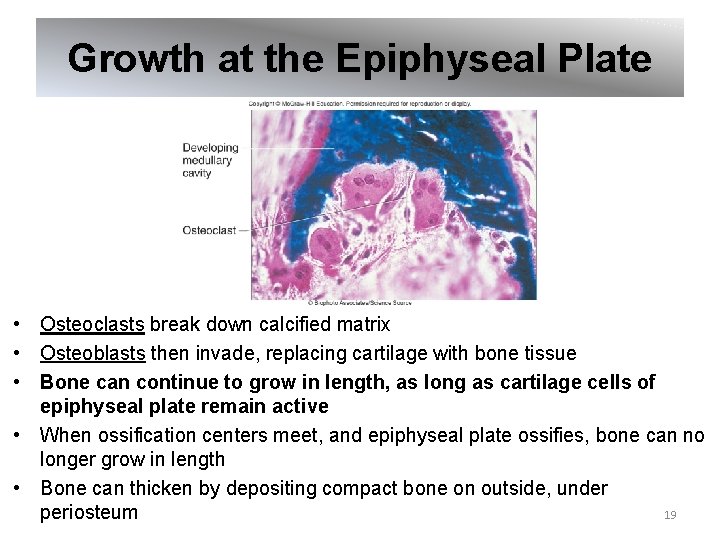
Growth at the Epiphyseal Plate • Osteoclasts break down calcified matrix • Osteoblasts then invade, replacing cartilage with bone tissue • Bone can continue to grow in length, as long as cartilage cells of epiphyseal plate remain active • When ossification centers meet, and epiphyseal plate ossifies, bone can no longer grow in length • Bone can thicken by depositing compact bone on outside, under periosteum 19
Homeostasis of Bone Tissue • Bone remodeling occurs throughout life • Opposing processes of deposition and resorption occur of surfaces of endosteum and periosteum • Bone Resorption: removal of bone, action of osteoclasts • Bone Deposition: formation of bone, action of osteoblasts • 10% - 20% of skeleton is replaced each year 20
Factors Affecting Bone Development, Growth and Repair Nutrition, sunlight exposure, hormone levels, and physical exercise all affect bone development, growth and repair: • Vitamin D: calcium absorption; deficiency causes rickets, osteomalacia • Vitamin A: osteoblast & osteoclast activity; deficiency retards bone development • Vitamin C: collagen synthesis; deficiency results in slender, fragile bones • Growth Hormone: stimulates cartilage cell division - Insufficiency in a child can result in pituitary dwarfism - Excess causes gigantism in child, acromegaly in adult • Thyroid Hormone: causes replacement of cartilage with bone in epiphyseal plate, osteoblast activity • Parathyroid Hormone (PTH): stimulates osteoclasts, bone breakdown • Sex Hormones (estrogen, testosterone): promote bone formation; stimulate ossification of epiphyseal plates • Physical Stress: stimulates bone growth 21
Clinical Application 7. 1 Fractures • Fractures are classified by cause and nature of break • Simple (closed) fracture: Fracture protected by uninjured skin (or mucous membrane) • Compound (open) fracture: Fracture in which the bone is exposed to the outside through opening in skin (or mucous membrane) 22
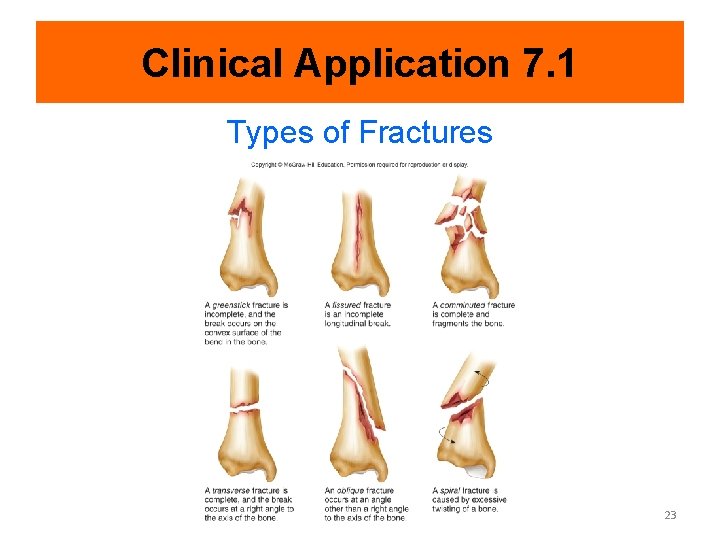
Clinical Application 7. 1 Types of Fractures 23
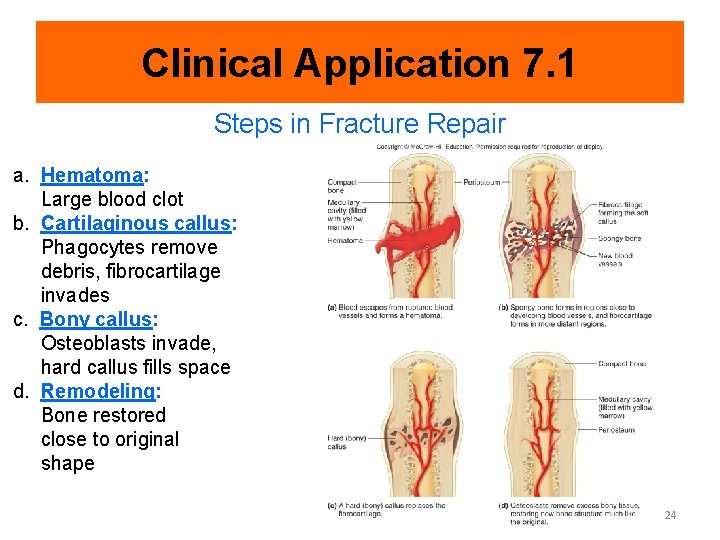
Clinical Application 7. 1 Steps in Fracture Repair a. Hematoma: Large blood clot b. Cartilaginous callus: Phagocytes remove debris, fibrocartilage invades c. Bony callus: Osteoblasts invade, hard callus fills space d. Remodeling: Bone restored close to original shape 24
7. 3: Bone Function Major functions of bones: • Provide shape to body • Support body structures • Protect body structures • Aid body movements • Contain tissue that produces blood cells • Store inorganic salts 25
Blood Cell Formation • Hematopoiesis: Blood cell formation • Blood cell production occurs in red bone marrow • Red blood cells, white blood cells, and platelets are produced in red bone marrow • With age, some red bone marrow is replaced by yellow bone marrow, which stores fat, but does not produce blood cells 26
Inorganic Salt Storage • About 70% of bone matrix consists of inorganic mineral salts • Inorganic Salt Storage • Most abundant salt is crystals of hydroxyapatite (calcium phosphate) • Other salts include: • Magnesium ions • Sodium ions • Potassium ions • Carbonate ions • Osteoporosis is a condition that results from loss of bone mineralization • Since calcium is vital in nerve impulse conduction and muscle contraction, blood calcium level is regulated by Parathyroid hormone and Calcitonin 27