
Chapter 02 Numerical methods for microfluidics Xiangyu Hu

- Slides: 39
Chapter 02: Numerical methods for microfluidics Xiangyu Hu Technical University of Munich
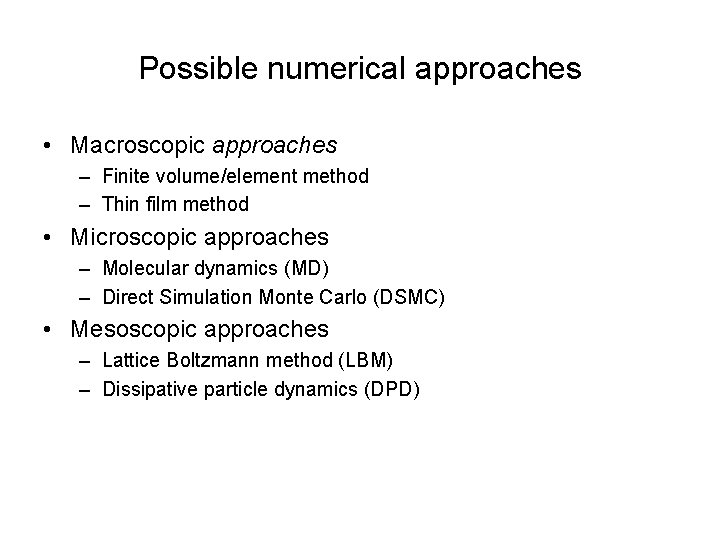
Possible numerical approaches • Macroscopic approaches – Finite volume/element method – Thin film method • Microscopic approaches – Molecular dynamics (MD) – Direct Simulation Monte Carlo (DSMC) • Mesoscopic approaches – Lattice Boltzmann method (LBM) – Dissipative particle dynamics (DPD)
Possible numerical approaches • Macroscopic approaches
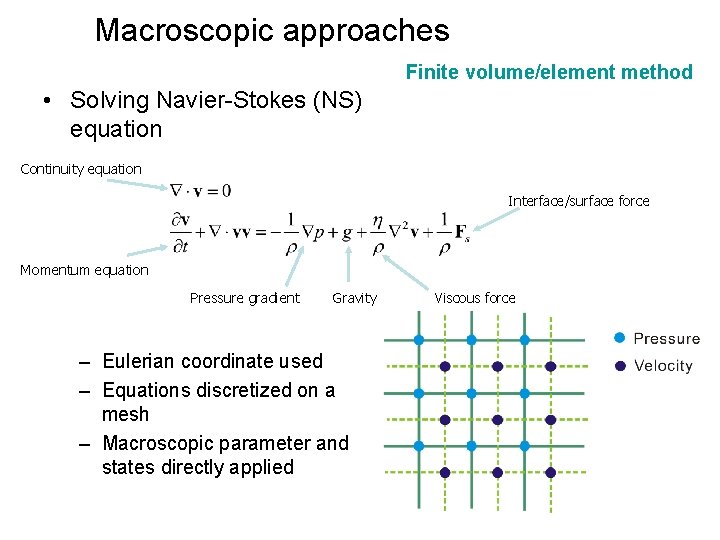
Macroscopic approaches Finite volume/element method • Solving Navier-Stokes (NS) equation Continuity equation Interface/surface force Momentum equation Pressure gradient Gravity – Eulerian coordinate used – Equations discretized on a mesh – Macroscopic parameter and states directly applied Viscous force
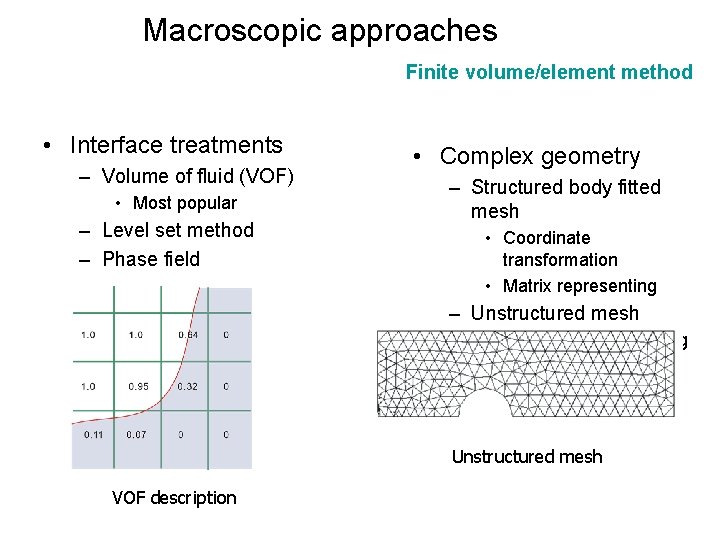
Macroscopic approaches Finite volume/element method • Interface treatments – Volume of fluid (VOF) • Most popular – Level set method – Phase field • Complex geometry – Structured body fitted mesh • Coordinate transformation • Matrix representing – Unstructured mesh • Linked list representing Unstructured mesh VOF description
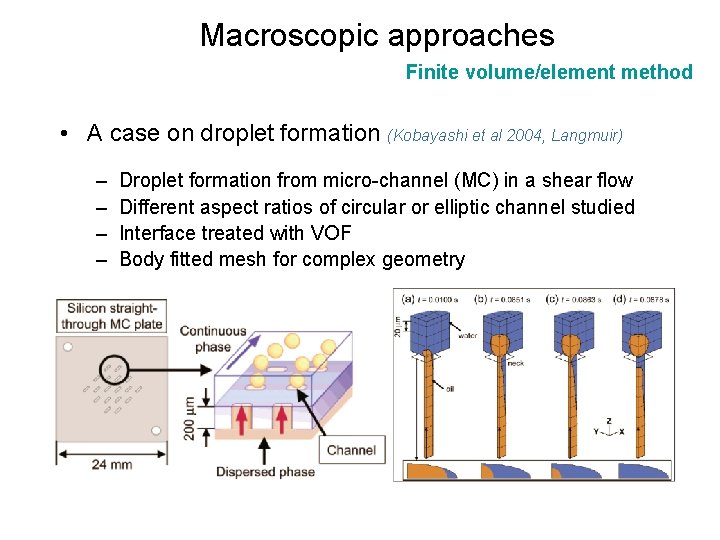
Macroscopic approaches Finite volume/element method • A case on droplet formation (Kobayashi et al 2004, Langmuir) – – Droplet formation from micro-channel (MC) in a shear flow Different aspect ratios of circular or elliptic channel studied Interface treated with VOF Body fitted mesh for complex geometry
Macroscopic approaches Finite volume/element method • Application in micro-fluidic simulations – Simple or multi-phase flows in micro-meter scale channels • Difficulties in micro-fluidic simulations – Dominant forces • Thermal fluctuation not included – Complex fluids • Multi-phase – Easy: simple interface (size comparable to the domain size) – Difficult: complex interficial flow (such as bubbly flow) • Polymer or colloids solution – Difficult – Complex geometry • Easy: static and not every complicated boundaries • Difficult: dynamically moving or complicated boundaries
Macroscopic approaches in current course • Numerical modeling for multi-phase flows – – – VOF method Level set method Phase field method Immersed interface method Vortex sheet method
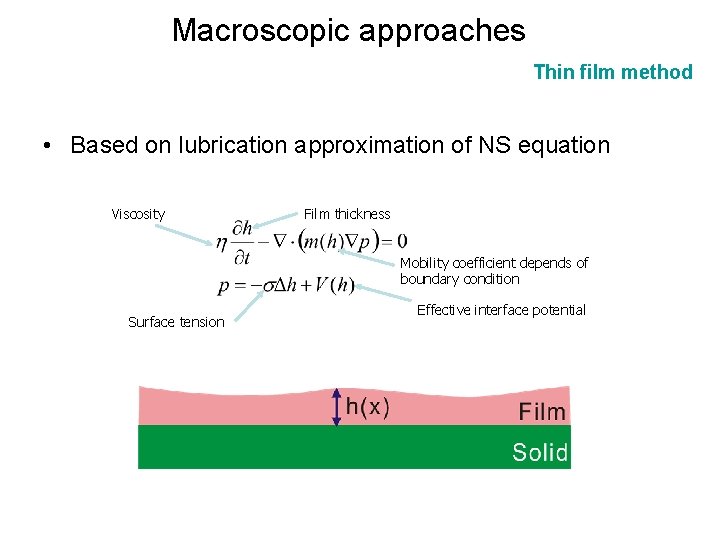
Macroscopic approaches Thin film method • Based on lubrication approximation of NS equation Viscosity Film thickness Mobility coefficient depends of boundary condition Surface tension Effective interface potential
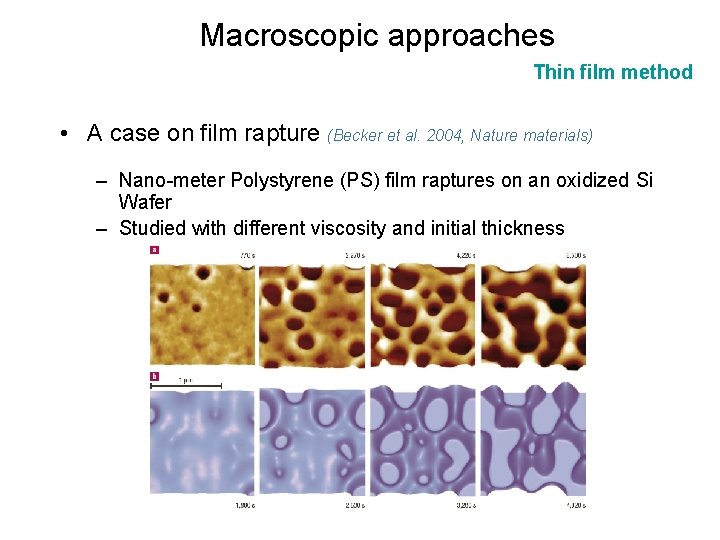
Macroscopic approaches Thin film method • A case on film rapture (Becker et al. 2004, Nature materials) – Nano-meter Polystyrene (PS) film raptures on an oxidized Si Wafer – Studied with different viscosity and initial thickness
Macroscopic approaches Thin film method • Limitation – Seems only suitable for film dynamics studies. • No further details will be considered in current course
Possible numerical approaches • Microscopic approaches
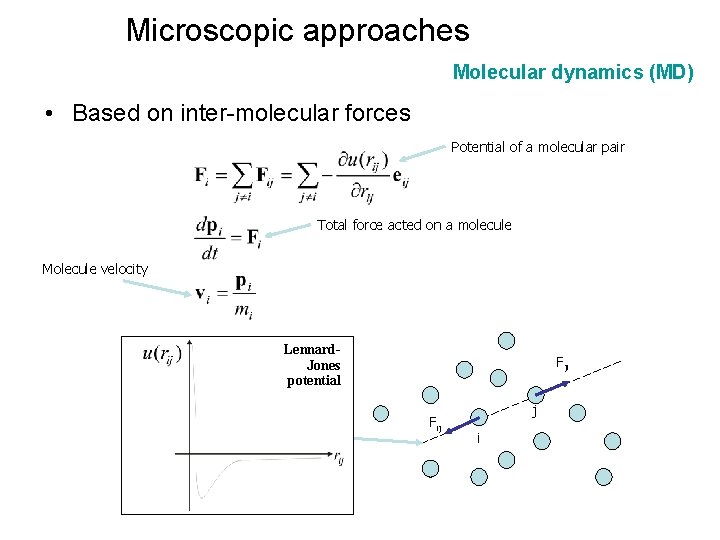
Microscopic approaches Molecular dynamics (MD) • Based on inter-molecular forces Potential of a molecular pair Total force acted on a molecule Molecule velocity Lennard. Jones potential Fji Fij j i
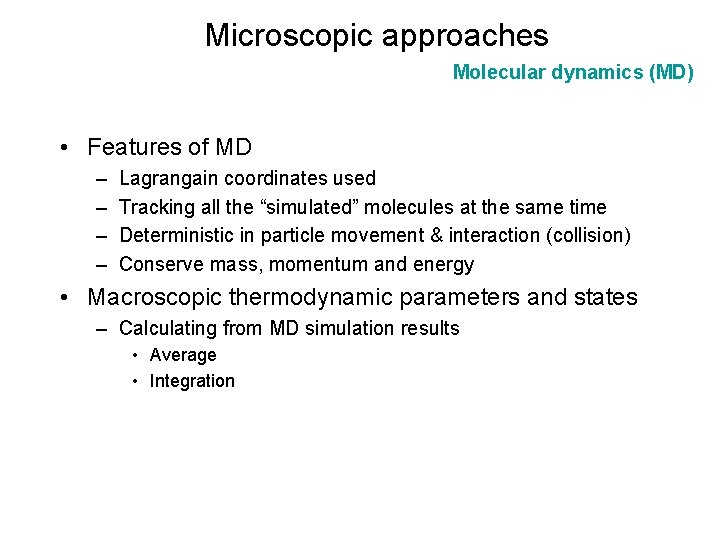
Microscopic approaches Molecular dynamics (MD) • Features of MD – – Lagrangain coordinates used Tracking all the “simulated” molecules at the same time Deterministic in particle movement & interaction (collision) Conserve mass, momentum and energy • Macroscopic thermodynamic parameters and states – Calculating from MD simulation results • Average • Integration
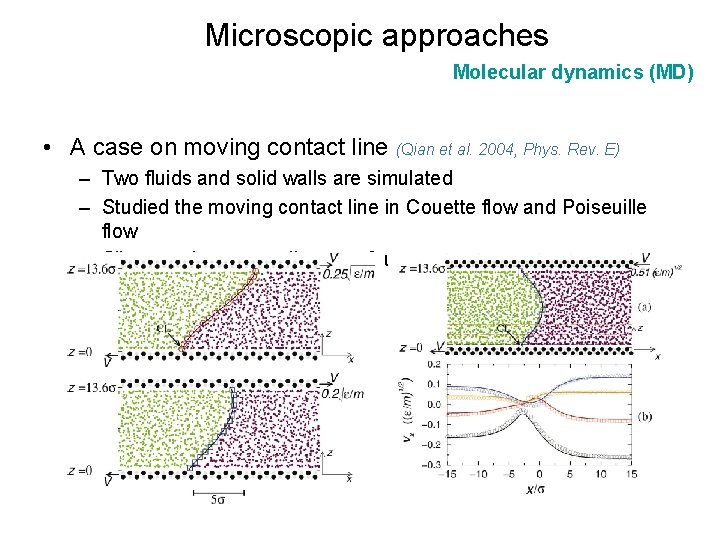
Microscopic approaches Molecular dynamics (MD) • A case on moving contact line (Qian et al. 2004, Phys. Rev. E) – Two fluids and solid walls are simulated – Studied the moving contact line in Couette flow and Poiseuille flow – Slip near the contact line was found
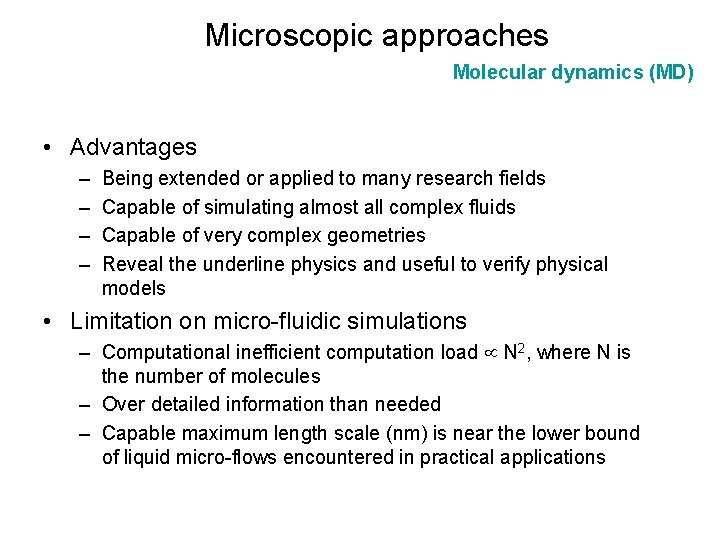
Microscopic approaches Molecular dynamics (MD) • Advantages – – Being extended or applied to many research fields Capable of simulating almost all complex fluids Capable of very complex geometries Reveal the underline physics and useful to verify physical models • Limitation on micro-fluidic simulations – Computational inefficient computation load N 2, where N is the number of molecules – Over detailed information than needed – Capable maximum length scale (nm) is near the lower bound of liquid micro-flows encountered in practical applications
Molecular dynamics in current course • Basic implementation • Multi-phase modeling • SHAKE alogrithm for rigid melocular structures
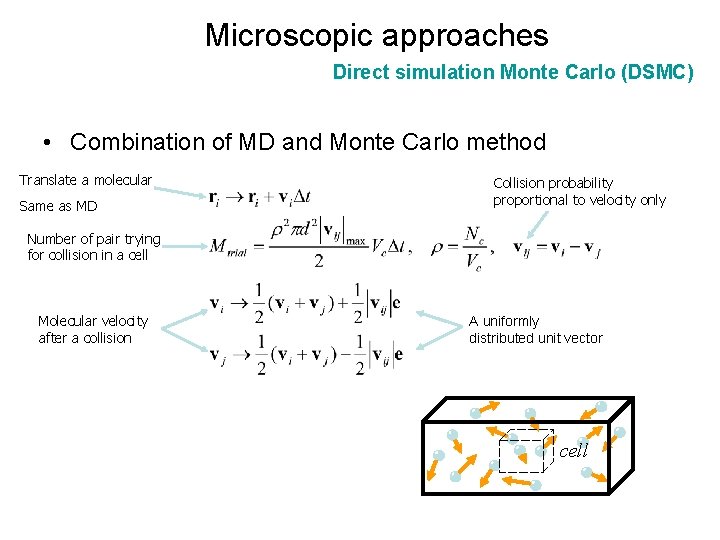
Microscopic approaches Direct simulation Monte Carlo (DSMC) • Combination of MD and Monte Carlo method Translate a molecular Same as MD Collision probability proportional to velocity only Number of pair trying for collision in a cell Molecular velocity after a collision A uniformly distributed unit vector cell
Microscopic approaches Direct simulation Monte Carlo (DSMC) • Features of DSMC – Deterministic in molecular movements – Probabilistic in molecular collisions (interaction) • Collision pairs randomly selected • The properties of collided particles determined statistically – Conserves momentum and energy • Macroscopic thermodynamic states – Similar to MD simulations • Average • Integration
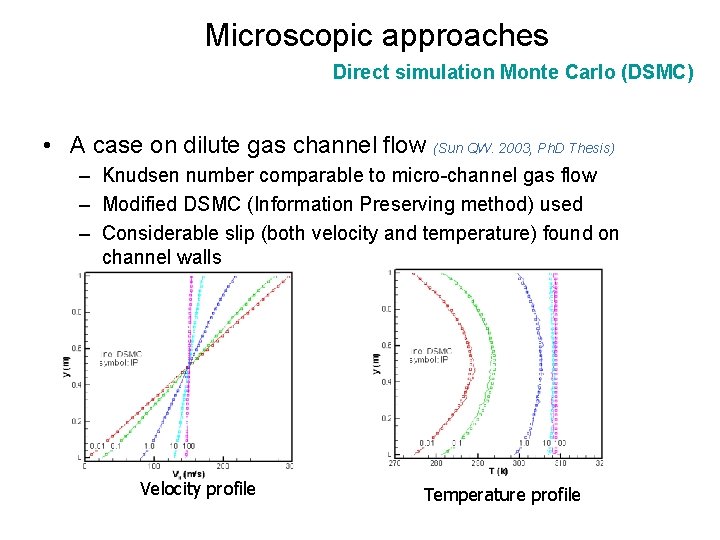
Microscopic approaches Direct simulation Monte Carlo (DSMC) • A case on dilute gas channel flow (Sun QW. 2003, Ph. D Thesis) – Knudsen number comparable to micro-channel gas flow – Modified DSMC (Information Preserving method) used – Considerable slip (both velocity and temperature) found on channel walls Velocity profile Temperature profile
Microscopic approaches Direct simulation Monte Carlo (DSMC) • Advantages – More computationally efficient than MD – Complex geometry treatment similar to finite volume/element method – Hybrid method possible by combining finite volume/element method • Limitation on micro-fluidic simulations – Suitable for gaseous micro-flows – Not efficiency and difficult for liquid or complex flow
DSMC in current course • Basic implementation • Introduction on noise decreasing methods – Information preserving (IP) DSMC
Possible numerical approaches • Mesoscopic approaches
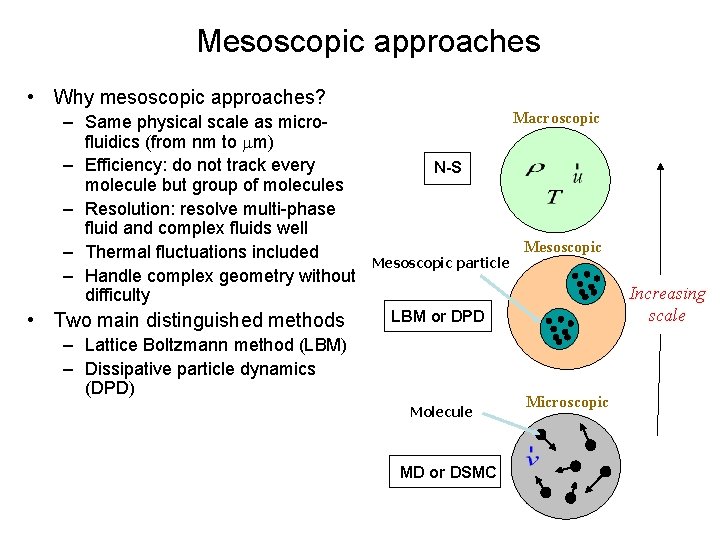
Mesoscopic approaches • Why mesoscopic approaches? – Same physical scale as microfluidics (from nm to mm) – Efficiency: do not track every molecule but group of molecules – Resolution: resolve multi-phase fluid and complex fluids well – Thermal fluctuations included – Handle complex geometry without difficulty • Two main distinguished methods Macroscopic N-S Mesoscopic particle Mesoscopic Increasing scale LBM or DPD – Lattice Boltzmann method (LBM) – Dissipative particle dynamics (DPD) Molecule MD or DSMC Microscopic
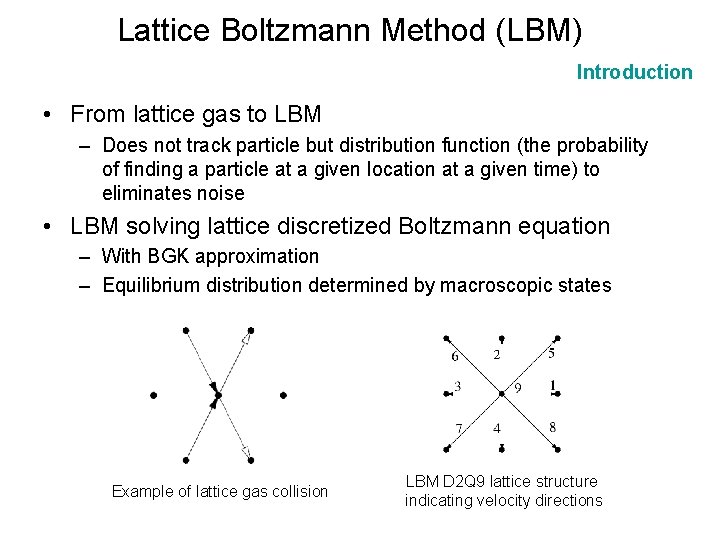
Lattice Boltzmann Method (LBM) Introduction • From lattice gas to LBM – Does not track particle but distribution function (the probability of finding a particle at a given location at a given time) to eliminates noise • LBM solving lattice discretized Boltzmann equation – With BGK approximation – Equilibrium distribution determined by macroscopic states Example of lattice gas collision LBM D 2 Q 9 lattice structure indicating velocity directions
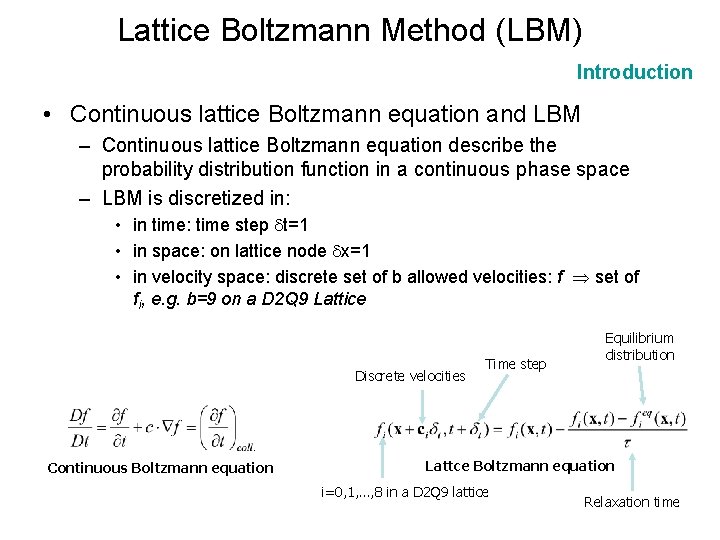
Lattice Boltzmann Method (LBM) Introduction • Continuous lattice Boltzmann equation and LBM – Continuous lattice Boltzmann equation describe the probability distribution function in a continuous phase space – LBM is discretized in: • in time: time step dt=1 • in space: on lattice node dx=1 • in velocity space: discrete set of b allowed velocities: f set of fi, e. g. b=9 on a D 2 Q 9 Lattice Discrete velocities Continuous Boltzmann equation Time step Equilibrium distribution Lattce Boltzmann equation i=0, 1, …, 8 in a D 2 Q 9 lattice Relaxation time
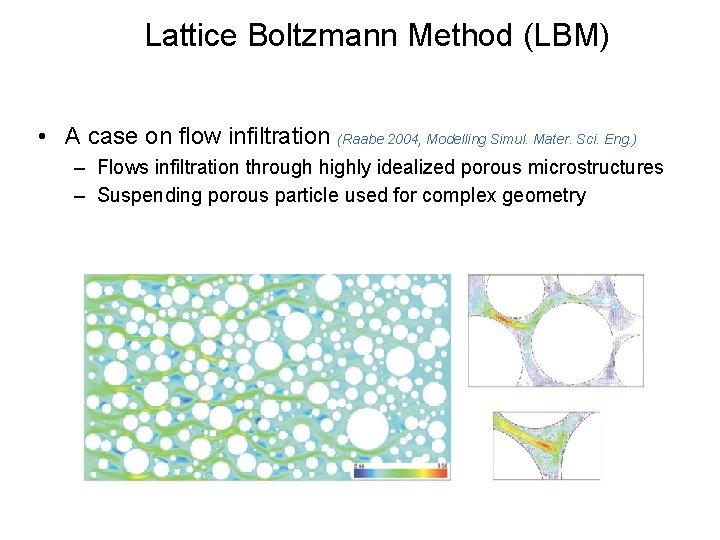
Lattice Boltzmann Method (LBM) • A case on flow infiltration (Raabe 2004, Modelling Simul. Mater. Sci. Eng. ) – Flows infiltration through highly idealized porous microstructures – Suspending porous particle used for complex geometry
Lattice Boltzmann Method (LBM) Application to micro-fluidic simulation • Simulation with complex fluids – Two approaches to model multi-phase fluid by Introducing species by colored particles • Free energy approach: a separate distribution for the order parameter • Particle with different color repel each other more strongly than particles with the same color – Amphiphiles and liquid crystals can be modeled • Introducing internal degree of freedom – Modeling polymer and colloid solution • Suspension model: solid body described by lattice points, only colloid can be modeled • Hybrid model (combining with MD method): solid body modeled by off-lattice particles, both polymer and colloid can be modeled
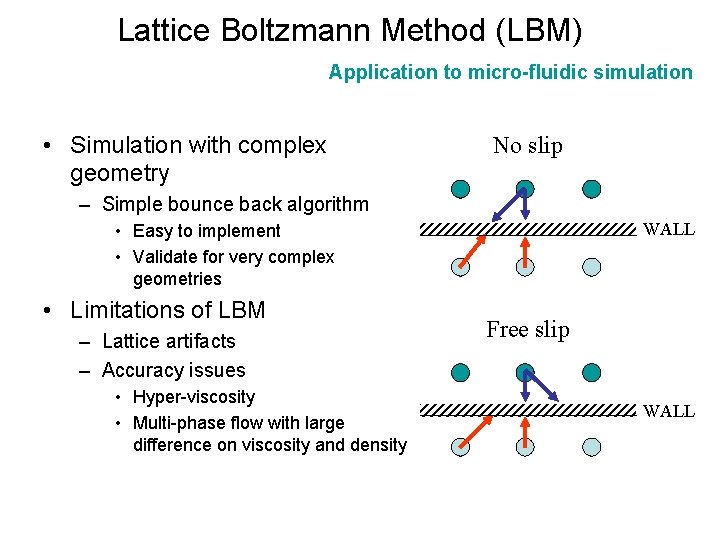
Lattice Boltzmann Method (LBM) Application to micro-fluidic simulation • Simulation with complex geometry No slip – Simple bounce back algorithm WALL • Easy to implement • Validate for very complex geometries • Limitations of LBM – Lattice artifacts – Accuracy issues • Hyper-viscosity • Multi-phase flow with large difference on viscosity and density Free slip WALL
LBM in current course • Basic implementation • Multi-phase modeling – Molcular force approach – Phase field model
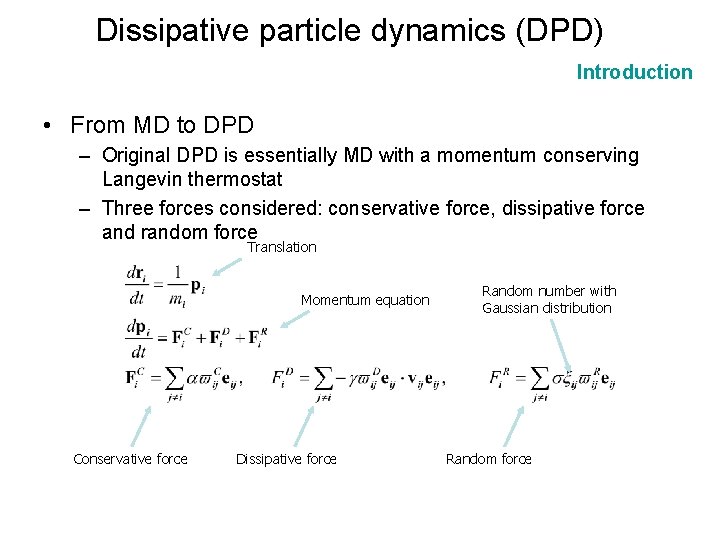
Dissipative particle dynamics (DPD) Introduction • From MD to DPD – Original DPD is essentially MD with a momentum conserving Langevin thermostat – Three forces considered: conservative force, dissipative force and random force Translation Momentum equation Conservative force Dissipative force Random number with Gaussian distribution Random force
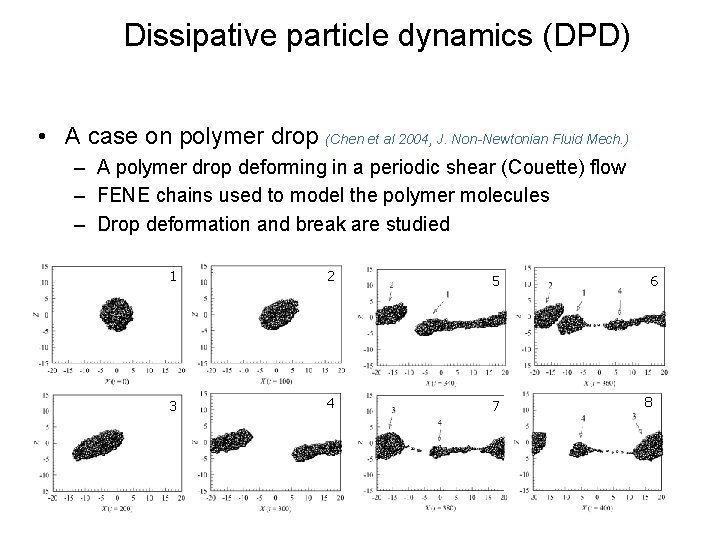
Dissipative particle dynamics (DPD) • A case on polymer drop (Chen et al 2004, J. Non-Newtonian Fluid Mech. ) – A polymer drop deforming in a periodic shear (Couette) flow – FENE chains used to model the polymer molecules – Drop deformation and break are studied 1 2 5 3 4 7 6 8
Dissipative particle dynamics (DPD) Application to micro-fluidic simulation • Simulation with complex fluids – Similar to LBM, particle with different color repel each other more strongly than particles with the same color – Internal degree of freedom can be included for amphiphiles or liquid crystals – modeling polymer and colloid solution • Easier than LBM because of off-lattice Lagrangian properties • Simulation with complex geometries – Boundary particle or virtual particle used
Dissipative particle dynamics (DPD) Application to micro-fluidic simulation • Advantages comparing to LBM – No lattice artifacts – Strictly Galilean invariant • Difficulties of DPD – No directed implement of macroscopic states • Free energy multi-phase approach used in LBM is difficult to implement • Scale is smaller than LBM and many micro-fluidic applications – Problems caused by soft sphere inter-particle force • Polymer and colloid simulation, crossing cannot avoid • Unphysical density depletion near the boundary • Unphysical slippage and particle penetrating into solid body
Dissipative particle dynamics (DPD) New type of DPD method • To solving the difficulties of the original DPD – Allows to implement macroscopic parameter and states directly • Use equation of state, viscosity and other transport coefficients • Thermal fluctuation included in physical ways by the magnitude increase as the physical scale decreases • Simulating flows with the same scale as LBM or even finite volume/element – Inter-particle force adjustable to avoid unphysical penetration or depletion near the boundary • Mean ideas – Deducing the particle dynamics directly from NS equation – Introducing thermal fluctuation with GENRIC or Fokker. Planck formulations
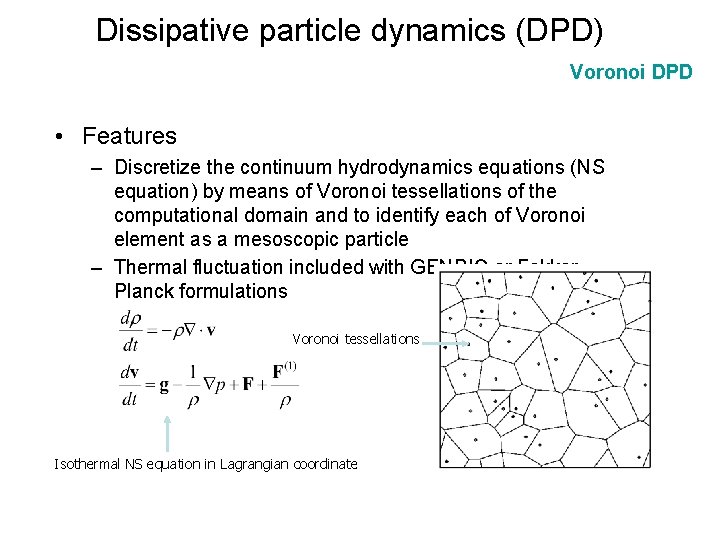
Dissipative particle dynamics (DPD) Voronoi DPD • Features – Discretize the continuum hydrodynamics equations (NS equation) by means of Voronoi tessellations of the computational domain and to identify each of Voronoi element as a mesoscopic particle – Thermal fluctuation included with GENRIC or Fokker. Planck formulations Voronoi tessellations Isothermal NS equation in Lagrangian coordinate
Dissipative particle dynamics (DPD) Smoothed dissipative particle dynamics (SDPD) • Features – Discretize the continuum hydrodynamics equations (NS equation) with smoothed particle hydrodynamics (SPH) method which is developed in 1970’s for macroscopic flows – Include thermal fluctuations by GENRIC formulation • Advantages of SDPD – Fast and simpler than Voronoi DPD – Easy for extending to 3 D (Voronoi DPD in 3 D is very complicate) • Simulation with complex fluids and complex geometries – Require further investigations
DPD in current course • DPD is the main focus in current course – Implementation of traditional DPD – Implementation of SDPD • Multi-phase modeling • Multi-scale simulations with DPD and MD – Micro-flows with immersed nano-strcutres
Summary • The features of micro-fluidics are discussed – Scale: from nm to mm – Complex fluids – Complex geometries • Different approaches are introduced in the situation of micro-fluidic simulations – Macroscopic method: finite volume/element method and thin film method – Microscopic method: molecular dynamics and direct simulation Monte Carlo – Mesoscopic method: lattice Boltzmann method and dissipative particle dynamics • The mesoscopic methods are found more powerful than others