
Chapter 01 Reproduction in Organisms Std XII By
Chapter 01 -Reproduction in Organisms Std XII By Ms Madhusrabani Patro, PGT Biology DAV Public School, Berhampur
• • • Introduction The period from birth to natural death is known as life span. It don’t corellate with the size of organisms. (complete fig 1. 1 of NCERT book) No one is immortal except the unicellular organisms, when there is no natural death is found. Reproduction is the process by which every organism ensures its continuity. It is the process through which organisms produce young ones, which in turn mature to give rise to their young ones. Reproduction enables the Continuity of the species generation after generation. It depends upon the Habitat, internal physiology death and other factors of an organism. birth growth
Reproduction Asexual reproduction • Involvement of single parent with or without the involvement of gamete formation Sexual reproduction • Involvement of both the parents and also fusion of male and female gamete.
Asexual Reproduction • In this type, a single parent can produce offspring. • The produced offspring are clones of each other i. e identical to each other morphologically and genetically and to the parent. • It is commonly seen in unicellular organisms belonging to protista and monera. • Here, the cell division itself is the mode of reproduction.
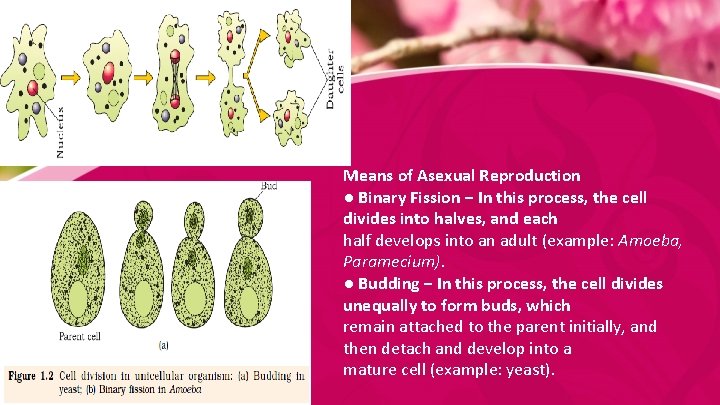
Means of Asexual Reproduction ● Binary Fission − In this process, the cell divides into halves, and each half develops into an adult (example: Amoeba, Paramecium). ● Budding − In this process, the cell divides unequally to form buds, which remain attached to the parent initially, and then detach and develop into a mature cell (example: yeast).
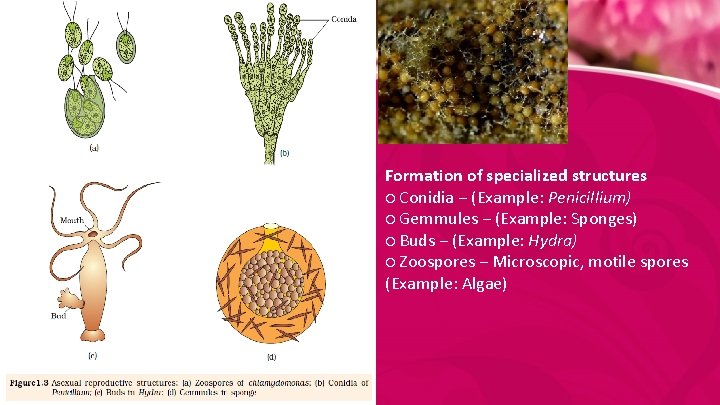
Formation of specialized structures ○ Conidia − (Example: Penicillium) ○ Gemmules − (Example: Sponges) ○ Buds − (Example: Hydra) ○ Zoospores − Microscopic, motile spores (Example: Algae)
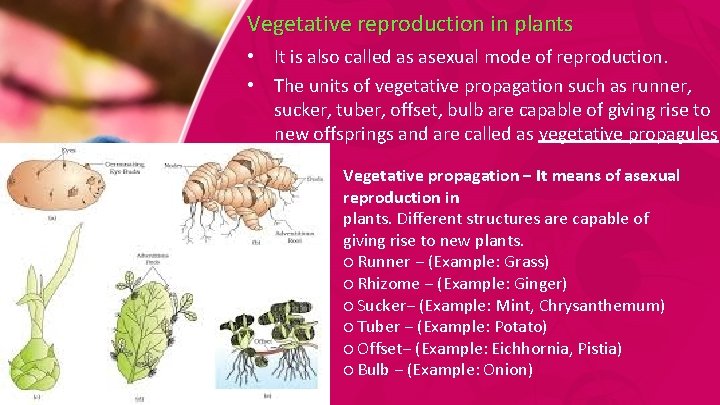
Vegetative reproduction in plants • It is also called as asexual mode of reproduction. • The units of vegetative propagation such as runner, sucker, tuber, offset, bulb are capable of giving rise to new offsprings and are called as vegetative propagules Vegetative propagation − It means of asexual reproduction in plants. Different structures are capable of giving rise to new plants. ○ Runner − (Example: Grass) ○ Rhizome − (Example: Ginger) ○ Sucker− (Example: Mint, Chrysanthemum) ○ Tuber − (Example: Potato) ○ Offset− (Example: Eichhornia, Pistia) ○ Bulb − (Example: Onion)
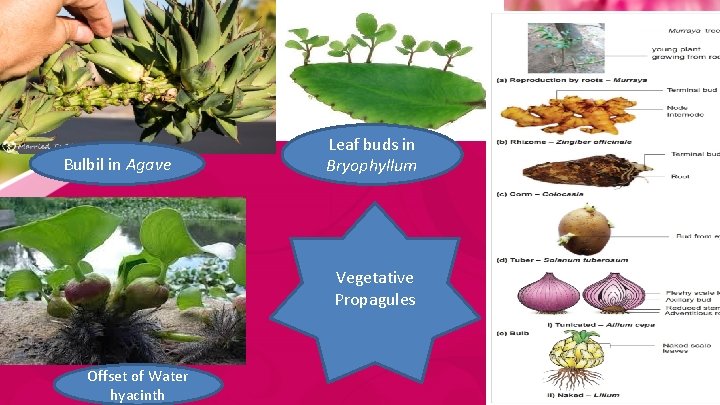
Bulbil in Agave Leaf buds in Bryophyllum Vegetative Propagules Offset of Water hyacinth
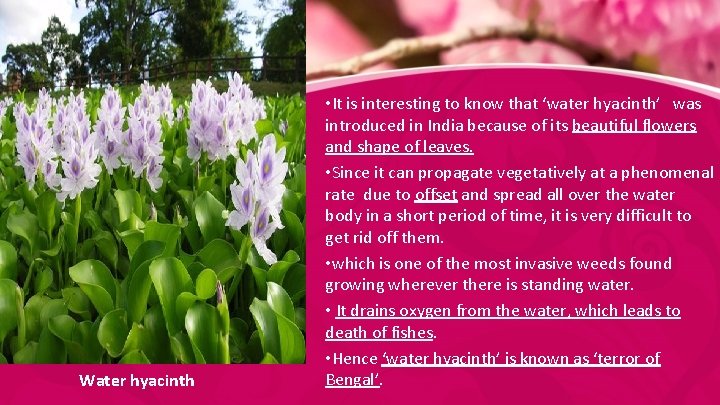
Water hyacinth • It is interesting to know that ‘water hyacinth’ was introduced in India because of its beautiful flowers and shape of leaves. • Since it can propagate vegetatively at a phenomenal rate due to offset and spread all over the water body in a short period of time, it is very difficult to get rid off them. • which is one of the most invasive weeds found growing wherever there is standing water. • It drains oxygen from the water, which leads to death of fishes. • Hence ‘water hyacinth’ is known as ‘terror of Bengal’.
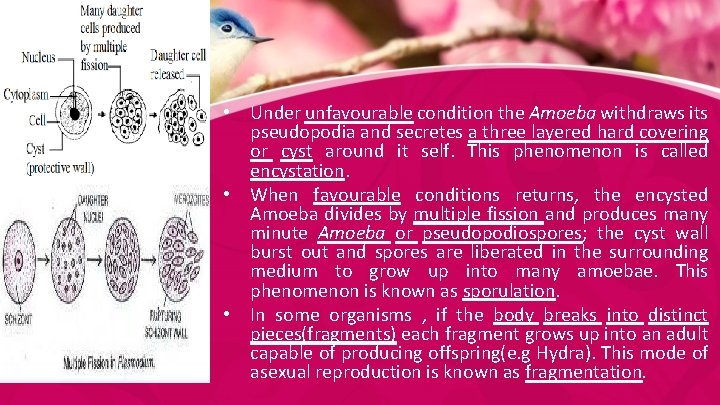
• Under unfavourable condition the Amoeba withdraws its pseudopodia and secretes a three layered hard covering or cyst around it self. This phenomenon is called encystation. • When favourable conditions returns, the encysted Amoeba divides by multiple fission and produces many minute Amoeba or pseudopodiospores; the cyst wall burst out and spores are liberated in the surrounding medium to grow up into many amoebae. This phenomenon is known as sporulation. • In some organisms , if the body breaks into distinct pieces(fragments) each fragment grows up into an adult capable of producing offspring(e. g Hydra). This mode of asexual reproduction is known as fragmentation.
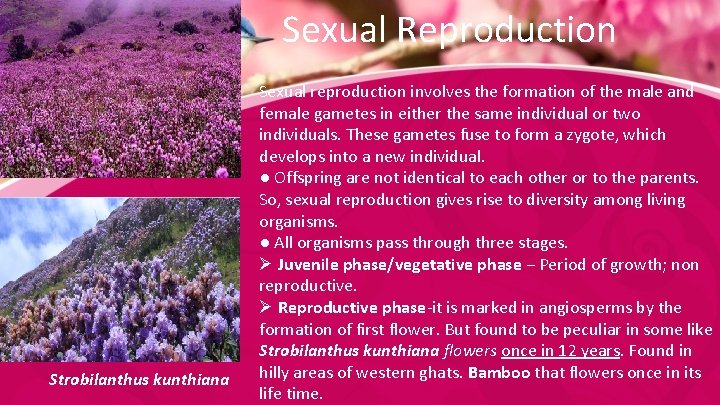
Sexual Reproduction Strobilanthus kunthiana Sexual reproduction involves the formation of the male and female gametes in either the same individual or two individuals. These gametes fuse to form a zygote, which develops into a new individual. ● Offspring are not identical to each other or to the parents. So, sexual reproduction gives rise to diversity among living organisms. ● All organisms pass through three stages. Ø Juvenile phase/vegetative phase − Period of growth; non reproductive. Ø Reproductive phase-it is marked in angiosperms by the formation of first flower. But found to be peculiar in some like Strobilanthus kunthiana flowers once in 12 years. Found in hilly areas of western ghats. Bamboo that flowers once in its life time.
• The females of placental mammals exhibit cyclical changes in the activities of ovaries and accessory ducts as well as hormones during the reproductive phase. In non-primate mammals like rats, sheep, dogs, cows etc it is called the oestrus cycle, in primates like monkeys, apes and humans, it is called the menstrual cycle. • Certain mammals are called continuous breeders since they can reproduce throughout their reproductive phase, while some are called seasonal breeders since they can reproduce only in the favourable seasons.
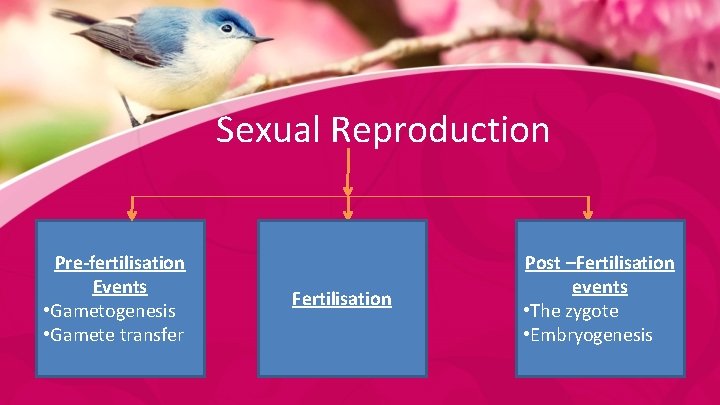
Sexual Reproduction Pre-fertilisation Events • Gametogenesis • Gamete transfer Fertilisation Post –Fertilisation events • The zygote • Embryogenesis
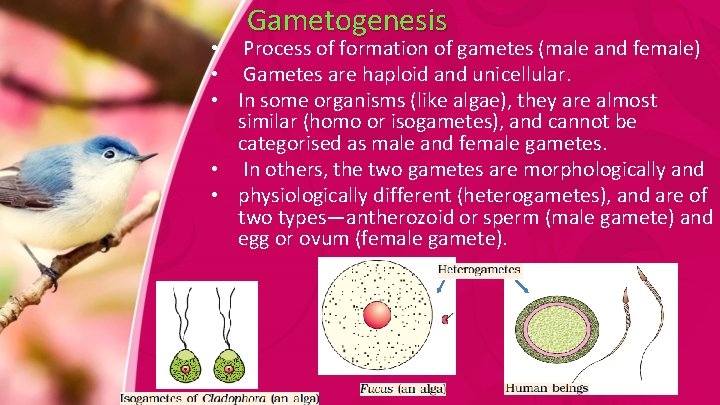
Gametogenesis • Process of formation of gametes (male and female) • Gametes are haploid and unicellular. • In some organisms (like algae), they are almost similar (homo or isogametes), and cannot be categorised as male and female gametes. • In others, the two gametes are morphologically and • physiologically different (heterogametes), and are of two types—antherozoid or sperm (male gamete) and egg or ovum (female gamete).
Sexuality in organisms • • • In some organisms both the sexes are present in the same individual (monoecious or homothallic or bisexual or hermaphrodites) example: cucurbits, coconut , Leech, earthworm , sponge , tapeworm. in others, they are present in two individuals (dioecious or heterothallic or unisexual). Example: Papaya, and date palm, cockroach. In a unisexual flower, the male flower is called staminate and the female flower is called pistillate. Gamete formation takes place by cell division. In haploid parents like in monera , fungi , algae, bryophytes , it is by mitosis; in diploid parents like gymnosperms, angiosperms and in animals it is by meiosis, with specialised cells called meiocytes( gamete mother cell) undergoing meiosis so that each gamete gets only one set of chromosomes.
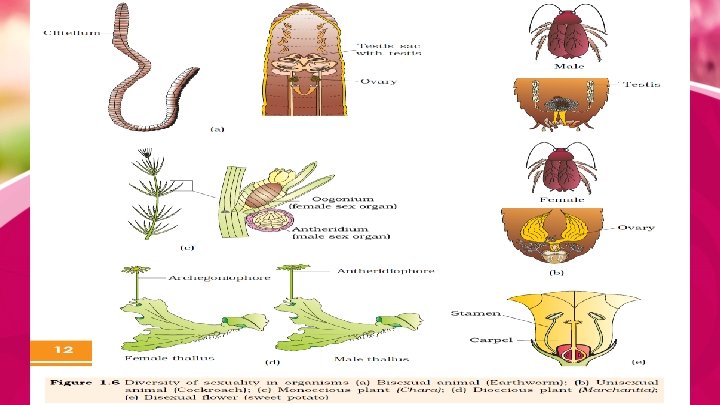
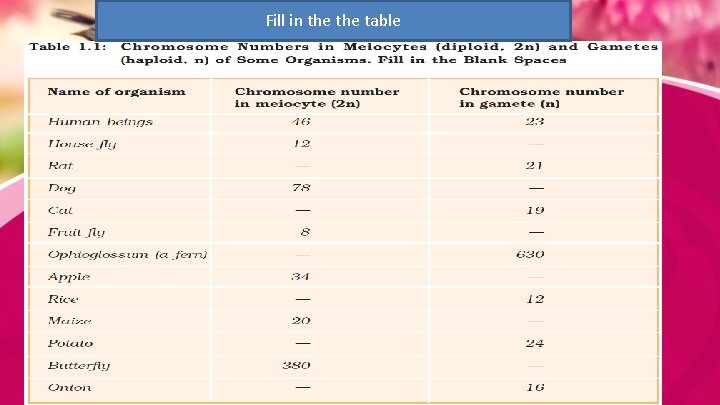
Fill in the table
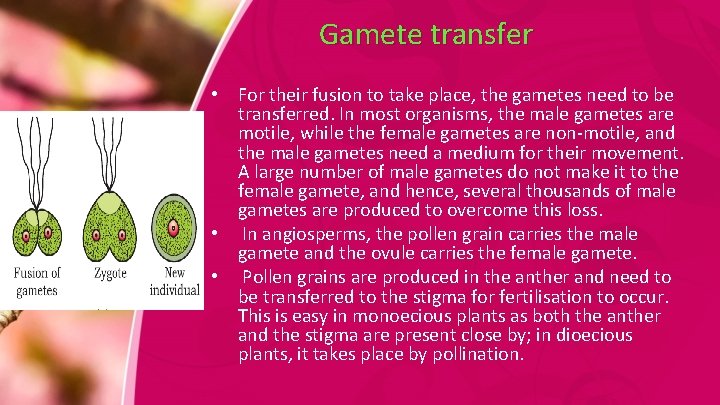
Gamete transfer • For their fusion to take place, the gametes need to be transferred. In most organisms, the male gametes are motile, while the female gametes are non-motile, and the male gametes need a medium for their movement. A large number of male gametes do not make it to the female gamete, and hence, several thousands of male gametes are produced to overcome this loss. • In angiosperms, the pollen grain carries the male gamete and the ovule carries the female gamete. • Pollen grains are produced in the anther and need to be transferred to the stigma for fertilisation to occur. This is easy in monoecious plants as both the anther and the stigma are present close by; in dioecious plants, it takes place by pollination.
Fertilisation • • • Fertilisation is the most important event in sexual reproduction. This process is also called syngamy and leads to the formation of the zygote. However, in some organisms, the female gamete undergoes development to form new organisms without fertilisation, and is known as parthenogenesis (occurs in rotifers, honeybees and some lizards). In most aquatic organisms and amphibians, fertilisation takes place outside their body (in the water), and is termed as external fertilisation. Their eggs and offspring are highly vulnerable to predators and this threatens their survival upto adulthood. ● In most terrestrial organisms, fertilisation is internal, i. e. , it takes place inside the female body. In this process, the male gamete is motile and reaches the female gamete to fuse with it, thereby forming zygote. Male gametes are produced in large numbers.
Post fertilisation Events The Zygote • The haploid gametes fuse to form a diploid zygote in all organisms. • In external fertilisation, a zygote is formed in an external medium, and in internal fertilisation, a zygote is formed inside the individual. • The development of a zygote depends upon the life cycle of an organism and its surroundings. In organisms with haplontic life cycle, zygote divides by meiosis to form haploid spores that grow into haploid individuals. • In some organisms, the zygote does not develop immediately, and develops a thick wall around itself. This wall is resistant to damage and desiccation.
Embryogenesis • • • It is the process of development of the embryo from the zygote. The zygote undergoes cell division and differentiation. Cell division increases the number of cells of the embryo, and cell differentiation helps the cells undergo modifications to form specialised tissues and organs. Animals can be grouped into two categories based on how and where the development of the zygote takes place. These categories are: ○ Oviparous − The fertilised egg is covered by a calcareous shell and is released into the outside environment. The development takes place inside the egg and the young one hatches out (example: birds and reptiles). ○ Viviparous − The development of the zygote takes place inside the female body, and the developed young one is delivered outside (example: mammals, including humans).
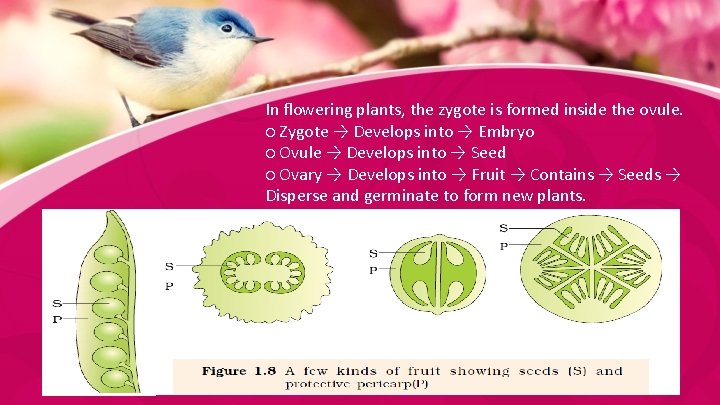
In flowering plants, the zygote is formed inside the ovule. ○ Zygote → Develops into → Embryo ○ Ovule → Develops into → Seed ○ Ovary → Develops into → Fruit → Contains → Seeds → Disperse and germinate to form new plants.
Answer the following questions 1. Offsprings produced by asexual reproduction are referred to as clones. Why? 2. Name the most invasive aquatic plant weed which is called as Terror of Bengal. 3. How does Zygote usually differ from Zoospore in terms of ploidy? 4. Mention the main difference between the offspring produced by asexual reproduction and progeny produced by sexual reproduction. 5. Which characteristic property of Bryophyllum is exploited by gardeners and farmers? 6. What represents the life span of an organism? 7. Which individuals can be termed as clones? 8. How do the following organisms reproduce: Paramoecium and Penicillium? 9. State the function of a vegetative propagule. 10. How will you grow a banana and a ginger plant?
Answer the following 1. 2. 3. 4. 5. 6. 7. 8. 9. 10. 11. 12. Differentiate between oestrus cycle and menstrual cycle. Differentiate between seasonal breeder and continuous breeder. Differentiate between zygote and zygospore. Differentiate between gametogenesis and embryogenesis. Differentiate between oviparous animals and viviparous animals. Differentiate between parthenogenesis and parthenocarpy. Differentiate between asexual and sexual reproduction. Cucurbita and Papaya are producing unisexual flowers but still differ in their sexuallity. Give reason. Bony fishes and frogs are producing large number of gametes. Give reason. Unicellular organisms are immortal. Give reason. Explain the significance of meiocytes in diploid organisms. Why do algae and fungi shift to the sexual mode of reproduction just before the onset of adverse conditions?
Some important questions: 1. 2. 3. 4. 5. 6. 7. 8. 9. 10. Why water hyacinth is known as ‘terrror of bengal’? Name two plants which shows piculiarity in their flowering. How the Amoeba overcomes from the unfavourable condition? For a farmer seeds of ginger, banana, potato and bryophyllum is not necessary still he can grow them. How? Offsprings of asexual reproduction are called as clones. Explain. Mention the number of chromosomes found in the prothallus of Ophioglossum ? Mention the post fertilisation events in a flower. Name the group of organisms hat produces non motile male gametes. How do they reach the female gamete for fertilisation. When are the non flowering plants said to be homothallic and monoecious and heterothallic and dioecious? Mention the significance of meiosis in haploids and deploids.
1. 2. Diagram basic questions Identify the organism and the labellings a and b. what is the sexuality of this organism? Name the organisms and the type of gametes that they are producing. 3. Name the asexual reproductive strucures in the given figure.

Refer the diagrams of your NCERT book. THANK YOU
- Slides: 27