
Chapter 0 Introduction Computer Science An Overview Tenth
- Slides: 21
Chapter 0: Introduction Computer Science: An Overview Tenth Edition by J. Glenn Brookshear Copyright © 2008 Pearson Education, Inc. Publishing as Pearson Addison-Wesley
Chapter 0: Introduction • • • 0. 1 The Role of Algorithms 0. 2 The Origins of Computing Machines 0. 3 The Science of Algorithms 0. 4 Abstraction 0. 5 An Outline of Our Study 0. 6 Social Repercussions Copyright © 2008 Pearson Education, Inc. Publishing as Pearson Addison-Wesley 2
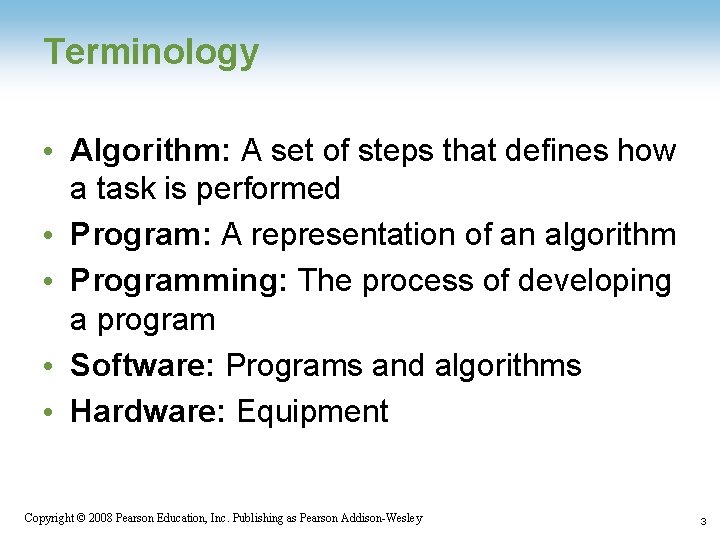
Terminology • Algorithm: A set of steps that defines how a task is performed • Program: A representation of an algorithm • Programming: The process of developing a program • Software: Programs and algorithms • Hardware: Equipment Copyright © 2008 Pearson Education, Inc. Publishing as Pearson Addison-Wesley 3
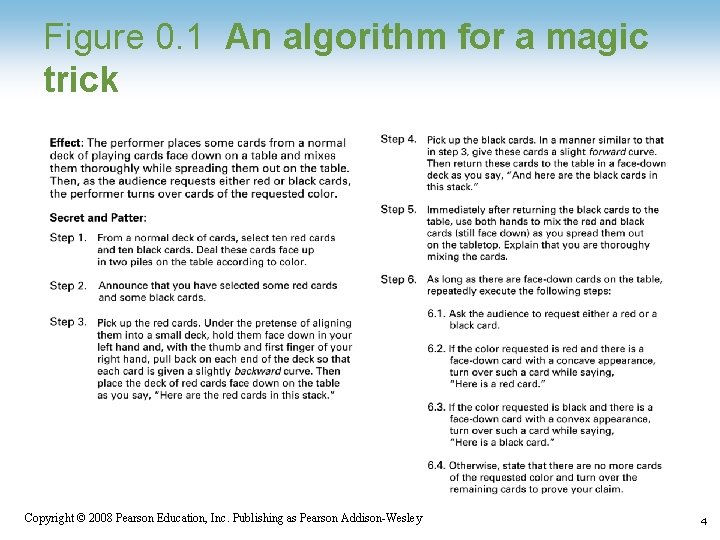
Figure 0. 1 An algorithm for a magic trick Copyright © 2008 Pearson Education, Inc. Publishing as Pearson Addison-Wesley 4
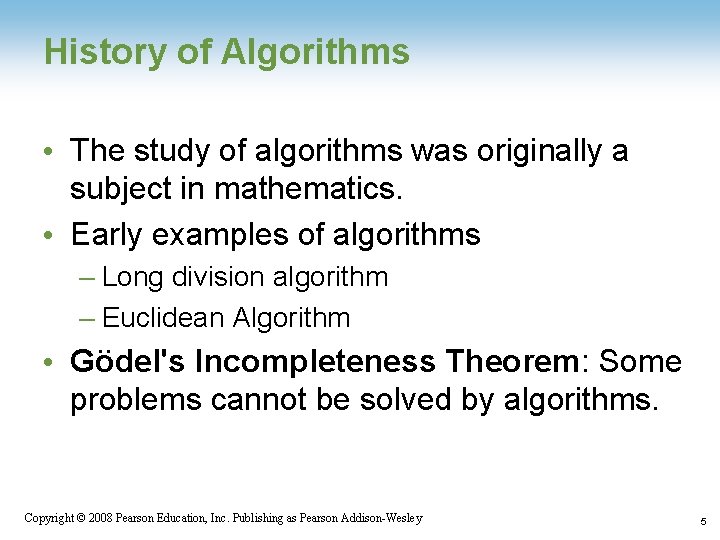
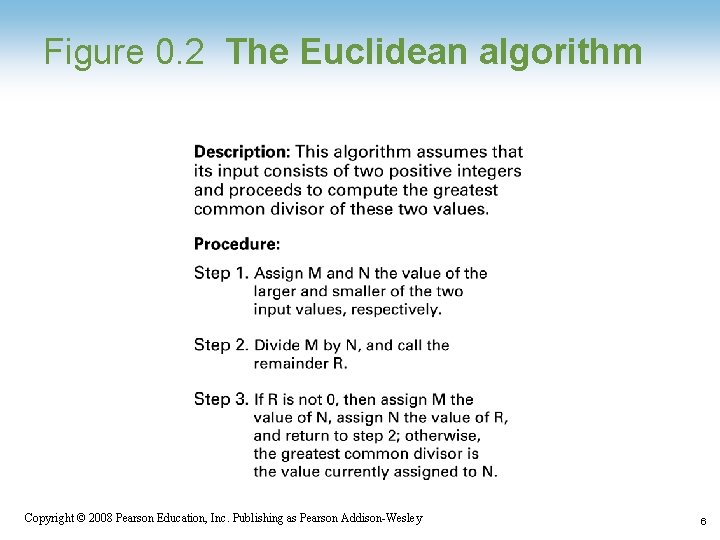
History of Algorithms • The study of algorithms was originally a subject in mathematics. • Early examples of algorithms – Long division algorithm – Euclidean Algorithm • Gödel's Incompleteness Theorem: Some problems cannot be solved by algorithms. Copyright © 2008 Pearson Education, Inc. Publishing as Pearson Addison-Wesley 5
Figure 0. 2 The Euclidean algorithm Copyright © 2008 Pearson Education, Inc. Publishing as Pearson Addison-Wesley 6
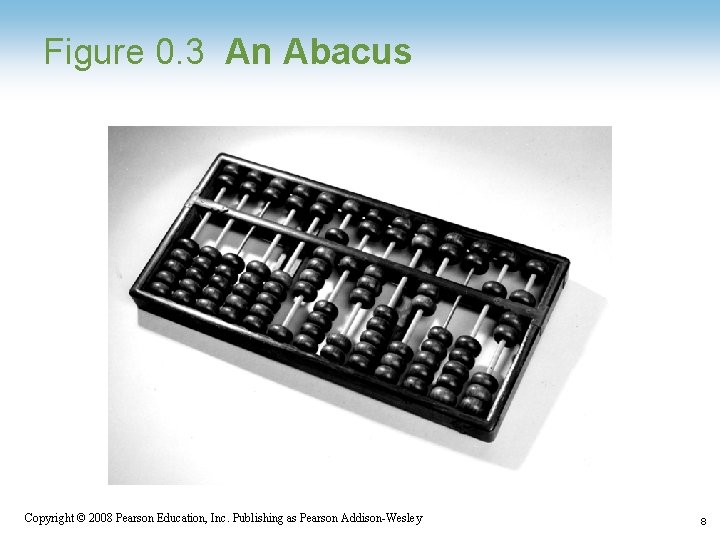
Origins of Computing Machines • Early computing devices – Abacus: positions of beads represent numbers – Gear-based machines (1600 s-1800 s) • Positions of gears represent numbers • Blaise Pascal, Wilhelm Leibniz, Charles Babbage Copyright © 2008 Pearson Education, Inc. Publishing as Pearson Addison-Wesley 7
Figure 0. 3 An Abacus Copyright © 2008 Pearson Education, Inc. Publishing as Pearson Addison-Wesley 8
Early Data Storage • Punched cards – First used in Jacquard Loom (1801) to store patterns for weaving cloth – Storage of programs in Babbage’s Analytical Engine – Popular through the 1970’s • Gear positions Copyright © 2008 Pearson Education, Inc. Publishing as Pearson Addison-Wesley 9
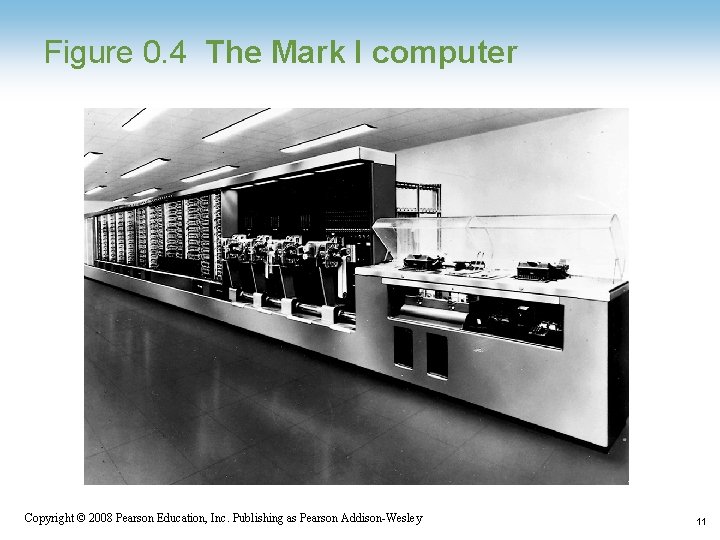
Early Computers • Based on mechanical relays – 1940: Stibitz at Bell Laboratories – 1944: Mark I: Howard Aiken and IBM at Harvard • Based on vacuum tubes – 1937 -1941: Atanasoff-Berry at Iowa State – 1940 s: Colossus: secret German code-breaker – 1940 s: ENIAC: Mauchly & Eckert at U. of Penn. Copyright © 2008 Pearson Education, Inc. Publishing as Pearson Addison-Wesley 10
Figure 0. 4 The Mark I computer Copyright © 2008 Pearson Education, Inc. Publishing as Pearson Addison-Wesley 11
Personal Computers – First used by hobbyists – IBM introduced the PC in 1981. • Accepted by business • Became the standard hardware design for most desktop computers • Most PCs use software from Microsoft Copyright © 2008 Pearson Education, Inc. Publishing as Pearson Addison-Wesley 12
Computer Science • The science of algorithms • Draws from other subjects, including – Mathematics – Engineering – Psychology – Business Administration – Psychology Copyright © 2008 Pearson Education, Inc. Publishing as Pearson Addison-Wesley 13
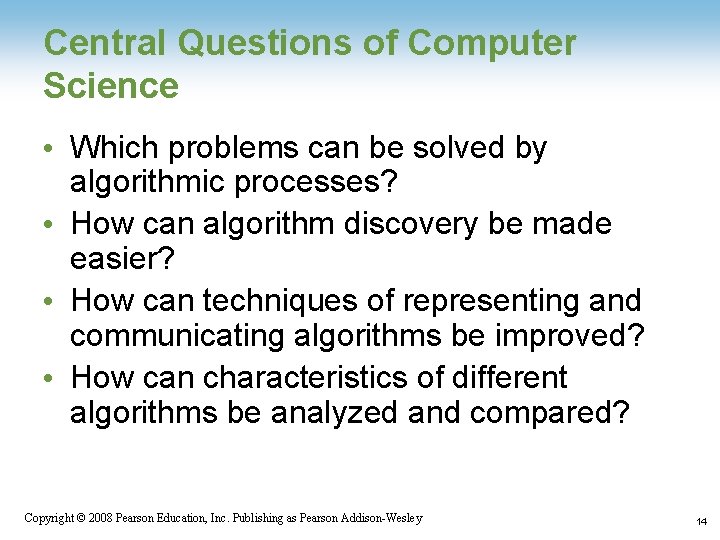
Central Questions of Computer Science • Which problems can be solved by algorithmic processes? • How can algorithm discovery be made easier? • How can techniques of representing and communicating algorithms be improved? • How can characteristics of different algorithms be analyzed and compared? Copyright © 2008 Pearson Education, Inc. Publishing as Pearson Addison-Wesley 14
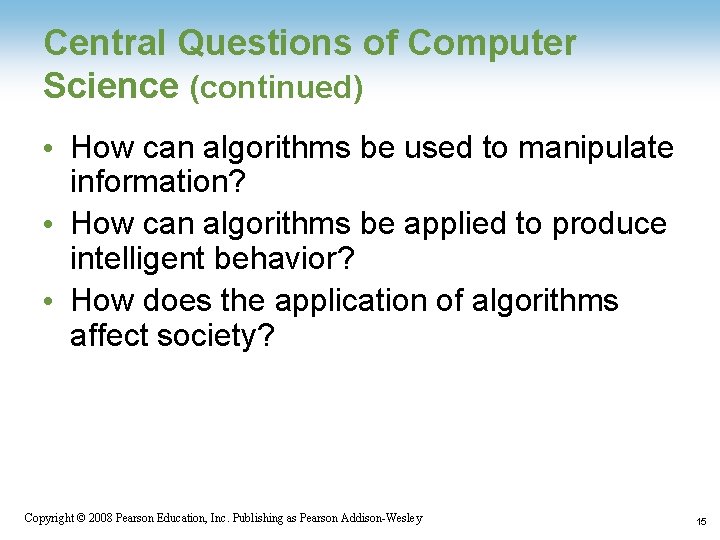
Central Questions of Computer Science (continued) • How can algorithms be used to manipulate information? • How can algorithms be applied to produce intelligent behavior? • How does the application of algorithms affect society? Copyright © 2008 Pearson Education, Inc. Publishing as Pearson Addison-Wesley 15
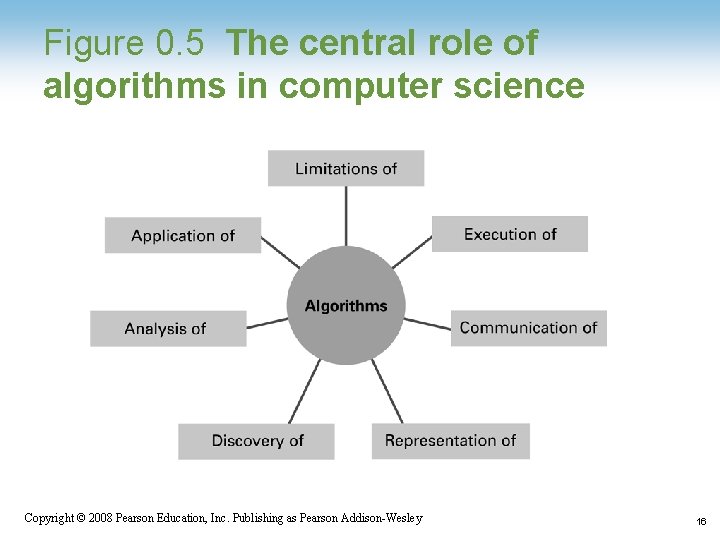
Figure 0. 5 The central role of algorithms in computer science Copyright © 2008 Pearson Education, Inc. Publishing as Pearson Addison-Wesley 16
Abstraction • Abstraction: The distinction between the external properties of an entity and the details of the entity’s internal composition • Abstract tool: A “component” that can be used without concern for the component’s internal properties Copyright © 2008 Pearson Education, Inc. Publishing as Pearson Addison-Wesley 17
Outline of Our Study • • • Chapter 1: Chapter 2: Chapter 3: Chapter 4: Chapter 5: Chapter 6: Data Storage Data Manipulation Operating Systems Networks and the Internet Algorithms Programming Languages Copyright © 2008 Pearson Education, Inc. Publishing as Pearson Addison-Wesley 18
Outline of Our Study (continued) • • • Chapter 7: Software Engineering Chapter 8: Data Abstractions Chapter 9: Database Systems Chapter 10: Computer Graphics Chapter 11: Artificial Intelligence Chapter 12: Theory of Computation Copyright © 2008 Pearson Education, Inc. Publishing as Pearson Addison-Wesley 19
Social Repercussions • Advances in computer science raise new questions. – In law: Questions of rights and liabilities – In government: Questions of regulation – In the work place: Questions of professionalism – In society: Questions of social behavior Copyright © 2008 Pearson Education, Inc. Publishing as Pearson Addison-Wesley 20
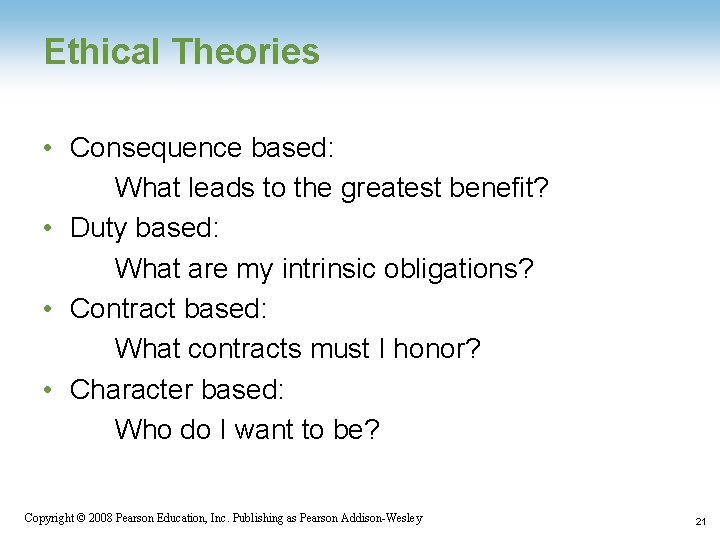
Ethical Theories • Consequence based: What leads to the greatest benefit? • Duty based: What are my intrinsic obligations? • Contract based: What contracts must I honor? • Character based: Who do I want to be? Copyright © 2008 Pearson Education, Inc. Publishing as Pearson Addison-Wesley 21