
Chap 9 1 Micro Hybrid Processes Introduction total
Chap 9 -1. Micro Hybrid Processes
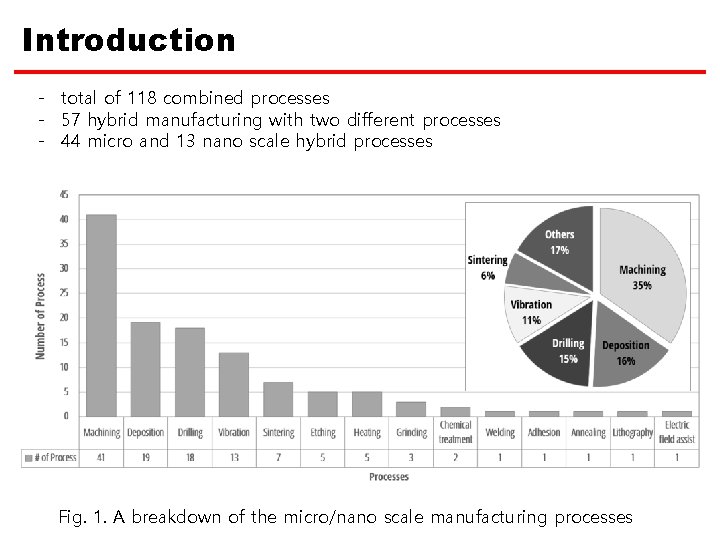
Introduction - total of 118 combined processes - 57 hybrid manufacturing with two different processes - 44 micro and 13 nano scale hybrid processes Fig. 1. A breakdown of the micro/nano scale manufacturing processes

What is “Hybrid Manufacturing” ? Fig. 2. Schematic diagram showing hybrid manufacturing by ‘timing’.
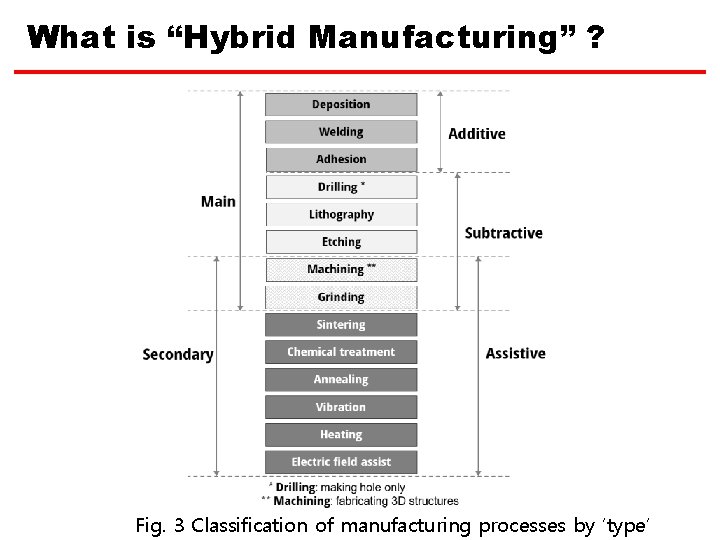
What is “Hybrid Manufacturing” ? Fig. 3 Classification of manufacturing processes by ‘type’
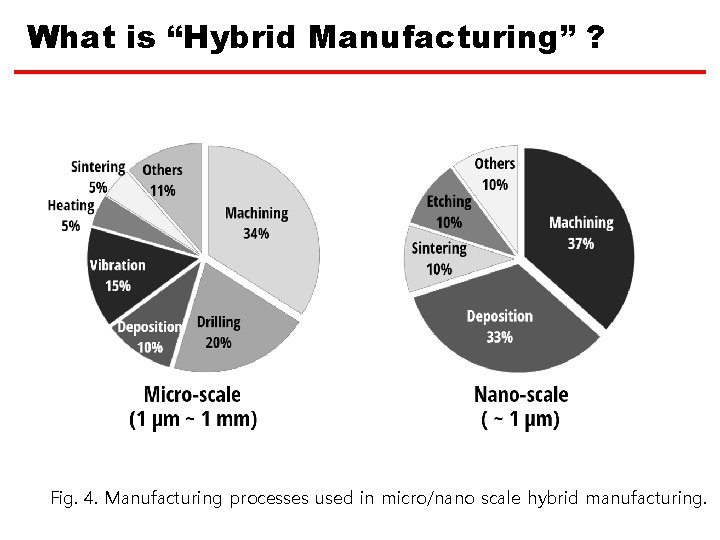
What is “Hybrid Manufacturing” ? Fig. 4. Manufacturing processes used in micro/nano scale hybrid manufacturing.

What is “Hybrid Manufacturing” ? Fig. 5. Combinations of manufacturing processes used in micro scale hybrid manufacturing.
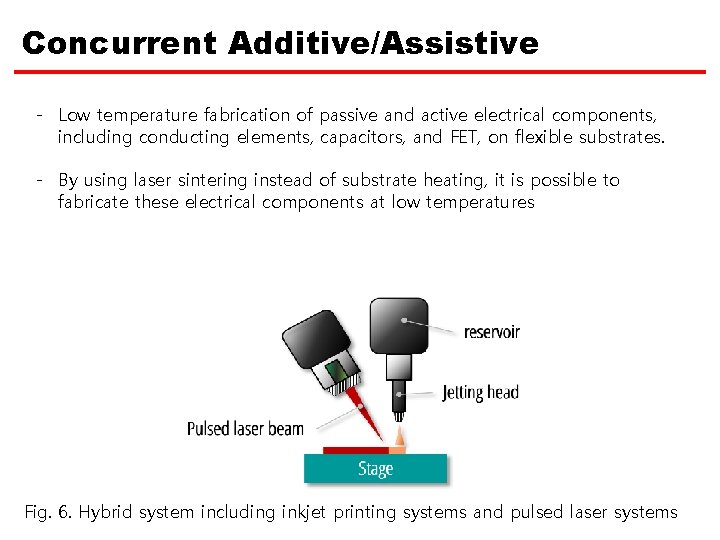
Concurrent Additive/Assistive - Low temperature fabrication of passive and active electrical components, including conducting elements, capacitors, and FET, on flexible substrates. - By using laser sintering instead of substrate heating, it is possible to fabricate these electrical components at low temperatures Fig. 6. Hybrid system including inkjet printing systems and pulsed laser systems
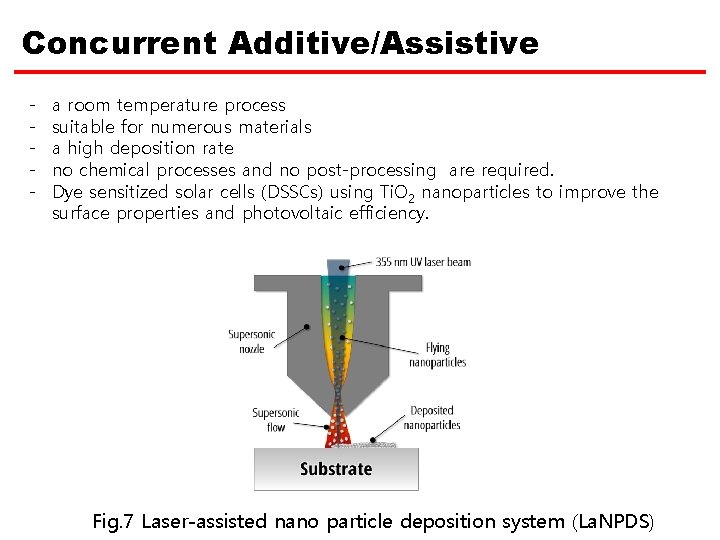
Concurrent Additive/Assistive - a room temperature process suitable for numerous materials a high deposition rate no chemical processes and no post-processing are required. Dye sensitized solar cells (DSSCs) using Ti. O 2 nanoparticles to improve the surface properties and photovoltaic efficiency. Fig. 7 Laser-assisted nano particle deposition system (La. NPDS)
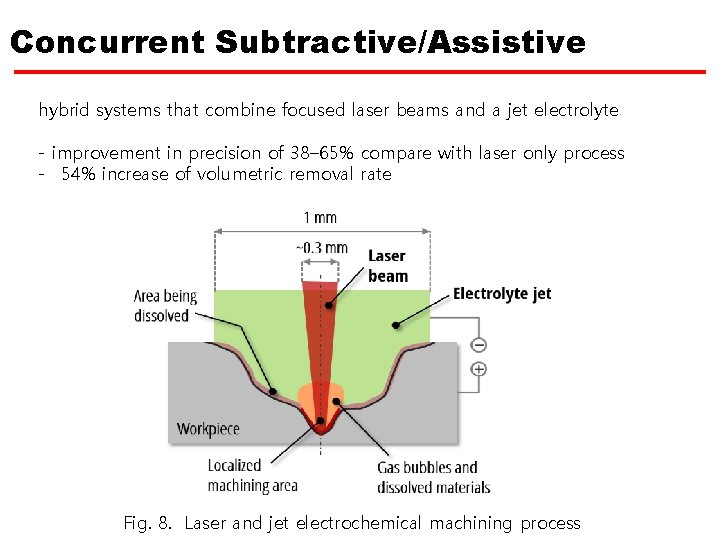
Concurrent Subtractive/Assistive hybrid systems that combine focused laser beams and a jet electrolyte - improvement in precision of 38– 65% compare with laser only process - 54% increase of volumetric removal rate Fig. 8. Laser and jet electrochemical machining process
Concurrent Subtractive/Assistive Chemical treated Laser process in electrolyte solution (Manchester University) > 300% increase in MRR when compared with no chemical treatment. EDM machining and ECM grinding (Zurich) Ø improvement in precision of 25% Laser assisted machining > Improvement in machinability and surface quality Laser assisted milling machine (Georgia Institute of Technology and Timken) > 200% increase in cutting rate Laser heating system for turning (Purdue University) Ø 20% reduction in the specific cutting energy compared with no laser heating Optimum process for high material removal rates (The University of Nebraska) Ø 400 improvement in the precision and 300% increase in cutting rate Ø 200% improvement in volumetric removal rate
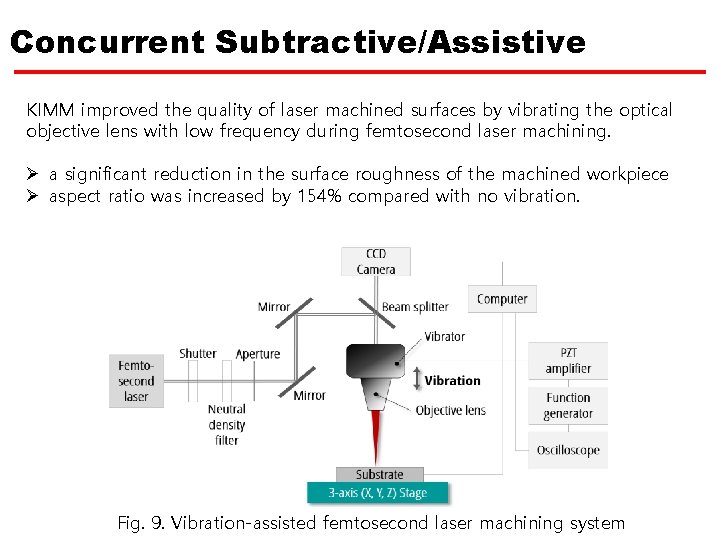
Concurrent Subtractive/Assistive KIMM improved the quality of laser machined surfaces by vibrating the optical objective lens with low frequency during femtosecond laser machining. Ø a significant reduction in the surface roughness of the machined workpiece Ø aspect ratio was increased by 154% compared with no vibration. Fig. 9. Vibration-assisted femtosecond laser machining system
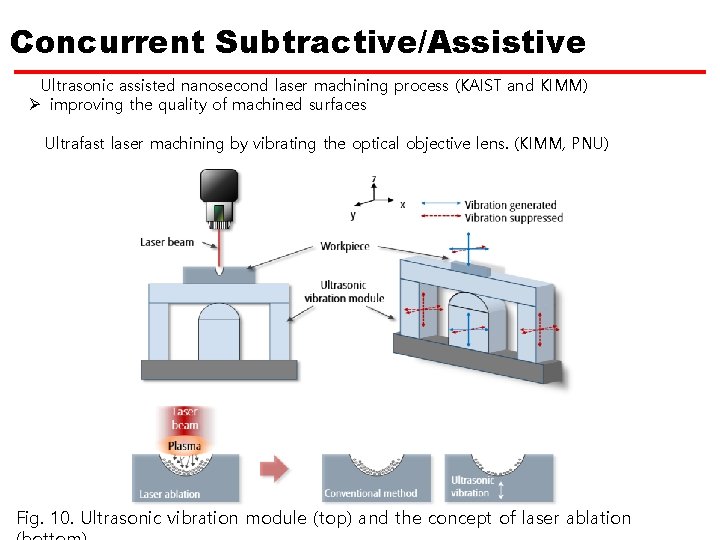
Concurrent Subtractive/Assistive Ultrasonic assisted nanosecond laser machining process (KAIST and KIMM) Ø improving the quality of machined surfaces Ultrafast laser machining by vibrating the optical objective lens. (KIMM, PNU) Fig. 10. Ultrasonic vibration module (top) and the concept of laser ablation
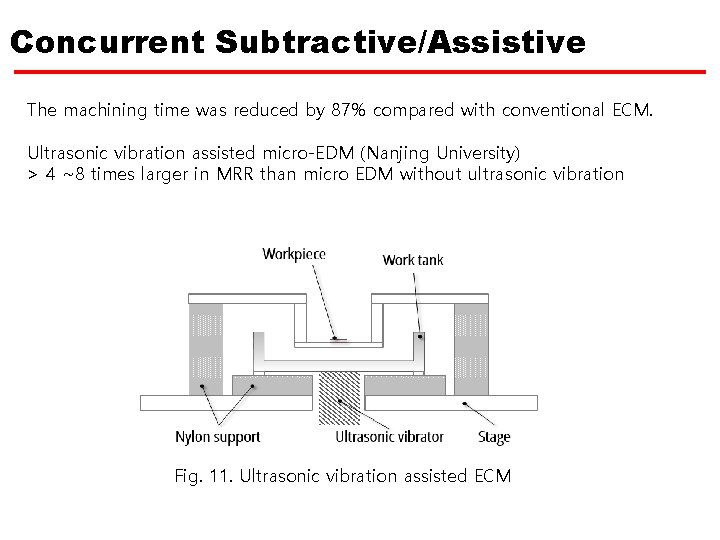
Concurrent Subtractive/Assistive The machining time was reduced by 87% compared with conventional ECM. Ultrasonic vibration assisted micro-EDM (Nanjing University) > 4 ~8 times larger in MRR than micro EDM without ultrasonic vibration Fig. 11. Ultrasonic vibration assisted ECM
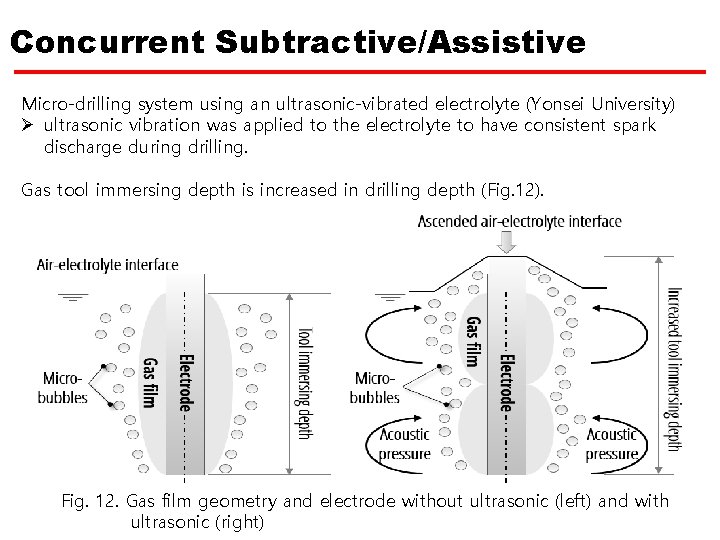
Concurrent Subtractive/Assistive Micro-drilling system using an ultrasonic-vibrated electrolyte (Yonsei University) Ø ultrasonic vibration was applied to the electrolyte to have consistent spark discharge during drilling. Gas tool immersing depth is increased in drilling depth (Fig. 12). Fig. 12. Gas film geometry and electrode without ultrasonic (left) and with ultrasonic (right)
Concurrent Subtractive/Subtrative Example ; EDM together with ECM or etching High speed wire electrical discharge machining (HSWEDM) machine (Nanjing) - used electric discharge and anodic etching together - increase of 200– 600% in the cutting rate Combining micro-EDM and high-frequency dither grinding - improve the precision by 40% - 5μm long wedge-type micro-grooves and square-type micro-structure of length were fabricated which can be used to micro-molds.
M/S Sequence Additive/Assistive - Inkjet printing can be used as additive process, followed by diode pumped solid state (DPSS) laser sintering or annealing of the deposited materials. > reduce the conductivity of fabricated electronic parts by 67%. - Micro-EDM as a subtractive process and laser assembly as an assistive process Ø Enhance the process applicability -Chemical mechanical micro-machining process (PNU) Ø The chemically reacted layer results in lower machining force, tool wear reduction and high form accuracy. Ø Both brittle and ductile material showed improvements in surface quality.
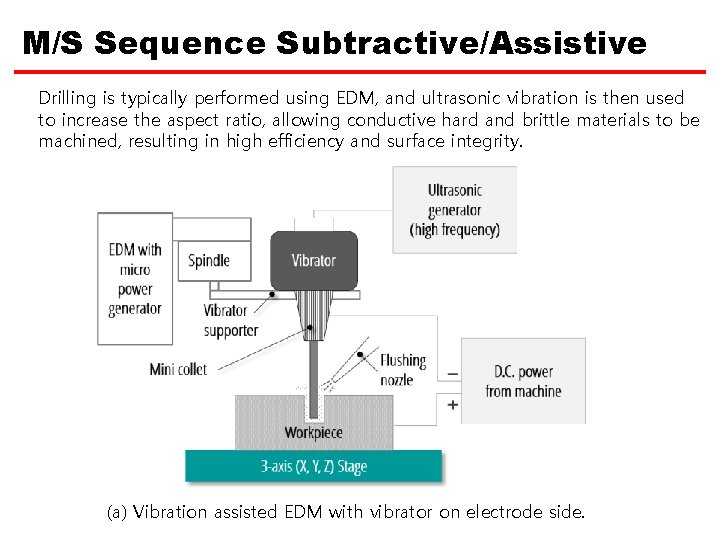
M/S Sequence Subtractive/Assistive Drilling is typically performed using EDM, and ultrasonic vibration is then used to increase the aspect ratio, allowing conductive hard and brittle materials to be machined, resulting in high efficiency and surface integrity. (a) Vibration assisted EDM with vibrator on electrode side.
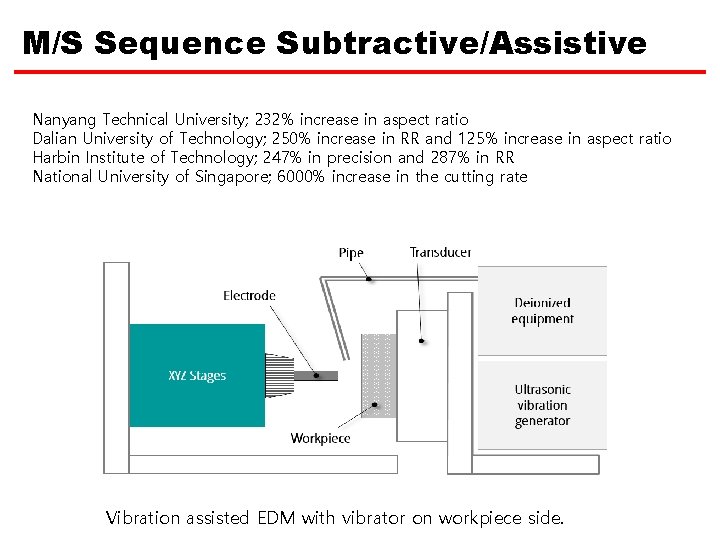
M/S Sequence Subtractive/Assistive Nanyang Technical University; 232% increase in aspect ratio Dalian University of Technology; 250% increase in RR and 125% increase in aspect ratio Harbin Institute of Technology; 247% in precision and 287% in RR National University of Singapore; 6000% increase in the cutting rate Vibration assisted EDM with vibrator on workpiece side.
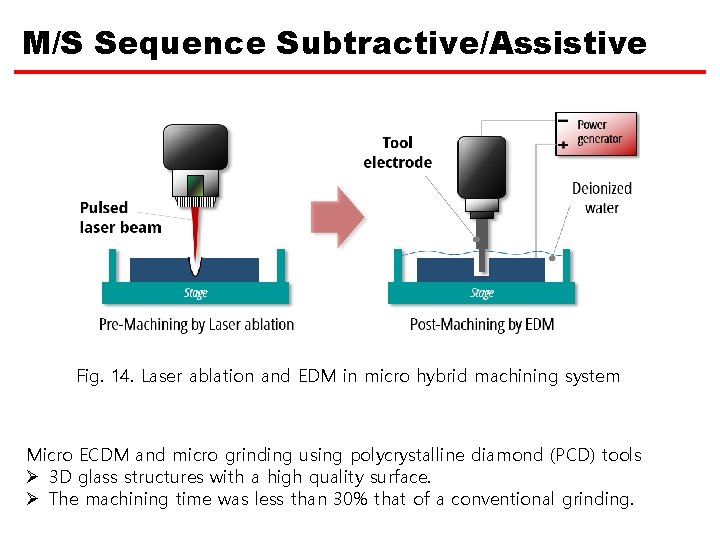
M/S Sequence Subtractive/Assistive Fig. 14. Laser ablation and EDM in micro hybrid machining system Micro ECDM and micro grinding using polycrystalline diamond (PCD) tools Ø 3 D glass structures with a high quality surface. Ø The machining time was less than 30% that of a conventional grinding.
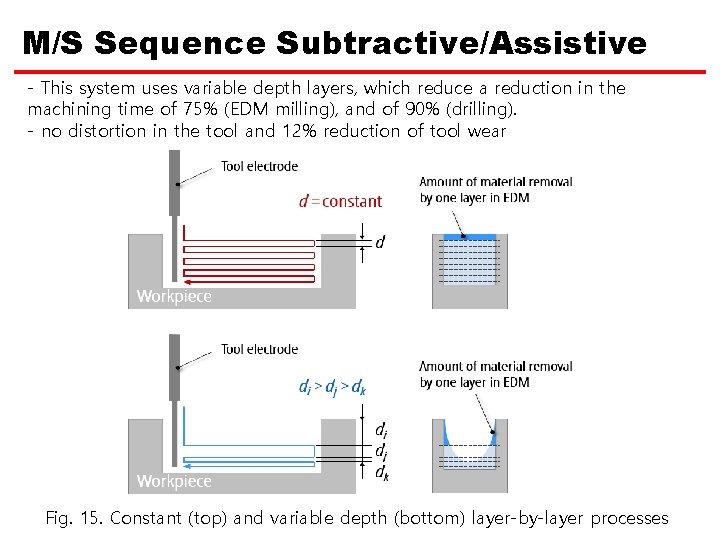
M/S Sequence Subtractive/Assistive - This system uses variable depth layers, which reduce a reduction in the machining time of 75% (EDM milling), and of 90% (drilling). - no distortion in the tool and 12% reduction of tool wear Fig. 15. Constant (top) and variable depth (bottom) layer-by-layer processes
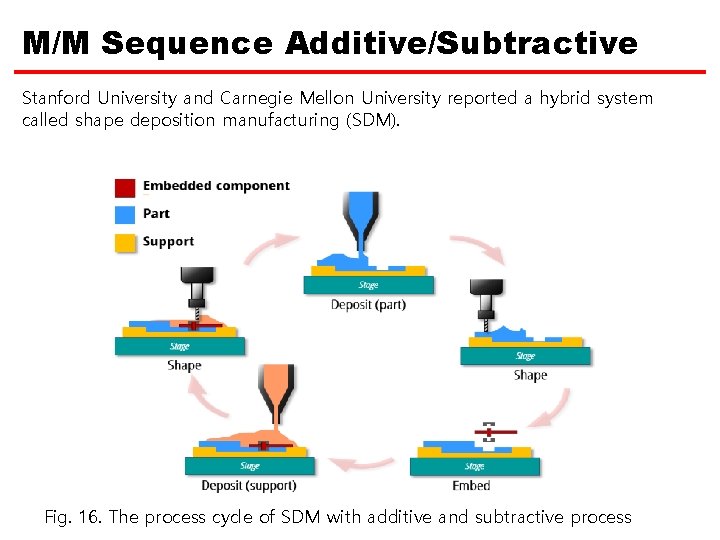
M/M Sequence Additive/Subtractive Stanford University and Carnegie Mellon University reported a hybrid system called shape deposition manufacturing (SDM). Fig. 16. The process cycle of SDM with additive and subtractive process
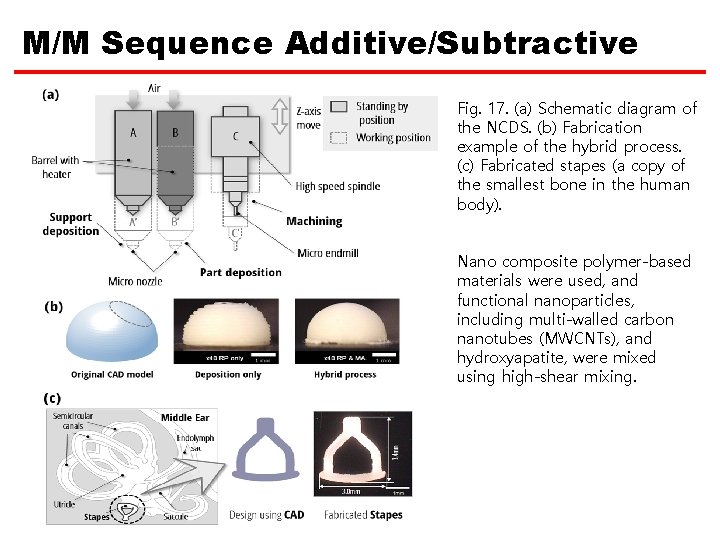
M/M Sequence Additive/Subtractive Fig. 17. (a) Schematic diagram of the NCDS. (b) Fabrication example of the hybrid process. (c) Fabricated stapes (a copy of the smallest bone in the human body). Nano composite polymer-based materials were used, and functional nanoparticles, including multi-walled carbon nanotubes (MWCNTs), and hydroxyapatite, were mixed using high-shear mixing.
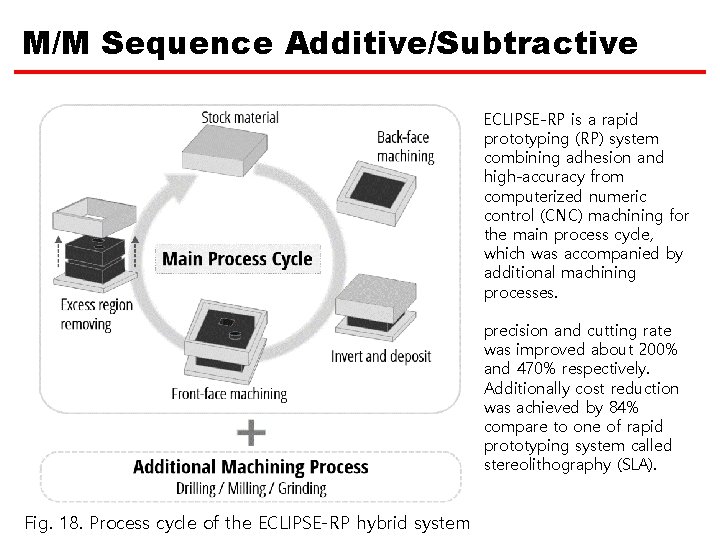
M/M Sequence Additive/Subtractive ECLIPSE-RP is a rapid prototyping (RP) system combining adhesion and high-accuracy from computerized numeric control (CNC) machining for the main process cycle, which was accompanied by additional machining processes. precision and cutting rate was improved about 200% and 470% respectively. Additionally cost reduction was achieved by 84% compare to one of rapid prototyping system called stereolithography (SLA). Fig. 18. Process cycle of the ECLIPSE-RP hybrid system
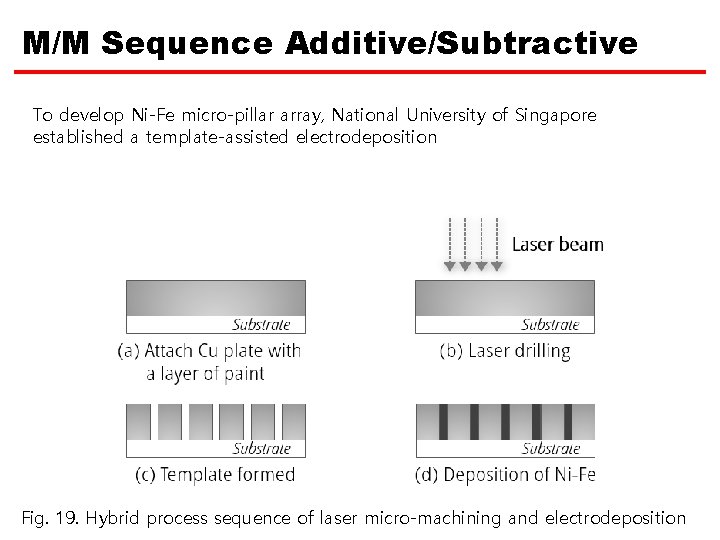
M/M Sequence Additive/Subtractive To develop Ni-Fe micro-pillar array, National University of Singapore established a template-assisted electrodeposition Fig. 19. Hybrid process sequence of laser micro-machining and electrodeposition
M/M Sequence Subtractive/Subtractive Laser pre-drilling and single-lip deep hole drilling (TU Dortmund) Ø enhance tool life by approximately 250%. Ø reduce the drilling time by 70% and the cost by 42%. Ø increase the production capacity by 90%. Mechanical peck-drilling and reverse-EDM Ø Fabricate micro-pin arrays with high-density and high-hardness Ø provides a rapid and efficient process
- Slides: 25