
Chap 6 1 Review on Hybrid Processes College
Chap 6 -1. Review on Hybrid Processes College International Pour la Recherche en Productique (CIRP)
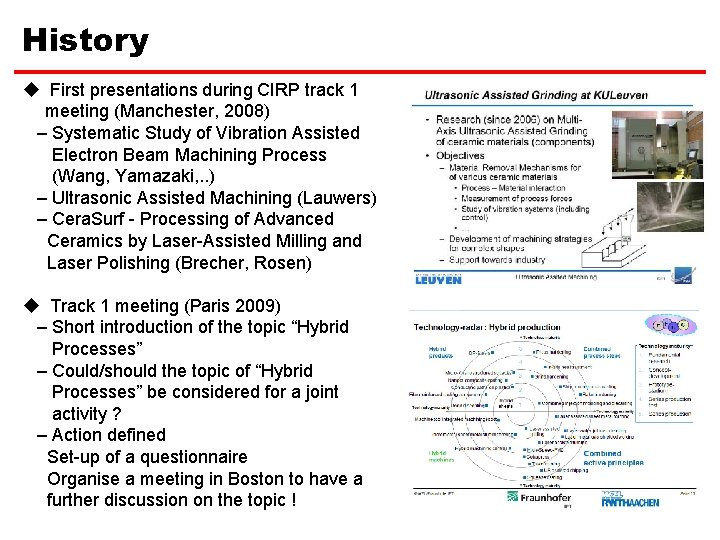
History u First presentations during CIRP track 1 meeting (Manchester, 2008) – Systematic Study of Vibration Assisted Electron Beam Machining Process (Wang, Yamazaki, . . ) – Ultrasonic Assisted Machining (Lauwers) – Cera. Surf - Processing of Advanced Ceramics by Laser-Assisted Milling and Laser Polishing (Brecher, Rosen) u Track 1 meeting (Paris 2009) – Short introduction of the topic “Hybrid Processes” – Could/should the topic of “Hybrid Processes” be considered for a joint activity ? – Action defined Set-up of a questionnaire Organise a meeting in Boston to have a further discussion on the topic !

Hybrid Processes and Products ? l Integrated application or combination of different physical active principles e. g. : Laser assisted machining, vibration assisted machining…. l Integrated combination of usually separated performed process steps e. g. : stretch forming and incremental sheet metal forming l Integrated machines, that can perform different processes at one place e. g. : Milling and accompanying laser application l Hybrid products, i. e. : Components or systems with hybrid structure or hybrid function e. g. : Metal plastics composite components, components with micro / nano structuring

Definition & Classification (1) Open definition: a hybrid mfg process combines two or more established manufacturing processes into a new combined set-up whereby the advantage of each discrete process can be exploited synergistically. (2) Narrow definition: hybrid processes comprise a simultaneous acting of different processing principles on the same processing zone. (After Z. Zhu, A review of hybrid manufacturing processes – state of the art and future perspectives, International Journal of Computer Integrated Manufacturing 2013, Vol. 26, No. 7, 596 -615)
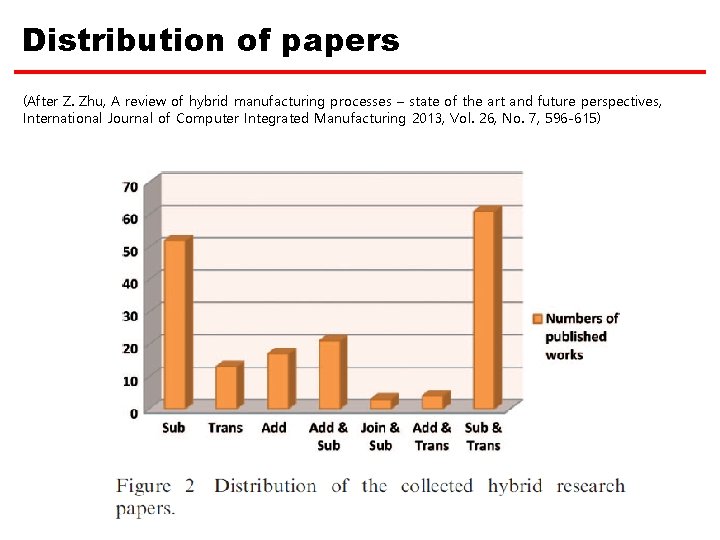
Distribution of papers (After Z. Zhu, A review of hybrid manufacturing processes – state of the art and future perspectives, International Journal of Computer Integrated Manufacturing 2013, Vol. 26, No. 7, 596 -615)
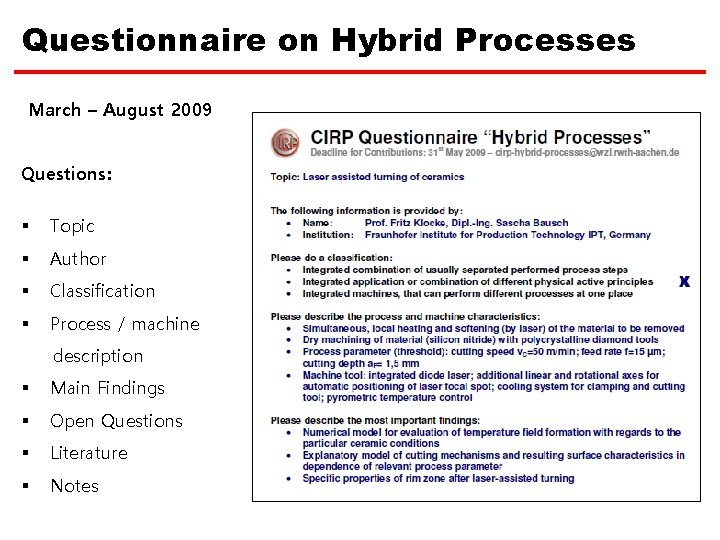
Questionnaire on Hybrid Processes March – August 2009 Questions: § Topic § Author § Classification § Process / machine description § Main Findings § Open Questions § Literature § Notes

Hybrid process (M+M)
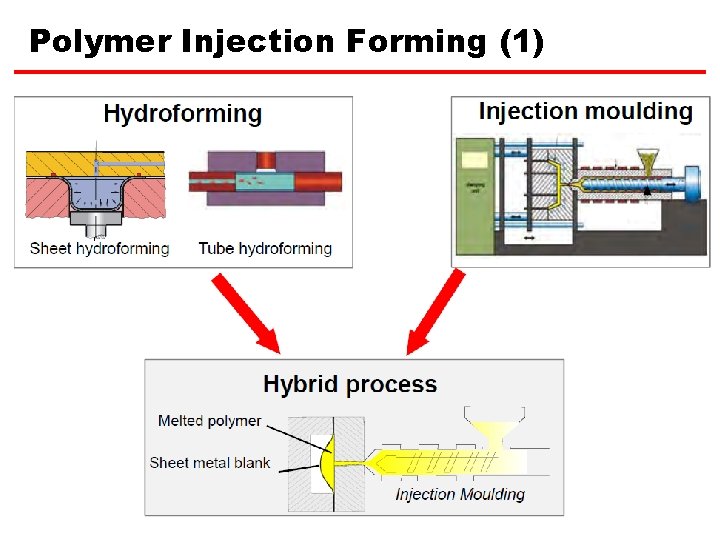
Polymer Injection Forming (1)
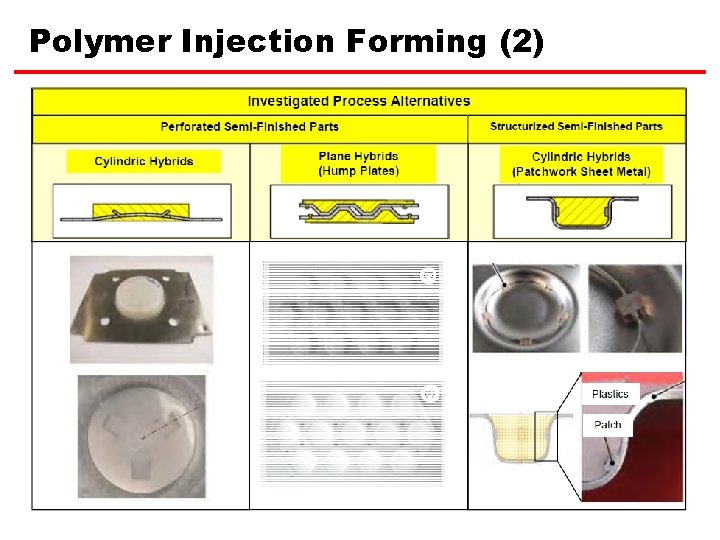
Polymer Injection Forming (2)
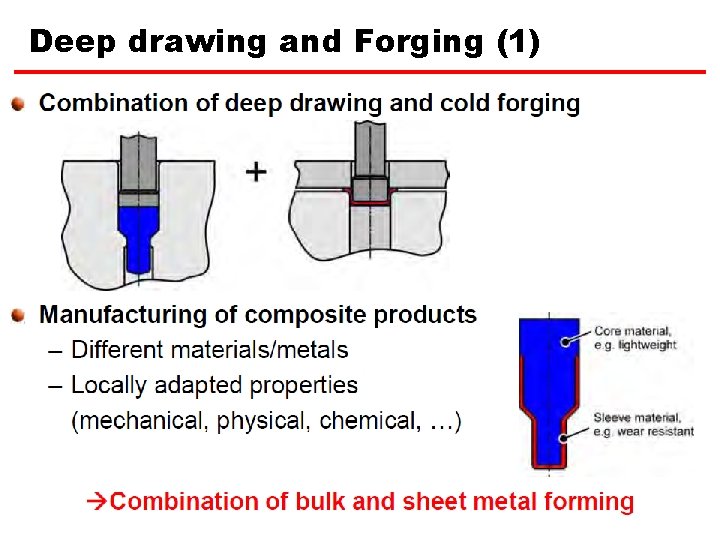
Deep drawing and Forging (1)
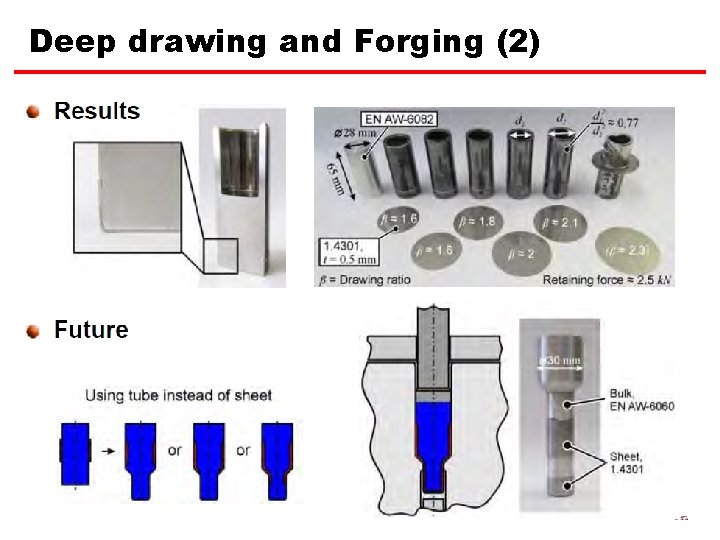
Deep drawing and Forging (2)
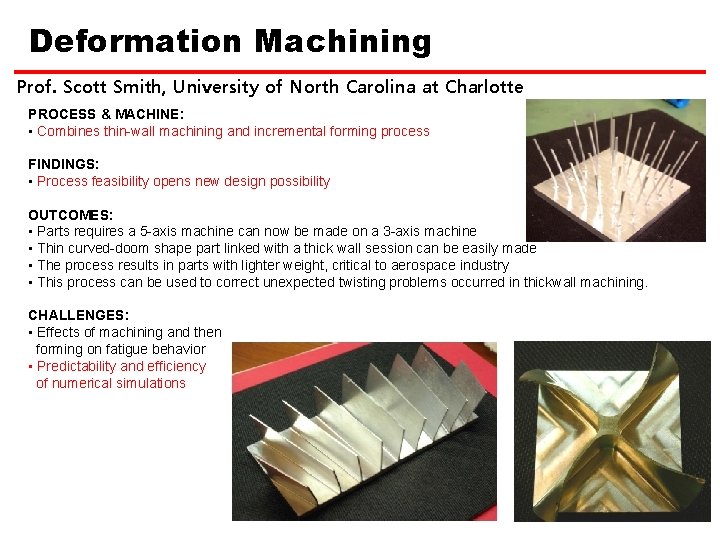
Deformation Machining Prof. Scott Smith, University of North Carolina at Charlotte PROCESS & MACHINE: • Combines thin-wall machining and incremental forming process FINDINGS: • Process feasibility opens new design possibility OUTCOMES: • Parts requires a 5 -axis machine can now be made on a 3 -axis machine • Thin curved-doom shape part linked with a thick wall session can be easily made • The process results in parts with lighter weight, critical to aerospace industry • This process can be used to correct unexpected twisting problems occurred in thickwall machining. CHALLENGES: • Effects of machining and then forming on fatigue behavior • Predictability and efficiency of numerical simulations
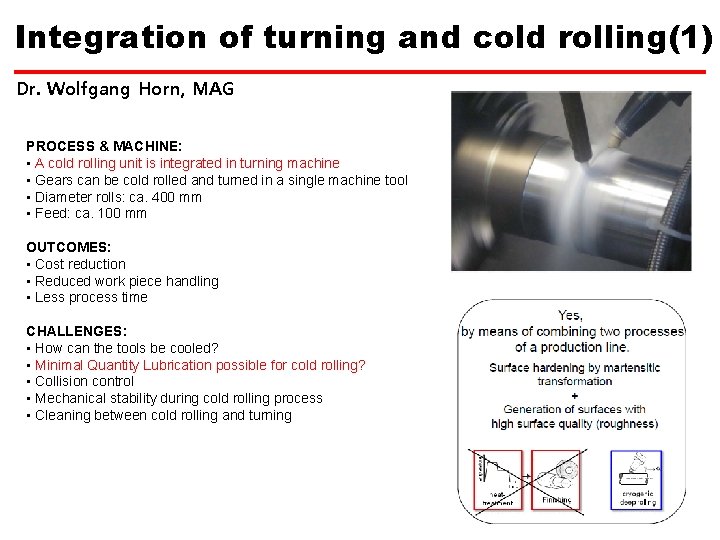
Integration of turning and cold rolling(1) Dr. Wolfgang Horn, MAG PROCESS & MACHINE: • A cold rolling unit is integrated in turning machine • Gears can be cold rolled and turned in a single machine tool • Diameter rolls: ca. 400 mm • Feed: ca. 100 mm OUTCOMES: • Cost reduction • Reduced work piece handling • Less process time CHALLENGES: • How can the tools be cooled? • Minimal Quantity Lubrication possible for cold rolling? • Collision control • Mechanical stability during cold rolling process • Cleaning between cold rolling and turning
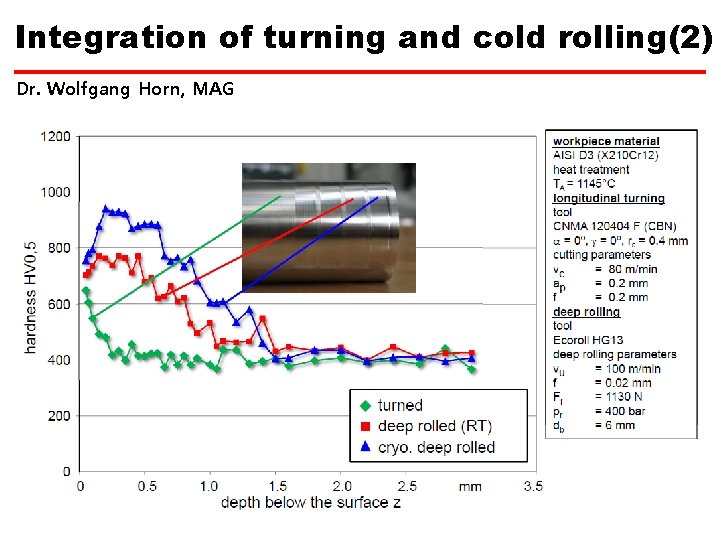
Integration of turning and cold rolling(2) Dr. Wolfgang Horn, MAG
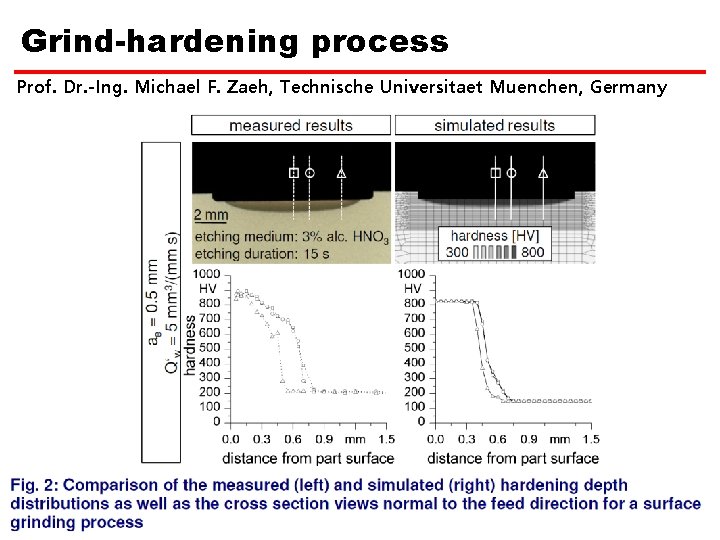
Grind-hardening process Prof. Dr. -Ing. Michael F. Zaeh, Technische Universitaet Muenchen, Germany
Grind-hardening process Prof. Dr. -Ing. Michael F. Zaeh, Technische Universitaet Muenchen, Germany PROCESS & MACHINE: • Simultaneous, grinding and surface hardening using the heat input during the grinding process • Process can be realised using a standard grinding machine with cooling lubricant • Exemplary process parameters machining 100 Cr 6 with a cutting speed of 35 m/s (surface grinding): depth of cut greater or equal than 0. 35 mm and specific MRR greater or equal than 5 mm³/(mm s) • Process layout concerning hardening depth distribution, surface hardness and part distortions using FEA FINDINGS: • Extending of the fundamental knowledge concerning the grind-hardening process • Presentation of a method to identify the process window and resulting distortions • Beginning to qualify the process concerning a wide industrial implementation • Reduction of time and costs for the process layout due to the extended knowledge and the use of the numerical methods OUTPUTS • Target-oriented use of the process heat to realise surface hardening in a combined process step • Elimination of the hardening process as well as the resulting transportations and exposure times • Therefore, grind-hardening is a possibility to save resources and energy CHALLENGES: • Control of the process parameters and the resulting part distortions • Numerical calculation of the hardening depth distribution and the distortions exclusively based on the input parameters of the grinding process • Grind-hardening of complex workpiece structures
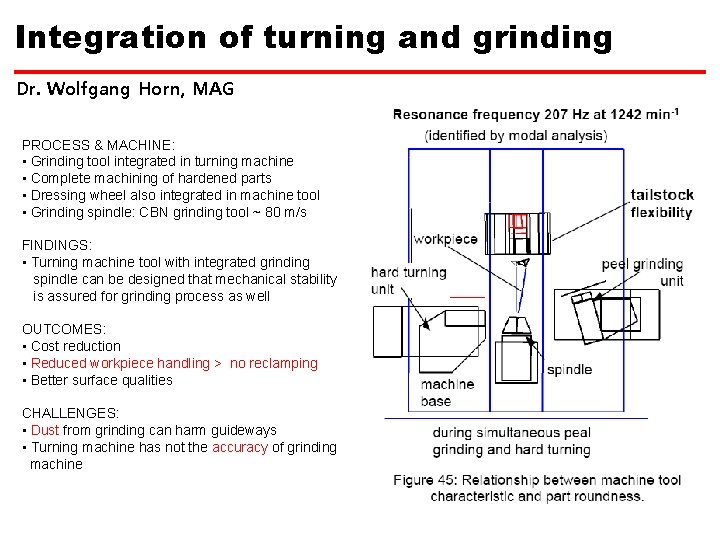
Integration of turning and grinding Dr. Wolfgang Horn, MAG PROCESS & MACHINE: • Grinding tool integrated in turning machine • Complete machining of hardened parts • Dressing wheel also integrated in machine tool • Grinding spindle: CBN grinding tool ~ 80 m/s FINDINGS: • Turning machine tool with integrated grinding spindle can be designed that mechanical stability is assured for grinding process as well OUTCOMES: • Cost reduction • Reduced workpiece handling > no reclamping • Better surface qualities CHALLENGES: • Dust from grinding can harm guideways • Turning machine has not the accuracy of grinding machine
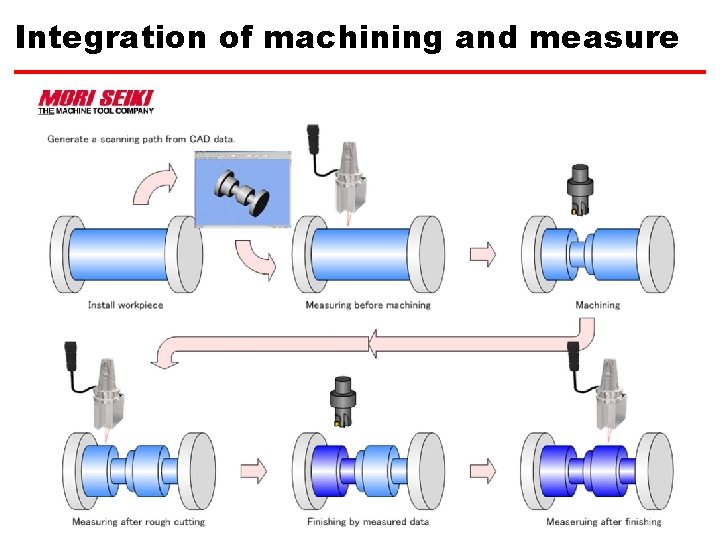
Integration of machining and measure
- Slides: 18