
Chap 5 The Height of Greek Civilization Section
- Slides: 27
Chap 5 – The Height of Greek Civilization Section 1: Quest for Beauty and Meaning
Building for the Gods § The Parthenon – the temple to Athena built on the summit of the Acropolis in Athens – best exemplifies classical Greek architecture. § The Parthenon’s graceful proportions perfectly balance width, height, length, exemplifying the Greek ideal of the “golden mean. ” § http: //www. youtube. com/watch? v=D VL-Of. E 3 Jgg
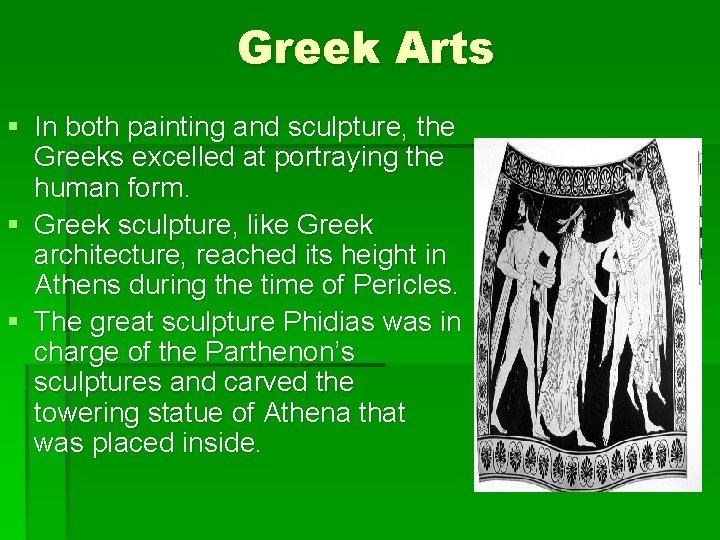
Greek Arts § In both painting and sculpture, the Greeks excelled at portraying the human form. § Greek sculpture, like Greek architecture, reached its height in Athens during the time of Pericles. § The great sculpture Phidias was in charge of the Parthenon’s sculptures and carved the towering statue of Athena that was placed inside.
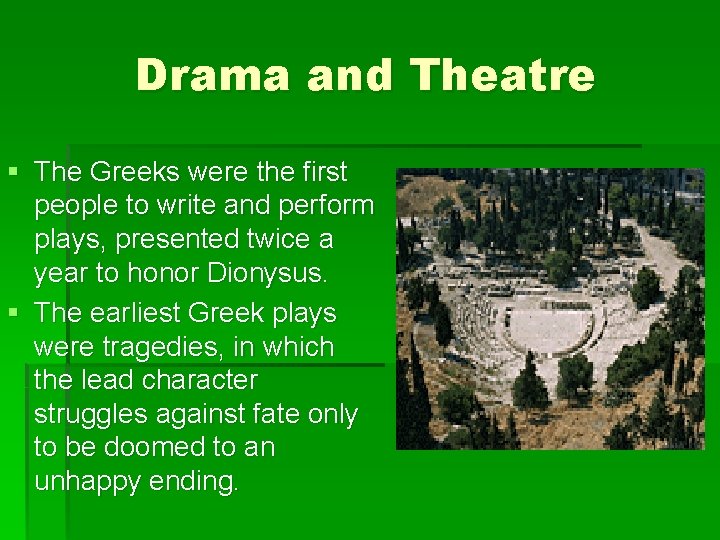
Drama and Theatre § The Greeks were the first people to write and perform plays, presented twice a year to honor Dionysus. § The earliest Greek plays were tragedies, in which the lead character struggles against fate only to be doomed to an unhappy ending.
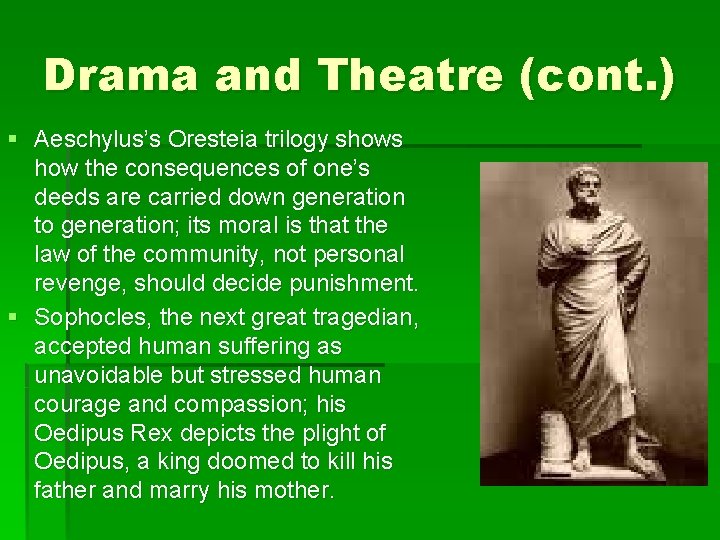
Drama and Theatre (cont. ) § Aeschylus’s Oresteia trilogy shows how the consequences of one’s deeds are carried down generation to generation; its moral is that the law of the community, not personal revenge, should decide punishment. § Sophocles, the next great tragedian, accepted human suffering as unavoidable but stressed human courage and compassion; his Oedipus Rex depicts the plight of Oedipus, a king doomed to kill his father and marry his mother.
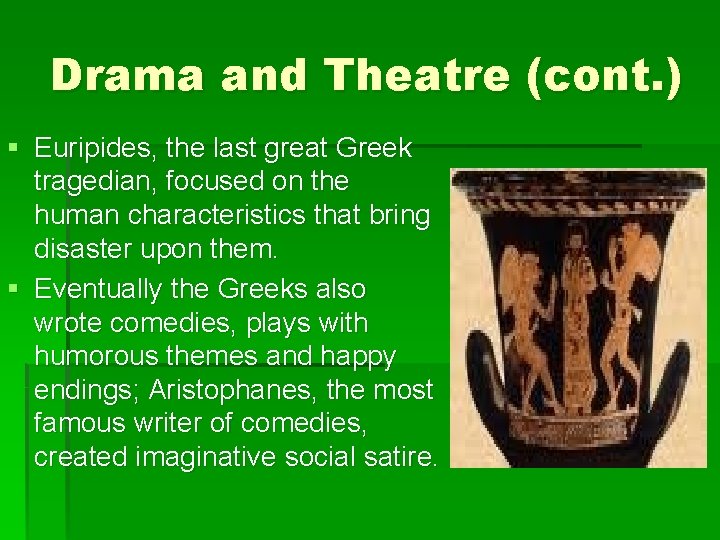
Drama and Theatre (cont. ) § Euripides, the last great Greek tragedian, focused on the human characteristics that bring disaster upon them. § Eventually the Greeks also wrote comedies, plays with humorous themes and happy endings; Aristophanes, the most famous writer of comedies, created imaginative social satire.
The Olympic Games § Believing that healthy bodies made the best use of nature’s gifts, the ancient Greeks stressed athleticism in their school curriculum. § The ancient Greeks held the Olympic Games in Olympia every four years to honor Zeus; trade and war stopped while the Games were going on.
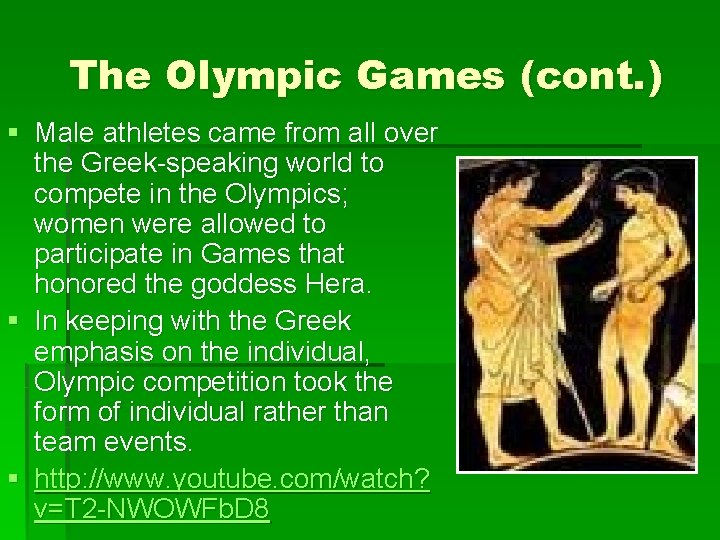
The Olympic Games (cont. ) § Male athletes came from all over the Greek-speaking world to compete in the Olympics; women were allowed to participate in Games that honored the goddess Hera. § In keeping with the Greek emphasis on the individual, Olympic competition took the form of individual rather than team events. § http: //www. youtube. com/watch? v=T 2 -NWOWFb. D 8
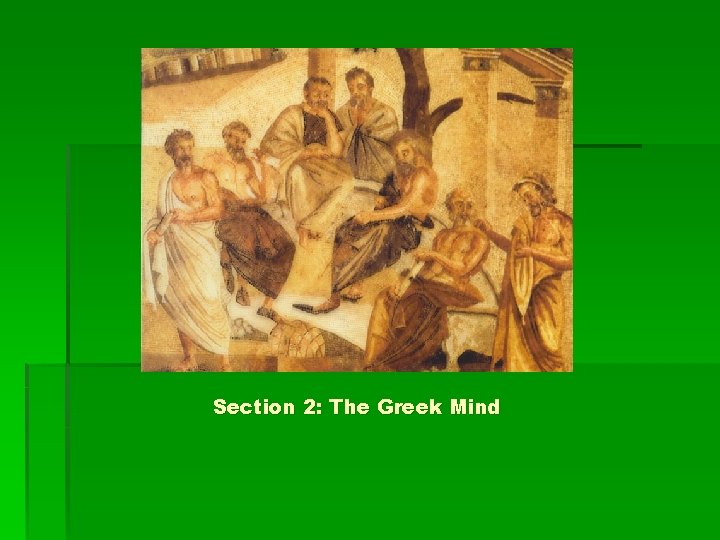
Section 2: The Greek Mind
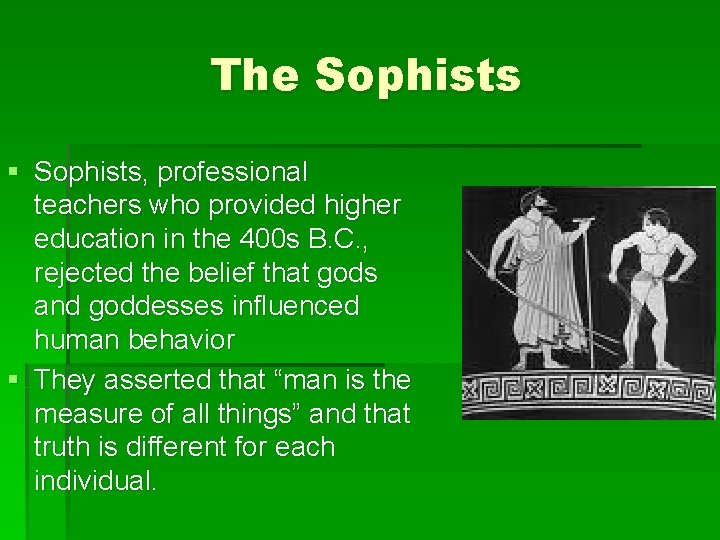
The Sophists § Sophists, professional teachers who provided higher education in the 400 s B. C. , rejected the belief that gods and goddesses influenced human behavior § They asserted that “man is the measure of all things” and that truth is different for each individual.
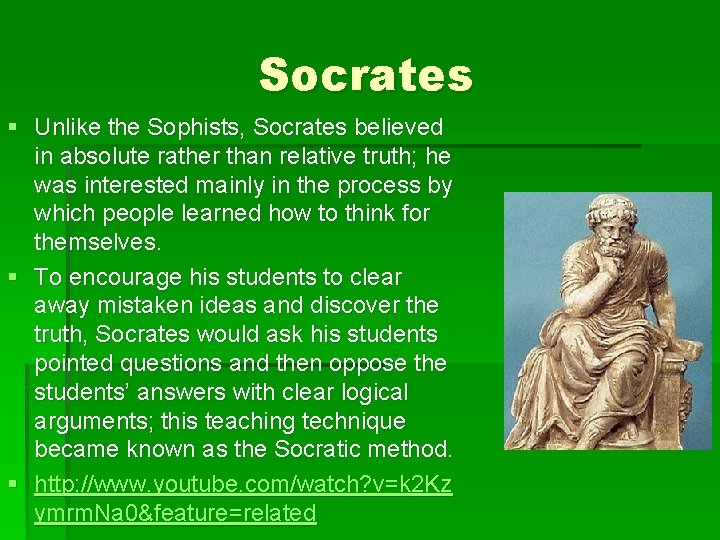
Socrates § Unlike the Sophists, Socrates believed in absolute rather than relative truth; he was interested mainly in the process by which people learned how to think for themselves. § To encourage his students to clear away mistaken ideas and discover the truth, Socrates would ask his students pointed questions and then oppose the students’ answers with clear logical arguments; this teaching technique became known as the Socratic method. § http: //www. youtube. com/watch? v=k 2 Kz ymrm. Na 0&feature=related
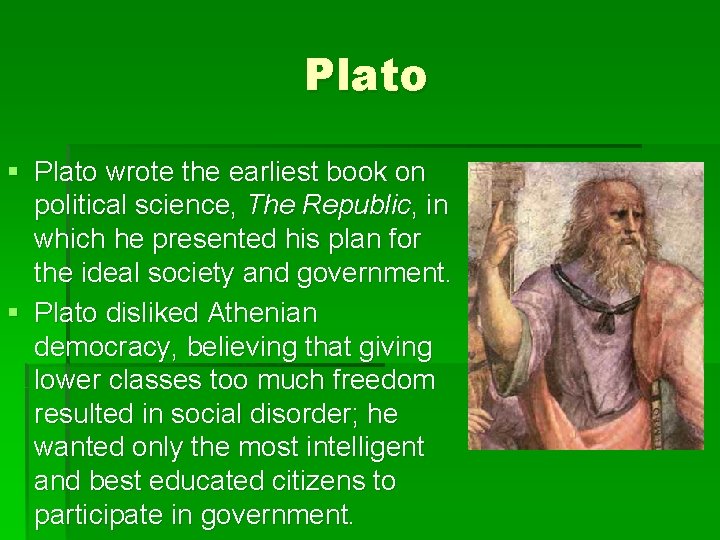
Plato § Plato wrote the earliest book on political science, The Republic, in which he presented his plan for the ideal society and government. § Plato disliked Athenian democracy, believing that giving lower classes too much freedom resulted in social disorder; he wanted only the most intelligent and best educated citizens to participate in government.
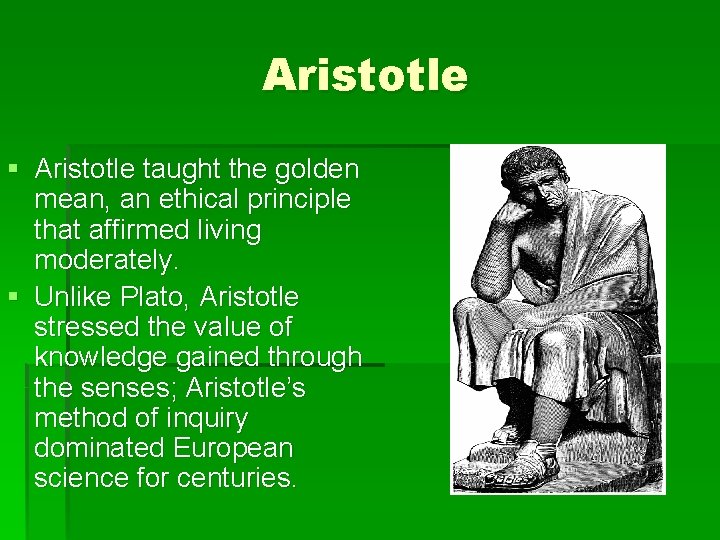
Aristotle § Aristotle taught the golden mean, an ethical principle that affirmed living moderately. § Unlike Plato, Aristotle stressed the value of knowledge gained through the senses; Aristotle’s method of inquiry dominated European science for centuries.
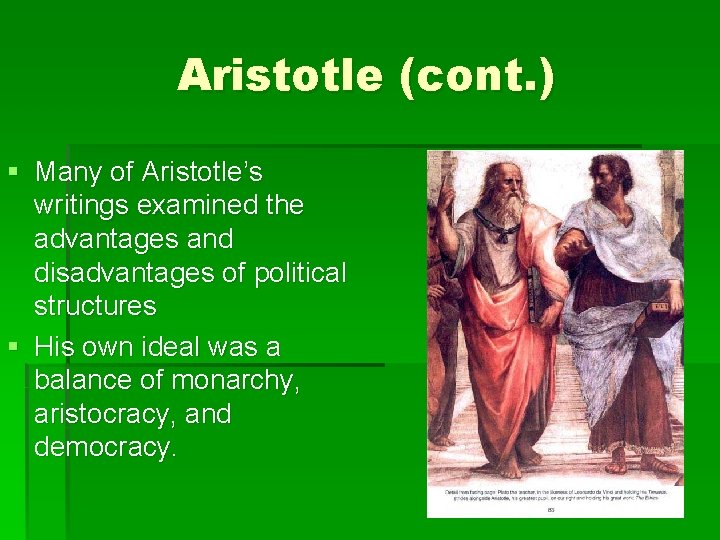
Aristotle (cont. ) § Many of Aristotle’s writings examined the advantages and disadvantages of political structures § His own ideal was a balance of monarchy, aristocracy, and democracy.
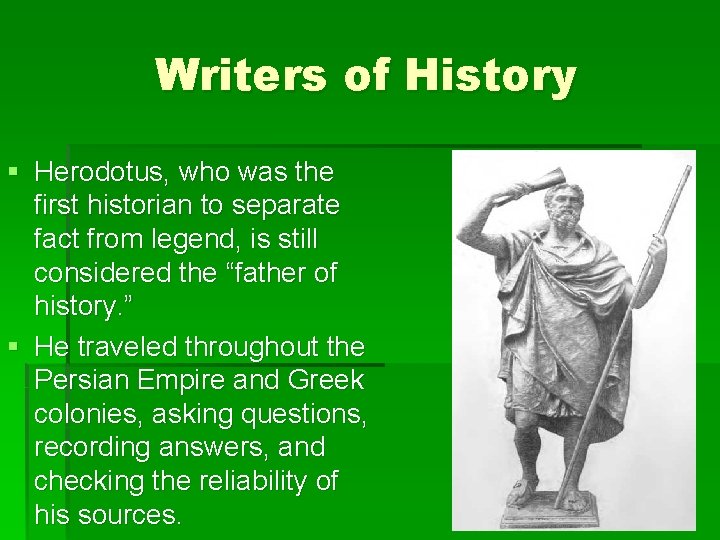
Writers of History § Herodotus, who was the first historian to separate fact from legend, is still considered the “father of history. ” § He traveled throughout the Persian Empire and Greek colonies, asking questions, recording answers, and checking the reliability of his sources.
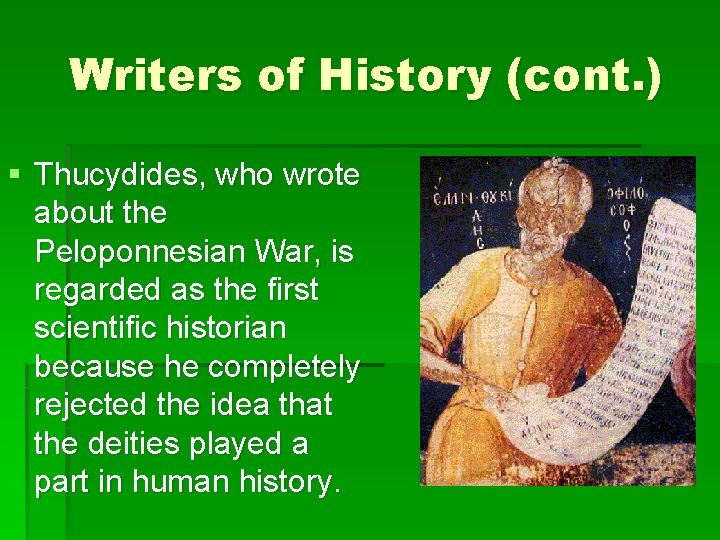
Writers of History (cont. ) § Thucydides, who wrote about the Peloponnesian War, is regarded as the first scientific historian because he completely rejected the idea that the deities played a part in human history.
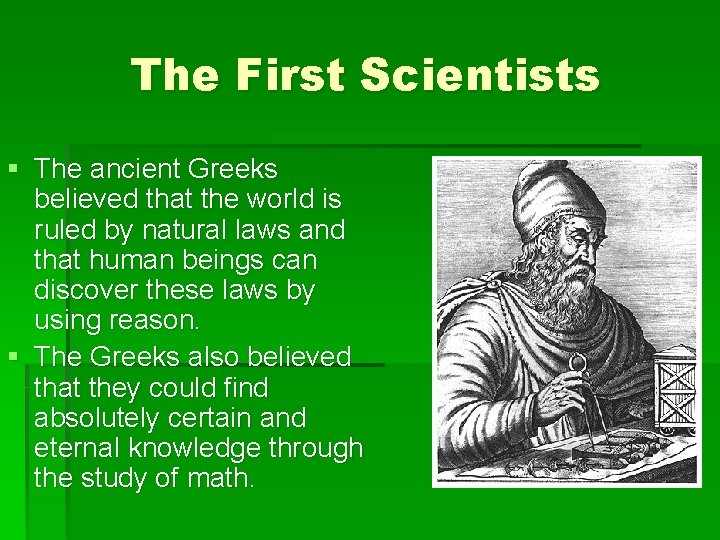
The First Scientists § The ancient Greeks believed that the world is ruled by natural laws and that human beings can discover these laws by using reason. § The Greeks also believed that they could find absolutely certain and eternal knowledge through the study of math.
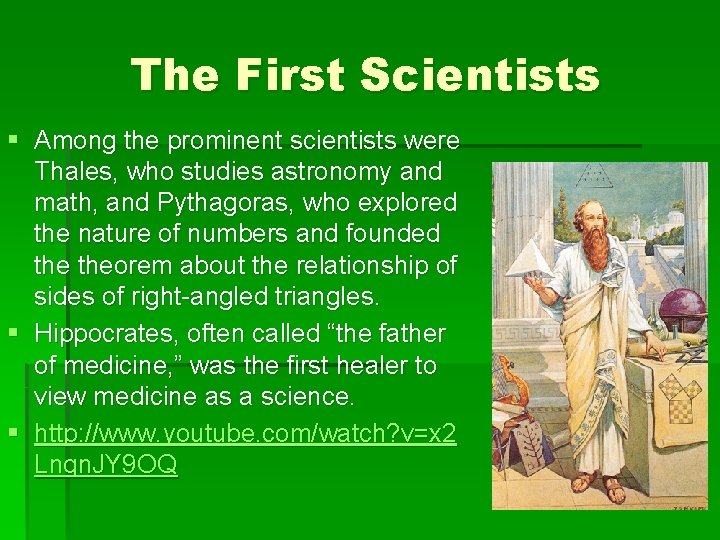
The First Scientists § Among the prominent scientists were Thales, who studies astronomy and math, and Pythagoras, who explored the nature of numbers and founded theorem about the relationship of sides of right-angled triangles. § Hippocrates, often called “the father of medicine, ” was the first healer to view medicine as a science. § http: //www. youtube. com/watch? v=x 2 Lnqn. JY 9 OQ
Section 3: Alexander’s Empire
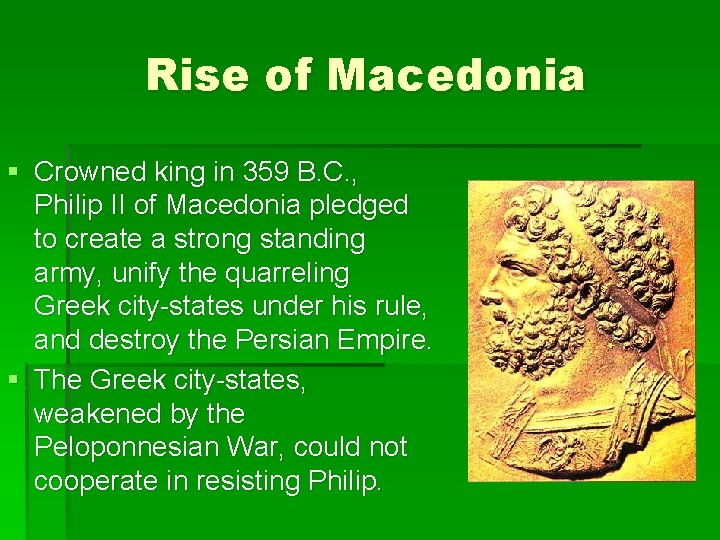
Rise of Macedonia § Crowned king in 359 B. C. , Philip II of Macedonia pledged to create a strong standing army, unify the quarreling Greek city-states under his rule, and destroy the Persian Empire. § The Greek city-states, weakened by the Peloponnesian War, could not cooperate in resisting Philip.
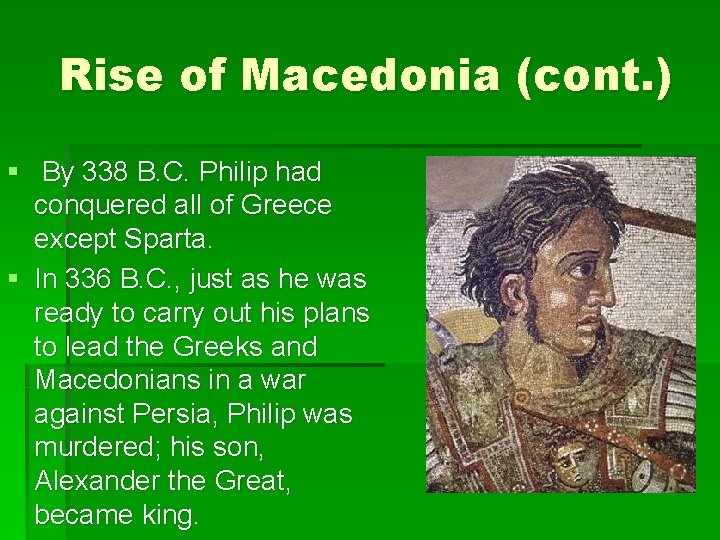
Rise of Macedonia (cont. ) § By 338 B. C. Philip had conquered all of Greece except Sparta. § In 336 B. C. , just as he was ready to carry out his plans to lead the Greeks and Macedonians in a war against Persia, Philip was murdered; his son, Alexander the Great, became king.
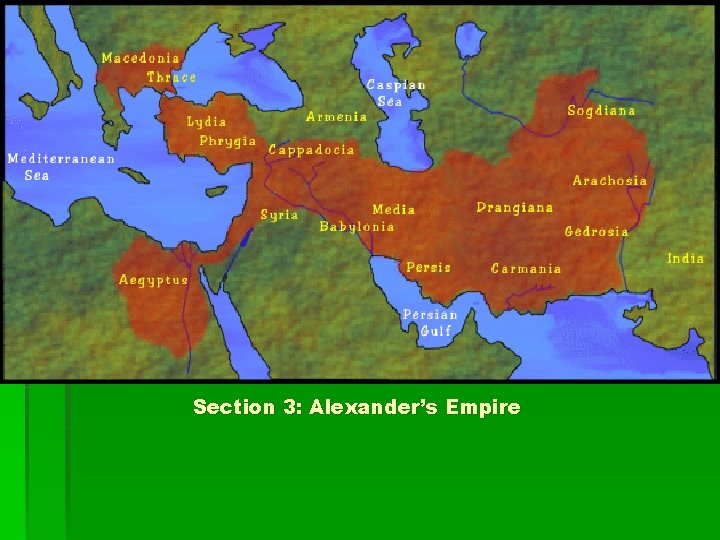
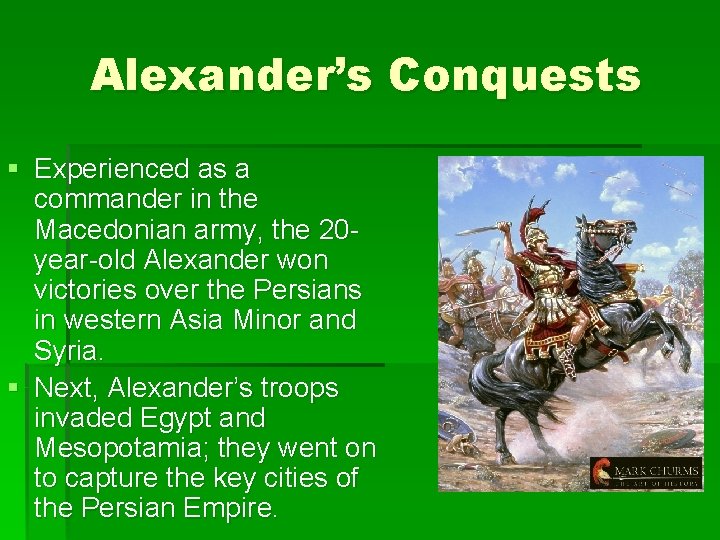
Alexander’s Conquests § Experienced as a commander in the Macedonian army, the 20 year-old Alexander won victories over the Persians in western Asia Minor and Syria. § Next, Alexander’s troops invaded Egypt and Mesopotamia; they went on to capture the key cities of the Persian Empire.
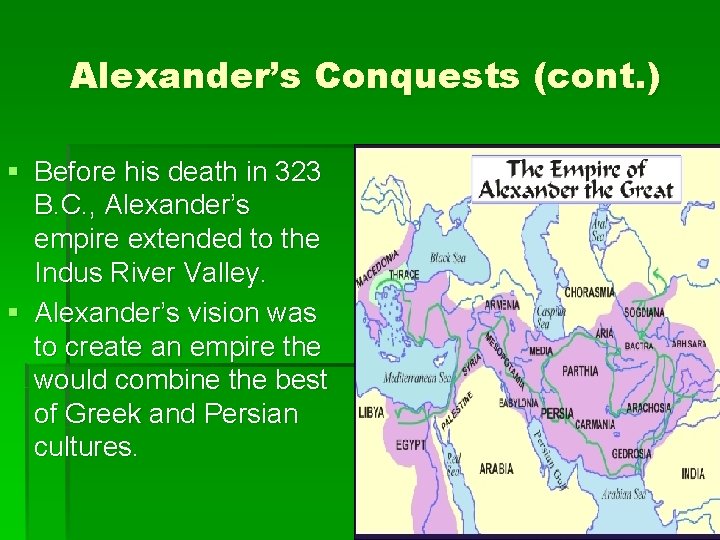
Alexander’s Conquests (cont. ) § Before his death in 323 B. C. , Alexander’s empire extended to the Indus River Valley. § Alexander’s vision was to create an empire the would combine the best of Greek and Persian cultures.
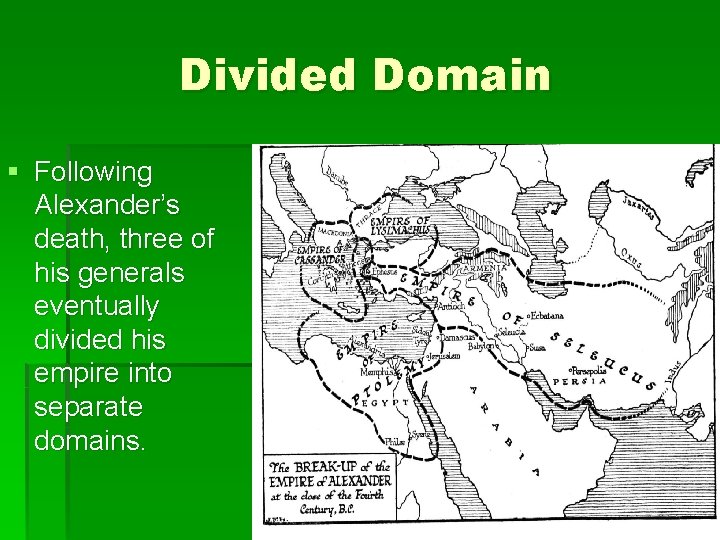
Divided Domain § Following Alexander’s death, three of his generals eventually divided his empire into separate domains.
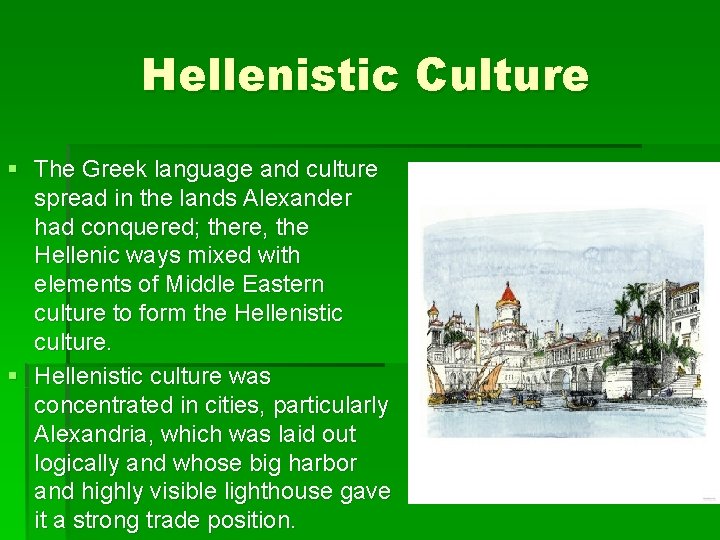
Hellenistic Culture § The Greek language and culture spread in the lands Alexander had conquered; there, the Hellenic ways mixed with elements of Middle Eastern culture to form the Hellenistic culture. § Hellenistic culture was concentrated in cities, particularly Alexandria, which was laid out logically and whose big harbor and highly visible lighthouse gave it a strong trade position.
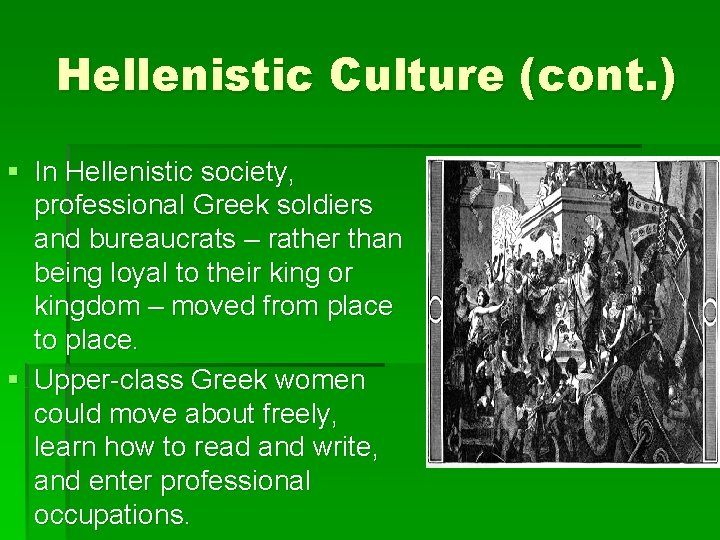
Hellenistic Culture (cont. ) § In Hellenistic society, professional Greek soldiers and bureaucrats – rather than being loyal to their king or kingdom – moved from place to place. § Upper-class Greek women could move about freely, learn how to read and write, and enter professional occupations.
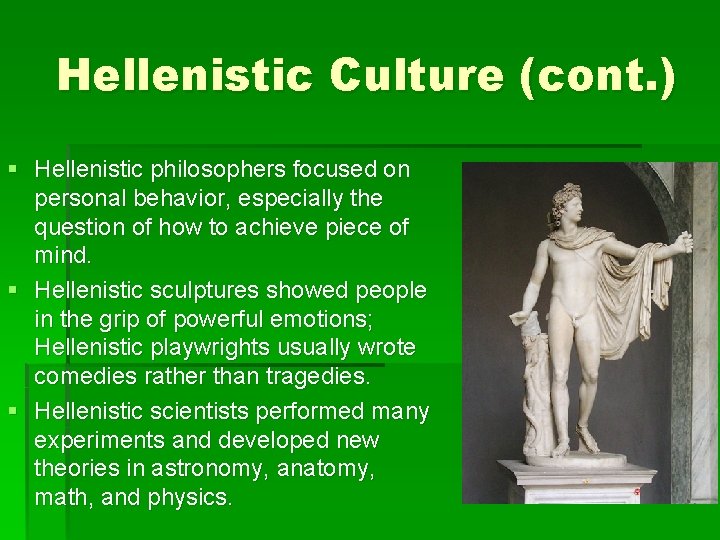
Hellenistic Culture (cont. ) § Hellenistic philosophers focused on personal behavior, especially the question of how to achieve piece of mind. § Hellenistic sculptures showed people in the grip of powerful emotions; Hellenistic playwrights usually wrote comedies rather than tragedies. § Hellenistic scientists performed many experiments and developed new theories in astronomy, anatomy, math, and physics.