
Chap 5 Access Control Lists Learning Objectives Explain
Chap 5 – Access Control Lists Learning Objectives • • • Explain how ACLs are used to secure a medium-size Enterprise branch office network. Configure standard ACLs in a medium-size Enterprise branch office network. Configure extended ACLs in a medium-size Enterprise branch office network. • • • Not NAMED ACLs – Different configuration method. Describe complex ACLs in a medium-size Enterprise branch office network. Implement, verify and troubleshoot ACLs in an enterprise network environment. 1 Chapter 5
How it fits in • • Chapter 5 of CCNA 4 online material Assessed in skills test • • Assessed in end test • • You’ll need to create an ACL There’ll be some questions about ACLS Recommended labs – • • 5. 2. 4 and 5. 2. 8 (at end of lecture) 5. 5. 1, 5. 5. 2, 5. 5. 3 (on askgeoff) 2 Chapter 5
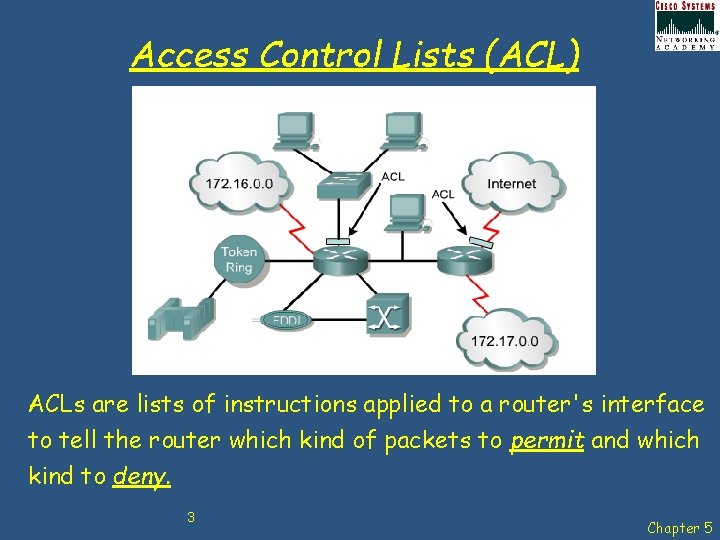
Access Control Lists (ACL) ACLs are lists of instructions applied to a router's interface to tell the router which kind of packets to permit and which kind to deny. 3 Chapter 5
Access Control Lists (ACL) • An ACL is a sequential list of permit or deny statements that apply to IP addresses or upper-layer protocols. The ACL can extract the following information from the packet header, test it against its rules, and make "allow" or "deny" decisions based on: 1. 2. 3. • Source IP address Destination IP address ICMP message type The ACL can also extract upper layer information and test it against its rules. Upper layer information includes: 1. 2. TCP/UDP source port TCP/UDP destination port 4 Chapter 5
Access Control Lists (ACL) • Limit network traffic and increase network performance. Provide traffic flow control. • ACLs can restrict the delivery of routing updates. If updates are not required because of network conditions, bandwidth is preserved. • Provide a basic level of security for network access. ACLs can allow one host to access a part of the network and prevent another host from accessing the same area. • Decide which types of traffic are forwarded or blocked at the router interfaces. ACLs can permit e-mail traffic to be routed, but block all Telnet traffic. • Control which areas a client can access on a network. • ACLs can be used to permit or deny a user to access file types such as FTP or HTTP. 5 Chapter 5
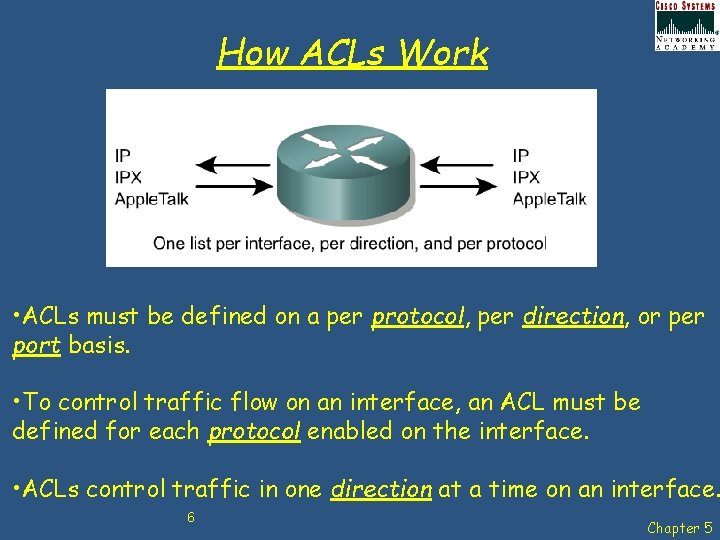
How ACLs Work • ACLs must be defined on a per protocol, per direction, or per port basis. • To control traffic flow on an interface, an ACL must be defined for each protocol enabled on the interface. • ACLs control traffic in one direction at a time on an interface. 6 Chapter 5
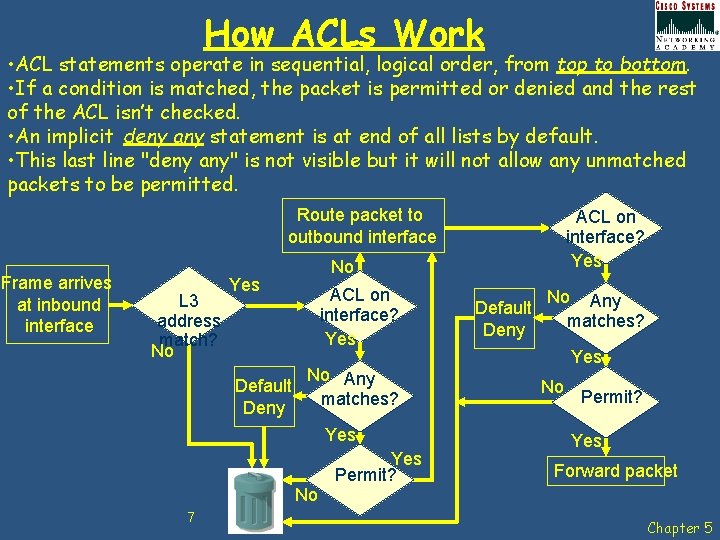
How ACLs Work • ACL statements operate in sequential, logical order, from top to bottom. • If a condition is matched, the packet is permitted or denied and the rest of the ACL isn’t checked. • An implicit deny any statement is at end of all lists by default. • This last line "deny any" is not visible but it will not allow any unmatched packets to be permitted. Route packet to outbound interface Frame arrives at inbound interface L 3 address match? No No Yes Default Deny ACL on interface? Yes No Any matches? Yes No 7 ACL on interface? Yes Permit? Default Deny No Any matches? Yes No Permit? Yes Forward packet Chapter 5
Wildcard Masks • • • ACLs statements include masks, also called wildcard masks. The mask determines how much of an IP source or destination address to apply to the address match. The numbers 1 and 0 in the mask identify how to treat the corresponding IP address bits. They are different to subnet masks, and follow different rules. Wildcard masks and subnet masks are both 32 bits long and use binary 1 s and 0 s. Subnet masks use binary 1 s and 0 s to identify the network, subnet, and host portion of an IP address. Wildcard masks use binary 1 s and 0 s to filter individual or groups of IP addresses to permit or deny access to resources based on an IP address. By carefully setting wildcard masks, you can permit or deny a single or several IP addresses 8 Chapter 5
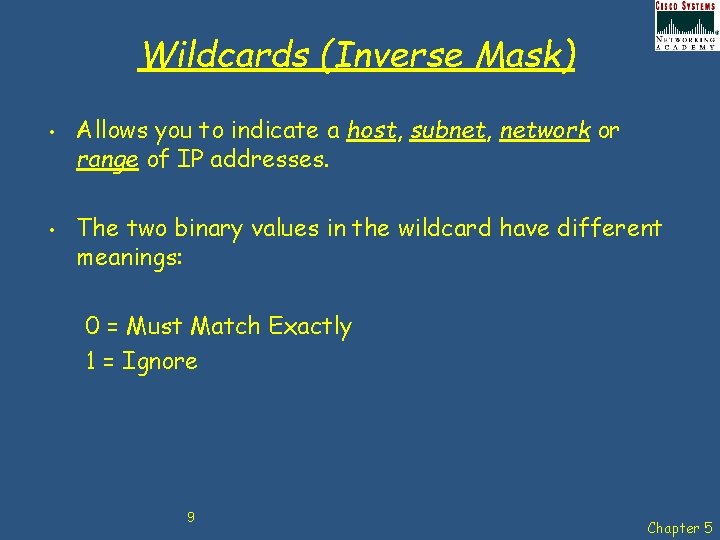
Wildcards (Inverse Mask) • • Allows you to indicate a host, subnet, network or range of IP addresses. The two binary values in the wildcard have different meanings: 0 = Must Match Exactly 1 = Ignore 9 Chapter 5
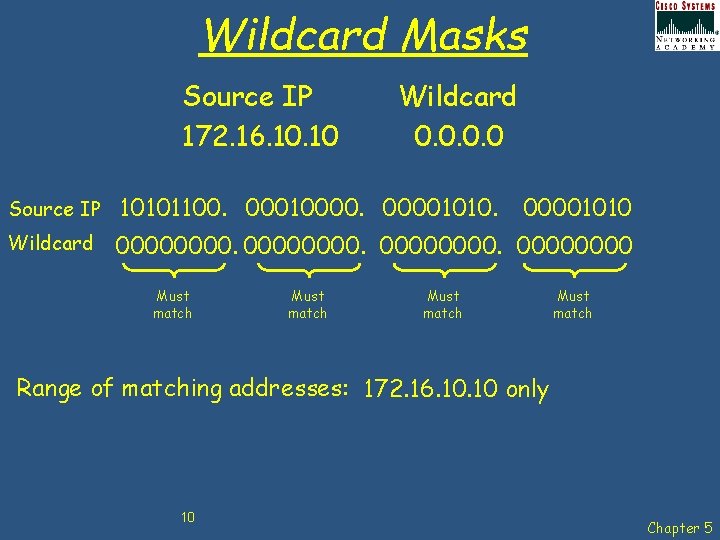
Wildcard Masks Source IP 172. 16. 10 Wildcard 0. 0 Source IP 10101100. 000100001010. Wildcard 00000000. 0000 Must match 00001010 Must match Range of matching addresses: 172. 16. 10 only 10 Chapter 5
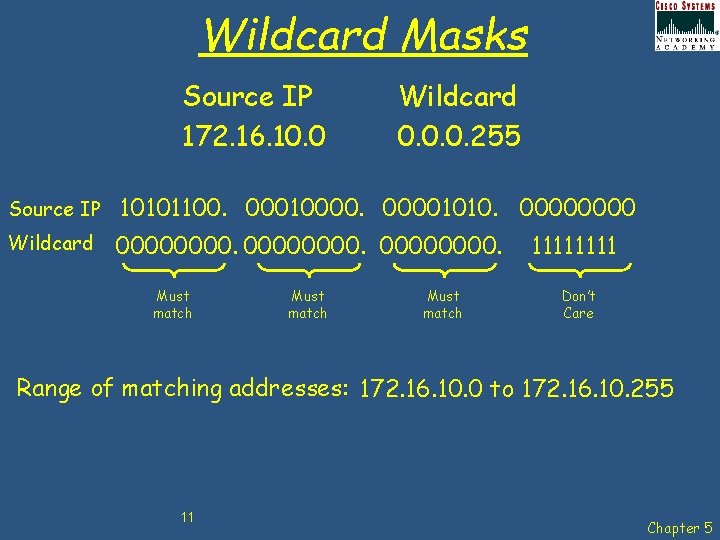
Wildcard Masks Source IP 172. 16. 10. 0 Wildcard 0. 0. 0. 255 Source IP 10101100. 000100001010. 0000 Wildcard 00000000. Must match 1111 Don’t Care Range of matching addresses: 172. 16. 10. 0 to 172. 16. 10. 255 11 Chapter 5
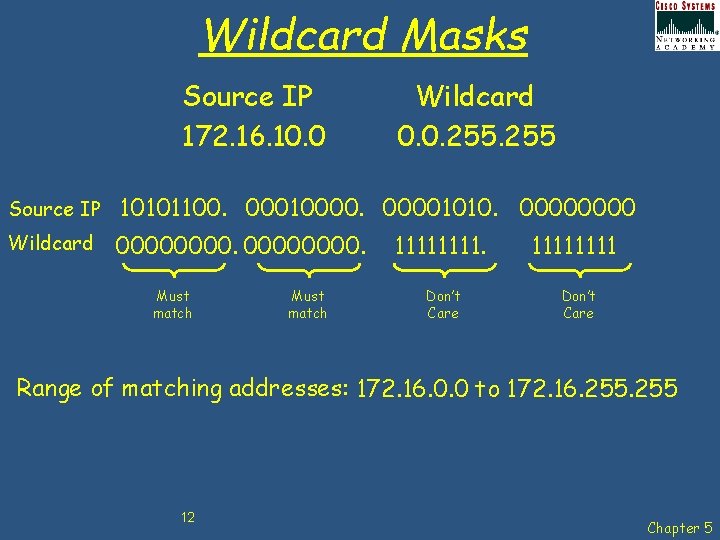
Wildcard Masks Source IP 172. 16. 10. 0 Wildcard 0. 0. 255 Source IP 10101100. 000100001010. 0000 Wildcard 00000000. Must match 1111. Don’t Care 1111 Don’t Care Range of matching addresses: 172. 16. 0. 0 to 172. 16. 255 12 Chapter 5
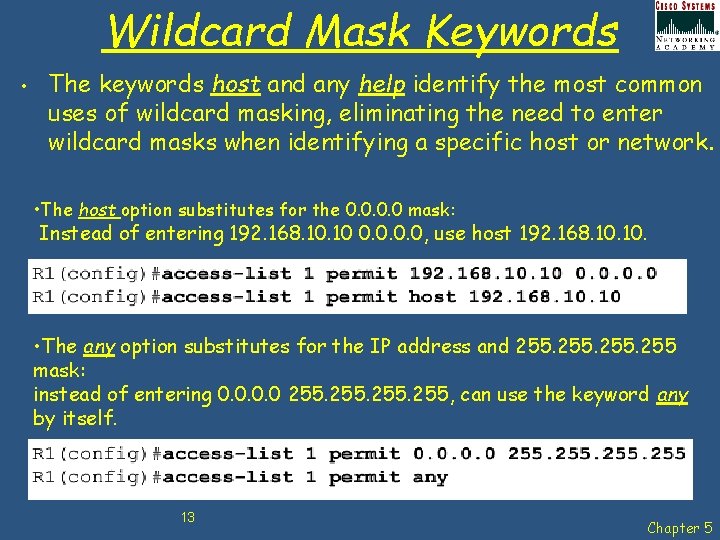
Wildcard Mask Keywords • The keywords host and any help identify the most common uses of wildcard masking, eliminating the need to enter wildcard masks when identifying a specific host or network. • The host option substitutes for the 0. 0 mask: Instead of entering 192. 168. 10 0. 0, use host 192. 168. 10. • The any option substitutes for the IP address and 255 mask: instead of entering 0. 0 255, can use the keyword any by itself. 13 Chapter 5
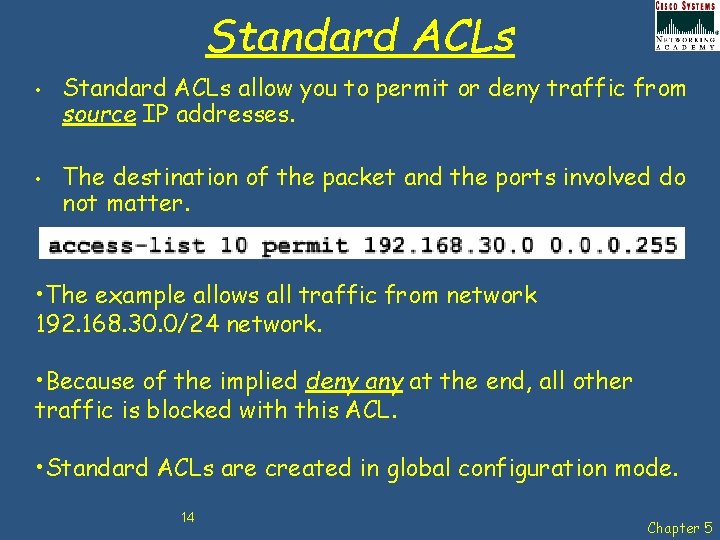
Standard ACLs • • Standard ACLs allow you to permit or deny traffic from source IP addresses. The destination of the packet and the ports involved do not matter. • The example allows all traffic from network 192. 168. 30. 0/24 network. • Because of the implied deny at the end, all other traffic is blocked with this ACL. • Standard ACLs are created in global configuration mode. 14 Chapter 5
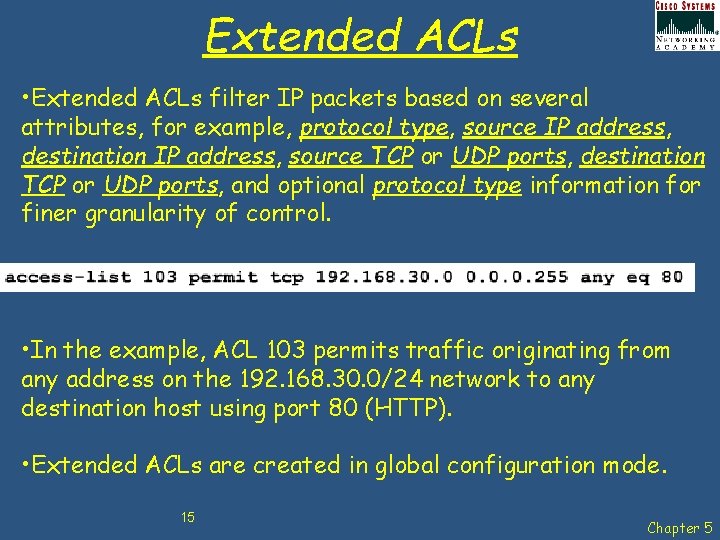
Extended ACLs • Extended ACLs filter IP packets based on several attributes, for example, protocol type, source IP address, destination IP address, source TCP or UDP ports, destination TCP or UDP ports, and optional protocol type information for finer granularity of control. • In the example, ACL 103 permits traffic originating from any address on the 192. 168. 30. 0/24 network to any destination host using port 80 (HTTP). • Extended ACLs are created in global configuration mode. 15 Chapter 5
Numbering & Naming ACLs Numbered ACLs - Assign a number based on which protocol is to be filtered: • (1 to 99) and (1300 to 1999): Standard IP ACL • (100 to 199) and (2000 to 2699): Extended IP ACL Named ACLs - assign a name by providing the name of the ACL: (only after IOS Release 11. 2!) • Names can contain alphanumeric characters. • Recommended that the name be written in CAPITAL LETTERS. • Names cannot contain spaces or punctuation and mustbegin with a letter. • Possible to add or delete entries within the ACL. 16 Chapter 5
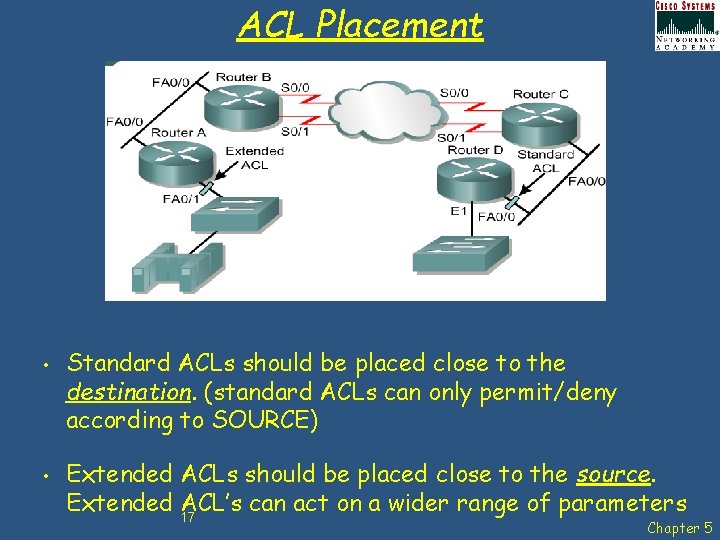
ACL Placement • • Standard ACLs should be placed close to the destination. (standard ACLs can only permit/deny according to SOURCE) Extended ACLs should be placed close to the source. Extended 17 ACL’s can act on a wider range of parameters Chapter 5
ACL Best Practice Using ACLs requires attention to detail and great care. Mistakes can be costly in terms of downtime, troubleshooting efforts, and poor network service. Before starting to configure an ACL, basic planning is required: • • • Base ACLs on the security policy of the organisation. Prepare a description of what ACLs are required to do. Use a text editor to create, edit and save ACLs. • • DON’T create them on the fly! Test ACLs on a development network before 18 implementing them on a production network. Chapter 5
Editing Numbered ACLs • • When configuring an ACL, the statements are added in the order that they are entered at the end of the ACL. However, there is no built-in editing feature that allows you to edit a change in an ACL selectively inserting or deleting lines is not possible. Therefore, any ACL is best constructed in a text editor such as MS Notepad, allowing the ACL to be edited and then pasted into the router as follows: 1. 2. 3. Display the ACL using the sh run command. Highlight the ACL, copy it, and then paste it into MS Notepad. Edit the list as required. Once the ACL is correctly displayed in MS Notepad, highlight it and copy it. In global configuration mode, remove the old access list using the no access-list command. Then paste the new ACL into the configuration of the router. 19 Chapter 5
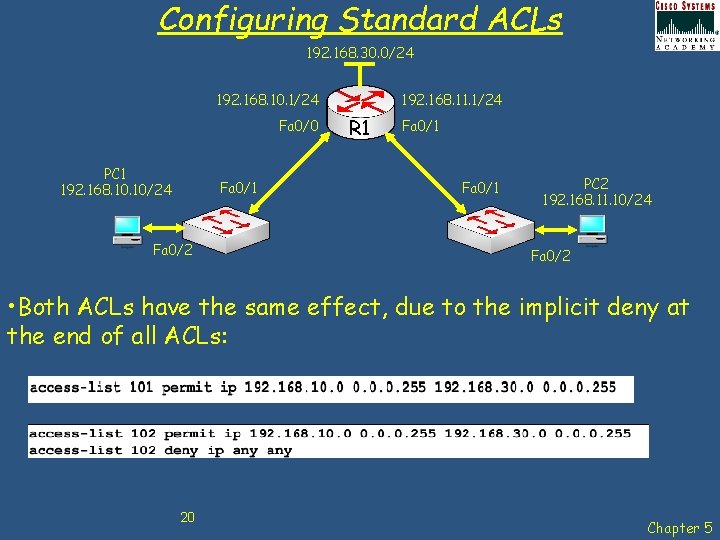
Configuring Standard ACLs 192. 168. 30. 0/24 192. 168. 10. 1/24 Fa 0/0 PC 1 192. 168. 10/24 Fa 0/1 Fa 0/2 192. 168. 11. 1/24 R 1 Fa 0/1 PC 2 192. 168. 11. 10/24 Fa 0/2 • Both ACLs have the same effect, due to the implicit deny at the end of all ACLs: 20 Chapter 5
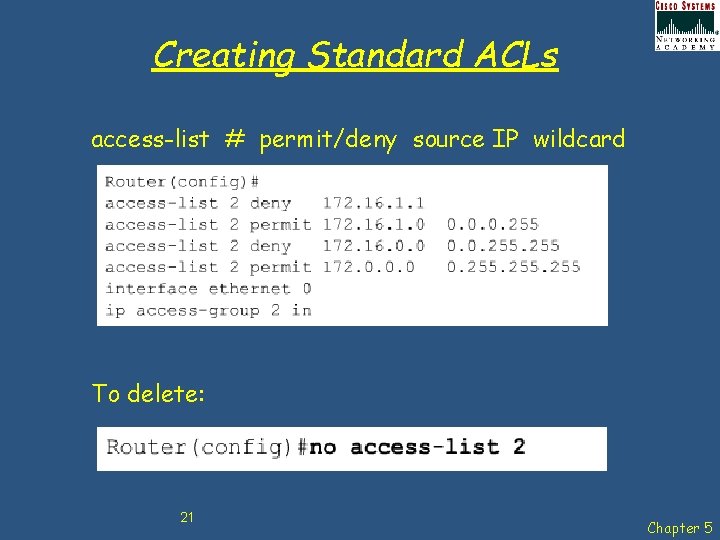
Creating Standard ACLs access-list # permit/deny source IP wildcard To delete: 21 Chapter 5
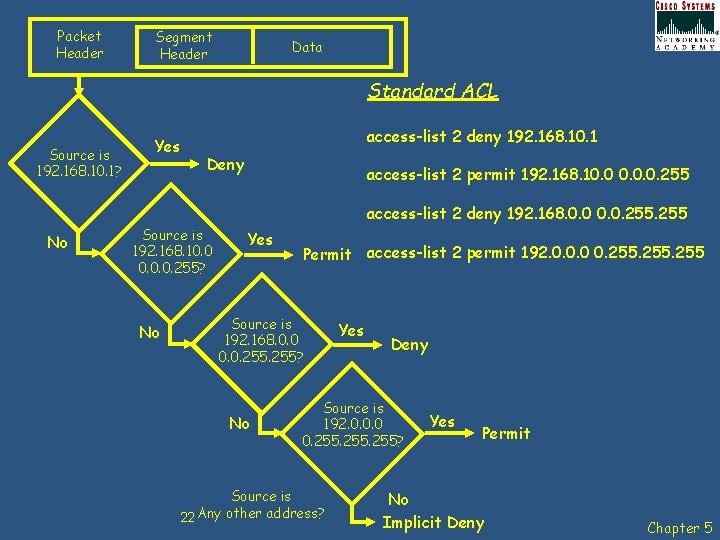
Packet Header Segment Header Data Standard ACL Source is 192. 168. 10. 1? Yes access-list 2 deny 192. 168. 10. 1 Deny access-list 2 permit 192. 168. 10. 0. 0. 255 access-list 2 deny 192. 168. 0. 0. 255 No Source is 192. 168. 10. 0. 0. 255? No Yes Permit access-list 2 permit 192. 0. 0. 0 0. 255 Source is 192. 168. 0. 0. 255? No Yes Deny Source is 192. 0. 0. 0 0. 255? Source is 22 Any other address? Yes Permit No Implicit Deny Chapter 5
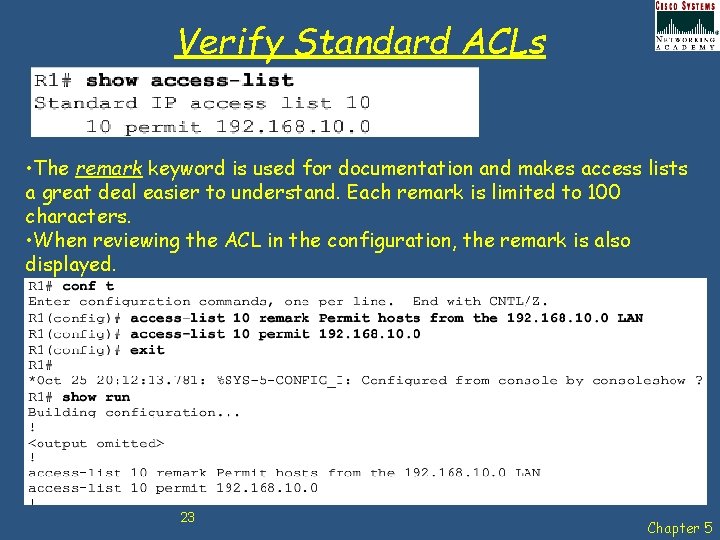
Verify Standard ACLs • The remark keyword is used for documentation and makes access lists a great deal easier to understand. Each remark is limited to 100 characters. • When reviewing the ACL in the configuration, the remark is also displayed. 23 Chapter 5
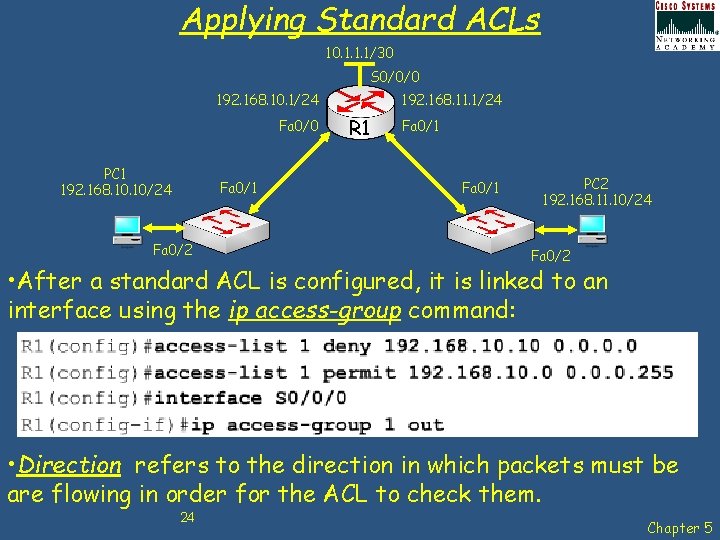
Applying Standard ACLs 10. 1. 1. 1/30 S 0/0/0 192. 168. 10. 1/24 Fa 0/0 PC 1 192. 168. 10/24 Fa 0/1 Fa 0/2 192. 168. 11. 1/24 R 1 Fa 0/1 PC 2 192. 168. 11. 10/24 Fa 0/2 • After a standard ACL is configured, it is linked to an interface using the ip access-group command: • Direction refers to the direction in which packets must be are flowing in order for the ACL to check them. 24 Chapter 5
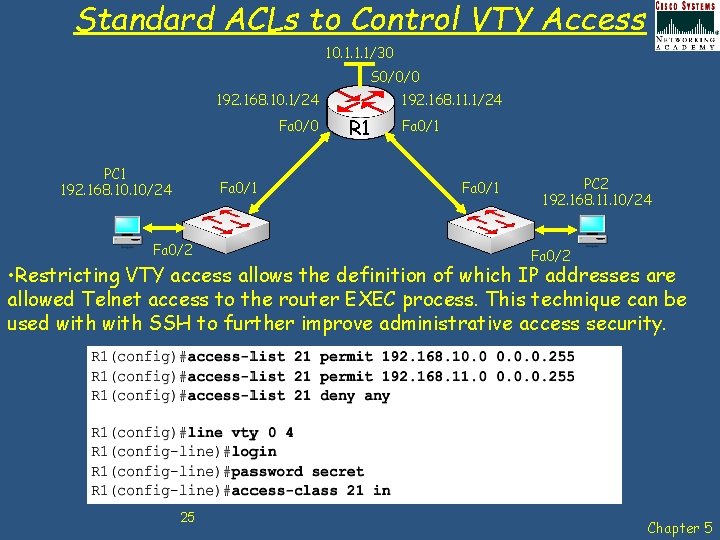
Standard ACLs to Control VTY Access 10. 1. 1. 1/30 S 0/0/0 192. 168. 10. 1/24 Fa 0/0 PC 1 192. 168. 10/24 Fa 0/1 Fa 0/2 192. 168. 11. 1/24 R 1 Fa 0/1 PC 2 192. 168. 11. 10/24 Fa 0/2 • Restricting VTY access allows the definition of which IP addresses are allowed Telnet access to the router EXEC process. This technique can be used with SSH to further improve administrative access security. 25 Chapter 5
Verifying ACLs There are many show commands that will verify the content and placement of ACLs on the router: • • show ip interface show access-lists show access-list <ACL-number> show running-config 26 Chapter 5
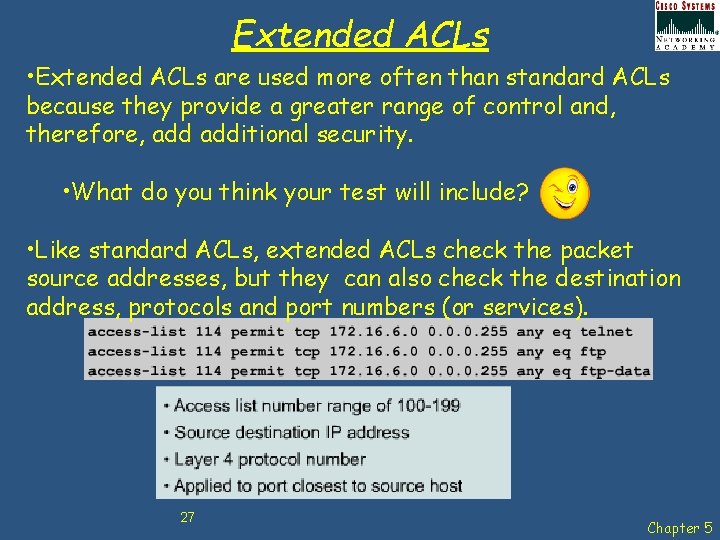
Extended ACLs • Extended ACLs are used more often than standard ACLs because they provide a greater range of control and, therefore, additional security. • What do you think your test will include? • Like standard ACLs, extended ACLs check the packet source addresses, but they can also check the destination address, protocols and port numbers (or services). 27 Chapter 5
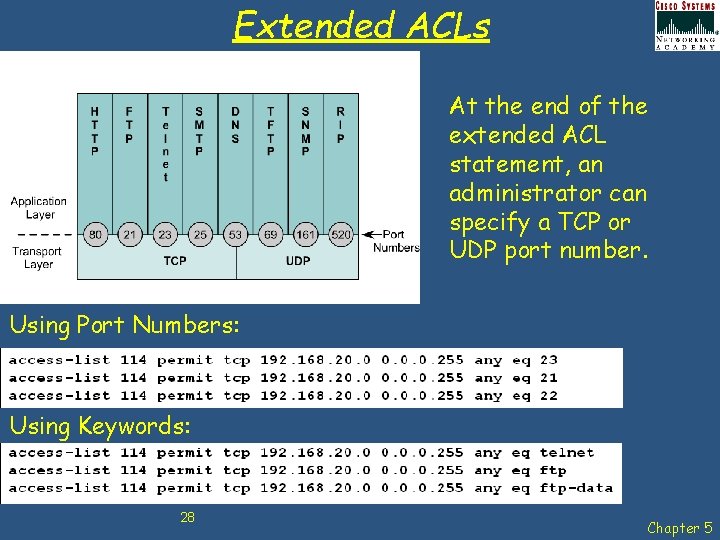
Extended ACLs At the end of the extended ACL statement, an administrator can specify a TCP or UDP port number. Using Port Numbers: Using Keywords: 28 Chapter 5
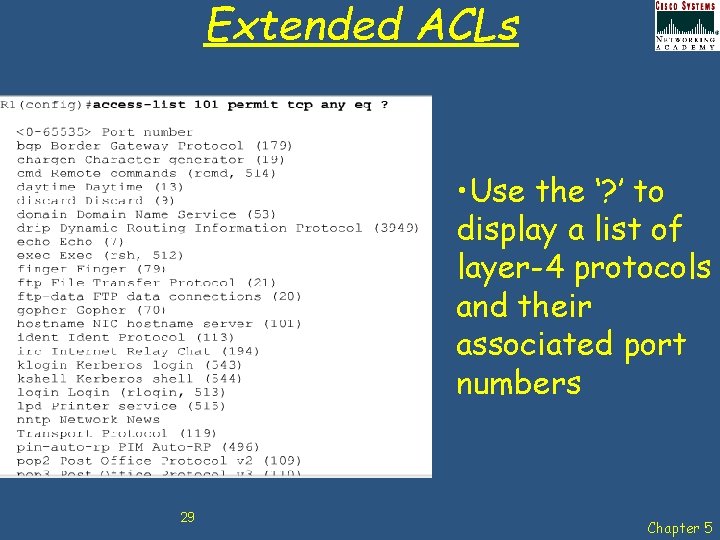
Extended ACLs • Use the ‘? ’ to display a list of layer-4 protocols and their associated port numbers 29 Chapter 5
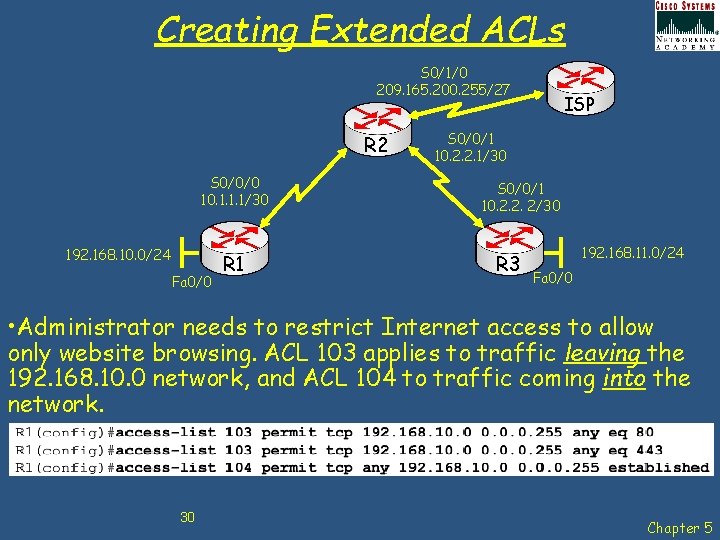
Creating Extended ACLs S 0/1/0 209. 165. 200. 255/27 R 2 S 0/0/0 10. 1. 1. 1/30 192. 168. 10. 0/24 Fa 0/0 R 1 ISP S 0/0/1 10. 2. 2. 1/30 S 0/0/1 10. 2. 2. 2/30 R 3 192. 168. 11. 0/24 Fa 0/0 • Administrator needs to restrict Internet access to allow only website browsing. ACL 103 applies to traffic leaving the 192. 168. 10. 0 network, and ACL 104 to traffic coming into the network. 30 Chapter 5
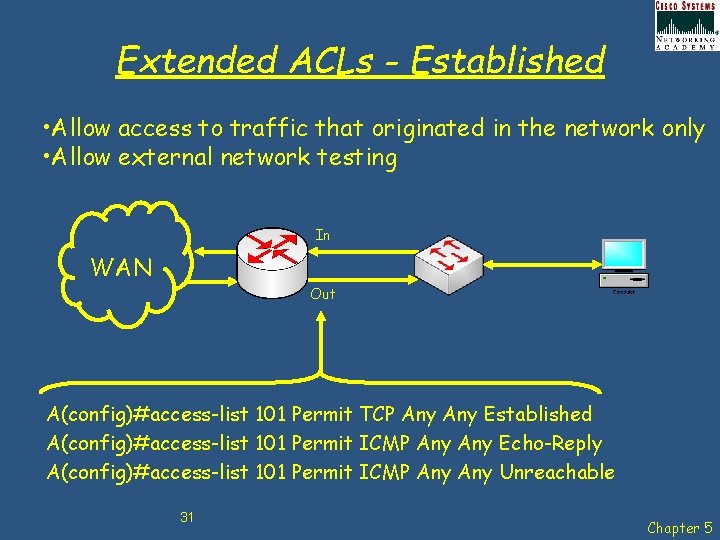
Extended ACLs - Established • Allow access to traffic that originated in the network only • Allow external network testing In WAN Out A(config)#access-list 101 Permit TCP Any Established A(config)#access-list 101 Permit ICMP Any Echo-Reply A(config)#access-list 101 Permit ICMP Any Unreachable 31 Chapter 5
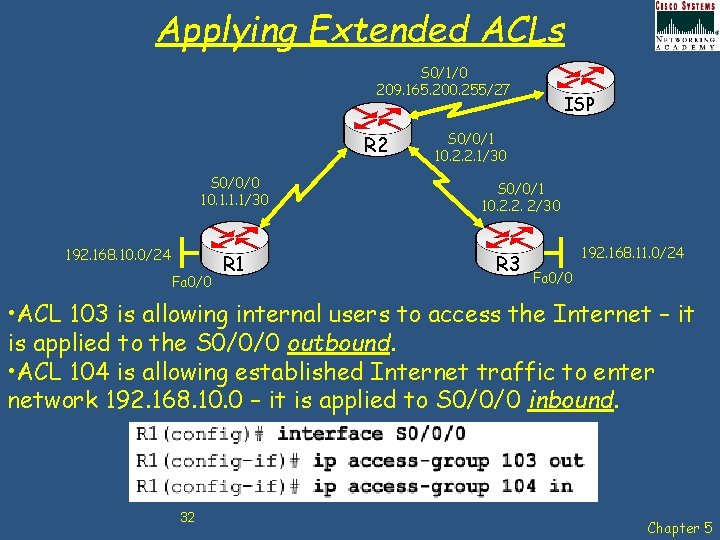
Applying Extended ACLs S 0/1/0 209. 165. 200. 255/27 R 2 S 0/0/0 10. 1. 1. 1/30 192. 168. 10. 0/24 Fa 0/0 R 1 ISP S 0/0/1 10. 2. 2. 1/30 S 0/0/1 10. 2. 2. 2/30 R 3 192. 168. 11. 0/24 Fa 0/0 • ACL 103 is allowing internal users to access the Internet – it is applied to the S 0/0/0 outbound. • ACL 104 is allowing established Internet traffic to enter network 192. 168. 10. 0 – it is applied to S 0/0/0 inbound. 32 Chapter 5
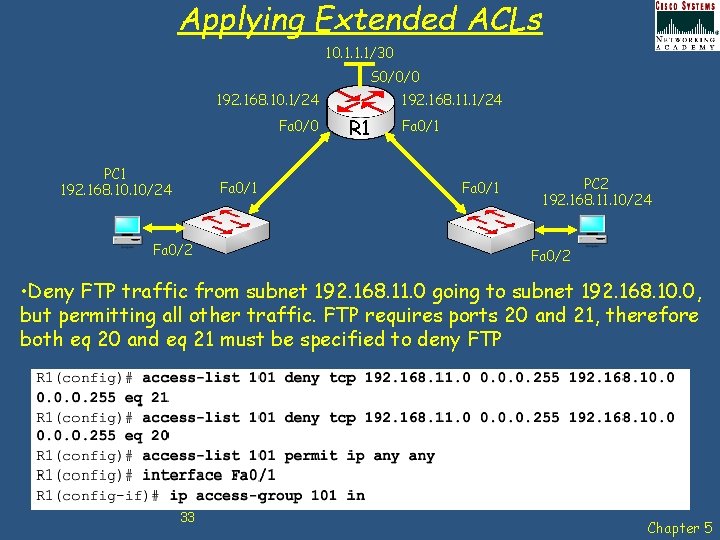
Applying Extended ACLs 10. 1. 1. 1/30 S 0/0/0 192. 168. 10. 1/24 Fa 0/0 PC 1 192. 168. 10/24 Fa 0/1 Fa 0/2 192. 168. 11. 1/24 R 1 Fa 0/1 PC 2 192. 168. 11. 10/24 Fa 0/2 • Deny FTP traffic from subnet 192. 168. 11. 0 going to subnet 192. 168. 10. 0, but permitting all other traffic. FTP requires ports 20 and 21, therefore both eq 20 and eq 21 must be specified to deny FTP 33 Chapter 5
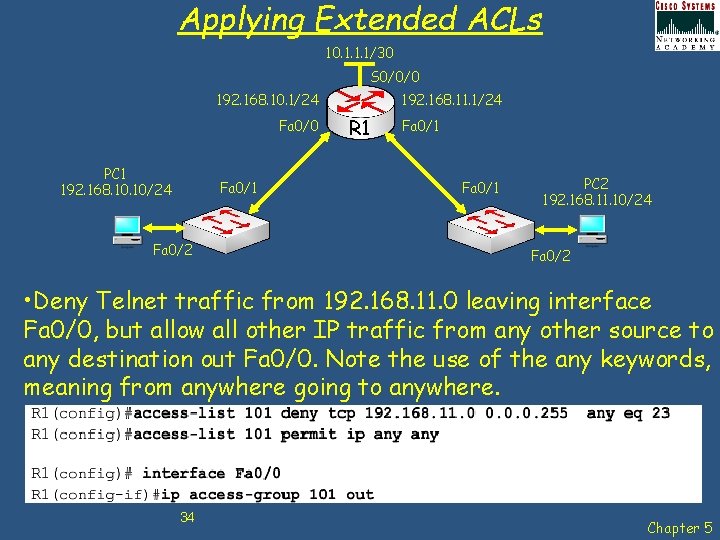
Applying Extended ACLs 10. 1. 1. 1/30 S 0/0/0 192. 168. 10. 1/24 Fa 0/0 PC 1 192. 168. 10/24 Fa 0/1 Fa 0/2 192. 168. 11. 1/24 R 1 Fa 0/1 PC 2 192. 168. 11. 10/24 Fa 0/2 • Deny Telnet traffic from 192. 168. 11. 0 leaving interface Fa 0/0, but allow all other IP traffic from any other source to any destination out Fa 0/0. Note the use of the any keywords, meaning from anywhere going to anywhere. 34 Chapter 5
Chap 5 – Access Control Lists Learning Objectives • • • Explain how ACLs are used to secure a medium-size Enterprise branch office network. Configure standard ACLs in a medium-size Enterprise branch office network. Configure extended ACLs in a medium-size Enterprise branch office network. Describe complex ACLs in a medium-size Enterprise branch office network. Implement, verify and troubleshoot ACLs in an enterprise network environment. 35 Chapter 5

Any Questions? 36 Chapter 5
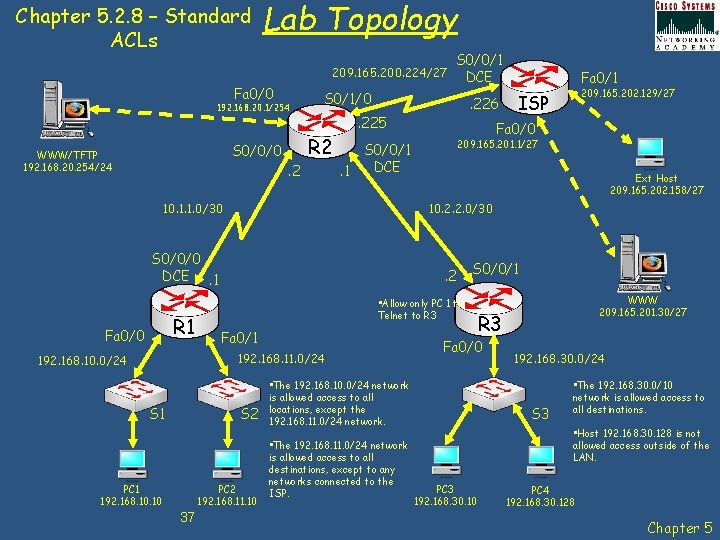
Chapter 5. 2. 8 – Standard ACLs Lab Topology 209. 165. 200. 224/27 Fa 0/0 192. 168. 20. 1/254 S 0/0/0 WWW/TFTP 192. 168. 20. 254/24 S 0/1/0 R 2. 2 S 1 Ext Host 209. 165. 202. 158/27 S 0/0/1 • Allow only PC 1 to Telnet to R 3 Fa 0/1 PC 2 192. 168. 11. 10 37 209. 165. 201. 1/27 . 2 S 2 PC 1 192. 168. 10 209. 165. 202. 129/27 ISP 10. 2. 2. 0/30 192. 168. 11. 0/24 192. 168. 10. 0/24 Fa 0/1 Fa 0/0 S 0/0/1 DCE. 1 S 0/0/0 DCE. 1 R 1 . 226 . 225 10. 1. 1. 0/30 Fa 0/0 S 0/0/1 DCE • The 192. 168. 11. 0/24 network is allowed access to all destinations, except to any networks connected to the ISP. R 3 Fa 0/0 • The 192. 168. 10. 0/24 network is allowed access to all locations, except the 192. 168. 11. 0/24 network. WWW 209. 165. 201. 30/27 192. 168. 30. 0/24 S 3 • The 192. 168. 30. 0/10 network is allowed access to all destinations. • Host 192. 168. 30. 128 is not allowed access outside of the LAN. PC 3 192. 168. 30. 10 PC 4 192. 168. 30. 128 Chapter 5
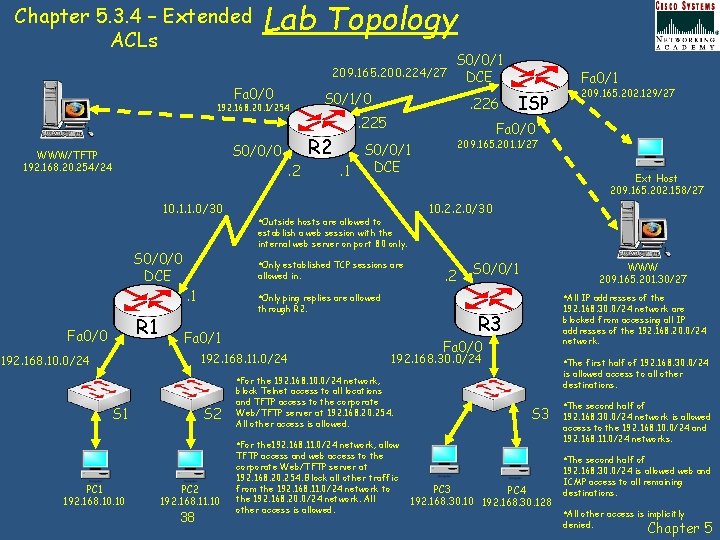
Chapter 5. 3. 4 – Extended ACLs Lab Topology 209. 165. 200. 224/27 Fa 0/0 192. 168. 20. 1/254 S 0/0/0 WWW/TFTP 192. 168. 20. 254/24 10. 1. 1. 0/30 . 225 ISP 209. 165. 201. 1/27 S 0/0/1 DCE. 1 Ext Host 209. 165. 202. 158/27 10. 2. 2. 0/30 • Outside hosts are allowed to allowed in. . 2 S 0/0/1 WWW 209. 165. 201. 30/27 • Only ping replies are allowed • All IP addresses of the through R 2. 192. 168. 11. 0/24 192. 168. 30. 0/24 network are blocked from accessing all IP addresses of the 192. 168. 20. 0/24 network. R 3 Fa 0/1 192. 168. 10. 0/24 Fa 0/0 192. 168. 30. 0/24 • The first half of 192. 168. 30. 0/24 is allowed access to all other destinations. • For the 192. 168. 10. 0/24 network, S 1 S 2 block Telnet access to all locations and TFTP access to the corporate Web/TFTP server at 192. 168. 20. 254. All other access is allowed. S 3 • For the 192. 168. 11. 0/24 network, allow PC 1 192. 168. 10 209. 165. 202. 129/27 Fa 0/0 • Only established TCP sessions are . 1 R 1 . 226 Fa 0/1 establish a web session with the internal web server on port 80 only. S 0/0/0 DCE Fa 0/0 S 0/1/0 R 2. 2 S 0/0/1 DCE PC 2 192. 168. 11. 10 38 TFTP access and web access to the corporate Web/TFTP server at 192. 168. 20. 254. Block all other traffic from the 192. 168. 11. 0/24 network to the 192. 168. 20. 0/24 network. All other access is allowed. • The second half of 192. 168. 30. 0/24 network is allowed access to the 192. 168. 10. 0/24 and 192. 168. 11. 0/24 networks. • The second half of PC 3 PC 4 192. 168. 30. 10 192. 168. 30. 128 192. 168. 30. 0/24 is allowed web and ICMP access to all remaining destinations. • All other access is implicitly denied. Chapter 5
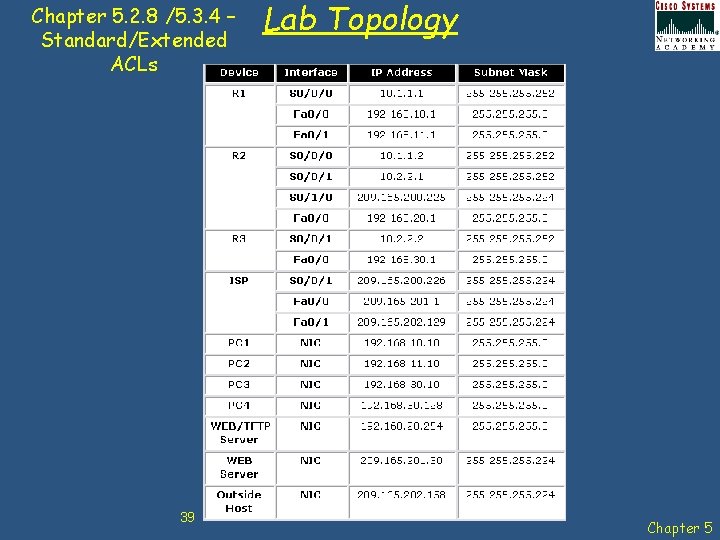
Chapter 5. 2. 8 /5. 3. 4 – Standard/Extended ACLs 39 Lab Topology Chapter 5
- Slides: 39