
Chap 2 Threedimensional lattices Dept of Phys The
- Slides: 18
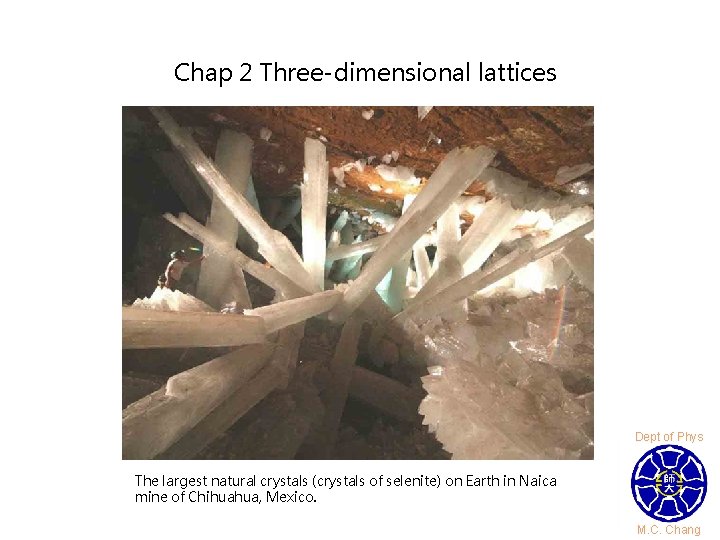
Chap 2 Three-dimensional lattices Dept of Phys The largest natural crystals (crystals of selenite) on Earth in Naica mine of Chihuahua, Mexico. M. C. Chang
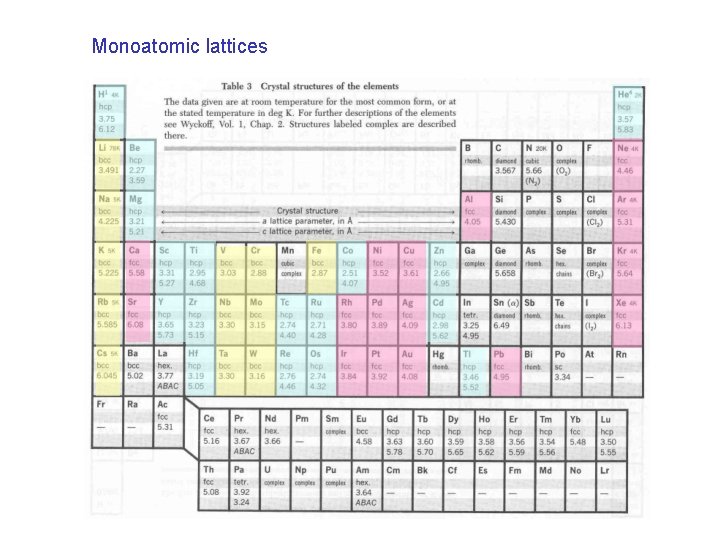
Monoatomic lattices
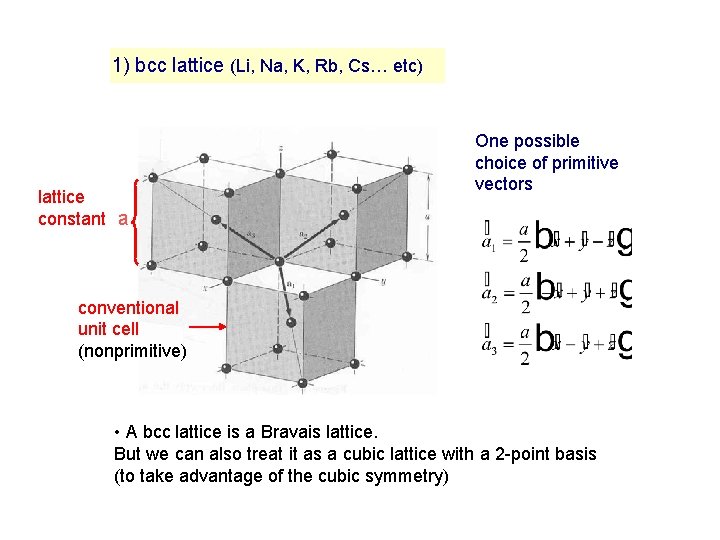
1) bcc lattice (Li, Na, K, Rb, Cs… etc) lattice constant a One possible choice of primitive vectors conventional unit cell (nonprimitive) • A bcc lattice is a Bravais lattice. But we can also treat it as a cubic lattice with a 2 -point basis (to take advantage of the cubic symmetry)
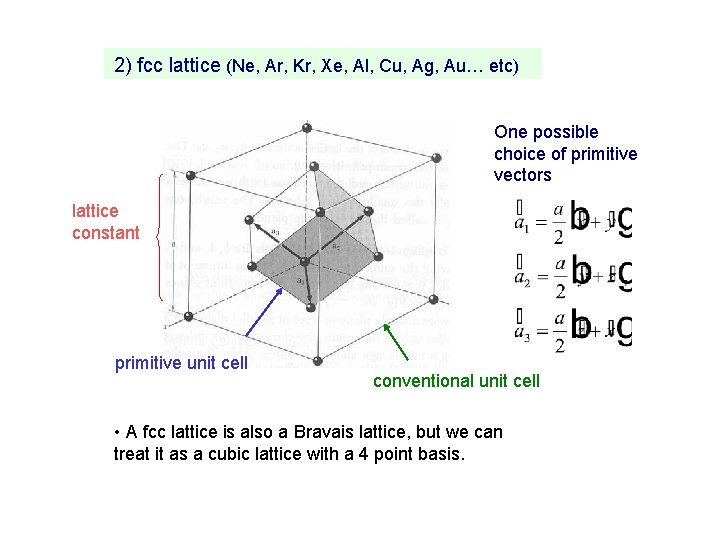
2) fcc lattice (Ne, Ar, Kr, Xe, Al, Cu, Ag, Au… etc) One possible choice of primitive vectors lattice constant primitive unit cell conventional unit cell • A fcc lattice is also a Bravais lattice, but we can treat it as a cubic lattice with a 4 point basis.
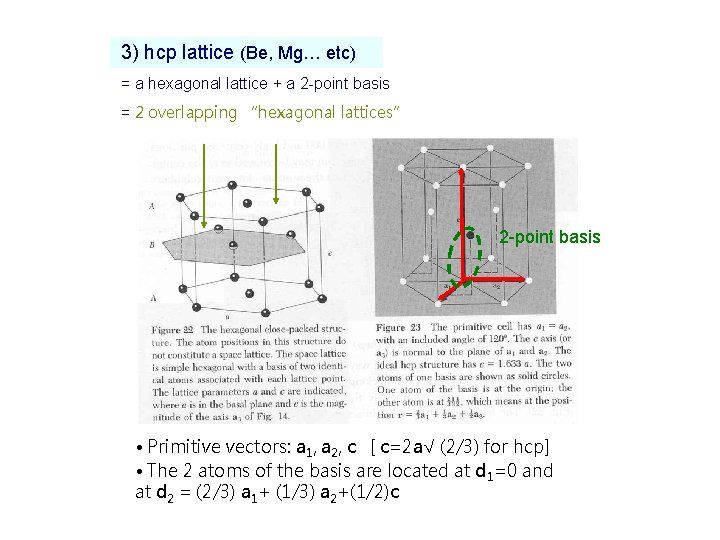
3) hcp lattice (Be, Mg… etc) = a hexagonal lattice + a 2 -point basis = 2 overlapping “hexagonal lattices” 2 -point basis • Primitive vectors: a 1, a 2, c [ c=2 a√ (2/3) for hcp] • The 2 atoms of the basis are located at d 1=0 and at d 2 = (2/3) a 1+ (1/3) a 2+(1/2)c
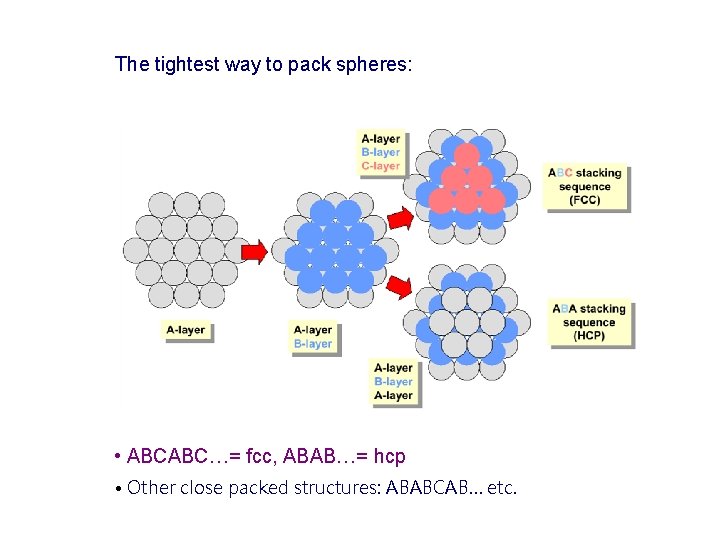
The tightest way to pack spheres: • ABCABC…= fcc, ABAB…= hcp • Other close packed structures: ABABCAB… etc.
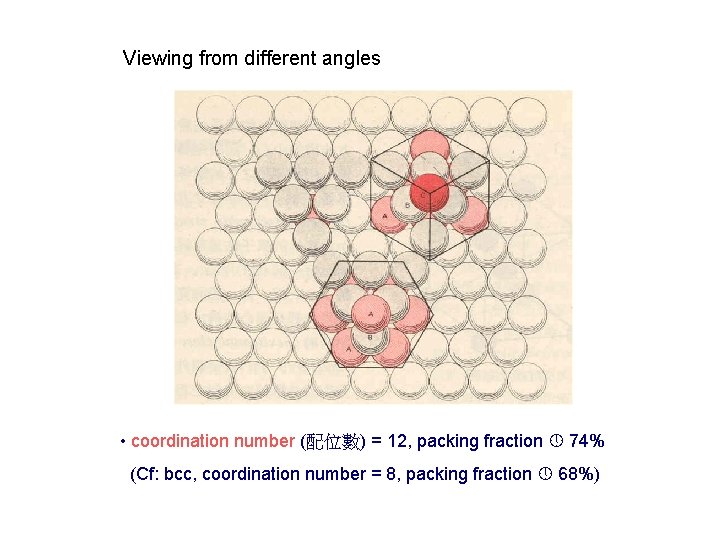
Viewing from different angles • coordination number (配位數) = 12, packing fraction 74% (Cf: bcc, coordination number = 8, packing fraction 68%)
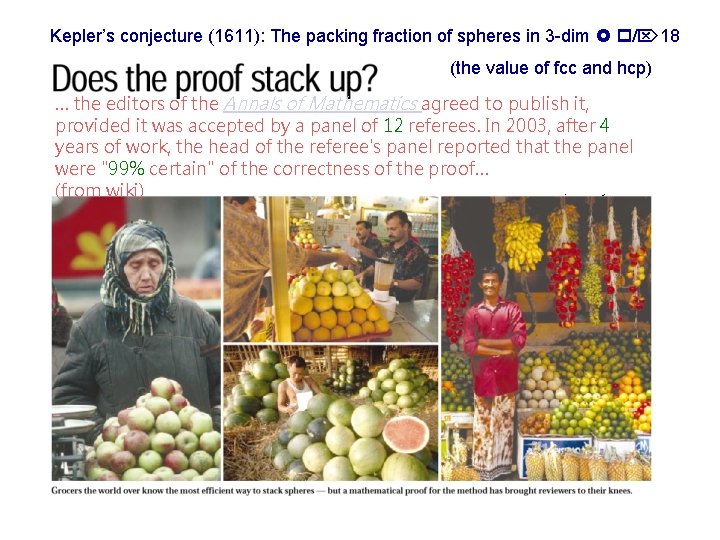
Kepler’s conjecture (1611): The packing fraction of spheres in 3 -dim / 18 (the value of fcc and hcp) … the editors of the Annals of Mathematics agreed to publish it, provided it was accepted by a panel of 12 referees. In 2003, after 4 years of work, the head of the referee's panel reported that the panel were "99% certain" of the correctness of the proof… Nature, 3 July 2003 (from wiki)
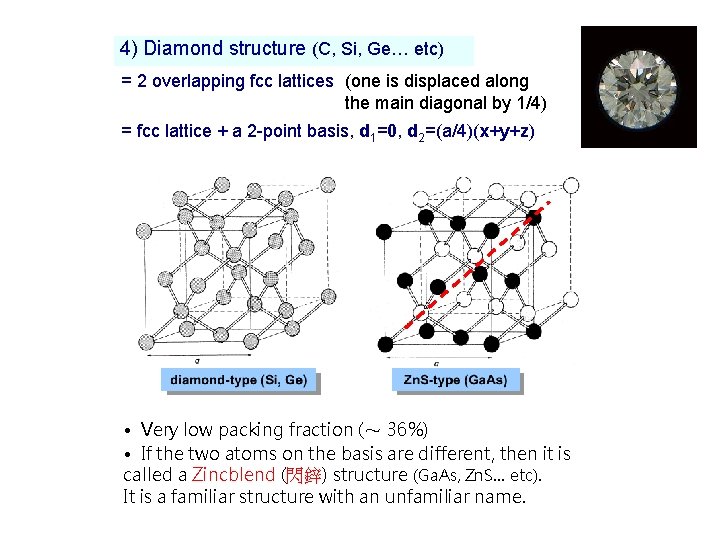
4) Diamond structure (C, Si, Ge… etc) = 2 overlapping fcc lattices (one is displaced along the main diagonal by 1/4) = fcc lattice + a 2 -point basis, d 1=0, d 2=(a/4)(x+y+z) • Very low packing fraction (~ 36%) • If the two atoms on the basis are different, then it is called a Zincblend (閃鋅) structure (Ga. As, Zn. S… etc). It is a familiar structure with an unfamiliar name.
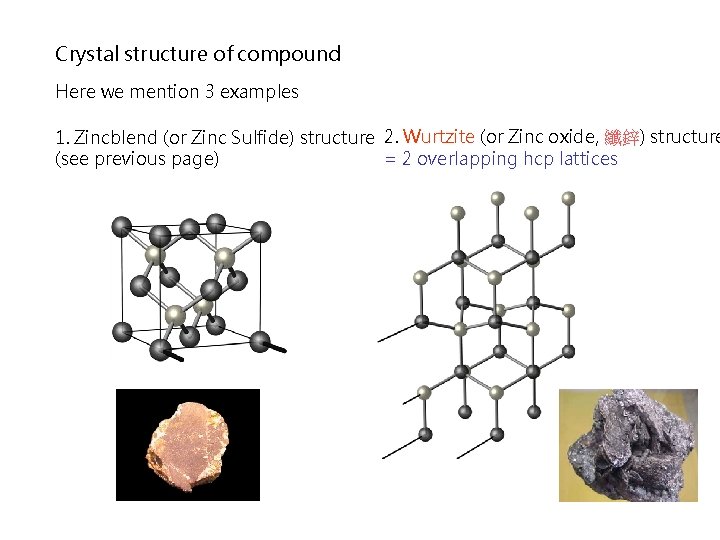
Crystal structure of compound Here we mention 3 examples 1. Zincblend (or Zinc Sulfide) structure 2. Wurtzite (or Zinc oxide, 纖鋅) structure (see previous page) = 2 overlapping hcp lattices
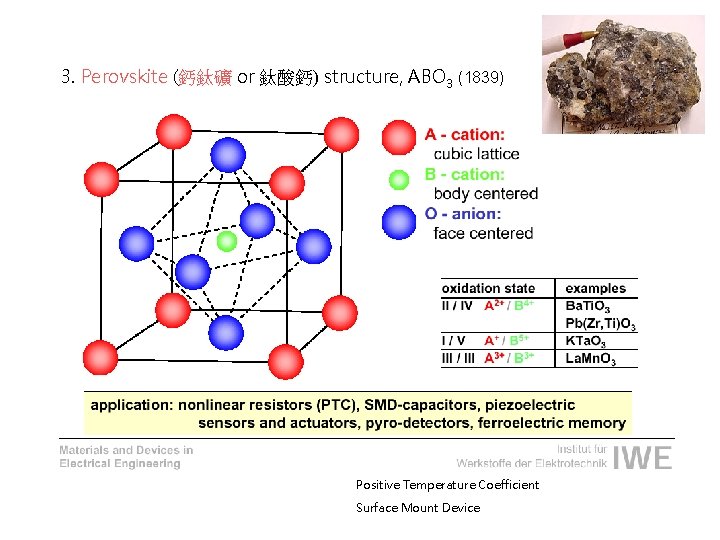
3. Perovskite (鈣鈦礦 or 鈦酸鈣) structure, ABO 3 (1839) Positive Temperature Coefficient Surface Mount Device
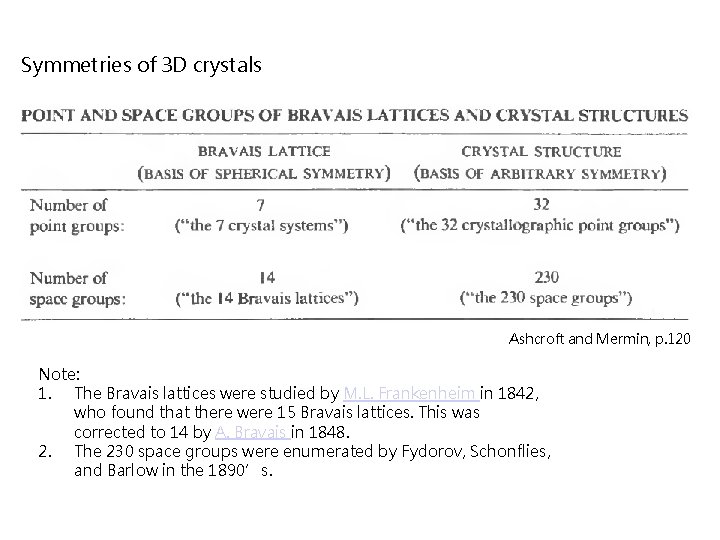
Symmetries of 3 D crystals Ashcroft and Mermin, p. 120 Note: 1. The Bravais lattices were studied by M. L. Frankenheim in 1842, who found that there were 15 Bravais lattices. This was corrected to 14 by A. Bravais in 1848. 2. The 230 space groups were enumerated by Fydorov, Schonflies, and Barlow in the 1890’s.
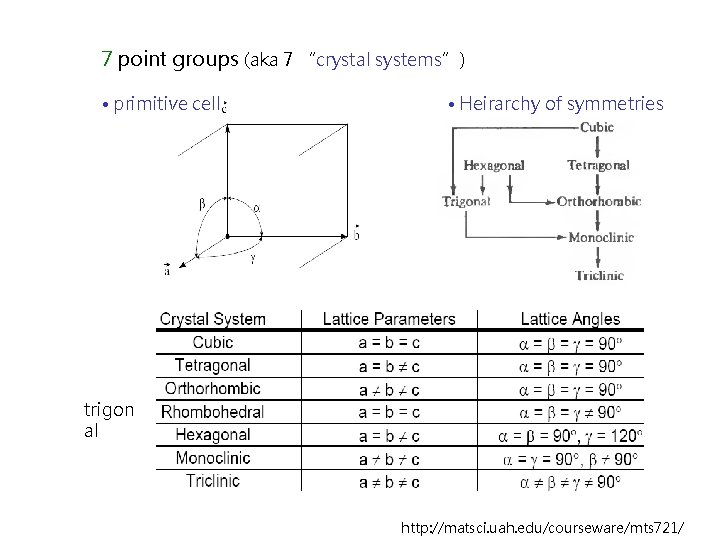
7 point groups (aka 7 “crystal systems”) • primitive cell • Heirarchy of symmetries trigon al http: //matsci. uah. edu/courseware/mts 721/
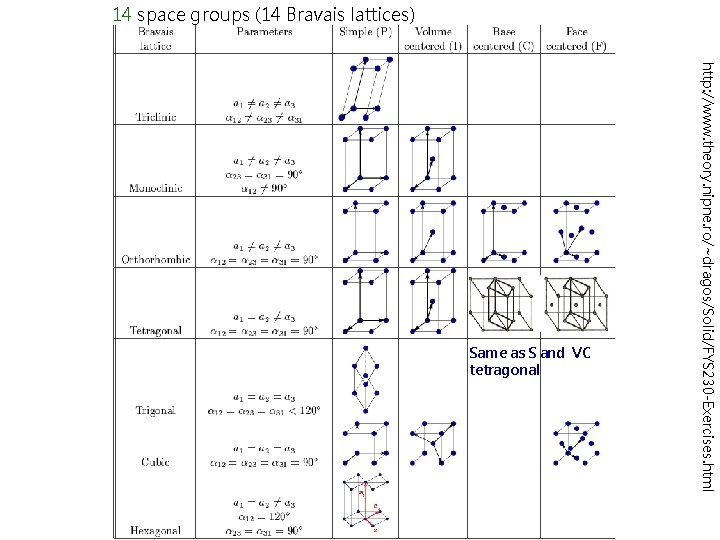
14 space groups (14 Bravais lattices) Same as S and VC tetragonal http: //www. theory. nipne. ro/~dragos/Solid/FYS 230 -Exercises. html Q: why no BC and FC tetragonal?
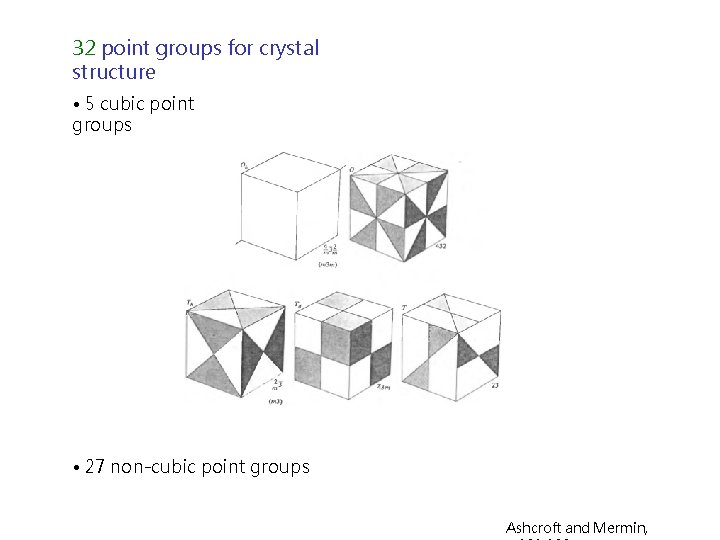
32 point groups for crystal structure • 5 cubic point groups • 27 non-cubic point groups Ashcroft and Mermin,
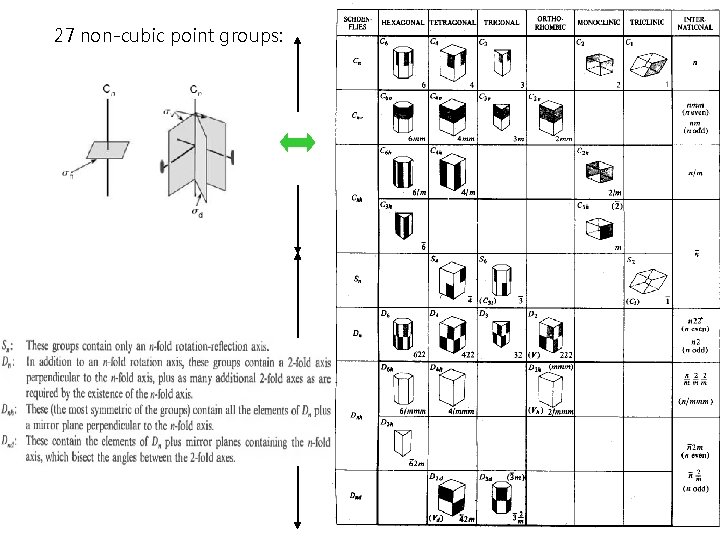
27 non-cubic point groups:
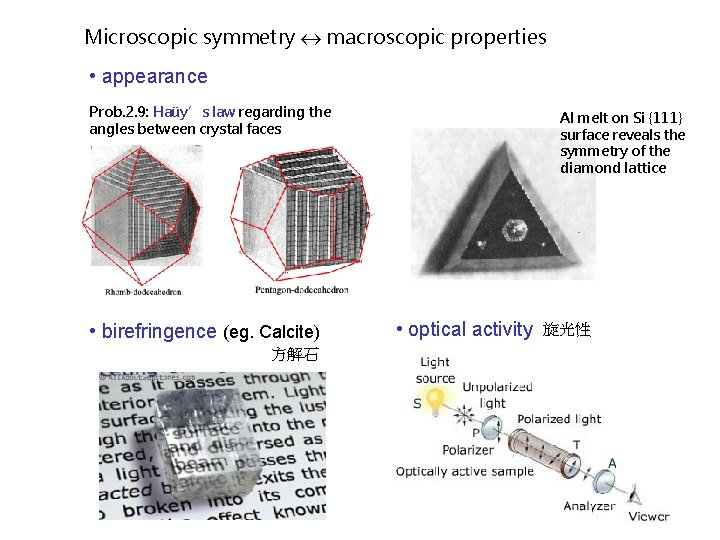
Microscopic symmetry macroscopic properties • appearance Prob. 2. 9: Haüy’s law regarding the angles between crystal faces • birefringence (eg. Calcite) 方解石 Al melt on Si {111} surface reveals the symmetry of the diamond lattice • optical activity 旋光性
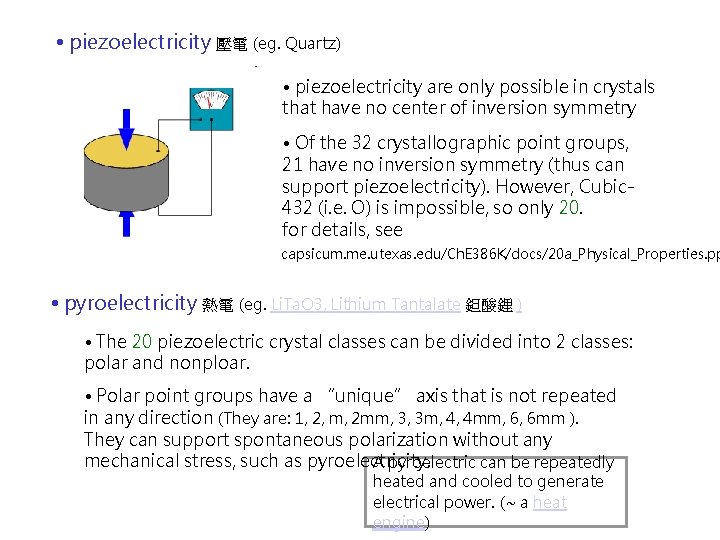
• piezoelectricity 壓電 (eg. Quartz) • piezoelectricity are only possible in crystals that have no center of inversion symmetry • Of the 32 crystallographic point groups, 21 have no inversion symmetry (thus can support piezoelectricity). However, Cubic 432 (i. e. O) is impossible, so only 20. for details, see capsicum. me. utexas. edu/Ch. E 386 K/docs/20 a_Physical_Properties. pp • pyroelectricity 熱電 (eg. Li. Ta. O 3, Lithium Tantalate 鉭酸鋰 ) • The 20 piezoelectric crystal classes can be divided into 2 classes: polar and nonploar. • Polar point groups have a “unique” axis that is not repeated in any direction (They are: 1, 2, m, 2 mm, 3, 3 m, 4, 4 mm, 6, 6 mm ). They can support spontaneous polarization without any mechanical stress, such as pyroelectricity. A pyroelectric can be repeatedly heated and cooled to generate electrical power. (~ a heat engine)