
Chap 19 Thermal Properties Thermostat Rail lines buckled
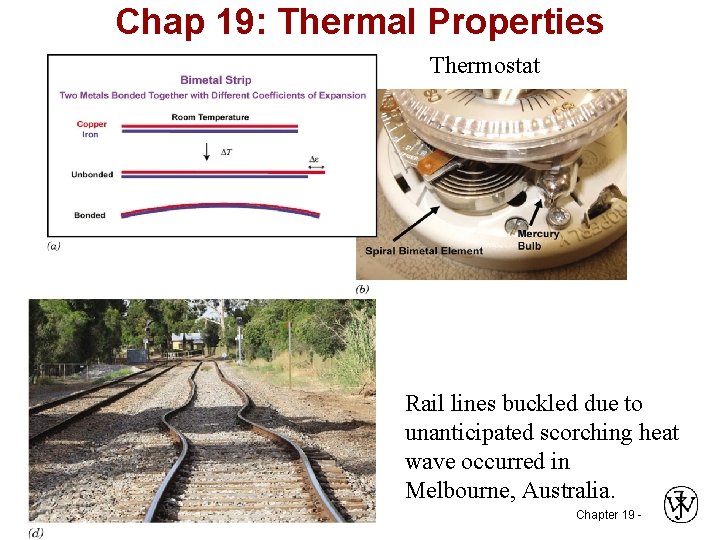
Chap 19: Thermal Properties Thermostat Rail lines buckled due to unanticipated scorching heat wave occurred in Melbourne, Australia. Chapter 19 -
Chapter 19: Thermal Properties ISSUES TO ADDRESS. . . • How do materials respond to the application of heat? • How do we define and measure. . . -- heat capacity? -- thermal expansion? -- thermal conductivity? -- thermal shock resistance? • How do thermal properties of ceramics, metals, and polymers differ? Chapter 19 - 2
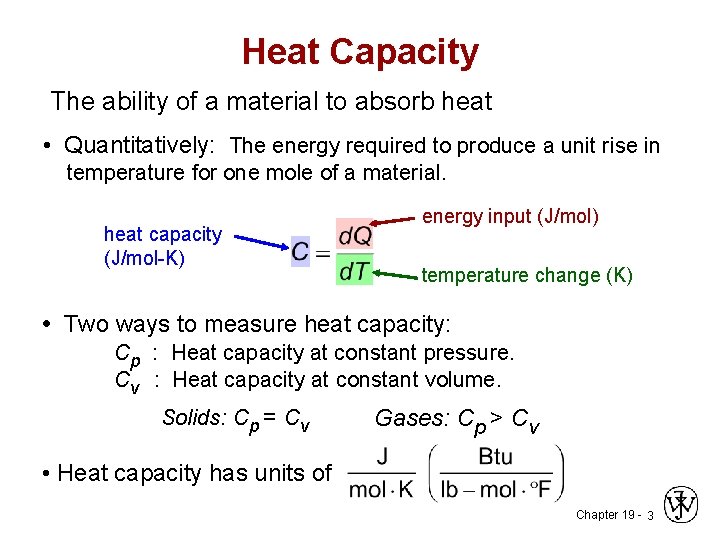
Heat Capacity The ability of a material to absorb heat • Quantitatively: The energy required to produce a unit rise in temperature for one mole of a material. heat capacity (J/mol-K) energy input (J/mol) temperature change (K) • Two ways to measure heat capacity: Cp : Heat capacity at constant pressure. Cv : Heat capacity at constant volume. Solids: Cp = Cv Gases: Cp > Cv • Heat capacity has units of Chapter 19 - 3
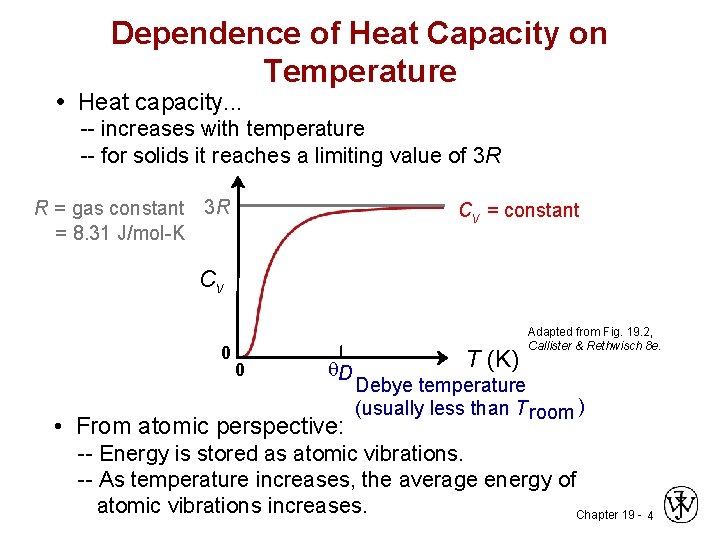
Dependence of Heat Capacity on Temperature • Heat capacity. . . -- increases with temperature -- for solids it reaches a limiting value of 3 R R = gas constant 3 R = 8. 31 J/mol-K Cv = constant Cv 0 0 q. D • From atomic perspective: T (K) Adapted from Fig. 19. 2, Callister & Rethwisch 8 e. Debye temperature (usually less than T room ) -- Energy is stored as atomic vibrations. -- As temperature increases, the average energy of atomic vibrations increases. Chapter 19 - 4
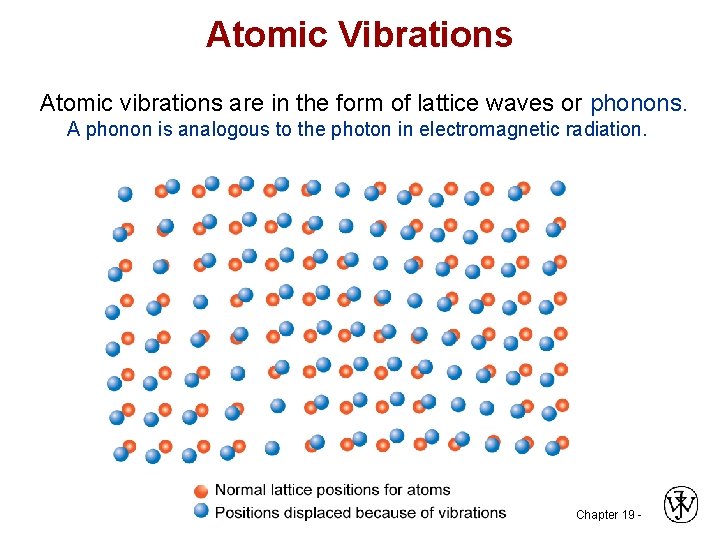
Atomic Vibrations Atomic vibrations are in the form of lattice waves or phonons. A phonon is analogous to the photon in electromagnetic radiation. Chapter 19 -
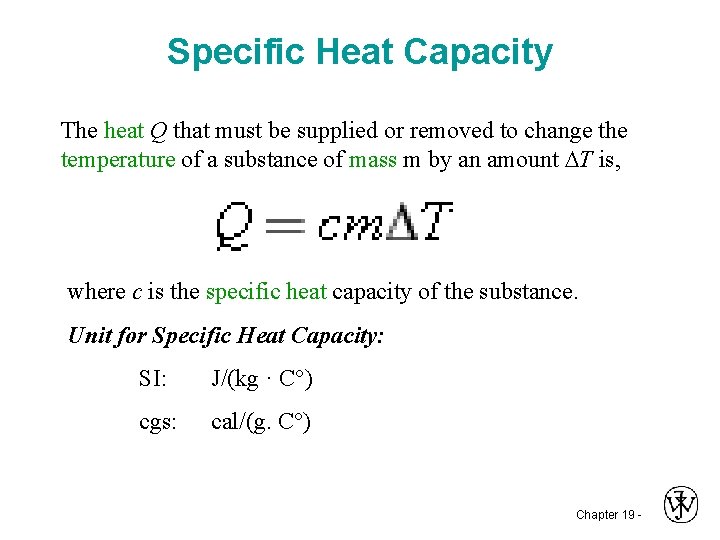
Specific Heat Capacity The heat Q that must be supplied or removed to change the temperature of a substance of mass m by an amount DT is, where c is the specific heat capacity of the substance. Unit for Specific Heat Capacity: SI: J/(kg · C°) cgs: cal/(g. C°) Chapter 19 -

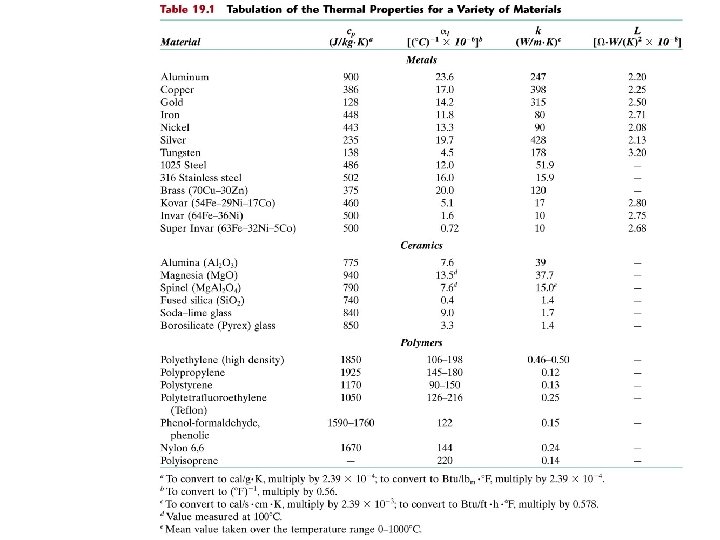
Specific Heat: Comparison increasing cp Material • Polymers Polypropylene Polyethylene Polystyrene Teflon cp (J/kg-K) at room T 1925 1850 1170 1050 • Ceramics Magnesia (Mg. O) Alumina (Al 2 O 3) Glass 940 775 840 • Metals Aluminum Steel Tungsten Gold 900 486 138 128 cp (specific heat): (J/kg-K) Cp (heat capacity): (J/mol-K) Selected values from Table 19. 1, Callister & Rethwisch 8 e. Chapter 19 - 7
Chapter 19 - 8
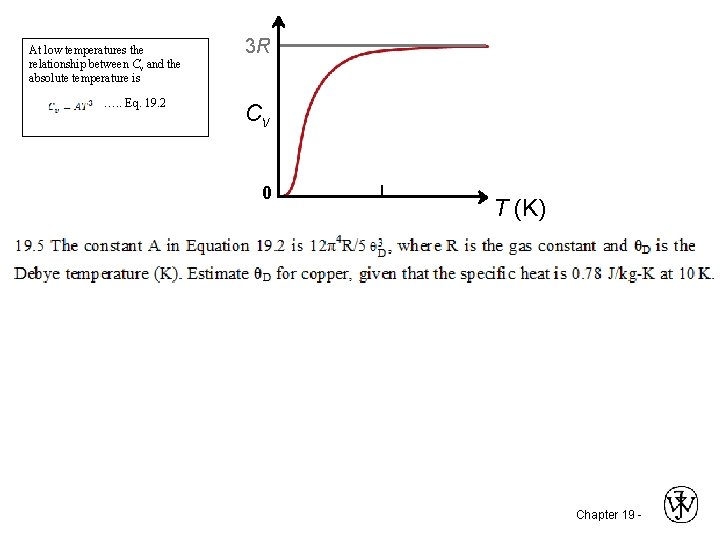
At low temperatures the relationship between Cv and the absolute temperature is …. . Eq. 19. 2 3 R Cv 0 T (K) Chapter 19 -
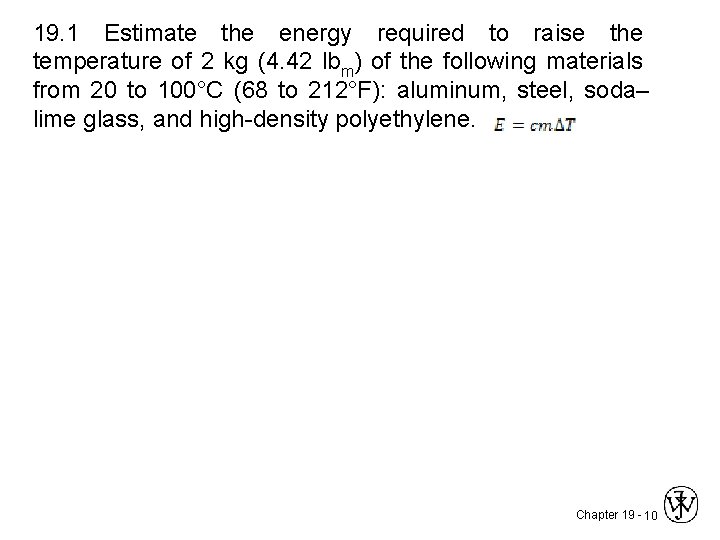
19. 1 Estimate the energy required to raise the temperature of 2 kg (4. 42 lbm) of the following materials from 20 to 100°C (68 to 212°F): aluminum, steel, soda– lime glass, and high-density polyethylene. Chapter 19 - 10
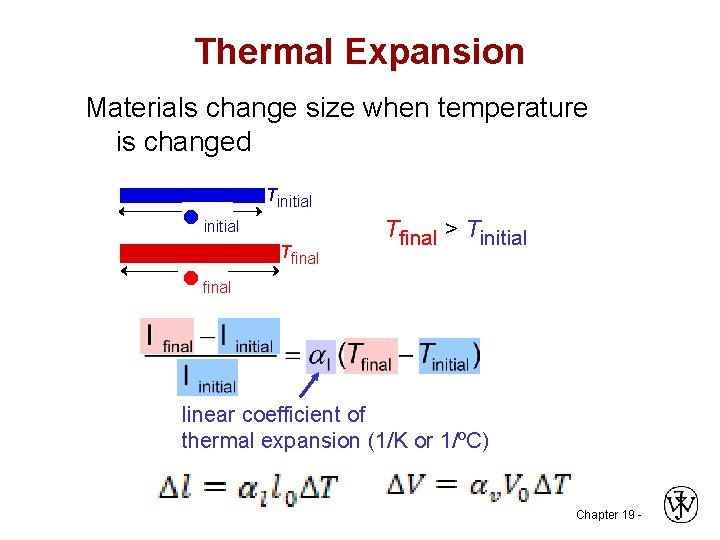
Thermal Expansion Materials change size when temperature is changed initial final Tinitial Tfinal > Tinitial linear coefficient of thermal expansion (1/K or 1/ºC) Chapter 19 -
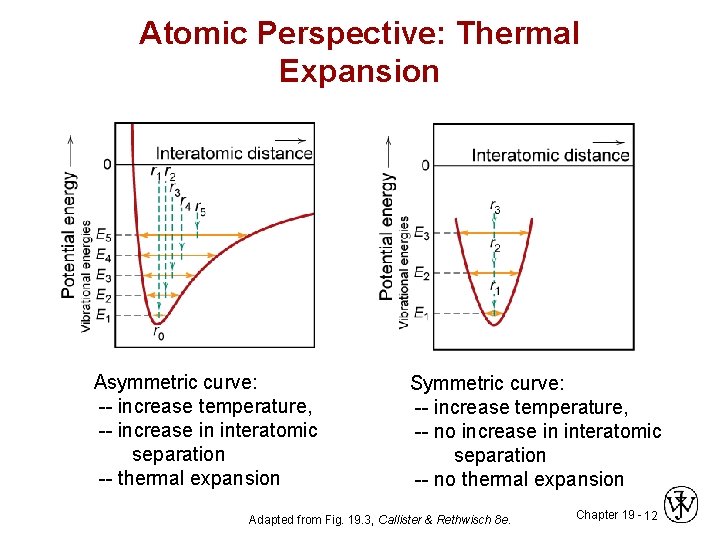
Atomic Perspective: Thermal Expansion Asymmetric curve: -- increase temperature, -- increase in interatomic separation -- thermal expansion Symmetric curve: -- increase temperature, -- no increase in interatomic separation -- no thermal expansion Adapted from Fig. 19. 3, Callister & Rethwisch 8 e. Chapter 19 - 12
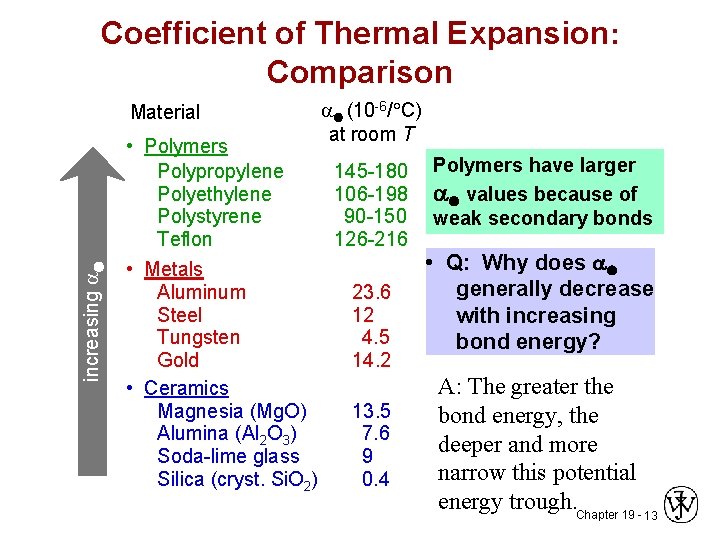
Coefficient of Thermal Expansion: Comparison Material increasing • Polymers Polypropylene Polyethylene Polystyrene Teflon • Metals Aluminum Steel Tungsten Gold • Ceramics Magnesia (Mg. O) Alumina (Al 2 O 3) Soda-lime glass Silica (cryst. Si. O 2) (10 -6/ C) at room T 145 -180 106 -198 90 -150 126 -216 23. 6 12 4. 5 14. 2 13. 5 7. 6 9 0. 4 Polymers have larger values because of weak secondary bonds • Q: Why does generally decrease with increasing bond energy? A: The greater the bond energy, the deeper and more narrow this potential energy trough. Chapter 19 - 13
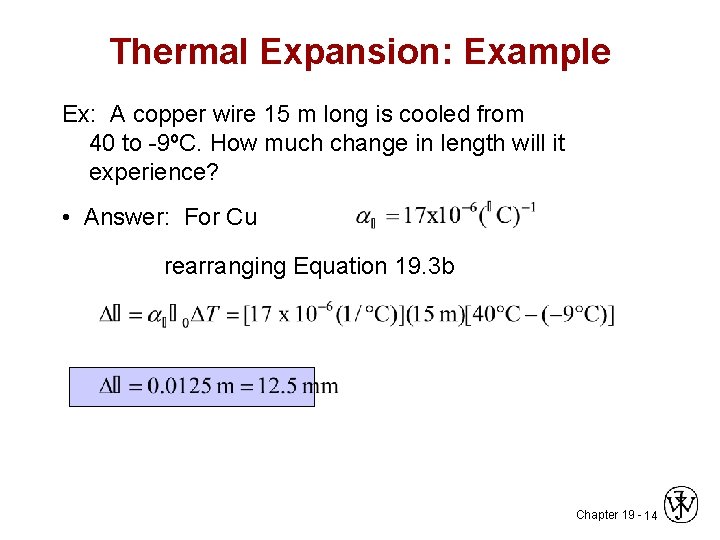
Thermal Expansion: Example Ex: A copper wire 15 m long is cooled from 40 to -9ºC. How much change in length will it experience? • Answer: For Cu rearranging Equation 19. 3 b Chapter 19 - 14
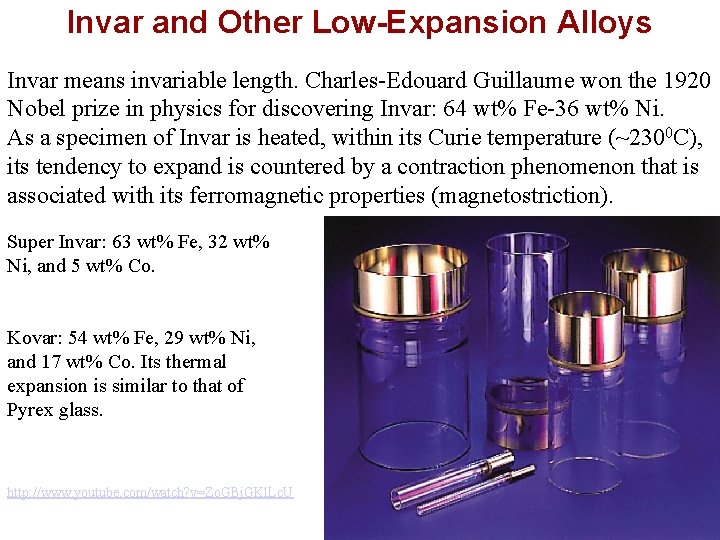
Invar and Other Low-Expansion Alloys Invar means invariable length. Charles-Edouard Guillaume won the 1920 Nobel prize in physics for discovering Invar: 64 wt% Fe-36 wt% Ni. As a specimen of Invar is heated, within its Curie temperature (~2300 C), its tendency to expand is countered by a contraction phenomenon that is associated with its ferromagnetic properties (magnetostriction). Super Invar: 63 wt% Fe, 32 wt% Ni, and 5 wt% Co. Kovar: 54 wt% Fe, 29 wt% Ni, and 17 wt% Co. Its thermal expansion is similar to that of Pyrex glass. http: //www. youtube. com/watch? v=Zo. GBj. GKl. Lc. U Chapter 19 - 15
- Slides: 15