
Channeling effect in nuclear events of Cs ITl
![Introduction to the channeling effect �Measurement of the channeling effect[2] (a) photographic reproduction (b)](https://slidetodoc.com/presentation_image_h/35e189b352123414e043f3ac8c00dc16/image-6.jpg "Introduction to the channeling effect �Measurement of the channeling effect[2] (a) photographic reproduction (b)")
![Introduction to the channeling effect �Calculated interatomic potential[2] V(r) = (Z 1 Z 2](https://slidetodoc.com/presentation_image_h/35e189b352123414e043f3ac8c00dc16/image-7.jpg "Introduction to the channeling effect �Calculated interatomic potential[2] V(r) = (Z 1 Z 2")
![Introduction to the channeling effect �Calculation of the Channeling effect[1] C : 31/2 a.](https://slidetodoc.com/presentation_image_h/35e189b352123414e043f3ac8c00dc16/image-8.jpg "Introduction to the channeling effect �Calculation of the Channeling effect[1] C : 31/2 a.")
![Investigation Methods �Comparing quenching factors of SRIM & MARLOWE for Cs. I(Tl) [7] [3]](https://slidetodoc.com/presentation_image_h/35e189b352123414e043f3ac8c00dc16/image-11.jpg "Investigation Methods �Comparing quenching factors of SRIM & MARLOWE for Cs. I(Tl) [7] [3]")
![Validity of our methods �Comparing of Ranges of MARLOWE & Experiments[11] ( Ion :](https://slidetodoc.com/presentation_image_h/35e189b352123414e043f3ac8c00dc16/image-12.jpg "Validity of our methods �Comparing of Ranges of MARLOWE & Experiments[11] ( Ion :")
![References [1] Eur. Phys. J. C 53 (2008) 205 [2] Rev. Mod. Phys. Vol.](https://slidetodoc.com/presentation_image_h/35e189b352123414e043f3ac8c00dc16/image-20.jpg "References [1] Eur. Phys. J. C 53 (2008) 205 [2] Rev. Mod. Phys. Vol.")
![References [9] Astro. Phys. 11 (1999) 457 [10] Nucl. Instrum. Meth. A 557 (2006)](https://slidetodoc.com/presentation_image_h/35e189b352123414e043f3ac8c00dc16/image-21.jpg "References [9] Astro. Phys. 11 (1999) 457 [10] Nucl. Instrum. Meth. A 557 (2006)")
- Slides: 21
Channeling effect in nuclear events of Cs. I(Tl) 2009. 10. 22 KIMS Seoul National University Juhee Lee KPS in Changwon 1
Contents ① ② ③ ④ ⑤ ⑥ ⑦ ⑧ Motivation & Objectives Introduction to channeling effect Investigation methods Validity of our methods Results Conclusion Summary References KPS in Changwon 2
Motivation �KIMS (Korea Invisible matter search) has been trying to see the WIMP signal with Cs. I(Tl) crystal. We use PSD (Pulse Shape Discrimination) method to discriminate nuclear events with the gamma background. �DAMA saids that there is the channeling effect in crystal detector which induces higher quenching factor in nuclear events with some probability, so PSD method will remove that kind of real events. [1] KPS in Changwon 3
Objectives �How much the channeling effect can we expect in Cs. I(Tl)? �Can we measure that kind of event? KPS in Changwon 4
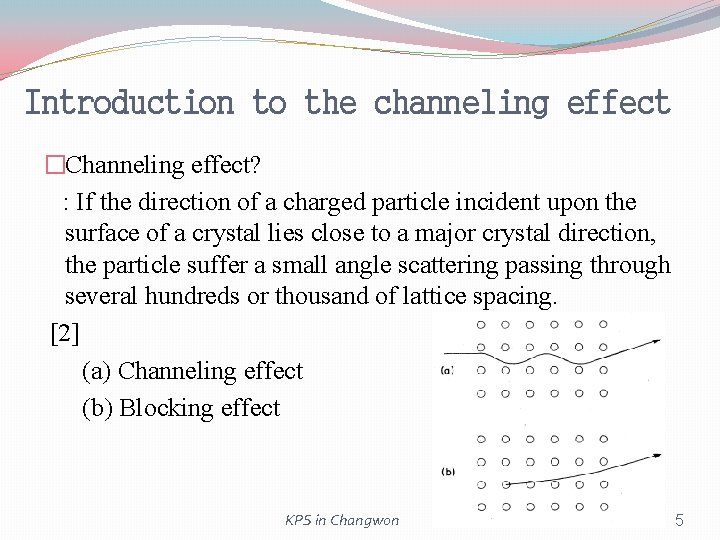
Introduction to the channeling effect �Channeling effect? : If the direction of a charged particle incident upon the surface of a crystal lies close to a major crystal direction, the particle suffer a small angle scattering passing through several hundreds or thousand of lattice spacing. [2] (a) Channeling effect (b) Blocking effect KPS in Changwon 5
Introduction to the channeling effect �Measurement of the channeling effect[2] (a) photographic reproduction (b) radial projection of the (111) face of the fcc crystal KPS in Changwon 6
Introduction to the channeling effect �Calculated interatomic potential[2] V(r) = (Z 1 Z 2 e 2/r) (r/a) , (r/a) : screening function (a) I -> Ag target <110> R - target atom’s position dot - the minima of potential KPS in Changwon 7
Introduction to the channeling effect �Calculation of the Channeling effect[1] C : 31/2 a. TF : The screening length of Tomas-Fermi interaction d : Interatomic spacing E : Ion’s kinetic energy KPS in Changwon 8
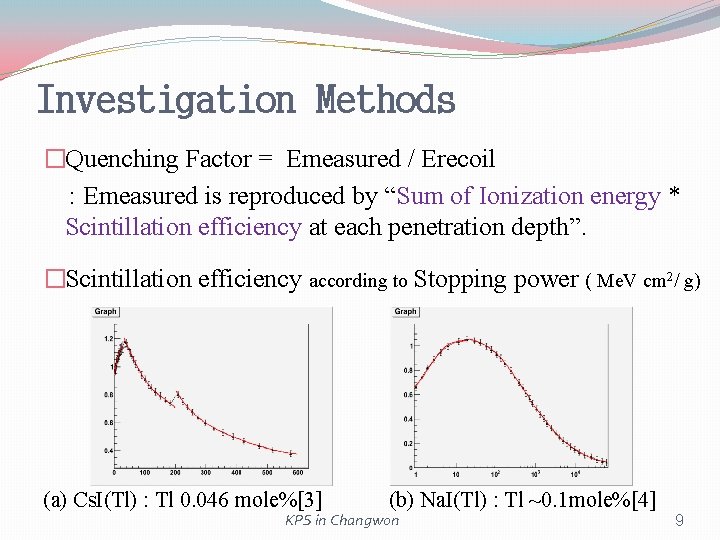
Investigation Methods �Quenching Factor = Emeasured / Erecoil : Emeasured is reproduced by “Sum of Ionization energy * Scintillation efficiency at each penetration depth”. �Scintillation efficiency according to Stopping power ( Me. V cm 2/ g) (a) Cs. I(Tl) : Tl 0. 046 mole%[3] (b) Na. I(Tl) : Tl ~0. 1 mole%[4] KPS in Changwon 9
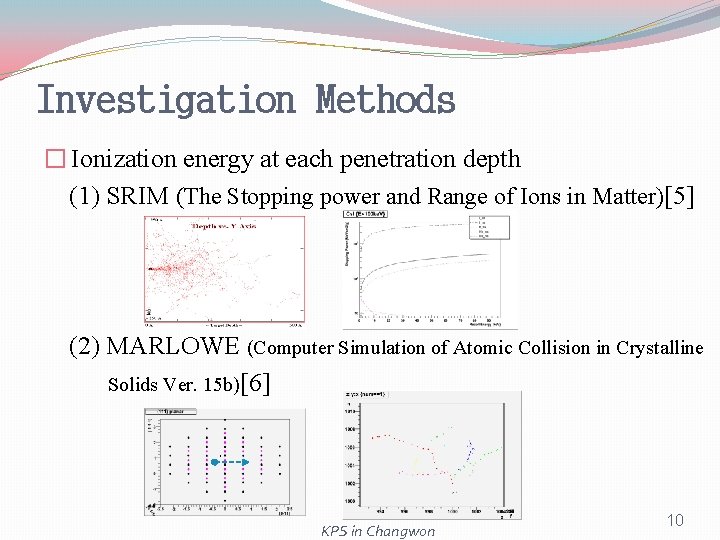
Investigation Methods � Ionization energy at each penetration depth (1) SRIM (The Stopping power and Range of Ions in Matter)[5] (2) MARLOWE (Computer Simulation of Atomic Collision in Crystalline Solids Ver. 15 b)[6] KPS in Changwon 10
Investigation Methods �Comparing quenching factors of SRIM & MARLOWE for Cs. I(Tl) [7] [3] [10] [11] SRIM MARLOWE (a) Stopping power distribution for the amorphous target [8 ] [9 ] (b) Quenching factors for Cs. I(Tl) KPS in Changwon 11
Validity of our methods �Comparing of Ranges of MARLOWE & Experiments[11] ( Ion : 40 ke. V 85 Kr+ , Target : Al ) (b) Polycrystalline Al Amorphous Al 2 O 3 Amorphous Al SRIM <110> Al <100> Al 7 from <211> Al <111> Al MARLOWE (a) Stopping power distribution for the amorphous target KPS in Changwon (b) Ranges 12
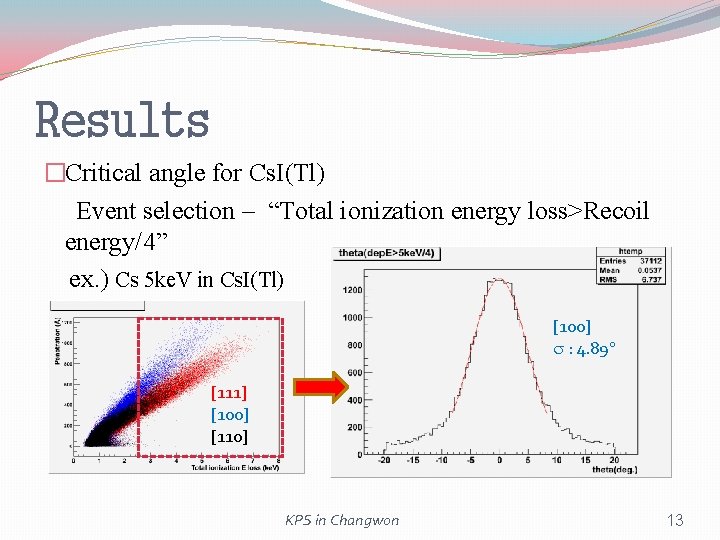
Results �Critical angle for Cs. I(Tl) Event selection – “Total ionization energy loss>Recoil energy/4” ex. ) Cs 5 ke. V in Cs. I(Tl) [100] : 4. 89 [111] [100] [110] KPS in Changwon 13
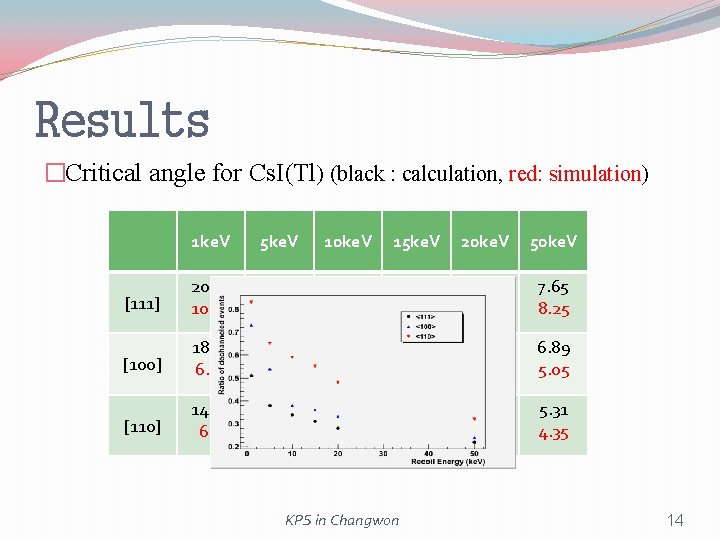
Results �Critical angle for Cs. I(Tl) (black : calculation, red: simulation) 1 ke. V 5 ke. V 10 ke. V 15 ke. V 20 ke. V 50 ke. V [111] 20. 34 10. 62 13. 6 8. 02 11. 44 7. 1 10. 33 7. 36 9. 62 7. 87 7. 65 8. 25 [100] 18. 31 6. 27 9. 44 4. 89 7. 94 5. 32 7. 18 5. 01 6. 68 5. 33 6. 89 5. 05 [110] 14. 12 6. 4 9. 44 4. 05 7. 94 3. 08 7. 18 3. 49 6. 68 3. 55 5. 31 4. 35 KPS in Changwon 14
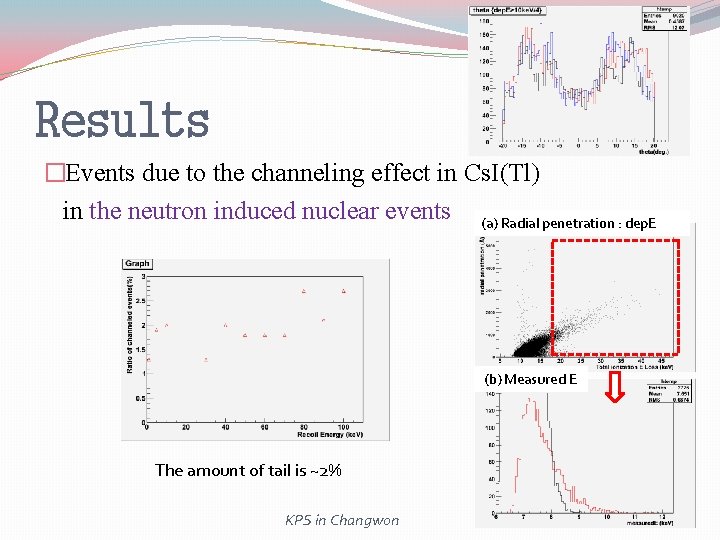
Results �Events due to the channeling effect in Cs. I(Tl) in the neutron induced nuclear events (a) Radial penetration : dep. E (b) Measured E The amount of tail is ~2% KPS in Changwon 15
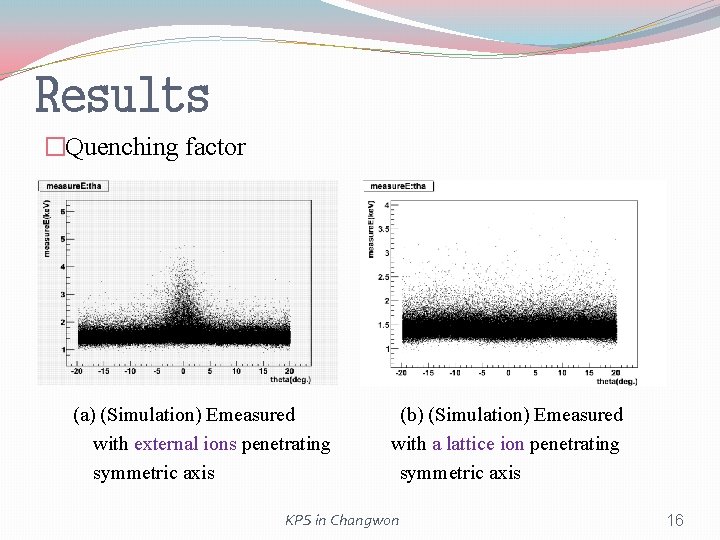
Results �Quenching factor (a) (Simulation) Emeasured with external ions penetrating symmetric axis (b) (Simulation) Emeasured with a lattice ion penetrating symmetric axis KPS in Changwon 16
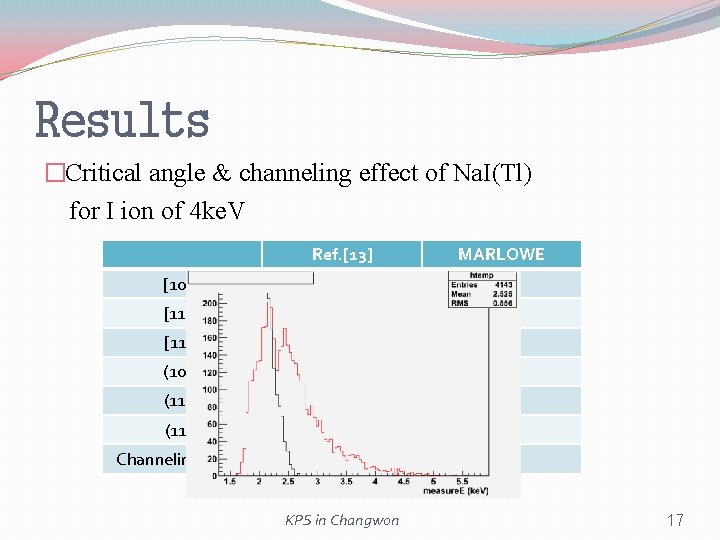
Results �Critical angle & channeling effect of Na. I(Tl) for I ion of 4 ke. V Ref. [13] [100] 6. 4 [110] 4. 9 [111] 2. 8 (100) 4. 1 (110) 3. 2 (111) 2. 7 Channeling effect ~20% KPS in Changwon MARLOWE 4. 1% 17
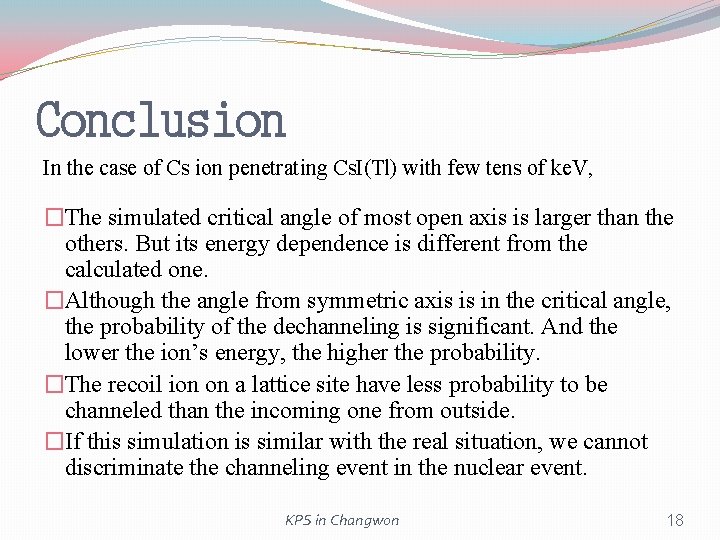
Conclusion In the case of Cs ion penetrating Cs. I(Tl) with few tens of ke. V, �The simulated critical angle of most open axis is larger than the others. But its energy dependence is different from the calculated one. �Although the angle from symmetric axis is in the critical angle, the probability of the dechanneling is significant. And the lower the ion’s energy, the higher the probability. �The recoil ion on a lattice site have less probability to be channeled than the incoming one from outside. �If this simulation is similar with the real situation, we cannot discriminate the channeling event in the nuclear event. KPS in Changwon 18
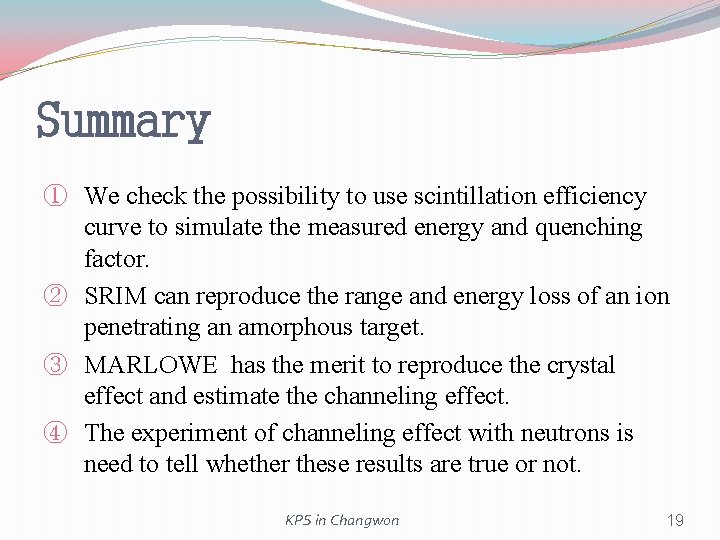
Summary ① We check the possibility to use scintillation efficiency curve to simulate the measured energy and quenching factor. ② SRIM can reproduce the range and energy loss of an ion penetrating an amorphous target. ③ MARLOWE has the merit to reproduce the crystal effect and estimate the channeling effect. ④ The experiment of channeling effect with neutrons is need to tell whether these results are true or not. KPS in Changwon 19
References [1] Eur. Phys. J. C 53 (2008) 205 [2] Rev. Mod. Phys. Vol. 46, No. 1 (1974) [3] Phys. Rev. Vol. 131, No. 2 (1963) [4] Phys. Rev. Vol. 122, No. 3 (1961) [5] http: //www. srim. org [6] http: //www-rsicc. ornl. gov/rsiccnew/ Codes. Available. Elsewhere. htm [7] Phys. Lett. B 536 (2002) 203 [8] Nucl. Inst. Meth. A 491 (2002) 460 KPS in Changwon 20
References [9] Astro. Phys. 11 (1999) 457 [10] Nucl. Instrum. Meth. A 557 (2006) 490 [11] Nucl. Instrum. Meth. A 500 (2003) 337 [12] Phys. Rev. Lett. Vol. 10 (1963) 399 [13] ar. Xiv: 0706. 3095 v 2 KPS in Changwon 21