
Channel Model and Simulation Using Matlab AbdulAziz M
Channel Model and Simulation Using Matlab Abdul-Aziz. M Al-Yami Khurram Masood
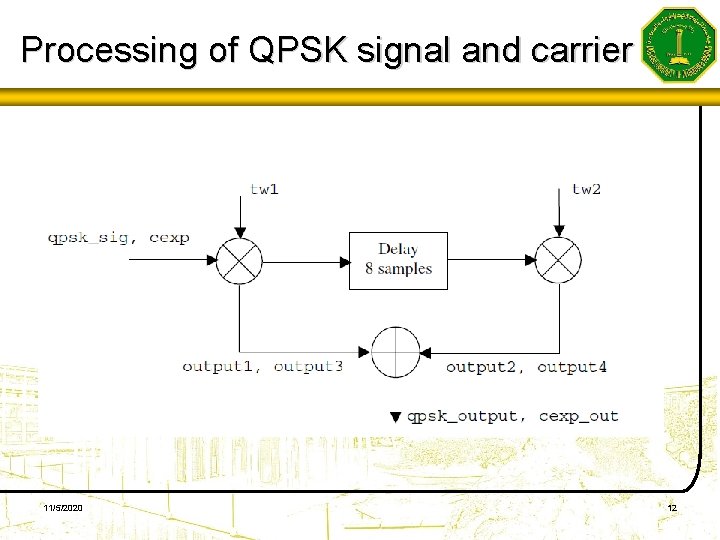
Channel Model • Discrete Multipath fading channel (2 paths) • Doppler filter – Jake’s model – fd = 100 Hz • • Delay between paths = 8 samples = 0. 5 *Ts Power of paths = [1 0. 5] Signal Bandwidth (Lowpass equivalent) Bs = 10 k. Hz Symbol time, Ts = 1/Bs = 0. 1 msec Data Rate = 10 k sym/sec Sampling rate = 160 k samples/sec Samples/symbol = 16 11/5/2020 2
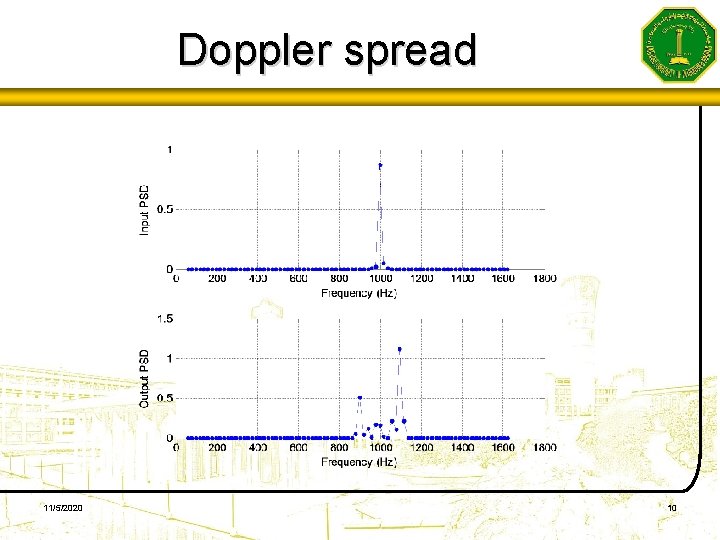
Sampling and Doppler Bandwidth • An important aspect of the Tapped Delay Line (TDL) model is the sampling rate for simulations. • In simulation we use sampled values which should be sampled at 8 to 32 times the bandwidth • The doppler bandwidth, or the doppler spread, Bd, is the bandwidth of the doppler spectrum Sd(λ), and is an indicator of how fast the channel characteristics are changing (fading) as a function of time. If Bd is of the order of the signal bandwidth Bs (≈ 1/Ts), the channel characteristics are changing (fading) at a rate comparable to the symbol rate, and the channel is said to be fast fading. Otherwise the channel is said to be slow fading. Thus – Bd << Bs ≈ 1/Ts (Slow fading channel) – Bd >> Bs ≈ 1/Ts (Fast fading channel) 11/5/2020 3
Parameters • • Signal bandwidth = Bs = 10 k. Hz Ts = 0. 1 msec Maximum doppler frequency = fd = 100 Hz Sampling frequency = fs = 16*Bs = 160 k samples/sec Simulation length = 5 / (fd) = 50 msec = 8 k samples Interpolation factor = 100 Delay between taps = 8 samples = 0. 5 Ts Carrier – c(t) = exp[j 2π(1000)t] 11/5/2020 4
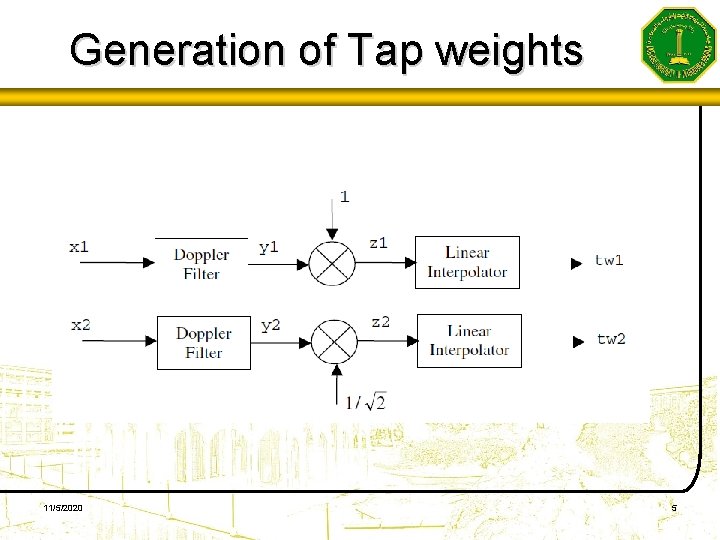
Generation of Tap weights 11/5/2020 5
Tap Input Process Data • Two independent Gaussian random variables x 1 and x 2 are generated – X 1, X 2 ~ N(0, 1) • For a given Doppler Frequency fd and system symbol rate 1/Ts. • The term fd. Ts is known as the fade rate. • Each I and Q components should have this fade rate. • The envelope should be Rayleigh distributed and the phase should be uniformly distributed 11/5/2020 6
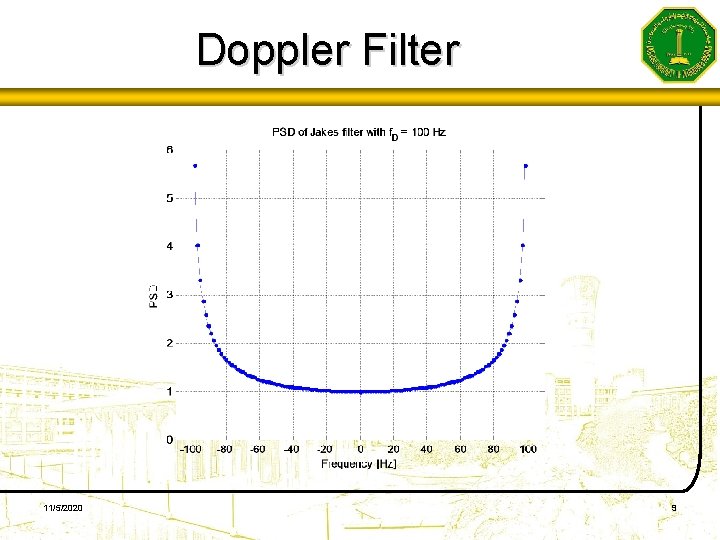
Doppler Filter • The models for doppler power spectral densities for mobile applications assume: – there are many multipath components – each multipath has different delays – all components have the same doppler spectrum. • Each multipath component (ray) – made up of a large number of simultaneously arriving unresolvable multipath components – angle of arrival with a uniform angular distribution at the receive antenna. 11/5/2020 7
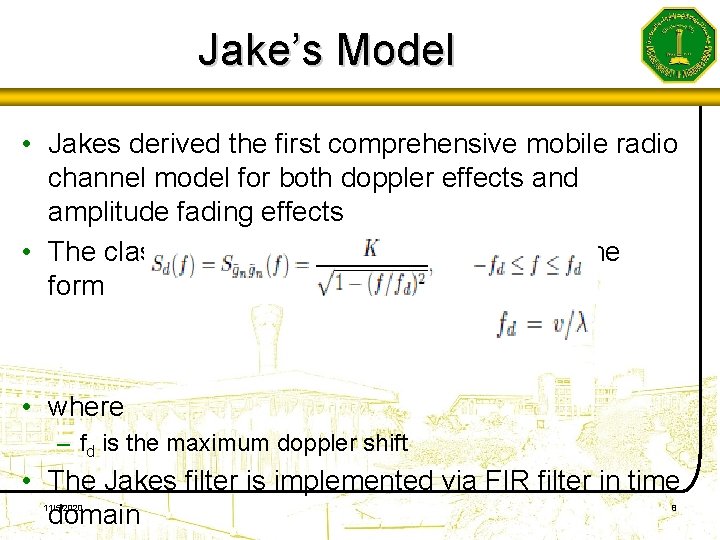
Jake’s Model • Jakes derived the first comprehensive mobile radio channel model for both doppler effects and amplitude fading effects • The classical Jake’s doppler spectrum has the form • where – fd is the maximum doppler shift • The Jakes filter is implemented via FIR filter in time domain 11/5/2020 8
Doppler Filter 11/5/2020 9
Doppler spread 11/5/2020 10
Linear Interpolation • In generating the tap gain processes it should be noted that the bandwidth of the tap gain processes for slowly timevarying channels will be very small compared to the bandwidth of the signals that flow through them. • In this case, the tap gain filter should be designed and executed at a slower sampling rate. • Interpolation can be used at the output of the filter to produce denser samples at a rate consistent with the sampling rate of the signal coming into the tap. • Designing the filter at the higher rate will lead to computational inefficiencies as well as stability problems. 11/5/2020 11
Processing of QPSK signal and carrier 11/5/2020 12
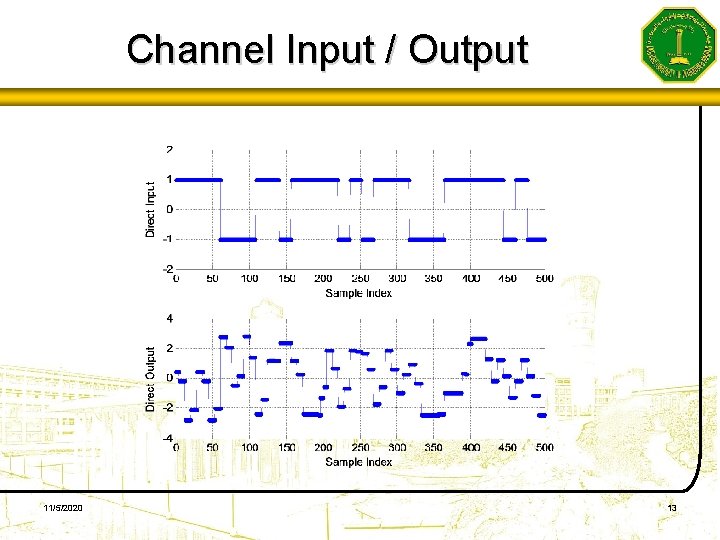
Channel Input / Output 11/5/2020 13
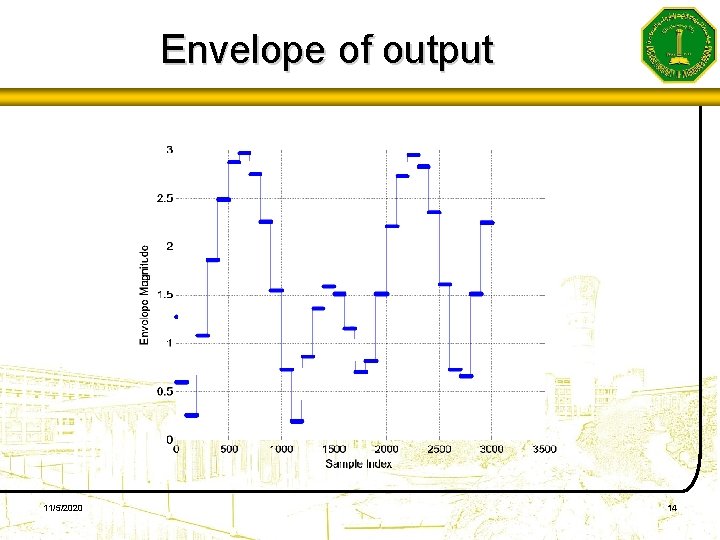
Envelope of output 11/5/2020 14
- Slides: 14