
Channel Flow Routing Reading Applied Hydrology Sections 8
- Slides: 21
Channel Flow Routing Reading: Applied Hydrology Sections 8. 4, 9. 1 -9. 4, 9. 7
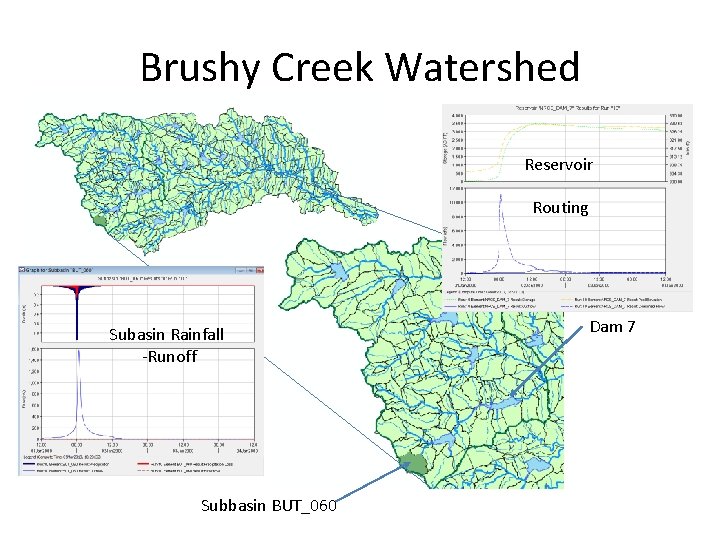
Brushy Creek Watershed Reservoir Routing Subasin Rainfall -Runoff Subbasin BUT_060 Dam 7
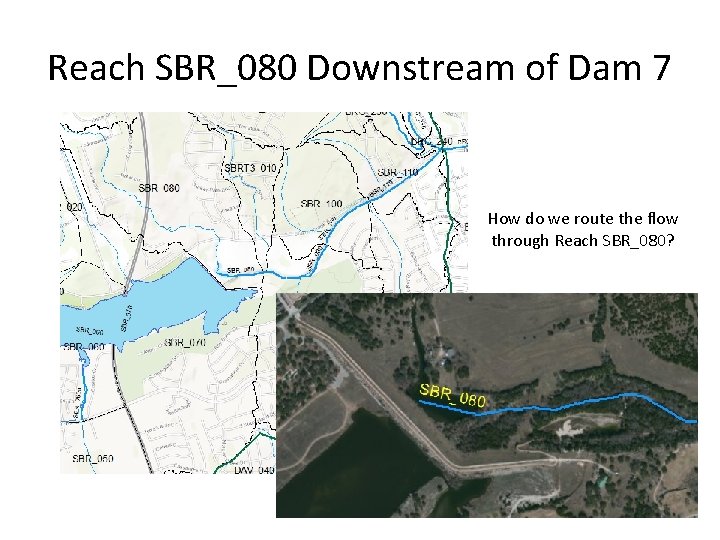
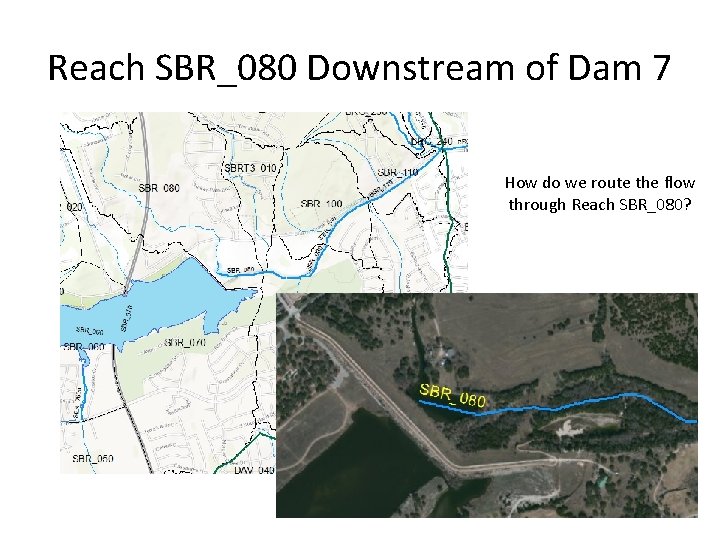
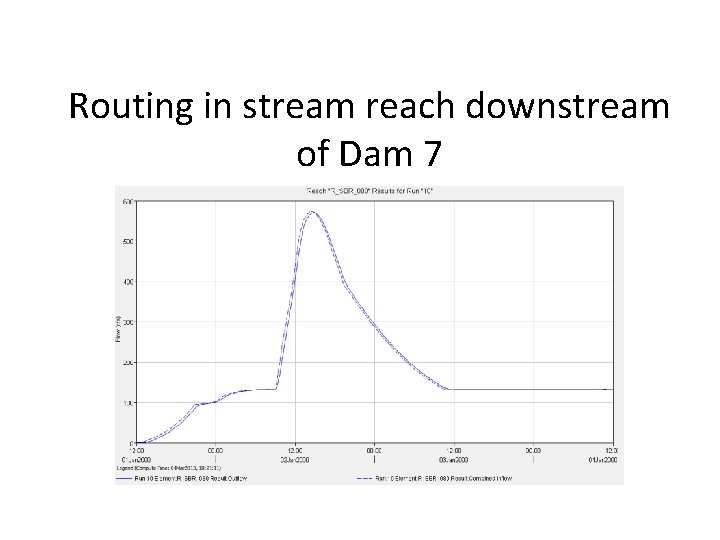
Reach SBR_080 Downstream of Dam 7 How do we route the flow through Reach SBR_080?
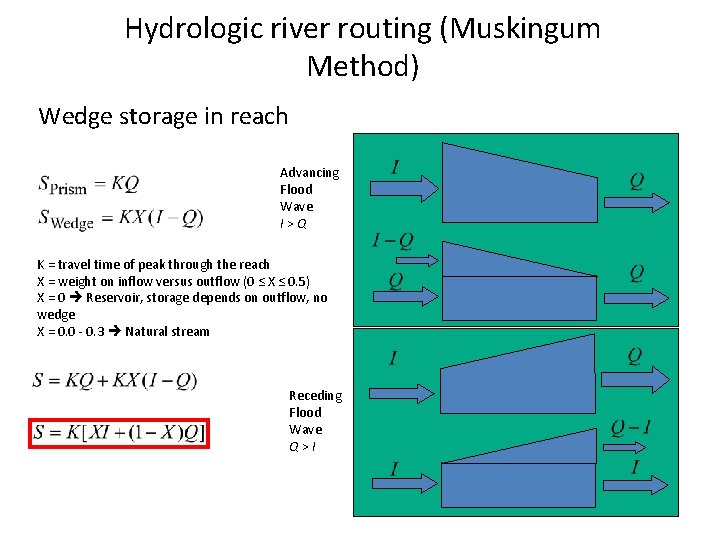
Hydrologic river routing (Muskingum Method) Wedge storage in reach Advancing Flood Wave I > Q K = travel time of peak through the reach X = weight on inflow versus outflow (0 ≤ X ≤ 0. 5) X = 0 Reservoir, storage depends on outflow, no wedge X = 0. 0 - 0. 3 Natural stream Receding Flood Wave Q > I
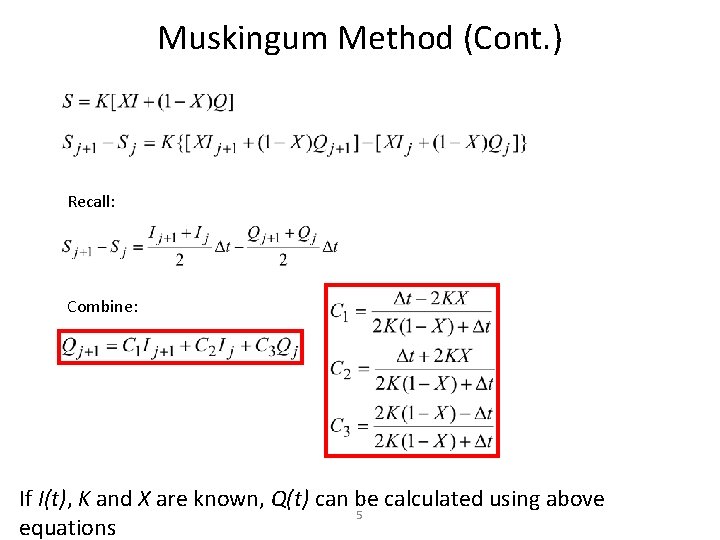
Muskingum Method (Cont. ) Recall: Combine: If I(t), K and X are known, Q(t) can be calculated using above 5 equations
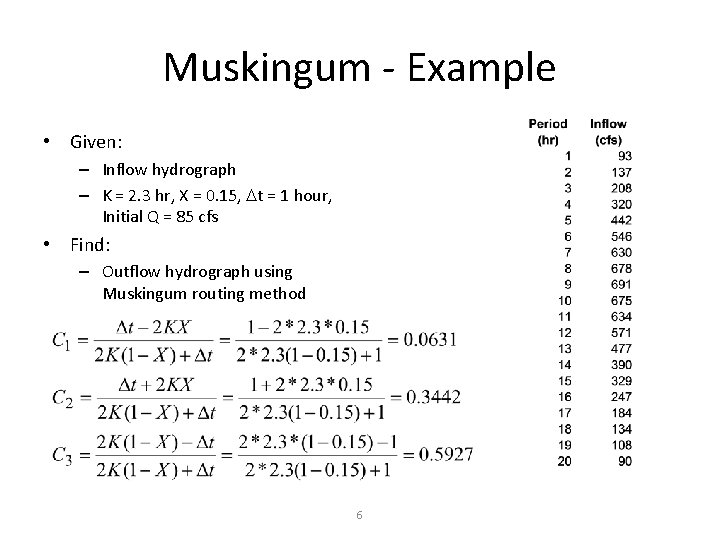
Muskingum - Example • Given: – Inflow hydrograph – K = 2. 3 hr, X = 0. 15, Dt = 1 hour, Initial Q = 85 cfs • Find: – Outflow hydrograph using Muskingum routing method 6
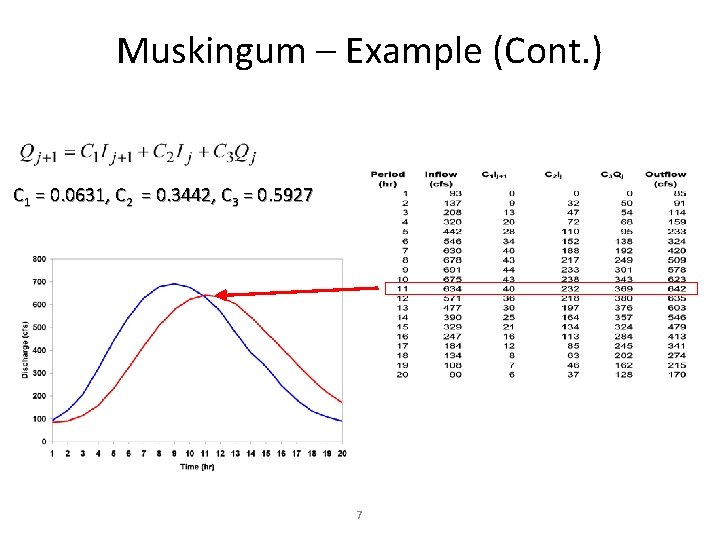
Muskingum – Example (Cont. ) C 1 = 0. 0631, C 2 = 0. 3442, C 3 = 0. 5927 7
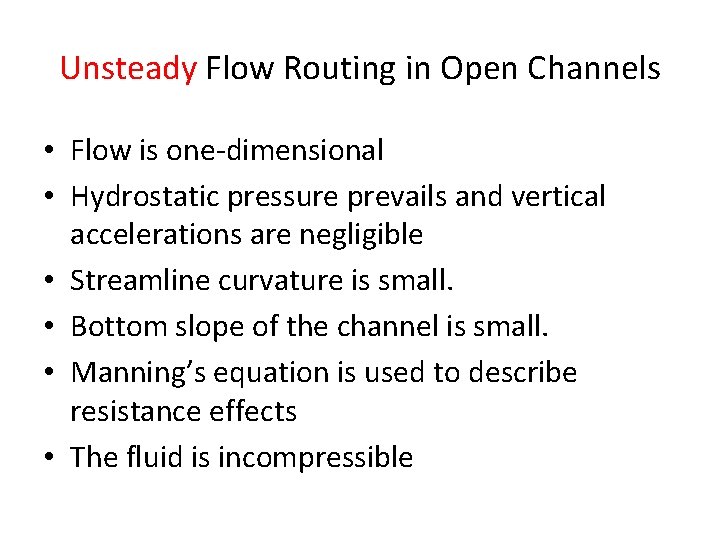
Unsteady Flow Routing in Open Channels • Flow is one-dimensional • Hydrostatic pressure prevails and vertical accelerations are negligible • Streamline curvature is small. • Bottom slope of the channel is small. • Manning’s equation is used to describe resistance effects • The fluid is incompressible
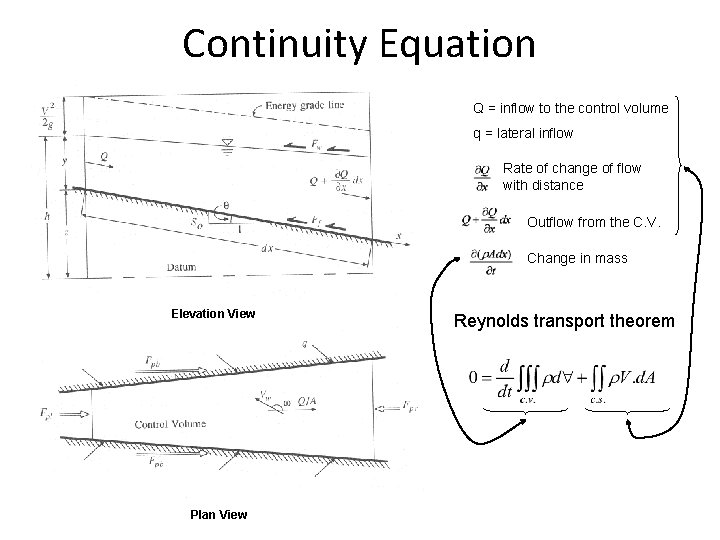
Continuity Equation Q = inflow to the control volume q = lateral inflow Rate of change of flow with distance Outflow from the C. V. Change in mass Elevation View Plan View Reynolds transport theorem
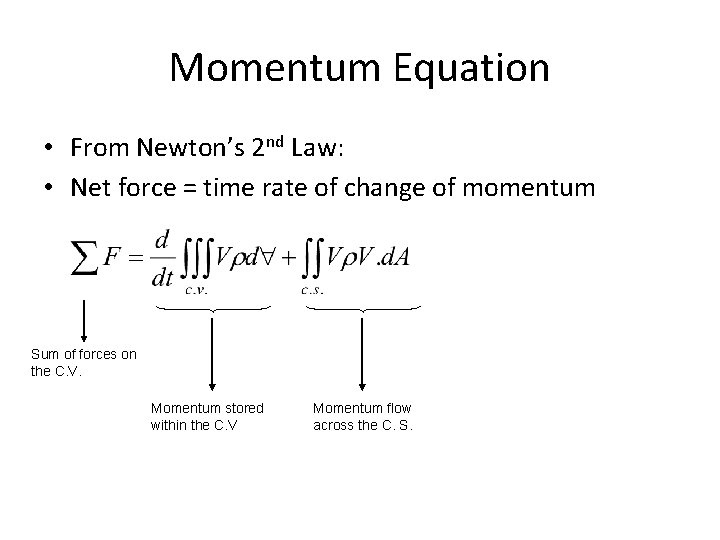
Momentum Equation • From Newton’s 2 nd Law: • Net force = time rate of change of momentum Sum of forces on the C. V. Momentum stored within the C. V Momentum flow across the C. S.
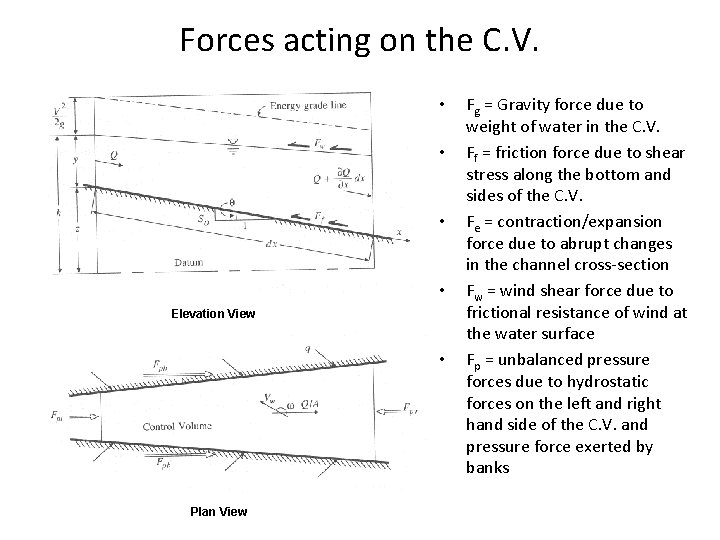
Forces acting on the C. V. • • Elevation View • Plan View Fg = Gravity force due to weight of water in the C. V. Ff = friction force due to shear stress along the bottom and sides of the C. V. Fe = contraction/expansion force due to abrupt changes in the channel cross-section Fw = wind shear force due to frictional resistance of wind at the water surface Fp = unbalanced pressure forces due to hydrostatic forces on the left and right hand side of the C. V. and pressure force exerted by banks
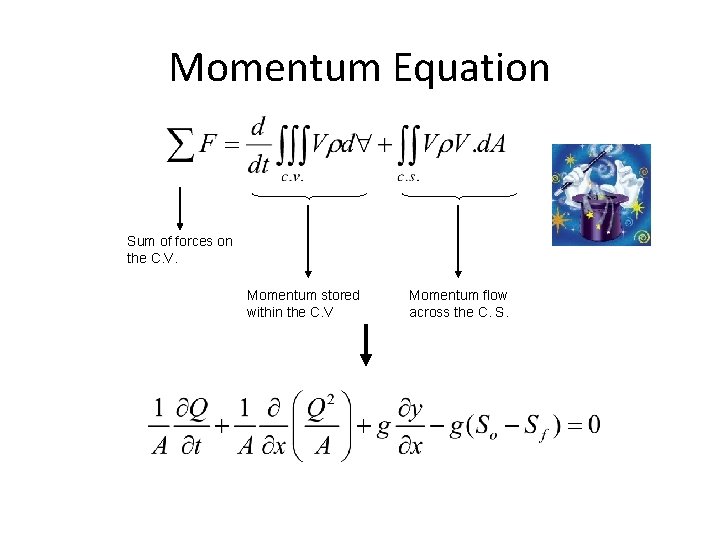
Momentum Equation Sum of forces on the C. V. Momentum stored within the C. V Momentum flow across the C. S.
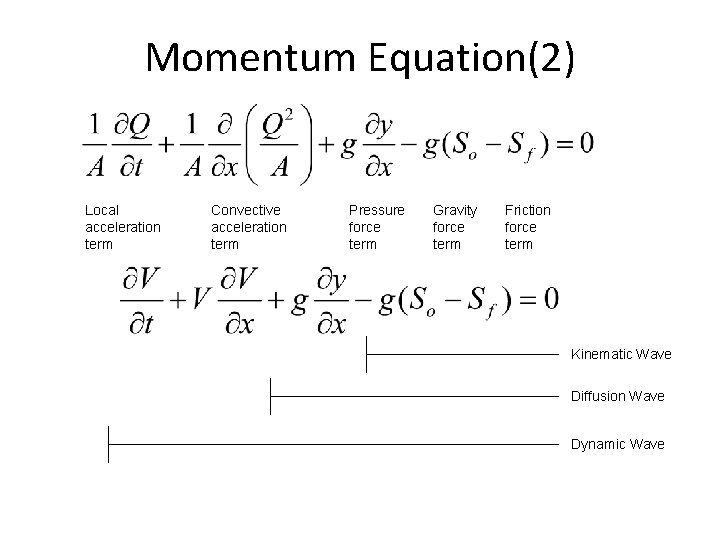
Momentum Equation(2) Local acceleration term Convective acceleration term Pressure force term Gravity force term Friction force term Kinematic Wave Diffusion Wave Dynamic Wave
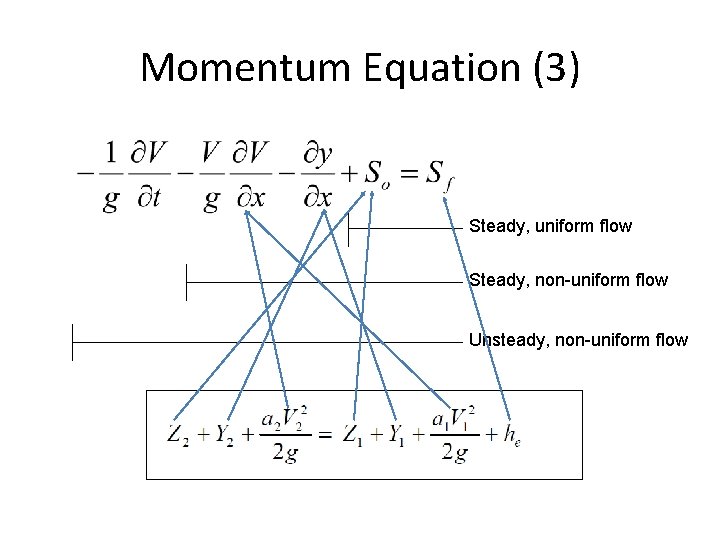
Momentum Equation (3) Steady, uniform flow Steady, non-uniform flow Unsteady, non-uniform flow
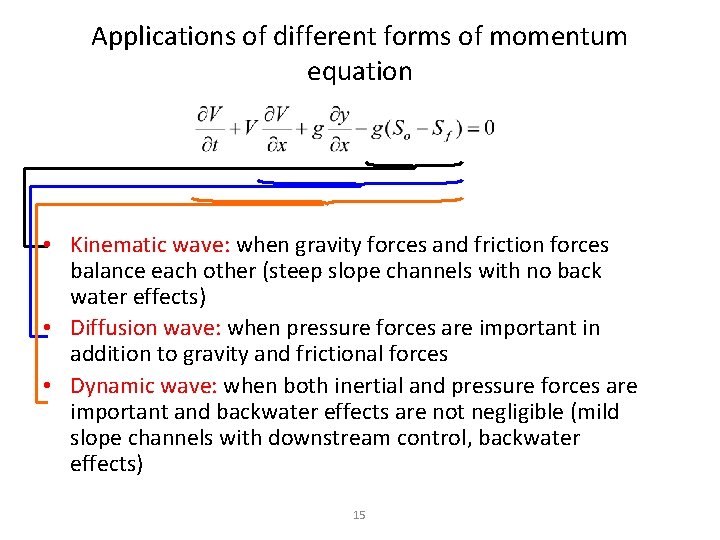
Applications of different forms of momentum equation • Kinematic wave: when gravity forces and friction forces balance each other (steep slope channels with no back water effects) • Diffusion wave: when pressure forces are important in addition to gravity and frictional forces • Dynamic wave: when both inertial and pressure forces are important and backwater effects are not negligible (mild slope channels with downstream control, backwater effects) 15
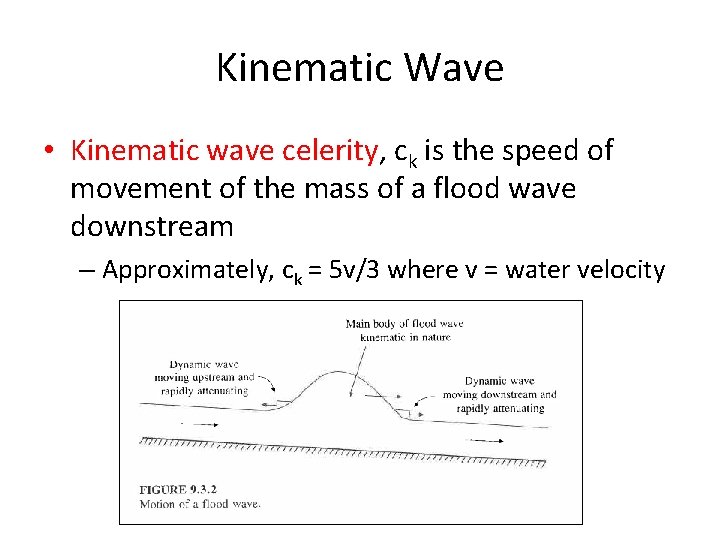
Kinematic Wave • Kinematic wave celerity, ck is the speed of movement of the mass of a flood wave downstream – Approximately, ck = 5 v/3 where v = water velocity
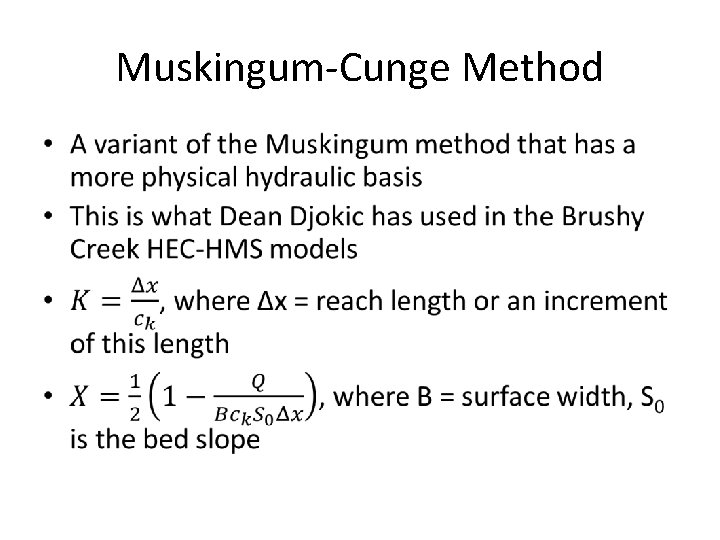
Muskingum-Cunge Method •
Reach SBR_080 Downstream of Dam 7 How do we route the flow through Reach SBR_080?
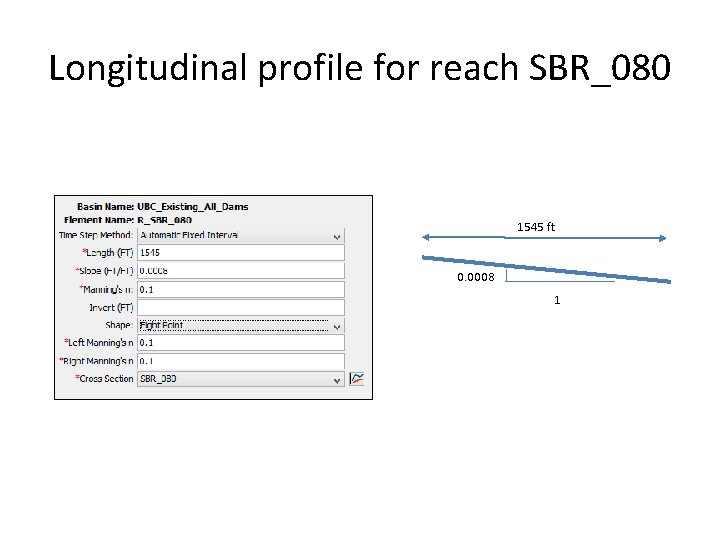
Longitudinal profile for reach SBR_080 1545 ft 0. 0008 1
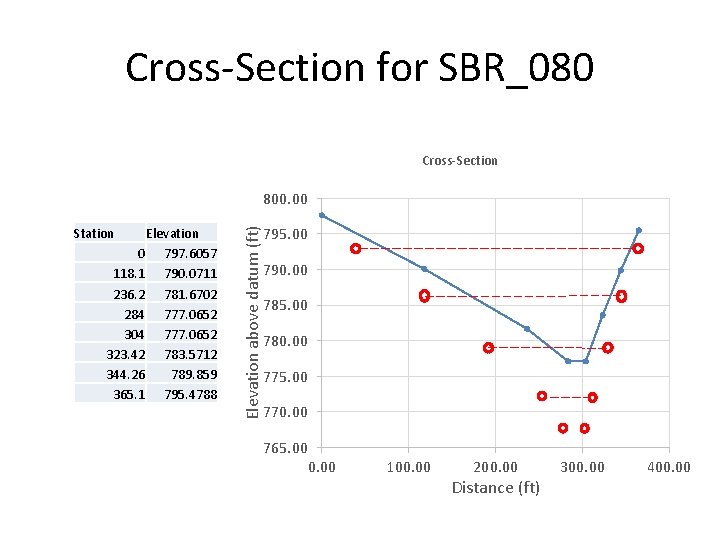
Cross-Section for SBR_080 Cross-Section Station Elevation 0 797. 6057 118. 1 790. 0711 236. 2 781. 6702 284 777. 0652 304 777. 0652 323. 42 783. 5712 344. 26 789. 859 365. 1 795. 4788 Elevation above datum (ft) 800. 00 795. 00 790. 00 785. 00 780. 00 775. 00 770. 00 765. 00 0. 00 100. 00 200. 00 Distance (ft) 300. 00 400. 00
Routing in stream reach downstream of Dam 7