
Channel Coordination and Quantity Discounts Z Kevin Weng
![The Model (Con’t) Supplier’s profit: GS(p) = (p-c)D(x) - [SSD(x)/Q + h. SQ/2] Buyer’s](https://slidetodoc.com/presentation_image_h/ca12ffed886238a30a17c7c236346e9a/image-6.jpg "The Model (Con’t) Supplier’s profit: GS(p) = (p-c)D(x) - [SSD(x)/Q + h. SQ/2] Buyer’s")
- Slides: 21
Channel Coordination and Quantity Discounts Z. Kevin Weng Presented by Jing Zhou
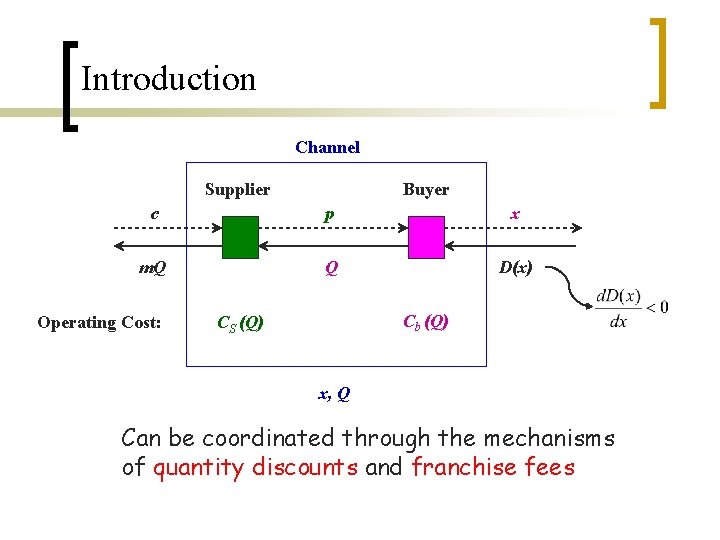
Introduction Channel Supplier Buyer c p x m. Q Q D(x) Operating Cost: Cb (Q) CS (Q) x, Q Can be coordinated through the mechanisms of quantity discounts and franchise fees
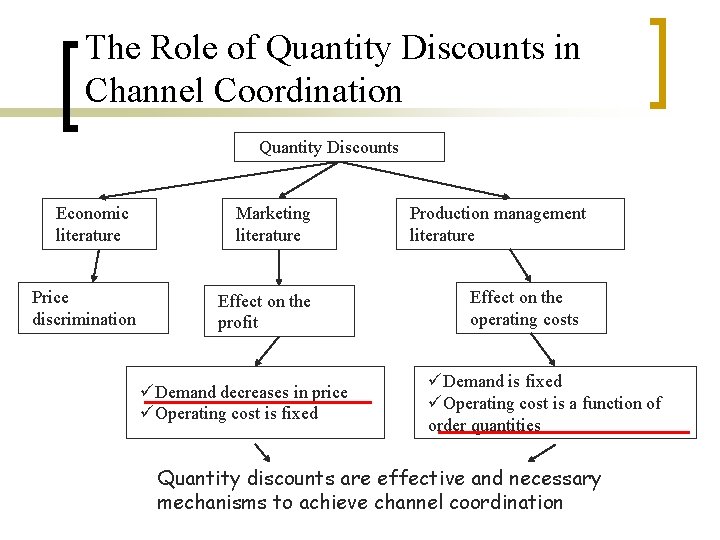
The Role of Quantity Discounts in Channel Coordination Quantity Discounts Economic literature Price discrimination Marketing literature Effect on the profit üDemand decreases in price üOperating cost is fixed Production management literature Effect on the operating costs üDemand is fixed üOperating cost is a function of order quantities Quantity discounts are effective and necessary mechanisms to achieve channel coordination
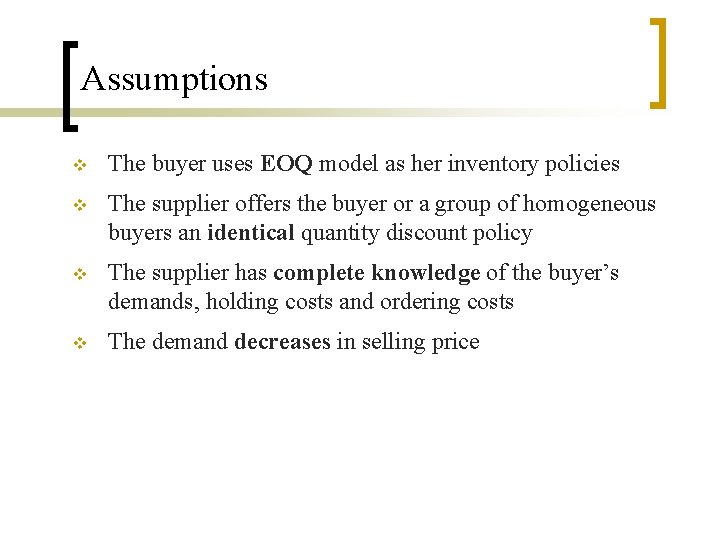
Assumptions v The buyer uses EOQ model as her inventory policies v The supplier offers the buyer or a group of homogeneous buyers an identical quantity discount policy v The supplier has complete knowledge of the buyer’s demands, holding costs and ordering costs v The demand decreases in selling price
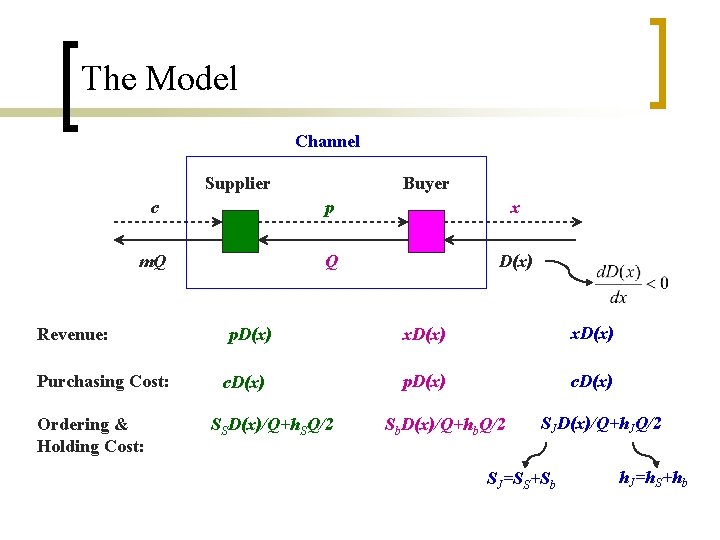
The Model Channel Supplier Buyer c p x m. Q Q D(x) Revenue: Purchasing Cost: Ordering & Holding Cost: p. D(x) c. D(x) SSD(x)/Q+h. SQ/2 x. D(x) p. D(x) c. D(x) Sb. D(x)/Q+hb. Q/2 SJD(x)/Q+h. JQ/2 SJ=SS+Sb h. J=h. S+hb
The Model (Con’t) Supplier’s profit: GS(p) = (p-c)D(x) - [SSD(x)/Q + h. SQ/2] Buyer’s profit: Gb(x, Q) = (x-p)D(x) - [Sb. D(x)/Q + hb. Q/2] Channel’s profit: GJ(x, Q) = (x-c)D(x) - [SJD(x)/Q + h. JQ/2]
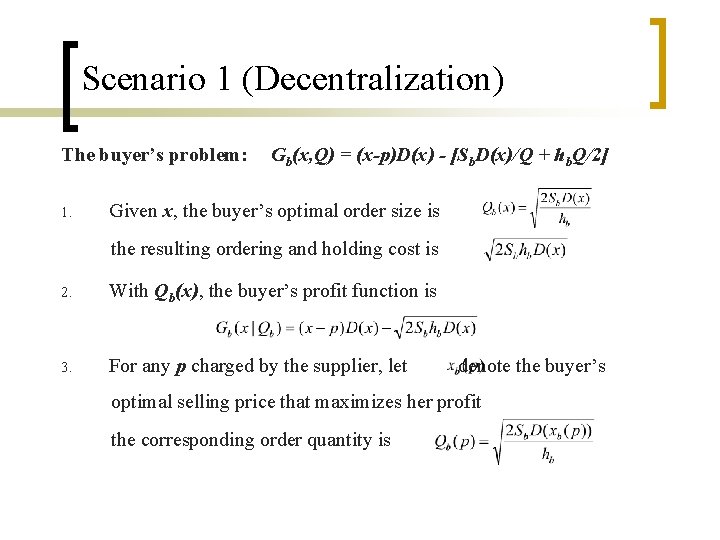
Scenario 1 (Decentralization) The buyer’s problem: 1. Gb(x, Q) = (x-p)D(x) - [Sb. D(x)/Q + hb. Q/2] Given x, the buyer’s optimal order size is the resulting ordering and holding cost is 2. With Qb(x), the buyer’s profit function is 3. For any p charged by the supplier, let denote the buyer’s optimal selling price that maximizes her profit the corresponding order quantity is
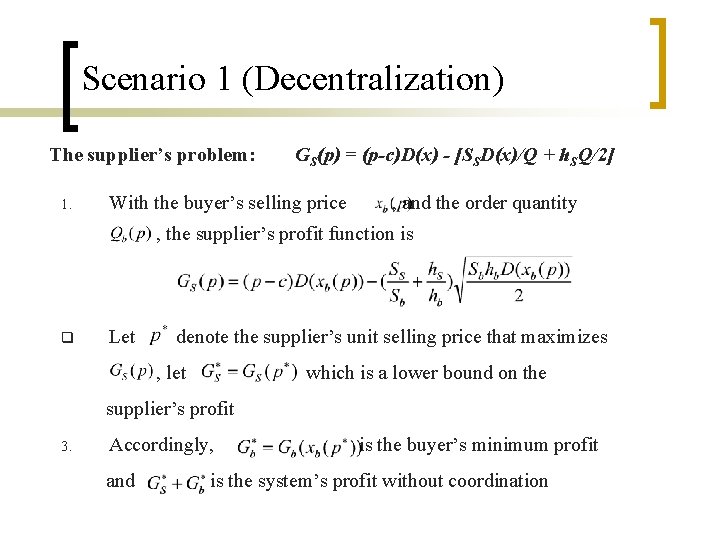
Scenario 1 (Decentralization) The supplier’s problem: 1. GS(p) = (p-c)D(x) - [SSD(x)/Q + h. SQ/2] With the buyer’s selling price , and the order quantity , the supplier’s profit function is q Let denote the supplier’s unit selling price that maximizes , let which is a lower bound on the supplier’s profit 3. Accordingly, and is the buyer’s minimum profit is the system’s profit without coordination
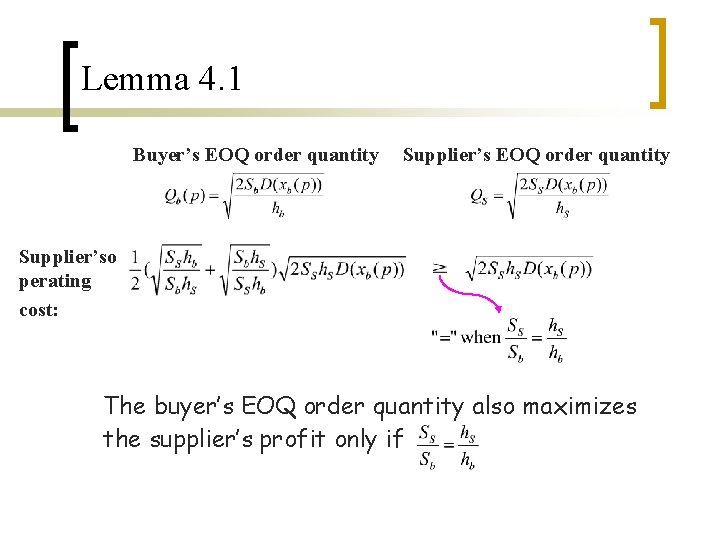
Lemma 4. 1 Buyer’s EOQ order quantity Supplier’so perating cost: The buyer’s EOQ order quantity also maximizes the supplier’s profit only if
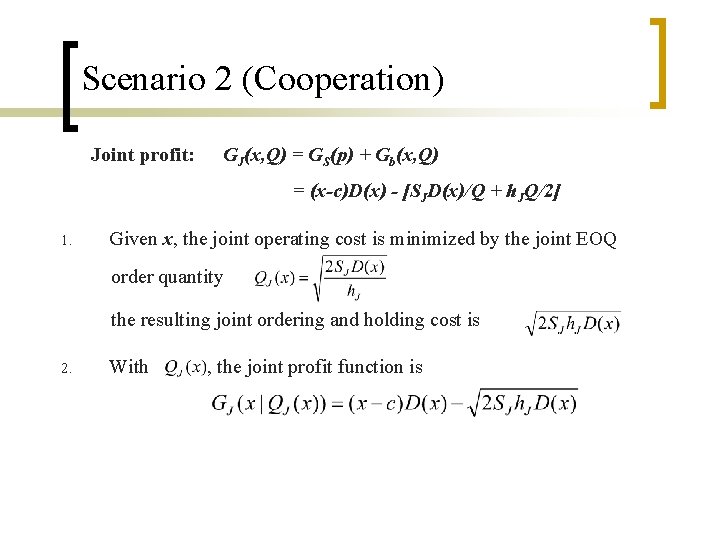
Scenario 2 (Cooperation) Joint profit: GJ(x, Q) = GS(p) + Gb(x, Q) = (x-c)D(x) - [SJD(x)/Q + h. JQ/2] 1. Given x, the joint operating cost is minimized by the joint EOQ order quantity the resulting joint ordering and holding cost is 2. With , the joint profit function is
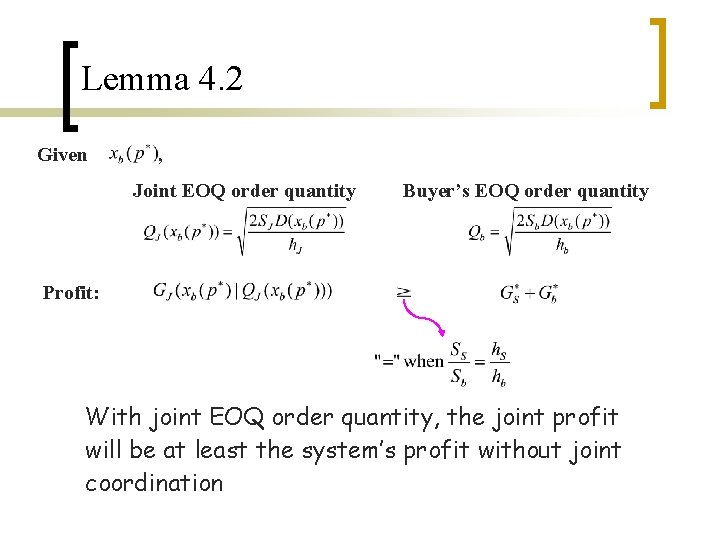
Lemma 4. 2 Given , Joint EOQ order quantity Buyer’s EOQ order quantity Profit: With joint EOQ order quantity, the joint profit will be at least the system’s profit without joint coordination
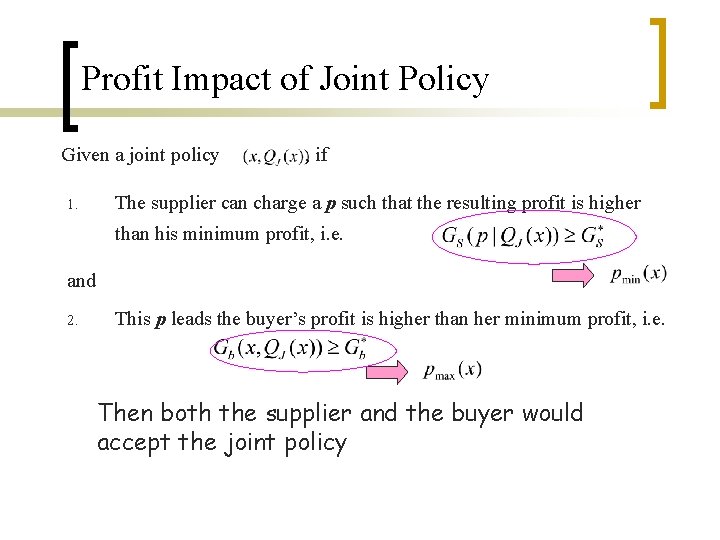
Profit Impact of Joint Policy Given a joint policy 1. , if The supplier can charge a p such that the resulting profit is higher than his minimum profit, i. e. and 2. This p leads the buyer’s profit is higher than her minimum profit, i. e. Then both the supplier and the buyer would accept the joint policy
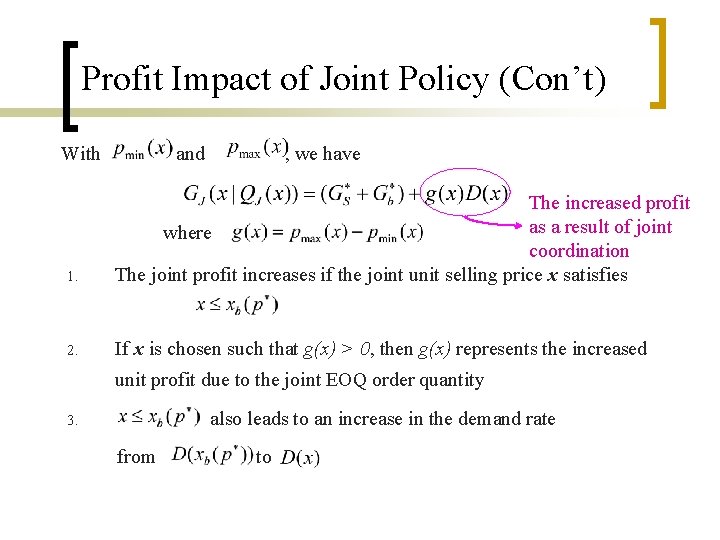
Profit Impact of Joint Policy (Con’t) With and , we have 1. The increased profit as a result of joint where coordination The joint profit increases if the joint unit selling price x satisfies 2. If x is chosen such that g(x) > 0, then g(x) represents the increased unit profit due to the joint EOQ order quantity also leads to an increase in the demand rate 3. from to
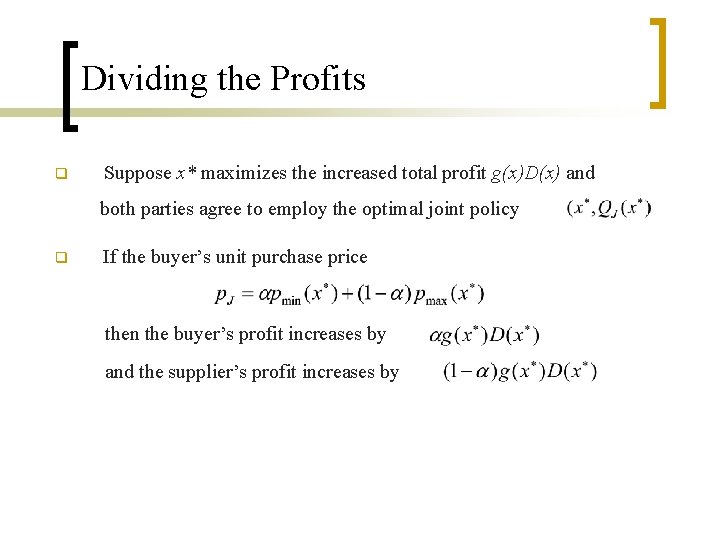
Dividing the Profits q Suppose x* maximizes the increased total profit g(x)D(x) and both parties agree to employ the optimal joint policy q If the buyer’s unit purchase price then the buyer’s profit increases by and the supplier’s profit increases by
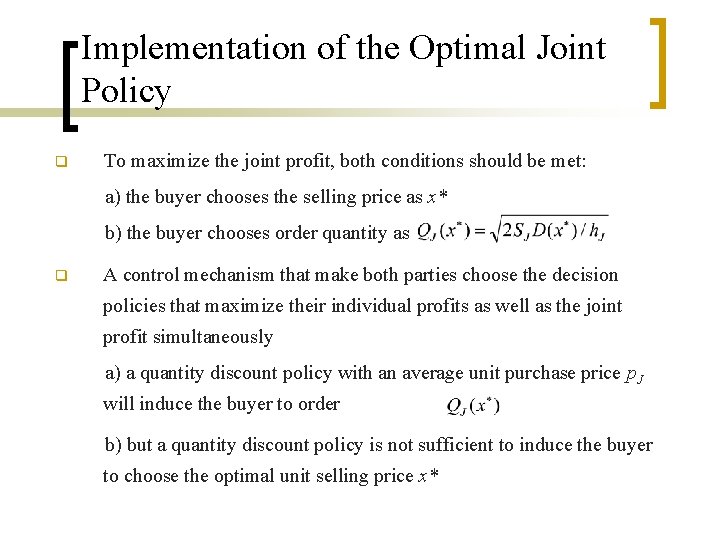
Implementation of the Optimal Joint Policy q To maximize the joint profit, both conditions should be met: a) the buyer chooses the selling price as x* b) the buyer chooses order quantity as q A control mechanism that make both parties choose the decision policies that maximize their individual profits as well as the joint profit simultaneously a) a quantity discount policy with an average unit purchase price p. J will induce the buyer to order b) but a quantity discount policy is not sufficient to induce the buyer to choose the optimal unit selling price x*
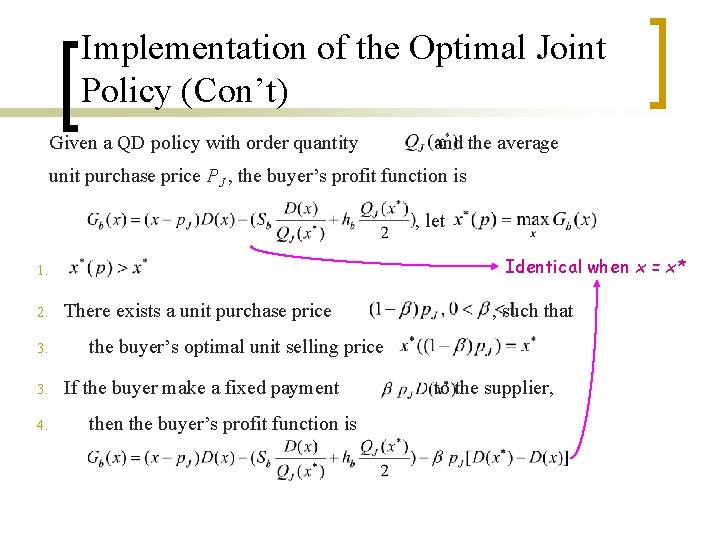
Implementation of the Optimal Joint Policy (Con’t) Given a QD policy with order quantity and the average unit purchase price PJ , the buyer’s profit function is , let Identical when x = x* 1. 2. 3. 3. 4. There exists a unit purchase price , such that the buyer’s optimal unit selling price If the buyer make a fixed payment then the buyer’s profit function is to the supplier,
Quantity discounts and franchise fees q Quantity discounts and franchise fees can coordinate the channel q The role of quantity discounts is to ensure that the joint order quantity selected by both parties minimizes the joint operating costs q The role of franchise fees is to enforce the joint profit maximization for both parties
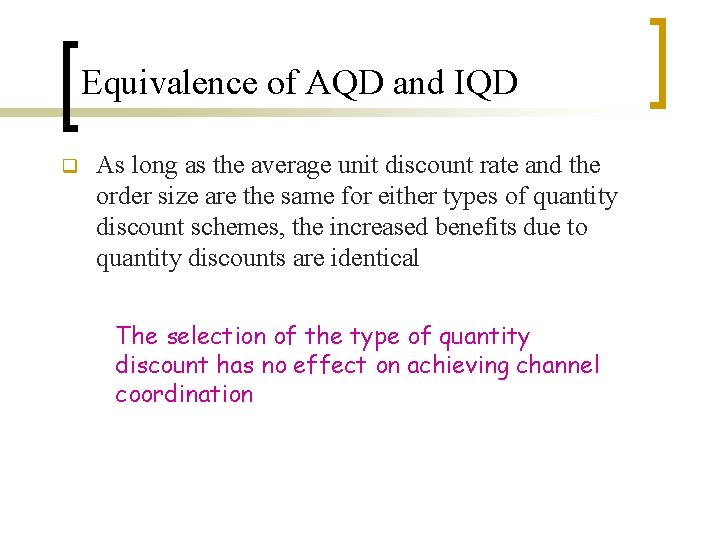
Equivalence of AQD and IQD q As long as the average unit discount rate and the order size are the same for either types of quantity discount schemes, the increased benefits due to quantity discounts are identical The selection of the type of quantity discount has no effect on achieving channel coordination
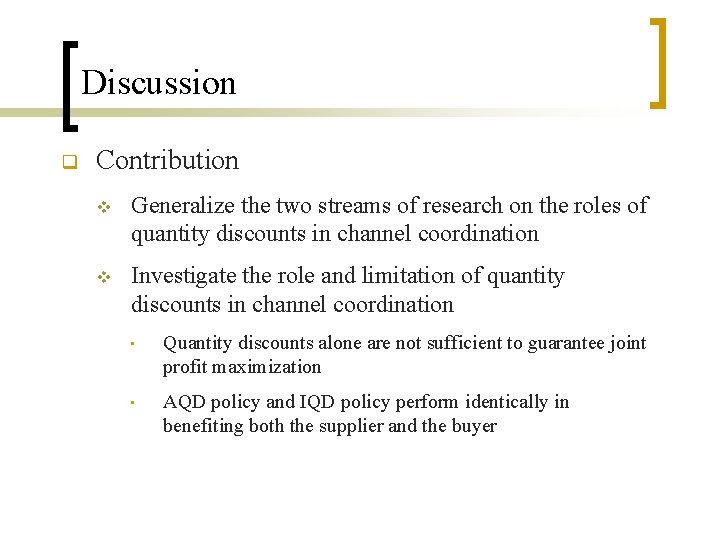
Discussion q Contribution v Generalize the two streams of research on the roles of quantity discounts in channel coordination v Investigate the role and limitation of quantity discounts in channel coordination • Quantity discounts alone are not sufficient to guarantee joint profit maximization • AQD policy and IQD policy perform identically in benefiting both the supplier and the buyer
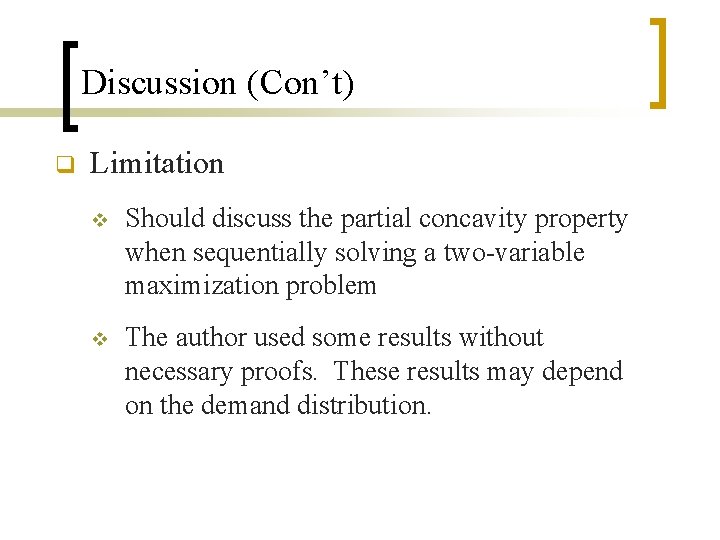
Discussion (Con’t) q Limitation v Should discuss the partial concavity property when sequentially solving a two-variable maximization problem v The author used some results without necessary proofs. These results may depend on the demand distribution.
Thank you!