
Channel and Distribution Tactics Bucklins definition of distribution
Channel and Distribution Tactics • • • Bucklin’s definition of distribution Today’s system of exchange Channel intermediaries Six basic channel decisions Selection consideration Potential Influence Strategies - Frazier and Sheth (1989) • Frequencies of use of influence strategies - Frazier and Summers (1984) Tim Friesner - Marketing Management
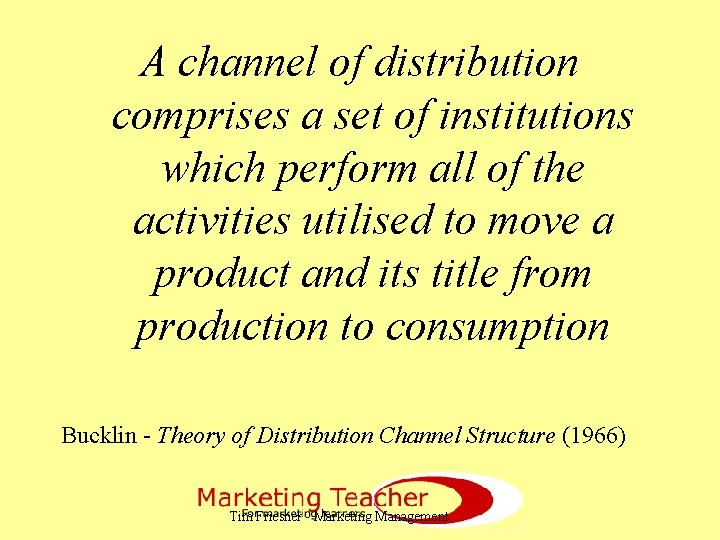
A channel of distribution comprises a set of institutions which perform all of the activities utilised to move a product and its title from production to consumption Bucklin - Theory of Distribution Channel Structure (1966) Tim Friesner - Marketing Management
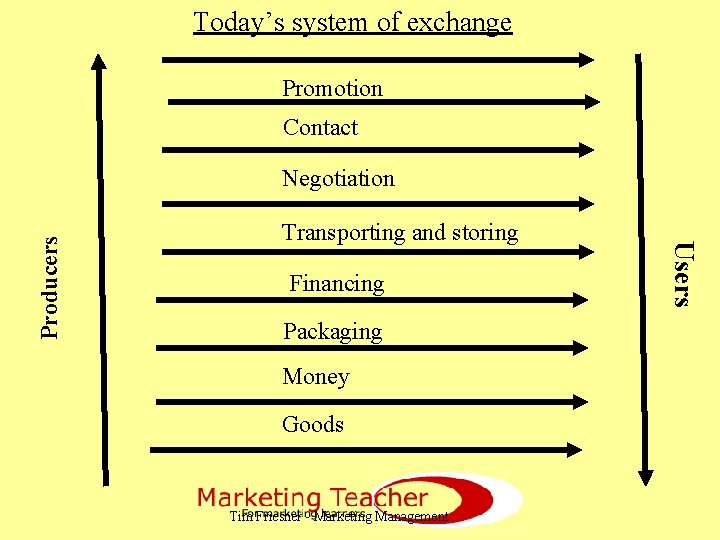
Today’s system of exchange Promotion Contact Transporting and storing Financing Packaging Money Goods Tim Friesner - Marketing Management Users Producers Negotiation
Channel intermediaries Wholesalers • Break down ‘bulk’ • buys from producers and sell small quantities to retailers • Provides storage facilities • reduces contact cost between producer and consumer • Wholesaler takes some of the marketing responsibility e. g sales force, promotions Tim Friesner - Marketing Management
Channel intermediaries - Agents • Mainly used in international markets • Commission agent - does not take title of the goods. Secures orders. • Stockist agent - hold ‘consignment’ stock • Control is difficult due to cultural differences • Training, motivation, etc are expensive Tim Friesner - Marketing Management
Channel intermediaries - Retailer • Much stronger personal relationship with the consumer • Hold a variety of products • Offer consumers credit • Promote and merchandise products • Price the final product • Build retailer ‘brand’ in the high street Tim Friesner - Marketing Management
Channel intermediaries - Internet • • Sell to a geographically disperse market Able to target and focus on specific segments Relatively low set-up costs Use of e-commerce technology (for payment, shopping software, etc) • Paradigm shift in commerce and consumption Tim Friesner - Marketing Management

Six basic channel decisions • • • Direct or indirect channels Single or multiple channels Length of channel Types of intermediaries Number of intermediaries at each level Which intermediaries? Avoid intrachannel conflict Tim Friesner - Marketing Management

Selection consideration • Market segment - must know the specific segment and target customer • Changes during plc - different channels are exploited at various stages of plc • Producer-distributor fit - their policies, strategies and image • Qualification assessment - experience and track record must be established • Distributor training and support Tim Friesner - Marketing Management
Potential Influence Strategies. Frazier and Sheth (1989) • Indirect influence strategies - information is merely exchanged with channel member personnel • Direct unmediated strategies - consequences of a poor response from the market are stressed • Reward and punishment strategies - given to channel members and their firms Tim Friesner - Marketing Management
• Direct unweighted strategy or request producer’s wishes are communicated. No consequences are applied or mentioned • Direct mediated strategies - specific action is requested and consequences of rejection are stressed – e. g. 1 control of retail pricing – e. g. 2 minimum order size – e. g. 3 salesperson training – e. g. 4 physical layout of store – e. g. 5 territorial and customer restrictions Tim Friesner - Marketing Management

Frequencies of use of Influence Strategies Frazier and Summers (1984) Tim Friesner - Marketing Management
- Slides: 12