
Changing the way we approach learning styles in
![Previous knowledge • “the single most widely demonstrated difference [in learning outcomes] is prior](https://slidetodoc.com/presentation_image_h/31f716ff7981f7f7cc09cd00af178aba/image-26.jpg "Previous knowledge • “the single most widely demonstrated difference [in learning outcomes] is prior")



- Slides: 43
Changing the way we approach learning styles in teacher education Carol Lethaby clethaby@clethaby. com Website: clethaby. com Patricia Harries patti. harries@gmail. com
1 “Neuromyths” 2 Our study 3 Recommendations 4 What we’re doing now 5 The way forward? Carol Lethaby and Patricia Harries, 2016
What is a “neuromyth”? Carol Lethaby and Patricia Harries, 2016
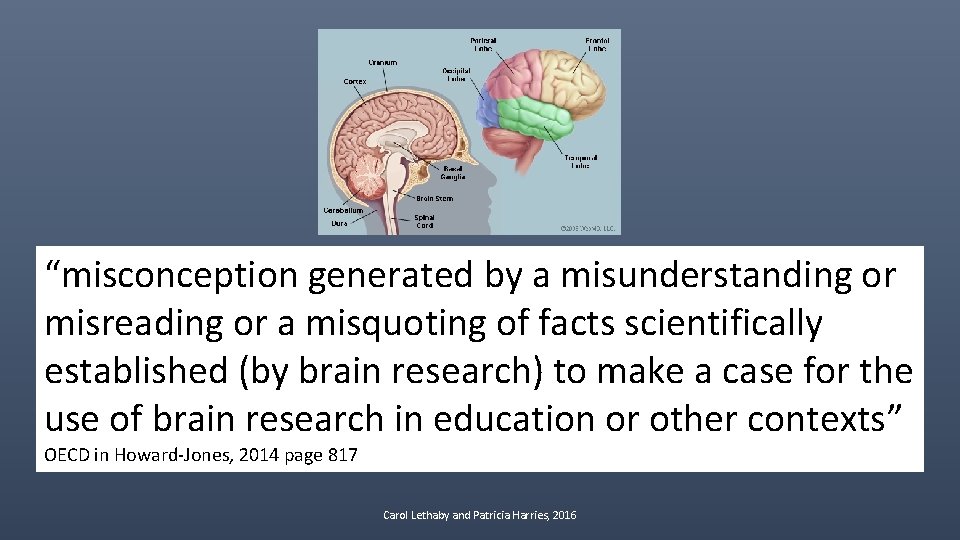
“misconception generated by a misunderstanding or misreading or a misquoting of facts scientifically established (by brain research) to make a case for the use of brain research in education or other contexts” OECD in Howard-Jones, 2014 page 817 Carol Lethaby and Patricia Harries, 2016
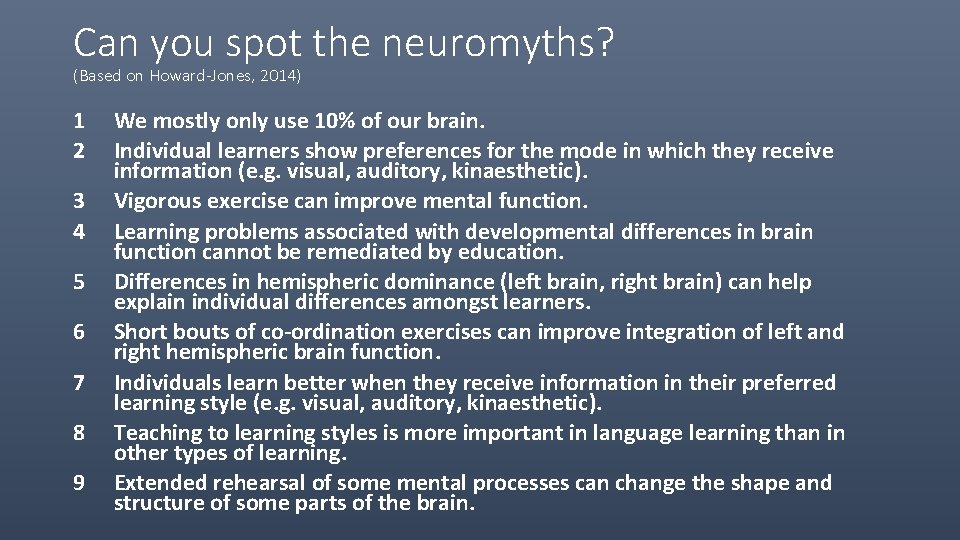
Can you spot the neuromyths? (Based on Howard-Jones, 2014) 1 2 3 4 5 6 7 8 9 We mostly only use 10% of our brain. Individual learners show preferences for the mode in which they receive information (e. g. visual, auditory, kinaesthetic). Vigorous exercise can improve mental function. Learning problems associated with developmental differences in brain function cannot be remediated by education. Differences in hemispheric dominance (left brain, right brain) can help explain individual differences amongst learners. Short bouts of co-ordination exercises can improve integration of left and right hemispheric brain function. Individuals learn better when they receive information in their preferred learning style (e. g. visual, auditory, kinaesthetic). Teaching to learning styles is more important in language learning than in other types of learning. Extended rehearsal of some mental processes can change the shape and structure of some parts of the brain.
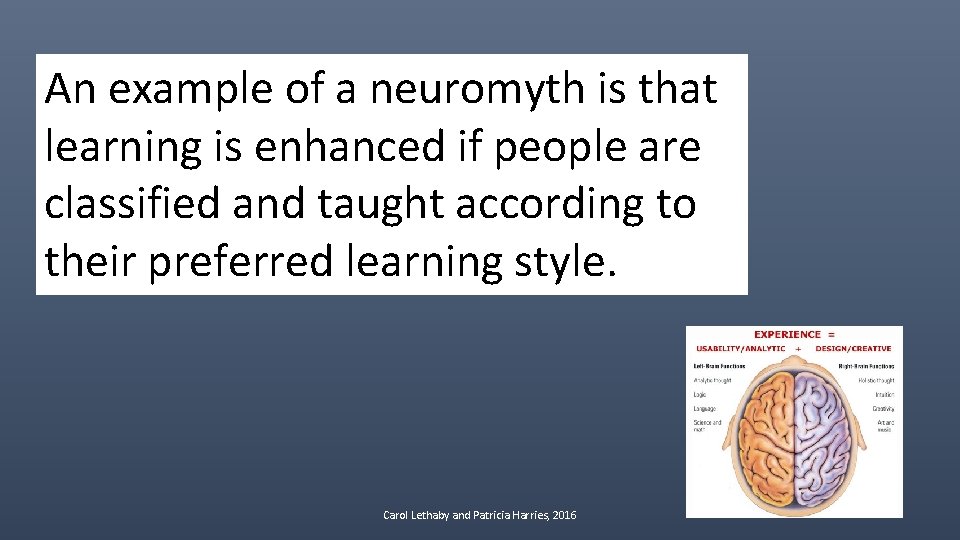
An example of a neuromyth is that learning is enhanced if people are • ( classified and taught according to their preferred learning style. Carol Lethaby and Patricia Harries, 2016
“This misconception is based on a valid research finding, namely that visual, auditory, and kinesthetic information is processed in different parts of the brain. ” (Dekker et al, 2012) Carol Lethaby and Patricia Harries, 2016
Thus, it is incorrect to assume that only one sensory modality is involved with information processing. ” (Dekker et al, 2012) Carol Lethaby and Patricia Harries, 2016
Recommendations So, what are the problems with learning styles? Carol Lethaby and Patricia Harries, 2016
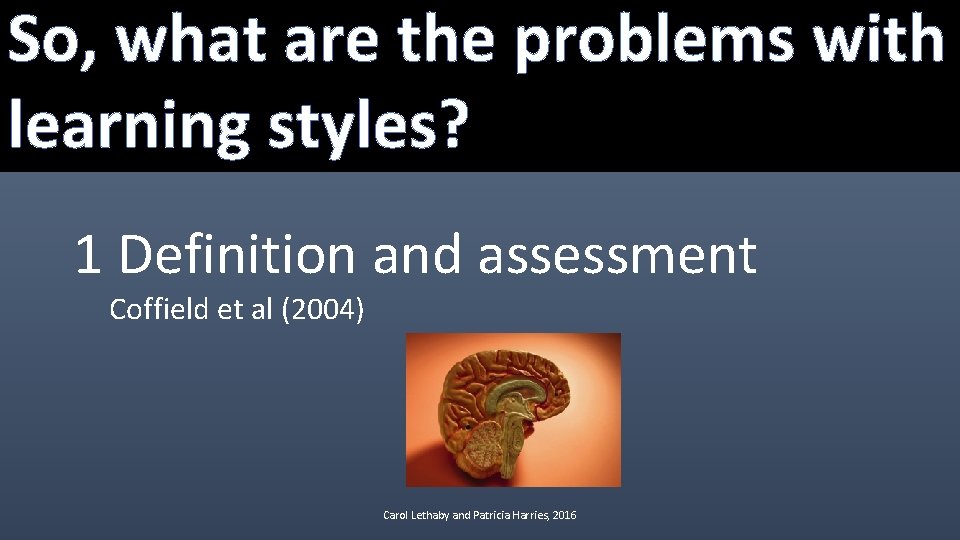
So, what are the problems with Problems with learning styles? 1 Definition and assessment Coffield et al (2004) Carol Lethaby and Patricia Harries, 2016
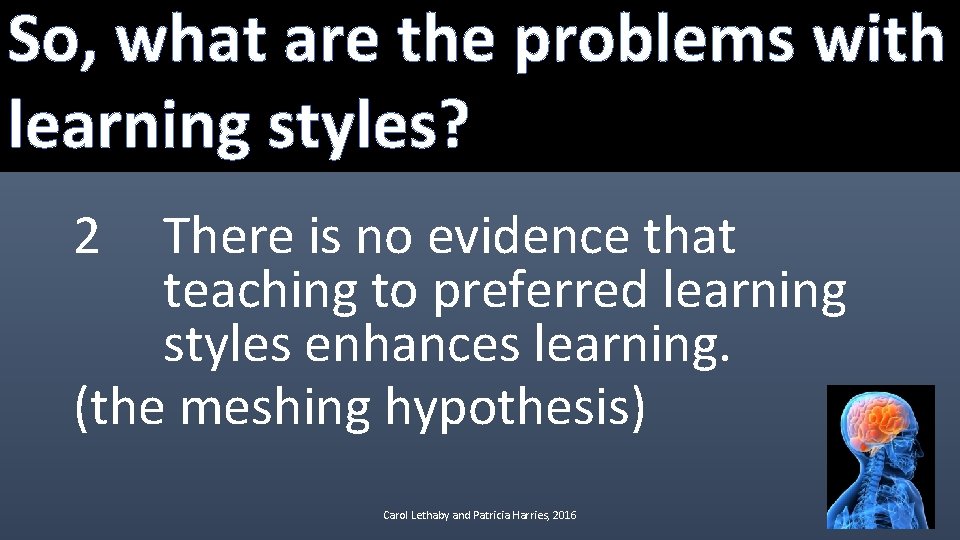
So, what are the problems with Problems with learning styles: learning styles? 2 There is no evidence that teaching to preferred learning styles enhances learning. (the meshing hypothesis) Carol Lethaby and Patricia Harries, 2016
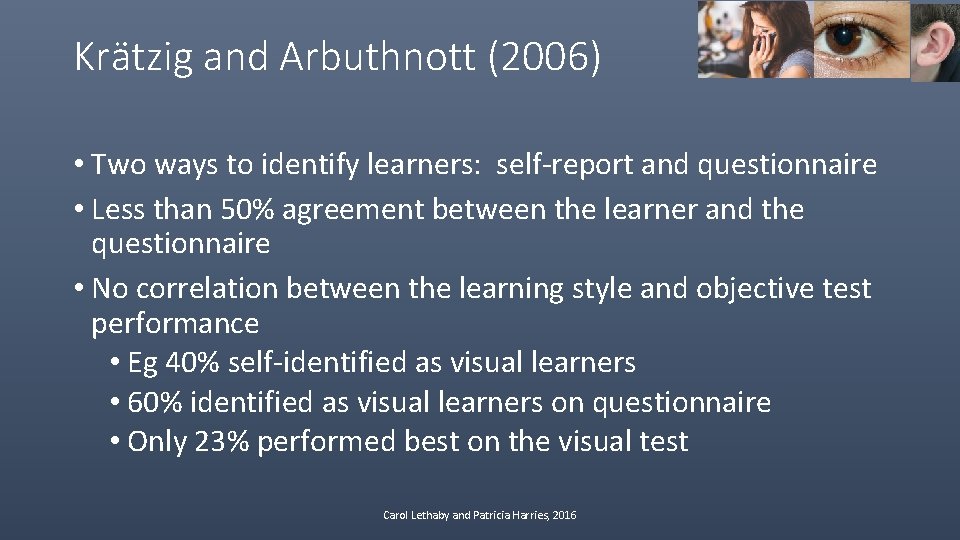
Krätzig and Arbuthnott (2006) • Two ways to identify learners: self-report and questionnaire • Less than 50% agreement between the learner and the questionnaire • No correlation between the learning style and objective test performance • Eg 40% self-identified as visual learners • 60% identified as visual learners on questionnaire • Only 23% performed best on the visual test Carol Lethaby and Patricia Harries, 2016
Rogowsky et al (2015) • Attempts to test the ‘meshing hypothesis’ directly • First … • Auditory and visual learning preferences determined through a standardized questionnaire • Verbal comprehension aptitude test in both oral and written forms • No relationship • Second … • Participants randomly assigned to one of two groups – information through etext or audiobook • Tested immediately and after two weeks • NO significant relationship between preferred mode of learning, teaching mode and results of the tests Carol Lethaby and Patricia Harries, 2016
• Coffield, F. , Moseley, D. , Hall, E. , and Ecclestone, K. (2004). Learning Styles and Pedagogy in Post-16 Learning. A Systematic and Critical Review. London: Learning and Skills Research Centre. • Krätzig, G. P. and Arbuthnott, K. D. (2006). Perceptual learning style and learning proficiency: A test of the hypothesis. Journal of Educational Psychology, 98, 238246. • Pashler, H. , Mc. Daniel, M. , Rohrer, D. , & Bjork, R. (2009). Learning styles: Concepts and evidence. Psychological Science in the Public Interest, 9(3), 105 -119. • Riener, C. , & Willingham, D. (2010). The myth of learning styles. Change, Sept/Oct, 32 -36. • Rogowsky, B. A. , Calhoun, B. M. , & Tallal, P. (2015). Matching learning style to instructional method: Effects on comprehension. Journal of Educational Psychology, 107(1), 64. Carol Lethaby and Patricia Harries, 2016
So, what about in language learning and teaching? How widespread is the use of learning styles in our teaching and the belief that this helps learning? Carol Lethaby and Patricia Harries, 2016
The Survey – Lethaby and Harries, 2015 • Howard-Jones (2014) – 938 participants, 38 statements about the brain • Our survey (2015) - 128 participants, 9 statements mainly focusing on learning styles Carol Lethaby and Patricia Harries, 2016
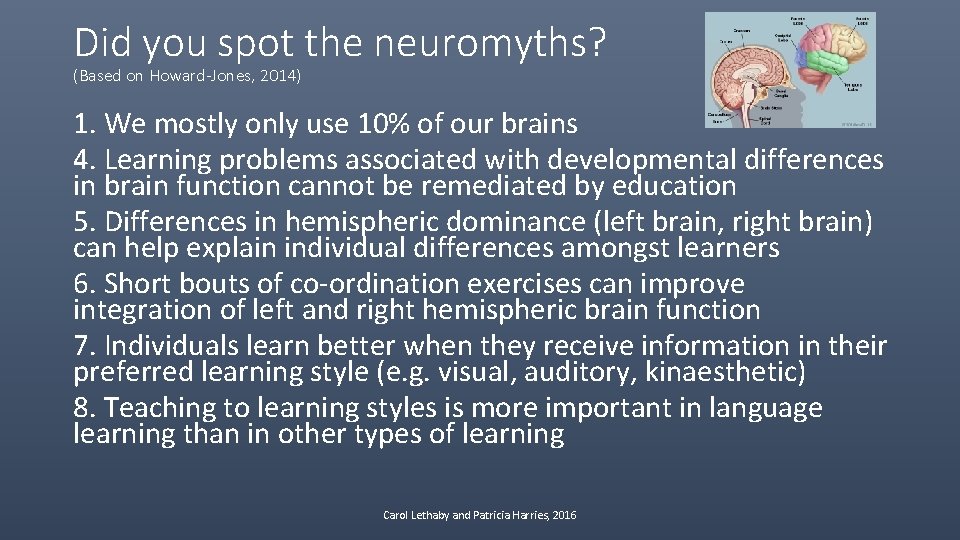
Did you spot the neuromyths? (Based on Howard-Jones, 2014) 1. We mostly only use 10% of our brains 4. Learning problems associated with developmental differences in brain function cannot be remediated by education 5. Differences in hemispheric dominance (left brain, right brain) can help explain individual differences amongst learners 6. Short bouts of co-ordination exercises can improve integration of left and right hemispheric brain function 7. Individuals learn better when they receive information in their preferred learning style (e. g. visual, auditory, kinaesthetic) 8. Teaching to learning styles is more important in language learning than in other types of learning Carol Lethaby and Patricia Harries, 2016
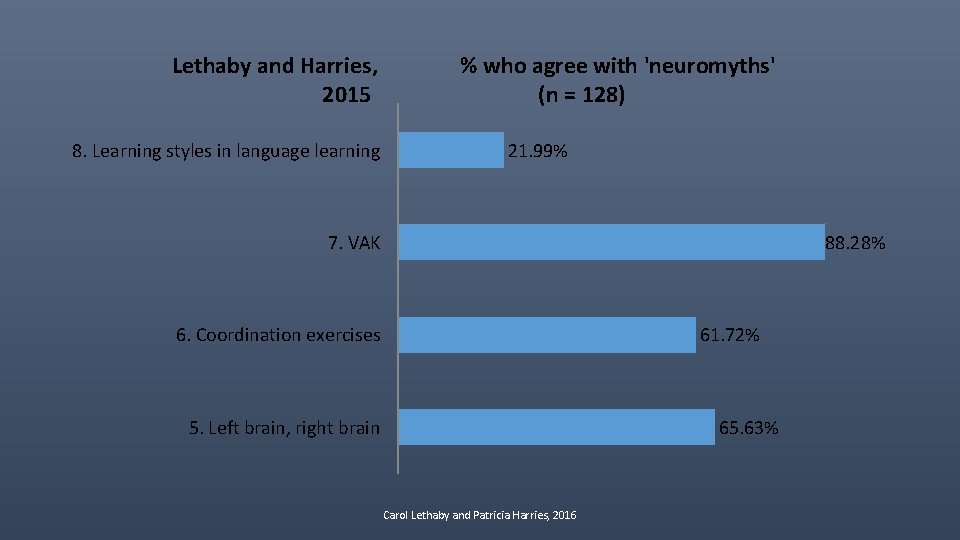
Lethaby and Harries, 2015 8. Learning styles in language learning % who agree with 'neuromyths' (n = 128) 21. 99% 7. VAK 88. 28% 6. Coordination exercises 61. 72% 65. 63% 5. Left brain, right brain Carol Lethaby and Patricia Harries, 2016
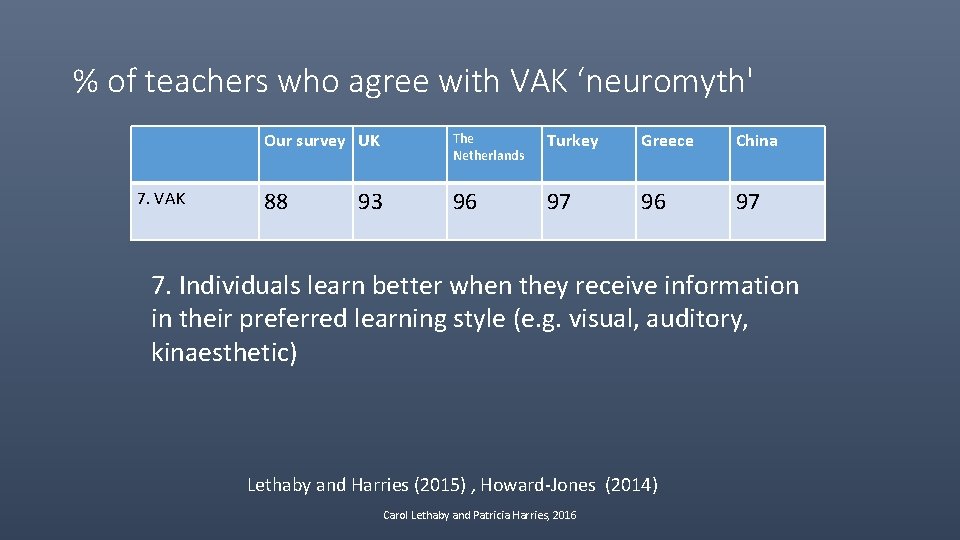
% of teachers who agree with VAK ‘neuromyth' 7. VAK Our survey UK The Netherlands Turkey Greece China 88 96 97 93 7. Individuals learn better when they receive information in their preferred learning style (e. g. visual, auditory, kinaesthetic) Lethaby and Harries (2015) , Howard-Jones (2014) Carol Lethaby and Patricia Harries, 2016
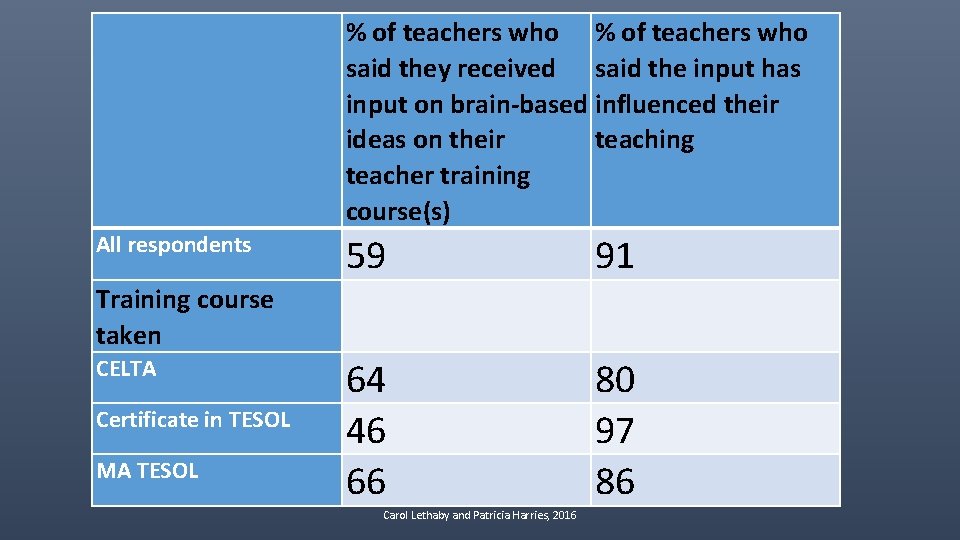
% of teachers who said they received said the input has input on brain-based influenced their ideas on their teaching teacher training course(s) All respondents 59 91 64 46 66 80 97 86 Training course taken CELTA Certificate in TESOL MA TESOL Carol Lethaby and Patricia Harries, 2016
Where do teachers get their neuromyths from? • Fifty-nine per cent of respondents said they had received brain-based ideas in their training, while 88 per cent of the survey participants believe that accommodating perceptual learning styles enhances learning. • (Lethaby and Harries, 2015) Carol Lethaby and Patricia Harries, 2016
Some survey conclusions • TESOL training courses may encourage beliefs in ‘neuromyths’ • Teachers say their teaching is influenced by beliefs in ‘neuromyths’ • Teachers also hear and read about ‘neuromyths’ and brain- based ideas outside of their teaching and training Carol Lethaby and Patricia Harries, 2016
Recommendations Carol Lethaby and Patricia Harries, 2016
1 Clark (2015) – Don’t waste your time and resources with learning styles assessments Carol Lethaby and Patricia Harries, 2016
2 Why not focus on evidence-based ways that we know are more helpful to learners? – learn how to use visuals / text / audio better! (eg Butcher, (2006), or Wouters et al (2008)) Carol Lethaby and Patricia Harries, 2016
Previous knowledge • “the single most widely demonstrated difference [in learning outcomes] is prior knowledge. ” (Clark, 2015: 335). Carol Lethaby and Patricia Harries, 2016
3 Teacher training • 1 Stop teaching / perpetuating neuromyths! Talk about this overtly with trainees • 2 Spend more time on other evidence-based ways to improve learning • 3 Petition organisations such as Cambridge English to remove learning styles from the syllabus of teacher training courses Carol Lethaby and Patricia Harries, 2016
“Possessing greater general knowledge about the brain does not appear to protect teachers from picking up neuromyths” • Dekker et al (2012: 6) Carol Lethaby and Patricia Harries, 2016
Read the article here: • Lethaby, C. and Harries, P (2016) Learning styles and teacher training: are we perpetuating neuromyths? ELTJ 70/1 (Jan 2016) Carol Lethaby and Patricia Harries, 2016
What we’re doing now Carol Lethaby and Patricia Harries, 2016
What we’re doing now: • TESOL certificate - UCBX • Spring 2015, Fall 2015, Spring 2016 (40 pre-service teachers) • MA TESOL – The New School • Spring 2015 (15 teachers) • In-Service Teacher development course – Teachers from Brazil’s Federal Institutes - CCSF • Spring 2016 (38 experienced teachers) • Talks and presentations • Mexico – Colima, Tepic, Hermosillo, Sinaloa, MEXTESOL (500 teachers and student teachers) Carol Lethaby and Patricia Harries, 2016
• Administer questionnaire • Openly talk about neuromyths • Get reactions and discussion from participants • Then: follow-up • Discuss and exemplify prior knowledge that does have a huge research base to support it Carol Lethaby and Patricia Harries, 2016
Further polling 95 % of 148 EFL teachers surveyed in Mexico in 2015 agreed with the statement: Individuals learn better when they receive information in their preferred learning style (e. g. visual, auditory, kinaesthetic) (Neuromyth #7) Carol Lethaby and Patricia Harries, 2016
90% of 20 teachers at UCBX 72% of 36 teachers from FIs in Brazil Carol Lethaby and Patricia Harries, 2016
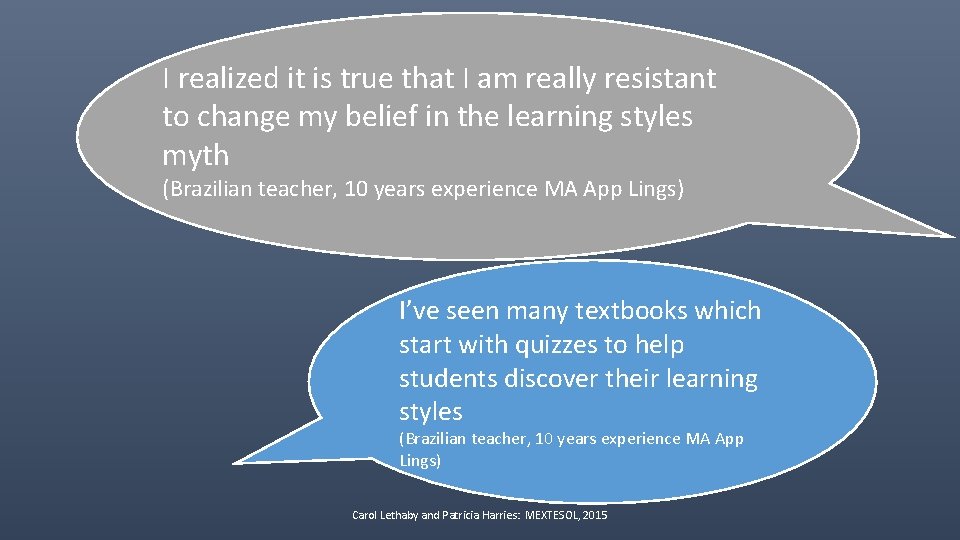
I realized it is true that I am really resistant to change my belief in the learning styles myth (Brazilian teacher, 10 years experience MA App Lings) I’ve seen many textbooks which start with quizzes to help students discover their learning styles (Brazilian teacher, 10 years experience MA App Lings) Carol Lethaby and Patricia Harries: MEXTESOL, 2015
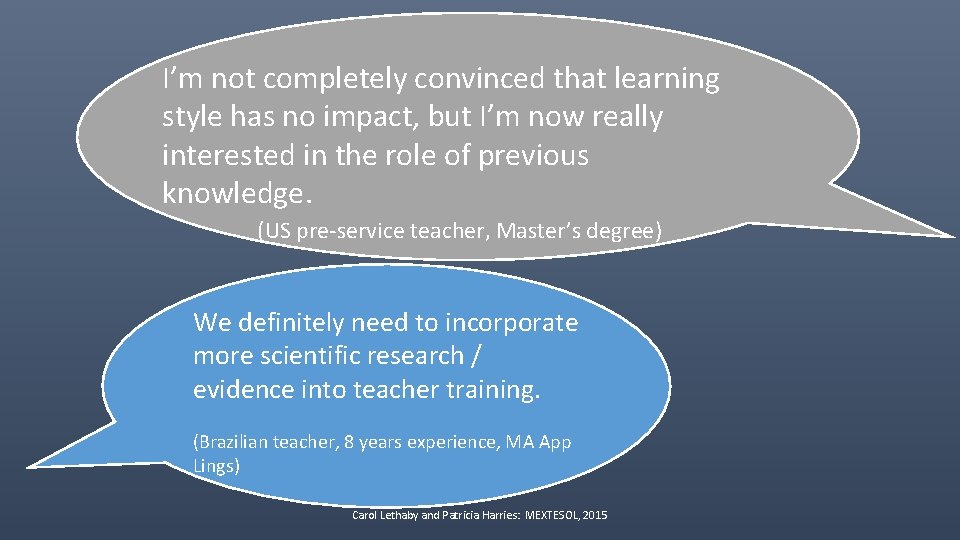
I’m not completely convinced that learning style has no impact, but I’m now really interested in the role of previous knowledge. (US pre-service teacher, Master’s degree) We definitely need to incorporate more scientific research / evidence into teacher training. (Brazilian teacher, 8 years experience, MA App Lings) Carol Lethaby and Patricia Harries: MEXTESOL, 2015
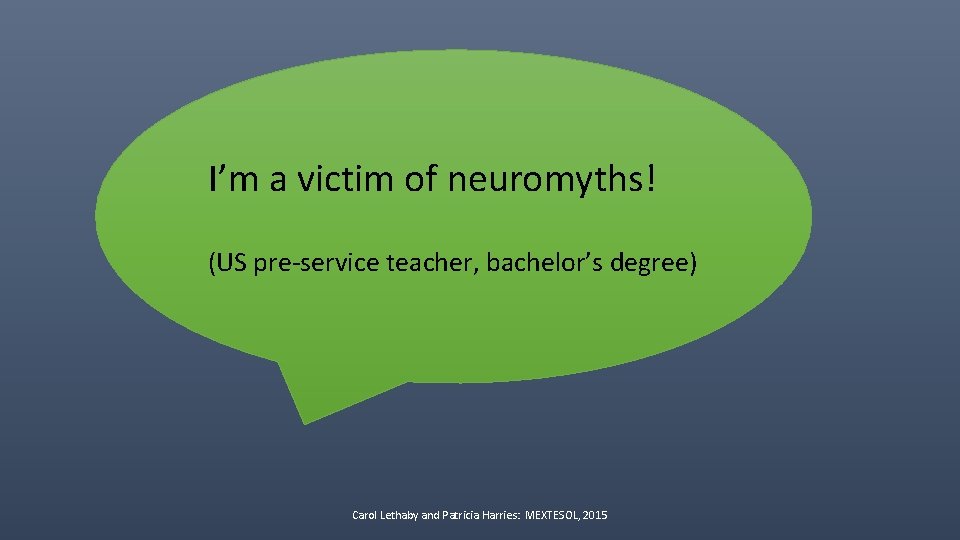
I’m a victim of neuromyths! (US pre-service teacher, bachelor’s degree) Carol Lethaby and Patricia Harries: MEXTESOL, 2015
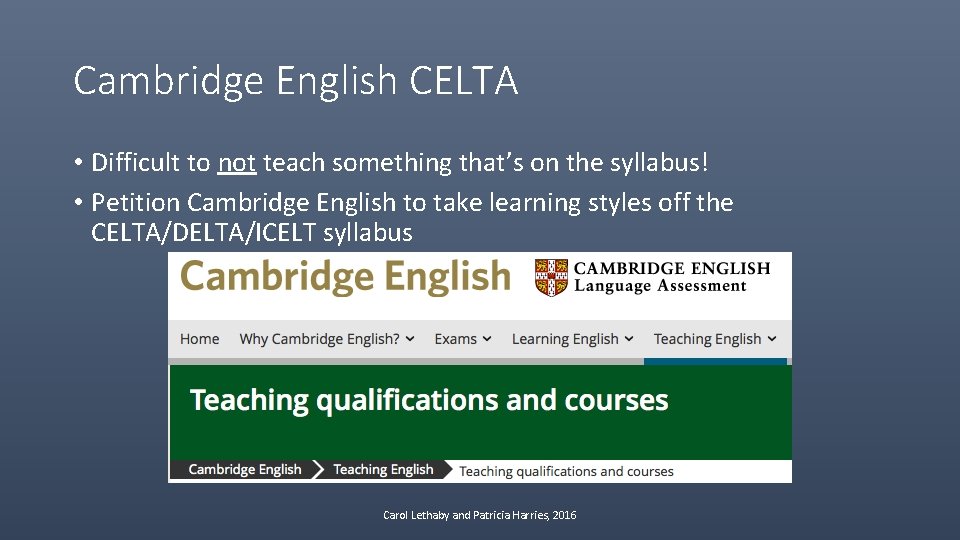
Cambridge English CELTA • Difficult to not teach something that’s on the syllabus! • Petition Cambridge English to take learning styles off the CELTA/DELTA/ICELT syllabus Carol Lethaby and Patricia Harries, 2016
Recommendations Conclusions: the way forward Carol Lethaby and Patricia Harries, 2016
Conclusions: the way forward • The learning styles neuromyth has a strong hold on the profession • Learners do have preferences about how they like to learn • Variety in the classroom is good both for motivation and for learning • There’s no evidence for the meshing hypothesis and we need to actively talk about this in teacher education and take it off syllabuses • There is plenty of evidence / a research base for other teaching strategies (eg involving prior learning, how to combine text and video, how to learn vocabulary more effectively) Carol Lethaby and Patricia Harries, 2016
Carol Lethaby and Patricia Harries, 2016
• References • Butcher, K. R. (2006). Learning from text with diagrams: Promoting mental model development and inference generation. Journal of Educational Psychology, 98, 182 -197 • Clark, R. C (2015) Evidence-based Training Methods ASTD • Coffield, F. , Moseley, D. , Hall, E. , and Ecclestone, K. (2004). Learning Styles and Pedagogy in Post-16 Learning. A Systematic and Critical Review. London: Learning and Skills Research Centre. • Dekker, S. , Lee, N. C. , Howard-Jones, P. , and Jolles, J. (2012). Neuromyths in education: Prevalence and predictors of misconceptions among teachers. Frontiers in Psychology 3/429 1 - 8 • Howard-Jones, P (2014) Neuroscience and education: myths and messages. Nature Reviews Neuroscience Volume 15 December 2014 817 -824 • Krätzig, G. P. and Arbuthnott, K. D. (2006). Perceptual learning style and learning proficiency: A test of the hypothesis. Journal of Educational Psychology, 98, 238 -246. • Lethaby, C. and Harries, P (2016) Learning styles and teacher training: are we perpetuating neuromyths? ELTJ 70/1 (f. Jan 2016) • Pashler, H. , Mc. Daniel, M. , Rohrer, D. , & Bjork, R. (2009). Learning styles: Concepts and evidence. Psychological Science in the Public Interest, 9(3), 105 -119. • Pickering, S. J. , and Howard-Jones, P. (2007). Educators’ views on the role of neuroscience in education: findings from a study of UK and international perspectives. Mind Brain Educ. 1, 109– 113. • Riener, C. , & Willingham, D. (2010). The myth of learning styles. Change, Sept/Oct, 32 -36. • Rogowsky, B. A. , Calhoun, B. M. , & Tallal, P. (2015). Matching learning style to instructional method: Effects on comprehension. Journal of Educational Psychology, 107(1), 64. • Wouters, P. , Paas, F. & van Merrienboer, J. J. G. (2008). How to optimize learning from animated models: A review of guidelines based on cognitive load. Review of Educational Research, 78, 645 -675. Carol Lethaby and Patricia Harries, 2016
Changing the way we approach learning styles in teacher education Carol Lethaby clethaby@clethaby. com Website: clethaby. com Patricia Harries patti. harries@gmail. com