
Changing the I Codes Maureen Traxler Code Development
- Slides: 31
Changing the I Codes Maureen Traxler Code Development Manager City of Seattle Lee Kranz Plan Review Supervisor City of Bellevue Chair WABO Technical Code Development Committee Tim Nogler Managing Director Washington State Building Code Council
Outline Code development process 30 minutes o ICC o WSBCC cdp. ACCESS Hands On—Voting for real 30 minutes o Work through one as an example; vote as a group o Each table/person with laptop votes Writing proposals with exercise 60 minutes o Picking an issue o Formatting your proposal o Reason statements o Code change pitfalls
Why should you care about code development? You learn a lot—about codes, reasons for code sections, new technologies… It fixes problems you encounter Keeps codes current for new products and technology You can get the code changed o WABO’s proposals have a good success rate Code development just got easier with cdp. ACCESS o We asked for a way for everyone to participate, now we have it. o You have opportunity to vote; understanding the code development process will help you understand how to vote Your participation is important One person can’t do it alone With more people participating, the end result is better
Code Development Process Goals Open to all parties Not dominated by proprietary or commercial interests Transparent Balance of interests Based on consensus “Governmental consensus process” Final vote is consensus of governmental members who have no financial interest in outcomes; represent the general public “ANSI process” is very different. Used for A 117, ASCE 7, ACI & other materials standards, UPC, NEC, NFPA 13 Allows longer debates, industry votes (no group can dominate), less opportunity to participate for people who aren’t on the committee Fair appeals process
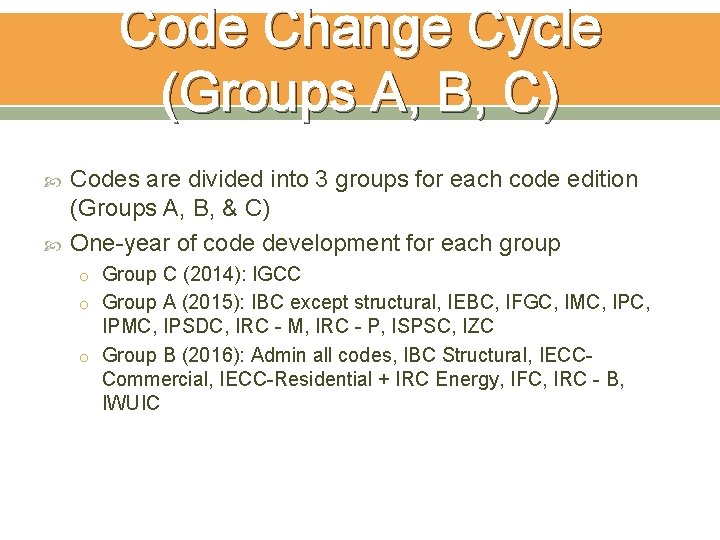
Code Change Cycle (Groups A, B, C) Codes are divided into 3 groups for each code edition (Groups A, B, & C) One-year of code development for each group o Group C (2014): IGCC o Group A (2015): IBC except structural, IEBC, IFGC, IMC, IPC, IPMC, IPSDC, IRC - M, IRC - P, ISPSC, IZC o Group B (2016): Admin all codes, IBC Structural, IECCCommercial, IECC-Residential + IRC Energy, IFC, IRC - B, IWUIC
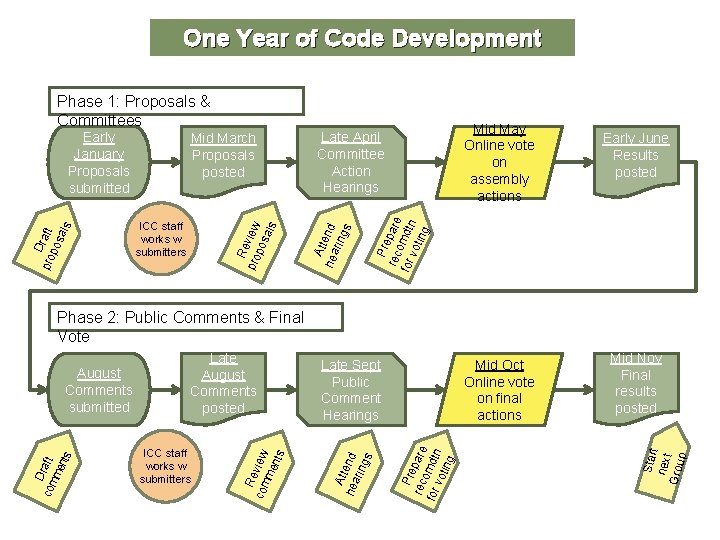
One Year of Code Development Phase 1: Proposals & Committees Early June Results posted Pre rec pare for omdtn vot ing ICC staff works w submitters Mid May Online vote on assembly actions Late April Committee Action Hearings At hea tend ring s Mid March Proposals posted Re pro view pos als D pro raft pos als Early January Proposals submitted Phase 2: Public Comments & Final Vote Pre rec pare for omdtn vot ing Mid Nov Final results posted Star t next Grou p Mid Oct Online vote on final actions Late Sept Public Comment Hearings At hea tend ring s ICC staff works w submitters Re com view me nts D com raft me nts August Comments submitted Late August Comments posted
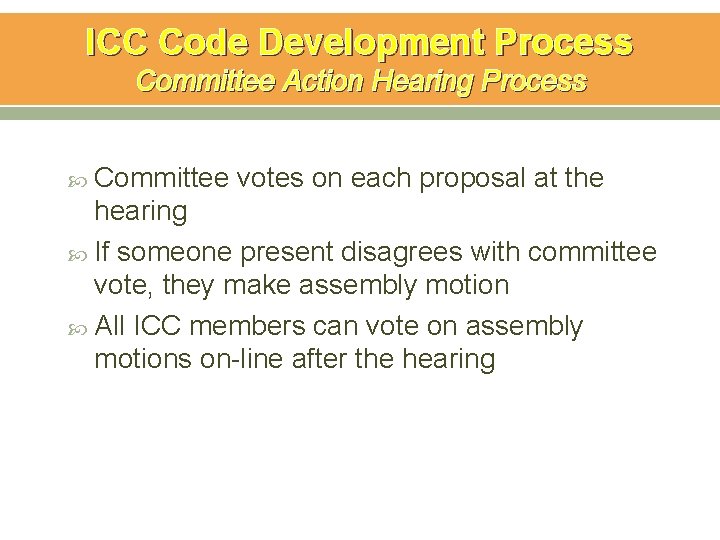
ICC Code Development Process Committee Action Hearing Process Committee votes on each proposal at the hearing If someone present disagrees with committee vote, they make assembly motion All ICC members can vote on assembly motions on-line after the hearing
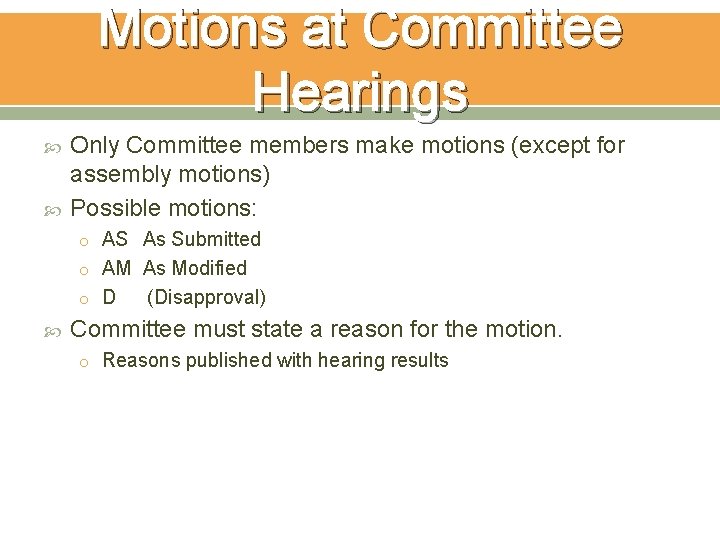
Motions at Committee Hearings Only Committee members make motions (except for assembly motions) Possible motions: o AS As Submitted o AM As Modified o D (Disapproval) Committee must state a reason for the motion. o Reasons published with hearing results
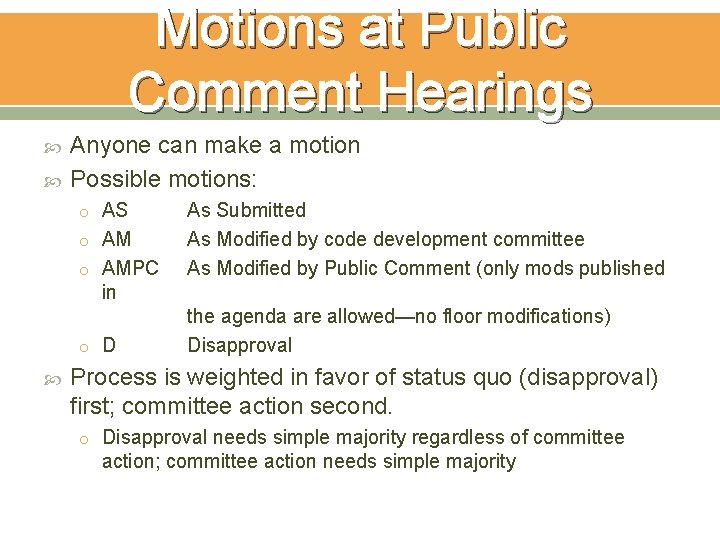
Motions at Public Comment Hearings Anyone can make a motion Possible motions: o AS o AMPC As Submitted As Modified by code development committee As Modified by Public Comment (only mods published in o D the agenda are allowed—no floor modifications) Disapproval Process is weighted in favor of status quo (disapproval) first; committee action second. o Disapproval needs simple majority regardless of committee action; committee action needs simple majority
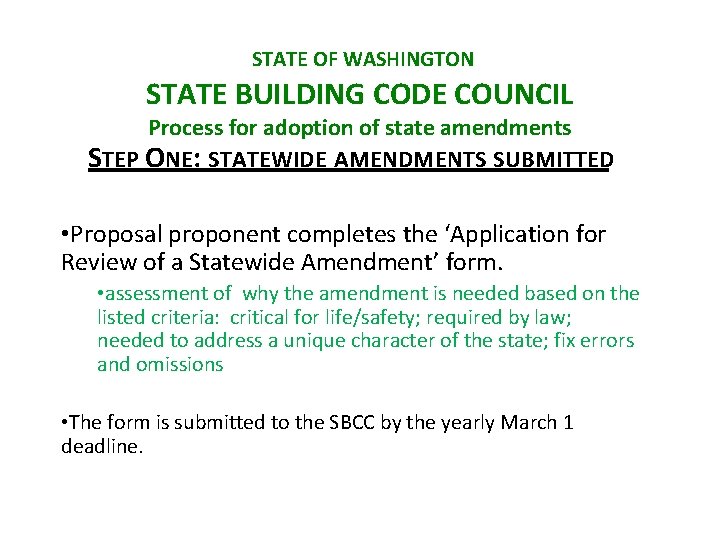
STATE OF WASHINGTON STATE BUILDING CODE COUNCIL Process for adoption of state amendments STEP ONE: STATEWIDE AMENDMENTS SUBMITTED • Proposal proponent completes the ‘Application for Review of a Statewide Amendment’ form. • assessment of why the amendment is needed based on the listed criteria: critical for life/safety; required by law; needed to address a unique character of the state; fix errors and omissions • The form is submitted to the SBCC by the yearly March 1 deadline.
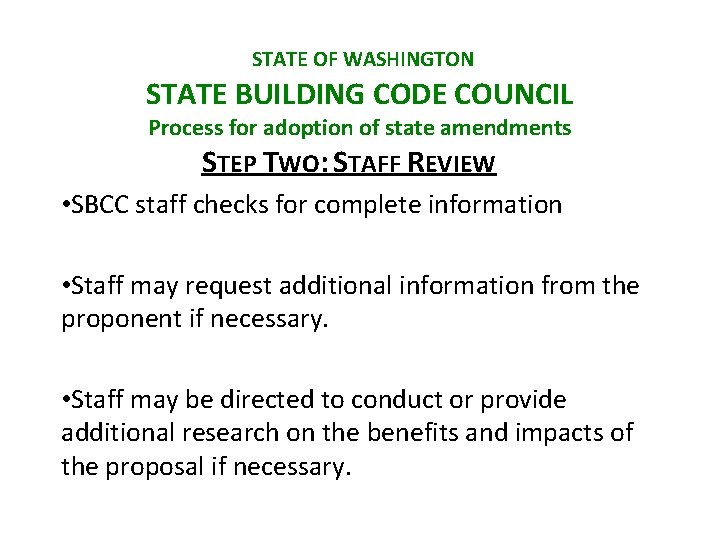
STATE OF WASHINGTON STATE BUILDING CODE COUNCIL Process for adoption of state amendments STEP TWO: STAFF REVIEW • SBCC staff checks for complete information • Staff may request additional information from the proponent if necessary. • Staff may be directed to conduct or provide additional research on the benefits and impacts of the proposal if necessary.
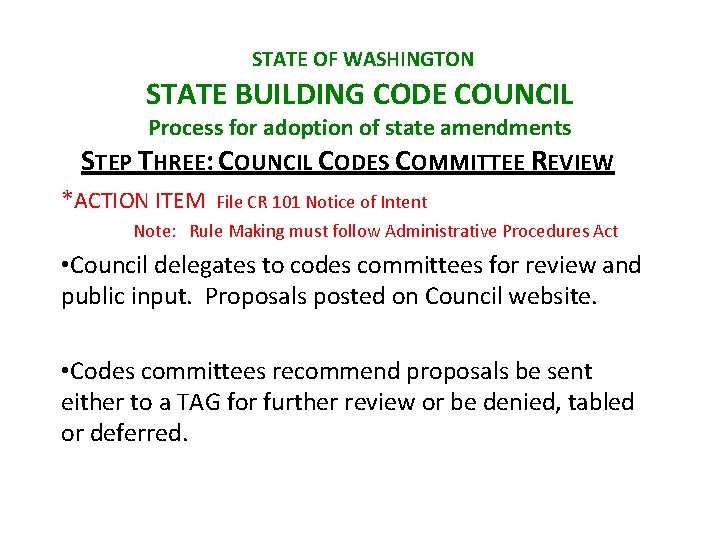
STATE OF WASHINGTON STATE BUILDING CODE COUNCIL Process for adoption of state amendments STEP THREE: COUNCIL CODES COMMITTEE REVIEW *ACTION ITEM File CR 101 Notice of Intent Note: Rule Making must follow Administrative Procedures Act • Council delegates to codes committees for review and public input. Proposals posted on Council website. • Codes committees recommend proposals be sent either to a TAG for further review or be denied, tabled or deferred.
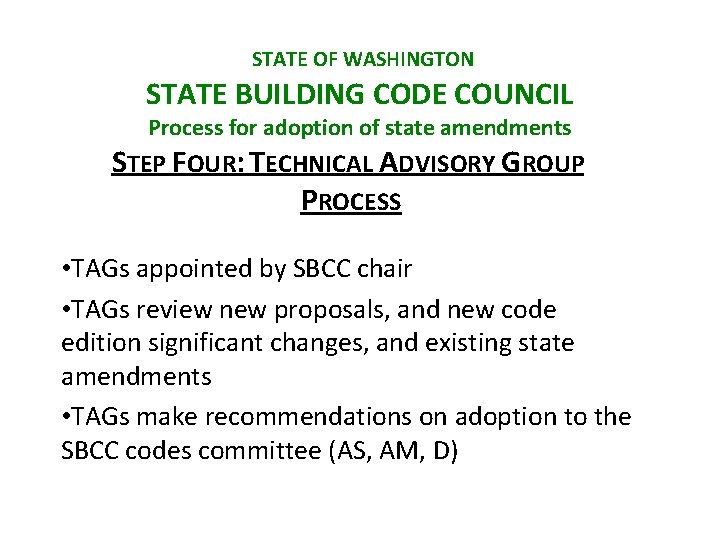
STATE OF WASHINGTON STATE BUILDING CODE COUNCIL Process for adoption of state amendments STEP FOUR: TECHNICAL ADVISORY GROUP PROCESS • TAGs appointed by SBCC chair • TAGs review new proposals, and new code edition significant changes, and existing state amendments • TAGs make recommendations on adoption to the SBCC codes committee (AS, AM, D)
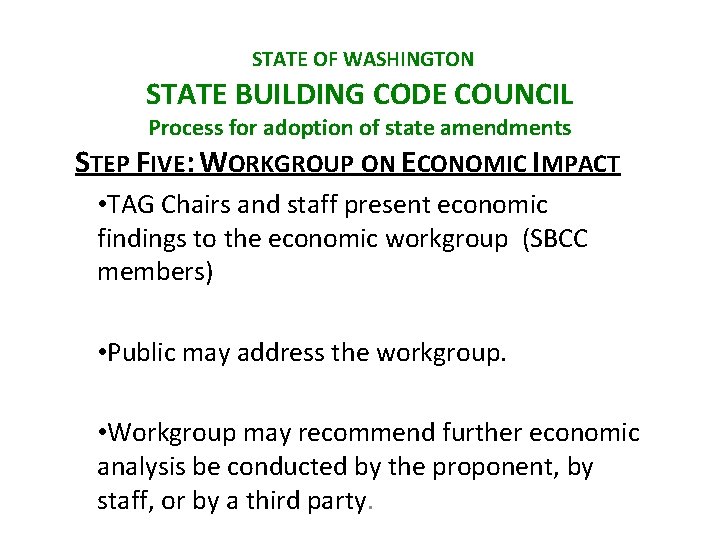
STATE OF WASHINGTON STATE BUILDING CODE COUNCIL Process for adoption of state amendments STEP FIVE: WORKGROUP ON ECONOMIC IMPACT • TAG Chairs and staff present economic findings to the economic workgroup (SBCC members) • Public may address the workgroup. • Workgroup may recommend further economic analysis be conducted by the proponent, by staff, or by a third party.
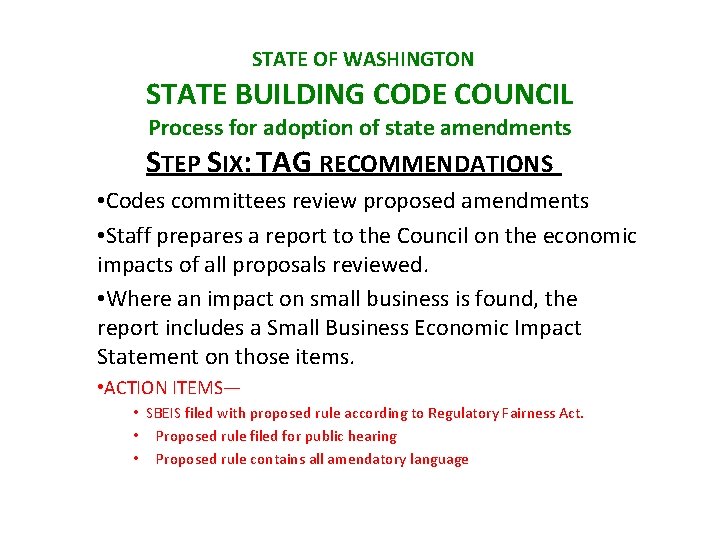
STATE OF WASHINGTON STATE BUILDING CODE COUNCIL Process for adoption of state amendments STEP SIX: TAG RECOMMENDATIONS • Codes committees review proposed amendments • Staff prepares a report to the Council on the economic impacts of all proposals reviewed. • Where an impact on small business is found, the report includes a Small Business Economic Impact Statement on those items. • ACTION ITEMS— • SBEIS filed with proposed rule according to Regulatory Fairness Act. • Proposed rule filed for public hearing • Proposed rule contains all amendatory language
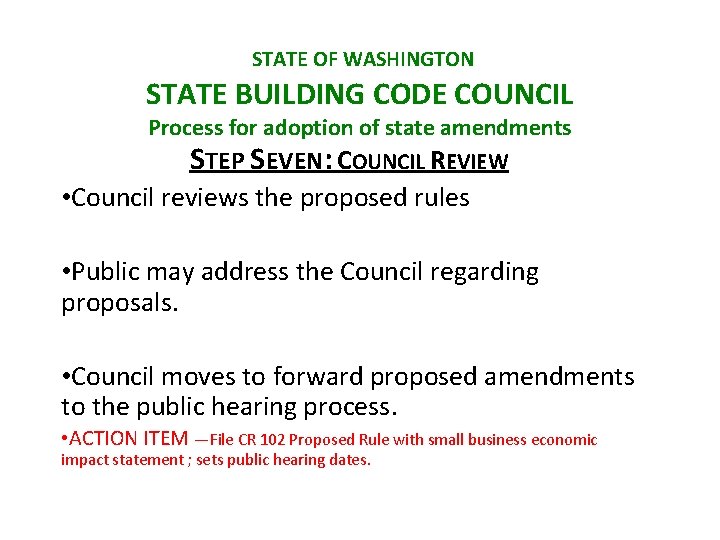
STATE OF WASHINGTON STATE BUILDING CODE COUNCIL Process for adoption of state amendments STEP SEVEN: COUNCIL REVIEW • Council reviews the proposed rules • Public may address the Council regarding proposals. • Council moves to forward proposed amendments to the public hearing process. • ACTION ITEM —File CR 102 Proposed Rule with small business economic impact statement ; sets public hearing dates.
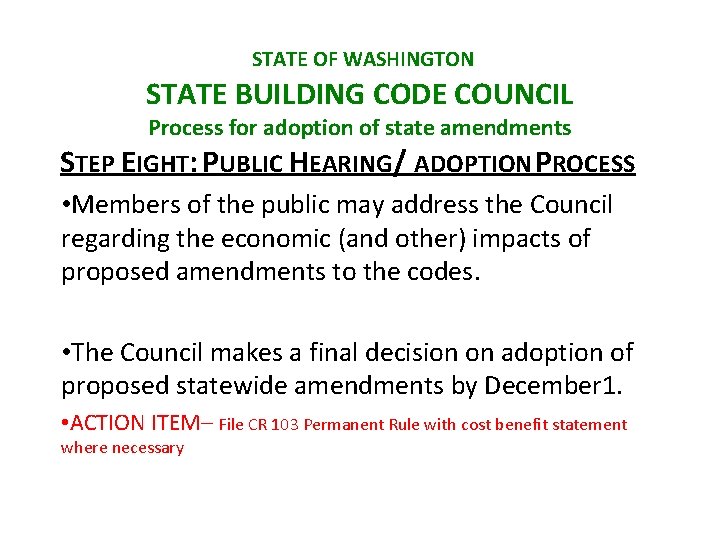
STATE OF WASHINGTON STATE BUILDING CODE COUNCIL Process for adoption of state amendments STEP EIGHT: PUBLIC HEARING/ ADOPTION PROCESS • Members of the public may address the Council regarding the economic (and other) impacts of proposed amendments to the codes. • The Council makes a final decision on adoption of proposed statewide amendments by December 1. • ACTION ITEM– File CR 103 Permanent Rule with cost benefit statement where necessary
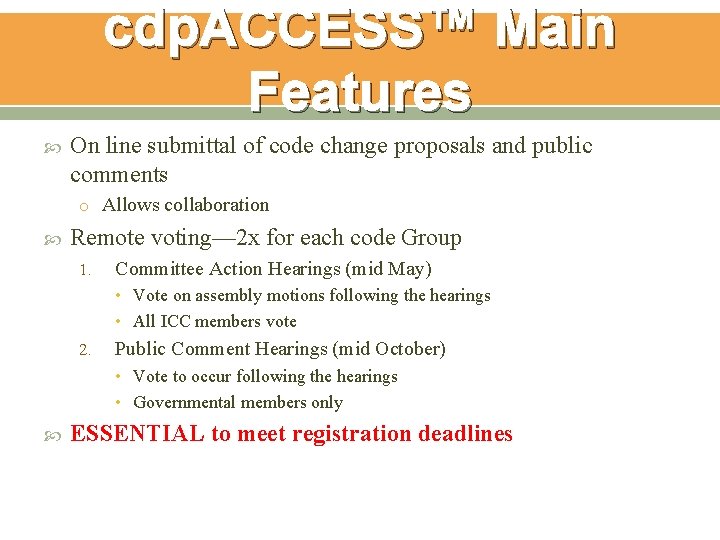
cdp. ACCESS™ Main Features On line submittal of code change proposals and public comments o Allows collaboration Remote voting— 2 x for each code Group 1. Committee Action Hearings (mid May) • Vote on assembly motions following the hearings • All ICC members vote 2. Public Comment Hearings (mid October) • Vote to occur following the hearings • Governmental members only ESSENTIAL to meet registration deadlines
Reason for cdp. ACCESS Response to ICC members’ request for a way to participate in code development w/o travel o Can’t afford time & money to attend hearings Added benefit: participate at your own pace o 2 -week window to vote
Voting with cdp. ACCESS Voters can view video of hearings, text of proposals and comments For more information on cdp. ACCESS™ go to: http: //www. iccsafe. org/cdp. ACCESS
WABO TCD Works as a group on: o Drafting code change proposals o Drafting public comments o Reviewing proposals and comments o Testimony for hearings o Issues related to code development WABO TCD is not the same as WABO Membership: o Does not represent WABO Membership except as directed by the WABO Executive Committee o Identify ourselves as representing WABO TCD on all proposals o WABO TCD focuses on ICC codes and Washington State codes
Nuts & Bolts of Code Changes Code change proposals have 2 parts o Revision to code text o Reason supporting change
Keeping track of your code change issues WABO Discussions—TCD discussion forum (WABO website) Lee keeps ideas in a 3 -ring binder and on website forum Maureen keeps a list in her computer
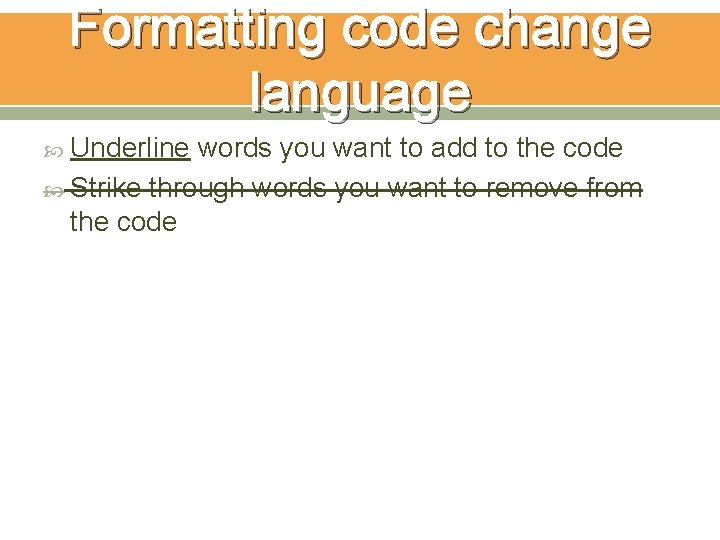
Formatting code change language Underline words you want to add to the code Strike through words you want to remove from the code
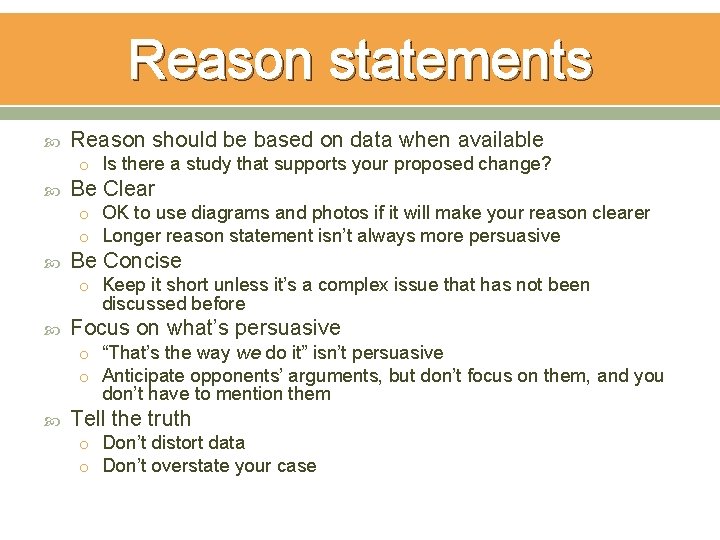
Reason statements Reason should be based on data when available o Is there a study that supports your proposed change? Be Clear o OK to use diagrams and photos if it will make your reason clearer o Longer reason statement isn’t always more persuasive Be Concise o Keep it short unless it’s a complex issue that has not been discussed before Focus on what’s persuasive o “That’s the way we do it” isn’t persuasive o Anticipate opponents’ arguments, but don’t focus on them, and you don’t have to mention them Tell the truth o Don’t distort data o Don’t overstate your case
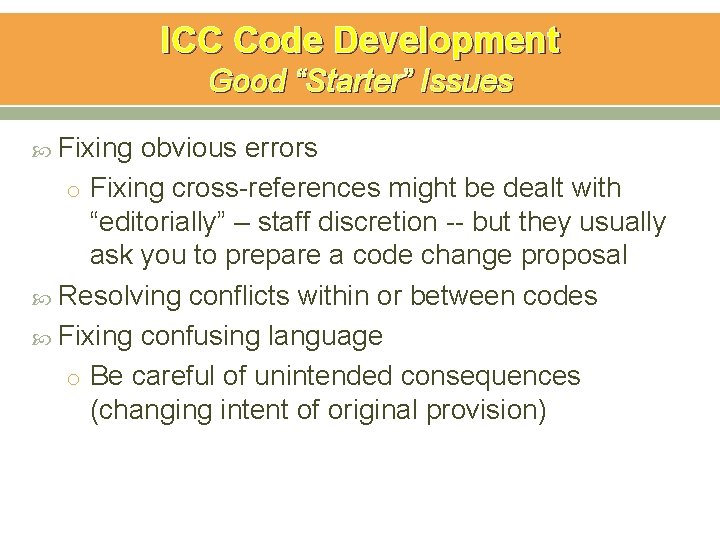
ICC Code Development Good “Starter” Issues Fixing obvious errors o Fixing cross-references might be dealt with “editorially” – staff discretion -- but they usually ask you to prepare a code change proposal Resolving conflicts within or between codes Fixing confusing language o Be careful of unintended consequences (changing intent of original provision)
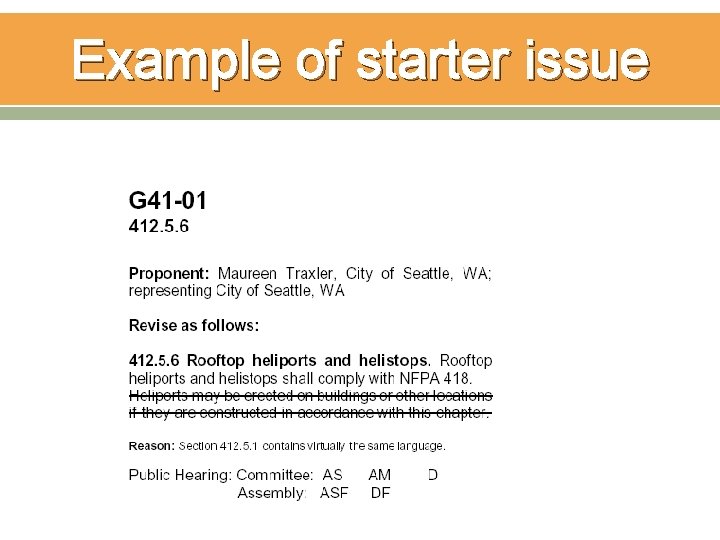
Example of starter issue
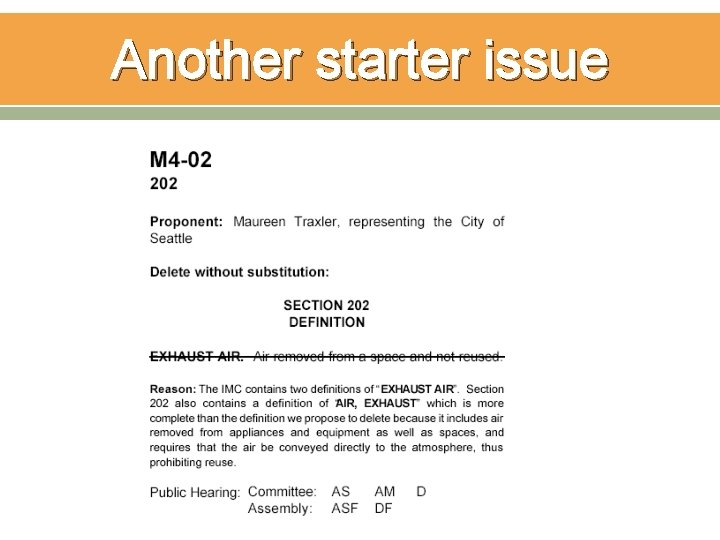
Another starter issue
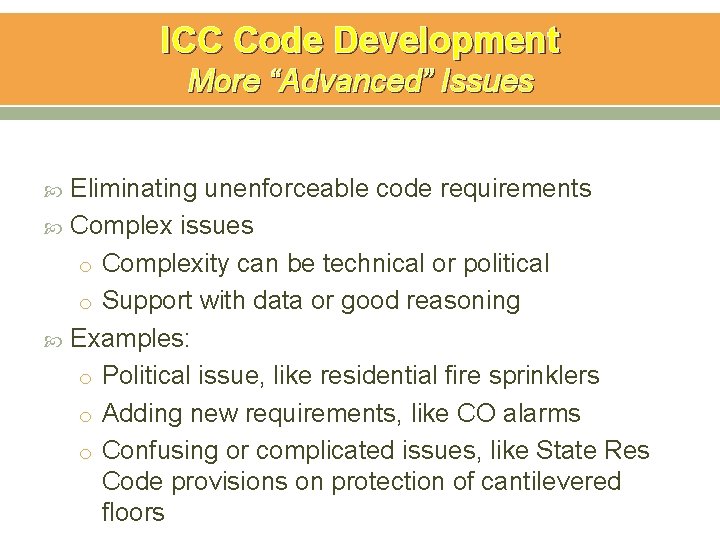
ICC Code Development More “Advanced” Issues Eliminating unenforceable code requirements Complex issues o Complexity can be technical or political o Support with data or good reasoning Examples: o Political issue, like residential fire sprinklers o Adding new requirements, like CO alarms o Confusing or complicated issues, like State Res Code provisions on protection of cantilevered floors
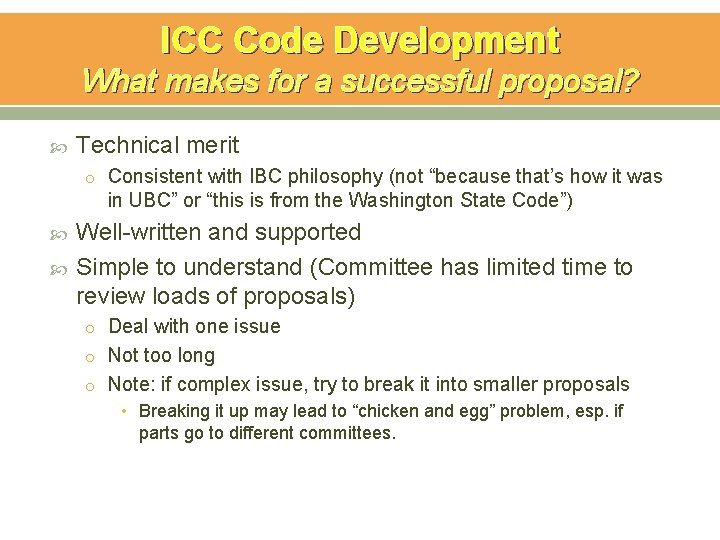
ICC Code Development What makes for a successful proposal? Technical merit o Consistent with IBC philosophy (not “because that’s how it was in UBC” or “this is from the Washington State Code”) Well-written and supported Simple to understand (Committee has limited time to review loads of proposals) o Deal with one issue o Not too long o Note: if complex issue, try to break it into smaller proposals • Breaking it up may lead to “chicken and egg” problem, esp. if parts go to different committees.
Wrap up: WABO TCD wants you (to give us your code change ideas)! You can make a positive difference in your community. Let us know if you need help with your code changes. TCD keeps a meeting schedule on the WABO website. Thanks for your participation today and in the future!