
Changing the Culture of Retention Focused Academic Advising
- Slides: 36
Changing the Culture of Retention Focused Academic Advising Peter R. Jones Senior Vice Provost for Undergraduate Studies Temple University, Philadelphia, PA NACADA Annual Conference Las Vegas, NV October 6 th 2015 1
Outline of Presentation Setting the context – Temple University Issues when we started - 2005 Retention – risk models ◦ Risk-Needs-Responsivity ◦ Generations of risk model Interventions and response ◦ Academic Advising 2
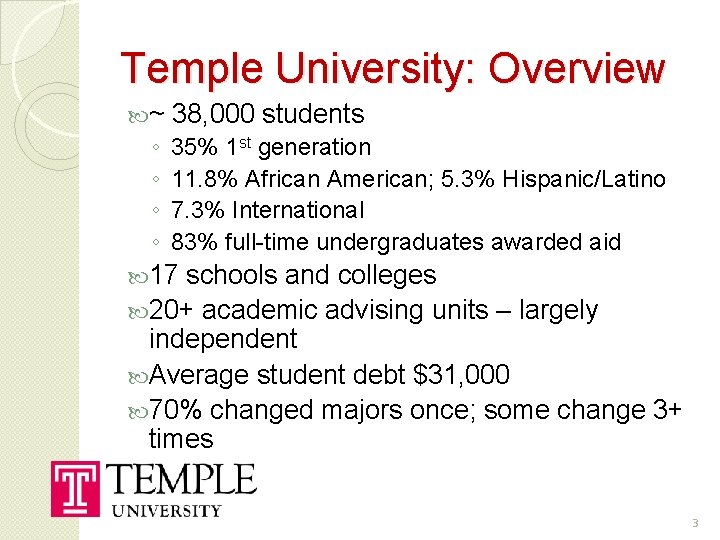
Temple University: Overview ~ 38, 000 students ◦ ◦ 35% 1 st generation 11. 8% African American; 5. 3% Hispanic/Latino 7. 3% International 83% full-time undergraduates awarded aid 17 schools and colleges 20+ academic advising units – largely independent Average student debt $31, 000 70% changed majors once; some change 3+ times 3
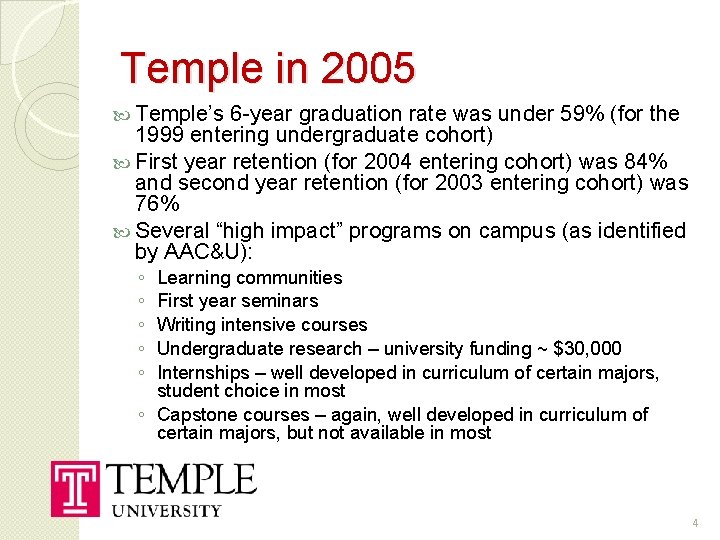
Temple in 2005 Temple’s 6 -year graduation rate was under 59% (for the 1999 entering undergraduate cohort) First year retention (for 2004 entering cohort) was 84% and second year retention (for 2003 entering cohort) was 76% Several “high impact” programs on campus (as identified by AAC&U): ◦ ◦ ◦ Learning communities First year seminars Writing intensive courses Undergraduate research – university funding ~ $30, 000 Internships – well developed in curriculum of certain majors, student choice in most ◦ Capstone courses – again, well developed in curriculum of certain majors, but not available in most 4
Temple in 2005 (Continued) University policy and practice essentially passive and reactive ◦ Many students – especially the at-risk students – in precontemplative stage (Stage 1) of Di. Clemente and Prochaska 6 stages of Change Model (1984). In this stage the student may not even recognize they have a problem. ◦ University academic policies – warning, probation, dismissal (with 30 credit ‘window’ preventing early dismissal) ◦ No limit on repeating courses, withdrawals, etc. ◦ Dismissed students placed on “conditional status” – up to two years or 40 credits to remediate c. GPA and return to good academic standing Student support centers - Writing Center and Math & Science Resource Center - both rely primarily on student walk ups. 5
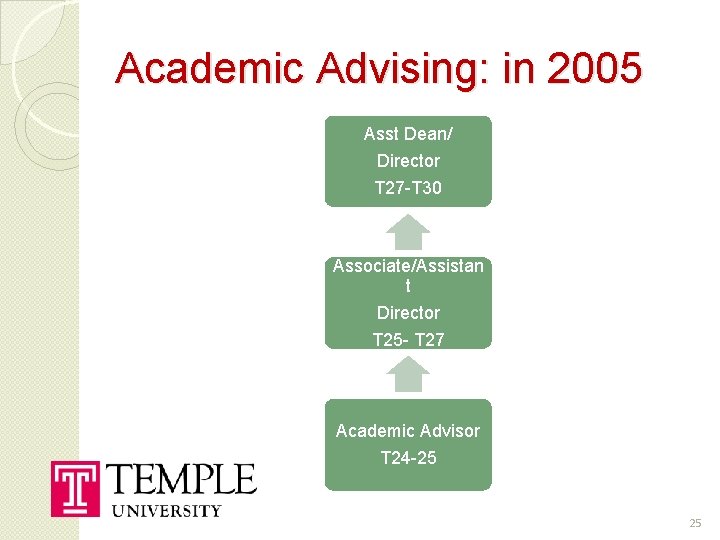
Academic Advising in 2005 Temple had no clearly defined professional cadre of academic advisors – there were about 50+ professionals who included academic advising among their various duties. Student registration considered essence of role – developmental advising did occur. Academic advising was essentially a single-level professional area – career opportunities required one left advising or Temple. Major variations in salary, job description, professional credentials for hiring. Retention of advisors was challenging – one year attrition rates 18%+. 6
The Challenge: Cultural Shift Change outcomes ◦ Improve retention ◦ Reduce time to degree completion ◦ Reduce student debt burden Change policies and practices ◦ Tighten academic policy – repeats, dismissal ◦ Use analytics to inform practice ◦ Shift institutional culture to strategic and proactive 7
The Retention Plan Who is at-risk? ◦ Use analytics as basis for driving policy/practice What is the intervention strategy? ◦ Academic advising front line of intervention Academic support centers Other supports: Student Financial Services Student affairs – counseling, housing, disability services, recreation Challenges for advising? ◦ ◦ New role – what will interventions be? Proactive not passive Professionalism and career development Advising staff retention Develop proactive and very focused, strategic interventions – risk/needs/responsivity principle Identify measurable outcomes for impact assessment ◦ ◦ Retention rates Graduation rates 8
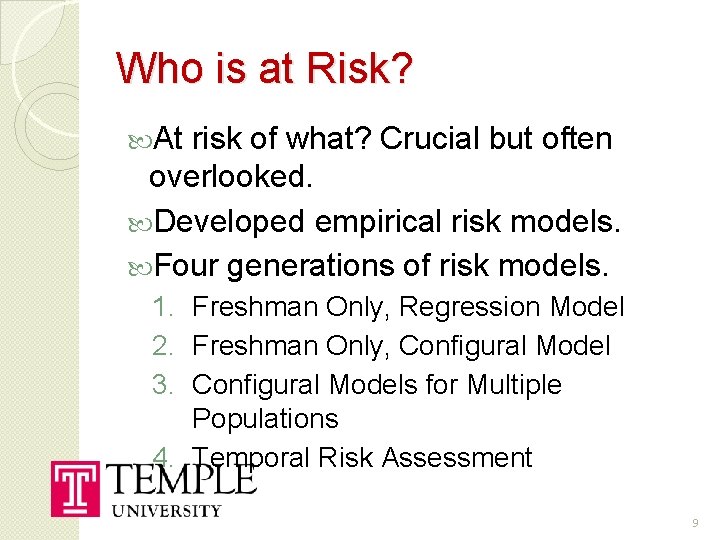
Who is at Risk? At risk of what? Crucial but often overlooked. Developed empirical risk models. Four generations of risk models. 1. Freshman Only, Regression Model 2. Freshman Only, Configural Model 3. Configural Models for Multiple Populations 4. Temporal Risk Assessment 9
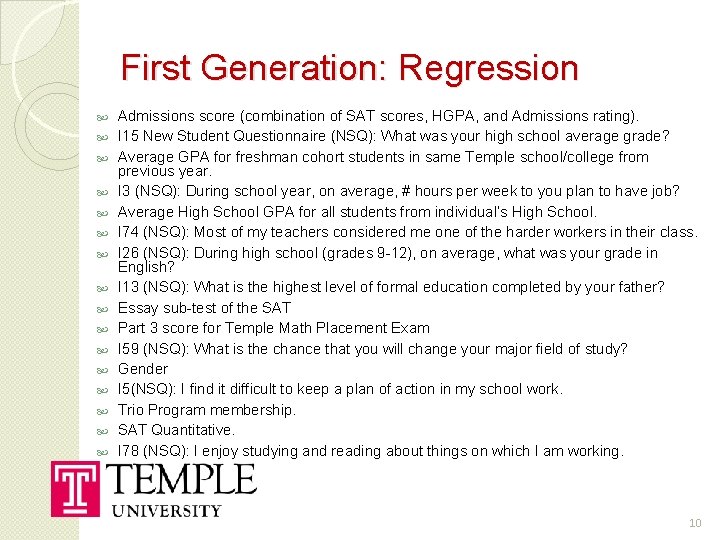
First Generation: Regression Admissions score (combination of SAT scores, HGPA, and Admissions rating). I 15 New Student Questionnaire (NSQ): What was your high school average grade? Average GPA for freshman cohort students in same Temple school/college from previous year. I 3 (NSQ): During school year, on average, # hours per week to you plan to have job? Average High School GPA for all students from individual’s High School. I 74 (NSQ): Most of my teachers considered me one of the harder workers in their class. I 26 (NSQ): During high school (grades 9 -12), on average, what was your grade in English? I 13 (NSQ): What is the highest level of formal education completed by your father? Essay sub-test of the SAT Part 3 score for Temple Math Placement Exam I 59 (NSQ): What is the chance that you will change your major field of study? Gender I 5(NSQ): I find it difficult to keep a plan of action in my school work. Trio Program membership. SAT Quantitative. I 78 (NSQ): I enjoy studying and reading about things on which I am working. 10
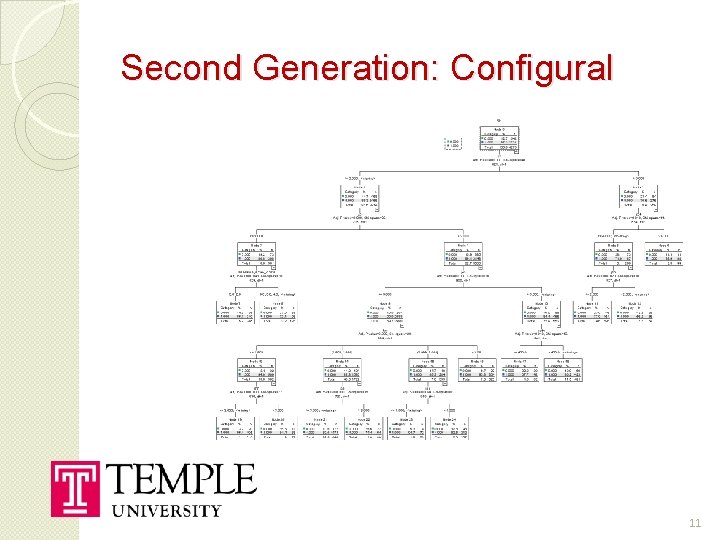
Second Generation: Configural 11
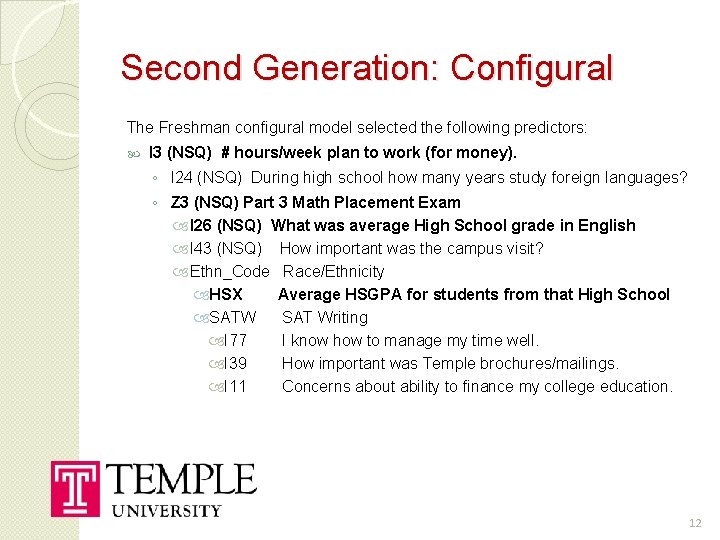
Second Generation: Configural The Freshman configural model selected the following predictors: I 3 (NSQ) # hours/week plan to work (for money). ◦ I 24 (NSQ) During high school how many years study foreign languages? ◦ Z 3 (NSQ) Part 3 Math Placement Exam I 26 (NSQ) What was average High School grade in English I 43 (NSQ) How important was the campus visit? Ethn_Code Race/Ethnicity HSX Average HSGPA for students from that High School SATW SAT Writing I 77 I know how to manage my time well. I 39 How important was Temple brochures/mailings. I 11 Concerns about ability to finance my college education. 12
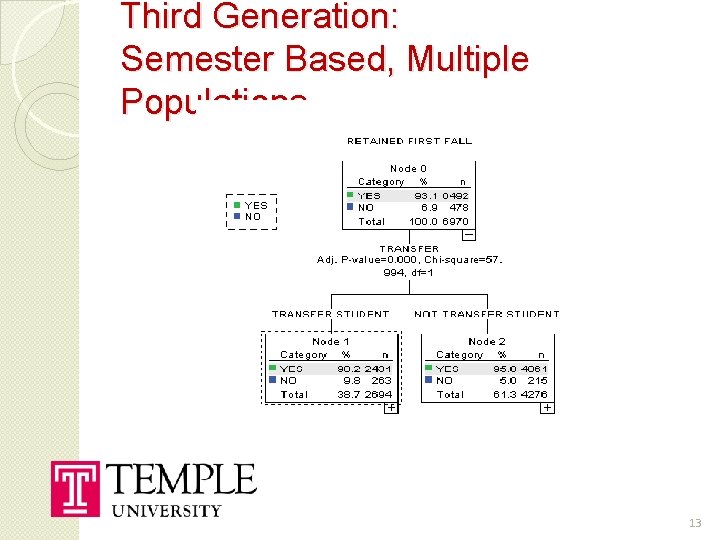
Third Generation: Semester Based, Multiple Populations 13
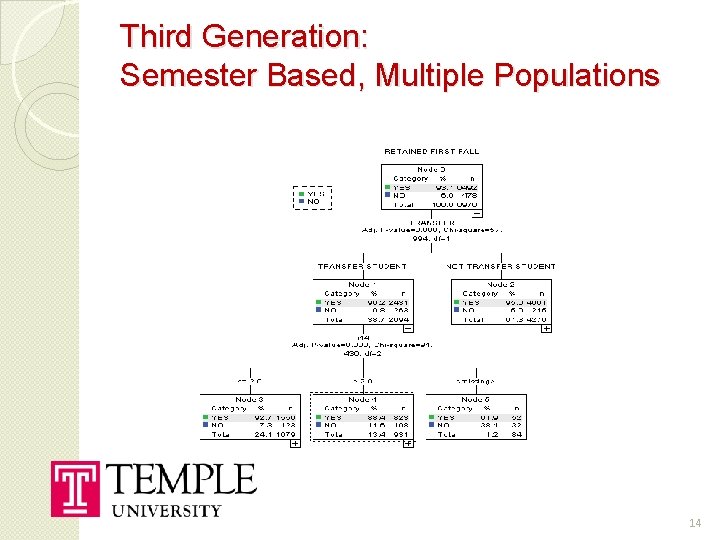
Third Generation: Semester Based, Multiple Populations 14
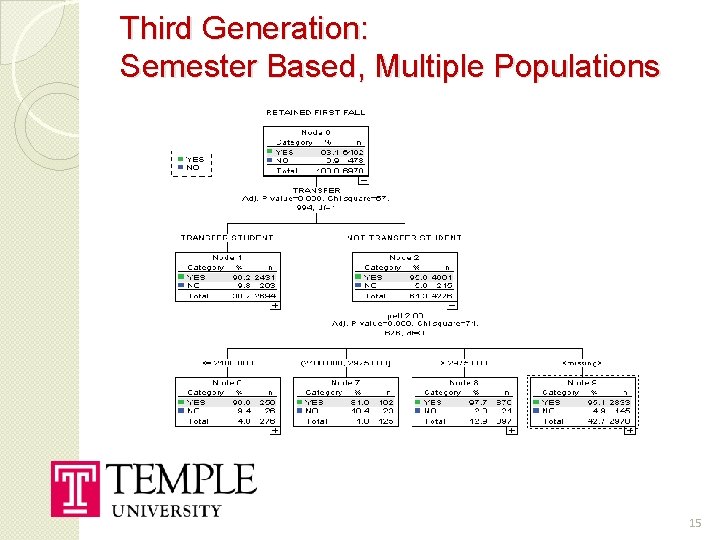
Third Generation: Semester Based, Multiple Populations 15
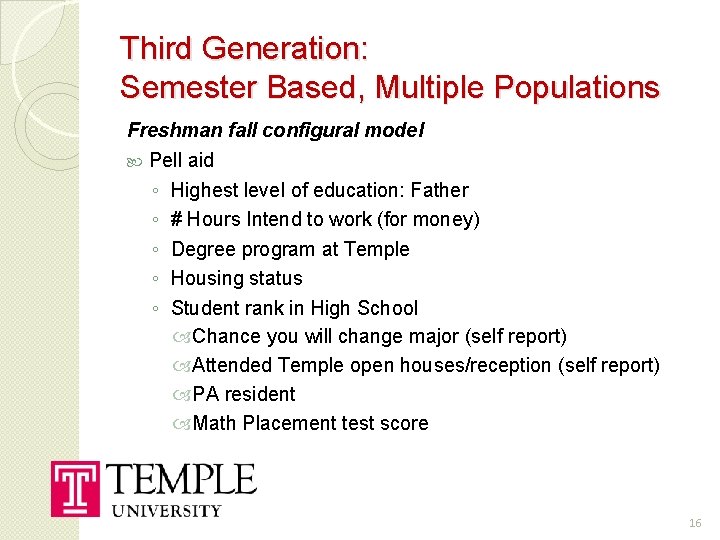
Third Generation: Semester Based, Multiple Populations Freshman fall configural model Pell aid ◦ Highest level of education: Father ◦ # Hours Intend to work (for money) ◦ Degree program at Temple ◦ Housing status ◦ Student rank in High School Chance you will change major (self report) Attended Temple open houses/reception (self report) PA resident Math Placement test score 16
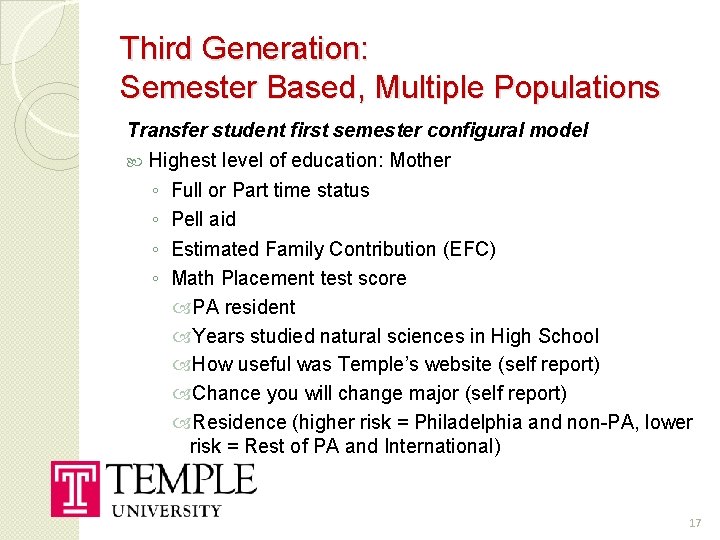
Third Generation: Semester Based, Multiple Populations Transfer student first semester configural model Highest level of education: Mother ◦ Full or Part time status ◦ Pell aid ◦ Estimated Family Contribution (EFC) ◦ Math Placement test score PA resident Years studied natural sciences in High School How useful was Temple’s website (self report) Chance you will change major (self report) Residence (higher risk = Philadelphia and non-PA, lower risk = Rest of PA and International) 17
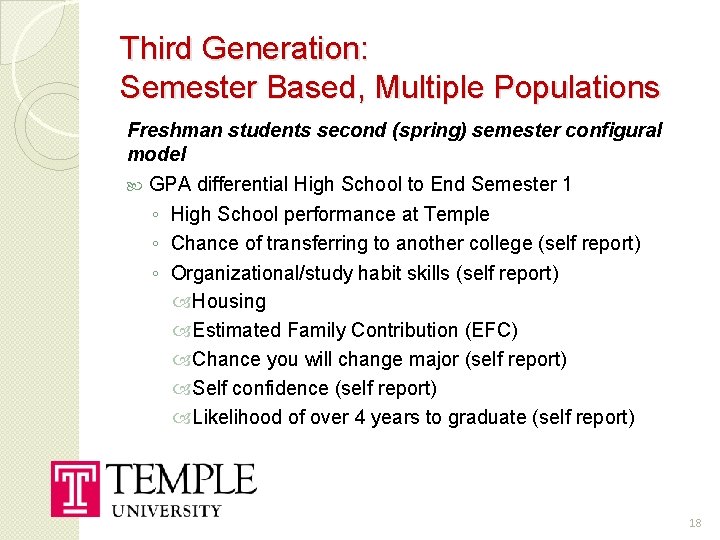
Third Generation: Semester Based, Multiple Populations Freshman students second (spring) semester configural model GPA differential High School to End Semester 1 ◦ High School performance at Temple ◦ Chance of transferring to another college (self report) ◦ Organizational/study habit skills (self report) Housing Estimated Family Contribution (EFC) Chance you will change major (self report) Self confidence (self report) Likelihood of over 4 years to graduate (self report) 18
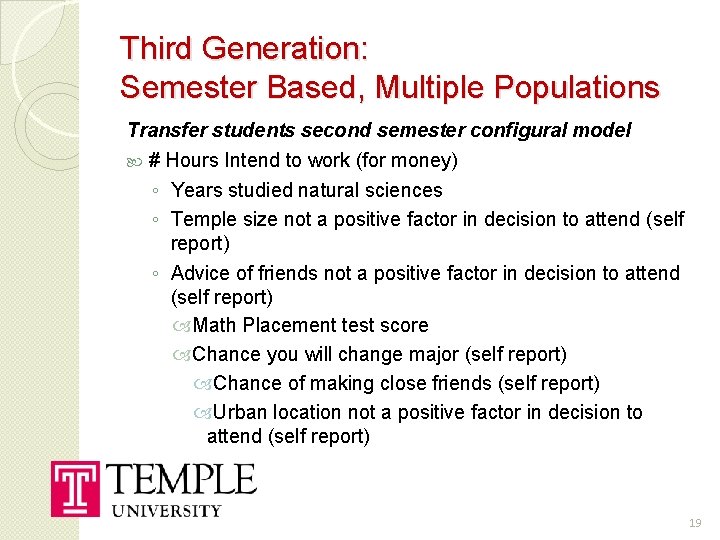
Third Generation: Semester Based, Multiple Populations Transfer students second semester configural model # Hours Intend to work (for money) ◦ Years studied natural sciences ◦ Temple size not a positive factor in decision to attend (self report) ◦ Advice of friends not a positive factor in decision to attend (self report) Math Placement test score Chance you will change major (self report) Chance of making close friends (self report) Urban location not a positive factor in decision to attend (self report) 19
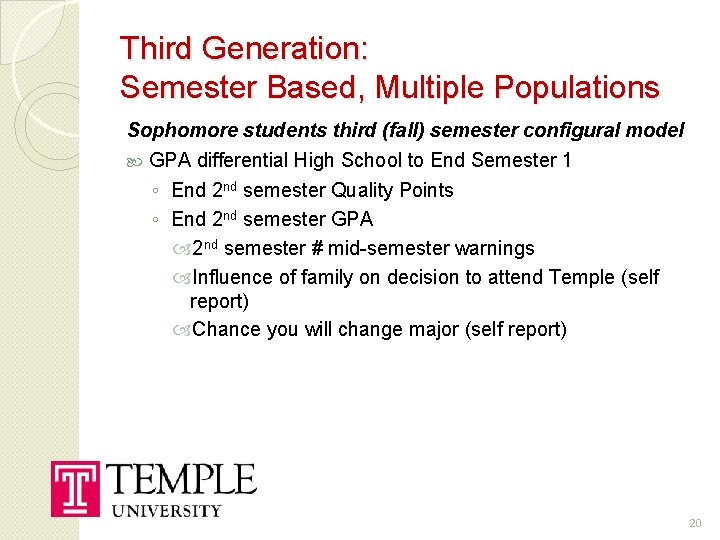
Third Generation: Semester Based, Multiple Populations Sophomore students third (fall) semester configural model GPA differential High School to End Semester 1 ◦ End 2 nd semester Quality Points ◦ End 2 nd semester GPA 2 nd semester # mid-semester warnings Influence of family on decision to attend Temple (self report) Chance you will change major (self report) 20
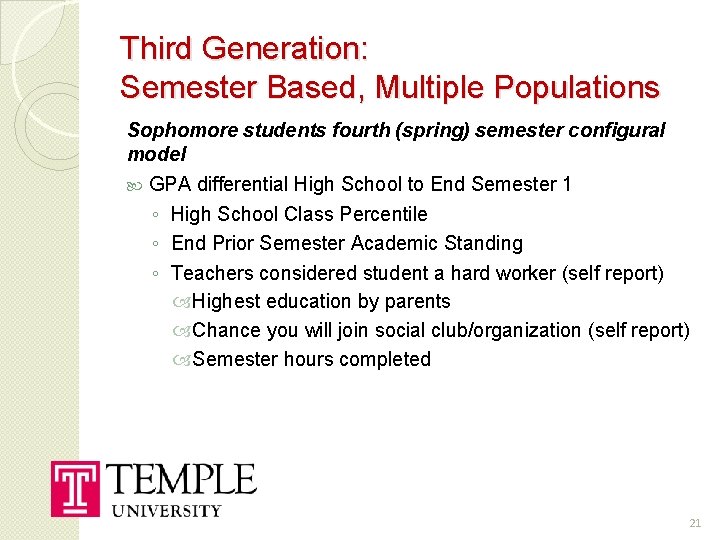
Third Generation: Semester Based, Multiple Populations Sophomore students fourth (spring) semester configural model GPA differential High School to End Semester 1 ◦ High School Class Percentile ◦ End Prior Semester Academic Standing ◦ Teachers considered student a hard worker (self report) Highest education by parents Chance you will join social club/organization (self report) Semester hours completed 21
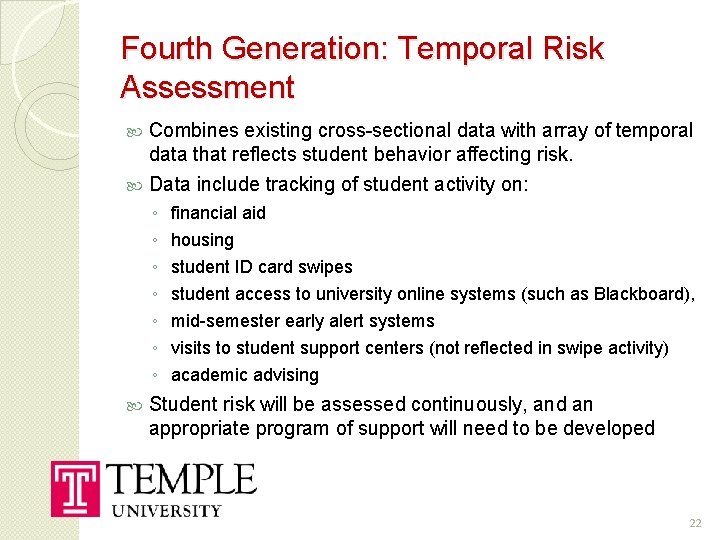
Fourth Generation: Temporal Risk Assessment Combines existing cross-sectional data with array of temporal data that reflects student behavior affecting risk. Data include tracking of student activity on: ◦ ◦ ◦ ◦ financial aid housing student ID card swipes student access to university online systems (such as Blackboard), mid-semester early alert systems visits to student support centers (not reflected in swipe activity) academic advising Student risk will be assessed continuously, and an appropriate program of support will need to be developed 22
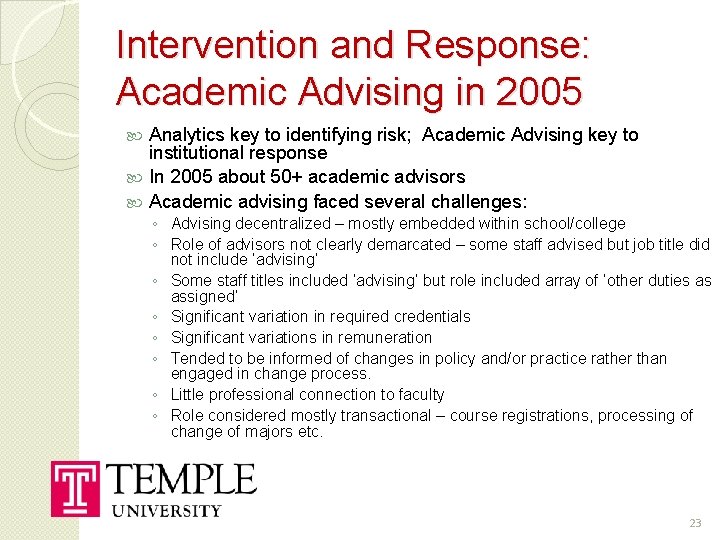
Intervention and Response: Academic Advising in 2005 Analytics key to identifying risk; Academic Advising key to institutional response In 2005 about 50+ academic advisors Academic advising faced several challenges: ◦ Advising decentralized – mostly embedded within school/college ◦ Role of advisors not clearly demarcated – some staff advised but job title did not include ‘advising’ ◦ Some staff titles included ‘advising’ but role included array of ‘other duties as assigned’ ◦ Significant variation in required credentials ◦ Significant variations in remuneration ◦ Tended to be informed of changes in policy and/or practice rather than engaged in change process. ◦ Little professional connection to faculty ◦ Role considered mostly transactional – course registrations, processing of change of majors etc. 23
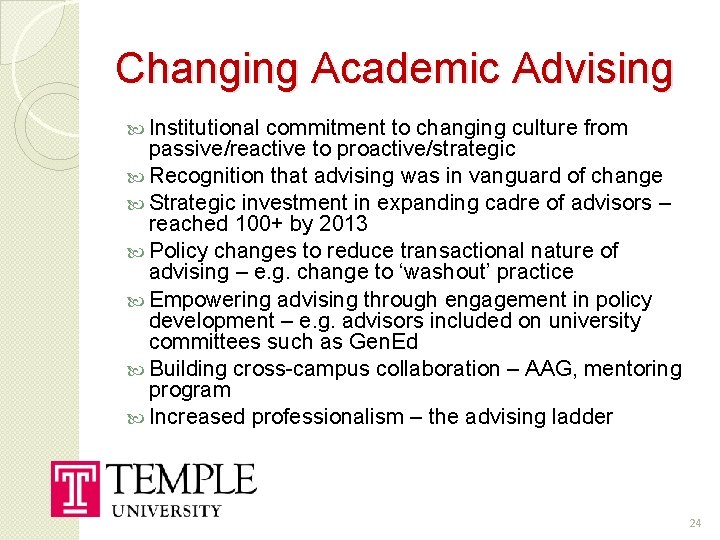
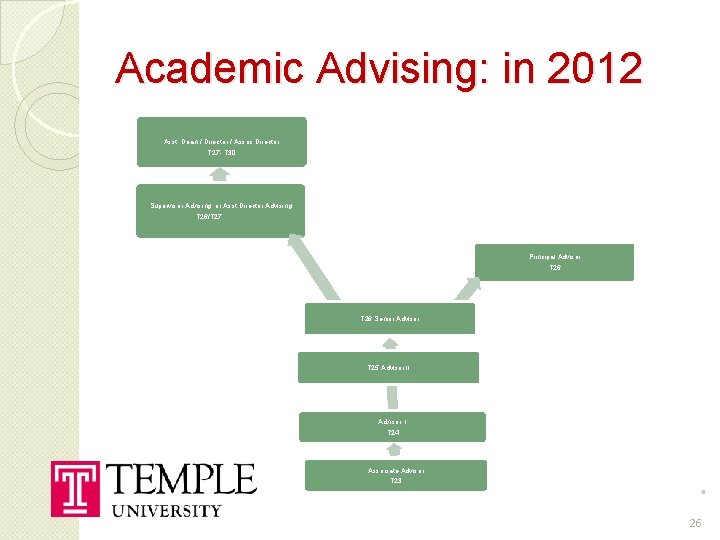
Changing Academic Advising Institutional commitment to changing culture from passive/reactive to proactive/strategic Recognition that advising was in vanguard of change Strategic investment in expanding cadre of advisors – reached 100+ by 2013 Policy changes to reduce transactional nature of advising – e. g. change to ‘washout’ practice Empowering advising through engagement in policy development – e. g. advisors included on university committees such as Gen. Ed Building cross-campus collaboration – AAG, mentoring program Increased professionalism – the advising ladder 24
Academic Advising: in 2005 Asst Dean/ Director T 27 -T 30 Associate/Assistan t Director T 25 - T 27 Academic Advisor T 24 -25 25
Academic Advising: in 2012 Asst Dean / Director / Assoc Director T 27 - T 30 Supervisor Advising or Asst Director Advising T 26/T 27 Principal Advisor T 26 Senior Advisor T 25 Advisor II Advisor I T 24 Associate Advisor T 23 26
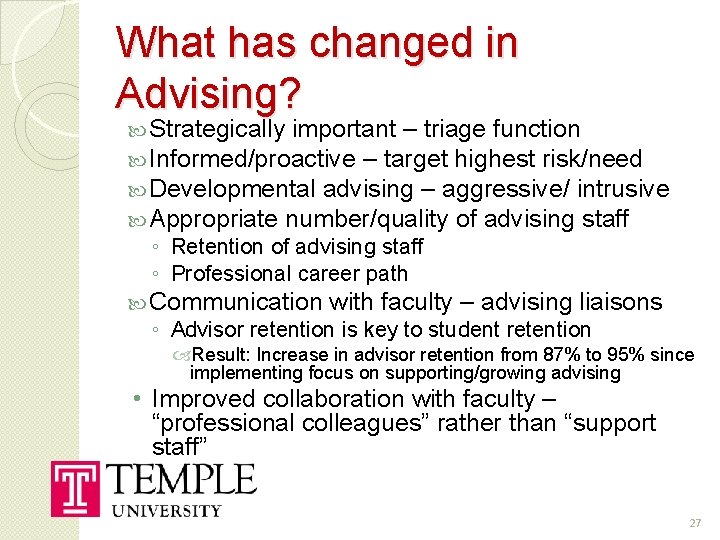
What has changed in Advising? Strategically important – triage function Informed/proactive – target highest risk/need Developmental advising – aggressive/ intrusive Appropriate number/quality of advising staff ◦ Retention of advising staff ◦ Professional career path Communication with faculty – advising liaisons ◦ Advisor retention is key to student retention Result: Increase in advisor retention from 87% to 95% since implementing focus on supporting/growing advising • Improved collaboration with faculty – “professional colleagues” rather than “support staff” 27
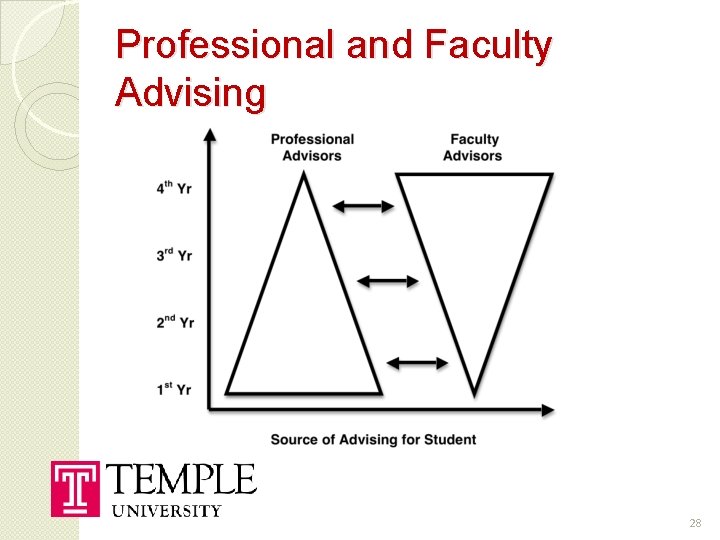
Professional and Faculty Advising 28
Organization of Interventions Coordinated centrally, developed locally Risk lists provided to all schools/colleges and specialized advising units Blackboard used to share all materials 29
Examples: College Liberal Arts “Stay on Track” Emphasis on ‘demystifying’ faculty to increase student: faculty engagement Provide financial literacy support Proactive (intrusive? ) outreach – multiple contacts via text, email, phone and in-person. Fox Business School “Fox Future Leaders” Early outreach inviting students to sign up for future leader program Social networking opportunities “Advice and a Slice” – meet peers, staff, advisors and with faculty Emphasis on leadership rather than ‘risk’ Focus always on strengthening engagement with the school through group advising and activities rather than one on one advising. 30
What are we learning: College Liberal Arts “Stay on Track” – retention rates for at-risk population have improved. Believe their efforts are scalable even with limited resources. In Fall 2014 98 at-risk students identified with predicted first semester attrition rates exceeding 25% for the group. Actual attrition was 4 students – a retention rate of 96%. 31
School/College Feedback: The risk lists include students with strong academic performance so… ◦ At-risk students not always the intuitive selection ◦ Interventions not always academic. Belief that at-risk students should be required to take a first year seminar course. Balancing risk program with other demands for time. Data overload – don’t need to know how, only who is at-risk and why. Incentivize advising unit participation and success. Keep sharing best practices 32
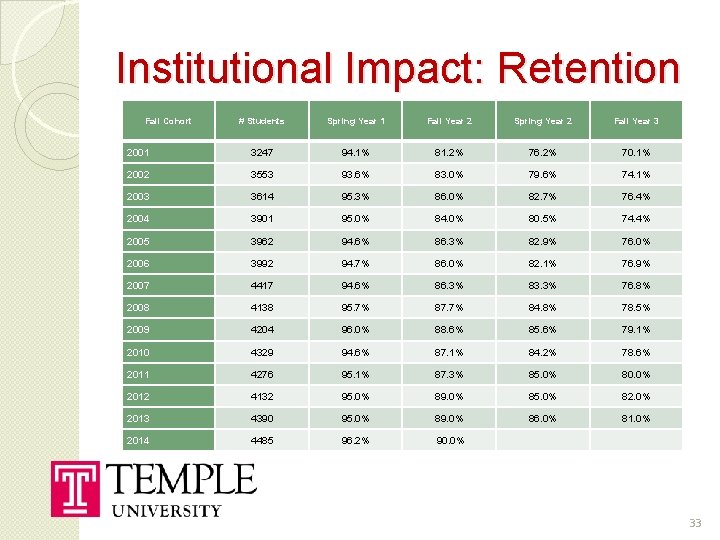
Institutional Impact: Retention Fall Cohort # Students Spring Year 1 Fall Year 2 Spring Year 2 Fall Year 3 2001 3247 94. 1% 81. 2% 76. 2% 70. 1% 2002 3553 93. 6% 83. 0% 79. 6% 74. 1% 2003 3614 95. 3% 86. 0% 82. 7% 76. 4% 2004 3901 95. 0% 84. 0% 80. 5% 74. 4% 2005 3962 94. 6% 86. 3% 82. 9% 76. 0% 2006 3992 94. 7% 86. 0% 82. 1% 76. 9% 2007 4417 94. 6% 86. 3% 83. 3% 76. 8% 2008 4138 95. 7% 87. 7% 84. 8% 78. 5% 2009 4204 96. 0% 88. 6% 85. 6% 79. 1% 2010 4329 94. 6% 87. 1% 84. 2% 78. 6% 2011 4276 95. 1% 87. 3% 85. 0% 80. 0% 2012 4132 95. 0% 89. 0% 85. 0% 82. 0% 2013 4390 95. 0% 89. 0% 86. 0% 81. 0% 2014 4485 96. 2% 90. 0% 33
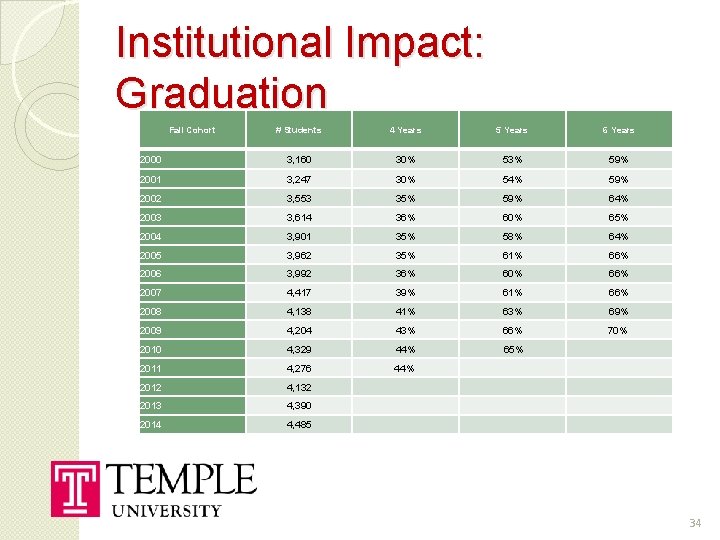
Institutional Impact: Graduation Fall Cohort # Students 4 Years 5 Years 6 Years 2000 3, 160 30% 53% 59% 2001 3, 247 30% 54% 59% 2002 3, 553 35% 59% 64% 2003 3, 614 36% 60% 65% 2004 3, 901 35% 58% 64% 2005 3, 962 35% 61% 66% 2006 3, 992 36% 60% 66% 2007 4, 417 39% 61% 66% 2008 4, 138 41% 63% 69% 2009 4, 204 43% 66% 70% 2010 4, 329 44% 65% 2011 4, 276 44% 2012 4, 132 2013 4, 390 2014 4, 485 34
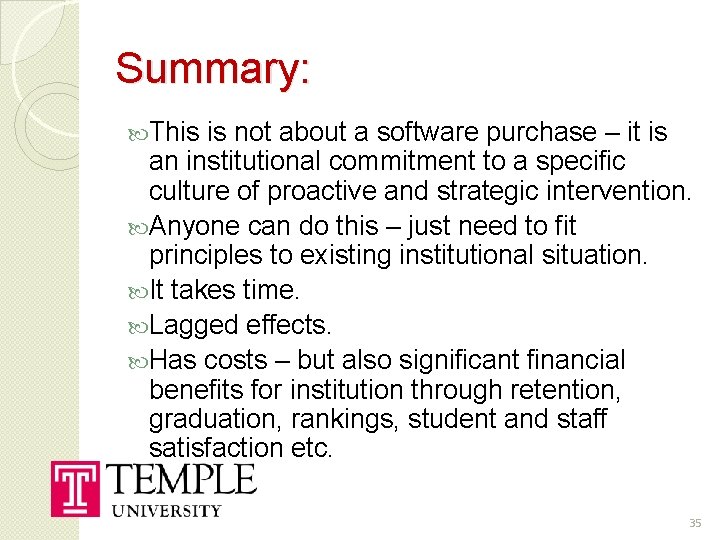
Summary: This is not about a software purchase – it is an institutional commitment to a specific culture of proactive and strategic intervention. Anyone can do this – just need to fit principles to existing institutional situation. It takes time. Lagged effects. Has costs – but also significant financial benefits for institution through retention, graduation, rankings, student and staff satisfaction etc. 35
Questions? Thank you. Peter R. Jones prjones@temple. edu 36