
Changing the Competency of Residency Education The Development
- Slides: 18
Changing the “Competency” of Residency Education: The Development of a Competency. Based Patient-Centered Medical Home Curriculum Bonnie T. Jortberg, MS, RD, CDE Nicole Deaner, MSW Linda Montgomery, MD David Clampitt, MD Perry Dickinson, MD
Presentation Overview • Project overview and PCMH curriculum competency development • Development of assessment tools (interview template, baseline report, resident survey) • Development of PCMH curriculum modules • PCMH curriculum implementation – real life experience from AF Williams
The Colorado Family Medicine Residency PCMH Project • 3 -year grant from the Colorado Health Foundation; began in December 2008 • Goal: To transform the 10 Colorado FM Residency Programs into medical homes through practice improvement and curriculum redesign
Who is Involved? • University of Colorado School of Medicine, Department of Family Medicine • Colorado Clinical Guidelines Collaborative • Colorado Association of Family Medicine Residencies • Colorado Institute for Family Medicine
Curriculum Redesign • Challenges and Opportunities – No organized, comprehensive PCMH curriculum or materials – No developed curriculum competencies – No tools to assess PCMH curricular activities or resident competency
PCMH Curriculum Competency Development • Started with developing competencies: – PCMH curriculum committee (faculty from UCDFM and CCGC) – See PCMH competency handout • Feedback from residency programs to “map” PCMH competencies to ACGME competencies
Curriculum Assessment • Developed Residency Curriculum Semi. Structured Interview Template (see handout) • Semi-Structured Template, completed with program faculty involved with curriculum: – Introductory questions (basic set up of program; how determine curriculum and process for making changes) • Competencies: – Who, what, where, when, how for each • Summary Questions: – Strengths/weaknesses of curriculum; resources; resident/staff/faculty interest and support
PCMH Curriculum Baseline Self -Assessment Report • Overall Observations from the Interviews – FMR has a curriculum committee that determines updates/changes to the curriculum. Each faculty member is assigned a section of the curriculum. This goes through an annual review process • Results from the PCMH Resident Curriculum Competency Survey • Key Areas Identified as PCMH Curricular Strengths
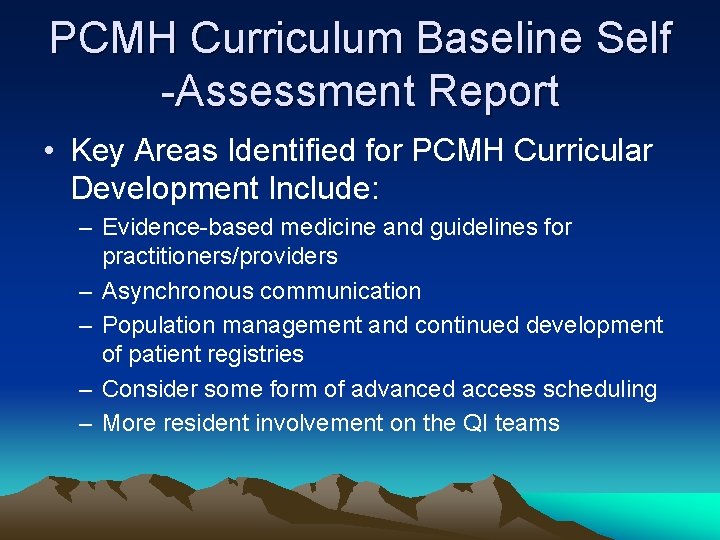
PCMH Curriculum Baseline Self -Assessment Report • Key Areas Identified for PCMH Curricular Development Include: – Evidence-based medicine and guidelines for practitioners/providers – Asynchronous communication – Population management and continued development of patient registries – Consider some form of advanced access scheduling – More resident involvement on the QI teams
PCMH Curriculum Baseline Self -Assessment Report • Key Areas Identified as PCMH Resource for Other Programs: – Resident involvement in QI teams – Strong integrated care team and curriculum.
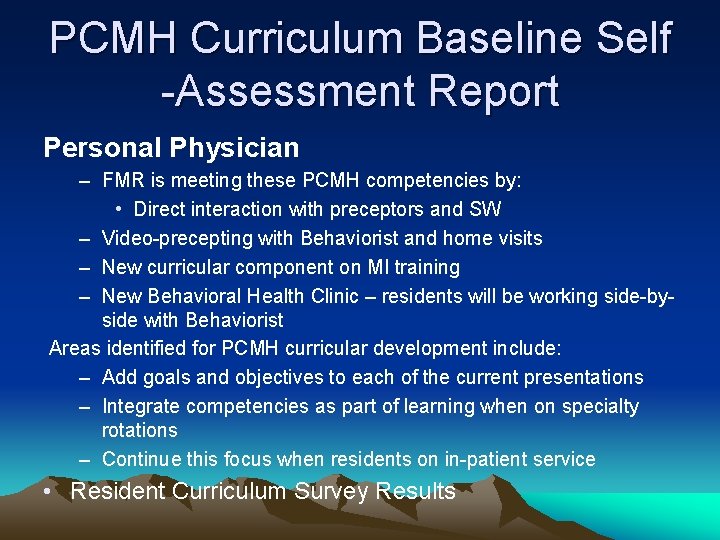
PCMH Curriculum Baseline Self -Assessment Report Personal Physician – FMR is meeting these PCMH competencies by: • Direct interaction with preceptors and SW – Video-precepting with Behaviorist and home visits – New curricular component on MI training – New Behavioral Health Clinic – residents will be working side-byside with Behaviorist Areas identified for PCMH curricular development include: – Add goals and objectives to each of the current presentations – Integrate competencies as part of learning when on specialty rotations – Continue this focus when residents on in-patient service • Resident Curriculum Survey Results
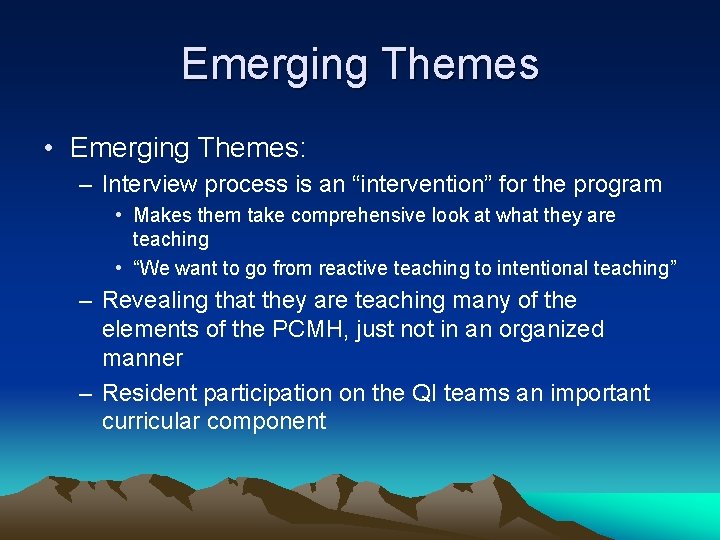
Emerging Themes • Emerging Themes: – Interview process is an “intervention” for the program • Makes them take comprehensive look at what they are teaching • “We want to go from reactive teaching to intentional teaching” – Revealing that they are teaching many of the elements of the PCMH, just not in an organized manner – Resident participation on the QI teams an important curricular component
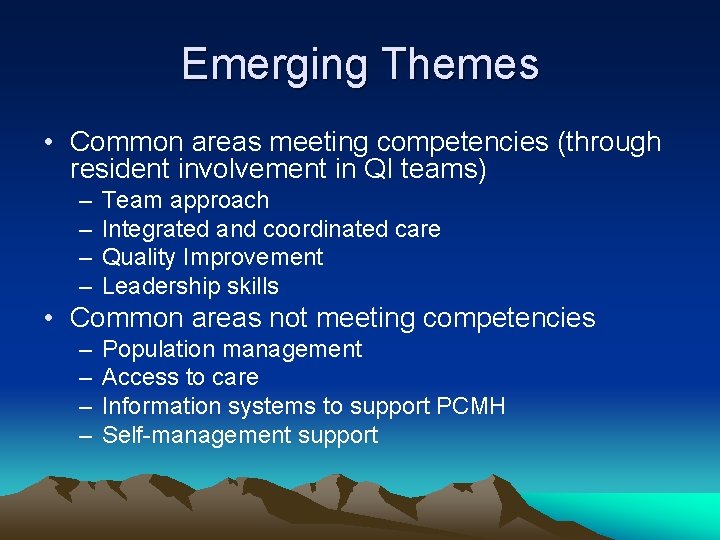
Emerging Themes • Common areas meeting competencies (through resident involvement in QI teams) – – Team approach Integrated and coordinated care Quality Improvement Leadership skills • Common areas not meeting competencies – – Population management Access to care Information systems to support PCMH Self-management support
PCMH Resident Curriculum Assessment Survey Results • Place holder – will add charts/graphs from survey results here
PCMH Curriculum Educational Modules • Created modules for each competency category • Place holder – will include example from elearning platform
AF Williams Experience with PCMH Curriculum
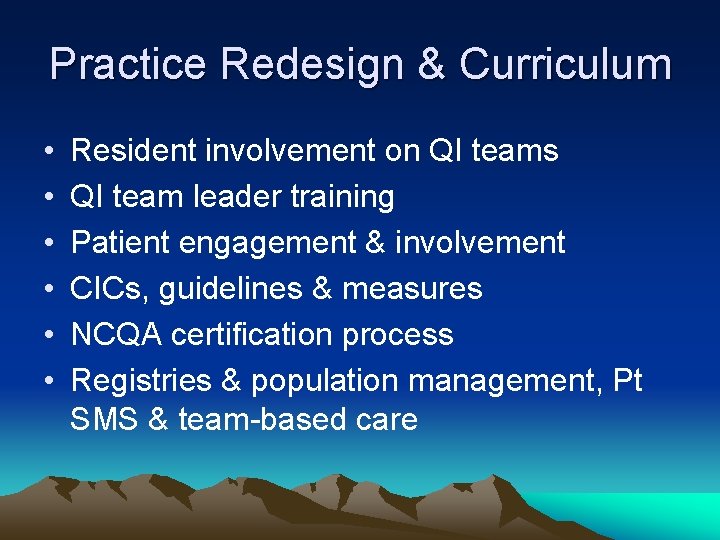
Practice Redesign & Curriculum • • • Resident involvement on QI teams QI team leader training Patient engagement & involvement CICs, guidelines & measures NCQA certification process Registries & population management, Pt SMS & team-based care
Questions? • Contact Information: – Perry Dickinson: perry. dickinson@ucdenver. edu – Bonnie Jortberg: bonnie. jortberg@ucdenver. edu – Nicole Deaner: ndeaner@coloradoguidelines. org – Linda Montgomery: Linda. montgomery@ucdenver. edu