
Changing Expectations Working together to support the individual


- Slides: 90
Changing Expectations: Working together to support the individual with FASD Dr. Karen Baker, Psychologist Regional Support Associates
It might be FASD if…. Peter breaks into a house and gets caught eating the chocolate cake from the fridge while watching TV
It might be FASD if…. Matt “borrows” his father’s car and gets involved in a low speed chase from the police and drives into a building and then runs (he doesn’t have a license)
It might be FASD if…. Cindy is always late or misses meetings with her CAS worker
It might be FASD if…. Kristy’s parents go bankrupt paying off her cell phone and internet usage bills
Facts Estimated 1% of population have FAS 3 – 5 times more have FASD usually undiagnosed FASD largest incidence of birth defects Estimated 50% of offenders have undiagnosed FASD Each individual with FASD costs the taxpayer approximately $1. 5 million in his/her lifetime In Canada total cost for all FASD = $600 billion over a lifetime
Terminology Fetal Alcohol Spectrum Disorder Fetal Alcohol Syndrome Partial Fetal Alcohol Syndrome Alcohol-Related Neurodevelopmental Disorder (ARND) Alcohol-Related Birth Defects Static Encephalopathy
FAS diagnostic criteria A. Confirmed maternal alcohol exposure B. Facial anomalies C. Growth retardation D. Central nervous system neurodevelopmental abnormalities FAS without confirmed maternal drinking B, C & D
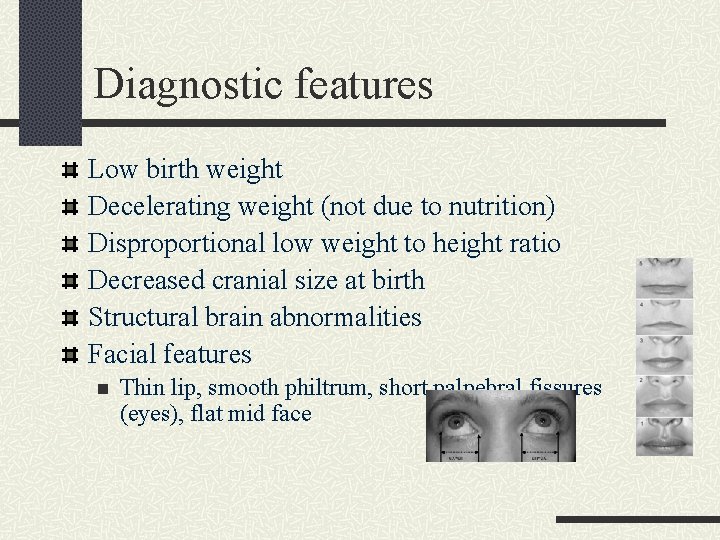
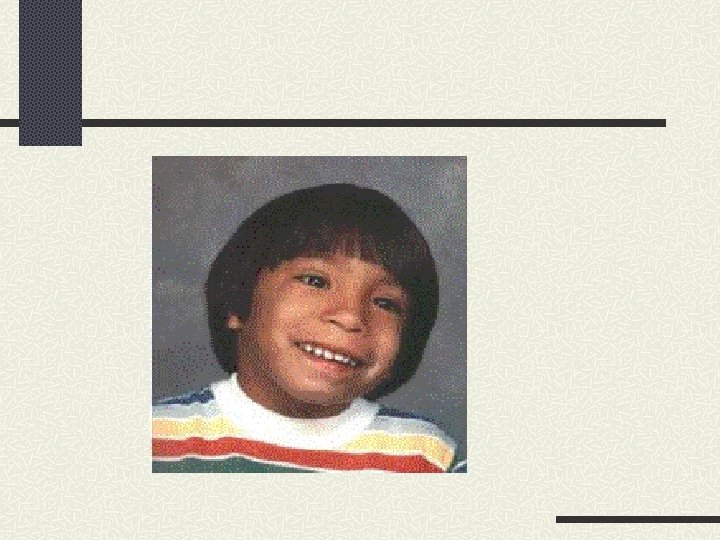
Diagnostic features Low birth weight Decelerating weight (not due to nutrition) Disproportional low weight to height ratio Decreased cranial size at birth Structural brain abnormalities Facial features n Thin lip, smooth philtrum, short palpebral fissures (eyes), flat mid face
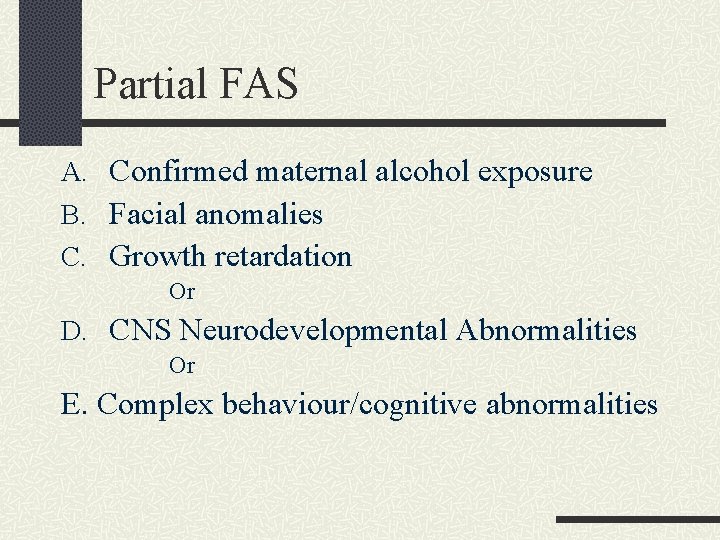
Partial FAS A. Confirmed maternal alcohol exposure B. Facial anomalies C. Growth retardation Or D. CNS Neurodevelopmental Abnormalities Or E. Complex behaviour/cognitive abnormalities
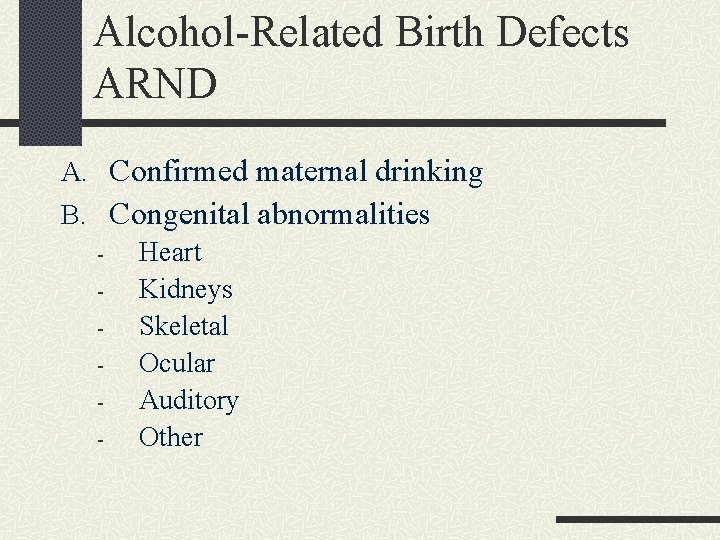
Alcohol-Related Birth Defects ARND A. Confirmed maternal drinking B. Congenital abnormalities Heart Kidneys Skeletal Ocular Auditory Other
ARND: Alcohol-Related Neurodevelopmental disorder A. Confirmed maternal drinking Presence of B or C or both B. CNS Neurodevelopmental abnormalities C. Complex pattern of behaviour or cognitive abnormalities that are inconsistent with developmental level and cannot be explained by familial background or environment alone.
Confirmed maternal drinking Pattern of excessive alcohol intake characterized by regular intake or heavy episodic drinking - frequent episodes of intoxication - tolerance or withdrawal -social problems related to drinking -legal problems related to drinking -medical problems related to drinking -risky behaviour while drinking
Complicating factors Mother may be in abusive situation Smoking Other drug use Poor nutrition Poor hygiene
After birth Possibility of Neglect n Abuse n Poor nutrition n Lack of stimulation n Attachment problems n
Protective factors Early diagnosis Caring environment Early intervention Continual and appropriate educational supports Supports for transitions Identification of individual strengths and needs
Barriers to Assessment Limited capacity across the country Isolated areas Not enough trained professionals with respect to FAS History often difficult to obtain Maternal drinking often difficult to confirm Lack of birth records Assessment of adults
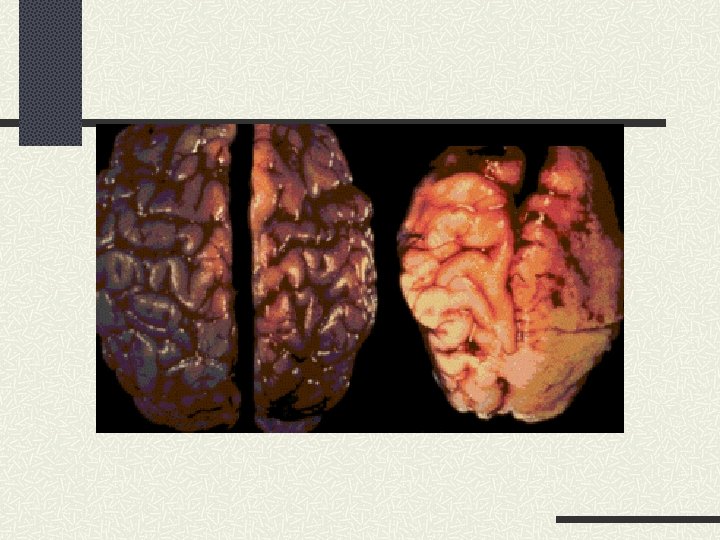
FASD is Brain Damage There is no cure.
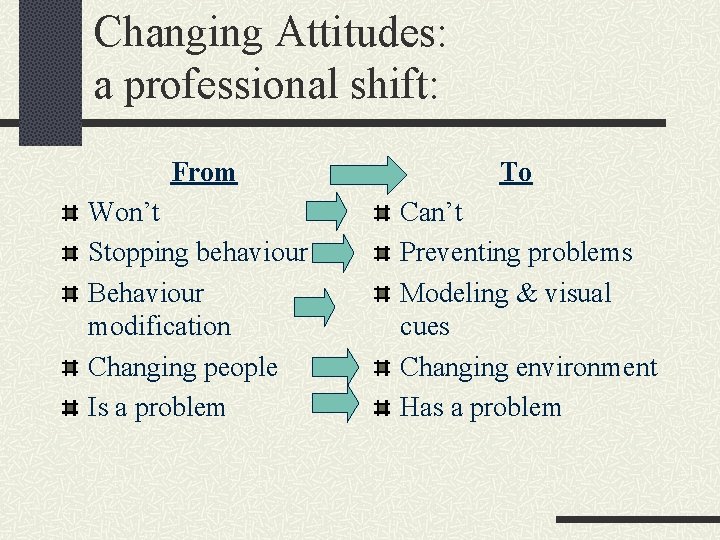
Changing Attitudes: a professional shift: From Won’t Stopping behaviour Behaviour modification Changing people Is a problem To Can’t Preventing problems Modeling & visual cues Changing environment Has a problem
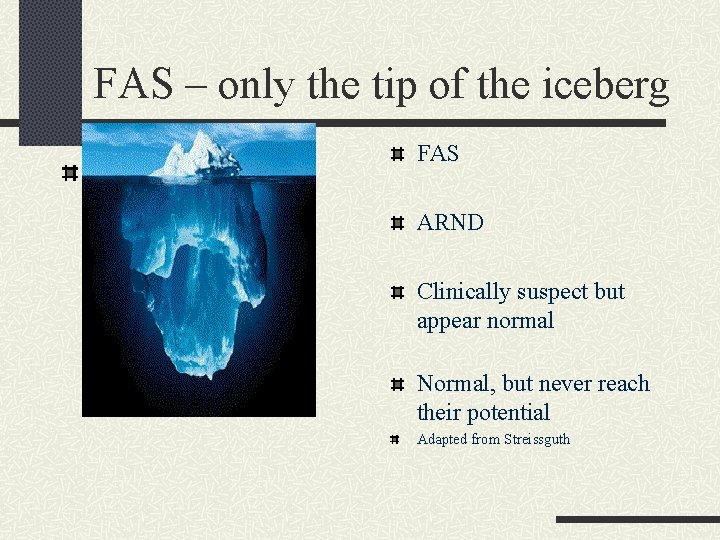
FAS – only the tip of the iceberg FAS ARND Clinically suspect but appear normal Normal, but never reach their potential Adapted from Streissguth
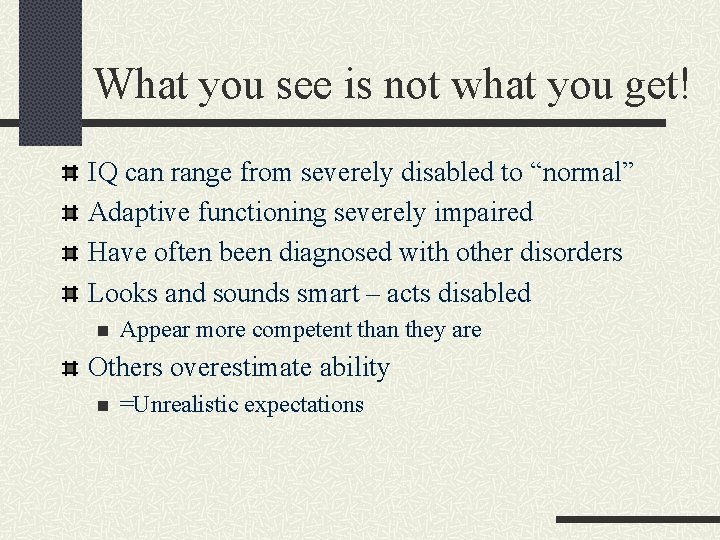
What you see is not what you get! IQ can range from severely disabled to “normal” Adaptive functioning severely impaired Have often been diagnosed with other disorders Looks and sounds smart – acts disabled n Appear more competent than they are Others overestimate ability n =Unrealistic expectations
Variable impairments Pattern and level of prenatal exposure create unique patterns of impairments and strengths No one defining characteristic Wide range of learning disabilities Diverse needs
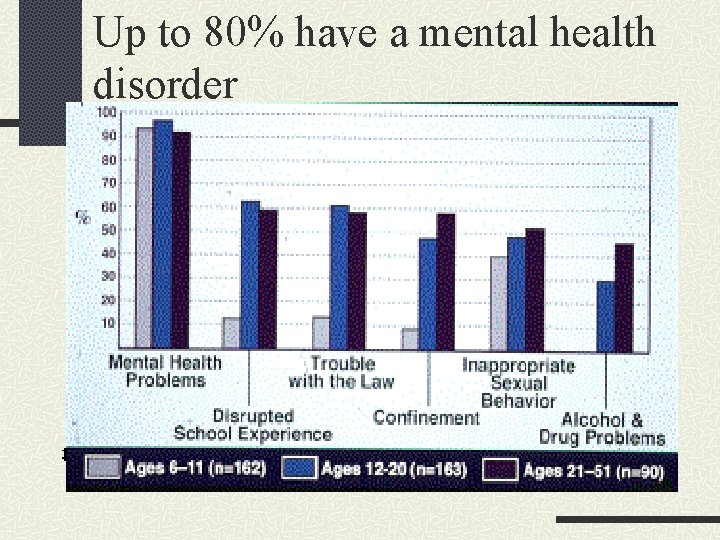
Up to 80% have a mental health disorder Streissguth, et al. , 1996
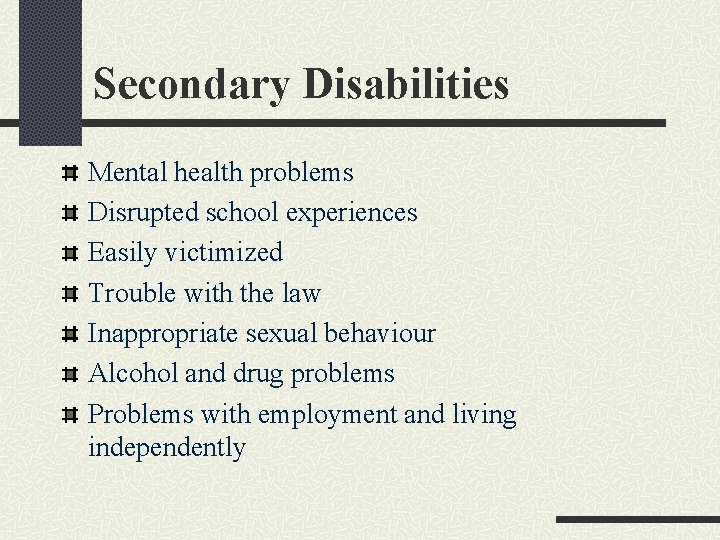
Secondary Disabilities Mental health problems Disrupted school experiences Easily victimized Trouble with the law Inappropriate sexual behaviour Alcohol and drug problems Problems with employment and living independently
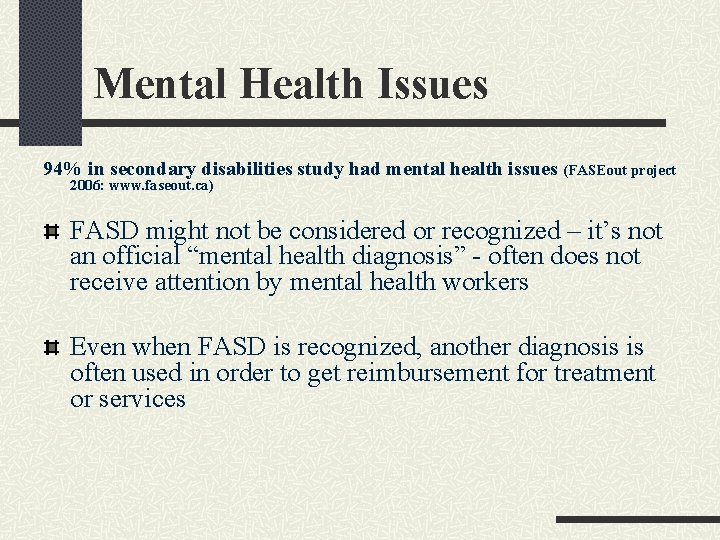
Mental Health Issues 94% in secondary disabilities study had mental health issues (FASEout project 2006: www. faseout. ca) FASD might not be considered or recognized – it’s not an official “mental health diagnosis” - often does not receive attention by mental health workers Even when FASD is recognized, another diagnosis is often used in order to get reimbursement for treatment or services
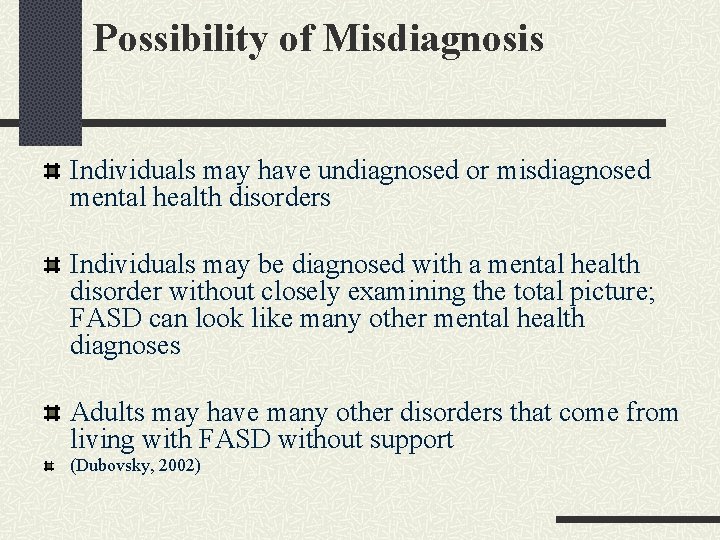
Possibility of Misdiagnosis Individuals may have undiagnosed or misdiagnosed mental health disorders Individuals may be diagnosed with a mental health disorder without closely examining the total picture; FASD can look like many other mental health diagnoses Adults may have many other disorders that come from living with FASD without support (Dubovsky, 2002)
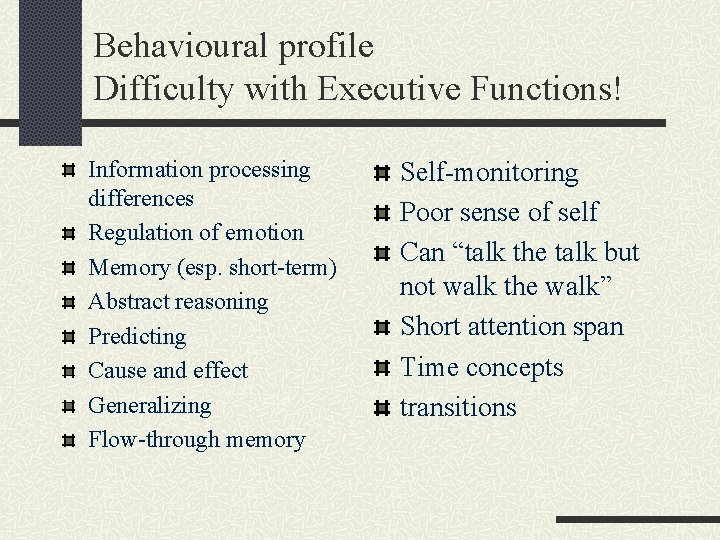
Behavioural profile Difficulty with Executive Functions! Information processing differences Regulation of emotion Memory (esp. short-term) Abstract reasoning Predicting Cause and effect Generalizing Flow-through memory Self-monitoring Poor sense of self Can “talk the talk but not walk the walk” Short attention span Time concepts transitions
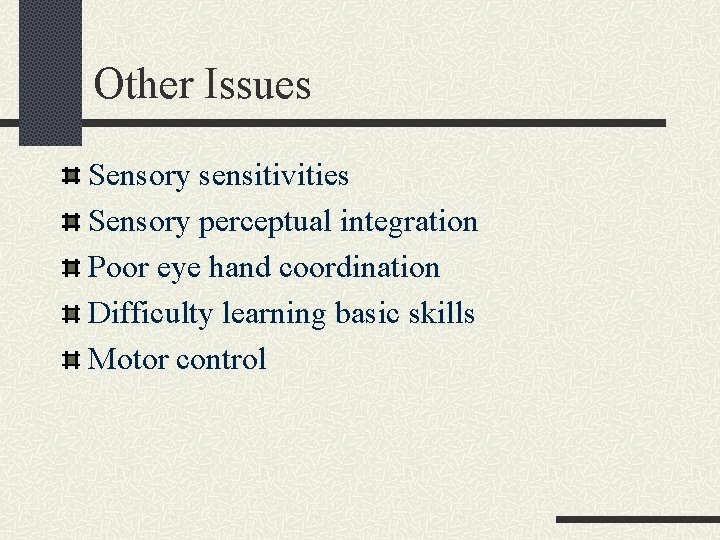
Other Issues Sensory sensitivities Sensory perceptual integration Poor eye hand coordination Difficulty learning basic skills Motor control
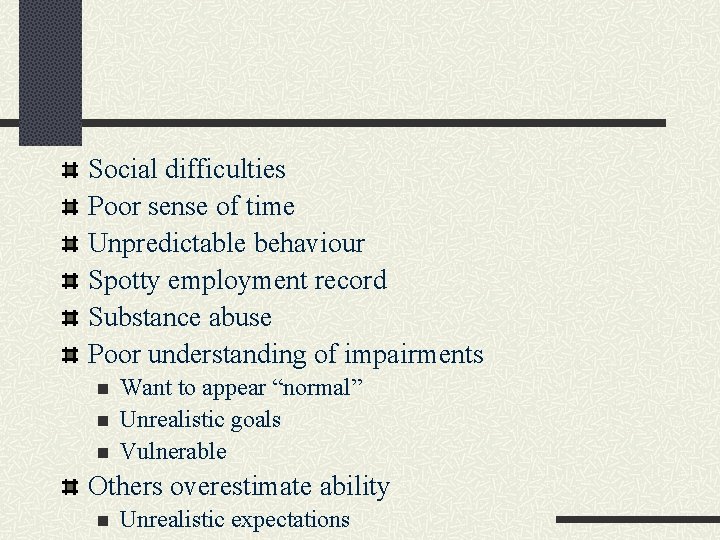
Social difficulties Poor sense of time Unpredictable behaviour Spotty employment record Substance abuse Poor understanding of impairments n n n Want to appear “normal” Unrealistic goals Vulnerable Others overestimate ability n Unrealistic expectations
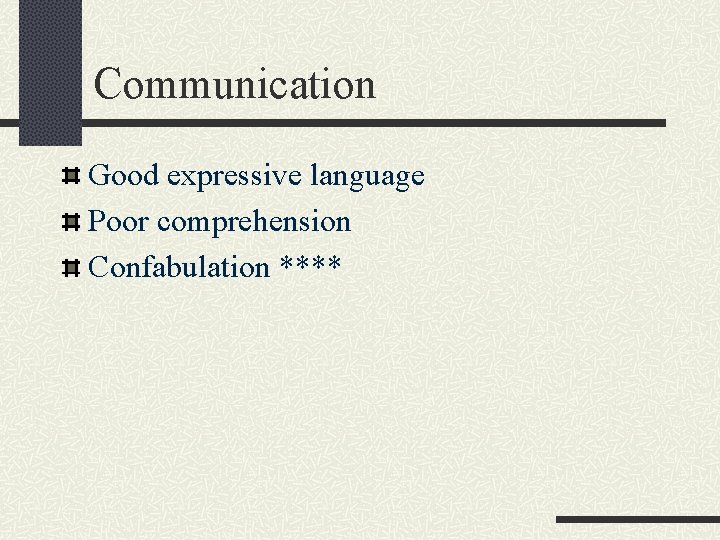
Communication Good expressive language Poor comprehension Confabulation ****
A. L. A. R. M. A – Adaptive behaviour n Weak life skills, difficulty meeting expectations L – Language n Good expressive language with poor comprehension A – Attention n Impulsive, limited concentration R – Reasoning n Inappropriate reactions. Difficulty linking action and consequence M – Memory n Weak short term or working memory, poor memory for details
Hidden Strengths!!!! Persistence and commitment in low stress situations Succeed in structured situations Learn effectively hands-on Can be loyal and kind Strong visual memory Good verbal fluency Creativity High energy level Athletic skills in individual sports
Early childhood “difficult child” Not bonding Hypersensitive Delayed milestones Poor sleep/wake pattern Difficulty with transitions Poor receptive language skills Lack of stranger anxiety
Behavioural Expectations: age 5 Typical 5 yr old Goes to school Follow 3 instructions Interactive, cooperative play Share Take turns Deb Evansen: Minnesota organization on Fetal Alcohol syndrome (www. mofas. org) FAS: 5 yrs going on 2 Take naps Follow one instruction Help mommy Sit still for 5 -10 minutes Parallel play Very active “my way or no way”
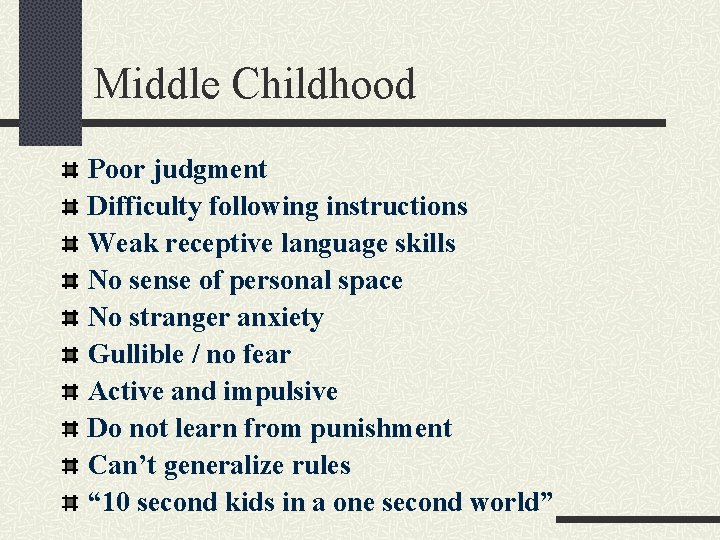
Middle Childhood Poor judgment Difficulty following instructions Weak receptive language skills No sense of personal space No stranger anxiety Gullible / no fear Active and impulsive Do not learn from punishment Can’t generalize rules “ 10 second kids in a one second world”
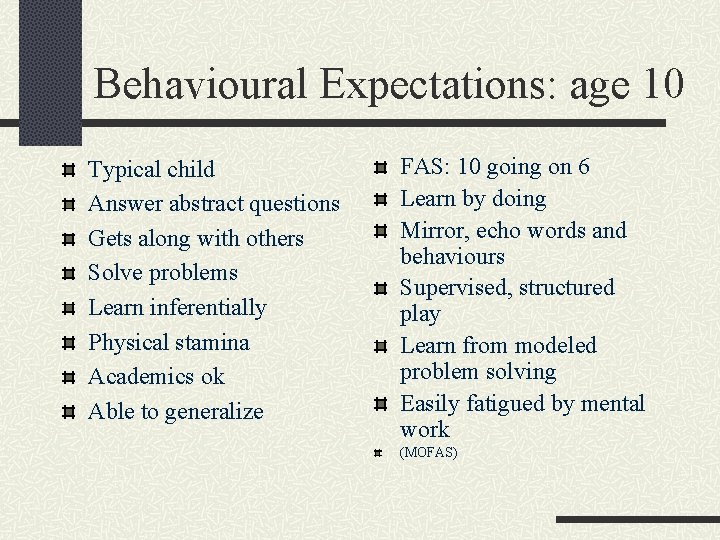
Behavioural Expectations: age 10 Typical child Answer abstract questions Gets along with others Solve problems Learn inferentially Physical stamina Academics ok Able to generalize FAS: 10 going on 6 Learn by doing Mirror, echo words and behaviours Supervised, structured play Learn from modeled problem solving Easily fatigued by mental work (MOFAS)
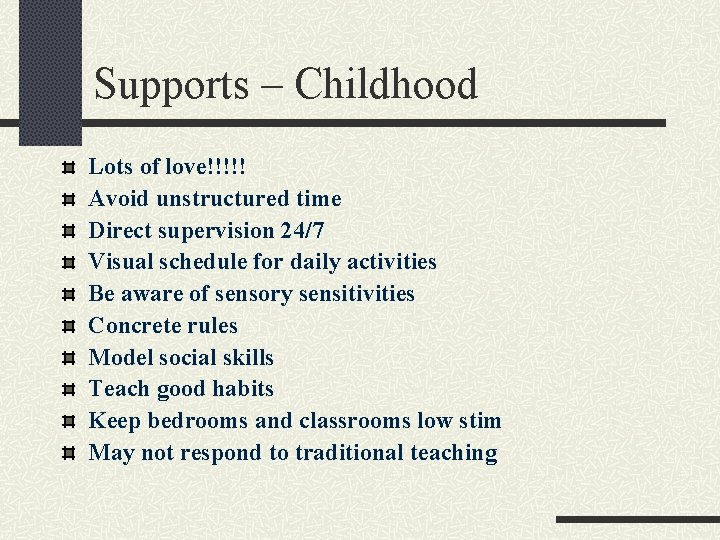
Supports – Childhood Lots of love!!!!! Avoid unstructured time Direct supervision 24/7 Visual schedule for daily activities Be aware of sensory sensitivities Concrete rules Model social skills Teach good habits Keep bedrooms and classrooms low stim May not respond to traditional teaching
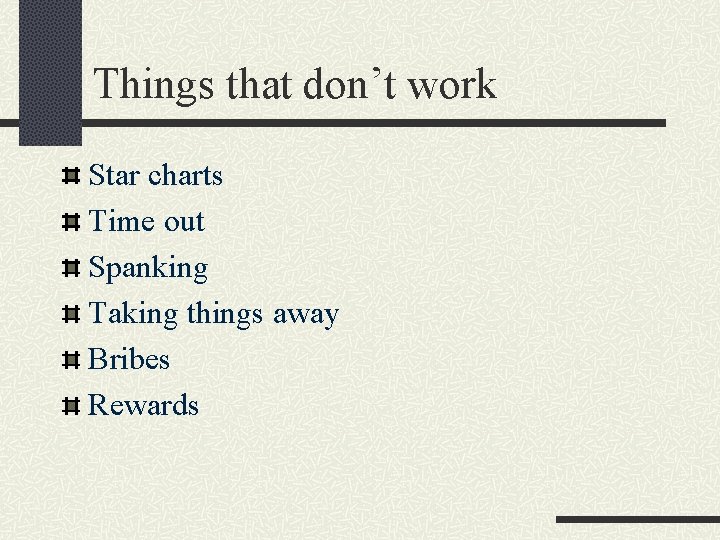
Things that don’t work Star charts Time out Spanking Taking things away Bribes Rewards
Adolescence Difficulty organizing tasks and materials Social problems Auditory processing problems May not respond to traditional teaching methods Difficulty following multiple directions May “melt down” due to sensory overload Act out in frustration when don’t understand
Adolescence Lying and stealing behaviours Easily manipulated by negative peer groups Faulty logic / fails to predict consequences Does not learn from experience Seems to show little remorse Can’t “walk the walk” Supervision needs similar to preschooler
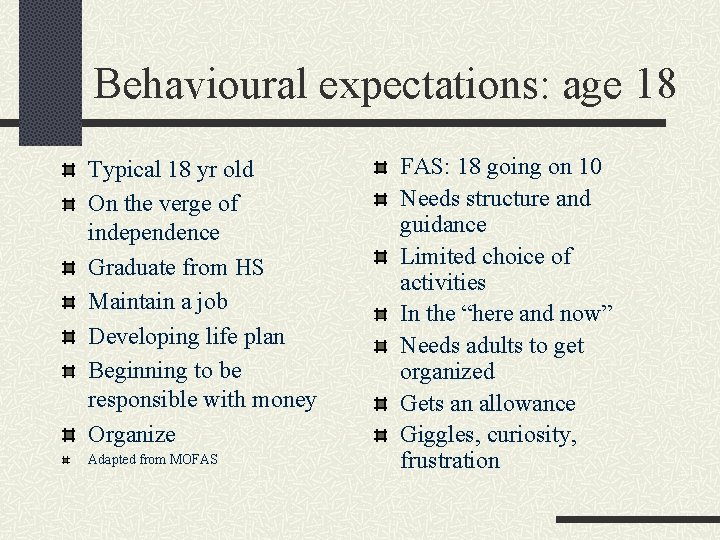
Behavioural expectations: age 18 Typical 18 yr old On the verge of independence Graduate from HS Maintain a job Developing life plan Beginning to be responsible with money Organize Adapted from MOFAS FAS: 18 going on 10 Needs structure and guidance Limited choice of activities In the “here and now” Needs adults to get organized Gets an allowance Giggles, curiosity, frustration
Supports: adolescents Unconditional love! Remember to think about developmental age, not chronological age Direct supervision, structure, routine! Check where going, who with etc. Remember peers can be great risk Praise good choices or attempts Teach good habits Model appropriate behaviour Provide experiences that use their strengths
Things that don’t work All the things that didn’t work with children Contracts Missing out on important events as punishment Jail time Reducing structure to increase independence Reduce structure because doing well
Adults Have often been diagnosed with other disorders Appear more competent than they are Looks and sounds smart – acts disabled Unrealistic / poor judgment Lacks self direction/control/discipline Memory deficits Unable to cope with day to day living First choice is only choice May be volatile
Adults (2) Social difficulties Poor sense of time Unpredictable behaviour Spotty employment record Substance abuse Poor understanding of impairments n n n Want to appear “normal” Unrealistic goals Vulnerable Others overestimate ability n Unrealistic expectations
8 magic keys for developing successful interventions Be concrete Consistency Repetition Routine Simplicity: keep it short and sweet Be specific: say exactly what you mean Structure Supervision n From fascenter. samhsa. gov
SCREAMS: 7 Secrets to Success Structure Cues Role models Environment Attitude Medications Supervision ( from Teresa Kellerman fasstar. com)
Red Flag Behaviours for FASD Non escalating pattern of repeat offences often the same offence Warnings, probation, prison do not deter Appears to have no remorse Exacerbated by drugs and alcohol Nice, friendly individuals when not drinking. Childlike criminals
Easily lead by others – usually the one that gets caught Often act against their own interests Inability to understand court proceedings and to assist in own defence
FASD and the justice system May not understand what is happening to them Do not understand rights/ may waive rights to appease the officer May not know the word ‘counsel’ means lawyer May have acted inappropriately during the arrest Memory difficulties/ poor time awareness may impact quality of information
FASD and Justice System False confession? n n Wanting to please / appease Did the individual confess to something they don’t have the capacity to remember? Difficulty understanding “undertakings, ” promises to appear, bail conditions or probation orders n n May be incapable of following time lines and expectations Won’t admit to not understanding
Equality Rights Section 15 Charter of Rights and Freedom 15. (1) Every individual is equal before and under the law and has the right to the equal protection and equal benefit of the law without discrimination and, in particular, without discrimination based on race, national or ethnic origin, colour, religion, sex, age or mental or physical disability.
Create an Identity Card David has Fetal Alcohol Spectrum disorder. If arrested call this number. David needs to see a lawyer immediately. David is exercising all of his Charter rights, specifically his right to counsel and his right to silence. David does not agree to waive any of his Charter rights. Phone numbers…………
For Lawyers Appear to understand more than they do Late or missed appointments Same offence –same circumstances Easily led by Police, Crown, Probation Officers – may act against their own interests Pleasant & engaging in interview
In Court May act inappropriately – appears not to respect the court Not able to tell court what happened in a way that makes sense Takes no responsibility for crime Will participate in pre-sentencing report even if against own interests
Jail? Immediate arrest: connects acts with consequences Long term incarceration rarely effective n Long time between offence and punishment Diversions programs Need for community based services
Individuals with FASD need an EXTERNAL BRAIN
Remember!!! Aggressive/volatile behaviour is not predatory Do not understand consequences of actions Difficulty learning from experience Think brain, not blame Supervision, supervision
Try Differently, not harder(Malbin) Remember that people with FASD have organic brain differences Modify environment / expectations Observe patterns of behaviour Reframe: from “won’t” to “can’t” Identify strengths, skills and interests Provide structure rather than control Establish routines
What does not work Group counselling doesn’t work Talk therapy doesn’t work Talk fast / too much / explain Over-react Expect independence Traditional behaviour modification approaches
Needs Housing Employment Ongoing supports Financial management Social activities Mental and physical health care Supervision!!!
Supports Realistic timelines – not ready for independent living at 18 Teach social skills Teach life skills Routines extremely important Concrete instructions / reinforcement Circles of support Adjust expectations Reminders re time: schedules/timers/lists Digital watch with alarm
CARES Model Cues Attitude Repetition Expectations Support (for a copy refer to www. annewright. ca; we CARES manual)
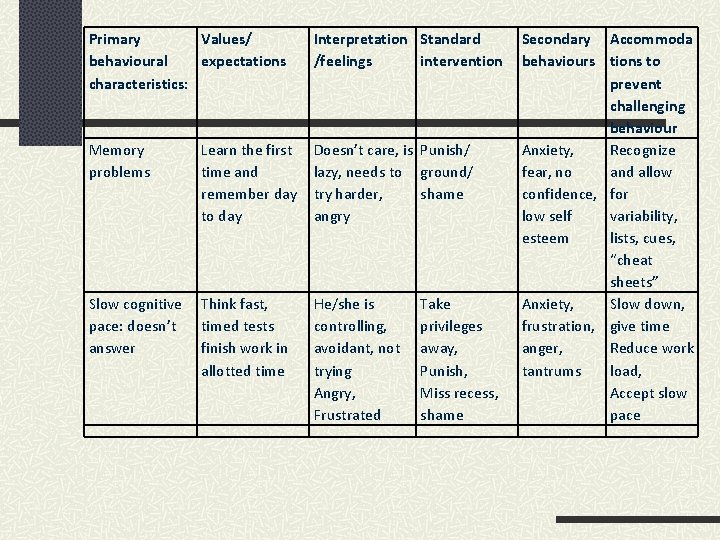
Primary Values/ behavioural expectations characteristics: Interpretation Standard /feelings intervention Memory problems Learn the first time and remember day to day Doesn’t care, is Punish/ lazy, needs to ground/ try harder, shame angry Slow cognitive pace: doesn’t answer Think fast, timed tests finish work in allotted time He/she is controlling, avoidant, not trying Angry, Frustrated Take privileges away, Punish, Miss recess, shame Secondary Accommoda behaviours tions to prevent challenging behaviour Anxiety, Recognize fear, no and allow confidence, for low self variability, esteem lists, cues, “cheat sheets” Anxiety, Slow down, frustration, give time anger, Reduce work tantrums load, Accept slow pace
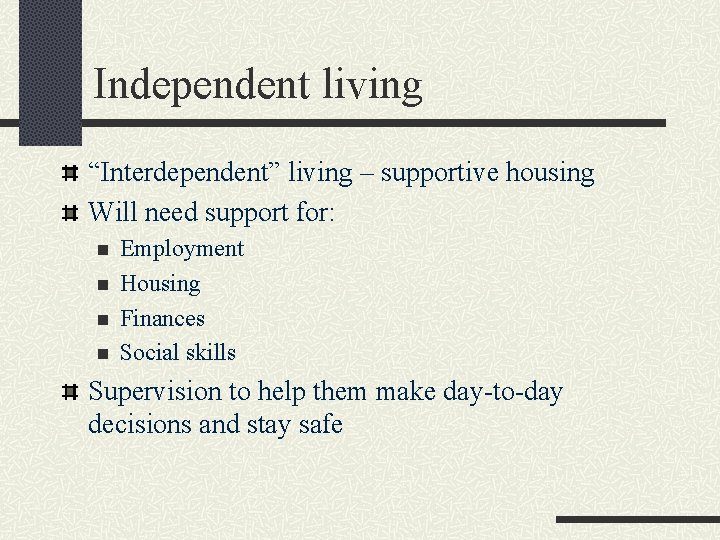
Independent living “Interdependent” living – supportive housing Will need support for: n n Employment Housing Finances Social skills Supervision to help them make day-to-day decisions and stay safe
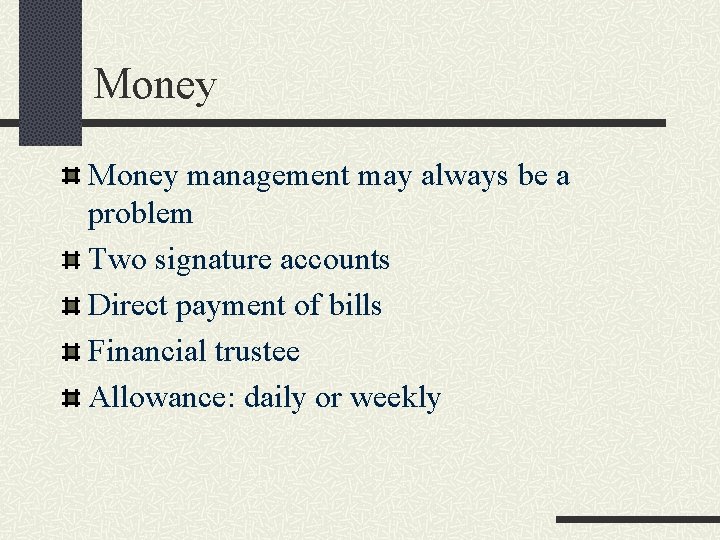
Money management may always be a problem Two signature accounts Direct payment of bills Financial trustee Allowance: daily or weekly
Employment Supported employment Job placement/ job coaching services KEY: reasonable expectations!!!! Use concrete language n Consistency and routine n Ongoing training n Review job expectations frequently n Help to interpret wishes and actions of others n
Hiring someone with FASD Hardworking, eager to please Loyal, fun, Hidden talents and strengths But Need structure and routine, repetition Restate job expectations, acceptable behaviour Checklists, visual cues
Strategies Simple concrete rules Limit choices = reduced stress Reasonable expectations Avoid why questions Be aware of fatigue Prepare in advance for transitions
More strategies Cuing Strategies for remembering n Lists, photographs, visual supports Use familiar language Aim for over learning One instruction at a time
And more… Role models Environment Attitude Medications Supervision
Work with the individual Brainstorm ways to stay organized Teach reasoning skills and sequential skills Be a mentor Model behaviour Practice! Develop privacy awareness
Teach functional and supportive life skills Safety Money management Social interaction Appropriate leisure skills Work-related skills Clear boundaries
Teach skills in several settings Use real life situations Prompt to use skill Build skills into chain of related skills Consistency in approach Check frequently to see if has generalized concept of skill
Teach time concepts Difficulty with analog clocks Difficulty with yesterday, last year, next week Teach in physical, concrete ways n Egg timer, visual charts
School/home interventions Developmental level should be the starting point for instructional planning n Leads to appropriate expectations Collaborative planning- build a team Communication books!
Classroom environment Calm, flexible, quiet environment n E. g. , tennis balls of chair legs Partitions Headphones, soothing music for quiet seat work Reduce displays on walls Distinct activity areas Additional space to organize belongings
Seating Seat students next to appropriate role models Plan movement breaks Low traffic flow location, away from distractions (windows, doors etc)
Gain attention Nonverbal cues Secret signals Simplify directions Stand near student Allow movement
Routine Consistency Develop expectations n (coming into class, requesting teacher’s attention etc. ) Checklists for routines Visual cues for routines Post daily and weekly schedules
Work with student Brainstorm ways to stay organized Teach reasoning skills and sequential skills Regular cleanup of desks/lockers Encourage self-talk Model behaviour Practice!
Teach pretend play Helps to distinguish between: True/false n Real/imaginary n Pretending/lying n Ask truth or story?
If strategies don’t work: don’t try harder, Try something different!!!
For Caregivers Take care of yourself Educate yourself and others about FASD Pick your battles Ask for respite Maintain own interests and hobbies Have patience Join a support group Surround yourself with understanding people Don’t sweat the small stuff
Resources FASD and the Criminal Legal System: Are we criminalizing disability? (video) n Deborah Rutman: drutman@uvic. ca Fetal Alcohol Syndrome and the Criminal Justice System (set of 3 videos) n www. asantecentre. org FASD and Legal Professionals n www. nogemag. ca
Resources 2 Mistakes I have made with FAS Clients n David Boulding, Criminal Lawyer When children who have FASD are arrested: What Parents need to know n David Boulding, Criminal Lawyer Extensive list of Canadian resources/information on FASD n www. faslink. org/katoc. htm http: //fasdjustice. on. ca Community Justice Project – Lethbridge, Alberta
FAS World Canada n http: //www. fasworld. com/home. ihtml www. fasstar. com http: fasdjustice. on. ca