
Changing Electron Donating Groups to Shift Maximum Absorption
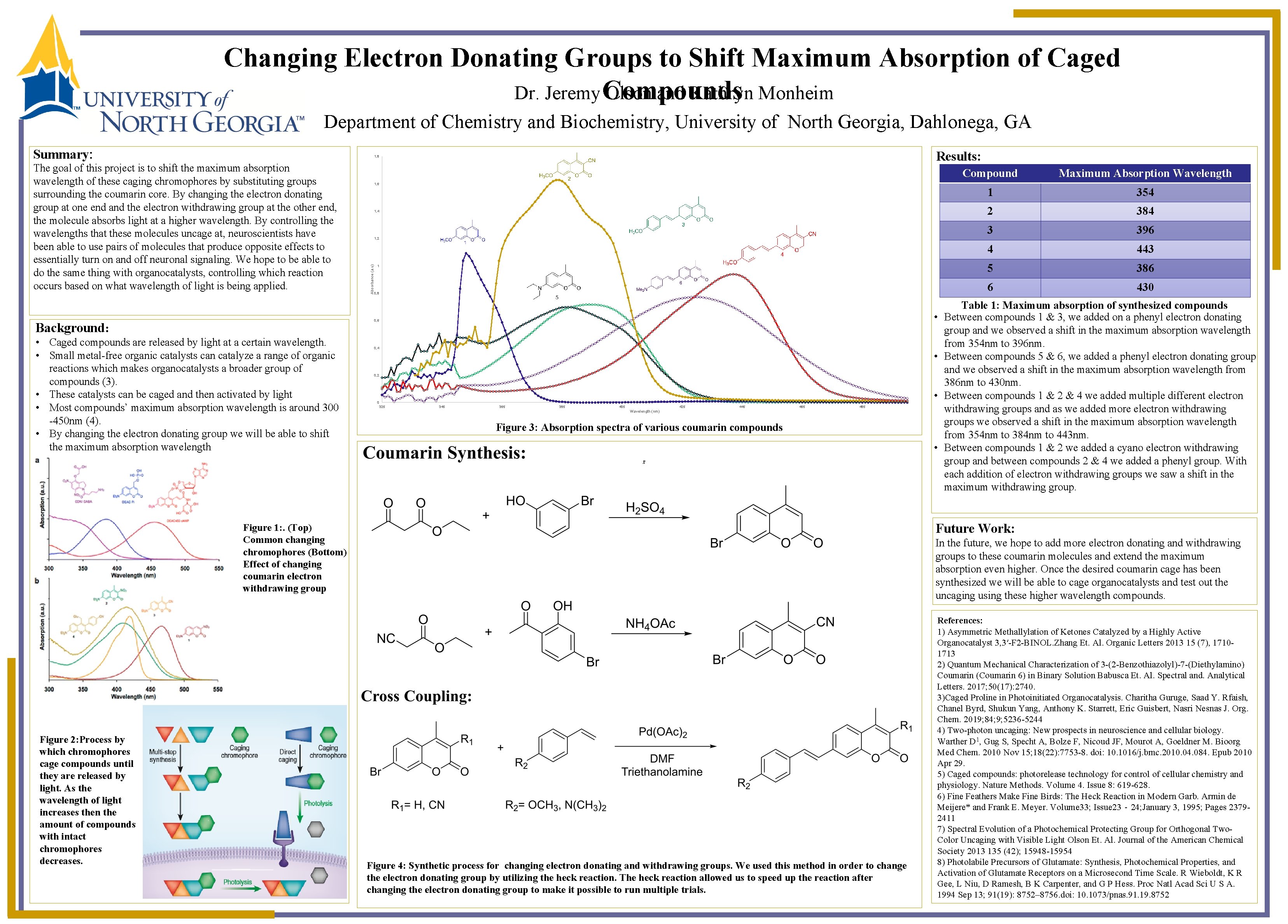
Changing Electron Donating Groups to Shift Maximum Absorption of Caged Dr. Jeremy Compounds Olson and Kathryn Monheim Department of Chemistry and Biochemistry, University of North Georgia, Dahlonega, GA Summary: Absorbance (a. u) The goal of this project is to shift the maximum absorption wavelength of these caging chromophores by substituting groups surrounding the coumarin core. By changing the electron donating group at one end and the electron withdrawing group at the other end, the molecule absorbs light at a higher wavelength. By controlling the wavelengths that these molecules uncage at, neuroscientists have been able to use pairs of molecules that produce opposite effects to essentially turn on and off neuronal signaling. We hope to be able to do the same thing with organocatalysts, controlling which reaction occurs based on what wavelength of light is being applied. Results: Background: • Caged compounds are released by light at a certain wavelength. • Small metal-free organic catalysts can catalyze a range of organic reactions which makes organocatalysts a broader group of compounds (3). • These catalysts can be caged and then activated by light • Most compounds’ maximum absorption wavelength is around 300 -450 nm (4). • By changing the electron donating group we will be able to shift the maximum absorption wavelength Wavelength (nm) Figure 3: Absorption spectra of various coumarin compounds Future Work: Figure 1: . (Top) Common changing chromophores (Bottom) Effect of changing coumarin electron withdrawing group Figure 2: Process by which chromophores cage compounds until they are released by light. As the wavelength of light increases then the amount of compounds with intact chromophores decreases. In the future, we hope to add more electron donating and withdrawing groups to these coumarin molecules and extend the maximum absorption even higher. Once the desired coumarin cage has been synthesized we will be able to cage organocatalysts and test out the uncaging using these higher wavelength compounds. Figure 4: Synthetic process for changing electron donating and withdrawing groups. We used this method in order to change the electron donating group by utilizing the heck reaction. The heck reaction allowed us to speed up the reaction after changing the electron donating group to make it possible to run multiple trials. References: 1) Asymmetric Methallylation of Ketones Catalyzed by a Highly Active Organocatalyst 3, 3′-F 2 -BINOL. Zhang Et. Al. Organic Letters 2013 15 (7), 17101713 2) Quantum Mechanical Characterization of 3 -(2 -Benzothiazolyl)-7 -(Diethylamino) Coumarin (Coumarin 6) in Binary Solution Babusca Et. Al. Spectral and. Analytical Letters. 2017; 50(17): 2740. 3)Caged Proline in Photoinitiated Organocatalysis. Charitha Guruge, Saad Y. Rfaish, Chanel Byrd, Shukun Yang, Anthony K. Starrett, Eric Guisbert, Nasri Nesnas J. Org. Chem. 2019; 84; 9; 5236 -5244 4) Two-photon uncaging: New prospects in neuroscience and cellular biology. Warther D 1, Gug S, Specht A, Bolze F, Nicoud JF, Mourot A, Goeldner M. Bioorg Med Chem. 2010 Nov 15; 18(22): 7753 -8. doi: 10. 1016/j. bmc. 2010. 04. 084. Epub 2010 Apr 29. 5) Caged compounds: photorelease technology for control of cellular chemistry and physiology. Nature Methods. Volume 4. Issue 8: 619 -628. 6) Fine Feathers Make Fine Birds: The Heck Reaction in Modern Garb. Armin de Meijere* and Frank E. Meyer. Volume 33; Issue 23‐ 24; January 3, 1995; Pages 23792411 7) Spectral Evolution of a Photochemical Protecting Group for Orthogonal Two. Color Uncaging with Visible Light Olson Et. Al. Journal of the American Chemical Society 2013 135 (42); 15948 -15954 8) Photolabile Precursors of Glutamate: Synthesis, Photochemical Properties, and Activation of Glutamate Receptors on a Microsecond Time Scale. R Wieboldt, K R Gee, L Niu, D Ramesh, B K Carpenter, and G P Hess. Proc Natl Acad Sci U S A. 1994 Sep 13; 91(19): 8752– 8756. doi: 10. 1073/pnas. 91. 19. 8752
- Slides: 1