
Changing Behaviour Using SelfDetermination Theory An Organized Classification

Changing Behaviour Using Self‐Determination Theory: An Organized Classification of Motivational Behaviour Change Techniques Martin S. Hagger Curtin University & University of Jyväskylä
Outline • • Behavioural interventions Considerations when designing interventions How behavioural interventions work Behaviour change techniques (BCTs) and taxonomies A taxonomy of motivational and behaviour change techniques (MBCTs) Self-determination theory Expert consensus study The collection of MBCTs
Behavioural Scientists • Behavioural scientists aim to: • Conduct basic research to provide an evidence base of the influential factors (‘antecedents’) related to health behaviour and • Develop methods or ‘behavioural techniques’ to manipulate the factors and change health behaviour • Interested in getting people to change by themselves for themselves: self-regulation
What is a Behavioural Intervention? • Strategy or initiative aimed at promoting change in behaviour of an individual or group to attain some sort of adaptive or beneficial outcome • Important features • • Content Delivery Evaluation/effectiveness Sustainability
Behavioural Interventions: Considerations • What is the problem that necessitates change? • Who needs to change? • What behaviours need to change? • What change mechanisms need to be activated? • What behaviour change techniques/strategies are needed to activate behaviour change?
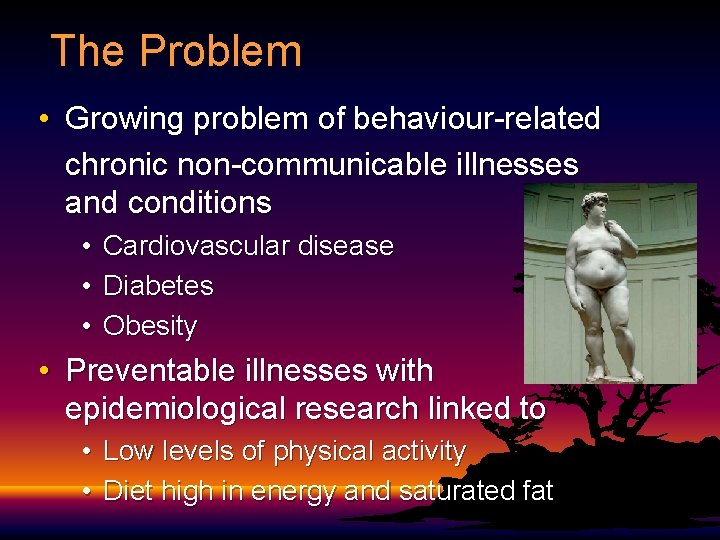
The Problem • Growing problem of behaviour-related chronic non-communicable illnesses and conditions • • • Cardiovascular disease Diabetes Obesity • Preventable illnesses with epidemiological research linked to • Low levels of physical activity • Diet high in energy and saturated fat
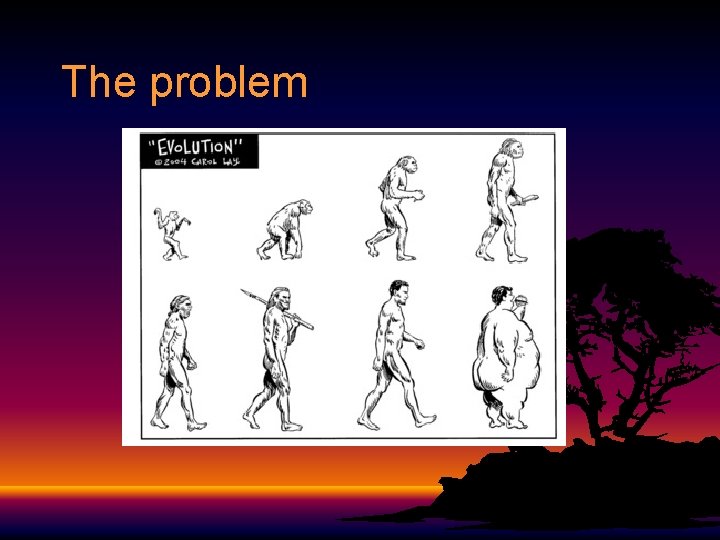
The problem
Behavioural Interventions: Considerations • What is the problem that necessitates change? • Who needs to change? • What behaviours need to change? • What change mechanisms need to be activated? • What behaviour change techniques/strategies are needed to activate behaviour change?

Target populations
Behavioural Interventions: Considerations • What is the problem that necessitates change? • Who needs to change? • What behaviours need to change? • What change mechanisms need to be activated? • What behaviour change techniques/strategies are needed to activate behaviour change?
What Behaviours Need to Change? Engaging in a suite of four healthy behaviors (not smoking, healthy diet, adequate physical activity, and moderate alcohol consumption) is associated with an estimated 11 to 14 year delay in allcause mortality (Ford, Zhao, Tsai, & Li, 2011; Khaw et al. , 2008)
Behavioural Interventions: Considerations • What is the problem that necessitates change? • Who needs to change? • What behaviours need to change? • What change mechanisms need to be activated? • What behaviour change techniques/strategies are needed to activate behaviour change?
Effective Behaviour Change Successful behavioural interventions… • Use theory in intervention design • Target cognitive and behavioural constructs • Target social influences e. g. norms • Train those delivering the intervention • Include multiple components Peters et al. (2009). BMC Public Health, 9: 182 doi: 10. 1186/1471 -2458 -9 -182
Role of Theory Answering the ‘what’ and ‘how’ questions • Behavioral theory helps develop and understanding of… • The personal and social factors (‘what’) – e. g. , attitudes, self-efficacy, intentions/motives • The mechanisms responsible (‘how’) – mediation and moderation • The targets ripe for intervention – what do we have to change to bring about change?
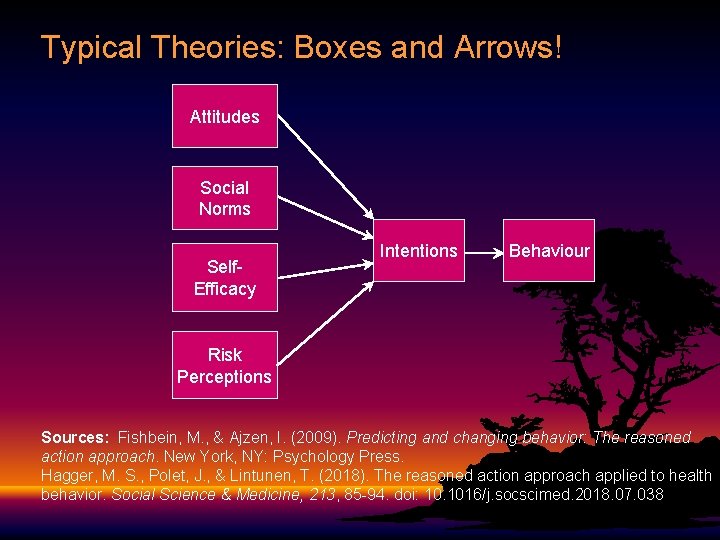
Typical Theories: Boxes and Arrows! Attitudes Social Norms Self. Efficacy Intentions Behaviour Risk Perceptions Sources: Fishbein, M. , & Ajzen, I. (2009). Predicting and changing behavior: The reasoned action approach. New York, NY: Psychology Press. Hagger, M. S. , Polet, J. , & Lintunen, T. (2018). The reasoned action approach applied to health behavior. Social Science & Medicine, 213, 85 -94. doi: 10. 1016/j. socscimed. 2018. 07. 038
Behavioural Interventions: Considerations • What is the problem that necessitates change? • Who needs to change? • What behaviours need to change? • What change mechanisms need to be activated? • What behaviour change techniques/strategies are needed to activate behaviour change?
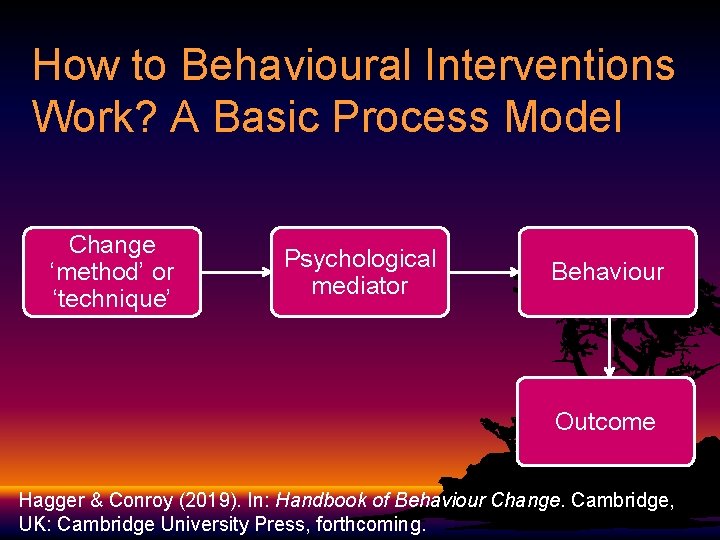
How to Behavioural Interventions Work? A Basic Process Model Change ‘method’ or ‘technique’ Psychological mediator Behaviour Outcome Hagger & Conroy (2019). In: Handbook of Behaviour Change. Cambridge, UK: Cambridge University Press, forthcoming.
Behaviour Change Techniques What is a behaviour change technique? “Techniques or processes that have been shown to be able to change one or more determinants of behaviour” (Kok et al. , 2016, p. 299) “Provides a toolbox that most efficiently enables planners to select the method that fits their circumstances” (Kok et al. , 2016, p. 304)

Behaviour Change Techniques • ‘Active ingredients’ of behaviour change interventions • They ‘do the work’ in changing behaviour • They are irreducible and unique in that they cannot be broken down further and are separate from others • Could be seen as the ‘tools’ in a behaviour change ‘toolbox’ • Can be used independently or in conjunction with others
Behaviour Change ‘Taxonomy’ • Structured organisation of unique techniques that make up behavioural interventions • “The need for a common vocabulary in terms of which content components of behaviour change interventions can be defined and described” (Abraham & Michie, 2008, p. 380) • Analogy: “Mapping the genome” of behaviour change interventions
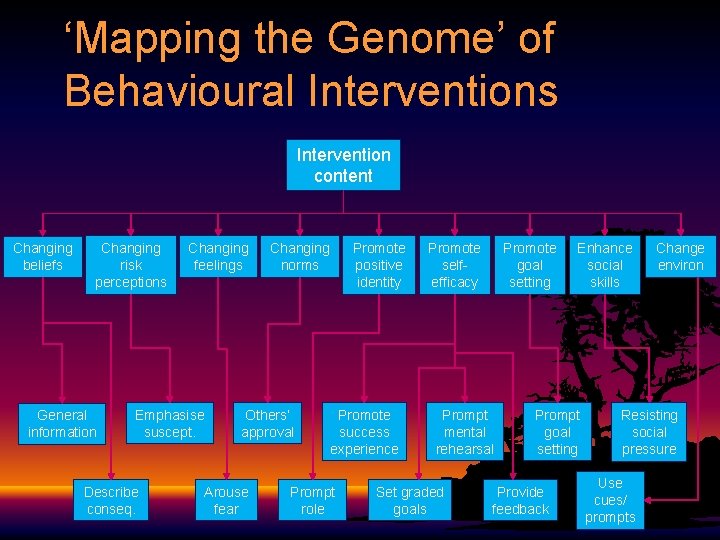
‘Mapping the Genome’ of Behavioural Interventions Intervention content Changing beliefs Changing risk perceptions General information Changing feelings Emphasise suscept. Describe conseq. Changing norms Others’ approval Arouse fear Promote positive identity Promote success experience Prompt role Promote selfefficacy Promote goal setting Prompt mental rehearsal Set graded goals Enhance social skills Prompt goal setting Provide feedback Change environ Resisting social pressure Use cues/ prompts
BCT Taxonomies • General taxonomies of BCTs (Michie et al. , 2013; Kok et al. , 2016) • Physical activity and dieting behaviour – CALO-RE (Michie, Ashford, Sniehotta, Dombrowski, Bishop, & French, 2011) • Individual behavioural support for smoking cessation (Michie, Hyder, Walia, & West, 2011) • Motivational interviewing (Hardcastle, Fortier, Blake, & Hagger, 2017)
Rationale § Self-determination theory is a theory of human behaviour § The theory of intrinsic motivation § Focuses on quality as well as quantity of motivation for behaviour § Psychological needs for autonomy, competence and relatedness are a key constructs § Satisfaction of needs determines type of motivation § Motivation can be autonomous or controlling § Autonomous motivation consistently related to persistence on behaviour
Rationale § Self-determination theory is increasingly used in behaviour change interventions § No standard for what constitutes an ‘selfdetermination theory’-based intervention (large variability) § Testing SDT mechanisms requires that intervention ‘techniques’ target the relevant theory constructs effectively § SDT techniques have not been included in existing taxonomies
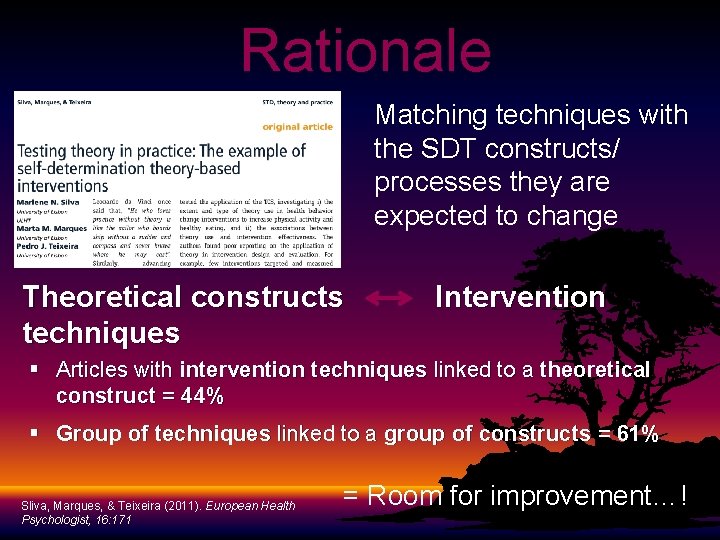
Rationale Matching techniques with the SDT constructs/ processes they are expected to change Theoretical constructs techniques Intervention § Articles with intervention techniques linked to a theoretical construct = 44% § Group of techniques linked to a group of constructs = 61% Sliva, Marques, & Teixeira (2011). European Health Psychologist, 16: 171 = Room for improvement…!
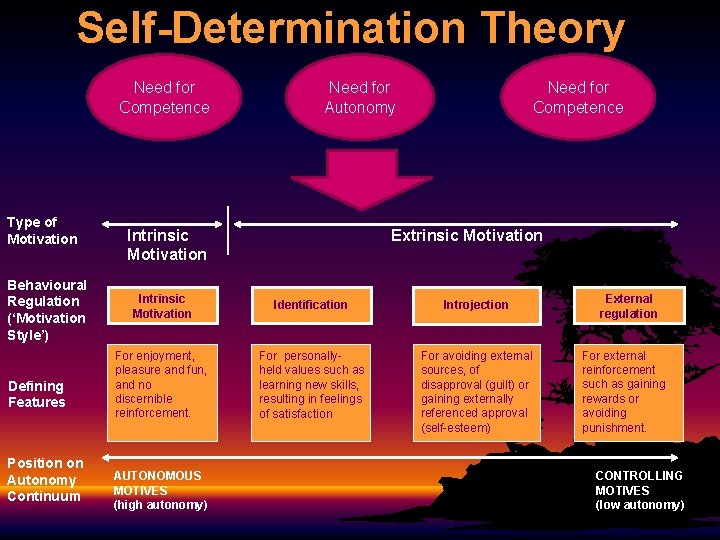
Self-Determination Theory Need for Competence Type of Motivation Behavioural Regulation (‘Motivation Style’) Defining Features Position on Autonomy Continuum Need for Autonomy Intrinsic Motivation Need for Competence Extrinsic Motivation Intrinsic Motivation Identification Introjection For enjoyment, pleasure and fun, and no discernible reinforcement. For personallyheld values such as learning new skills, resulting in feelings of satisfaction For avoiding external sources, of disapproval (guilt) or gaining externally referenced approval (self-esteem) AUTONOMOUS MOTIVES (high autonomy) External regulation For external reinforcement such as gaining rewards or avoiding punishment. CONTROLLING MOTIVES (low autonomy)
Aim To identify, define, and classify the distinct individual components of SDTbased health interventions that are more likely to influence the key mechanisms of action underlying motivation and behavior change, according to SDT
Motivation and Behavior Change Techniques (MBCTs) “Distinct, observable and replicable component of an intervention, designed to influence a person’s behavior directly of indirectly by impacting the person’s perceptions of autonomy, relatedness, and/or competence in relation to a particular behavior (or group of related behaviors)”.
Example of an MBCT Label Definition MBCT 2. Prompt identification of sources of pressure for behavior change Prompt identification of possible sources of external (or partially internalized) pressures and expectations, and explore how they may relate to client’s desired goals and outcomes.
Participants § 18 international leading researchers in SDT (11 men) with expertise in SDT-based health interventions for behavior change. § Residents in UK (5), US (5), Australia (2), Belgium (2), Sweden (2), and South Korea (1). § Backgrounds in Psychology, Medical Science, and Exercise and Nutrition.

Procedure § Development of the first list of MBCTs • Preliminary list of MBCTs derived from the content analysis of published SDT-based interventions (available at https: //osf. io/hufpj/) and key literature (e. g. HCCQ, SONIPE – Haerens et a 2013, Reeve et al 2011) • Detailed definitions formulated and techniques grouped into SDT mechanisms of action (3 Needs) § Iterative process - The core study team members (MM, MNS, PJT, & MSH) developed the first list of techniques, and were responsible for the feedback, discussion and refinement of the MBCTs between rounds
Procedure § Round 1: Clarity and content of each MBCT. § List of MBCTs refined by the core team members. § Round 2: Online survey sent to 18 experts (including round 1) • Specificity: Experts asked to rate the link between each MBCT and each of the three Needs – “Does this technique target AUT – REL – COMP? ” • Essentiality / Importance: How essential is this technique in an SDTbased health intervention? • Uniqueness: Are you satisfied that the MBCT is sufficiently unique in relation to others to justify being listed separately. § Round 2: • For all MBCTs where a consensus wasn’t reached, experts were again asked about the specificity and uniqueness of those MBCTs • For MBCTs added from Round 2, experts went through the same set of questions For details see OSF project: https: //osf. io/f 65 jy/
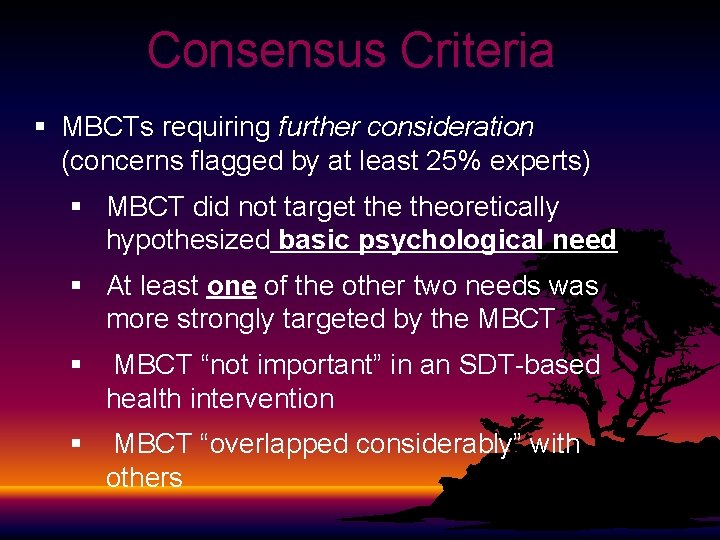
Consensus Criteria § MBCTs requiring further consideration (concerns flagged by at least 25% experts) § MBCT did not target theoretically hypothesized basic psychological need § At least one of the other two needs was more strongly targeted by the MBCT § MBCT “not important” in an SDT-based health intervention § MBCT “overlapped considerably” with others

Results Detailed results available on the OSF site for the project: https: //osf. io/f 65 jy/
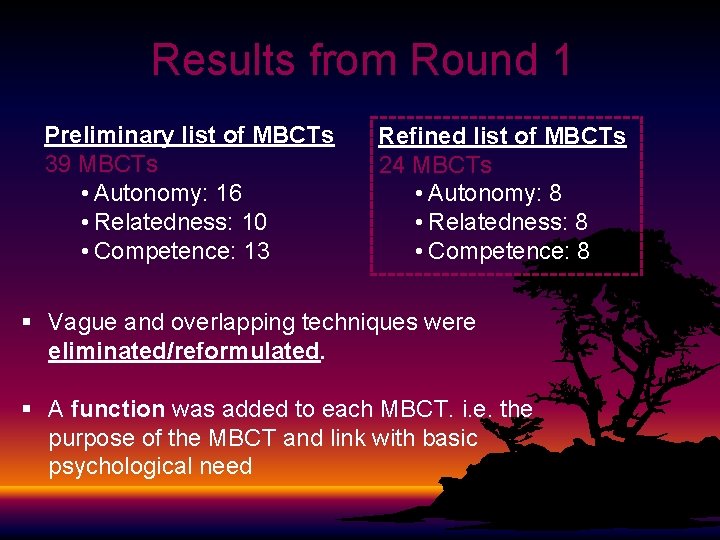
Results from Round 1 Preliminary list of MBCTs 39 MBCTs • Autonomy: 16 • Relatedness: 10 • Competence: 13 Refined list of MBCTs 24 MBCTs • Autonomy: 8 • Relatedness: 8 • Competence: 8 § Vague and overlapping techniques were eliminated/reformulated. § A function was added to each MBCT. i. e. the purpose of the MBCT and link with basic psychological need
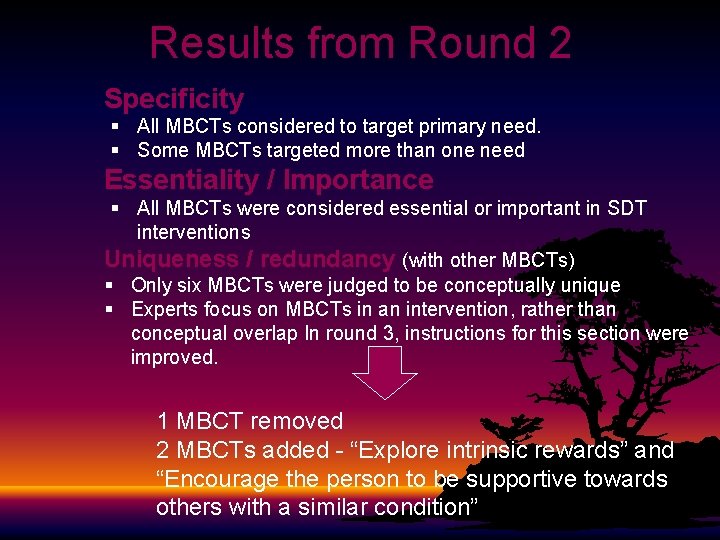
Results from Round 2 Specificity § All MBCTs considered to target primary need. § Some MBCTs targeted more than one need Essentiality / Importance § All MBCTs were considered essential or important in SDT interventions Uniqueness / redundancy (with other MBCTs) § Only six MBCTs were judged to be conceptually unique § Experts focus on MBCTs in an intervention, rather than conceptual overlap In round 3, instructions for this section were improved. 1 MBCT removed 2 MBCTs added - “Explore intrinsic rewards” and “Encourage the person to be supportive towards others with a similar condition”
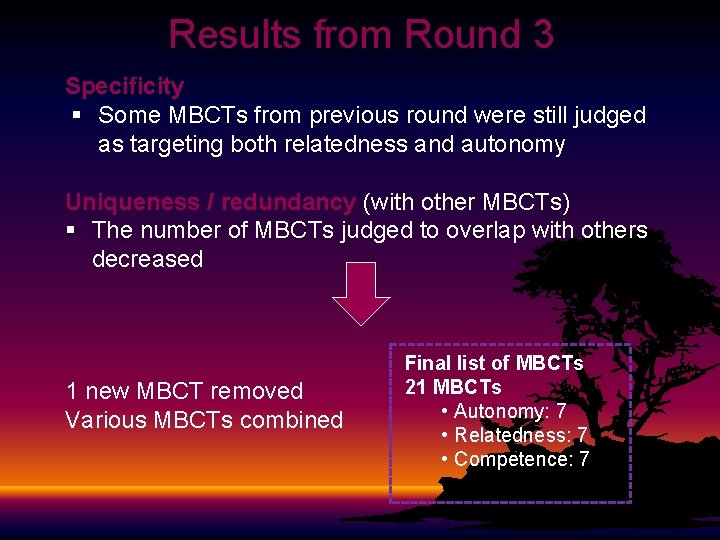
Results from Round 3 Specificity § Some MBCTs from previous round were still judged as targeting both relatedness and autonomy Uniqueness / redundancy (with other MBCTs) § The number of MBCTs judged to overlap with others decreased 1 new MBCT removed Various MBCTs combined Final list of MBCTs 21 MBCTs • Autonomy: 7 • Relatedness: 7 • Competence: 7
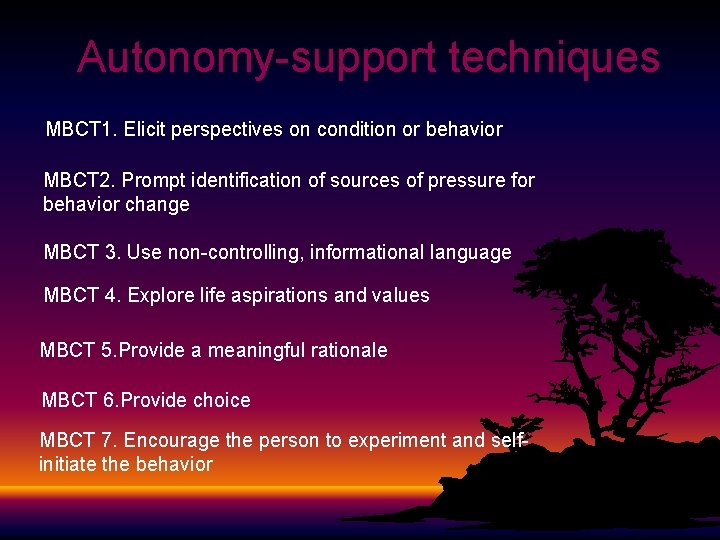
Autonomy-support techniques MBCT 1. Elicit perspectives on condition or behavior MBCT 2. Prompt identification of sources of pressure for behavior change MBCT 3. Use non-controlling, informational language MBCT 4. Explore life aspirations and values MBCT 5. Provide a meaningful rationale MBCT 6. Provide choice MBCT 7. Encourage the person to experiment and selfinitiate the behavior
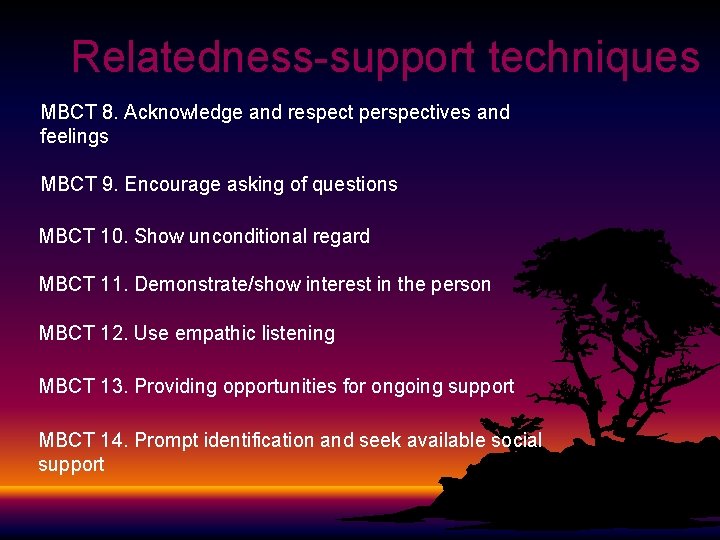
Relatedness-support techniques MBCT 8. Acknowledge and respect perspectives and feelings MBCT 9. Encourage asking of questions MBCT 10. Show unconditional regard MBCT 11. Demonstrate/show interest in the person MBCT 12. Use empathic listening MBCT 13. Providing opportunities for ongoing support MBCT 14. Prompt identification and seek available social support
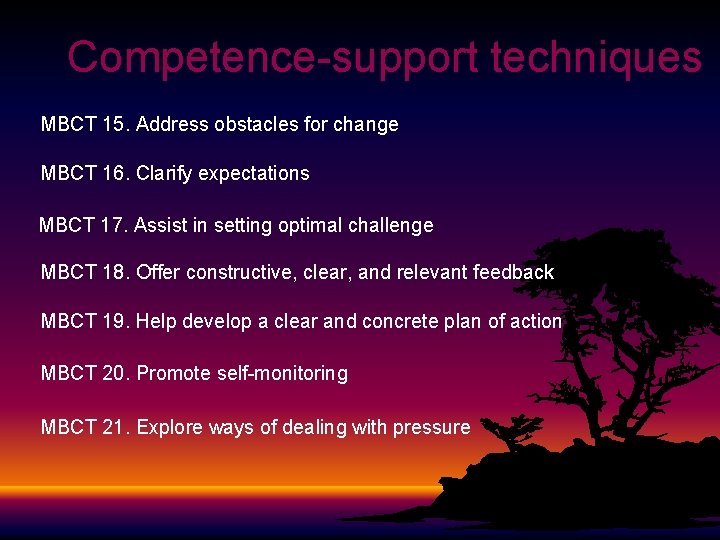
Competence-support techniques MBCT 15. Address obstacles for change MBCT 16. Clarify expectations MBCT 17. Assist in setting optimal challenge MBCT 18. Offer constructive, clear, and relevant feedback MBCT 19. Help develop a clear and concrete plan of action MBCT 20. Promote self-monitoring MBCT 21. Explore ways of dealing with pressure
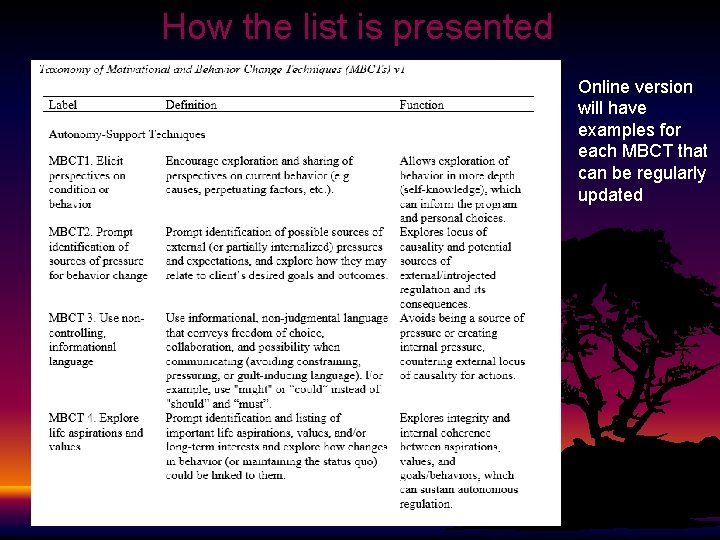
How the list is presented Online version will have examples for each MBCT that can be regularly updated
Summary and Conclusions • First formal attempt to systematize unique components of self-determination theory interventions • Enhances consistency in descriptions of, and facilitate better synthesis of evidence for, self-determination theory-based interventions • Guides research on the candidate mediators of interventions based on theory, and inform future research isolating main and interactive effects of theory -based intervention components.
Thanks to the Expert Panel and Research Team Jennifer Brunet Joan Duda Martin Hagger Leen Haerens Jennifer La Guardia Magnus Lindwall Chris Londsdale David Markland Marta Marques Susan Michie Arlen Moller Nikos Ntoumanis Heather Patrick Johnmarshall Reeve Richard Ryan Simon Sebire Marlene Silva Martin Standage Pedro Teixeira Maarten Vansteenkiste Geoffrey Williams Netta Weinstein Karin Weman-Josefsson …and Eliana Carraça and Jorge Encantado for their contribution to the data synthesis

Detailed results available in the OSF site for the project: https: //osf. io/f 65 jy/

https: //osf. io/f 65 jy/
- Slides: 45