
Changes to the NIH IRBs and Common Rule
Changes to the NIH IRBs and Common Rule JONATHAN M GREEN, MD MBA DIRECTOR: OFFICE OF HUMAN SUBJECTS RESEARCH PROTECTIONS TIFFANY GOMMEL, MS DIRECTOR: IRB OPERATIONS
Key Team members Tiffany Gommel: Director IRB Operations Nicole Grant: Associate Director OHSRP and Executive Chair, IRB OHSRP staff Current staff of all IRBs Current and future IRB members
Who I am Clinician Researcher IRB professional
Why I am here Centralize the NIH IRBs Implement the revised Common Rule ◦ Effective date: January 21, 2019
Create an efficient, effective and compliant IRB system Provide optimal protections for participants Facilitate research Partner with investigators Improve IRB member experience Keep everyone on the right side of the regulations ◦ Including revised CR compliance
Current State Strengths ◦ Dedicated engaged membership ◦ Broad and deep expertise ◦ Committed IRB staff
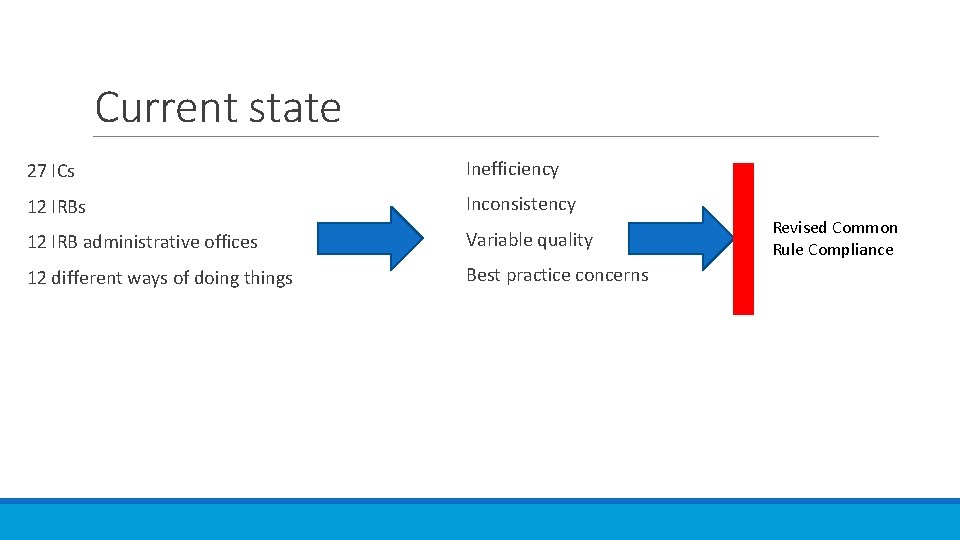
Current state 27 ICs Inefficiency 12 IRBs Inconsistency 12 IRB administrative offices Variable quality 12 different ways of doing things Best practice concerns Revised Common Rule Compliance
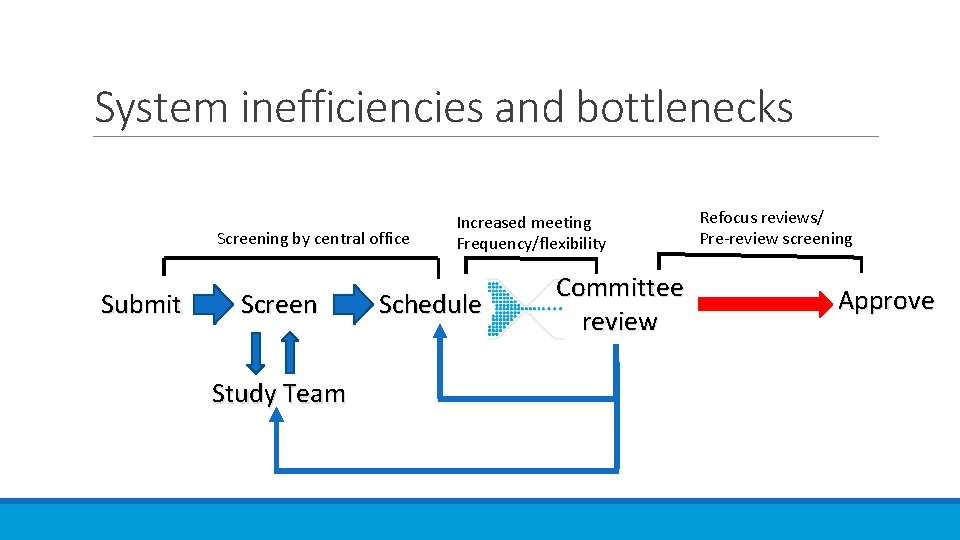
System inefficiencies and bottlenecks Screening by central office Submit Screen Study Team Increased meeting Frequency/flexibility Schedule Committee review Refocus reviews/ Pre-review screening Approve
What we have to do Steps to success ◦ Revise policies for CR compliance ◦ Stand up centralized administrative office ◦ Reorganize IRBs
Centralized administrative office Office of IRB Operations (IRBO) ◦ Director: Tiffany Gommel Functions ◦ ◦ ◦ Exempt/NHSR determinations Expedited Review Administrative screening for Full Board Review NIH i. RIS system Coordinate s. IRB activity
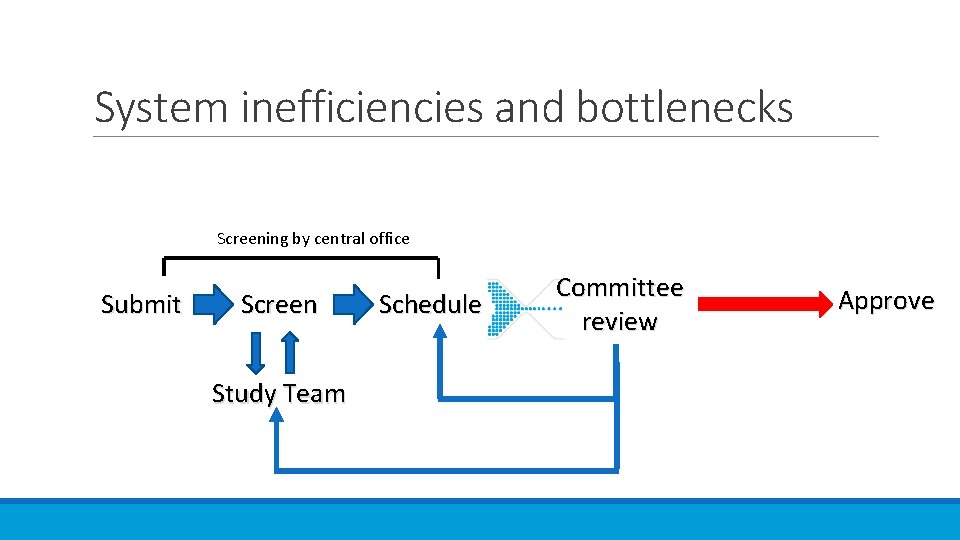
System inefficiencies and bottlenecks Screening by central office Submit Screen Study Team Schedule Committee review Approve
Penguins and Platypuses
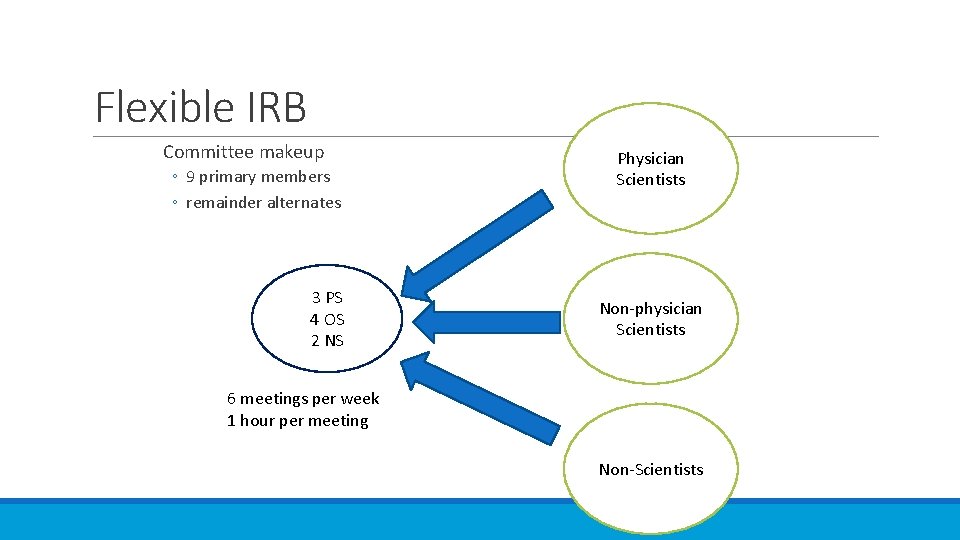
Flexible IRB Committee makeup ◦ 9 primary members ◦ remainder alternates 3 PS 4 OS 2 NS Physician Scientists Non-physician Scientists 6 meetings per week 1 hour per meeting Non-Scientists
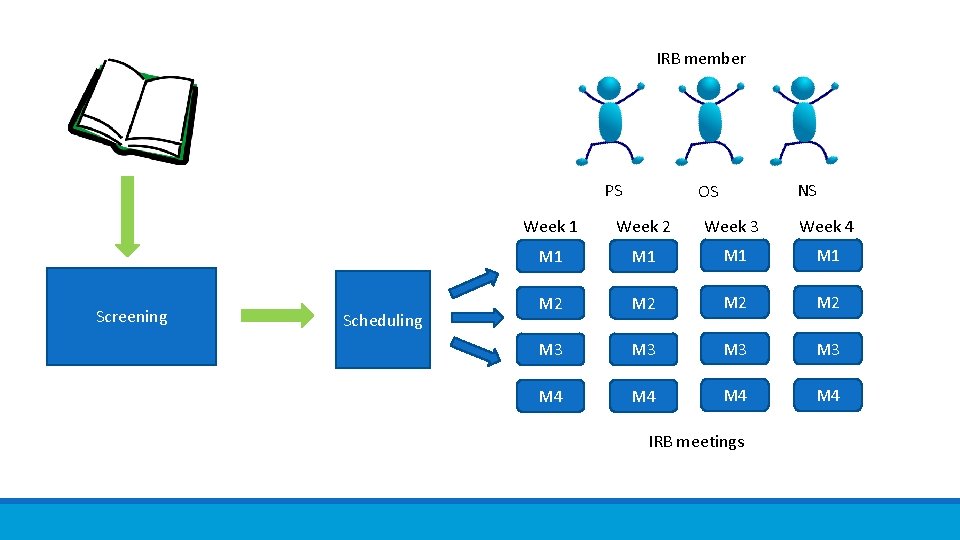
IRB member PS Screening Scheduling NS OS Week 1 Week 2 Week 3 Week 4 M 1 M 1 M 2 M 2 M 3 M 3 M 4 M 4 IRB meetings
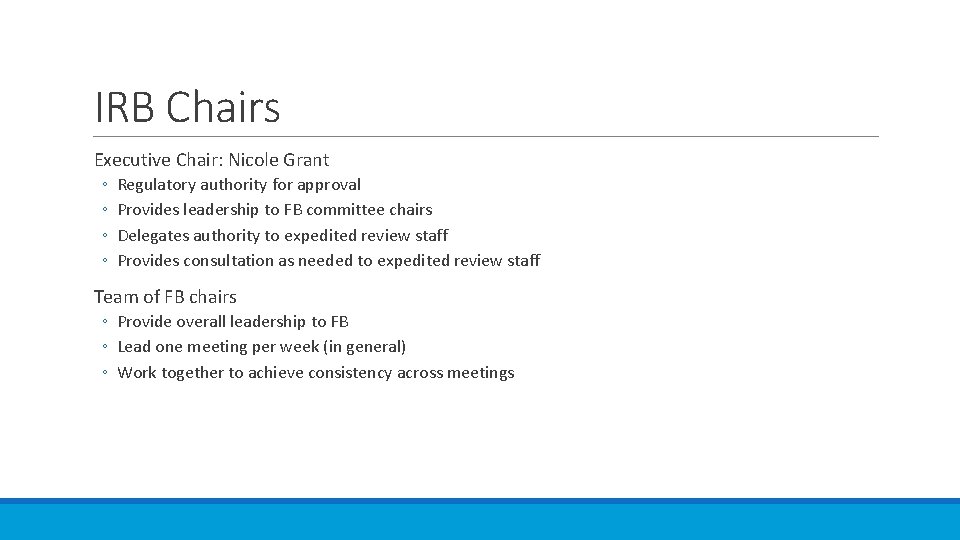
IRB Chairs Executive Chair: Nicole Grant ◦ ◦ Regulatory authority for approval Provides leadership to FB committee chairs Delegates authority to expedited review staff Provides consultation as needed to expedited review staff Team of FB chairs ◦ Provide overall leadership to FB ◦ Lead one meeting per week (in general) ◦ Work together to achieve consistency across meetings
What will I be asked to do? Attend 1 meeting per month ◦ Prepare for ~6 -8 agenda items (1 -2 IR) ◦ Primary or secondary on 1 -3 items Schedule meeting attending in advance ◦ Does not have to be same slot each month Be available for consultation or attendance occasionally if expertise required
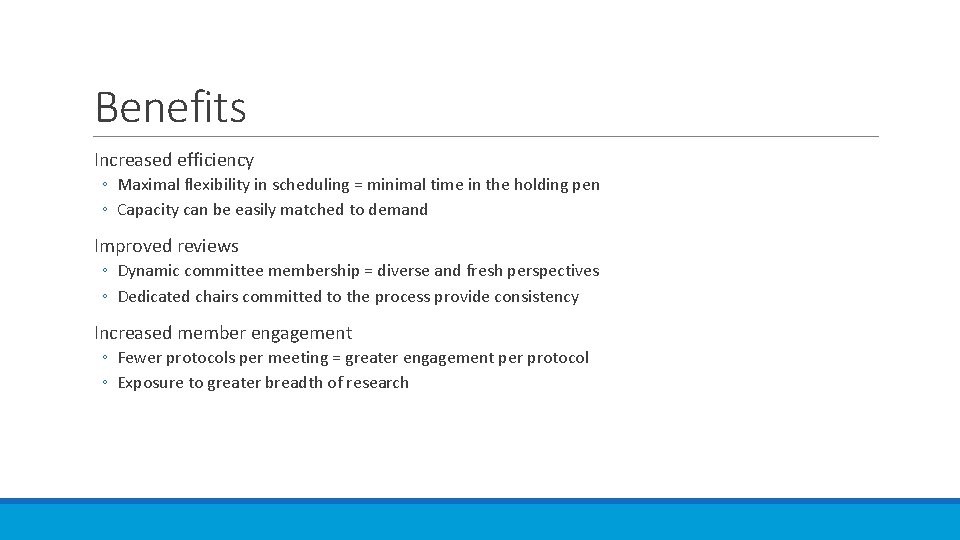
Benefits Increased efficiency ◦ Maximal flexibility in scheduling = minimal time in the holding pen ◦ Capacity can be easily matched to demand Improved reviews ◦ Dynamic committee membership = diverse and fresh perspectives ◦ Dedicated chairs committed to the process provide consistency Increased member engagement ◦ Fewer protocols per meeting = greater engagement per protocol ◦ Exposure to greater breadth of research

Whats the rush? Revised Common rule e
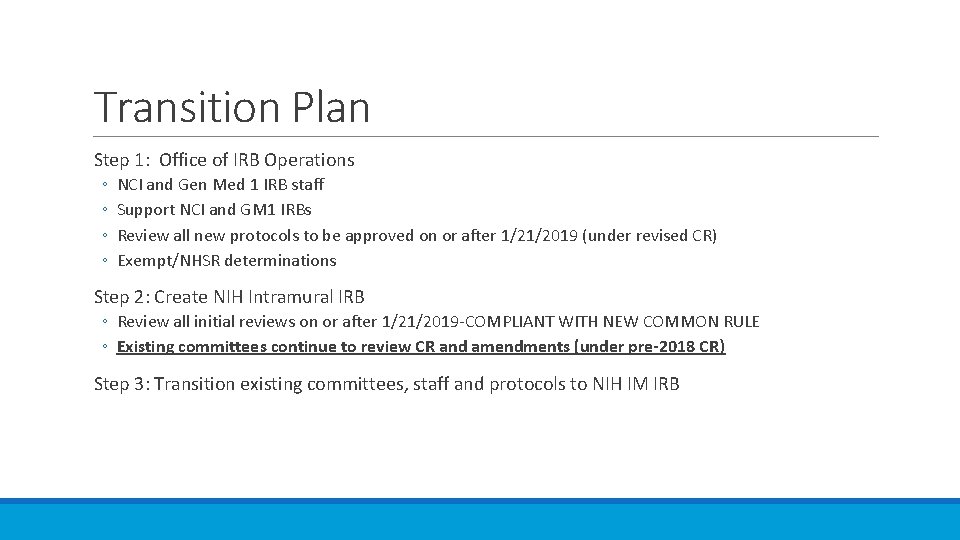
Transition Plan Step 1: Office of IRB Operations ◦ ◦ NCI and Gen Med 1 IRB staff Support NCI and GM 1 IRBs Review all new protocols to be approved on or after 1/21/2019 (under revised CR) Exempt/NHSR determinations Step 2: Create NIH Intramural IRB ◦ Review all initial reviews on or after 1/21/2019 -COMPLIANT WITH NEW COMMON RULE ◦ Existing committees continue to review CR and amendments (under pre-2018 CR) Step 3: Transition existing committees, staff and protocols to NIH IM IRB
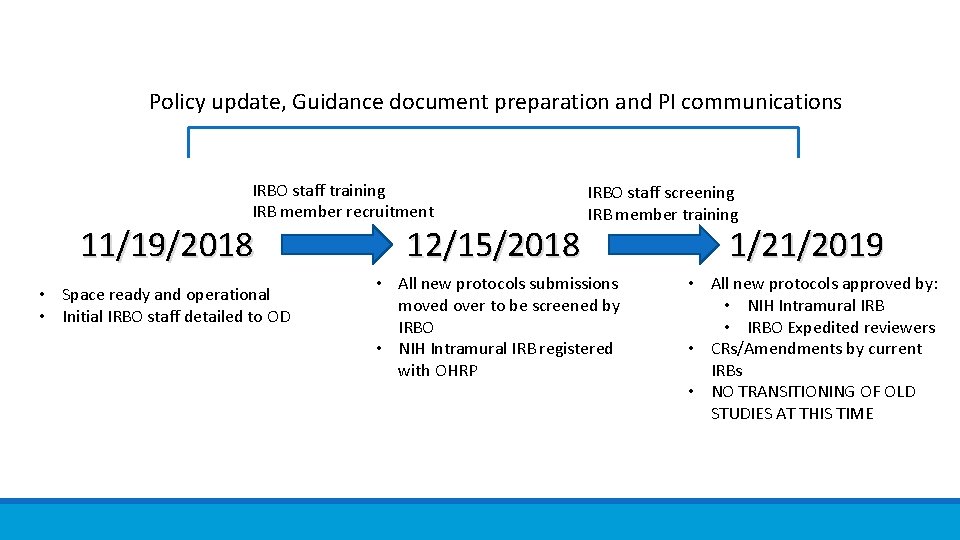
Policy update, Guidance document preparation and PI communications IRBO staff training IRB member recruitment 11/19/2018 • Space ready and operational • Initial IRBO staff detailed to OD 12/15/2018 IRBO staff screening IRB member training • All new protocols submissions moved over to be screened by IRBO • NIH Intramural IRB registered with OHRP 1/21/2019 • All new protocols approved by: • NIH Intramural IRB • IRBO Expedited reviewers • CRs/Amendments by current IRBs • NO TRANSITIONING OF OLD STUDIES AT THIS TIME
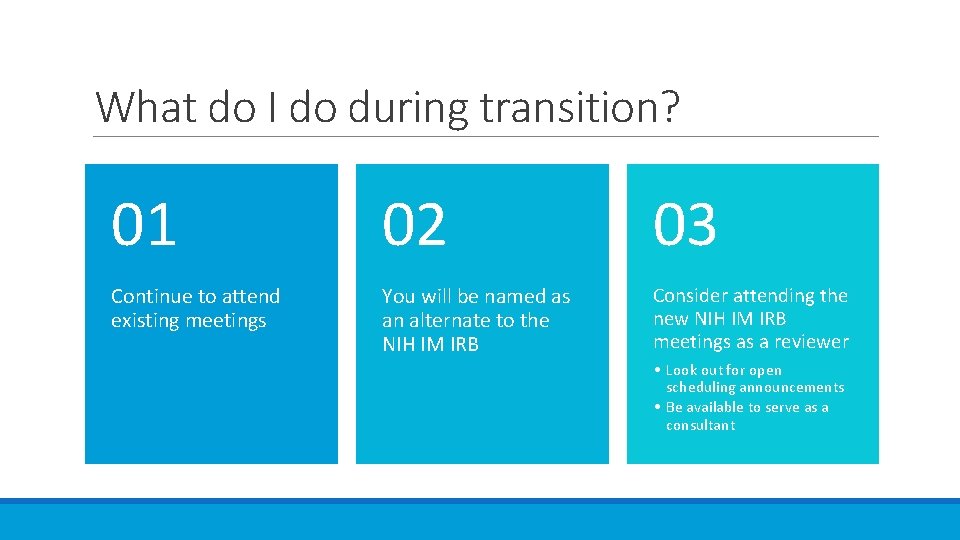
What do I do during transition? 01 02 03 Continue to attend existing meetings You will be named as an alternate to the NIH IM IRB Consider attending the new NIH IM IRB meetings as a reviewer • Look out for open scheduling announcements • Be available to serve as a consultant
Revised Common Rule New studies approved on or after 1/21/2019 must be compliant with new CR All other studies WILL remain under pre-2018 CR requirements. ◦ Option to transition to new CR at a later date
Revised Common Rule First major update since 1991 ONLY APPLIES TO NEW STUDIES APPROVED AFTER 1/21/2019 Major changes ◦ Informed consent ◦ ◦ ◦ ◦ Reasonable person standard Key information New elements Posting requirements Exemptions Continuing review requirements Single IRB Broad Consent
Informed Consent 45. CFR 46. 116 (a)(4) The prospective subject or the legally authorized representative must be provided with the information that a reasonable person would want to have in order to make an informed decision about whether to participate, and an opportunity to discuss that information. (5)(i) Informed consent must begin with a concise and focused presentation of the key information that is most likely to assist a prospective subject or legally authorized representative in understanding the reasons why one might or might not want to participate in the research. This part of the informed consent must be organized and presented in a way that facilitates comprehension. (5)(ii) Informed consent as a whole must present information in sufficient detail relating to the research, and must be organized and presented in a way that does not merely provide lists of isolated facts, but rather facilitates the prospective subject’s or legally authorized representative’s understanding of the reasons why one might or might not want to participate.
Informed Consent-Reasonable person Not defined in the regulations or preamble “It may be that a standard of "the reasonable volunteer" should be proposed: the extent and nature of information should be such that persons, knowing that the procedure is neither necessary for their care nor perhaps fully understood, can decide whether they wish to participate in the furthering of knowledge. Even when some direct benefit to them is anticipated, the subjects should understand clearly the range of risk and the voluntary nature of participation. ” Belmont Report
Informed Consent-Key information Information essential for the person to make an informed decision whether or not to participate Viewed from participants perspective Not formulaic May differ between studies May differ between populations
Informed Consent-Key information Preamble ◦ The fact that consent is being sought for research and that participation is voluntary ◦ The purposes of the research, the expected duration of the prospective subject’s participation, and the procedures to be followed in the research ◦ The reasonably foreseeable risks or discomforts to the prospective subject ◦ The benefits to the prospective subject or to others that may reasonably be expected from the research ◦ Appropriate alternative procedures or courses of treatments, if any, that might be advantageous to the prospective subject.
Other “key” information Whethere is randomization Whethere is a placebo arm Whether subjects will have to discontinue current treatments. How the treatment in the protocol is similar to, or different from, the clinical care the subject would receive if not in the protocol Any significant costs that could be incurred as a result of participation Compensation for injury How much time and/or how many research visits are required for participation Payments to subjects Impact on the subject’s future clinical care. For example, whether use of an experimental intervention is likely to make a standard clinical intervention ineffective or unavailable after the study Potential impact on non-participants e. g. , caregivers, family members, children, partners and the public at large Post-participation access to the experimental intervention.
Informed Consent-new elements (9) One of the following statements about any research that involves the collection of identifiable private information or identifiable biospecimens: ◦ (i) A statement that identifiers might be removed from the identifiable private information or identifiable biospecimens and that, after such removal, the information or biospecimens could be used for future research studies or distributed to another investigator future research studies without additional informed consent from the subject or the legally authorized representative, if this might be a possibility; or ◦ (ii) A statement that the subject’s information or biospecimens collected as part of the research, even if identifiers are removed, will not be used or distributed for future research studies.
Informed Consent-new elements When appropriate ◦ A statement that the subject’s biospecimens (even if identifiers are removed) may be used for commercial profit and whether the subject will or will not share in this commercial profit; ◦ A statement regarding whether clinically relevant research results, including individual research results, will be disclosed to subjects, and if so, under what conditions; and ◦ For research involving biospecimens, whether the research will (if known) or might include whole genome sequencing (i. e. , sequencing of a human germline or somatic specimen with the intent to generate the genome or exome sequence of that specimen).
How will OHSRP help? OHSRP Key information guidance sheet coming very soon Disseminate any OHRP guidance New consent template ◦ One template for all of NIH Will help with consent document compliance during screening process NO REVISED CONSENT FOR OLD STUDIES

Patience please!!!!!
Contact Jonathan Green: Director: OHSRP 301 -402 -3444 Jonathan. green 3@nih. gov Tiffany Gommel: Director: IRBO Tiffany. gommel@nih. gov Nicole Grant: Assoc Director OHSRP, Executive Chair of IRB grantn@mail. nih. gov

- Slides: 34